
September Employment Report— A Labor Market Drifting Sideways
Recession Risks Have Eased, Yet Labor Market Momentum Continues to Fade
-
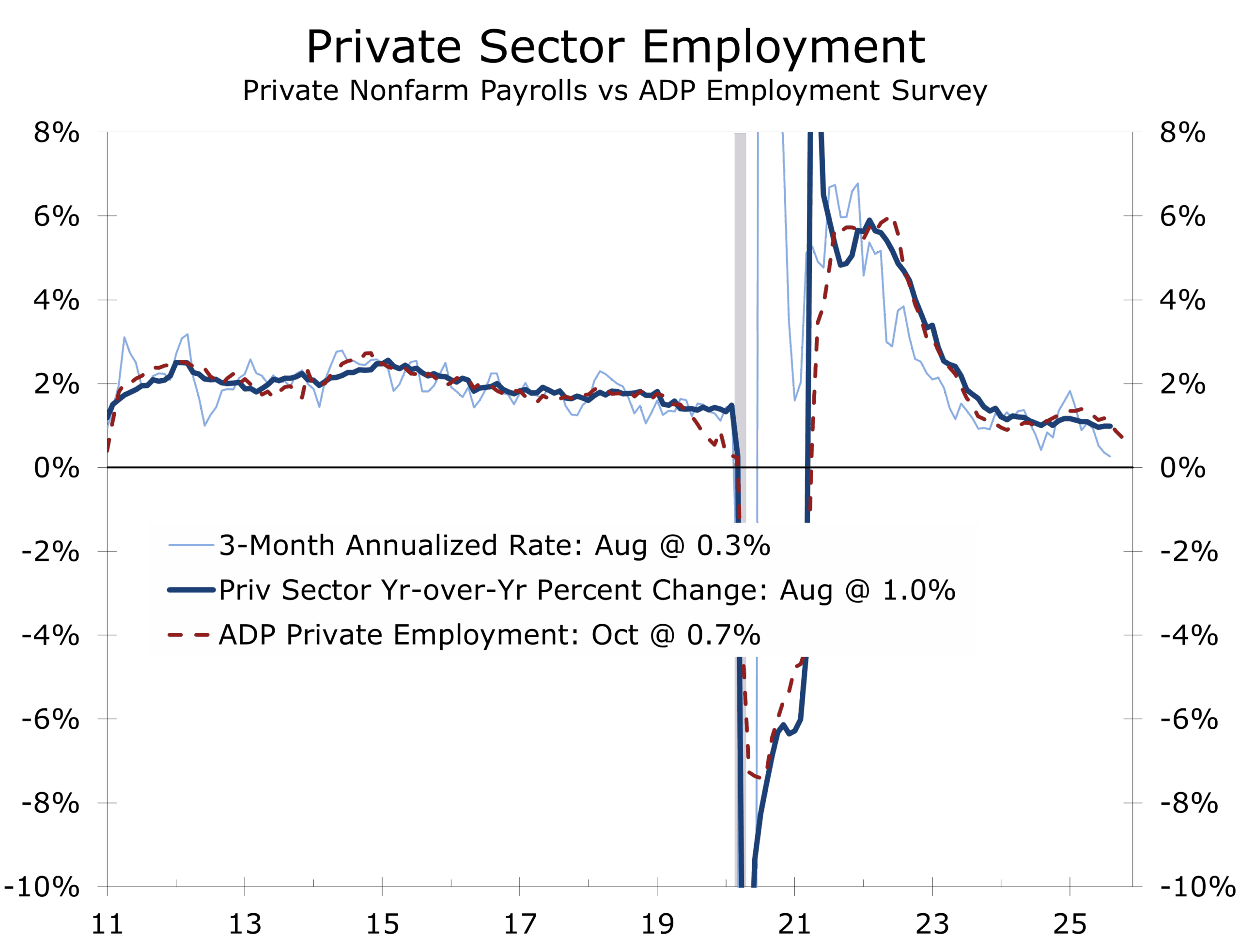
- Nonfarm payrolls rose 119,000 in September; the private sector added 97,000, easing some recession fears.
- Revisions lowered to the two prior months by 33,000; the three-month average improved to 62,000 but remains weak.
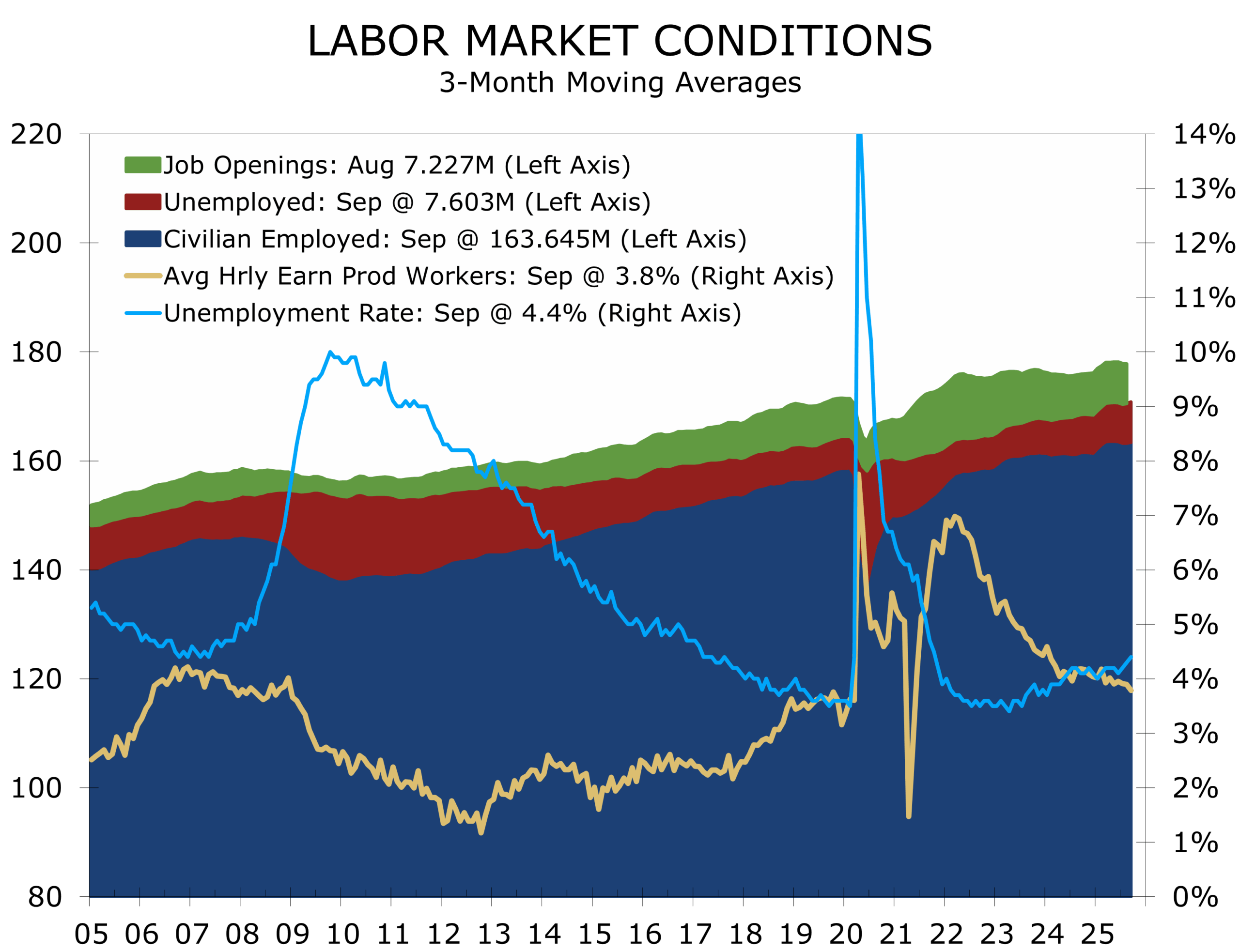
- The unemployment rate rose 0.1 pp to 4.4%, the highest since October 2021, with 7.6 million unemployed.
- Hiring remained concentrated in health care, restaurants, and social assistance.
- Wage growth slowed to 3.8% y/y, and hours worked remained flat.
- Rising permanent job losses, narrowing sectoral breadth, and weakening goods-producing momentum point to accumulating slack and diminishing inflationary tailwinds.
- The September employment report supports the case for further Fed easing, though the shutdown-delayed data release schedule complicates the timing. We continue to call for a quarter point cut, as we do not expect to see compelling evidence to suggest otherwise before the Fed meets on December 9-10.
A Labor Market That Stabilized in September—But on Unsteady Footing
September’s employment data delivered a welcome dose of stability at a moment when markets had begun to fear that the U.S. economy was sliding toward recession. Nonfarm payrolls rose 119,000, with the private sector adding 97,000 jobs — both comfortably above expectations and strong enough to reassure investors that the economy had not fallen off a cliff during the prolonged government shutdown. While the report is backward looking it is still reassuring. Employment conditions show no evidence of a pre-shutdown collapse and handily beat the market’s consensus estimates.
This modest strengthening followed another strong earnings report from Nvidia, which reinforced confidence in the AI investment cycle and eased doubts about the durability of the tech-driven productivity boom. Together, the labor data and renewed strength in AI provided just enough breathing room for markets rattled by the Liberation Day tariffs and rising global uncertainty.
Job growth has slowed to the bare minimum needed to keep unemployment from rising.
Yet beneath the steadier surface, the labor market remains fragile. Growth has slowed markedly since April, and the latest report does not change that overarching narrative. The three-month average for job gains improved to roughly 60,000, but that figure — even when adjusted upward — is barely above the job growth needed each month to keep the unemployment rate from rising . The upward bump is welcome but hardly convincing. Job growth has lost considerable momentum since the spring, and September represents stabilization, not a renewed acceleration.
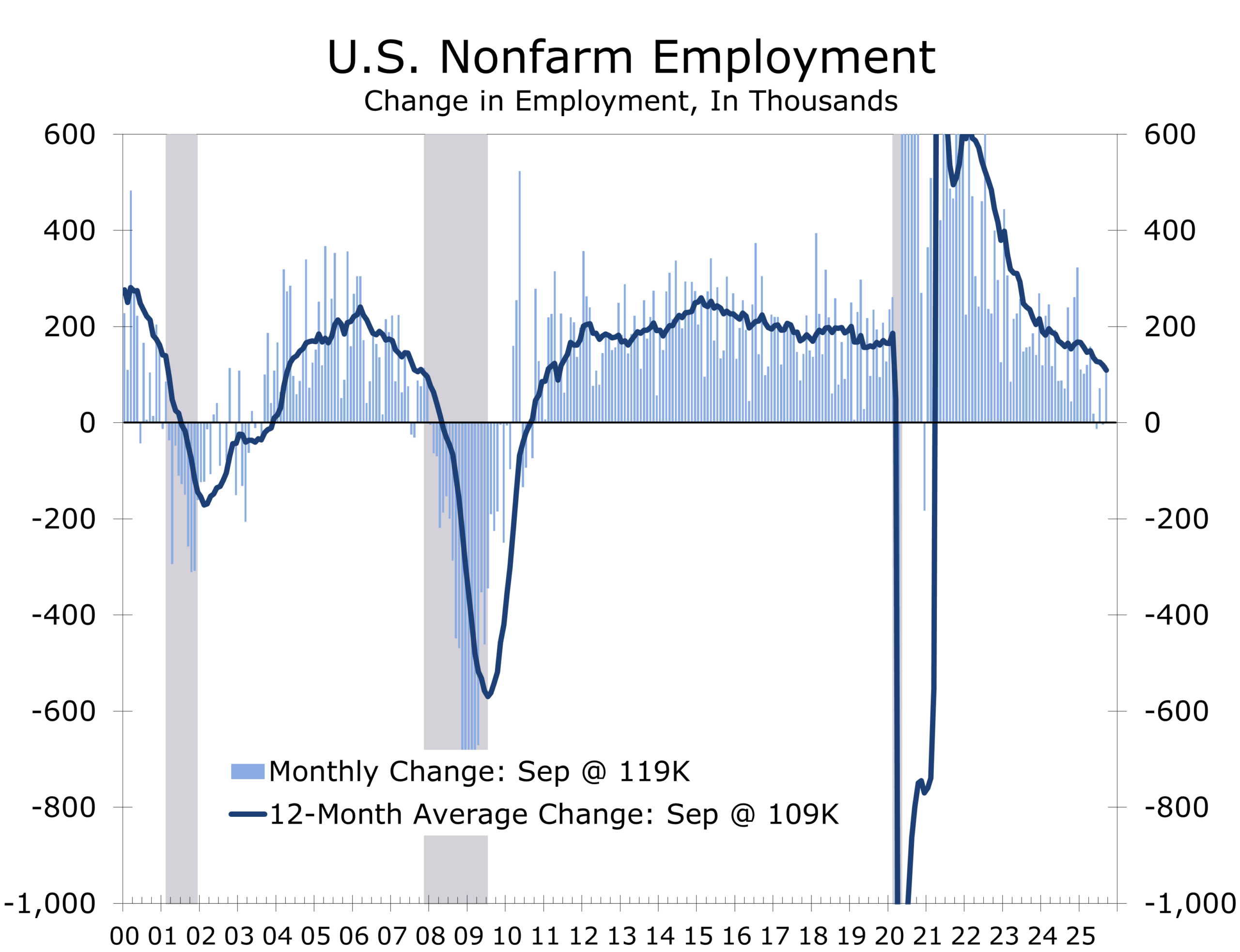
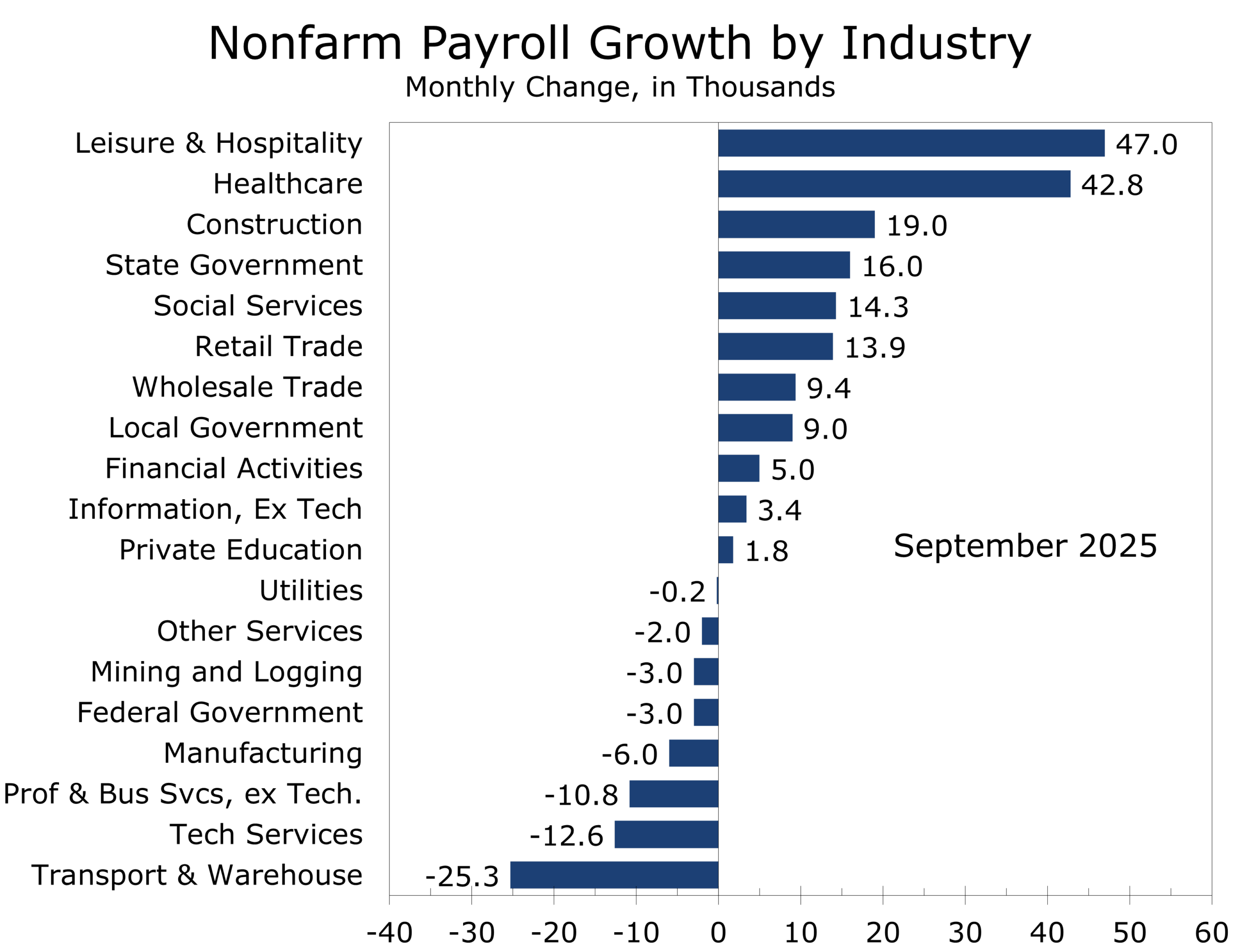
Revisions to July and August subtracted 33,000 jobs from the previous data, reminding us that the prior trend was weaker than first reported. And while the headline unemployment rate held at 4.4%, its highest since October 2021, the increase was driven partly by a surprisingly strong 470,000 jump in labor-force entrants. The influx is a sign that workers are reentering the job market rather than disengaging from it — a positive development. The household survey also showed rising permanent job losses, however, which climbed above 2 million for the first time since late 2021 — an unsettling development when hiring outside of a few industries remains sluggish. The trend has means a growing share of the unemployed have been without a job for 27 weeks or more.
Permanent job losses have quietly risen above 2 million — an early-cycle warning sign.
The shutdown itself added additional noise: the household survey was completed before the funding lapse, but establishment data were compiled using an unusually high 80% electronic reporting rate. October data will not be collected at all, and November will not be published until December 16. This complicates the Fed’s assessment at a critical moment.
Growth Carried by Health Care, Hospitality, and Social Services
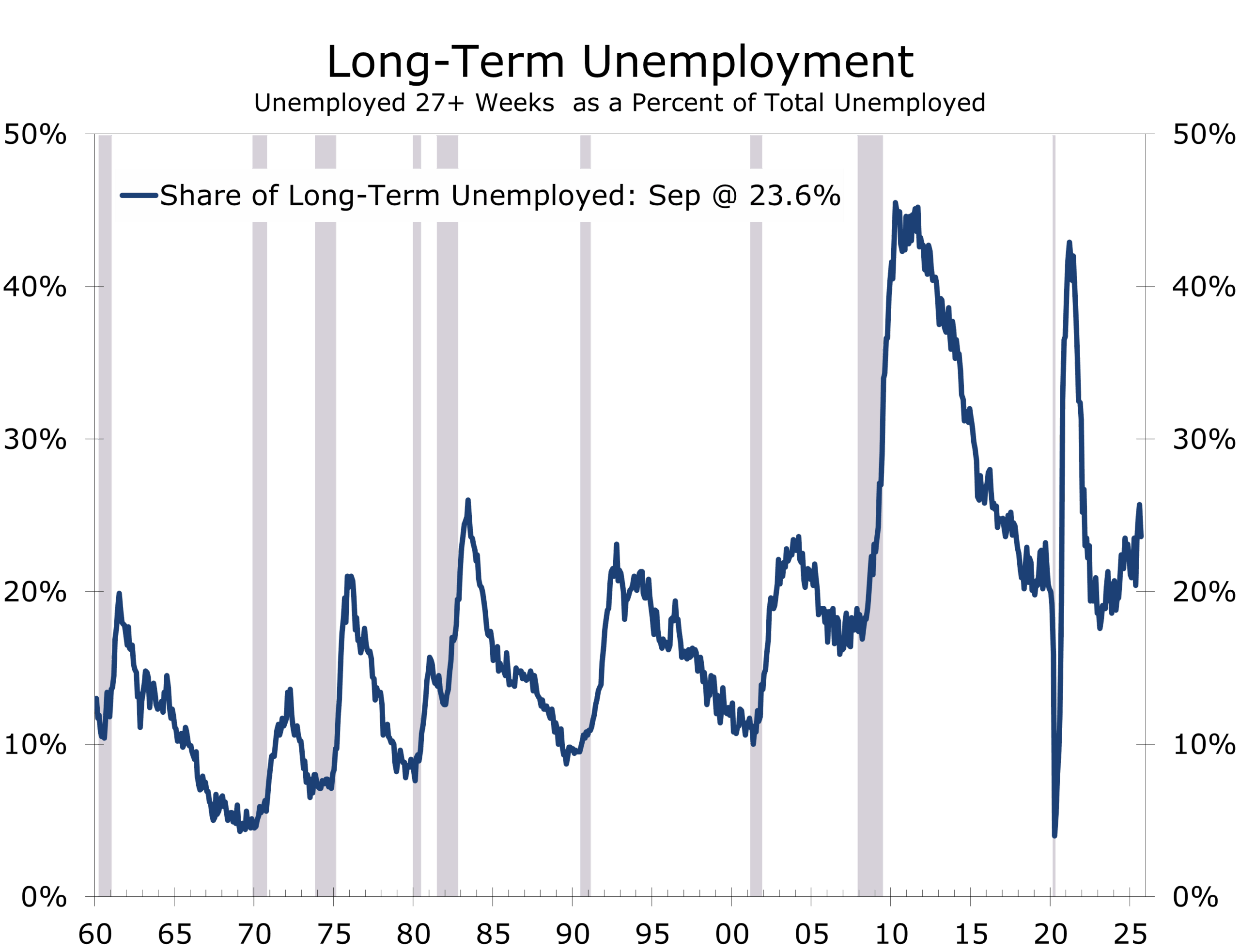
Where job growth did appear, it remained concentrated in a narrow slice of the service economy. Health care (+43,000) once again accounted for the largest share of gains, driven by ambulatory centers and hospitals. Restaurants and bars (+37,000) also contributed meaningfully, continuing a steady post-pandemic normalization. Social assistance (+14,000) was propelled by a 20,000 increase in individual and family services.
The top three contributors accounted for the overwhelming majority of net private-sector hiring in September, with most other major industries posting little change . Seasonal patterns related to the start of the school year may have boosted state and local government hiring and partially flattered the gains in leisure and education but do not account for all of the increase.
Meanwhile, the soft spots remained firmly in place. Transportation and warehousing shed 25,000 jobs, driven by losses in warehousing (–11,000) and couriers (–7,000). Professional and business services — often a bellwether for white-collar demand — also weakened. Temporary staffing was a notable weak spot but employment also fell in tech-centric industries. And federal employment declined another 3,000 ahead of what is expected to be a huge drop in October and November, as DOGE-related retirements and separations will show up.
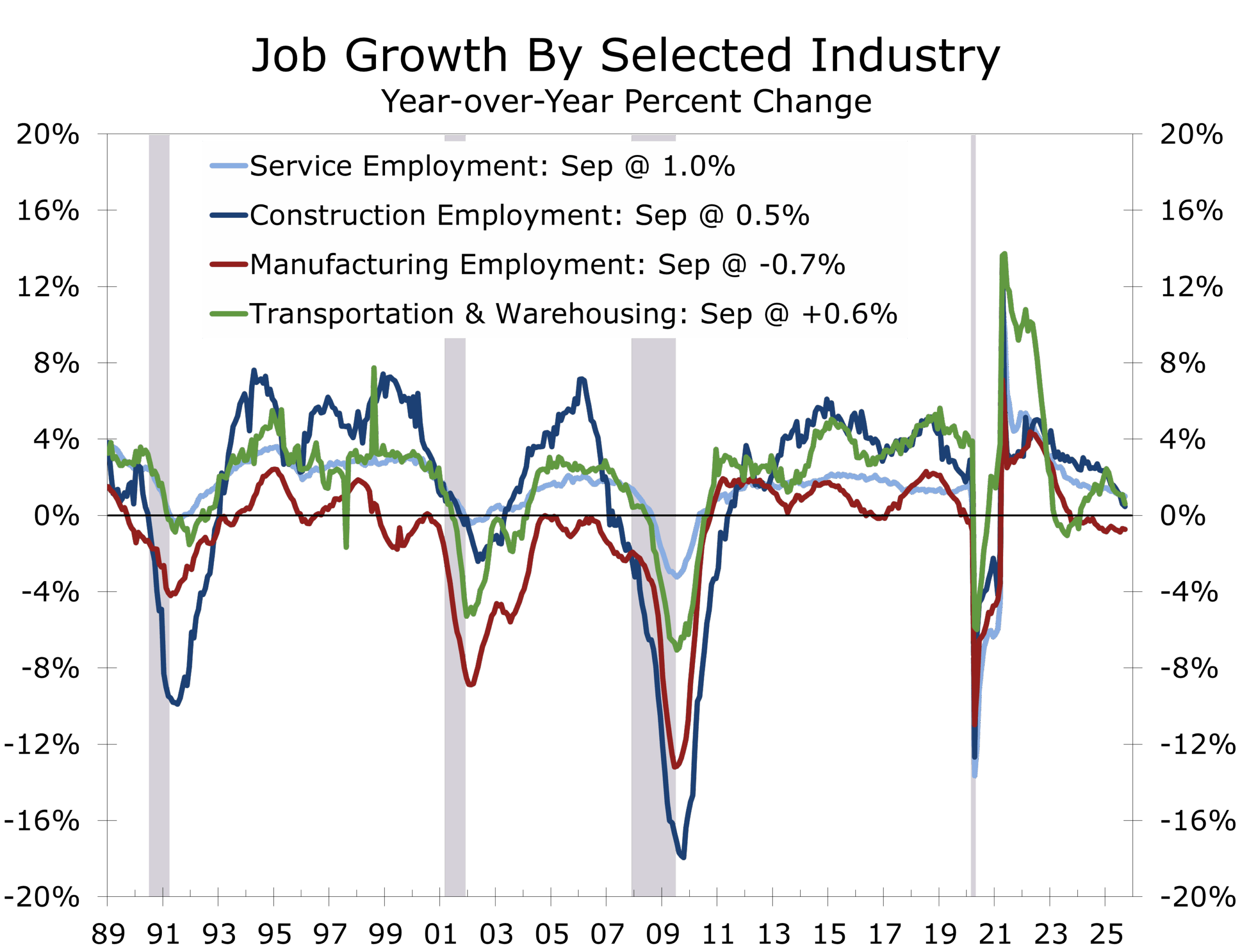
One relative bright spot: employment in the most cyclical parts of the economy — construction, manufacturing, and logistics — is holding up better than recessionary patterns would suggest. Construction remains modestly positive; manufacturing is only marginally negative; trucking shows mild year-to-year strength. In a downturn, all three would be sharply negative. This is one of the strongest arguments against the notion that the U.S. is sliding into recession today. Of course, these are preliminary figures and the revised data in February are expected to result in large downward revisions.
Unemployment Is Drifting Higher — and Slack Is Accumulating
The unemployment rate rose 0.1 percentage point 4.4%, but the underlying composition reveals a labor market cooling slowly, not collapsing. The labor force posted an outsized gain of 470,000, while household employment rate by 251,000. The number of unemployed rose by the difference, 219,000. This combination — more people looking for work, but not enough hiring to absorb them — is consistent with a plateauing labor market rather than an economy in free fall.
Participation remained at 62.4%, unchanged over the year. The employment-population ratio slipped to 59.7%, down 0.4 points since last September. And the composition of joblessness continues to shift in a concerning direction: permanent job losers rose above 2 million, while temporary layoffs and job leavers remained relatively stable. The rise in permanent job losses will exert further drag on consumer spending, particularly among middle- and lower-income households.
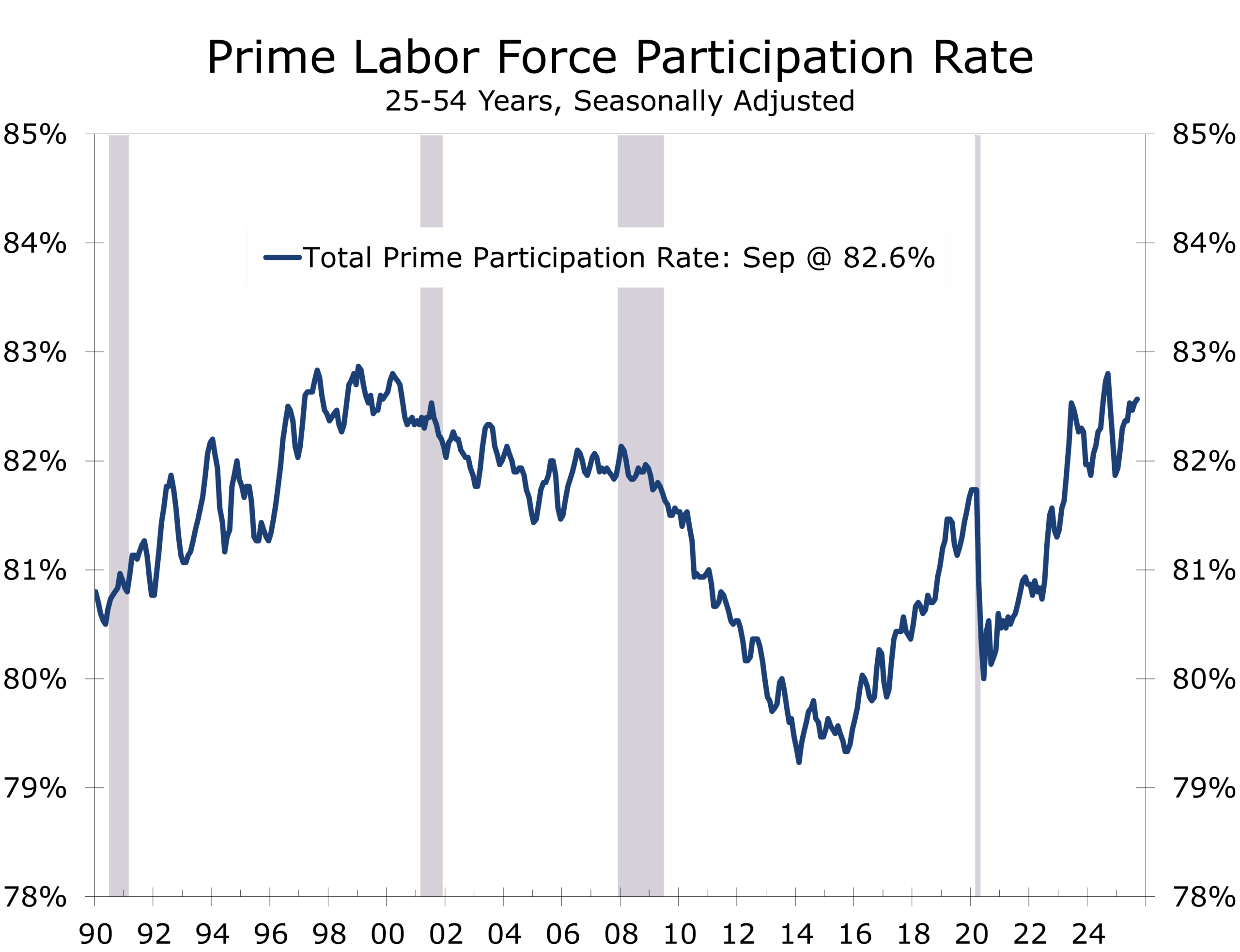
The share of the prime working-age population at work remains high, at just over 80%, and the Sahm Rule remains far from its triggering level, reinforcing that conditions do not yet meet recession thresholds.
Wage Growth and Hours Continue to Moderate
Wage growth slowed to 0.2% m/m and 3.8% y/y, on an overall basis, which is consistent with the Fed’s inflation target. Production and nonsupervisory workers saw slightly stronger gains at 0.3% m/m, but the overall pattern continues to reflect a gradual cooling.
Wage growth has aligned with the Fed’s inflation target — a key precondition for rate cuts.
Hours remained unchanged at 34.2, the average for the past year. Hours worked rose 0.1% in September and were essentially flat during the third quarter, which is well below our forecast of 3.7% GDP growth for the quarter, implying strong productivity growth.
A Late-Cycle Labor Market with Risks Tilting Toward the Downside
Structural indicators point to a maturing business cycle. Hiring is heavily concentrated in health care and services. Goods-producing sectors are flat to mildly negative. Federal employment faces a pending Q4 cliff due to deferred resignations. Permanent job losers are drifting upward. This is classic late-cycle behavior — not recessionary, but not healthy either.
The absence of broad-based deterioration is encouraging, but the accumulation of small points of weakness raises the risk of a slower Q4, especially given the fragile global backdrop and the extension of tariff pressures into fall.
FOMC Implications — A Case for Easing, Delayed by the Data Gap
September’s firmer headline does not change the broader trajectory: the labor market has downshifted from expansion to plateau. The Fed will not have October data and will receive November data only days before its mid-December meeting.
The ingredients for further easing remain in place. Unemployment is drifting higher. Wage pressures have aligned with the inflation target. Hiring is narrow and losing momentum. Goods-producing industries are weakening.
The case for a rate cut is firming — even as the calendar gets messier.
The Fed’s challenge is not the direction of travel — which is clearly softening — but the timing. With the data pipeline disrupted, there may be some reluctance to cut in December but we maintain that in the absence of compelling evidence to suggest otherwise, the Fed will go with the call made on the field and cut rates a quarter point at their December 9-10 FOMC meeting.
Disclaimer: This publication has been prepared for informational purposes only and is not intended as a recommendation offer or solicitation with respect to the purchase or sale of any security or other financial product nor does it constitute investment advice.
November 20, 2025
Mark Vitner, Chief Economist
(704) 458-4000

Amid Unevenly Clearing Fog: Nervous Markets, Missing Data, and the New Age of Deficits
Amid Unevenly Clearing Fog: Nervous Markets, Missing Data, and the New Age of Deficits
- The fog is finally lifting, but visibility remains uneven. The return of federal data should re-anchor expectations, and early releases appear likely to confirm what private indicators already signaled: a cooling yet still resilient economy.
- Markets remain choppy, with narrow leadership, rising volatility, and investors on edge. Headlines like The Economist’s “How the markets could topple the global economy” resonate sharply with investors who still carry memories of the GFC.
- Inflation continues to ease beneath the surface, with goods prices softening and core services showing further deceleration. Private trackers suggest official CPI will confirm a continued—if uneven—disinflation. The relaxation of several tariffs may support further goods disinflation.
- The labor market is bending, not breaking, as hiring slows and layoff announcements rise, but weekly initial claims remain low. The gig economy and surging Baby Boomer retirements continue to cushion the adjustment.
- Consumers are far more worried about affordability than employment, explaining the widening divergence between deeply pessimistic Sentiment readings and the still-resilient Confidence measure.
- Housing remains a paradox, with resale supply historically tight while new-home inventories climb. Lock-in dynamics, regional overbuilding, and demographic tailwinds support prices despite intense affordability pressures.
- AI skepticism reflects more dot-com trauma than current fundamentals. Today’s data show strong earnings, clean balance sheets, limited leverage, and capex aligned with real compute demand—conditions inconsistent with a speculative bubble.
- Gold is signaling deep doubts about fiscal sustainability, institutional credibility, and the viability of aging, deficit-heavy advanced economies.
- Fed Nears End of Runoff: Powell’s tone suggests a pivot to growth management, with two more rate cuts likely this year.
- Seven Years’ War fiscal dynamics are reemerging, with major powers overspending into demographic headwinds, rising tax burdens, and broadening generational doubts about capitalism. Stalin’s line—“There are decades where nothing happens, and weeks where decades happen”—feels uncomfortably relevant.
- Geopolitics remain tense but contained, with slow-motion diplomacy between Saudi Arabia and Israel, persistent risks around Iran, and a fragile equilibrium across the China–Taiwan Strait. Russia continues pressing against Ukraine, increasingly targeting civilian infrastructure to break morale or provoke retaliation that could erode Western support for Zelensky.
- Domestic political undercurrents are shifting, with cities such as New York and Seattle electing young, inexperienced Democratic Socialist mayors—reflecting rising generational discontent. This dynamic is already shaping early 2026 political currents, including left-wing pressure on Minority Leader Hakeem Jeffries within his Brooklyn district.
THE FOG BEGINS TO LIFT
The six-week government shutdown severed the economy from its statistical nerve center. Without the jobs report, inflation, income, spending, or productivity data, markets were forced to navigate with one eye closed. For much of that period, the absence of data created more uncertainty than any single release likely would have.
Now, the fog is beginning to thin. The return of the September employment report offers the first hard anchor in more than a month, and expectations point to modest job gains—precisely what private-sector trackers indicated before the shutdown. September is likely to show an economy that lost some momentum but remained fundamentally consistent with its pre-shutdown profile.
October will be murkier. Survey windows were missed, responses were delayed, and parts of the dataset may require reconstruction. Private-sector proxies, including ADP’s 42,000 job gain, slowing weekly job data, and rising layoff announcements—indicate softer conditions with higher downside risks, but not an unraveling.
A newly published ADP weekly series paints a more cautious picture: in the four weeks ending October 25, firms shed an average of 11,250 jobs per week, suggesting that job growth was inconsistent and late-month momentum faded. Layoff announcements continue to rise, and other proxies point to softer hiring, higher downside risk—but at this stage, the signal is of deceleration, not collapse. Still, early estimates for the October employment data call for a net decline in payrolls, as DOGE-era retirements lead to a drop in federal payrolls that will easily swamp what now looks like a modest rise in private payrolls.
Inflation appears to be following a similar arc. Tariffs pushed some goods prices higher, but broader pricing power is fading. Rents and home prices are decelerating. Core services inflation, while elevated, shows renewed signs of slowing. When CPI and PCE return, they are likely to confirm that the tariff-driven bump has largely run its course and that underlying inflation continues to cool.
The fog is clearing—but as it lifts, long-standing vulnerabilities that were hidden in the haze are coming back into view. The softer pace of job growth and easing underlying inflation will inevitably shape policy, increasing the likelihood of selective tariff rollbacks and reinforcing the case for additional interest-rate cuts.
MARKETS: A CORRECTION AND A REORIENTATION, NOT A BUST
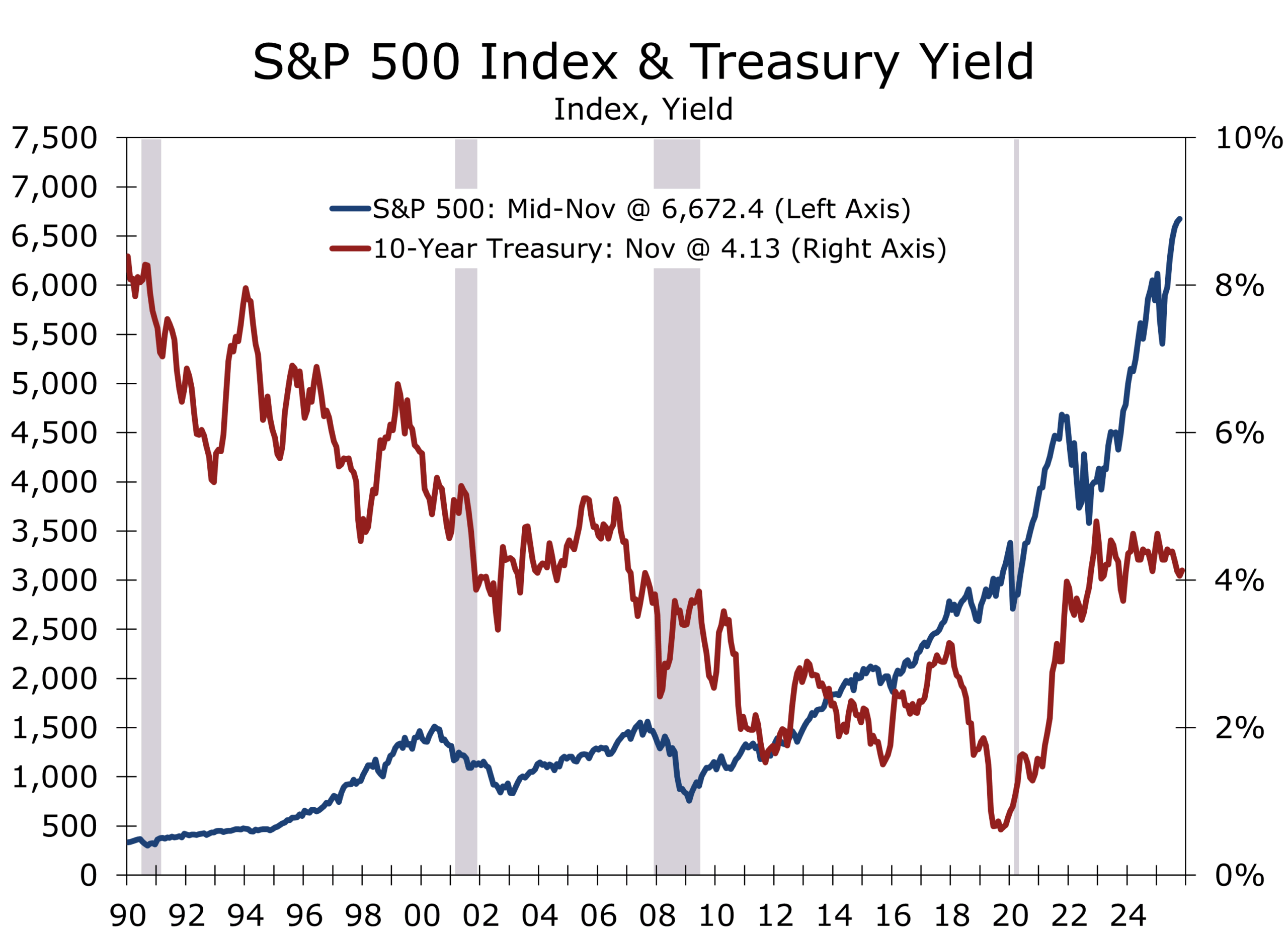
Markets remain cautious. The AI complex—once a runaway locomotive—is now moving more like a heavily loaded freight train cresting a grade: powerful, but deliberate, and increasingly sensitive to inclines. Recent selling has been concentrated in mega-cap tech, while cyclicals and defensives have held up better, signaling rotation rather than retreat.
AI skepticism has resurfaced, driven less by current fundamentals and more by the long shadow of the dot-com bust. The comparison, however, is superficial. Balance sheets are strong, leverage is minimal, earnings are rising, and capex remains tightly linked to real demand for computing power rather than speculative excess. IPO volumes are modest, and valuation expansion has been concentrated, not universal. A bubble requires broad exuberance and financial overextension; while markets have shown pockets of enthusiasm—especially as indices pushed to new highs—the underlying numbers do not support the excesses that typify true bubbles.
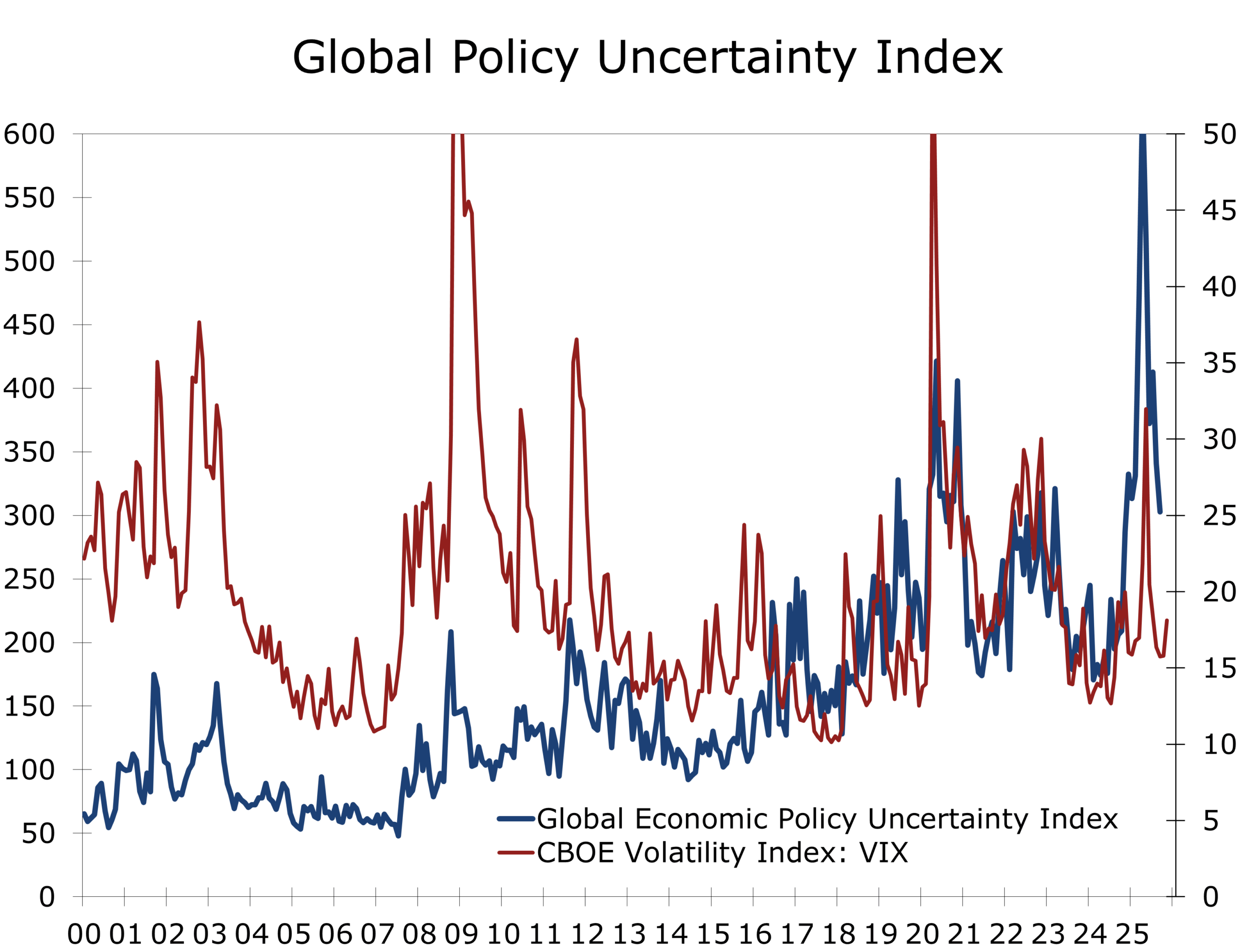
Even so, investors are on edge. The Economist’s warning that “the markets could topple the global economy” sharpened anxieties—especially among those who lived through 2000–2002 and 2008–2009. In this environment, sentiment reacts violently to uncertainty, even when fundamentals argue for a normal correction and continued sector rotation away from the most fully valued parts of the tech complex.
This market is undergoing a pivot—part correction, part rotation, part repricing—not a systemic breakdown. The path forward will depend on how quickly the data restore visibility. As the economic fog lifts and the trajectory of growth becomes clearer, we expect markets to stabilize and leadership to broaden beyond the narrow handful of AI-driven names that have dominated much of the past year.
RATES & THE CURVE: ORDERLY NORMALIZATION, LATE-1990s PARALLELS
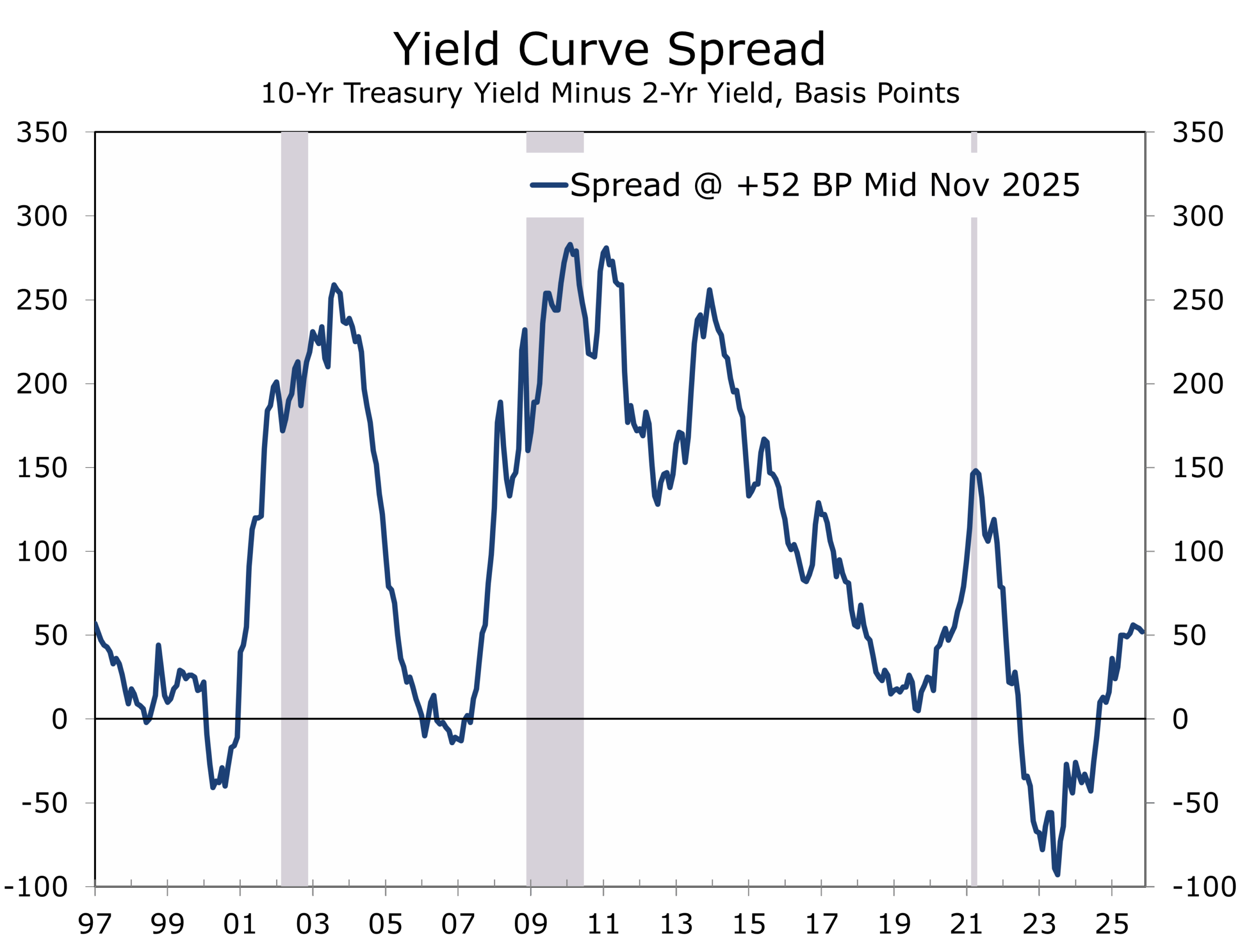
The yield curve has remained modestly positive for much of the year—a stark departure from the deep and persistent inversions of 2022–23. A drifting lower 2-year reflects expectations for at least one more cut in the federal funds rate, while the 10-year remains elevated due to firmer term premiums and large Treasury issuance. Together, they point to normalization rather than stress and reinforce our forecast for stronger growth in the second half of 2026 following a near pause in growth during the current quarter and Q1 2026.
Kevin Warsh and Kevin Hassett argue that today’s macro backdrop echoes aspects of the late 1990s: an early-stage productivity upswing driven by AI, hardened supply chains, and an investment-led expansion that could ultimately allow short-term rates to settle below what the forward curve implies. They view the present moment as closer to Internet 1.0 and the Y2K investment cycle than to any inflationary replay of the 1970s.
Christopher Waller—now widely seen as a leading contender for Fed Chair—takes a more incrementalist approach. He argues for refining the current framework rather than redesigning it and has signaled that another quarter-point cut in December will likely be appropriate. Waller has underscored that “easier financial conditions” reflected in markets earlier this fall were not being felt by middle-income households facing intense affordability pressures. He has also noted that the labor market is losing momentum and that tariff-related inflation noise is already fading, leaving core inflation “close to 2 percent.”
This debate highlights a deeper reality: high structural deficits are narrowing the Fed’s room to maneuver. Interest expense is consuming a growing share of federal revenues, Treasury issuance is lifting term premiums, and fiscal policy is exerting a growing pull on the long end of the curve. Monetary and fiscal tools—long treated as separate levers—are beginning to intersect in ways not seen in decades.
LABOR MARKETS: SOFTENING, BUT STRUCTURALLY SUPPORTED
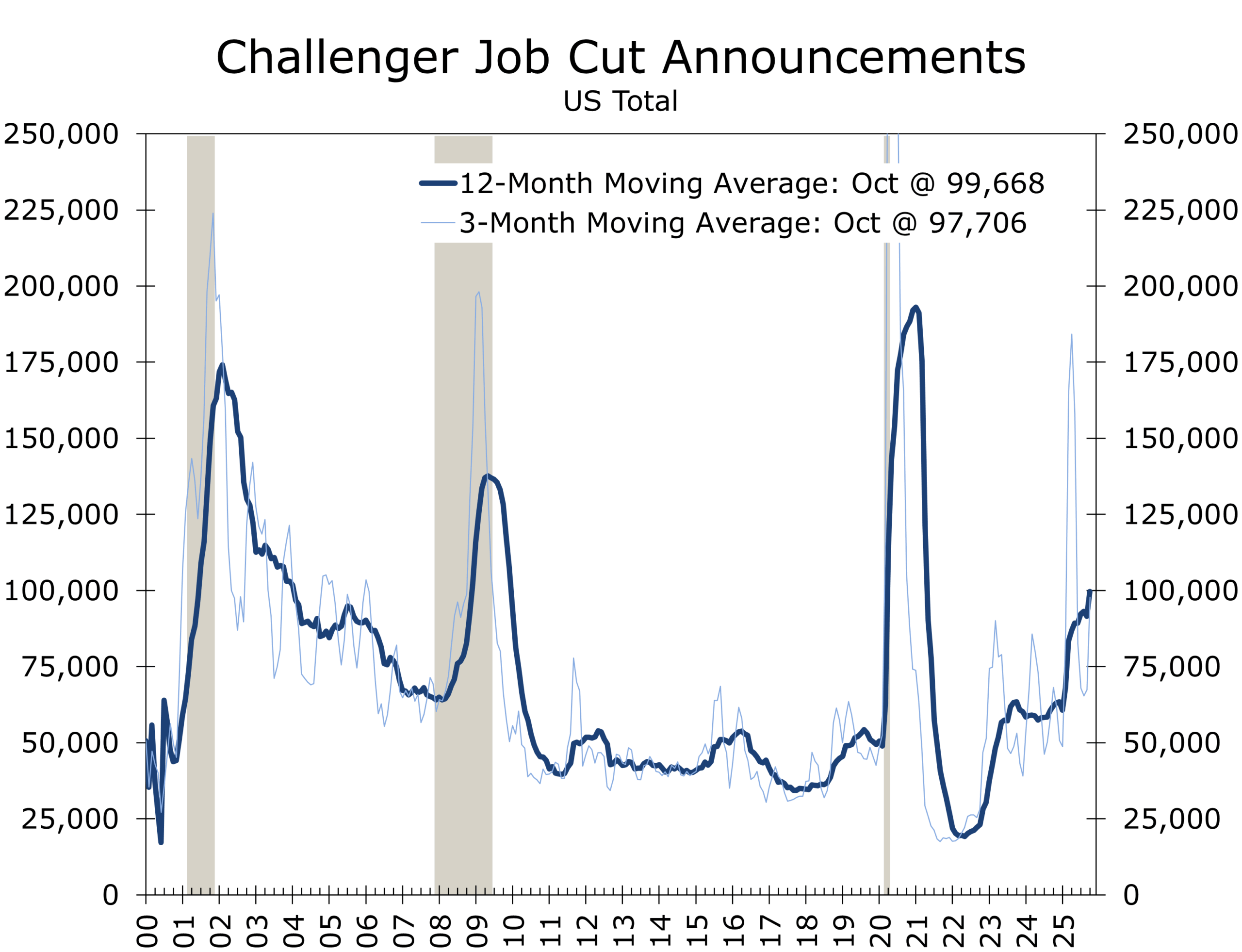
Labor markets continue to cool. Hiring has slowed, job postings have eased, and layoff announcements are rising. Challenger’s October tally was the highest for that month since 2003 and WARN notices in several large states have moved higher. The pattern is eerily similar to the early stages of past recessions, where firms begin trimming headcounts well before claims rise. The trend is also broadening. Verizon announced the largest layoff in its history this past week, with plans to eliminate 13,000 positions—an unusually large move for a company that typically adjusts costs more gradually.
Despite the tide of announcements, weekly jobless claims remain low. Two structural dynamics explain the apparent contradiction. First, the gig economy now acts as a shock absorber, allowing displaced workers to pivot quickly into rideshare, delivery, freelance, or digital task-based income. This was evident during the shutdown, when furloughed federal workers immediately turned to gig work to bridge income gaps. The availability of flexible, on-demand earnings blunts the impact of layoffs and suppresses claims.
Second, accelerating Baby Boomer retirements continue to thin the labor force even as demand softens. This demographic shift reduces measured slack, supports wage stability, and prevents the kind of sharp unemployment spikes seen in previous downturns. Many firms are eliminating positions that might previously have gone to younger workers rather than laying off incumbents.
Labor markets are bending, not breaking. The still low unemployment rate likely overstates strength, while the surge in layoff announcements likely overstates weakness. The truth lies somewhere in between—a cooler, more cautious labor market with meaningful pockets of resilience, with payroll gains averaging 75,000 a month.
CONSUMERS: AFFORDABILITY IS THE PRESSURE POINT
Consumers remain far more anxious about affordability than about job loss. Rents, insurance, utilities, medical services, auto repairs, and debt service continue to compress budgets. This explains why the University of Michigan’s Index of Consumer Sentiment remains historically weak while the Conference Board’s Consumer Confidence Index remains consistent with moderate growth.
High-frequency spending data show a cooler but still expanding consumer backdrop. Lower-income households face the most intense pressure, with rising delinquencies, heavier Buy Now–Pay Later usage, thinning liquidity buffers—but overall spending remains positive.
HOUSING: THE PARADOX THAT DEFINES THE CYCLE
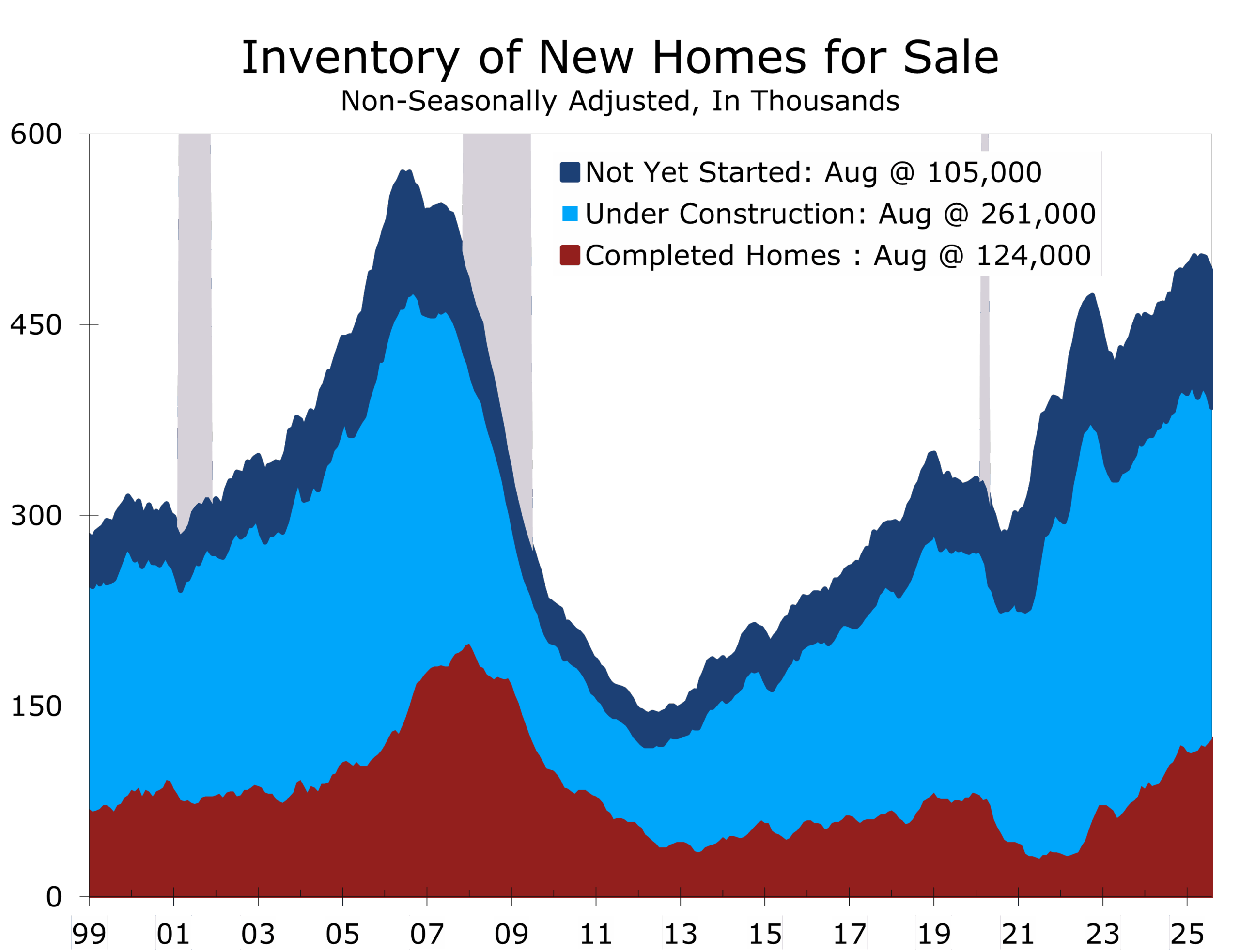
Housing remains the clearest example of structural imbalance. The existing home market is historically undersupplied. Millions of owners with sub-5% mortgages remain unwilling to list, creating structural scarcity and a durable price floor. By contrast, the new home market is working through the tail end of the pandemic-era pipeline. Builders in the Southeast and Mountain West are sitting on elevated completed inventories, the highest since the housing bubble—leading to aggressive incentives and rate buydowns to support absorption.
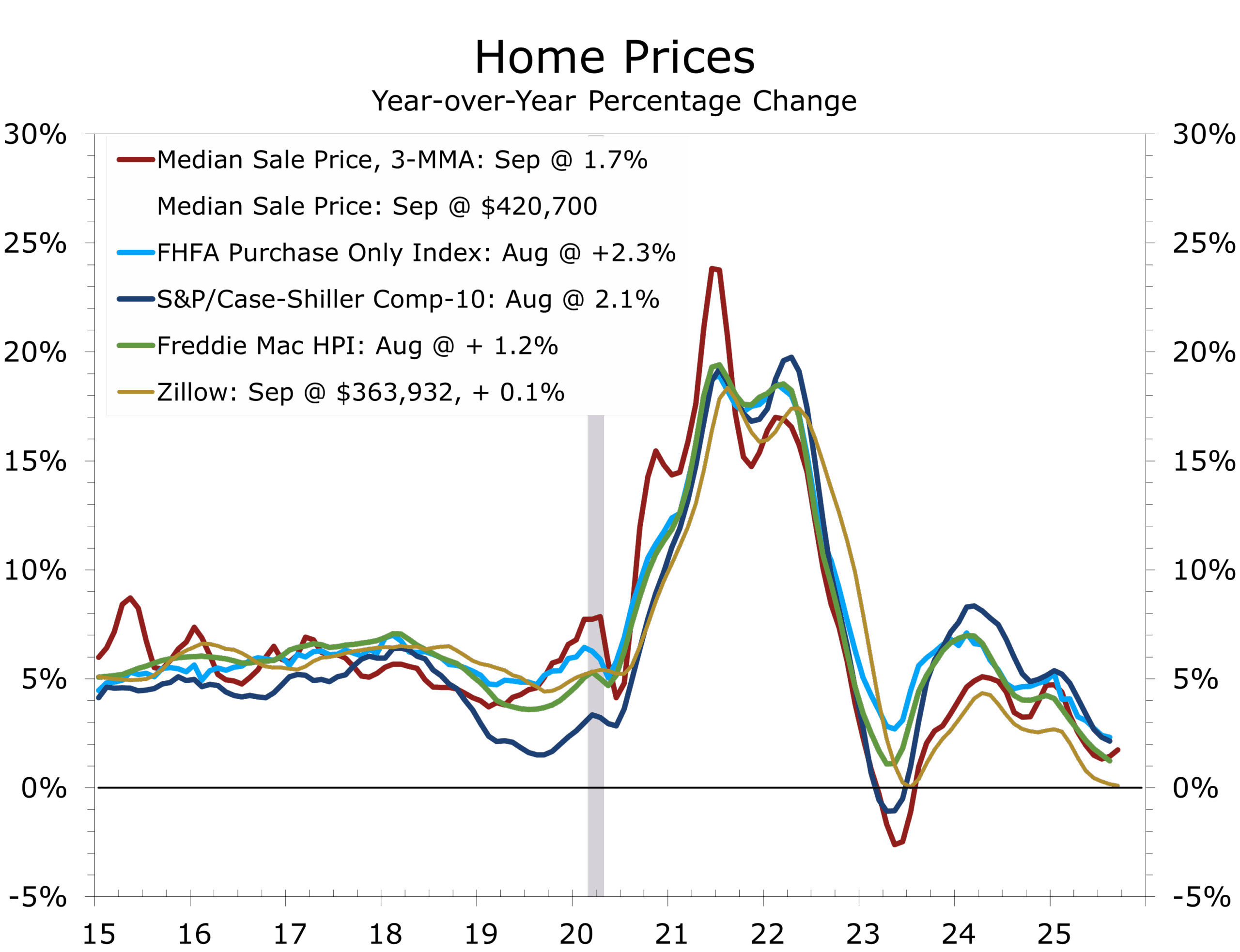
While new home inventories are the highest since the housing bust, this is not a replay of 2005–2007. While some formerly red-hot markets, most notably Central and Southern Florida, are seeing widespread declines, most markets are seeing only modest price adjustment and overall home prices are still running about 1.5% above their year ago level. The tight resale market prevents builders from slashing prices too much without triggering appraisal failures, cancellations, and margin deterioration. Moreover, Millennials and Gen Z continue to age into peak household-formation years, supporting underlying demand.
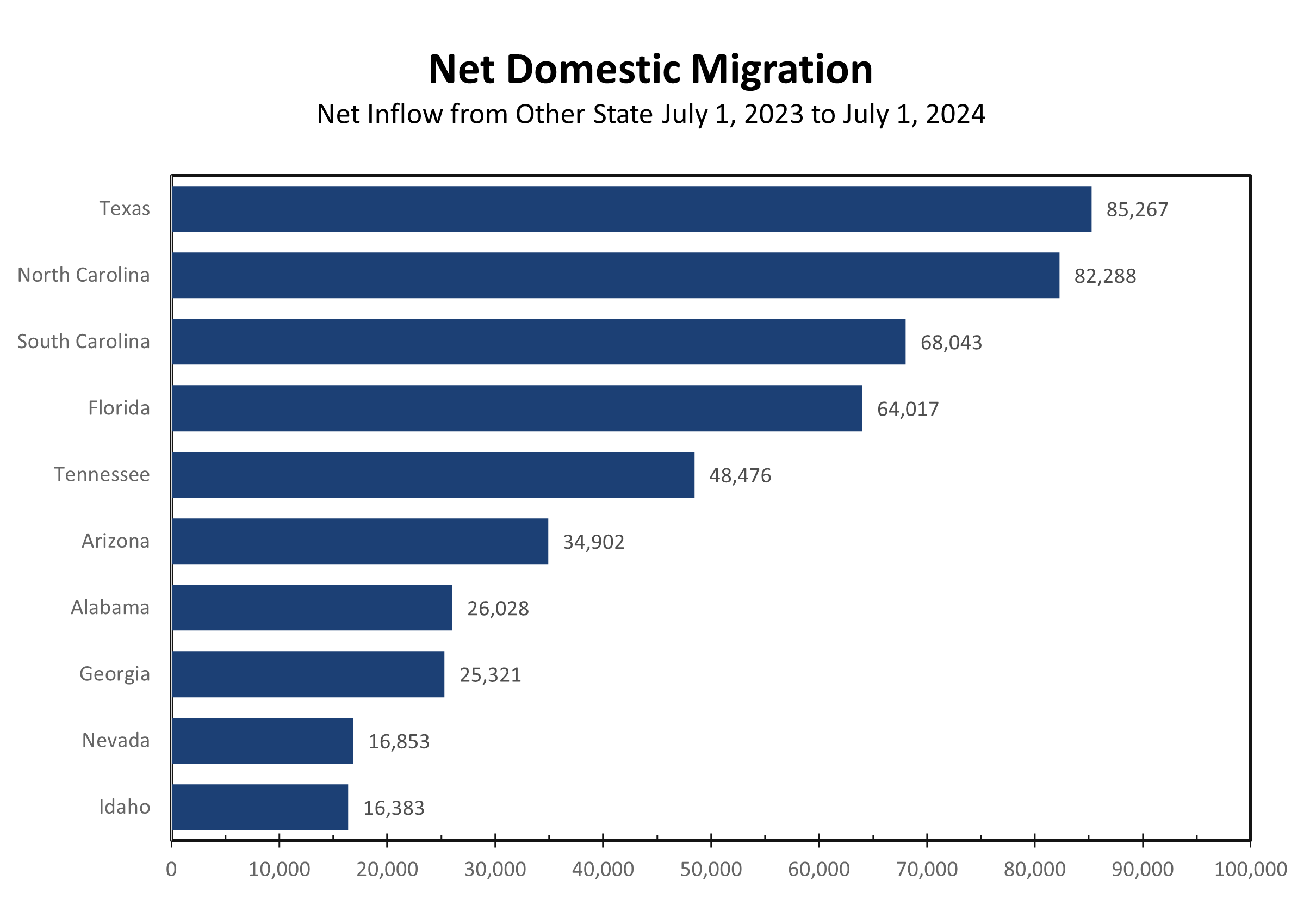
One way that consumers are adjusting is by migrating to parts of the country where housing is relatively more affordable. Texas, the Carolinas, Georgia, Tennessee, Arizona and Alabama are the big winners in this trend.
Gold, Deficits, and the New Age of Policy Doubt
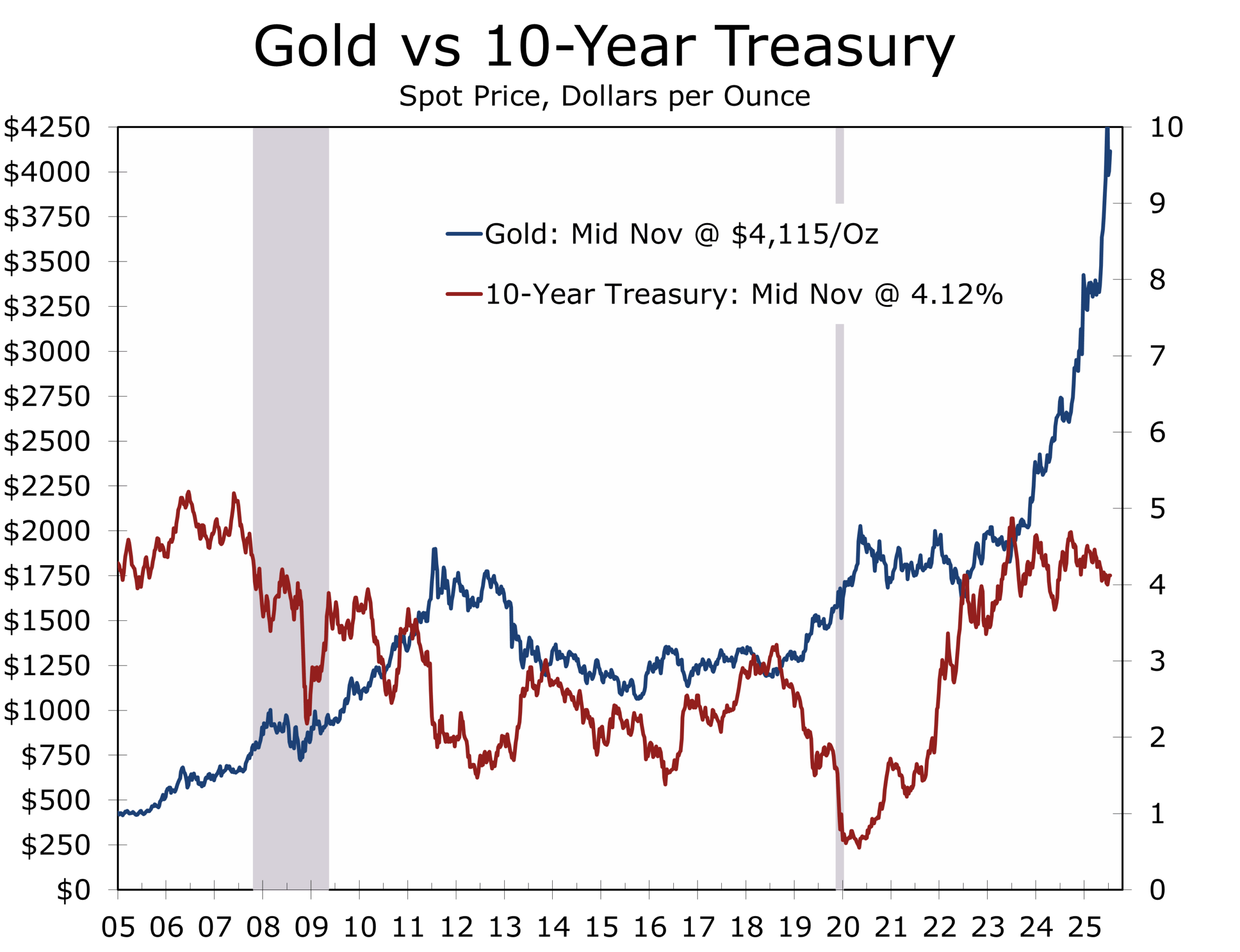
Gold is rallying not because of near-term inflation jitters but because investors are questioning the durability of fiscal and geopolitical strategy itself. Structural deficits continue to widen, aging populations are colliding with rising interest burdens, and political systems across advanced economies remain unwilling—or unable—to confront basic fiscal arithmetic. The result is a growing search for assets immune to policy drift. Gold has become less an inflation hedge and more a hedge against eroding fiscal capacity across the U.S., Europe, Japan, and increasingly China, where demographic decline and debt saturation present challenges just as severe.
Layered onto these pressures is the intensifying U.S.–China microchip rivalry—a technological arms race reshaping global power dynamics and straining national budgets. Washington’s CHIPS incentives and export controls, combined with Beijing’s massive state-backed subsidies, have set off a costly contest for semiconductor self-sufficiency. That competition is cascading through the rest of the world: developed economies in Europe and East Asia are being pulled into subsidy battles to protect their own chip ecosystems, while developing economies—from Vietnam and Malaysia to Mexico and India—are absorbing new investment flows as supply chains reroute. The race for technological sovereignty is becoming a fiscal challenge as much as a strategic one, amplifying the sense that traditional policy frameworks are no longer fit for the era.
The historical rhyme is unmistakable. The Seven Years’ War drained the treasuries of the world’s major powers as they chased geopolitical advantage, triggering fiscal crises, heavier taxes, and rising public frustration—conditions that helped set the stage for the American Revolution. Today’s environment carries a similar echo: mounting fiscal stress, institutional fatigue, and a generational skepticism that the existing economic model can still deliver upward mobility or broad-based prosperity.
Stalin’s stark warning captures the moment: “There are decades where nothing happens; and there are weeks where decades happen.” After years in which deeper structural issues could be deferred, the combination of deficits, demographics, and dual-use technology competition has pushed them to the forefront. Gold’s strength is not about the next CPI print—it reflects rising concern over what the next decade will demand from fiscal and monetary systems already stretched to their limits.
GEOPOLITICS: SLOW MOVES, SHARP UNDERCURRENTS
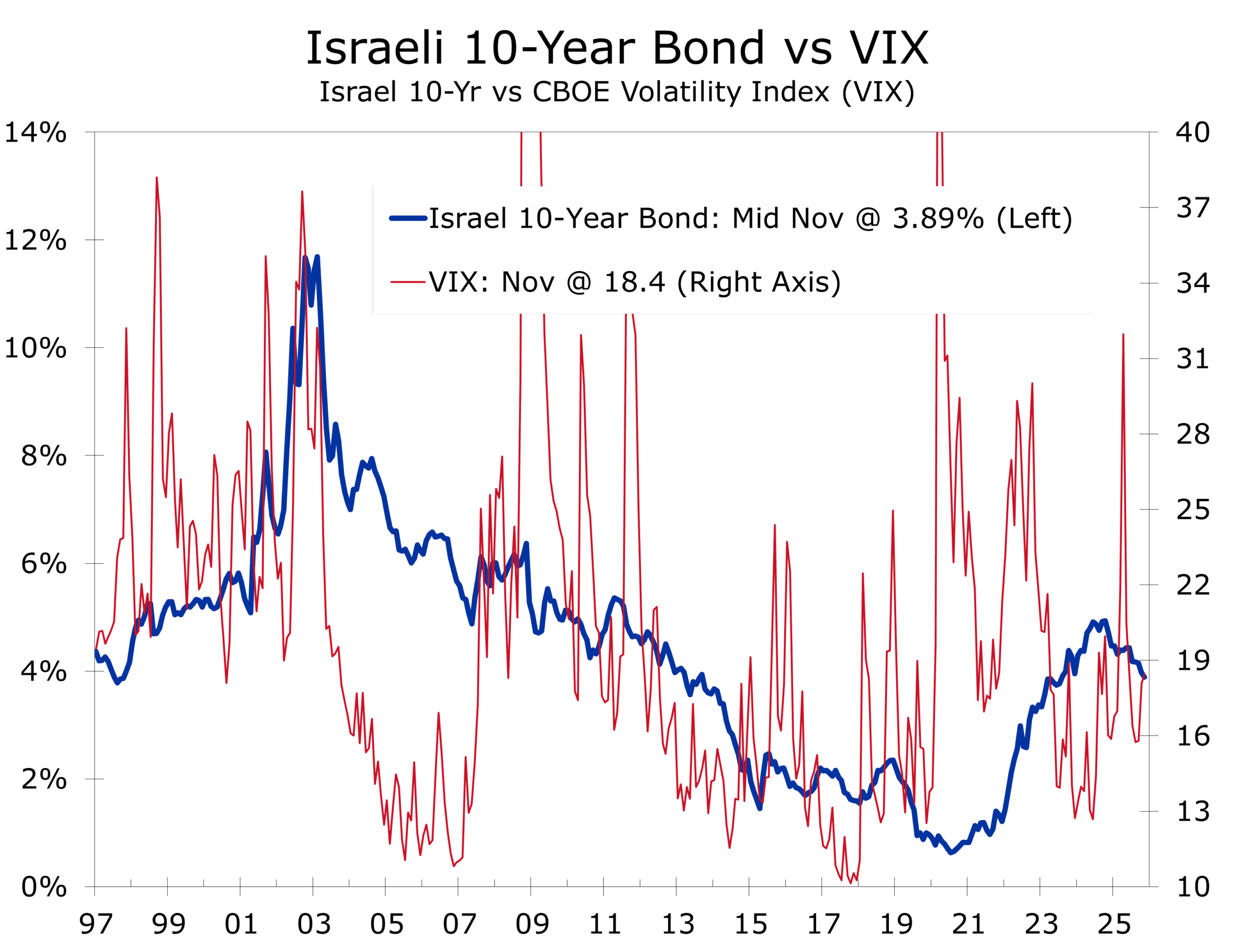
The Middle East tail risk has fallen sharply. The decisive ceasefire that took effect on October 10 has held and the UN Security Council’s unanimous November 17 endorsement of the Trump 20-point Gaza plan—backed by Saudi Arabia and the UAE—has dramatically raised the odds of Saudi-Israeli normalization at some point in 2026. Riyadh’s asks (U.S. defense treaty, civilian nuclear program, tangible Palestinian progress) are steep but now within reach. Credit markets have already responded: S&P shifted Israel’s outlook to stable on November 7, Israeli 10-year yields have dropped 45 bps since early October, and Gulf sovereign spreads are at two-year tights.
Iran remains the principal residual wildcard. Proxy forces are subdued but not disarmed, missile and cyber programs advance unchecked, and domestic pressure could still trigger asymmetric retaliation if Tehran feels encircled by a formal anti-Iran axis. Base case is further de-escalation.
China continues tightly calibrated gray-zone pressure on Taiwan while closing the military gap at pace. TSMC-centric exposures carry explicit invasion pricing—keep rotating to on-shored and diversified-node semis.
Russia systematically strikes Ukrainian civilian infrastructure while baiting Kyiv into responses on Russian soil that would erode international support. European utilities, grains, and freight remain vulnerable; energy prices appear too low given the risk set—stay long hard-currency energy.
U.S. generational backlash is accelerating, amplified by documented PRC, Russian, and Iranian social-media influence operations. DSA mayors hold New York and Seattle; Hakeem Jeffries and Governor Kathy Hochul face credible 2026 left-wing primaries. Favor investments in red states, particularly Texas; raise hurdles for duration and illiquid credit in progressive jurisdictions.
Mexico’s Gen Z protests have escalated into the most sustained and geographically widespread unrest since 1994. Triggered by collapsing real wages, cartel violence spilling into urban areas, and anger at perceived judicial capture under the outgoing administration, demonstrations have paralyzed major cities and forced repeated highway blockades. President-elect Sheinbaum has responded with a mix of concessions and force, but confidence in public security remains at multi-decade lows. Near-shoring beneficiaries with more than 30% Mexico revenue exposure (auto parts, electronics assembly, logistics) now trade with a visible political-risk discount. Selectively underweight or hedge that exposure; favor exporters with U.S.-centric or multi-Latin American footprints.
Risk premiums are easing but not gone. Favor gold, short-dated T-bills, defense, energy, commodity-exposed investment, and a neutral-to-modest overweight on Israeli and Gulf credits. Watch Saudi normalization triggers closely—upside surprises are now the higher-probability outcome. Position defensively but opportunistically.
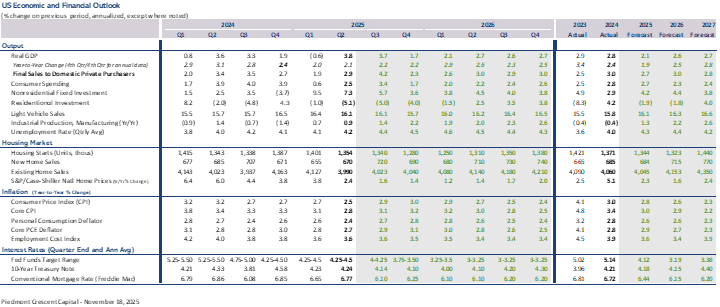
Outlook – The Fog is Thinning, Albeit Unevenly
U.S. growth has proven far more resilient than nearly anyone expected at mid-year. The Atlanta Fed GDPNow has consistently tracked at or above the high end of consensus, and even after the prolonged government shutdown shaved Q4 estimates, the underlying pace remains robust. Beneath the noise lies the same structural shift we have highlighted all year: an economy increasingly powered by capital-intensive, high-productivity sectors—AI infrastructure, aerospace, defense, and advanced manufacturing—rather than traditional labor-driven expansion. Productivity is quietly rebuilding the foundation for durable growth.
Layoffs have spiked but remain concentrated in a handful of over-extended sectors and have not yet triggered broader contagion. Housing continues to restrain momentum yet does not pose systemic risk; new-home inventories are rising, existing-home supply remains tight, and prices are adjusting modestly. The housing drag is now unambiguously disinflationary, giving the Fed additional latitude to ease.
We still expect the Fed to accomplish more by doing less—no more than three additional 25 bp cuts in the base case. A weakening labor market, the recent equity correction, and the Fed’s upcoming leadership transition introduce modest downside risks, but nothing that derails the expansion. Markets have begun pricing exactly this scenario. Not a boom, nor a bust, but a resilient gradual reacceleration that becomes visible by mid-2026.
The shutdown and layoff headlines generated fog, yet the core pillars: innovation, secure property rights, and trusted capital markets remain unshaken. The fog is thinning, unevenly but unmistakably. We expect growth to surprise to the upside once again in 2026.
Disclaimer: This publication has been prepared for informational purposes only and is not intended as a recommendation offer or solicitation with respect to the purchase or sale of any security or other financial product nor does it constitute investment advice.
November 18, 2025
Mark Vitner, Chief Economist
704-458-4000

A View from the Piedmont: Our Weekly Commentary on Money, Credit, Exchange Rates & Geopolitics – The Expansion Goes Jobless
Highlights of the Week
- The Government shutdown appears likely to end as a bipartisan Senate vote approaches; market uncertainty may ease.
- Private payrolls rose 42,000 in October per ADP, while Challenger layoffs surged 183% from September and jobless claims held near 228,000.
- The data reinforce a picture of a cooling but not collapsing labor market—one where hiring slows, layoffs rise selectively, and firms sustain output through productivity gains rather than adding staff. We may be entering a "jobless expansion".
- ISM Services rebounded while manufacturing remains mired in
- Fed officials remain divided as data blackout clouds the December policy decision.
- Stocks suffered their sharpest weekly loss since April; yields remain steady near 4 percent.
- Off-year U.S. elections deepened fiscal gridlock, while Russia escalated winter strikes on Ukraine’s power grid and Israel expanded operations against Hezbollah. Local politics—from New York to Beirut—are now reverberating globally, shaping fiscal policy, supply risk, and energy markets more than central banks.
U.S. ECONOMY & FINANCIAL MARKETS
This week’s commentary assesses the macro and policy landscape, focusing on persistent fiscal uncertainty, labor market bifurcation, and global flashpoints impacting risk assets and corporate strategy. As the government shutdown extends to historic length, prospects for a resolution are improving, with a pivotal Senate vote scheduled Sunday evening and Democrats signaling willingness to support a deal to reopen the government. Macro data visibility remains diminished, creating tactical challenges for allocators and policymakers.
An apparent resolution of the government shutdown appears to be in the works.
The longest government shutdown on record is finally moving toward a resolution. The Senate advanced a bipartisan funding bill on Sunday by a 60–40 vote, clearing the key procedural hurdle to reopen the government. The measure—backed by eight Democrats—would fund most federal agencies through late January and provide retroactive pay to furloughed workers. Negotiations continue over health-care subsidies and longer-term spending caps. The CBO estimates the shutdown has already shaved 1–2 percentage points off Q4 GDP, or roughly $14 billion. A final Senate vote is expected early this week, potentially allowing agencies to resume operations and easing mounting economic strains.
While discussions remain fluid and no deal is finalized until the vote is taken, the mood in Washington has shifted and a breakthrough appears increasingly likely—potentially ending weeks of fiscal drag and market volatility.
Federal contractors and air-traffic controllers remain unpaid, forcing the FAA to cut flight schedules at major hubs. Beyond the fiscal drag, the shutdown has created a data fog for the Federal Reserve just weeks before its December policy meeting. Key inflation and labor reports have been delayed, leaving policymakers to navigate without their usual instruments and relying on private data, experience and instincts.
Labor Market: Cooling, Not Collapsing
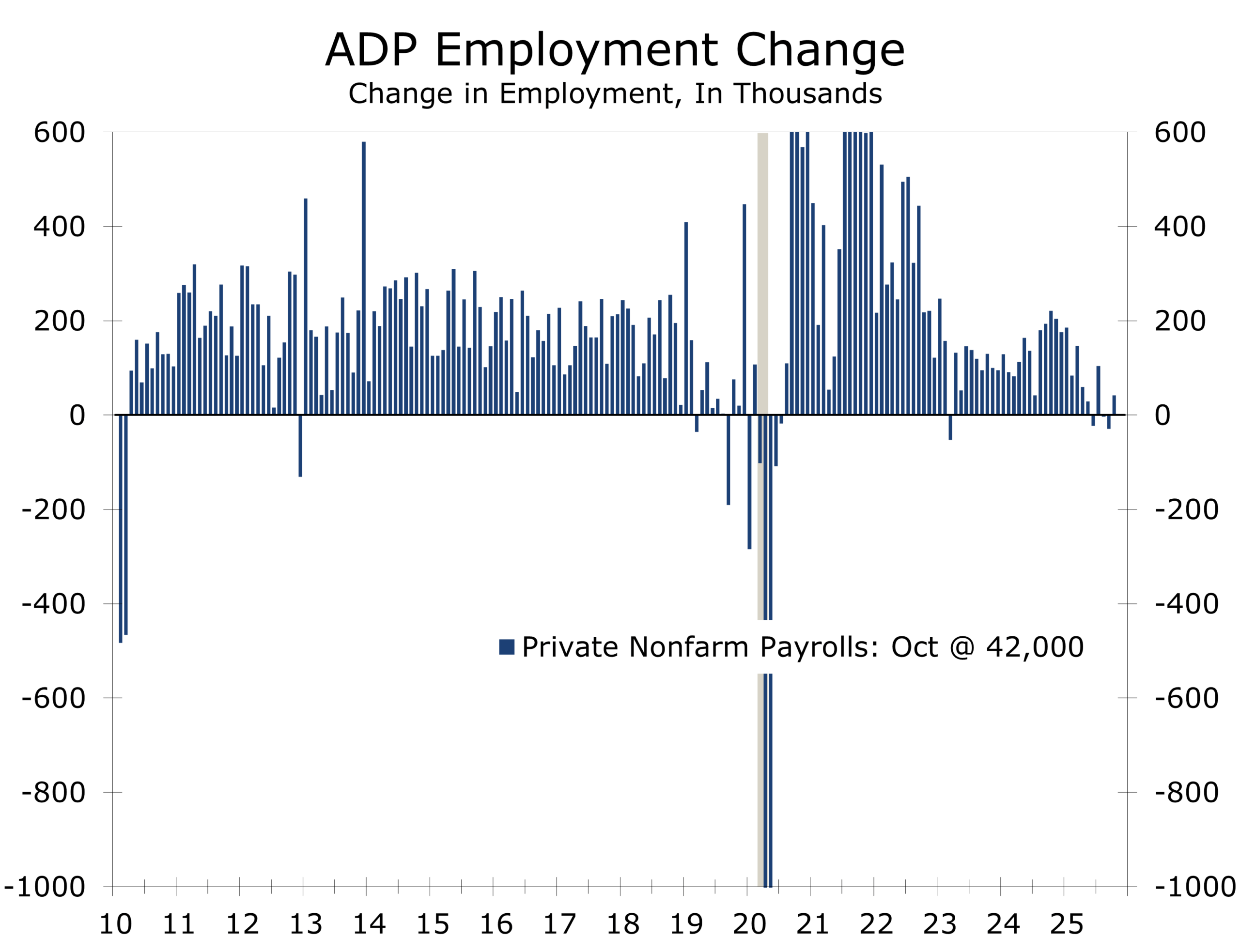
The October ADP report showed a modest 42,000 private-payroll gain—a rebound from two months of declines but well below the pre-pandemic trend. Hiring remains concentrated in healthcare, hospitality and travel-related services while professional and information industries continue to shed jobs. Small and medium sized firms have cut payrolls in five of the past six months, while large companies continue to add staff.
Depictions of a low-hire, low-firm environment may be slightly optimistic; recent data may be overstating net job growth. Productivity gains and AI-driven efficiencies are enabling firms to sustain output with fewer hires. The primary risk is not mass layoffs, but a prolonged period of stagnant hiring and more intense debate over inequality.
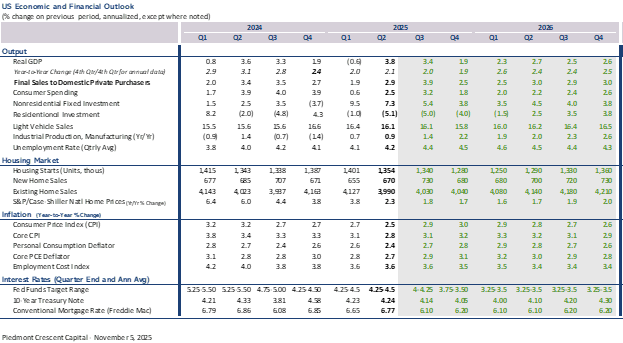
Real GDP is estimated to have risen at a 3.4 percent annual rate during Q3, while nonfarm payrolls averaged just 45,000 per month in July and August. Productivity growth is strong, but labor-force participation is slipping as attractive job opportunities become scarce, immigration slows, and policy uncertainty rises. The threshold for job growth to keep unemployment stable has fallen to roughly 45,000 per month, implying GDP can grow without meaningful job creation.
While layoff announcements spiked in October, state-level unemployment insurance filings do not reflect a generalized uptick. State-level jobless claims remain subdued at around 228,000 per week, consistent with a labor market that is cooling but not cracking. Layoff announcements typically take months to translate into job losses.
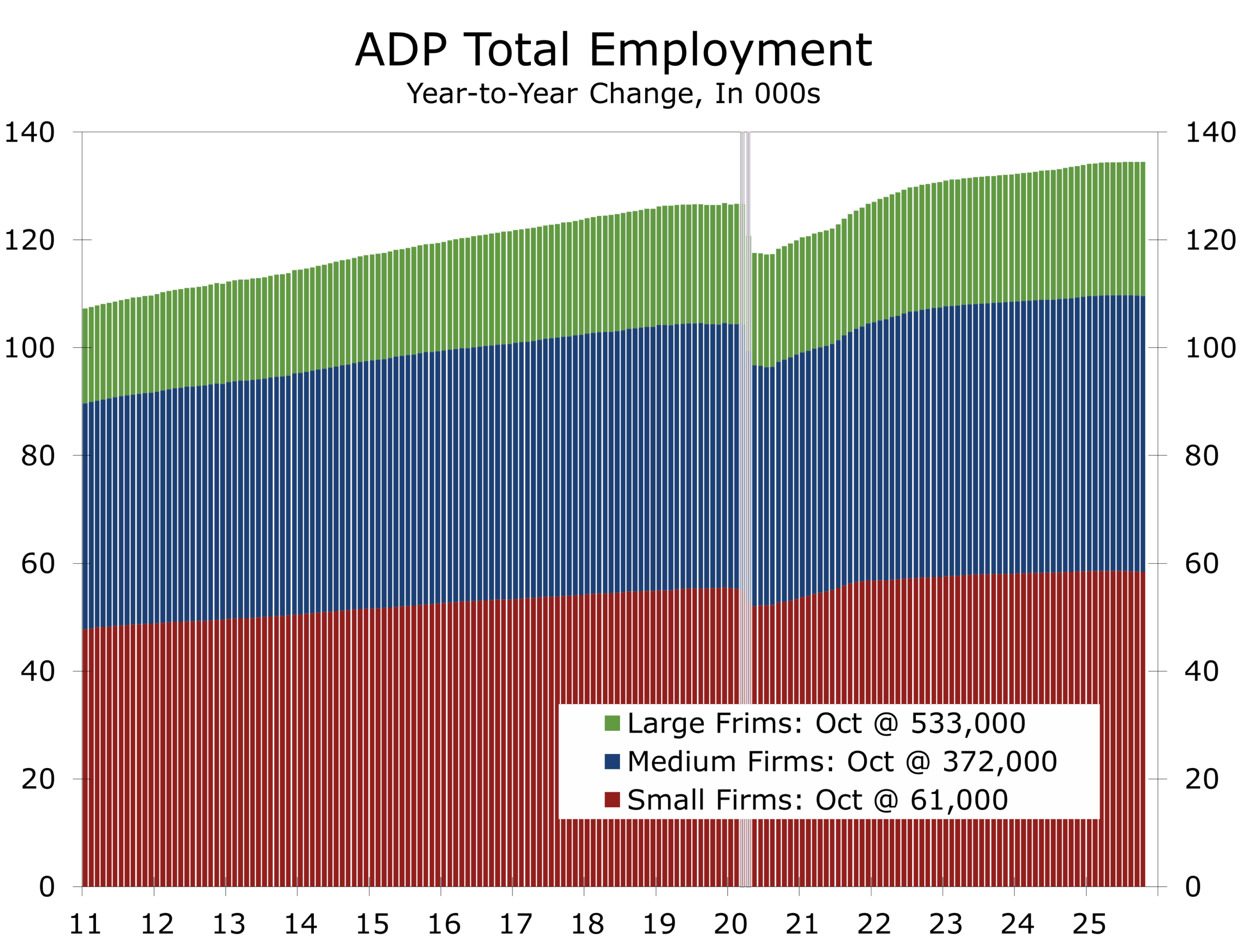
The gig economy, meanwhile, provides displaced workers opportunities to generate income while searching for a new position, reducing the impact on headline unemployment statistics.
Consumer Mood Sours
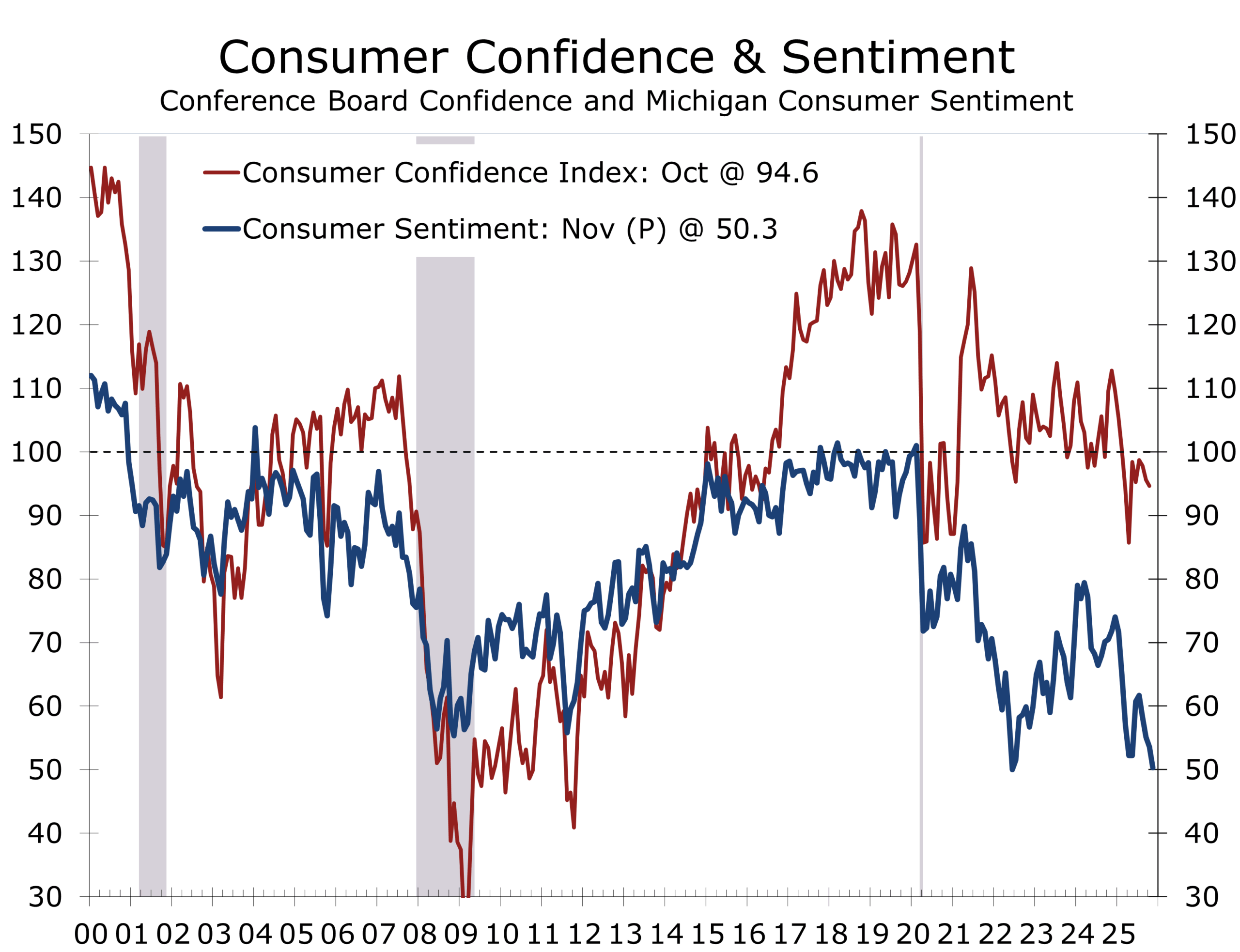
Consumer sentiment fell sharply in early November. The University of Michigan Index dropped 3.3 points to 50.3, the lowest since 2022. The decline reflects growing pessimism after the off-year elections and a deepening divide over the government shutdown. Inflation expectations remain elevated at 4.7 percent for one year and 3.6 percent over five to ten years. Notably, gasoline prices—normally inversely correlated with sentiment—fell in late October and early November.
Wealth effects sustain overall spending, even as confidence and credit use sag.
Despite weaker sentiment, the link between confidence and spending remains loose. Wealthier households, buoyed by strong equity holdings, continue to spend, while middle- and lower-income consumers face tighter credit and shrinking real incomes. Consumer credit rose $13.1 billion in September, driven primarily by student and auto loans. Revolving credit remains negative year over year, underscoring the uneven consumer base and the growing bifurcation of the U.S. household sector.
Manufacturing Still Contracting, Services Rebound
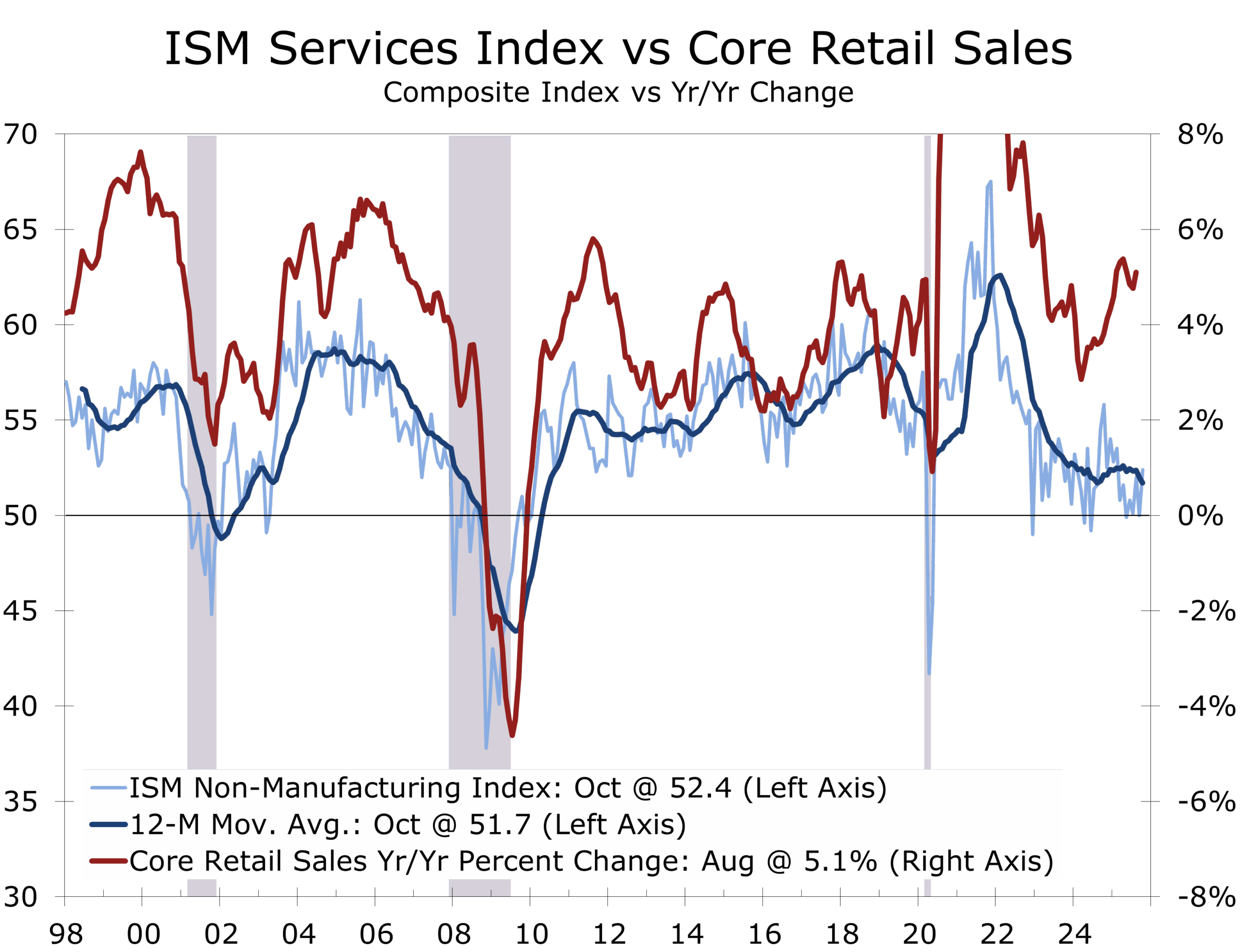
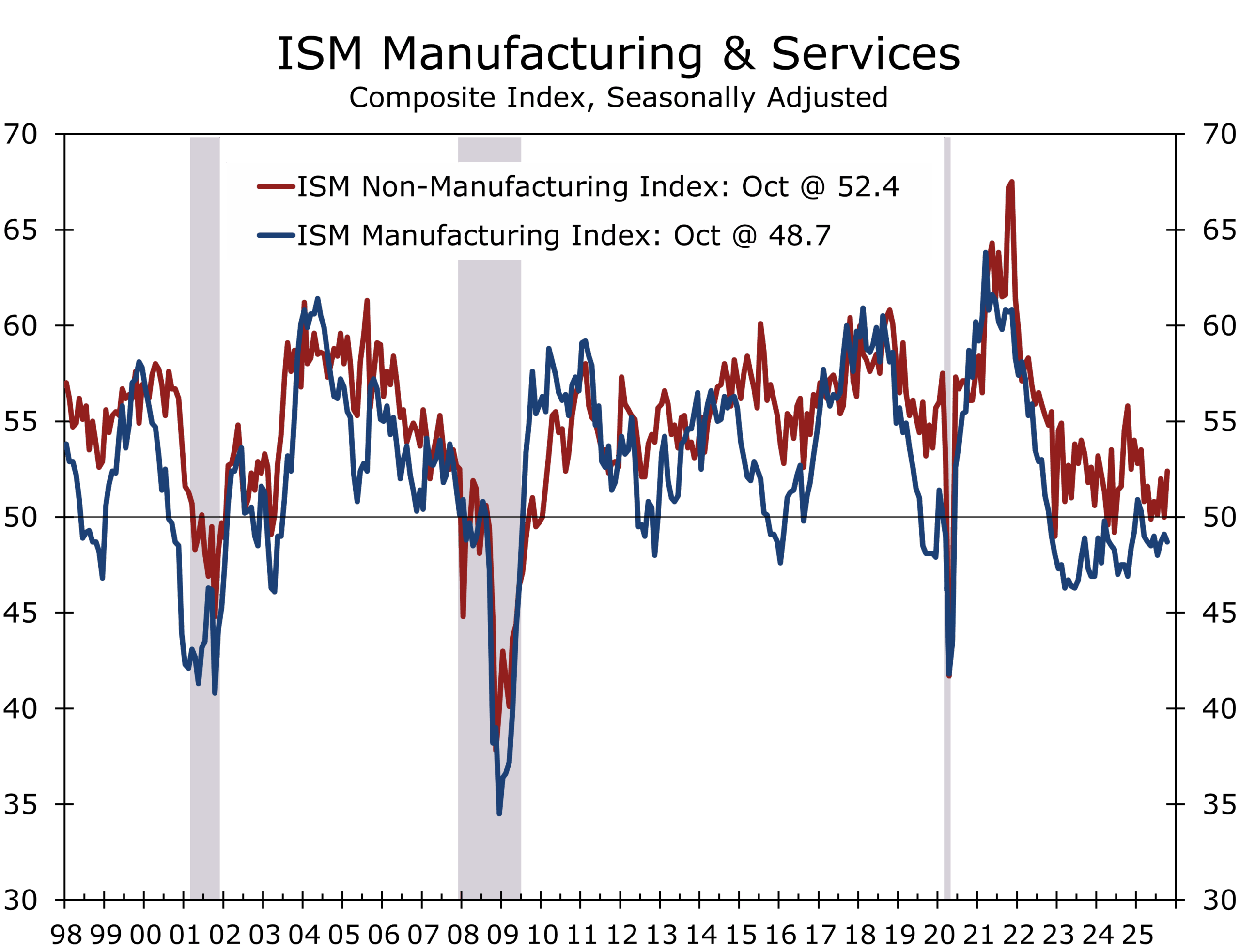
The October ISM Manufacturing Index improved modestly but remained in contraction at 48.7, its fourteenth straight month below 50. Production and new orders are still contracting, as manufacturers trim inventories. ISM Services rebounded to 52.4, driven by business activity and new orders, even as employment stayed soft. The Prices Paid Index rose to 70.0, its highest in nearly three years—a reminder that inflation pressures remain entrenched in services.
The economy appears stuck between resilient services and slowing manufacturing.
The mid-December FOMC meeting remains live, with futures markets assigning a 72 percent probability of a 25-basis-point cut. The December meeting resembles a “booth review” in football—a rate cut is the call on the field, and policymakers will need decisive evidence to overturn it, which would unsettle markets, businesses, and consumers.
With official data frozen, the Fed must weigh a softening labor market against potential inflationary effects from tariff pass-throughs. While inflation expectations have firmed, underlying measures continue to moderate. Rents are likely to remain soft through mid-2026. The jobs and hiring outlook has weakened more than expected, keeping risks weighted toward the employment side of the Fed’s mandate.
Markets: Stocks Snap Streak, Bonds Hold Ground
The stock market endured its worst week since April. The S&P 500 fell 1.8 percent, the Nasdaq lost 2.8 percent, and the Russell 2000 declined 2 percent. Selling was broad, led by technology and consumer discretionary sectors, as weak manufacturing data and mounting policy uncertainty weighed on investor sentiment. Stretched valuations in AI-related names and the worsening government shutdown contributed to a long-anticipated pullback.
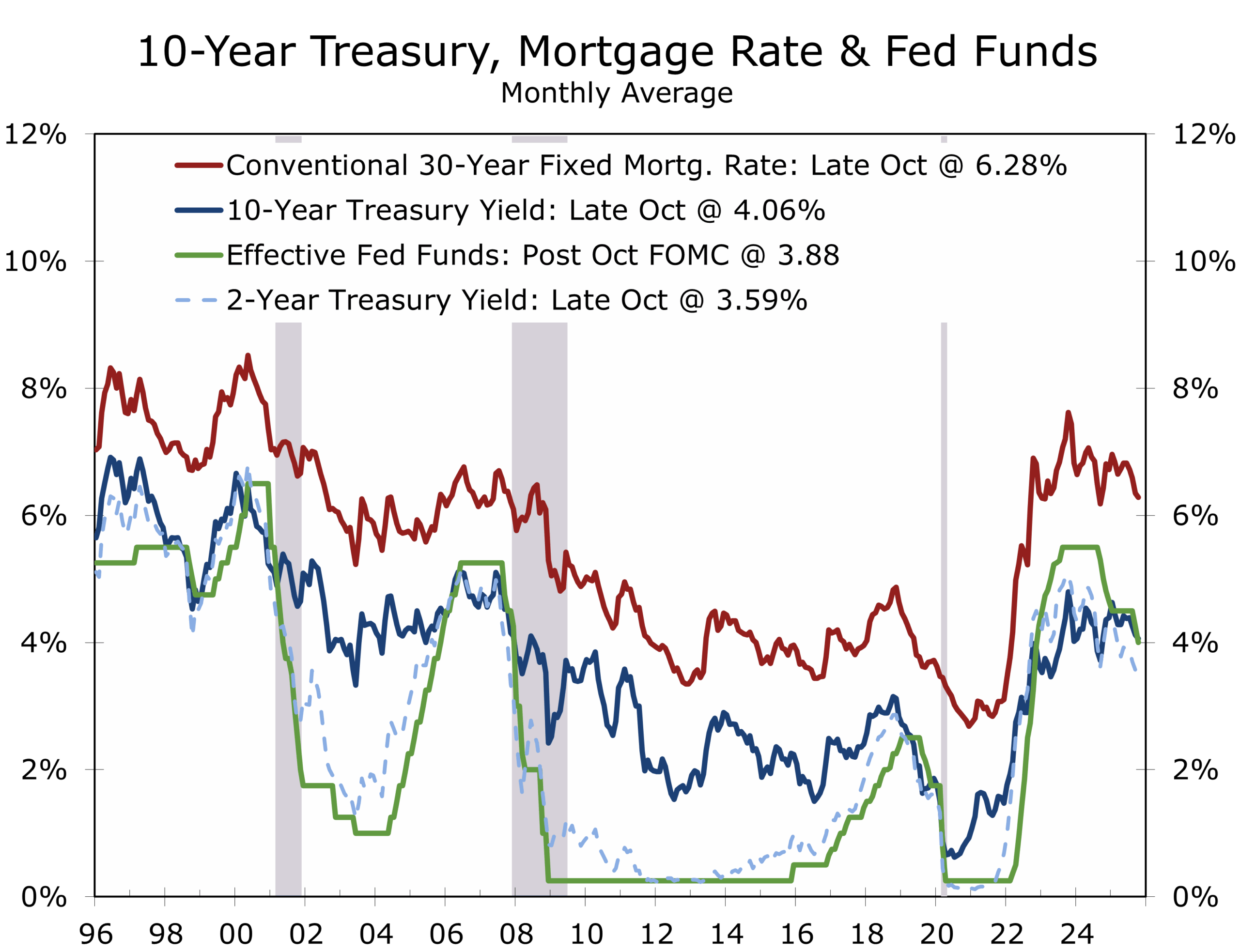
Treasuries rallied sharply mid-week before yields retraced. The 10-year ended near 4.10 percent and the 2-year at 3.56 percent. Credit spreads widened modestly, and rate volatility remained high as investors moved into quality.
Gold remains around $4,100 per ounce, near its all-time high, supported by safe-haven demand and growing conviction the Fed will cut rates further. Brent crude slipped toward $64 per barrel, the lowest since early spring, after OPEC+ paused production increases amid softening global demand indicators.
Tariffs and the Court
The Supreme Court’s review of Trump-era tariffs may reshape inflation and trade dynamics. Oral arguments last week revealed most justices are skeptical of presidential authority under IEEPA to impose tariffs without Congressional approval.
Prediction markets now place the odds of the Court upholding IEEPA tariffs at 30 percent, down from 40 percent pre-argument. A decision is expected in December or January, with a closely split result probable. Our take is that the Court will rule the president overstepped, but the Administration could shift tariffs under other statutes or preserve international agreements.
Refunds to U.S. importers will likely be less than originally remitted, with payments delayed and requiring legal follow-up. The net deflationary impact may emerge gradually, via lower import costs and modest relief to corporate margins.
Alternative tariff authorities include:
- Section 122 of the Trade Act of 1974—temporary tariffs up to 15 percent
- Section 301 of the Trade Act—retaliatory tariffs for unfair trade practices
- Section 232 of the Trade Expansion Act of 1962—tariffs on national security grounds
A ruling invalidating tariffs would slightly reduce near-term inflation risk, offering some cushion for policymakers heading into 2026. Renewed use of alternative authorities could reintroduce friction, sustaining supply chain and price volatility. The decision, expected late this year or early 2026, will add another twist to the Fed’s calculus.
Geopolitics: Off-Year Elections and Global Flashpoints
Off-year elections injected more volatility into Washington’s fiscal environment. Democrats gained ground in several key states, underscoring voter frustration with living costs, affordability, and the shutdown. The results strengthen Democrats’ negotiating position in the budget impasse, increasing pressure on House Republicans to act before the economic fallout widens.
Zohran Mamdani’s upset win in New York City on a platform of rent stabilization, transit breaks, and progressive taxation sent shockwaves, prompting immediate White House response—even threats to withhold funding. The federal-local confrontation highlights tangible risks for businesses tied to contracts, infrastructure, or transit systems.
The broader political takeaway is voter fatigue with dysfunction and an emphasis on affordability and stability over ideology. Markets have noticed: the sell-off in equities and rally in Treasuries reflect the view that fiscal disarray, not inflation, is the principal near-term risk.
Russia and Ukraine
Russia’s winter offensive intensified, launching the largest strike on Ukrainian energy infrastructure since the 2022 invasion.
- 458 drones and 45 missiles struck 25 sites across four regions.
- National generating capacity temporarily dropped to zero; outages of up to 12 hours daily in Kyiv
- Civilian casualties rose; Zelenskyy appealed to allies for more Patriot air defense systems
Sanctions waivers for Hungary and continued energy purchases further strain Ukraine’s resilience. Markets remain insulated so far, with energy prices subdued. But escalation risks remain if supply disruptions resurface.
Israel, Hezbollah, and Gaza
Conflict along Israel’s northern border flared, with strikes on Hezbollah in southern Lebanon targeting elite Radwan forces. Disarmament under UN Resolution 1701 remains critical but unfulfilled, complicating prospects for lasting peace. Lebanese and Israeli experts emphasize that failure to disarm Hezbollah undercuts incentives for Hamas and impedes regional stability.
The U.S. Treasury has sanctioned Hezbollah facilitators for funneling funds from Iran. Lebanon’s economic stability now hinges in part on progress toward disarmament.
Meanwhile, Gaza remains volatile. Hezbollah’s claim of success in resistance strategy and inter-group connectivity heighten the risk of north-south escalation. For markets, the status quo is baked in, but any misstep could quickly revive regional risk premiums across energy and defense assets.
OPEC+ and Energy Politics
OPEC+ opted to hold output increases through March 2026, raising only 137,000 barrels per day in December. Weak demand—especially in Asia—drives the decision. Oil prices reflect the freeze, with Brent crude in the low-$65 range and WTI at $61–62. The cartel’s strategy favors stability over spikes, aligning with fiscal stress and rising inventories.
Other Global Flashpoints:
- China: The Fifteenth Five-Year Plan signals more regulation over stimulus, weighing on equities.
- Iran: Intensified uranium enrichment sets the stage for future negotiations.
- Taiwan/Pacific: U.S. naval patrols continue, but risk of confrontation remains muted.
Strategy Watch: For CFOs and Treasurers
- Liquidity and Funding: Volatility in equities and steady Treasury yields present an opportunity to term out short-term debt before year-end. Curve remains slightly upward-sloping; locking in spreads provides insurance ahead of potential rate cuts.
- Cash and Investment Policy: Money-market yields have eased to 3.8–3.9 percent. Ladder Treasury bills and short-duration agencies to preserve liquidity and reduce reinvestment risk.
- Credit and Counterparty Risk: Spreads have widened modestly but remain tight by historical standards. Reassess supplier and customer credit exposure, especially for small or trade-exposed counterparties.
- FX and Commodities: Unwind euro hedges partially; maintain yen protection and update commodity-linked hedges for current price levels.
- Capital Spending and Planning: Expect slower Q4 cash flow, reflecting delayed federal contract payments. Maintain caution on discretionary capex until visibility improves in later this year and in early 2026.
The Week Ahead: November 10–16
Key indicators will remain limited by delayed federal releases. Focus on NFIB small business optimism, Fed speeches, weekly jobless claims, and pre-meeting remarks from Atlanta Fed President Bostic and Kansas City’s Schmid for insight into the Fed’s December outlook.
The economy is expected to post 3.4 percent real GDP growth for Q3 and to slow to just under 2 percent in Q4, with momentum increasingly reliant on consumer services and exports as hiring and credit conditions tighten.
Markets begin the week on a firmer footing. The 10-year Treasury yield jump back up to 4.15 percent on optimism that the government shutdown is nearing resolution before settling back in at 4.10. Equities look set to rebound, and the dollar remains mixed, reflecting improved fiscal sentiment but ongoing uncertainty about the Fed’s next move.
For CFOs, treasurers, and other decision makers: liquidity first, duration second, discipline always. Use near-term optimism around a fiscal resolution to lock in funding and reassess exposures—while remembering that the underlying structural issues remain unsettled.
The economy is still moving forward, but the composition of growth is shifting. Productivity, not payrolls, is now driving the expansion. The Fed faces a complex policy decision on a short timetable, and markets and business leaders are adjusting to a slower, leaner phase of growth.
In this environment, balance-sheet discipline and liquidity flexibility are the best tools—and staying opportunistic will be the edge as the market recalibrates around the next policy turn.
Disclaimer: This publication has been prepared for informational purposes only and is not intended as a recommendation offer or solicitation with respect to the purchase or sale of any security or other financial product nor does it constitute investment advice.
November 10, 2025
Mark Vitner, Chief Economist
mark.vitner@piedmontcrescentcapital.com
(704) 458-4000
October ISM Manufacturing: Uncertainty Is Increasingly Weighing on Manufacturers
Manufacturers Are Playing Defense
-
- ISM Manufacturing Index: 48.7 (–0.4) — signals the eighth straight month of contraction and a widening breadth of weakness across U.S. manufacturing.
- Production: 48.2 (down from 51.0) — slipped back into contraction after a brief September rebound.
- New Orders: 49.4 (up from 48.9) — second straight month below 50, still reflecting soft demand.
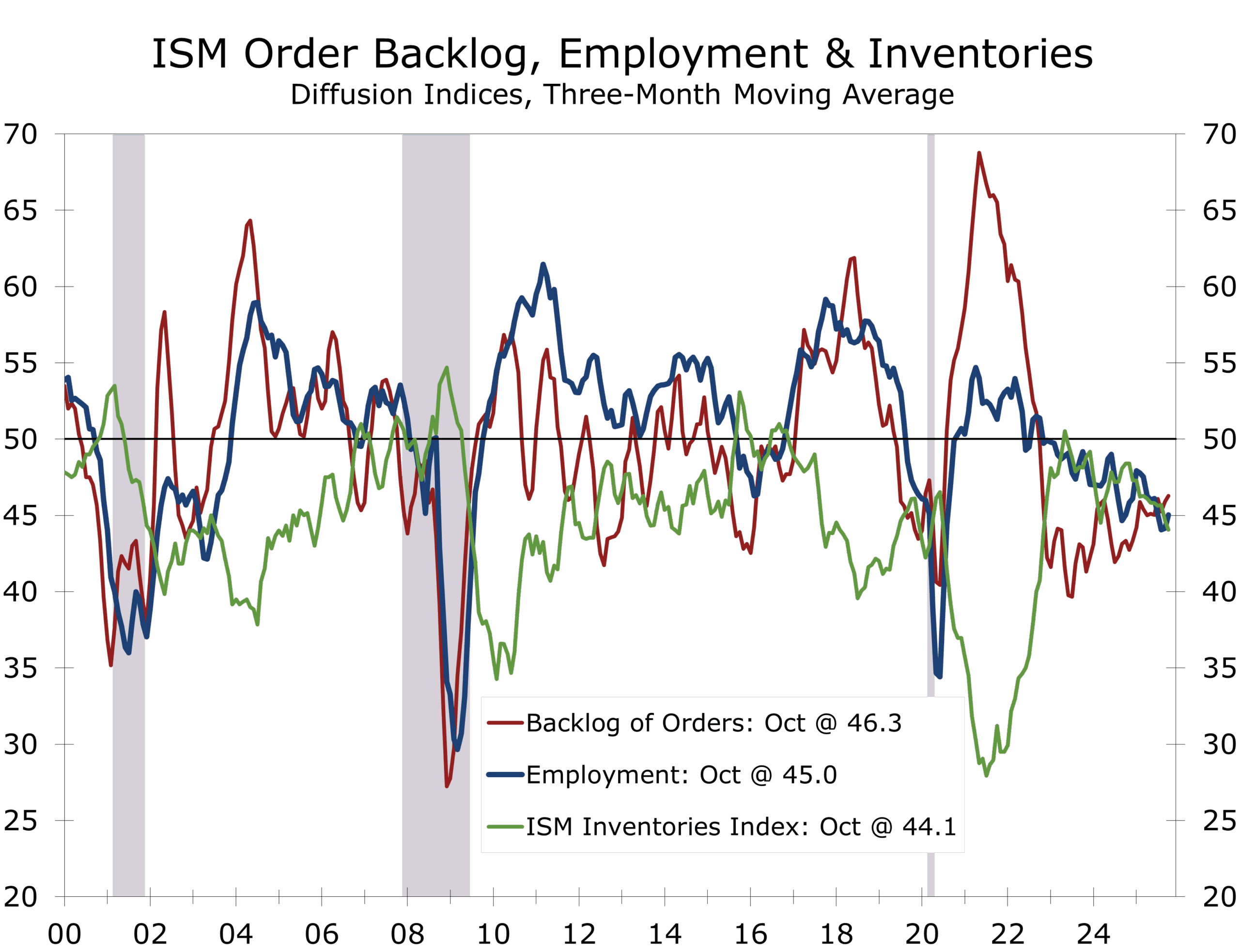
- Employment: 46.0 (+0.7) — ninth month of contraction as manufacturers continue managing headcount leanly.
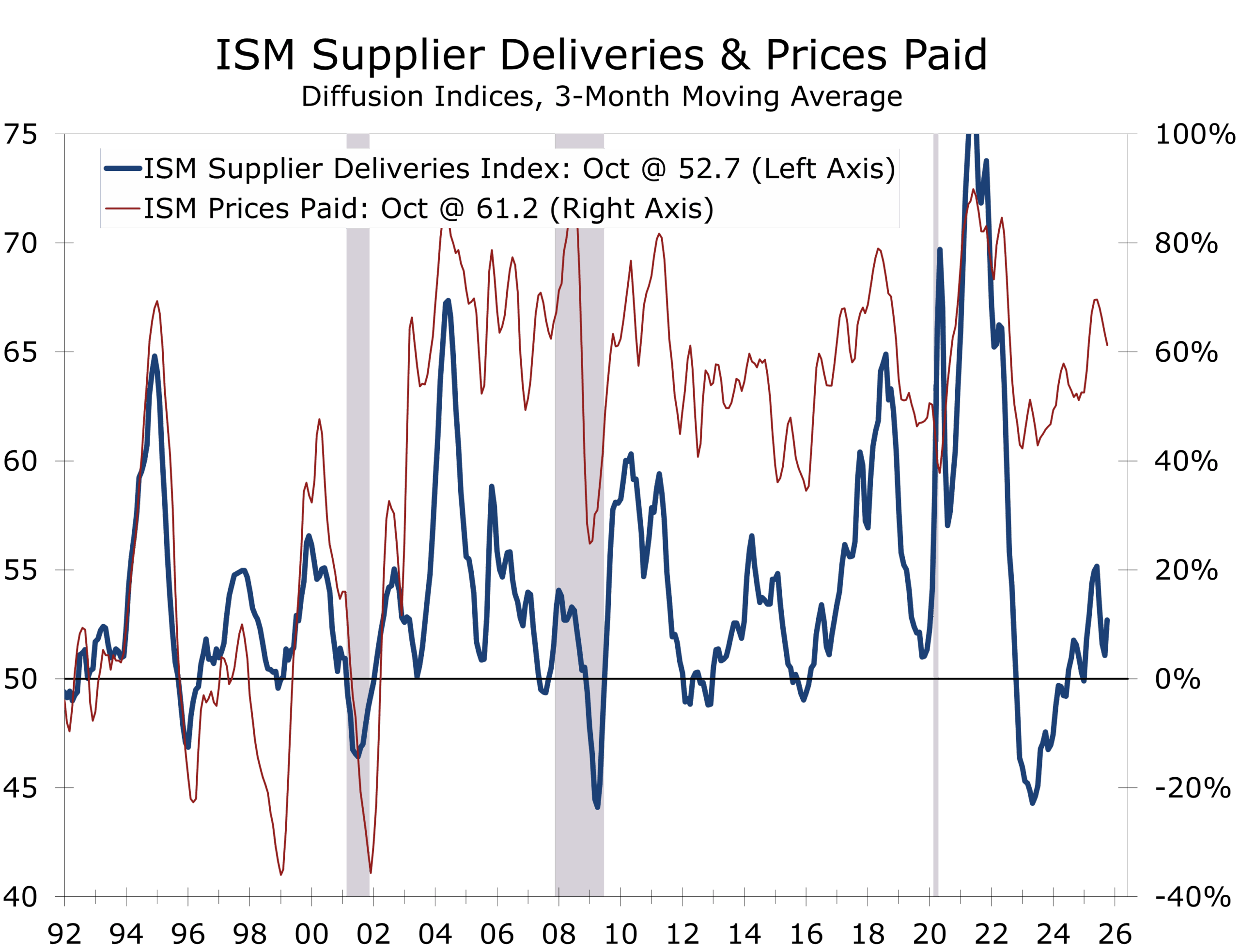
- Supplier Deliveries: 54.2 (+1.6) — slower deliveries for a third month, consistent with stabilized but subdued activity.
- Customers’ Inventories: 43.9 (+0.2) — still “too low,” implying potential for restocking once confidence improves.
- Prices Paid: 58.0 (–3.9) — still elevated but easing from September’s 61.9, indicating slower input cost inflation.
- Exports: 44.5 (+1.5) — contracting for an eighth consecutive month.
- Imports: 45.4 (+0.7) — seventh month of contraction as tariff pricing dampens activity.
- Backlog of Orders: 47.9 (+1.7) — modest improvement, but still in contraction.
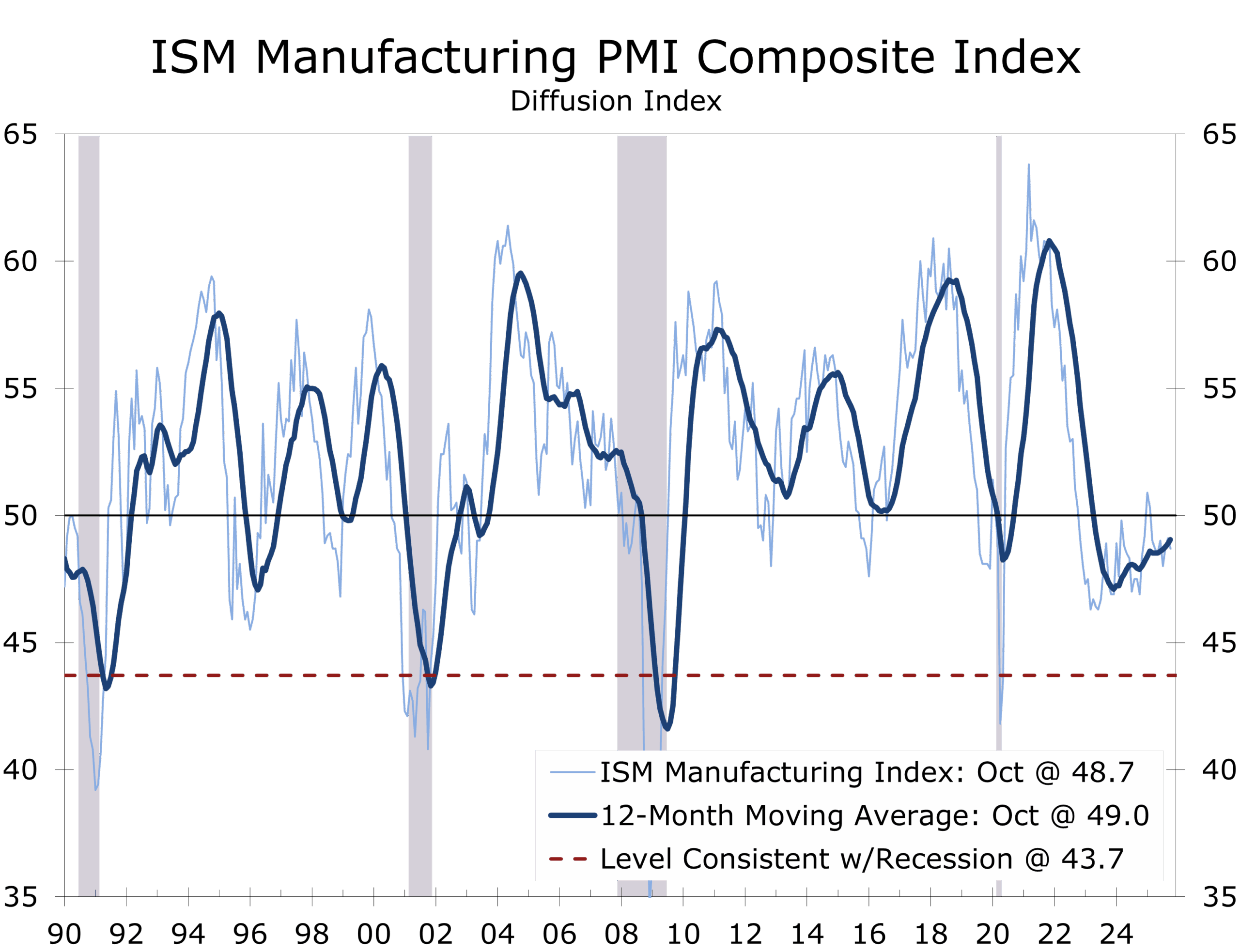
The ISM Manufacturing PMI® registered 48.7 in October, down 0.4 points from September, marking the eighth consecutive month of contraction following a brief reprieve earlier this year. As a diffusion index, readings below 50 mean that more firms report worsening rather than improving conditions — a measure of breadth, not magnitude.
Production fell 2.8 points to 48.2, returning to contraction territory—meaning more firms reported output decelerating rather than accelerating—after just one month of growth. New Orders (49.4) and Employment (46.0) both edged higher but remained below 50, indicating continued weakness in order flow and hiring. Inventories were drawn down more sharply, while supplier deliveries lengthened modestly. Notably, all four demand components—New Orders, New Export Orders, Order Backlogs, and Customers’ Inventories—improved slightly, though each remains in contraction. Overall, the index remains consistent with modest economic growth, and we believe it is uncertainty, more than demand softness, that is weighing on manufacturer sentiment.
The Uncertainty and policy volatility, not collapsing demand, continue to weigh on manufacturing.
Manufacturing weakness in October was broad-based but not especially severe, with about 58% of manufacturing GDP contracting and 41% in strong contraction (PMI® ≤ 45).
Panelists repeatedly described a cautious tone. Two-thirds of respondents indicated they are still managing headcount, not hiring. Most are adjusting production schedules to match slower demand and are reluctant to rebuild inventories or add capacity. Even as backlogs ticked up, they remain historically low — a sign that order pipelines are not refilling.
Firms are operating in risk-management mode, focused on flexibility, liquidity, and cost control.
Tariffs and Policy Volatility Weighing on Risk Taking
Uncertainty appears to be weighing on a growing proportion of manufacturers. ISM respondents cited the tariff environment, the recent government shutdown, and heightened geopolitical and policy uncertainty as key factors shaping business behavior.
Companies report cancelled or reduced orders due to shifting trade policies and reciprocal actions from China, such as export controls on rare earths and semiconductors. Firms in machinery, chemical products, and fabricated metals highlighted how the unpredictability of tariffs is disrupting cost planning, margin management, and investment decisions.
This climate has fostered a “wait-and-see” mindset. As one respondent put it, “Money is sitting tighter, and geopolitical changes add to the uncertainty/risk factor.” Across multiple industries, that sentiment is translating into leaner operations, reduced overtime, and tighter working-capital discipline.
.
Input Prices Remain Elevated but Easing
The Prices Paid Index fell 3.9 points to 58.0, marking the 13th consecutive month of increases but at a slower rate. Price pressure remains concentrated in metals — particularly steel, aluminum, and copper — and in tariff-affected imports. Fewer respondents reported rising costs (27 percent versus 33 percent in September), suggesting that input inflation is decelerating, even as overall price levels remain high.
This backdrop supports ISM’s observation that cost stickiness and margin compression continue to weigh on capital spending and hiring. Manufacturers are prioritizing balance sheet preservation over expansion.
Manufacturers are preserving liquidity and awaiting policy clarity before restocking or rehiring.
Inventories and Demand Indicators: “Too Low,” Yet Still Too Risky to Rebuild
Customer inventories stayed in “too low” territory at 43.9, which historically signals potential for future restocking. However, panelists remain hesitant to respond — instead choosing to operate lean amid uncertain end-market demand.
Inventories fell more sharply (45.8), and order backlogs, while modestly higher, remain in contraction. These dynamics reinforce a theme of defensive stock management rather than preparation for renewed growth. Until confidence strengthens, restocking may continue to lag underlying consumption.
Sector Breadth and Structural Takeaways
Only Food, Beverage & Tobacco Products and Transportation Equipment expanded in October, reflecting stable consumer demand, and solid aerospace activity and defense orders. Most other industries — including machinery, chemicals, fabricated metals, and electronics — saw broad-based declines, confirming that the softness is systemic rather than isolated.
The ISM estimates that the October PMI corresponds to roughly +1.8% annualized real GDP growth, indicating that while manufacturing is contracting, it has not dragged the broader economy into decline. Still, the diffusion of weakness across 12 industries warrants close monitoring as policymakers balance corralling inflation with sustaining growth momentum.
The October ISM Manufacturing Index reinforces our assessment that policy uncertainty—not just soft demand—is the primary headwind facing U.S. manufacturing. The latest data show a sector leaning hard on cost control and liquidity preservation as confidence remains clouded by tariffs, fiscal volatility, and geopolitical friction.
Customers and producers alike are running lean and deferring restocking or rehiring until visibility improves. While the index does not point to a collapse in output, the breadth of contraction has widened, signaling a slow, grinding adjustment phase rather than an outright downturn.
The combination of lean inventories, early signs of easing price pressures (-3.9 points to 58.0 in October), and pent-up replacement demand suggests the groundwork for eventual stabilization. For now, however, the prevailing mood is caution. Unless the policy environment steadies, manufacturers are likely to remain defensive through year-end, waiting for clearer signals before committing to renewed production growth.
Disclaimer: This publication has been prepared for informational purposes only and is not intended as a recommendation offer or solicitation with respect to the purchase or sale of any security or other financial product nor does it constitute investment advice.
November 3, 2025
Mark Vitner, Chief Economist
(704) 458-4000
A View from the Piedmont: Our Weekly Commentary on Money, Credit, Exchange Rates & Geopolitics – Balancing Diligence and Stability
Highlights of the Week
- The Fed cut the funds rate by 25 bps to 3.75–4.00%, but Powell’s warning that “a December rate cut is not a foregone conclusion” caught markets off guard.
- Front-end yields rose 10–12 bps as traders recalibrated expectations; the dollar firmed and equities ended mixed.
- The latest CPI print continues to germinate across markets and policy circles, with shelter costs and core inflation moderating.
- Consumer confidence held steady at 94.6, showing households are adapting rather than retreating.
- Labor markets continue to cool: initial claims hover near 219,000, while ADP’s new weekly series shows modest but positive hiring.
- Across the Piedmont and the broader South, AI infrastructure, aerospace, shipbuilding, pharmaceuticals and energy investment keep regional growth above trend.
- In Texas, factory activity expanded modestly in October while service and retail sectors contracted further, highlighting the uneven nature of the slowdown.
- Globally, Trump’s Southeast Asia tour and the Busan APEC summit produced a fragile U.S.–China truce — a pause in tariff and rare-earth escalation, not a durable peace — while global central banks signal policy stability.
U.S. ECONOMY & FINANCIAL MARKETS
The Federal Reserve’s October 29 decision marked a shift from momentum to management. Policymakers trimmed the funds rate by 25 bps to 3.75–4.00% and emphasized that policy “is not on a preset course,” reflecting both the committee’s divisions and the information gaps created by the continuing government shutdown.
A measured cut, anchored yields, and a reminder: policy is not on a preset course.
The shutdown itself, now the longest on record, has had limited near-term market impact. Senate leaders have rejected calls to repeal the filibuster rule, virtually guaranteeing its survival and ensuring that fiscal legislation will remain constrained. While the shutdown is likely to end before Thanksgiving, its political fallout has kept Washington’s focus narrow, limiting fiscal risk in the near term.
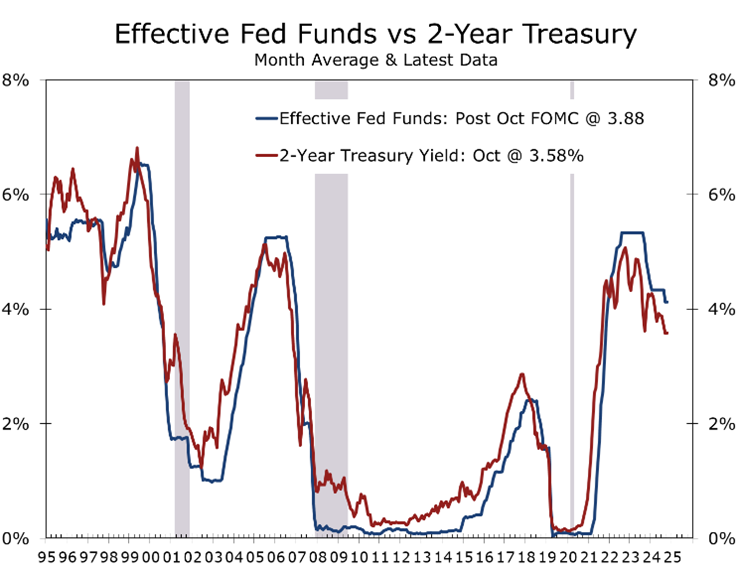
Markets reacted swiftly: the two-year Treasury yield rose to about 3.6%, the ten-year moved back above 4% and ended the week near 4.10%. The S&P 500 gained roughly 0.5%, supported by solid Q3 earnings and increased capex guidance from the major AI and cloud “hyperscalers.”.
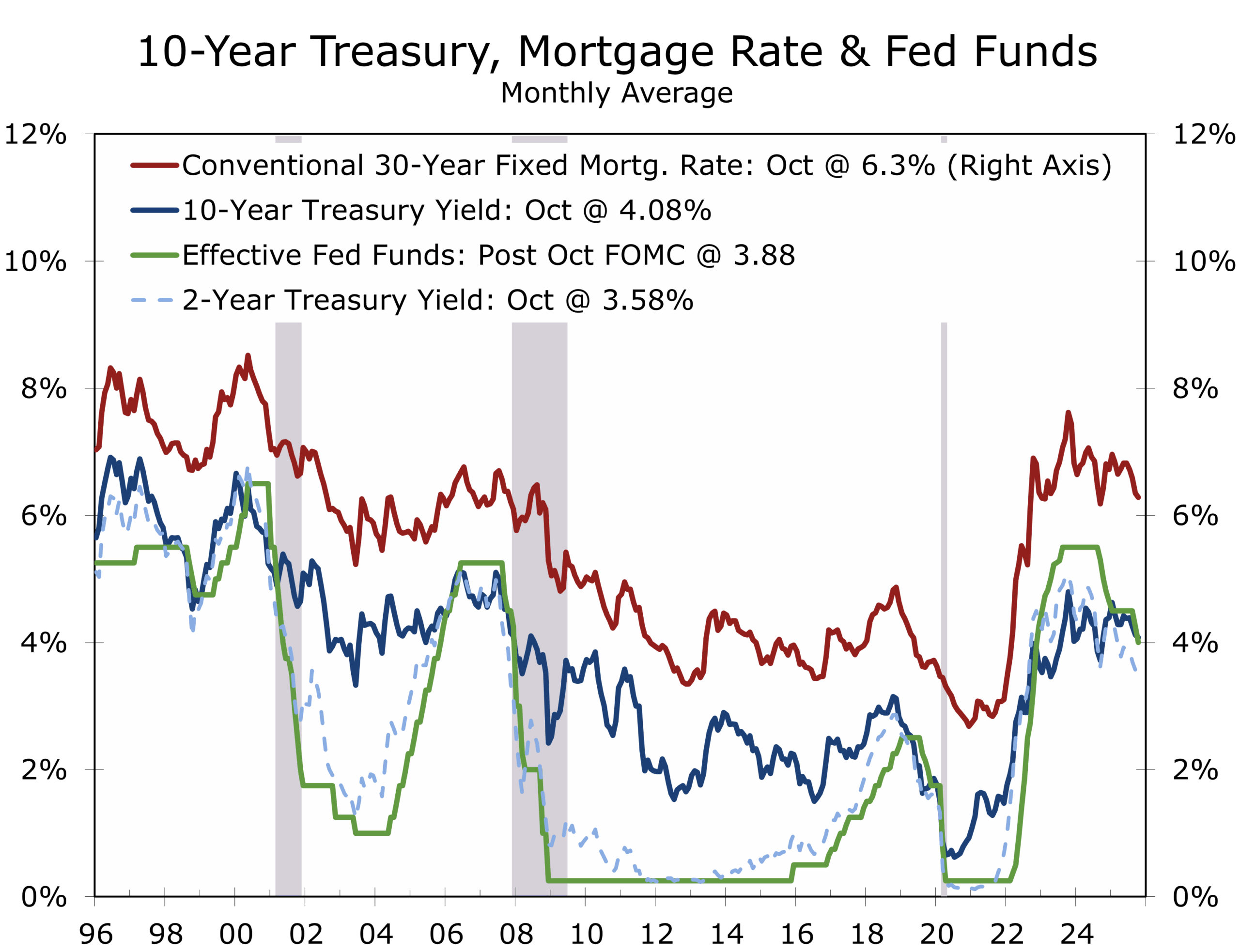
The latest CPI print continues to germinate across markets and policy circles. Core CPI rose 0.2% in September, with shelter’s contribution the smallest since 2021. While some worry the softening may be temporary, private-sector data show rent concessions rising, especially in the South. Headline CPI and core PCE are on pace to finish the year near 3% and to ease toward 2½% by late 2025, giving the Fed room to cut gradually without re-igniting demand.
Consumers remain resilient. The Conference Board confidence index held at 94.6 despite the shutdown, and the “jobs plentiful minus jobs hard to get” spread stabilized — a sign of adaptation, not collapse.
Labor data confirm that cooling, not collapse, is underway. Jobless claims hover just above 219 k, the Chicago Fed’s real-time unemployment measure sits near 4.35%, and ADP’s weekly series shows modest private-sector gains — all consistent with a soft landing.
Housing is showing tentative signs of revival. The Case-Shiller index rose 0.2% in August — its first monthly gain since winter — as inventories normalized and sellers re-entered the market. Price growth has slowed to 1½% y/y but appears stable through year-end.
Dallas Fed surveys show a mixed regional picture — steady factory output but service and retail weakness. Manufacturing’s production index held at 5.2 with new orders (–1.7) and capacity utilization (–1.1) softening. Business sentiment remained slightly negative (–5.0) while employment rose marginally (2.0) and hours worked fell (–5.5). Services contracted again (revenue –6.4, employment –5.8), and retail sales fell sharply (–23.5). Overall, industrial and capital-intensive sectors remain firm while consumer-facing industries absorb the slowdown.
The Piedmont Crescent
The Piedmont Crescent — stretching from Birmingham and northern Alabama through Atlanta and up through the Carolinas and Virginia to the D.C. area — continues to outperform the nation.
Atlanta’s logistics and technology corridors are expanding, Charlotte’s finance and manufacturing bases remain steady, and Raleigh–Durham’s research and biotech clusters attract sustained venture capital. Greensboro and the Triad are emerging as electric-vehicle and aerospace hubs, while Richmond and Northern Virginia benefit from defense and data-infrastructure investment.
Migration, population growth, and corporate relocations keep housing active even as national demand cools. Infrastructure upgrades and energy-grid projects continue to anchor industrial expansion.
The Broader South
The South remains the nation’s growth engine. Texas leads in energy and semiconductors, Florida’s tourism and construction expand despite affordability strains, and Tennessee and Alabama capitalize on EV and aerospace investment.
South Carolina’s ports and manufacturing hubs run near capacity, Louisiana and Mississippi advance grid-modernization and petrochemical projects, and shipbuilding along the Gulf Coast — from Mobile to Pascagoula and into New Orleans — is gaining momentum on Navy, Coast Guard, and commercial orders. Together, these trends keep Southern output well above national averages even as the broader economy slows.
Outside the Region
The Midwest’s industrial renaissance continues through chip fabrication and EV supply-chains. The West Coast is stabilizing after a year of tech layoffs as AI capex revives growth from Seattle to San Jose.
Major markets in the Northeast received a boost this year from the return to the office, which also boosted retail trade and the hospitality sector. Financial services have also had a strong year. Divergences across regions are widening, however, a classic late-cycle phenomenon.
Outside the Country — The APEC and ASEAN Circuit
President Trump’s Southeast Asia trip dominated the week’s geopolitical landscape. Visits to Thailand, Malaysia, Cambodia, and Vietnam produced agreements on critical-minerals cooperation and supply-chain diversification.
At the APEC summit in Busan, the U.S. and China announced a one-year truce without teeth — the U.S. cut tariffs tied to fentanyl from 20% to 10% in exchange for Beijing committing to reduce precursor shipments and crack down on the fentanyl trade in general. In addition, China will resume soybean and energy purchases, and suspend rare-earth export curbs for a year. Tariffs on most other goods remain high, and no progress was made on Taiwan or Russia ties.
A fragile détente steadies markets but leaves rivalries intact.
The U.S.–South Korea defense accord was another notable development, allowing Seoul to purchase or jointly develop a nuclear-powered submarine using U.S. technology to be built in a U.S. yard with Korean investment — a move anchoring the peninsula more firmly within the Indo-Pacific security framework. An added plus: Korean investment might also help bolster the U.S. shipbuilding industry.
Europe appears to be settling into a soft landing. The ECB kept rates at 2% for a third meeting, while the Bank of Canada also paused after its cut. The Bank of Japan remains on track to raise to 0.75% by year-end, though Prime Minister Takaichi may delay if data soften. Global policy tone is one of hawkish stability — fine-tuning after a year of adjustment.
Risk tone brightened as Washington and Beijing reached a provisional framework pausing threatened 100% tariffs and rare-earths export curbs—pending Trump–Xi leader sign-off later this week. President Trump said he expects to “come away with a deal,” with China delaying export bans and boosting U.S. soybean purchases—tactically easing AI supply-chain stress and trimming term-premium risk.
Oil prices have stabilized near the low-$60s for WTI and mid-$60s for Brent as higher U.S. output offsets Middle-East risk and sluggish European demand. Argentina’s Javier Milei scored a decisive election victory that reinvigorated market-friendly reform momentum across Latin America. Globally, the backdrop remains one of managed fragility — diplomacy buying time for markets without resolving underlying rivalries.
Policy and Market Wrap-up
Regional Fed surveys paint a mixed picture: Richmond at –2, Dallas and Kansas City showing softer orders, and Atlanta’s business-inflation expectations slipping to 2.5%. Markets now price one more 25-bp cut by January, consistent with a soft-landing baseline.
Private-credit markets are also entering a more discerning phase as the “ghosts of 2020–2021 vintages” resurface. Select distress is emerging in legacy loan books, while AI-linked direct-lending remains active. Alternatives investors are turning more defensive — upgrading infrastructure and ports, re-entering senior housing, and keeping hedge-fund allocations tilted toward global macro.
Credit spreads remain tight, volatility subdued, and equity leadership concentrated in capital-intensive sectors — AI, energy, aerospace, and defense. Next week’s ISM and NFIB surveys will test whether late-year momentum can carry into 2026.
Bottom Line
The U.S. economy continues to evolve rather than erode. Inflation is cooling, labor markets are rebalancing, and policy is shifting from restraint to fine-tuning. Across the Piedmont and the South, industrial investment and migration remain core drivers. Abroad, diplomacy has bought calm but not certainty. Another showdown awaits.
Markets Exhale Amid Persistent Rivalry
The headlines out of Busan were celebratory, but the subtext was cautionary. The temporary U.S.–China thaw — the cut in fentanyl-related tariffs to 10% in exchange for Beijing reducing precursor shipments, the resumption of soybean trade, and a one-year suspension of rare-earth export restrictions — amounts to a cease-fire, not reconciliation.
The U.S. and China have stepped back from escalation, not rivalry.
Behind the smiles and handshakes lies a strategic recalibration rather than surrender. Both nations are buying time: Washington to shore up domestic supply chains through ASEAN partnerships, Beijing to manage capital flight and maintain export leverage. The détente narrows downside risk for AI-driven capex and commodity markets yet underscores how interdependence remains both weapon and weakness.
History suggests that pauses like this often precede a new phase of competition. The world’s two largest economies have stepped back from escalation but not from rivalry. For now, markets can exhale — but they would be wise not to forget to keep their running shoes on.
Disclaimer: This publication has been prepared for informational purposes only and is not intended as a recommendation offer or solicitation with respect to the purchase or sale of any security or other financial product nor does it constitute investment advice.
November 2, 2025
Mark Vitner, Chief Economist
mark.vitner@piedmontcrescentcapital.com
(704) 458-4000
October 28-29 FOMC Meeting Recap: The Fed Cuts Again — Balancing Diligence and Destination
The Fed’s Mission: Find a Way to Balance Rising Risks at Both Ends of the Mandate
- Decision: The Federal Reserve cut the target range for the federal funds rate by 25 bps to 3.75–4.00%, marking a second consecutive reduction as policymakers sought to buffer a cooling labor market and maintain financial stability.
• Liquidity Management: The Fed announced it will halt balance sheet runoff on December 1 and begin reinvesting proceeds from maturing MBS into Treasury bills, effectively restarting limited Treasury purchases to preserve market liquidity.
• Tone: The statement acknowledged that “downside risks to employment rose in recent months,” while inflation “remains somewhat elevated.”
• Context: The decision was complicated by the federal government shutdown, which limited access to official data and forced reliance on private-sector indicators.
• Dissents: Governor Stephen Miran favored a 50 bp cut; Kansas City Fed President Jeffrey Schmid preferred no change. The split underscores the uncertainty about how much economic activity and job growth have slowed and how much more tariffs will add to headline inflation.
• PCC View: We expect quarter-point cuts in both December and January, with the funds rate bottoming at 3.125% in Q1. The Fed may opt to skip a meeting, however, which would extend the duration of the easing but not the depth. Core PCE inflation should end 2025 near 2.5%, down from around 3% this year. Economic growth is expected to strengthen next year, eliminating the need for a more dramatic easing.
Policy Decision and Statement
The Federal Reserve lowered the federal funds rate by 25 basis points to 3.75–4.00%, citing a “shift in the balance of risks” toward weaker employment. The statement described economic activity as expanding at a “moderate pace,” but noted that job gains have slowed and the unemployment rate has edged higher.
Inflation was said to have “moved up since earlier in the year and remains somewhat elevated,” language suggesting concern about price stickiness but confidence that inflation pressures will subside over time. The Committee acknowledged elevated uncertainty and reaffirmed it would “carefully assess incoming data” ahead of any further adjustments.
The Fed needs to find a way to balance rising risks at both ends of its mandate.
The policy statement also confirmed that the Fed will conclude its balance sheet runoff on December 1, marking the end of quantitative tightening and a shift to full reinvestment of maturing securities, primarily into short-dated Treasuries. This reflects concern about tightening liquidity conditions and the Fed’s longstanding commitment to maintaining “ample reserves.”
The operational shift is a technical but meaningful adjustment. By reinvesting MBS proceeds into Treasury bills, the Fed will maintain the size of its balance sheet while subtly improving liquidity in the front end of the curve
Recent strains in money markets—compounded by the government shutdown’s disruption of Treasury issuance—prompted the move. Powell and key officials have been explicit that this is not a return to quantitative easing, but rather a precautionary step to stabilize short-term funding markets and prevent another repo-style disruption.
This balance-sheet decision complements the rate cut: one addresses the cost of money; the other ensures the availability of money.
FOMC members will likely have a wider range of forecasts for growth, inflation and rates.
The 10–2 vote revealed the most ideologically divided Committee since the pandemic era.
- Governor Stephen Miran, who again dissented in favor of a 50 bp cut, is effectively playing the role once held by the Vice Chair—serving as the public voice of the Administration and advocating a faster easing pace to support employment.
- Kansas City Fed President Jeffrey Schmid, who voted against any rate cut, reflects the Kansas City Fed’s long-standing hawkish tradition, shaped by its historic focus on price stability and commodity-related inflation risks.
This dual dissent—from opposite ends of the policy spectrum—highlights the Fed’s internal balancing act: navigating slowing job growth without reigniting inflation or appearing politically influenced.
The government shutdown has limited official data, forcing policymakers to rely on alternative sources such as ADP, Homebase, and private job postings, which collectively suggest the labor market is weakening faster than the headline numbers imply.
At the same time, business investment remains firm, supported by AI infrastructure, defense technology, and reshoring of critical manufacturing. These conflicting signals—resilient capital spending versus softening labor demand—make this one of the most complex policy environments of Powell’s tenure.
Inflation from recent tariffs has been milder than anticipated. The Fed now sees price pressures easing back toward target over the next 18 months, assuming no renewed supply disruptions.

Powell’s Press Conference: Key Themes
Powell struck a measured, data-dependent tone at his press conference, reinforcing the Fed’s pivot from a rules-based framework to one guided by “discretion, diligence, and destination.”
Key themes:
- Labor risk management: “We cannot declare victory on inflation, but we must acknowledge the emerging risks to employment.”
- Liquidity assurance: Reinvesting MBS into T-bills is about function, not stimulus.
- Data limitations: Powell emphasized the difficulty of policymaking amid a statistical blackout. “What do you do when you are driving in a fog? You slow down.”
- December outlook: Powell also noted that a December cut was not a sure thing, even adding “far from it”. He also noted that “policy is not on a preset course” Powell emphasized this point repeatedly and is keeping his options open while implying that another 25 bp cut remains on the table.
- Neutral Rate and the next move: We are now back in the range of where most FOMC participants believe the neutral funds rate is. “There is a growing course that maybe we should wait a cycle.”
- Equity Markets: “We do look at any particular asset, we look at the overall financial system and ask whether it can withstand a shock.”
- The AI Boom: It is different from the 1980s. The companies driving the boom are earning money. These are investments not just ideas.
Piedmont Crescent Capital’s baseline scenario now assumes:
- We still see two additional 25 bp cuts — most likely in December January — bringing the funds rate to a cycle low of 3.125% in Q1 2026. The markets are pricing in less than that, with the 2-Year Treasury rising to 3.59%—essentially pricing in one more cut by the middle of next year.
- Core PCE inflation ending 2025 at around 2.5%, down from 3% this year, as supply normalization and tighter credit cool demand.
- The Fed may opt to skip a meeting and wait for more hard data on inflation and employment. That would essentially extend the duration of the easing cycle without making it any deeper.
- We see the long-run neutral rate around 3% but it is likely edging higher as the buildout of AI infrastructure boosts productivity and long-run potential growth.
We see the Fed nearing the end of its easing cycle, shifting from active accommodation to sustained vigilance. Cutting rates while headline inflation remains “elevated” demands precise messaging. Lower short-term rates and a stable balance sheet should gradually support credit-sensitive sectors in early 2026, fostering a modest pickup in activity without reigniting inflation. If markets perceive the Fed as easing too aggressively, however, long-term yields could rise and offset much of the intended benefit.

Disclaimer: This publication has been prepared for informational purposes only and is not intended as a recommendation offer or solicitation with respect to the purchase or sale of any security or other financial product nor does it constitute investment advice.
October 29, 2025
Mark Vitner, Chief Economist
mark.vitner@piedmontcrescentcapital.com
(704) 458-4000
October 2025 Consumer Confidence - Consumer Confidence Holds Steady Amid Data Drought
Anecdotes Provide Some Guidance
-
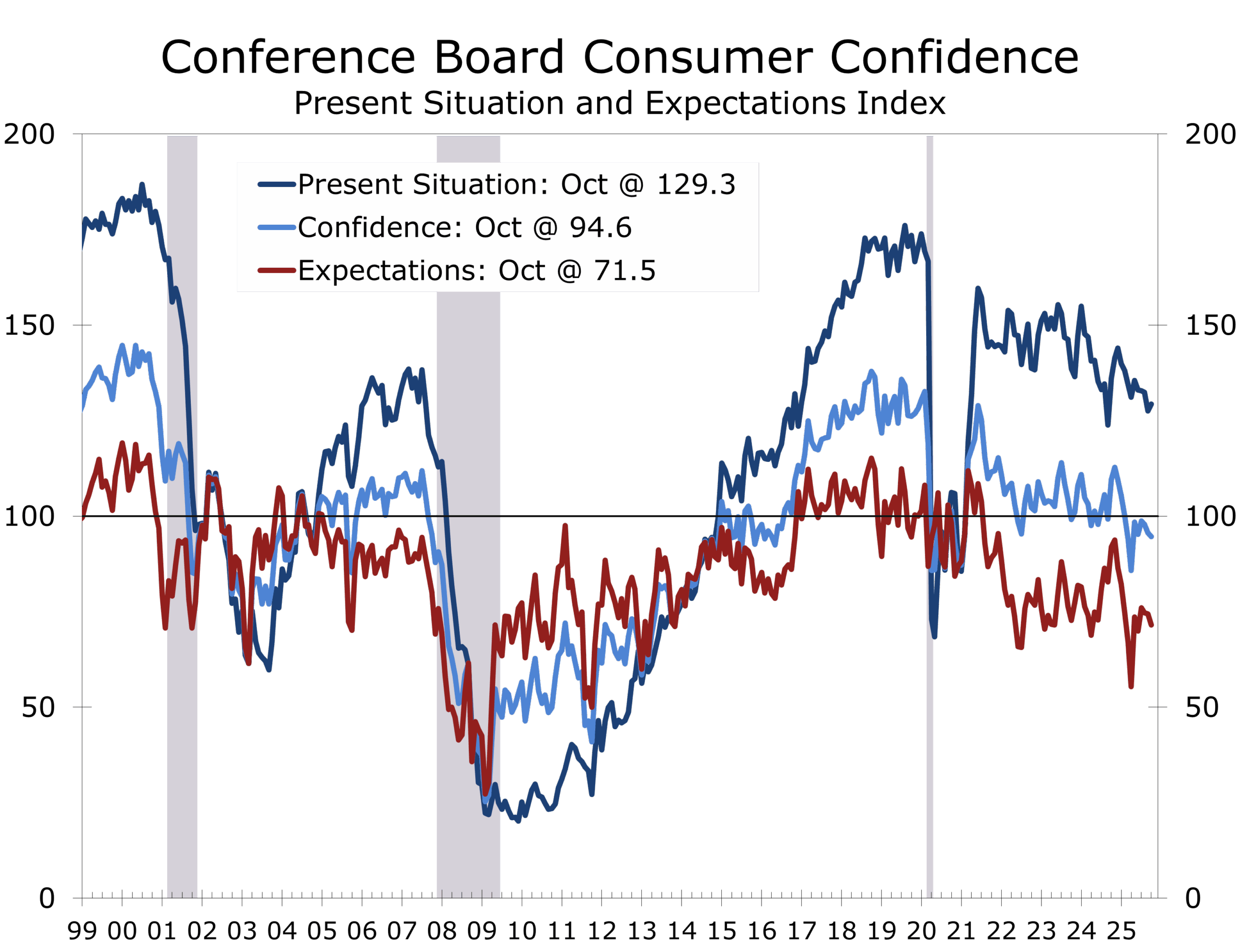
- The Conference Board’s Consumer Confidence Index® slipped 1.0 point in October to 94.6 (1985=100), essentially unchanged from September’s upwardly revised 95.6.
- The Present Situation Index rose 1.8 points to 129.3, while the Expectations Index declined 2.9 points to 71.5 — remaining below the key 80 threshold that historically signals recession risk.
- With most federal data releases delayed by the government shutdown, the Consumer Confidence report provides one of the few real-time signals on household sentiment and labor trends.
- Write-in comments continue to focus on prices, inflation, and the shutdown itself — though mentions of tariffs declined further.
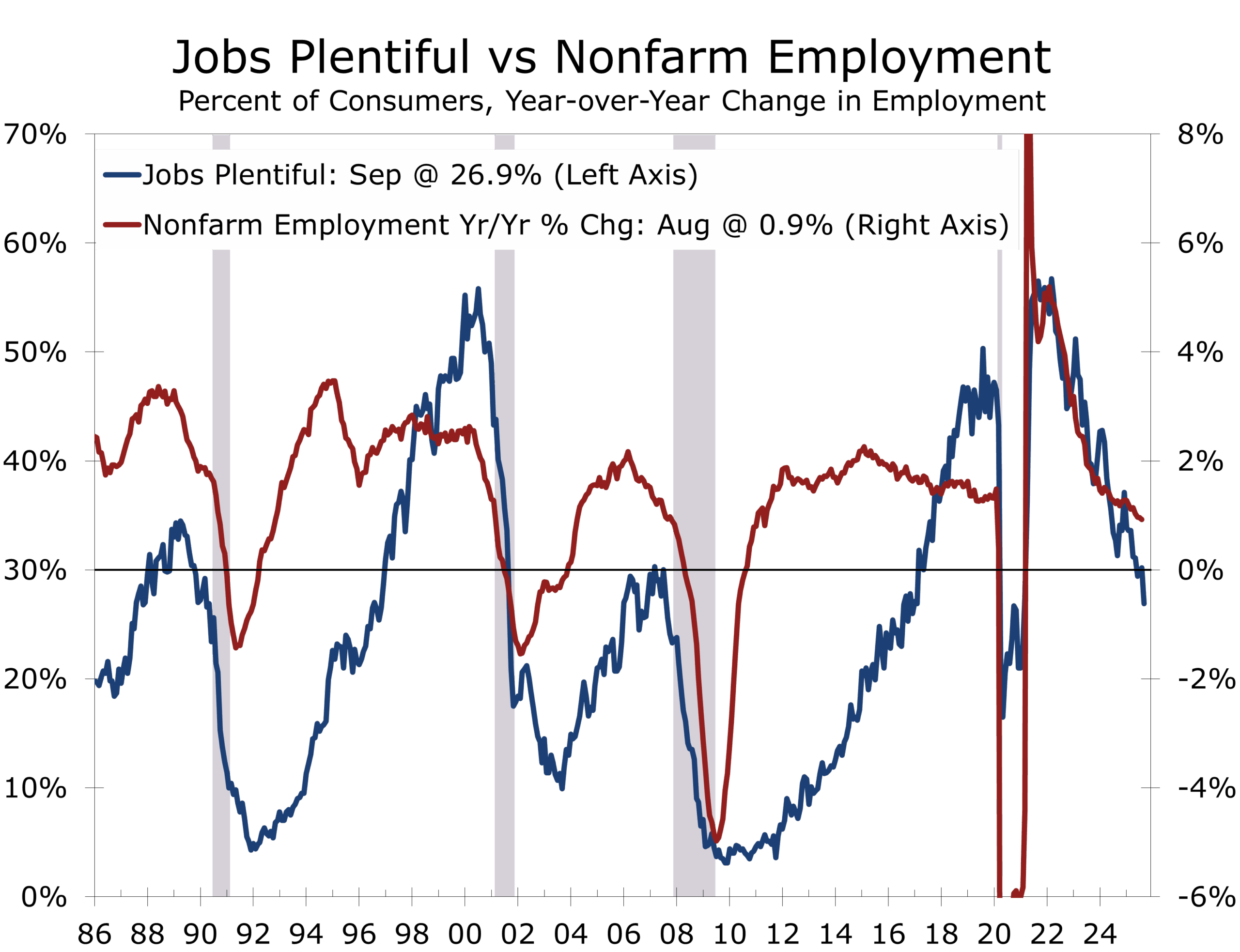
- Views of the job market improved slightly: 27.8% of consumers said jobs were “plentiful,” up from 26.9% in September.
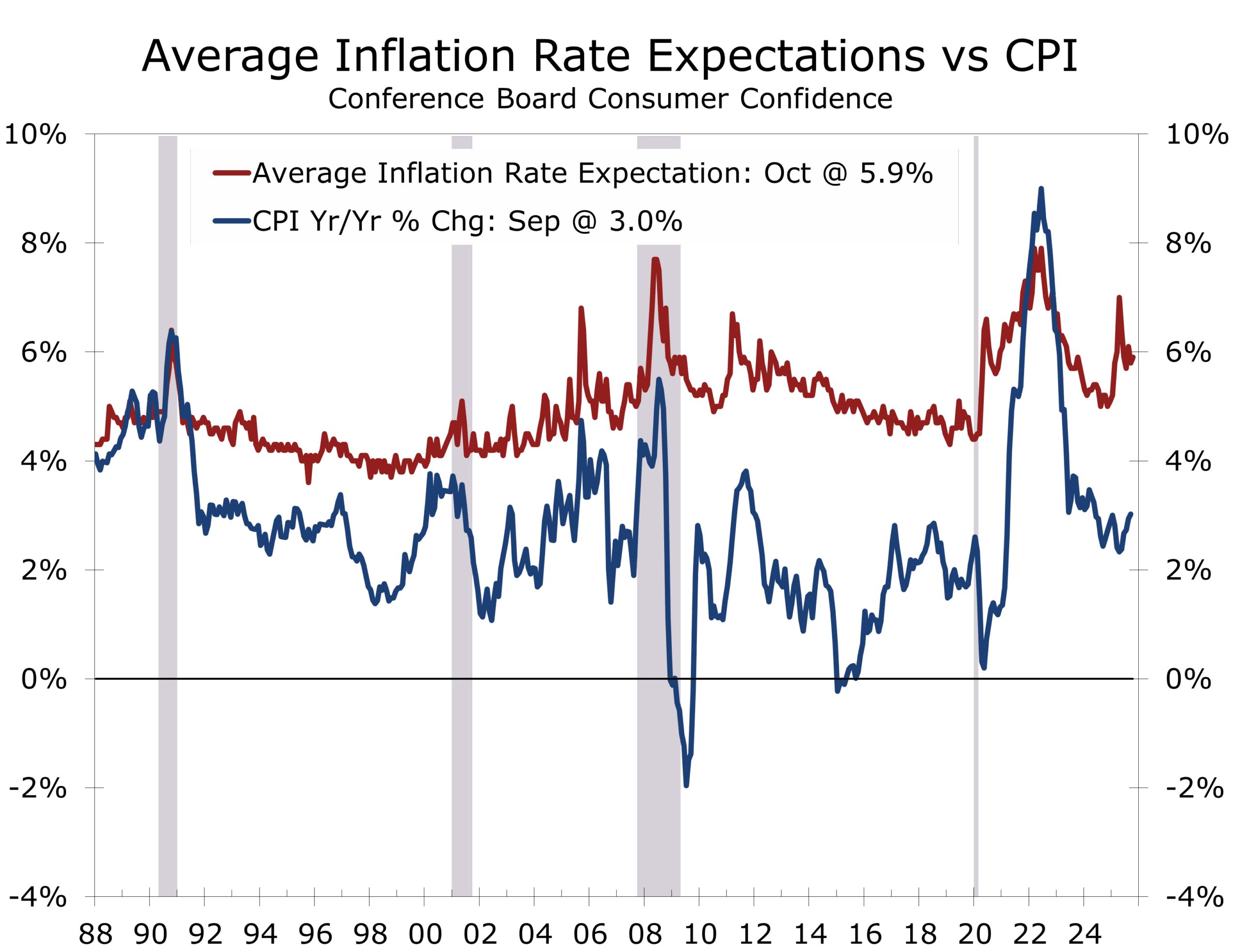
- Inflation expectations edged up to 5.9%, while the share expecting higher interest rates rose to 52.8%.
- October’s confidence readings are consistent with other private data (including this morning’s new weekly ADP report) showing modest payroll growth and a gradual rise in the unemployment rate. The Chicago Fed’s labor market indicator pegs October’s unemployment rate at 4.35%.
Confidence Holds Ground as Data Remains Scarce
With much of the federal statistical system offline during the ongoing government shutdown, this month’s Consumer Confidence report carries unusual weight. In the absence of payroll, retail sales, and inflation updates, the Conference Board survey offers rare, consistent insight into how households perceive current and future conditions. Historically, shifts in its labor market components — particularly the “jobs plentiful” and “hard to get” series — have led changes in nonfarm payrolls by one to two months.
Confidence edged lower, but revisions point to stronger underlying sentiment.
In October, confidence effectively moved sideways. The headline index dipped just one point to 94.6, from an upwardly revised September reading, with stronger views of current conditions offset by weaker expectations. The Present Situation Index gained 1.8 points to 129.3, while the Expectations Index fell nearly three points to 71.5. That measure has now been below 80 since February — a duration consistent with past pre-recession readings. On net, Consumer Confidence was slightly higher than was previously reported for September, despite falling 1 point from the revised reading.
Labor Sentiment Offers Early Clues
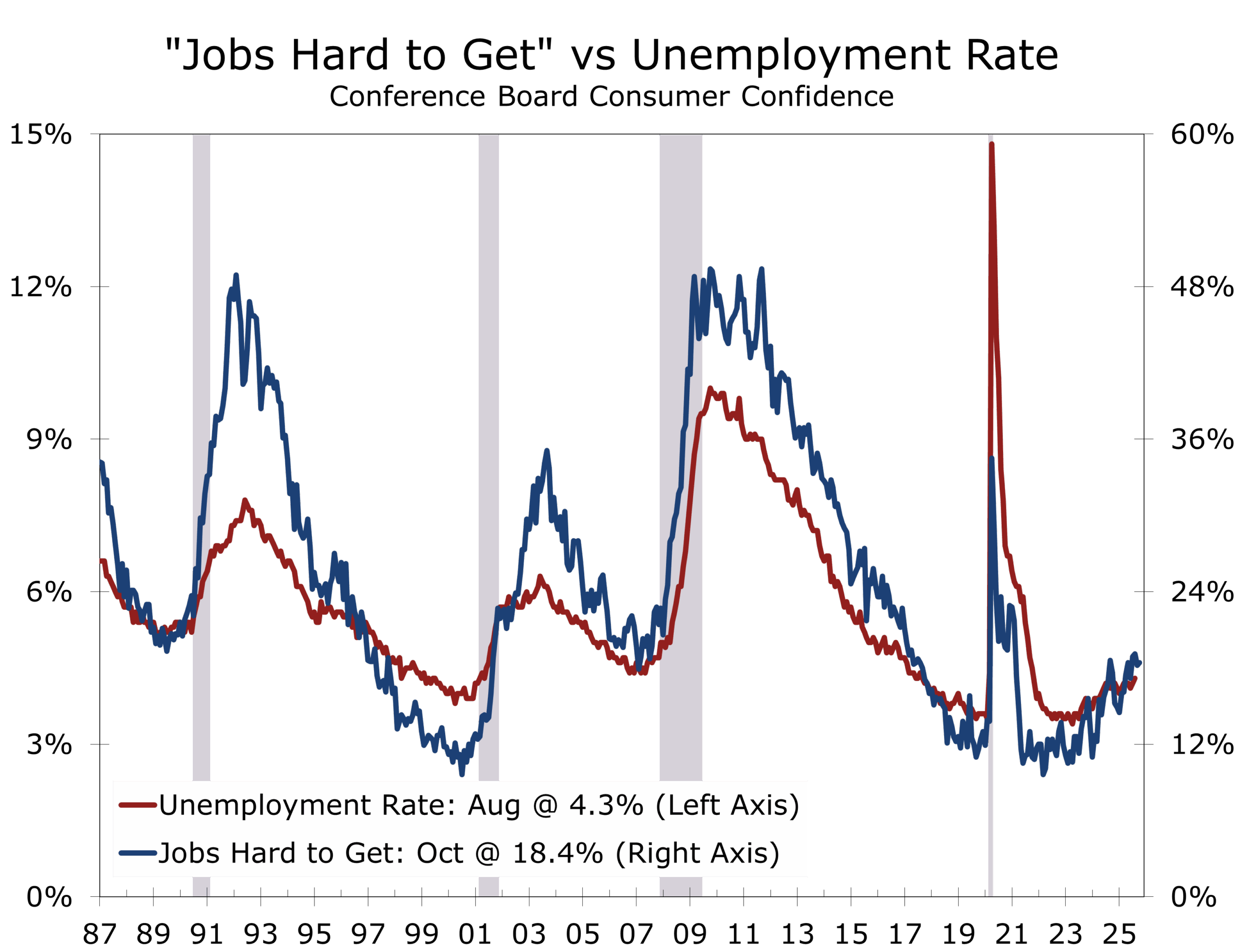
Consumers’ appraisal of the job market improved slightly for the first time since December 2024. The share calling jobs “plentiful” rose to 27.8%, while those calling jobs “hard to get” edged up to 18.4%. The resulting labor differential remains near 9 points — a level consistent with below-trend hiring and a modest uptick in unemployment.
Given the survey’s track record as a leading indicator, the October readings reinforce expectations that the labor market continues to cool, especially in lower-wage and entry-level positions. The latest official unemployment rate for the U.S. is 4.3% for August 2025.
Rising jobless expectations signal a softer market for lower-wage and entry-level workers.
Due to the ongoing government shutdown, however, more recent official data are unavailable. A model from the Federal Reserve Bank of Chicago estimates the jobless rate at around 4.35% for October 2025 and we see the jobless rate eventually rising to 4.5%.
Prices, Shutdown, and Political Fatigue
Consumers’ write-in responses again centered on inflation, which remains the most frequently mentioned concern, followed by the government shutdown and political uncertainty. References to tariffs declined further but remain elevated. Average 12-month inflation expectations edged up to 5.9%, and more than half of respondents expect higher interest rates ahead.
Confidence fell among younger consumers and lower-income households but improved for middle-aged respondents and those earning above $75,000, especially at the top end of the income spectrum. By political affiliation, the Conference Board noted that confidence increased among Independents but slipped among Democrats and Republicans alike.
Spending Signals Mixed but Holding Up
Despite downbeat expectations, spending behavior continues to outperform confidence measures. Purchasing plans for cars rose in October, driven by used vehicles, while home-buying plans weakened but remain higher on a six-month trend basis. Intentions to purchase big-ticket items were steady overall, and spending on services — particularly pet care, streaming, and vehicle maintenance — showed renewed strength.
Consumers remain cautious—but they’re still spending, prioritizing value and essentials.
We are looking for a 4.8% rise in holiday-related spending this year. Consumers cited promotions and “getting the most out of every dollar” as their main motivators — an early sign that value and price sensitivity will dominate this holiday season. That said, higher-end retailers will likely do best this season, given stronger income growth and asset appreciation among high-earning households.
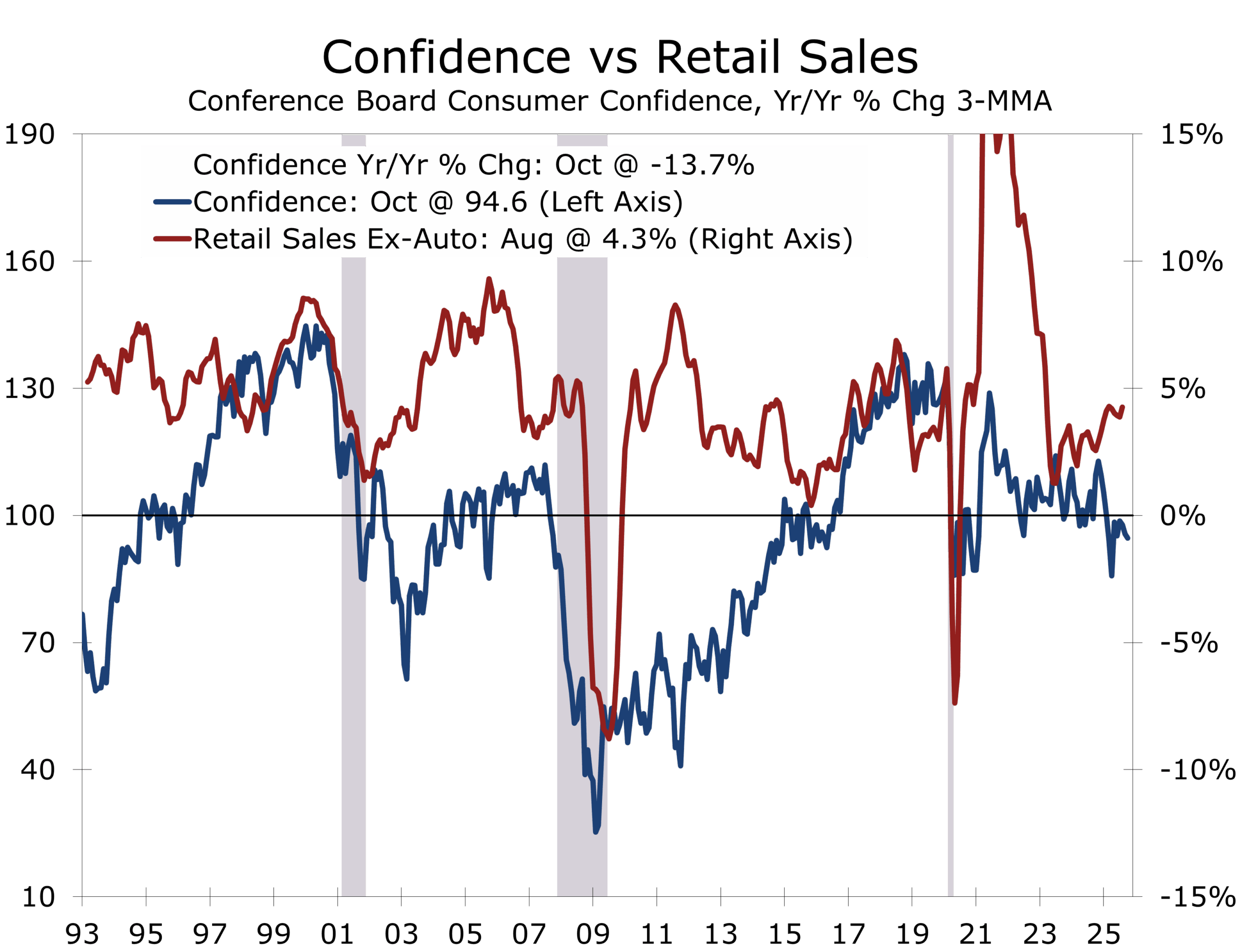
Interpreting the Disconnect
The Consumer Confidence Index remains a critical real-time gauge as official data flow stalls. While the survey has reliably led turning points in hiring and unemployment, its correlation with near-term spending has weakened. Elevated asset prices, pent-up savings among higher-income households, and the resilience of service spending continue to prop up consumption even as confidence drifts sideways. Moreover, expectations for future economic conditions have a stronger correlation with actual spending and remain historically low.
Consumers’ views of job availability continue to erode—often a leading signal for slower payroll growth
This divergence underscores that consumers are adapting, not retreating—trading down, delaying major purchases, yet still finding ways to meet everyday needs. Much of this resilience has been financed through rising credit card balances, a strategy that may prove short-lived as delinquency rates climb. For policymakers, the picture is mixed: inflation expectations remain stubbornly high, but overall spending has yet to crack, even as middle- and lower-income households scale back. For now, the labor market remains the key to watch. Most indicators—including consumers’ own perceptions of job availability—suggest that conditions are continuing to soften, a trend that will eventually weigh on spending. The Fed will weigh these crosscurrents carefully as it considers a possible December rate cut.
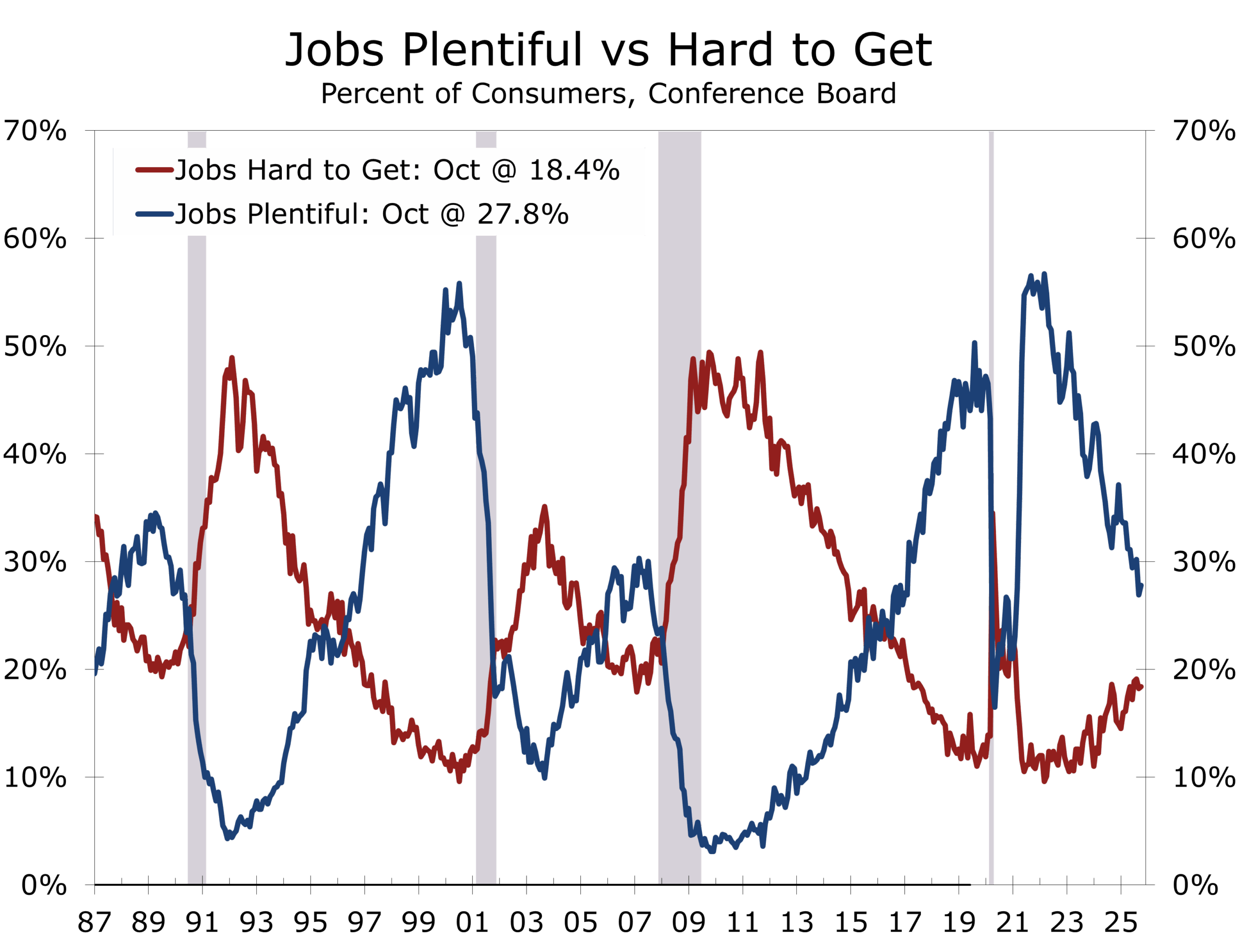
Disclaimer: This publication has been prepared for informational purposes only and is not intended as a recommendation offer or solicitation with respect to the purchase or sale of any security or other financial product nor does it constitute investment advice.
October 28, 2025
Mark Vitner, Chief Economist
(704) 458-4000
A View from the Piedmont: Our Weekly Commentary on Money, Credit, Exchange Rates & Geopolitics – The Fed Loves It When A Plan Comes Together
Highlights of the Week
- The Fed executed a perfectly timed A‑Team maneuver — ensuring the CPI report dropped ahead of the October FOMC — giving policymakers just enough cover to cut rates while long‑term yields stayed anchored near 4%.
- Growth continues, but the margin for error is narrow: Flash PMIs point to steady expansion, with much of the economy’s strength concentrated in asset appreciation, AI infrastructure, aerospace, and affluent‑driven services.
- The expansion is bifurcated: higher‑income households continue to spend as asset prices surge; middle‑ and lower‑income families face higher living costs, slowing job growth, and eroding affordability.
- Lower rates are stabilizing housing: existing‑home sales have firmed just over 4.0M units, inventories are rising, and price growth is cooling — a sign of renewed activity without reigniting shelter inflation.
- Markets are firmer today on headlines that Washington and Beijing have a framework to pause the threatened 100% tariffs and rare‑earths export curbs — relief is real, durability TBD.
- Trump’s Southeast Asia swing has raised hopes of a near‑term tariff truce — but the geopolitical road remains headline‑sensitive and volatile.
- With Powell’s plan working, the October cut remains the base case — but Mr. T’s driving leaves everyone wary of unexpected twists and turns.
The Setup — CPI Gets the Spotlight
September CPI came in cooler than expected, reinforcing disinflationary pressures and giving the Fed just enough visibility to continue easing without losing credibility. Headline CPI rose 0.3% m/m (3.0% y/y), down from 0.4% in August, while core printed softer at 0.2% m/m (3.0% y/y). Core goods inflation held at 1.5% y/y, and core services eased to 3.5% from 3.6% — confirming that tariffs (not demand) remain the primary inflation driver.
Inflation may be lagging, but leading indicators continue pointing lower. Private sector price gauges and survey data have clearly rolled over. Supplier delivery times remain stable, eliminating fears of a 2021-style relapse. The weaker labor market also suggests core services prices will moderate further.
The softer CPI report allows continued measured easing, while keeping long rates anchored.
The Mission — Gradual Easing to Support the Labor Market
The Fed’s mission has evolved: it now seeks to maintain disinflation progress while carefully cushioning a weakening labor market. With underlying inflation easing and signs of job market fragility emerging, policymakers have started cutting rates to prevent a downturn from spiraling into weaker consumer spending.
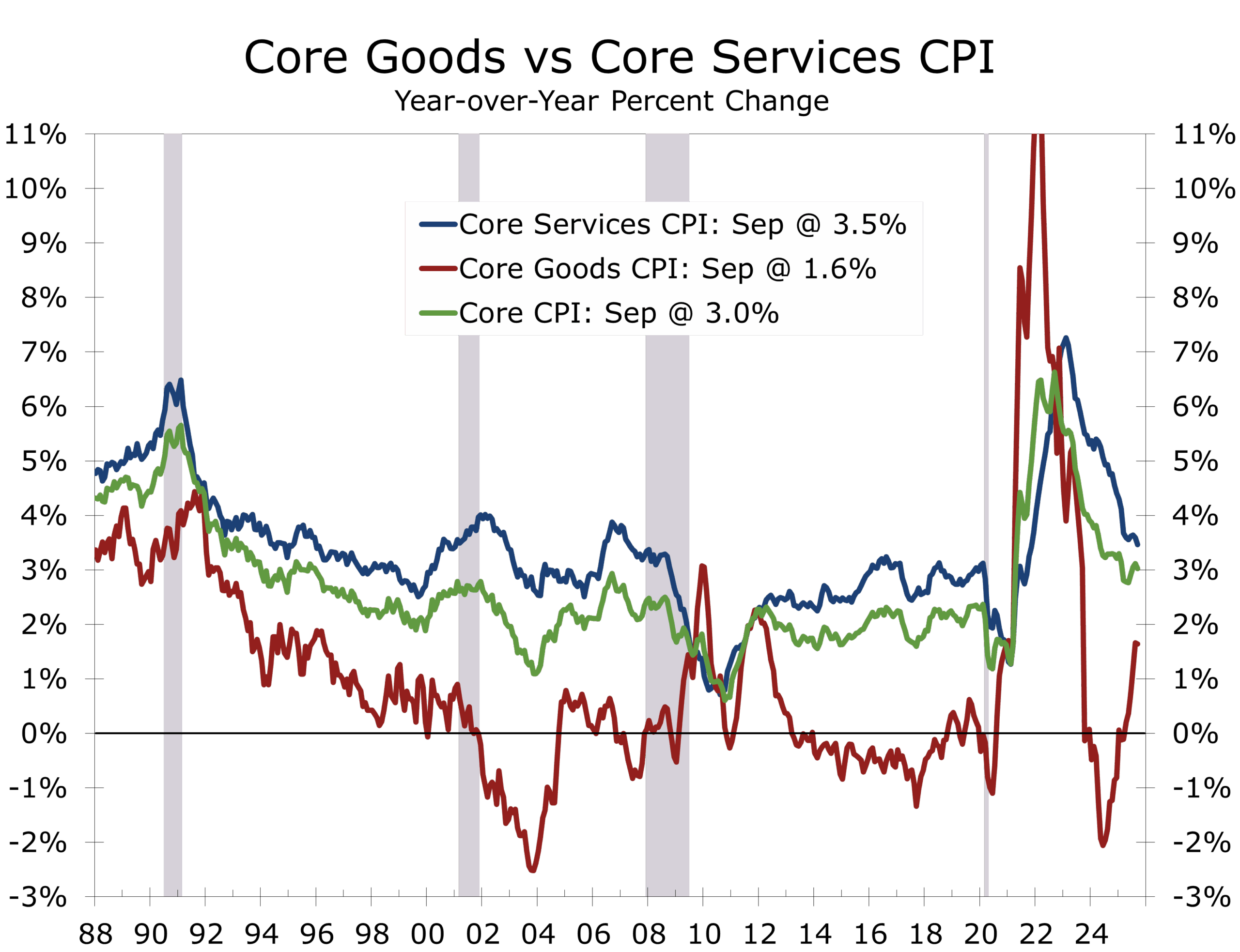
The ongoing federal shutdown amplifies these risks by clouding economic visibility, so the Fed must proceed with caution—not only to support jobs and growth, but also to maintain the confidence of bond markets and avoid fueling renewed volatility.
Recent layoff announcements underscore the stakes:
- Tech giants continue trimming staff tied to non-AI business units.
- Several major retailers have announced headquarters and distribution-center cutbacks, perhaps counting on a productivity boost from new technology investments.
- Transportation and logistics firms are consolidating as goods demand cools.
These cuts remain measured — but confidence-sensitive. A small slip could cascade.
The ongoing federal government shutdown adds another layer of risk. With paychecks now likely delayed, millions of workers — including contractors with minimal savings buffers — will be forced to pull back on spending. That drag will widen if the shutdown lingers into the holiday season.
.
S&P Global’s October Flash PMIs confirmed a pickup in business activity, with the Composite Output Index rising to 54.8 from 53.9—the highest since July and signaling the strongest pace of growth in several months. Services led the expansion with a reading of 55.2, while manufacturing improved to 52.2 but continued to lag, hampered by weak exports and rising inventories.
The data also highlight modest overall job gains, with services adding positions and manufacturing still shedding jobs, as firms express caution over policy and tariff risks. Business confidence remains subdued, but lower interest rates and resilient domestic demand are supporting continued solid, if uneven, momentum into Q4.
The Fed is easing just enough to keep the van rolling, but everyone can feel the suspension tightening as the road gets bumpier and risks multiply from layoffs and the federal government shutdown. The soft patch helps the Fed, by further anchoring long-term rates. Just like the A-Team, businesses are improvising under pressure, patching together solutions and aiming to stay ahead of each new obstacle that pops up.
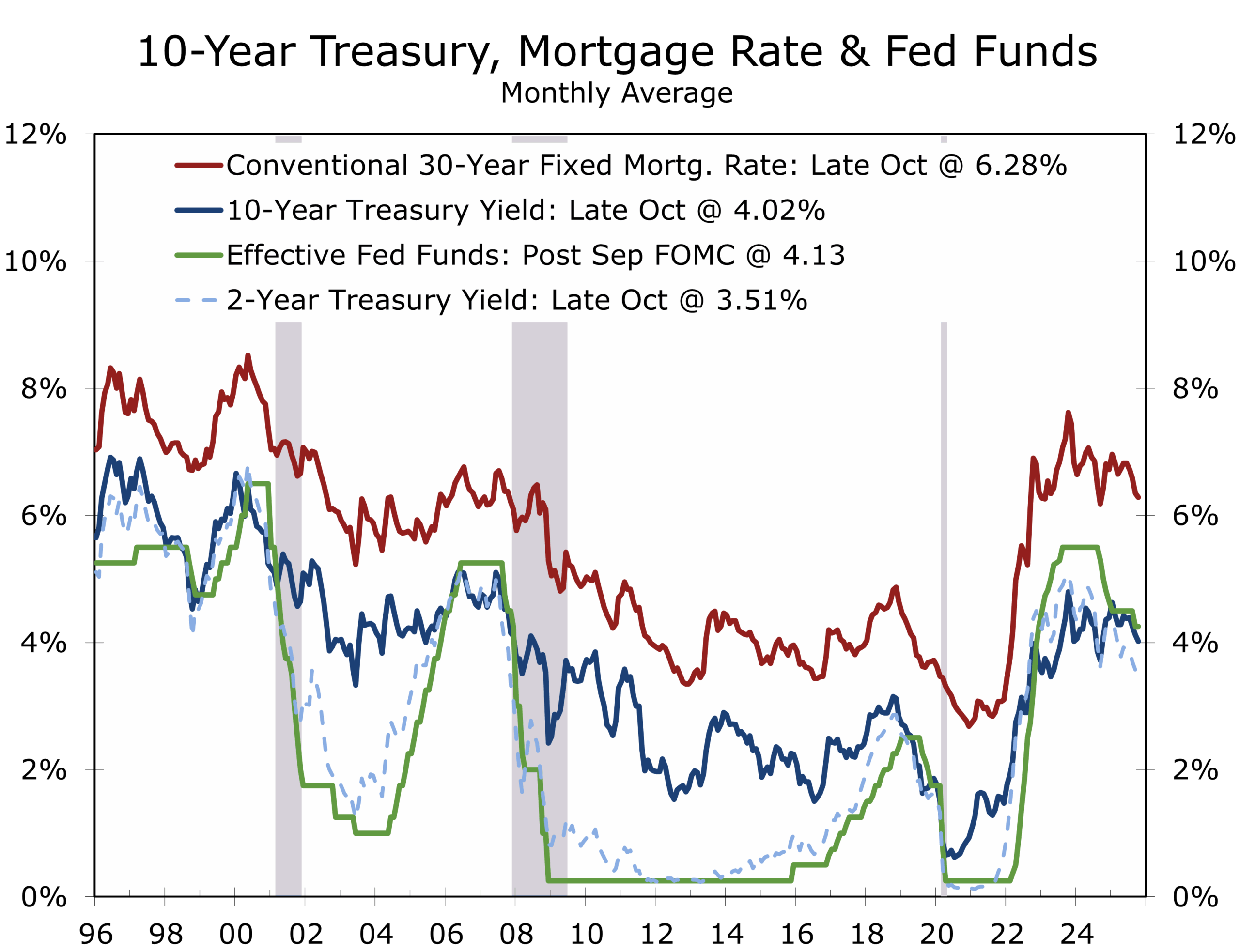
The Two‑Tier Economy — A Bifurcated Expansion
From inside the van, the ride feels smooth. Outside, road conditions vary considerably depending on which lane you are in.
Upper‑income households benefit from record‑high asset values and healthy discretionary spending. Wealth effects keep upscale services buoyant, especially in leisure, travel, and experiential activities.
Asset owners are celebrating the ride. Wage earners are gripping the armrests.
Middle‑ and lower‑income households remain under strain — slowing job gains, persistent price pressures, and housing affordability hurdles. Consumer sentiment remains fragile.
This bifurcation supports growth and disinflation — but it’s a knife‑edge. If the bottom weakens further, the mission shifts from landing the van to rescuing it.
Trade & Geopolitics — The Road Gets Bumpy
Risk tone brightened as Washington and Beijing reached a provisional framework pausing threatened 100% tariffs and rare-earths export curbs—pending Trump–Xi leader sign-off later this week. President Trump said he expects to “come away with a deal,” with China delaying export bans and boosting U.S. soybean purchases—tactically easing AI supply-chain stress and trimming term-premium risk.
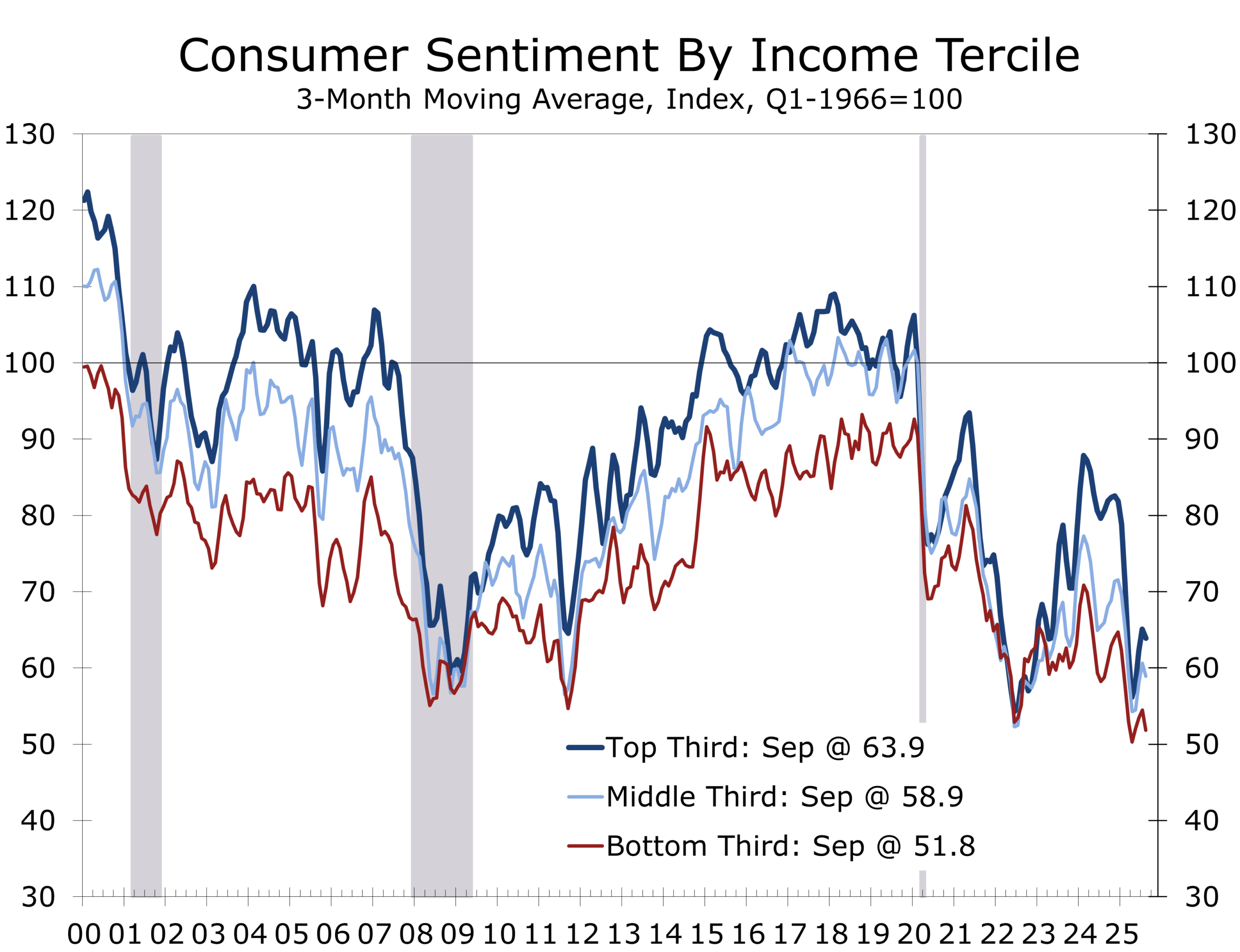
Trump’s multi-stop ASEAN tour, with Treasury Secretary Bessent and Secretary of State Rubio, is choreographed to lock the arrangement before the Trump–Xi summit. Markets rightly view this as a truce, not a treaty. Export controls remain active tools, holstered rather than removed.
Canada felt the other end of the stick: Trump announced a fresh 10% tariff on Canadian goods in retaliation for an Ontario advertisement he believed misrepresented Ronald Reagan’s views on tariffs, particularly as the speech was given while he himself was implementing tariffs. He labeled the ad a “hostile act,” abruptly ending ongoing trade talks and injecting fresh tension into North American supply chains. Ottawa’s response remains measured for now—as it quietly deepens ties with Asia.
Argentina delivered a political jolt with Liberty Advances, President Javier Milei’s party, securing 41% of the vote in midterm elections—an endorsement of his free-market reforms and fiscal consolidation efforts. The U.S. has reportedly offered expanded financial backstops if Milei’s reforms remain on track—complementing the newly announced $20B swap line and increased U.S. beef import target. Market takeaway: reform momentum is real, and external liquidity risks are easing. This is a positive for Argentina, Latin America as a whole and the U.S. Beef imports may provide some modest price relief.
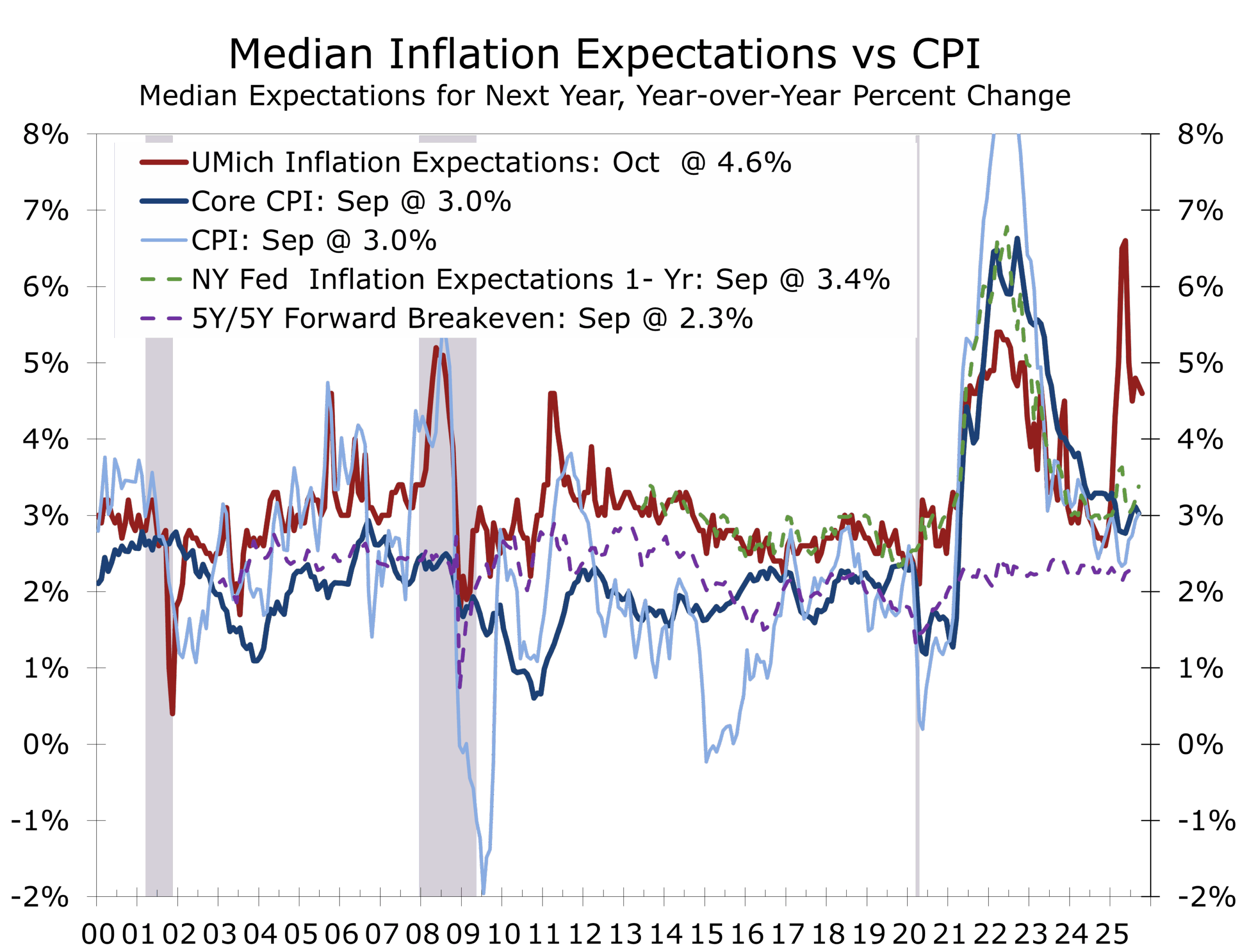
Geopolitically, the road may have straightened—but potholes remain in plain sight. And as markets have learned repeatedly this year, I pity the fool who gets on the wrong side of Mr. T.
Financial Markets & Rates — Keep the Roof Panels Secure – Markets continue to trade the Fed’s script: controlled disinflation paired with gradual easing favors long duration and curve steepeners. Equities rallied on the CPI release because a clean glide path reduces valuation risk.
Shutdown dynamics add a twist: delayed paychecks risk a sharper pullback in discretionary spending, which would increase expectations for further cuts — a development likely to reinforce the downward bias in long-term yields.
Industrial commodities remain subdued as global PMIs point toward slower momentum ahead. The S&P Global US composite PMI rose to 54.8 from 53.9, supported more by services than manufacturing. Output and new orders improved, while employment was mixed, rising in services and falling in manufacturing. Base metals and energy will likely underperform in this environment.
Gold’s recent correction appears to be more technical, rather than thesis changing. The world economy and global monetary framework are rapidly evolving. Central bank buying remains relentless — a secular force supporting the metal as insurance against fiat instability and geopolitical recoil.
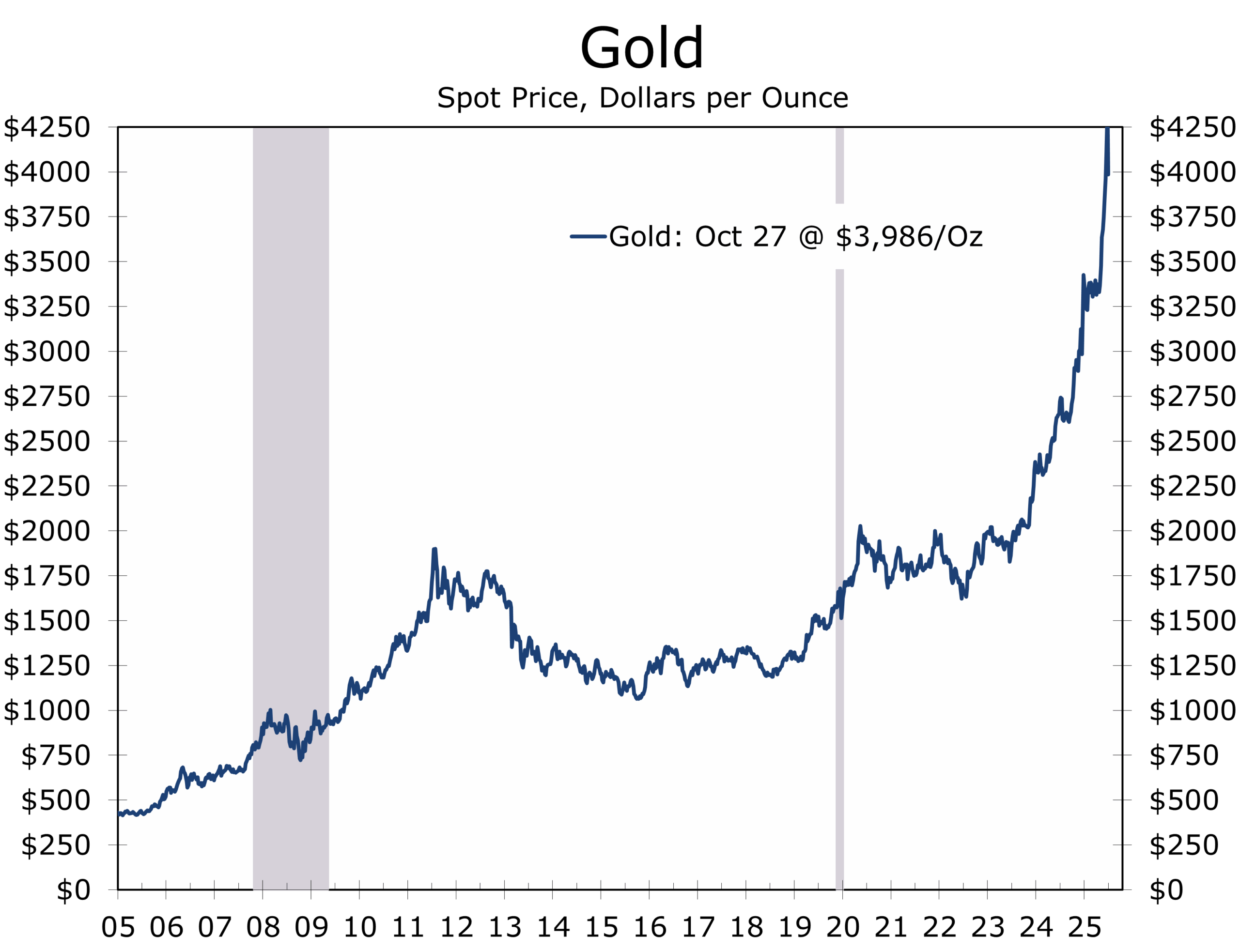
As long as Powell keeps the A-Team on message — and Mr. T refrains from yanking the wheel — the van should stay on the road and the term premium contained.
Housing & Business Signals — Checkpoints Along the Route – Housing is stabilizing — with lower mortgage rates coaxing more listings and buyers back into the market. Unlike the federal government, Realtors are still working. The National Association of Realtors reported last week that existing home sales ticked up to 4.06 million units in September (seasonally adjusted annual rate), marking the strongest pace in several months. Inventories continue to rise, with supply is up to 4.6 months, while median prices are increasing only in the low single digits (+2.1% y/y at $415,200).
From a structural viewpoint, this is significant. More listings improve choices for buyers, while moderate price growth reduces affordability pressure — but the market is still far from overheating. The inventory uptick plus stable sales pace suggests a rebalancing rather than a rebound. Lower mortgage rates and improving affordability are clearly lifting activity, yet first-time buyer share remains constrained, and many homeowners remain locked into their current homes, which have sub-4% mortgages.
Builders, brokers, and remodelers may finally get a smoother stretch of road, thanks to the pickup in listings and turnover rather than the chaotic spike-and-crash of the past couple of years.
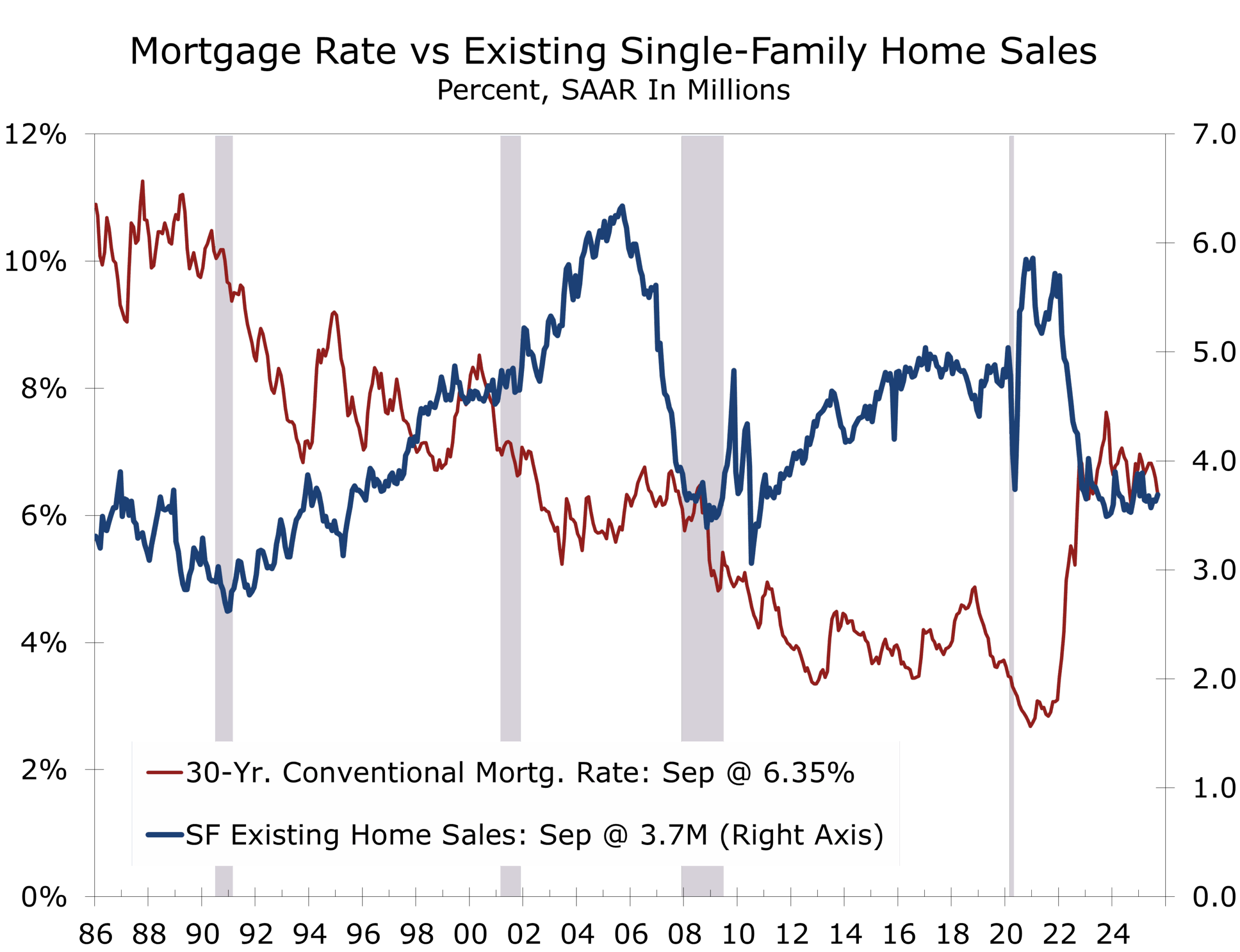
The moderation in housing price appreciation pairs well with the disinflation trend elsewhere — reducing shelter’s risk to the CPI.
Because the market is not overheating, the Federal Reserve has room to cut short-term rates without triggering a new wave of housing-fueled inflation.
In short: housing is shifting into a steady-state recovery, rather than a boom. Upper-income homeowners continue to benefit from equity gains, while first-time and middle-income buyers are finding incremental relief on affordability metrics — neither boom nor bust, but a slow ascent.
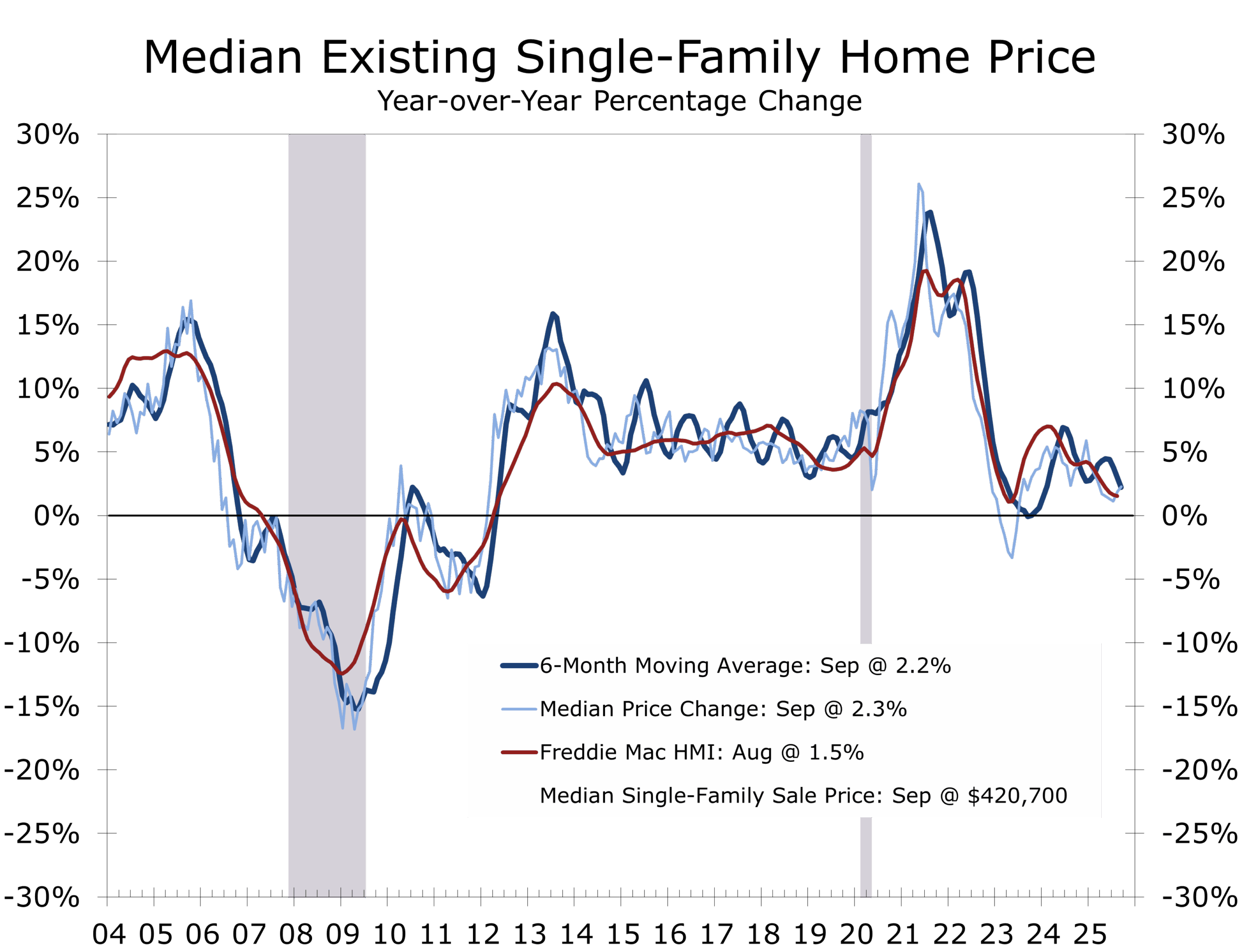
Landing the Van — The Fed’s Escape Route
One more cut in December remains realistic — but is still conditional.
Key risks remain: Tariffs could return, leading to a jolt in term premium and sending yields higher. Housing could ramp back up and boost shelter inflation, halting the disinflation trend. Geopolitics could flare up, leading to supply chain disruptions and energy spikes.
Our base case: Growth moderates toward 2.0%, headline inflation holds firm at around 3% through year end but softens a touch on an underlying basis, implying moderating top-line inflation in 2026. Long yields hover around 4% but rise modestly as the economic picture improves next year.
If Powell keeps the A‑Team on script, the plan will come together nicely. If Mr. T stomps on the accelerator and yanks the wheel in a different direction, the outcome could become less certain.
The Week Ahead
We will miss a number of high-impact economic data releases this week due to the government shutdown, including critical reports on durable goods, trade, Q3 GDP, and PCE inflation. Despite the uncertainty, consensus and private forecasts anticipate:
- Consumer confidence, home prices, and private sector estimates of first time unemployment claims will all likely draw more scrutiny amidst mixed signals from labor market data and recent PMI gains.
- We look for another 25bp cut in the federal funds rate target at the October FOMC, with a third cut in December still expected barring surprises. We will also look for more insight into when the Fed will end quantitative tightening.
- Q3 GDP growth tracking near 3.4% annualized, propelled by resilient personal consumption, AI-driven capital spending but tempered somewhat by weak residential investment and export.
- Earnings: Checking in on the Mag-7 — Microsoft, Apple, Alphabet, Amazon and Meta and all report earnings this week. The markets will not only focus on earnings and revenue trends but also capital spending and other clues about the buildout of AI.
Time to bring out a cigar?
The plan has come together — for now. CPI delivered on cue, markets bought the story, and the van moved forward. Colonel John ‘Hannibal’ Smith can bring out the cigar, but it would be wise not to light it just yet. With Mr. T driving, no one is relaxing. Stability is a moving target — and the Fed knows one wrong turn can rewrite the story.
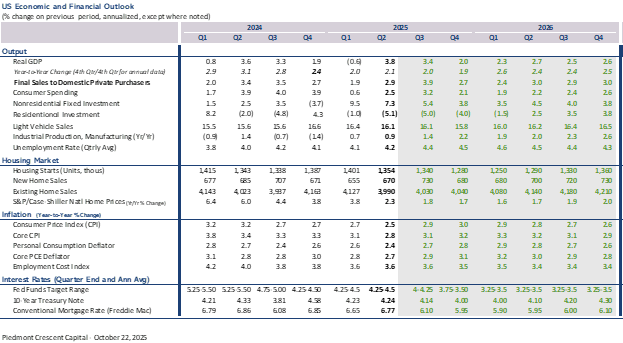
Disclaimer: This publication has been prepared for informational purposes only and is not intended as a recommendation offer or solicitation with respect to the purchase or sale of any security or other financial product nor does it constitute investment advice.
October 27, 2025
Mark Vitner, Chief Economist
mark.vitner@piedmontcrescentcapital.com
(704) 458-4000
September 2025 Consumer Price Index – Headline Lifted by Energy; Core Inflation Softens as Shelter Cools
Good Timing for a Lighter Inflation Report
-
- Headline CPI rose 3% in September (vs. 0.4% in August), while core CPI advanced 0.2%, the smallest increase in three months.
- Year-over-year CPI edged up to 0%, while core CPI held steady at 3.0%.
- Shelter inflation decelerated sharply, with owners’ equivalent rent (OER) up just 1%—the weakest since early 2021.
- Energy prices rose 5%, led by a 4.1% jump in gasoline, accounting for most of the month’s headline increase.
- Core goods rose 2%, with tariff-related gains in apparel, furniture, and personal goods offset by declines in used cars, insurance, and communications.
- Food prices rose 2%, rising 0.3% at grocery stores and 0.1% at restaurants.
- The Cleveland Fed’s Median CPI rose 2%, and the Trimmed Mean CPI increased 0.16%. We expect the core PCE deflator to rise 0.2%, leaving the Fed’s key inflation gauge up 2.9% year-over-year.
- This report reinforces expectations for a rate cut, though policymakers remain cautious that 3% inflation might linger.
Energy Lifts Headline, but Core Disinflation Resumes
Consumer prices rose less than expected in September, reinforcing the narrative that inflation is slowly cooling beneath the surface. The 0.3% monthly gain in headline CPI was powered by a 4.1% surge in gasoline, while electricity and natural gas prices declined. Excluding food and energy, prices rose 0.2%, and the three-month annualized pace of core inflation eased to roughly 2.5%—consistent with a slow glide path toward the Fed’s 2% target.
Shelter costs, which account for just over 44% of the core CPI, continued to moderate, rising 0.2%. Rent and OER slowed notably, with OER up only 0.1%, a figure partly influenced by regional volatility in Southern and Northeastern markets. The broader trend aligns with real-time rent data showing renewed softness, particularly across the South, where an influx of new supply is driving aggressive concession activity.
Shelter inflation has slowed to its weakest pace since early 2021, amidst a surge in new rentals.
Shelter and Core Services Show Genuine Cooling
The moderation in shelter costs, which account for just over 44% of the core CPI, represents meaningful progress for the Fed. This past month’s improvement coincides with weakening home prices and surge in apartment completions. Year-over-year shelter inflation has slowed to 3.6% from over 5% at the start of the year. Apartment completions will remain elevated through yearend, and market-based rent indices suggest further easing ahead.
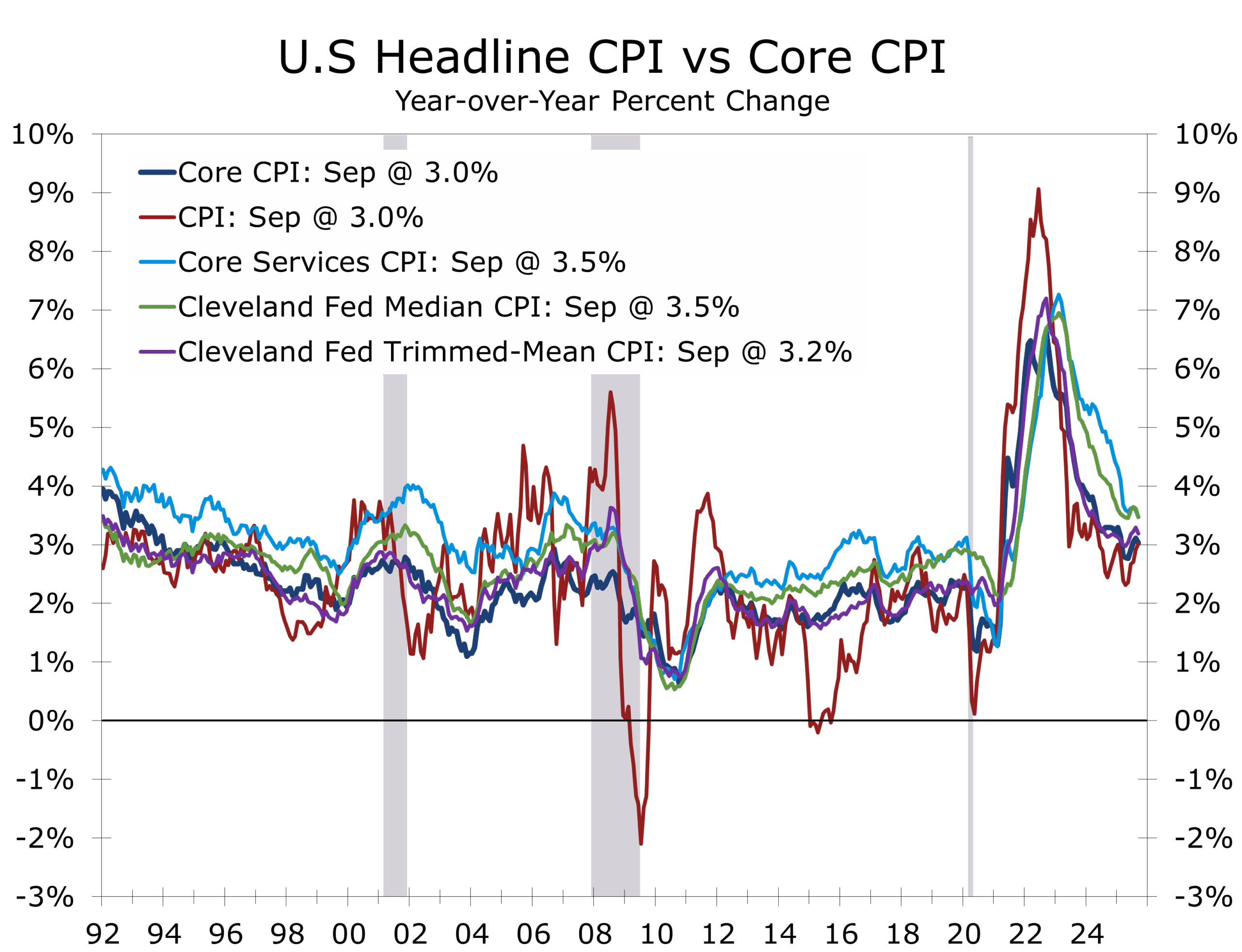
Outside housing, core services presented a mixed picture. Airline fares rose 2.7% and hotel prices 1.7%, reflecting strong upper-income travel demand. However, declines in motor vehicle insurance (-0.4%), communications (-0.2%), and used cars (-0.4%) offset some of those gains, providing modest relief to middle-income consumers. Insurance and vehicle costs trimmed about 2 basis points from the core index.
Inflation remains uneven, with tariffs pushing goods prices higher and prices easing elsewhere.
Core Goods and Tariff Pass-Through Broadens
Core goods prices rose 0.2% in September, but the composition reflects widening tariff pass-through. Apparel climbed 0.7%, while furnishings and recreation goods each rose 0.4%. The weaker dollar and elevated import costs are feeding into retail pricing, though the overall pace remains moderate relative to 2021–22.
Tariffs and the weaker dollar have likely added roughly 0.4 percentage points to headline inflation this year. We expect the impact from tariffs to wane next year, while housing costs and prices for services outside of housing ease further.
Food prices rose just 0.2% in September, following a 0.5% gain in August. Groceries rose 0.3%, led by cereals, bakery goods, and beverages, while dairy declined 0.5%. Dining-out costs were muted—climbing 0.2% at limited-service restaurants and holding flat at full-service establishments.
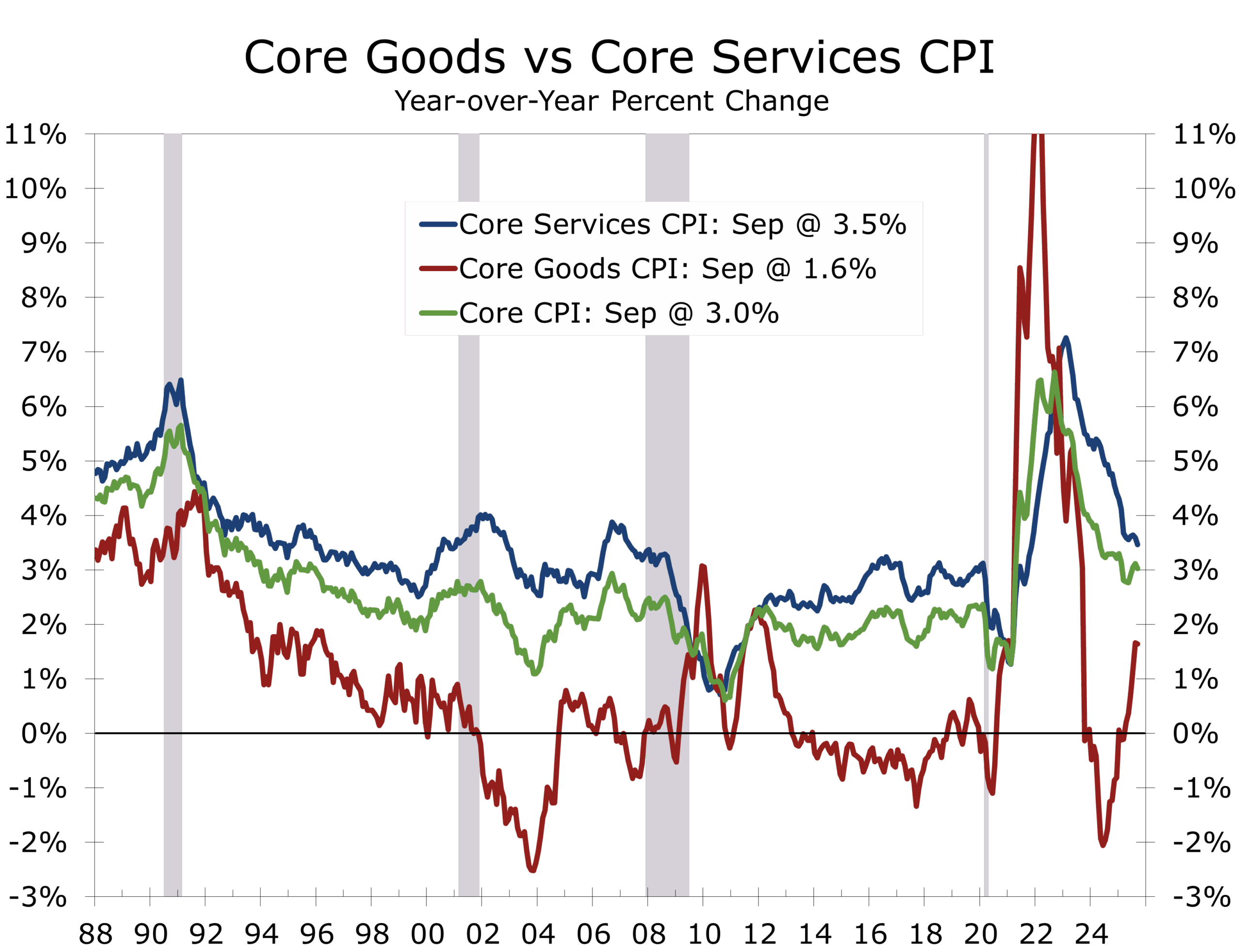
Policy and Market Implications
The September CPI report bolsters the Fed’s confidence that its soft-landing game plan remains intact. Inflation is cooling without derailing growth, and alternative measures from the Cleveland Fed confirm underlying price pressures are ebbing. We expect the core PCE deflator—the Fed’s preferred inflation gauge—to rise 0.2% in September, up 2.9% year-over-year. That remains above target, but close enough to justify continued policy easing.
We now anticipate four quarter-point cuts in this cycle, including next week’s, followed by reductions in December and January. Long-term yields have eased modestly as markets adjust expectations. While the UMich survey still shows elevated inflation expectations, TIPS breakevens remain anchored near 2.3%, suggesting the Fed retains market credibility.
September’s CPI report was just what the Fed needed—a modest headline gain, a softer core, and a clear signal that shelter inflation is finally bending lower. While some of the recent weakness in rents could prove transitory, the underlying pattern—moderating services, stable goods prices, and improving real incomes—indicates the disinflation process remains on course.
.
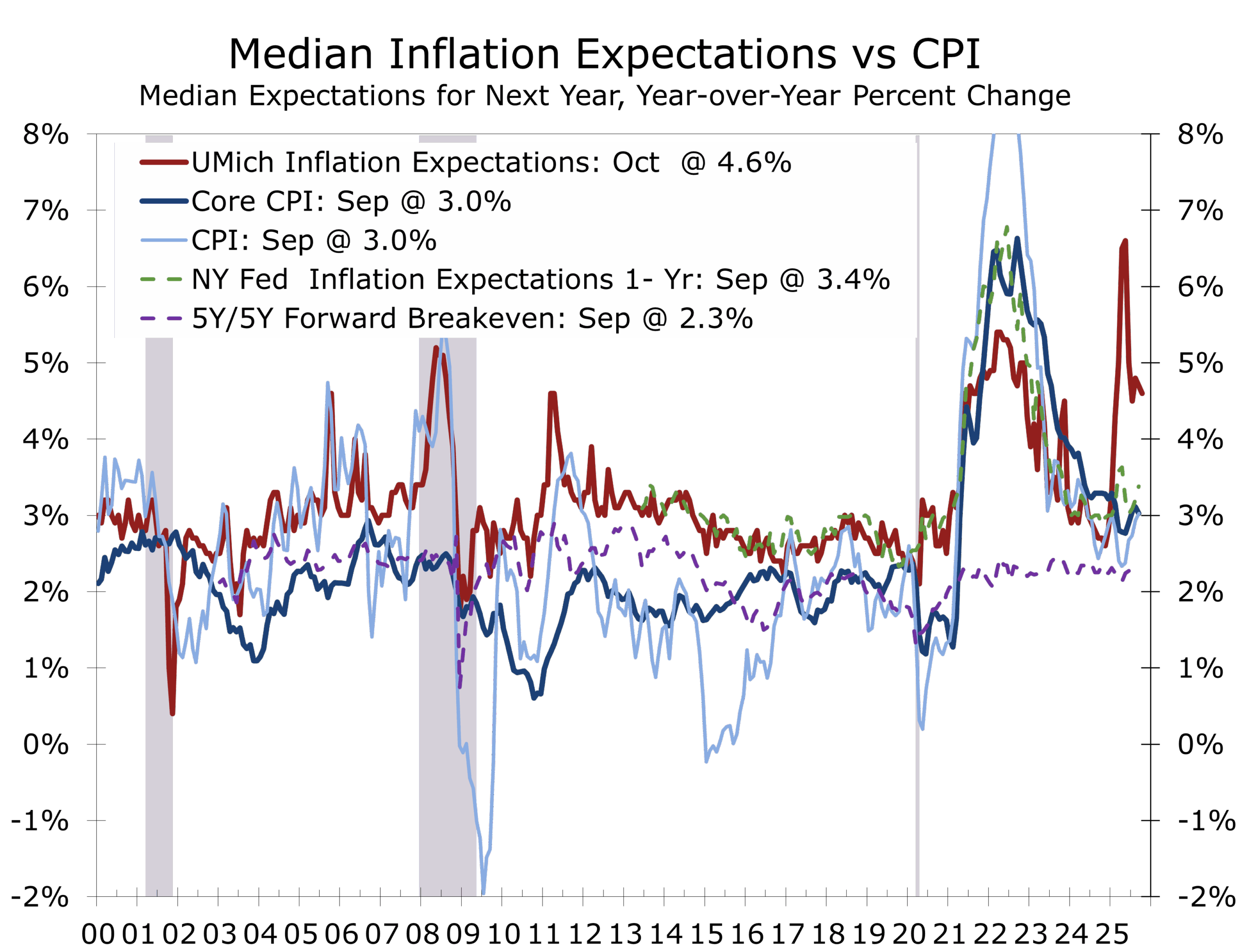
Disclaimer: This publication has been prepared for informational purposes only and is not intended as a recommendation offer or solicitation with respect to the purchase or sale of any security or other financial product nor does it constitute investment advice.
October 24, 2025
Mark Vitner, Chief Economist
(704) 458-4000
Roots of American Resilience: Shaped by the Boreal Winds
Roots of American Resilience: Shaped by the Boreal Winds
- Growth Exceeds Expectations: Q3 GDP tracking estimates have increased to between 3.4%–3.9%, supported by the buildout of AI and related infrastructure, resurgent aerospace production, and resilient consumer spending.
- Aerospace Resurgence: FAA approval for increased Boeing 737 MAX output underscores the manufacturing rebound, while defense restocking further extend backlogs.
- Growth–Employment Split: Output remains strong, but job creation has stalled — signaling potential hurdles to growth estimates rather than labor acceleration.
- Roots of Strength: America’s free enterprise system, protected IP, and deep, liquid capital markets continue to channel innovation and renewal.
- Consumers Selective but Steady: Spending has narrowed to upper-income households and affluent retirees, cushioning middle-income weakness.
- AI and Aerospace Investment: Twin drivers adding 0.4–0.5 percentage points to annual GDP growth; reshoring, defense, and data centers remain pivotal.
- Housing Still Soft: Elevated inventory and affordability constraints limit near-term growth; lower mortgage rates in 2026 may unlock pent-up demand.
- Inflation Eases, Unevenly: Core CPI steady near 3.1%, restrained by slower wage gains and rents but offset by tariff-related goods costs.
- Fed Nears End of Runoff: Powell’s tone suggests a pivot to growth management, with two more rate cuts likely this year.
- Markets Regain Lift: Steeper yield curves, stronger cyclicals, and resilient risk appetite reflect belief in a “strong but narrowing” expansion.
- Geopolitics Still a Wild Card: Fragile ceasefire barely ‘holds’ in Gaza, further U.S.–China tech decoupling, and European stagnation and political discord frame the global risk backdrop.
Forecast Summary:
The economy continues to evolve rather than erode, revealing a widening split between resilient real GDP growth and softening employment conditions. Growth is being reshaped by the rapid rollout of AI infrastructure, a resurgent aerospace sector, record defense outlays, and remarkably resilient consumers — including a growing cohort of affluent retirees whose spending forms the deep roots sustaining the canopy through shifting global winds.
Much like cycling through Puglia’s olive country, the journey is uneven: the path alternates between steep climbs and smooth coastal descents, yet the centuries-old trees endure — gnarled, resilient, and deeply rooted in fertile soil. The U.S. economy today mirrors that landscape: tested by headwinds yet anchored by enduring strengths that adapt rather than break.

Macro Overview – Growth Exceeds Expectations but Remains Uneven
The U.S. economy remains a study in contradictions. The Atlanta Fed’s GDPNow model pegs Q3 growth at 3.9%, well above potential and nearly double what forecasters expected earlier this summer. Our own estimate, at 3.4%, is only modestly lower — still impressive given the stall in job creation and moderation in hours worked.
Beneath the surface, however, momentum looks less robust. The NFIB Small Business Optimism Index and regional Fed manufacturing surveys signal rising uncertainty, weaker demand, and subdued capital spending intentions. The divergence between output and sentiment reflects an economy powered by narrow, capital-heavy engines — AI infrastructure, aerospace, and defense — that lift GDP but not necessarily payrolls.
Fed Governor Waller acknowledged this imbalance, observing that policy calibration will depend on “how the growth–employment split resolves.” In effect, the economy is producing more with fewer hands — a productivity rebound that complicates the inflation debate.
Boeing’s FAA approval to expand 737 MAX output from 38 to 42 planes per month, with potential to reach 45 by early 2026, captures this dynamic perfectly. Industrial momentum is reviving through sectors that are capital-intensive but labor-light, while defense contractors continue to work through record order backlogs as allied nations rearm and replenish depleted stockpiles. This underpins a durable manufacturing cycle even as broader business sentiment cools.
The service sector shows signs of fatigue — particularly in middle-income discretionary categories — but upper-income consumers remain the quiet engine behind growth. Spending in travel, leisure, and premium goods continues to expand, while home renovation and repair outlays partially offset the drag from new construction.
Taken together, the economy is expanding unevenly but firmly — evolving, not eroding.
Like those ancient olive groves that have weathered centuries of storms, the U.S. expansion is rooted in structural strengths that sustain it through changing winds. If the growth–employment split resolves through slower output rather than faster hiring, as we expect, long-duration assets and yield-curve steepeners should outperform into year-end.
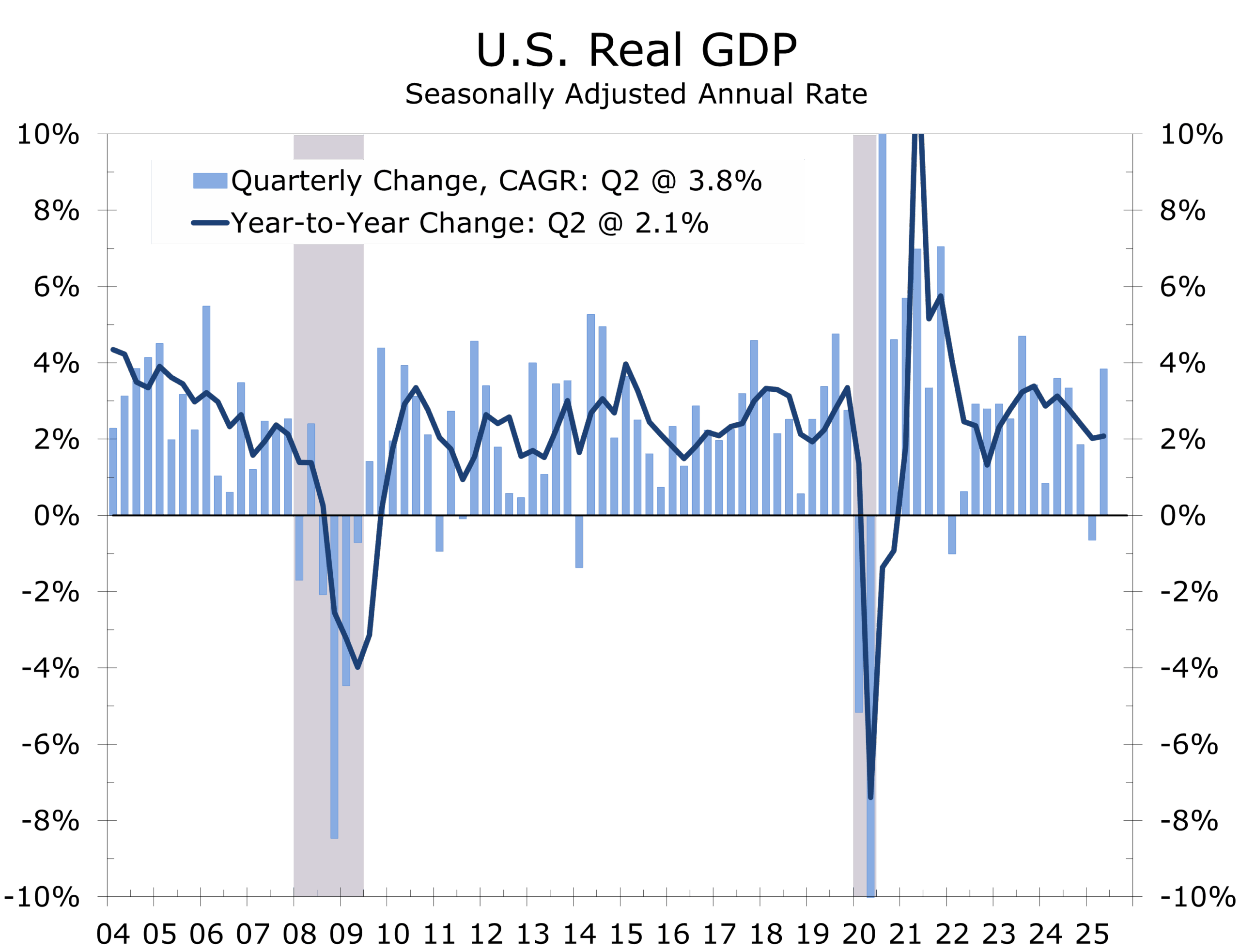
The Growth–Employment Split – A Cycle Out of Sync
Economic activity and employment typically move in a circular, self-reinforcing pattern — spending and capital investment drive income, which drives jobs and strengthens confidence, which fuels further spending and investment. Today, that feedback loop has weakened. GDP is expanding above potential, yet hiring has slowed and job openings have fallen to two-year lows just as federal retirements and furloughs have increased.
The causes behind this split are structural as well as cyclical. The AI buildout is labor-light but capital-deep, while the aerospace and defense sectors are operating under long-lead contracts that boost output before hiring. Tariffs and inventory restocking also inflate nominal GDP through price effects. The NFIB data confirm that small businesses face cost pressures and weaker sales expectations, signaling that hiring will remain modest.
The divergence will close primarily through slower economic growth rather than a meaningful rebound in jobs. Hard data, including hours worked and manufacturing employment, which typically preceded employment trends, have slowed since spring. For policymakers, this implies lower potential growth in the near term but less inflationary risk — a backdrop favoring rate cuts and longer duration. Longer term, the investment surge should strengthen potential growth and reduce inflationary pressures.
Markets are already reflecting this adjustment: breakeven inflation has stabilized, and forward-rate spreads point toward a softer landing. The U.S. may be entering a phase of “quiet deceleration” — with economic activity cooling without cracking.
.
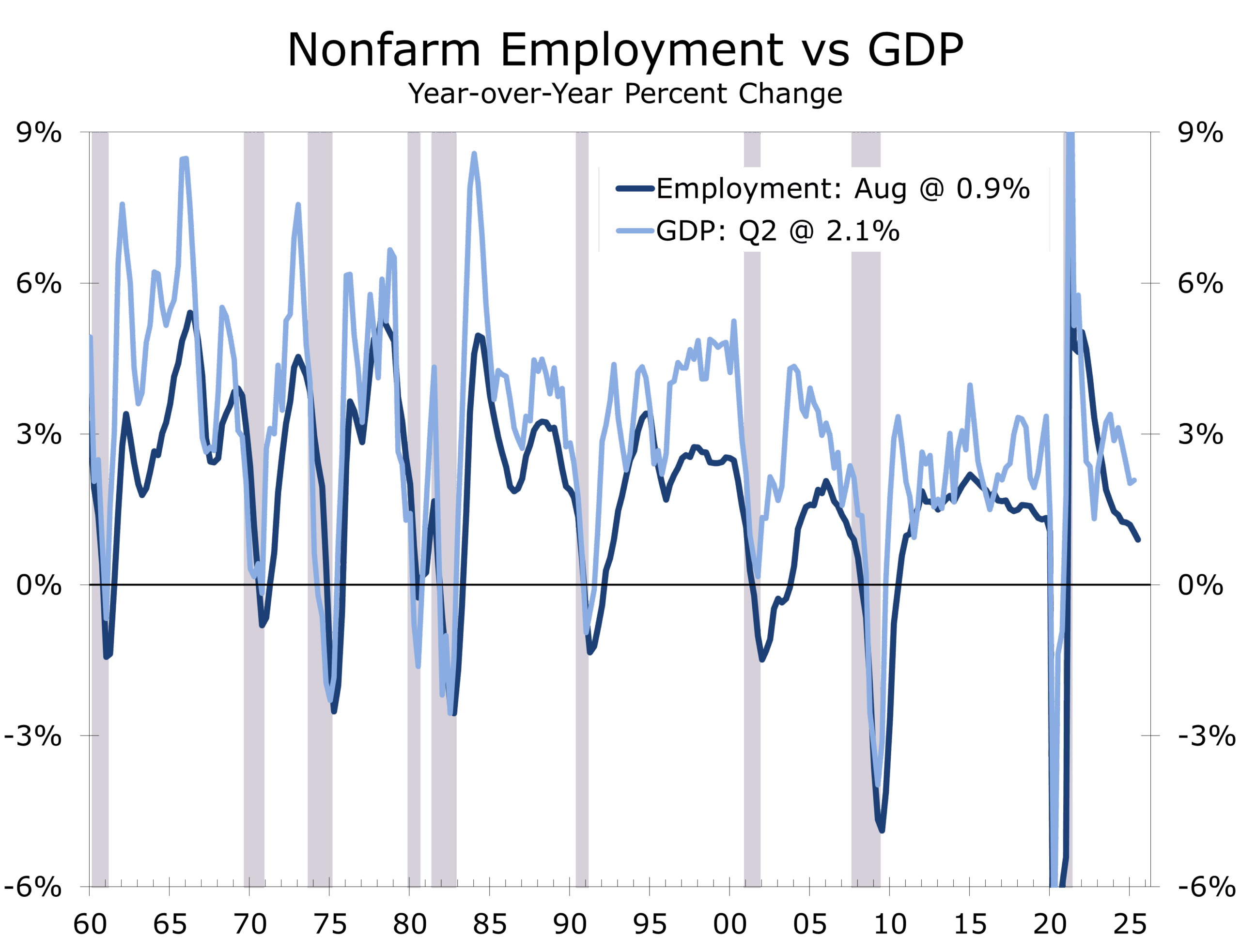
Consumers – Spending Through the Headwinds
Household spending remains the economy’s ballast, though its composition is shifting. Retail sales surprised to the upside through late summer, with strength in travel, healthcare, and restaurants. Credit costs are rising, with auto-loan delinquencies at ten-year highs and revolving credit balances outpacing income growth twofold. With the government shutdown, August is the last data point for retail sales. Redbook retail sales, which measure same-store sales at department stores, discount stores and chain stores, suggest sales have kept pace with their previous trend through October. We estimate that core retail sales rose at around a 0.4% pace in September and should rise by a like amount in October.
One stabilizing influence is demographics. Affluent retirees now account for an outsized share of discretionary consumption, supported by wealth gains and Social Security COLAs. This cohort’s spending is less sensitive to labor-market fluctuations and acts as an anchor during cyclical slowdowns. In contrast, lower- and middle-income households are increasingly value-conscious, trading down to discount brands and stretching loan maturities. Sales at chains dependent upon middle- and lower-income consumers have been lagging, with the exception of a few giant firms with marketing budget heft.
The Beige Book described consumer behavior as “price-aware but persistent.” Retailers report steady traffic but lower ticket sizes, a pattern consistent with slowing but sustainable real consumption. Inflation-adjusted spending remains positive, suggesting that while demand is cooling, it continues to stabilize the broader economy. Inventories remain in line with sales.
Over time, as borrowing costs ease, pent-up demand in autos and housing should reemerge, helping reignite related outlays. Until then, consumers are spending selectively — but they are still spending.
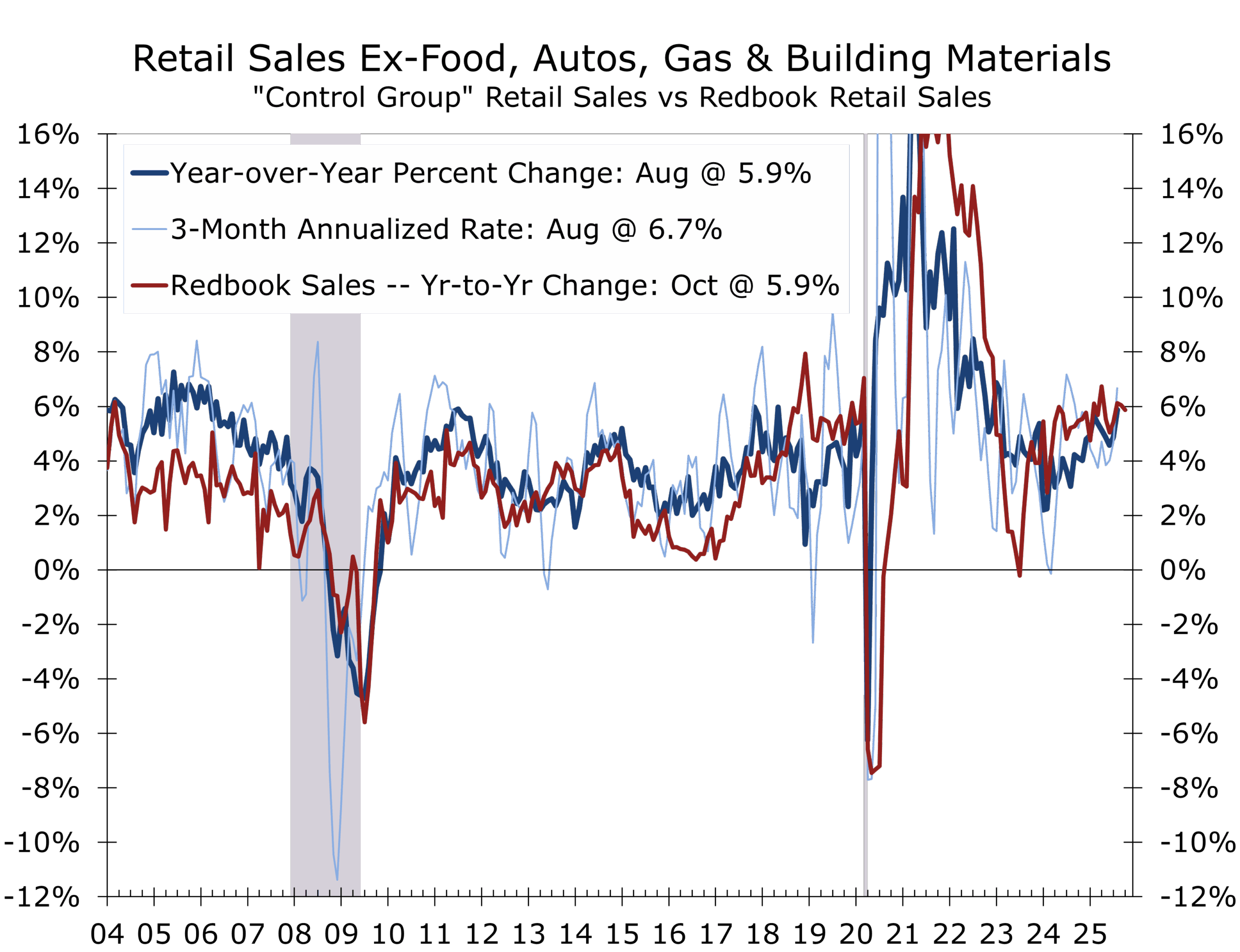
Business Fixed Investment – The AI and Aerospace Flywheel
AI and aerospace have become the twin engines of America’s capital cycle. Data-center construction is up more than 30% year-over-year and now accounts for nearly one-fifth of all private nonresidential structures. The AI capex surge is large enough to lift broader growth—its spillovers extend across utilities, logistics, and industrial construction—without crowding out other activity or fueling overheating.
Aerospace and defense form the second axis of strength. Boeing’s 737 MAX production ramp, alongside record backlogs at Lockheed Martin, RTX, and Northrop Grumman, underscores a durable manufacturing upturn. Defense suppliers across the U.S. and Europe are expanding capacity to rebuild arsenals, keeping output and exports elevated.
Outside these sectors, private investment remains mixed. Pharmaceuticals and medical devices are bright spots, but housing-related and consumer-linked spending remain soft. The Philadelphia Fed’s October survey showed a sharp headline decline, while the Empire survey jumped; together they imply manufacturing activity hovering just below the ISM’s 50-point threshold. Financing conditions remain tight, yet the scale of AI, defense, and blockbuster pharma projects—especially in the South—continues to move the needle for industrial demand.
The result is an economy driven by capital-deep innovation rather than broad expansion—one where productivity rises faster than payrolls. The pattern recalls the late 1990s tech cycle, though this phase appears earlier in its trajectory, with structural investment still gathering momentum. We expect capital spending to broaden, as the AI boom begins to materially reshape nearly every sector of the economy. The recent retrenchment in EV investment was an inevitable correction that will redirect capital toward internal combustion and hybrid platforms, strengthening the industrial base. Like those ancient olive trees in Puglia, today’s capex cycle is rooted deeply but growing deliberately—its expansion measured, resilient, and likely to bear fruit over a longer horizon.
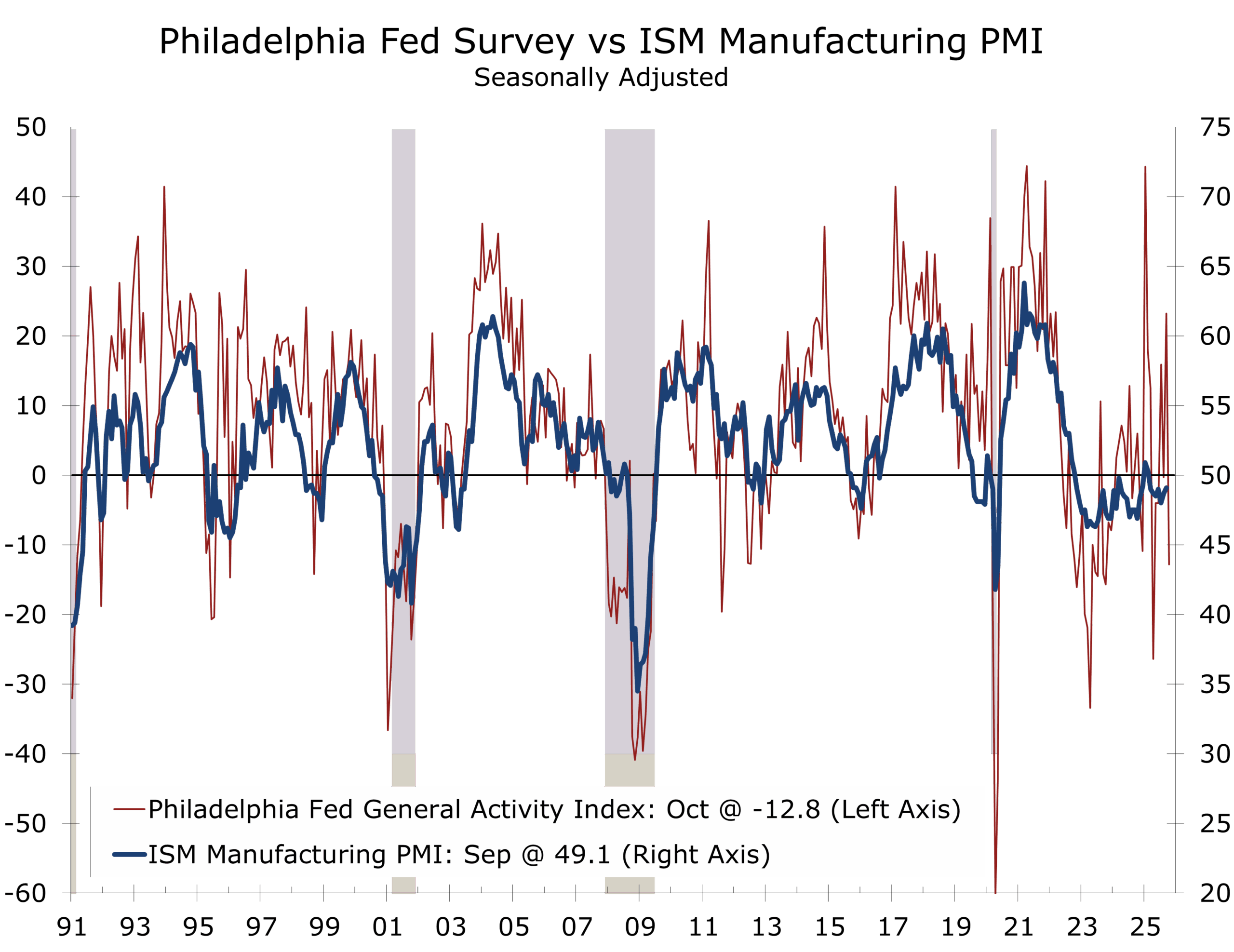
Housing – Waiting for Lower Rates to Take Root
Even as builders continue to grapple with elevated costs and macro uncertainty, sentiment in the single-family sector posted a meaningful uptick in October. The National Association of Home Builders/Wells Fargo Housing Market Index (HMI) climbed five points to 37 — the highest reading since April — as the sub-index for future sales expectations rose above the key 50-point breakeven threshold for the first time since January.
The improvement reflects two converging forces. Mortgage rates have edged down, with the 30-year fixed rate falling from just over 6.5 percent in early September to roughly 6.3 percent in early October, offering modest relief to strained affordability. At the same time, builders are positioning for a 2026 recovery, reporting firmer demand in premium and Sunbelt markets and a steady flow of well-capitalized buyers — including older, wealthier households driving remodeling and luxury activity. Yet most prospective buyers remain sidelined, awaiting more significant rate declines before re-entering the market.
Despite better sentiment, the market remains fragile. In October, 38 percent of builders reported cutting prices, with average reductions of 6 percent, while two-thirds offered sales incentives to preserve absorption rates. These tactics illustrate the sector’s bifurcation: strength in luxury and remodeling contrasts with persistent weakness in starter-home and turnover-driven segments. The NAHB estimates that single-family permits likely rose about 3 percent in September, despite the government shutdown delaying official Census data releases.
The broader outlook remains one of cautious optimism. Housing is unlikely to make a major contribution to GDP in 2025, but it is poised to regain momentum in 2026 as rates decline further and pent-up demand is released. For now, the economic spillovers are showing up in adjacent categories — furniture, appliances, home improvement, and repair services — rather than in new construction. The housing market, like the broader economy, is waiting for lower rates to take root — and once they do, it could set the stage for a glorious spring.
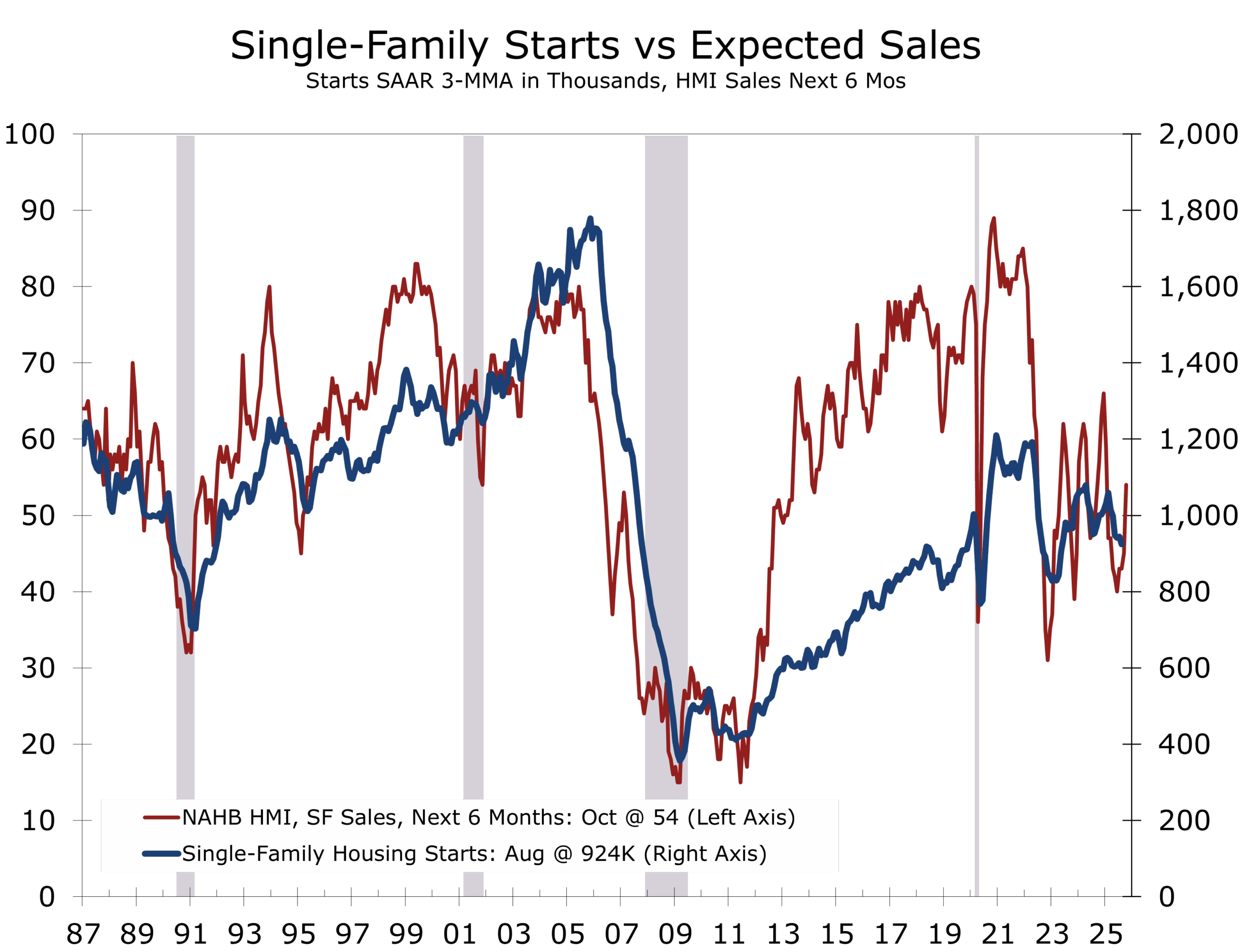
Inflation and Monetary Policy – Flying by Instruments
The latest inflation reading for August showed headline CPI up 0.4% month-over-month and 2.9% year-over-year, while core CPI rose 0.3% month-over-month and 3.1% year-over-year. Rent disinflation continues, but tariff-related goods prices and lingering auto supply bottlenecks have delayed a full return to target.
In a notable sign of the Fed’s priorities, the Bureau of Labor Statistics (BLS) recalled furloughed staff to complete the September CPI and rescheduled its release for October 24 — just days ahead of the Federal Open Market Committee (FOMC) meeting on October 29. That move highlights how essential the data are to policy direction: both to build internal consensus for a possible October cut and to preserve credibility with markets, calming volatility and helping anchor long-term yields.
Jerome Powell has signaled that the Fed is nearing the end of balance-sheet runoff “in the coming months,” marking a full pivot toward risk-management. Market expectations now price in two additional rate cuts by year-end (including October), consistent with easing inflation pressures and anchored expectations — as also shown by the National Federation of Independent Business (NFIB) survey’s moderation in wage growth and price intentions.
Volatility has eased as policy communication has become clearer. The Fed is now flying by instruments, guided by inflation expectations, credit conditions, and labor-market data rather than headline GDP. The divergence between core goods inflation (which remains elevated due to tariffs and supply constraints) and core services inflation (which continues to carry the bulk of sticky cost pressures but is also gradually easing as middle and lower-income consumers pull back discretionary spending) underscores the uneven nature of disinflation. Tariffs and supply frictions will likely keep core inflation hovering just above 2½% into 2026, but the overall trajectory remains benign enough for the Fed to ease policy cautiously while preserving market credibility.
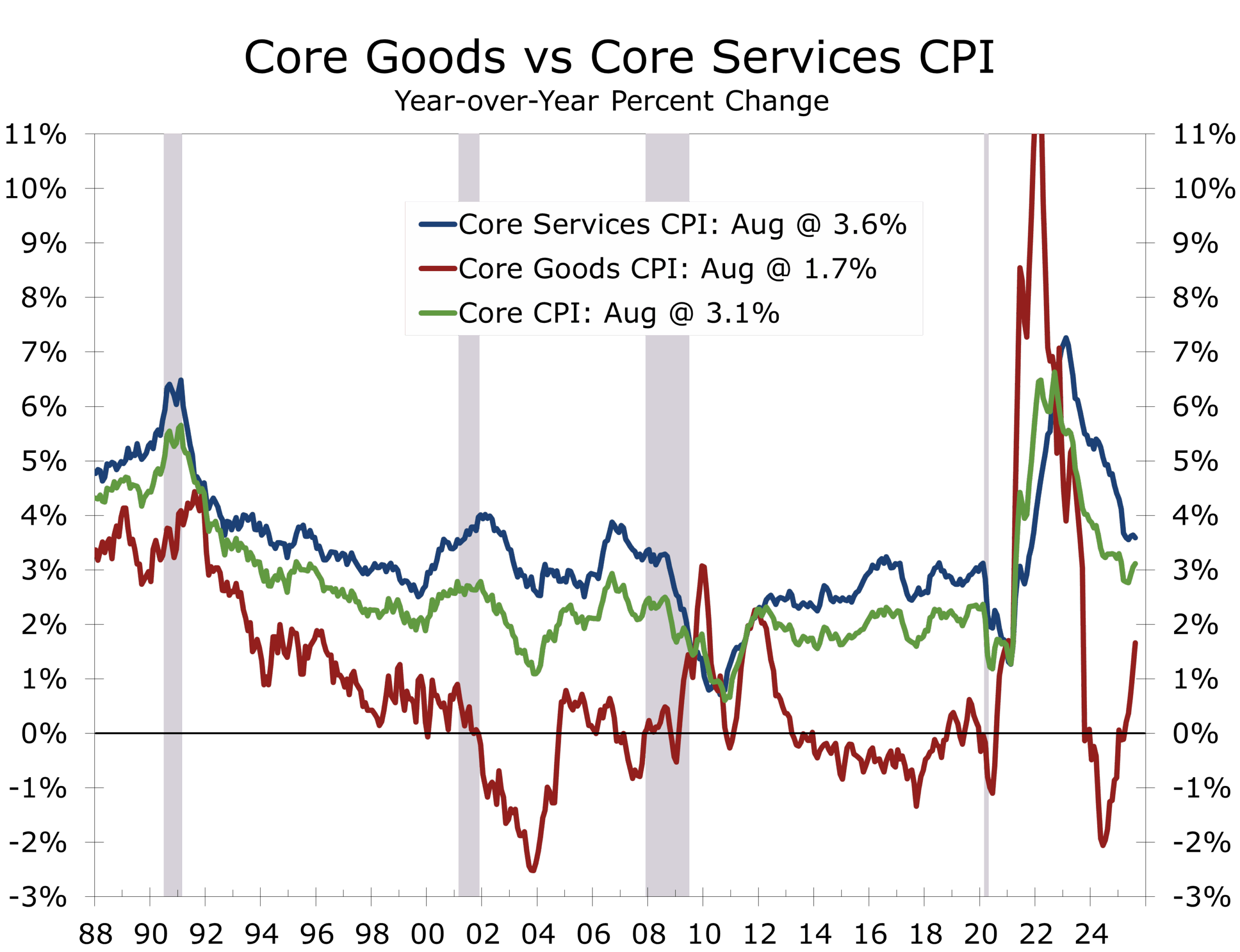
Financial Markets – Shifting Gears on the Climb
Markets are recalibrating as if on a long, steady climb — momentum slowing, cadence controlled. The S&P 500 recently touched an intraday record near 6,735, up roughly 1.1 % for the month and within sight of its all-time high. Gold surged past $4,300/oz, reaching a new milestone after a 60 % rally year-to-date, fueled by rate-cut expectations, a softer dollar, and unrelenting geopolitical crosswinds. Investors, like seasoned cyclists cresting a ridge, are pacing for endurance rather than acceleration.
Beneath that smooth surface, the gears of credit are grinding. The IMF’s $4.5 trillion estimate of bank exposure to hedge funds and private-credit vehicles underscores the growing entanglement between regulated and nonbank finance — a chain drive of leverage that is well-oiled in good weather but vulnerable to sudden strain. Floating-rate, covenant-lite loans from the 2020–21 vintage are now colliding with tighter funding conditions, creating a slow-motion stress test for private markets and smaller lenders alike.
Investor psychology is shifting accordingly. The flight toward duration and quality continues, with surveys showing over half of institutional investors expect gold to top $5,000/oz within a year — not just a hedge against inflation, but a bet on policy stability and system resilience. Credit spreads remain tight, and within that narrow peloton, Ba-rated corporates still offer the best risk-to-reward drafting position. Yet complacency lurks on the downhill: the private-credit boom increasingly evokes 2007, when leverage hid in plain sight and liquidity vanished just as the descent began.
In today’s markets, the winners are the riders who pace the climb. Steepeners beat sprinters. Patience, liquidity, and balance-sheet agility remain the key gear ratios for performance. With the yield curve still steep, policy credibility restored, and risk appetite re-aligning, long-duration Treasuries and high-grade spread assets remain best positioned for those who ride the course rather than chase the crowd.
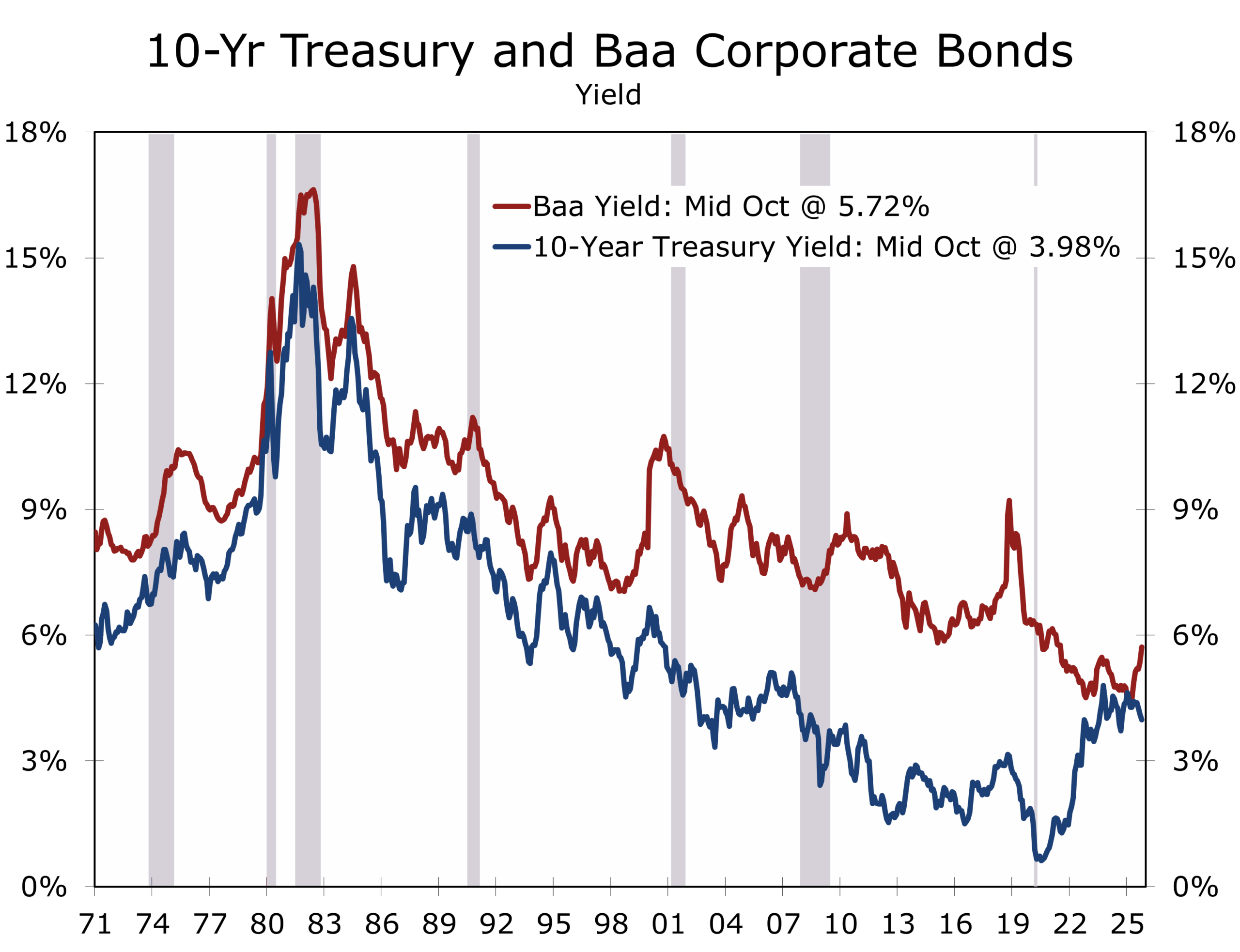
Geopolitics – Ceasefires, Stagecraft, and Supply Chains
Middle East: a truce on training wheels — The Hamas–Gaza Strip cease-fire is holding for now but remains fragile after weekend flare-ups and reciprocal allegations of violations. U.S. envoys are pressing both sides to recommit and preparing a “phase two” track. That said, core issues—Hamas disarmament, Israeli withdrawals, and the governance of Gaza—are still unresolved. For markets, the U.S.-brokered pause has reduced some energy risk premium, helping keep Brent around the low-$60s, after earlier trading sub-$60 on contentions of oversupply and logistical contango.
Trump–Zelensky: private heat, public cool. What likely happened? — Multiple credible outlets reported a contentious closed-door session in which Donald Trump pressed Volodymyr Zelensky to consider territorial concessions in the Donbas and warned of escalation by Vladimir Putin—even as the public press conference projected a measured tone and spoke of diplomatic “opportunities.”
Our read: Trump is negotiating on multiple fronts. His Middle East diplomacy feeds into the Russia-Ukraine axis, which in turn influences upcoming China talks. We believe the likely settlement will reflect the lines drawn today—rather than forcing Ukraine to relinquish more of the Donbas. If that fallback fails, we anticipate more sophisticated weapons transfers to Kyiv.
Energy diplomacy: calm by coordination, not coincidence — Simultaneously with the Gaza truce, Saudi pricing signals and incremental OPEC+ supply openings have aligned with softening demand data and a stronger dollar—together reinforcing the slide in crude. The upshot: Brent remains near $60 with a downside skew, provided surplus flows continue building.
U.S.–China: tariff détente on pause; controls tighten — Trade tensions remain under the surface but very active. Beijing expanded export controls on rare-earths, magnets and advanced manufacturing technologies—targeting inputs with as little as 0.1% China-origin content. Washington’s 100 % tariff threat remains suspended but not revoked, while new U.S. port fees due in coming years are nudging logistics costs higher. Net effect: supply chains are less brittle than during 2022-23 but are increasingly constrained for high-spec inputs.
Europe re-arms: risk and stimulus in one package — Defense spending keeps climbing and order backlogs are near historic highs—supporting capex cycles across aerospace, munitions, and sensors. The International Institute for Strategic Studies (IISS) documents a near-doubling of procurement since 2022; Fitch points to record backlogs boosting cash flow visibility. This is one of the rare geopolitical drivers that adds demand even while elevating headline risk.
Outlook – The Shape of Endurance
The U.S. economy is navigating an expansion on narrow but durable tracks. Growth remains stronger than expected, even as hiring loses pace and business confidence softens. The divergence reflects a structural transformation — an economy increasingly powered by capital-intensive industries rather than labor, by AI infrastructure, aerospace, and defense. Beneath the statistical noise, productivity is quietly rebuilding the foundation of growth. The challenge for policymakers is to recognize that this strength is real but uneven, and to calibrate policy easing without reigniting imbalances.
For now, the nation stands in a rare posture: robust overall growth, soft labor conditions, and a fading tariff-driven inflation flare-up that allows a gradual tilt toward easier policy. This equilibrium will not endure indefinitely, but it remains a favorable setup for both investors and households. As AI, aerospace, and affluent retirees reshape the composition of demand, the expansion is likely to moderate but remain structurally sound. The Fed’s task is to guide the economy through this labor-market deceleration without stifling renewal, preserving the potential for a lengthy, measured expansion.
Like the ancient olive trees of Puglia, the American economy draws its resilience from deep roots — free enterprise, property rights, innovation, and trusted financial markets. The winds may twist its branches, but not its foundations. Growth will bend but not break, and by the spring and early summer, the cycle is likely to show new shoots — evidence that endurance, not acceleration, remains the true measure of strength.
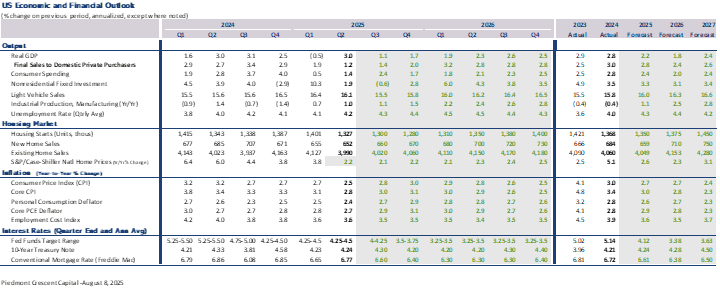
Disclaimer: This publication has been prepared for informational purposes only and is not intended as a recommendation offer or solicitation with respect to the purchase or sale of any security or other financial product nor does it constitute investment advice.
October 21, 2025
Mark Vitner, Chief Economist
704-458-4000