
February Retail Sales: : Broad-Based Rebound Masks Geopolitical and Tariff Headwinds
Consumer Spending Was Solid Ahead of the Iran War
- Retail sales rose 0.6% MoM in February 2026, a broad-based rebound following January’s upwardly revised –0.1% decline; the gain beat consensus estimates across all major categories.
- Core retail sales rose solidly. Sales excluding autos, gasoline, building materials, and restaurants rose +0.4% — the best reading since August 2025. Along with our estimate of services outlays, this points to a +0.6% nominal and +0.2% real increase in PCE for Februaryf.
- We have lowered our Q1 real GDP forecast by 0.1 percentage point to a 2.0% annual rate. Real PCE is tracking a 1.5% annualized gain in Q1, consistent with our previously published forecast. We expect growth to strengthen modestly in Q2 and to end the year with solid momentum.
- The U.S./Israel war with Iran will begin weighing on March data, as gasoline prices averaged approximately 75 cents per gallon higher than in February. The near-term buffer comes from income tax refunds, which are running +12.5% YoY — cushioning discretionary spending for another month or two.
- Import prices surged +1.3% in February, the largest monthly jump since March 2022, compressing real purchasing power — most acutely for lower- and middle-income households who face a disproportionate tariff burden.
- Our 2026 outlook remains essentially the same as was published in March. We see real personal consumption expenditures rising at just a 1.6% pace in the first half of 2026, but look for spending to rebound to a 2.1% pace in the second half, aided by larger tax refunds and lower energy prices.
Data Note
Source and Methodology
This report draws on the U.S. Census Bureau’s Advance Monthly Retail Trade Survey (MARTS) released April 1, 2026, covering February 2026 activity. The release was rescheduled from March 16 following a lapse in federal appropriations. All figures are seasonally adjusted and not adjusted for price changes unless stated. Oxford Economics/Haver Analytics commentary (April 1, 2026) provides the analysis of cumulative year-over-year tax refunds, which helped influence the forecast for personal consumption expenditures.
| +0.6%
Total retail & food services, MoM — February 2026 |
+0.4%
Control group (ex-auto, gasoline, building material, food services) — 6-month high |
| +1.5%
Real PCE, Q1 2026 annualized — consistent with prior forecast |
2.0%
Piedmont Crescent Capital Q1 real GDP forecast (annualized rate) |
The February Rebound: Sales by Category
February’s +0.6% gain was the broadest monthly advance since mid-2025. The increase was broad-based and includes gains in categories where spending was likely depressed by weather in January — automobiles and restaurants and bars in particular. The only two categories to register outright declines were furniture, which continues to be weighed down by elevated mortgage rates and weak existing-home sales, and grocery stores, where deflation in some food categories is depressing the nominal total. Motor vehicles drove the headline increase, but the control group’s +0.4% print — which strips out autos, gas, building materials, and food services — confirms that the underlying demand signal is broad and genuine.
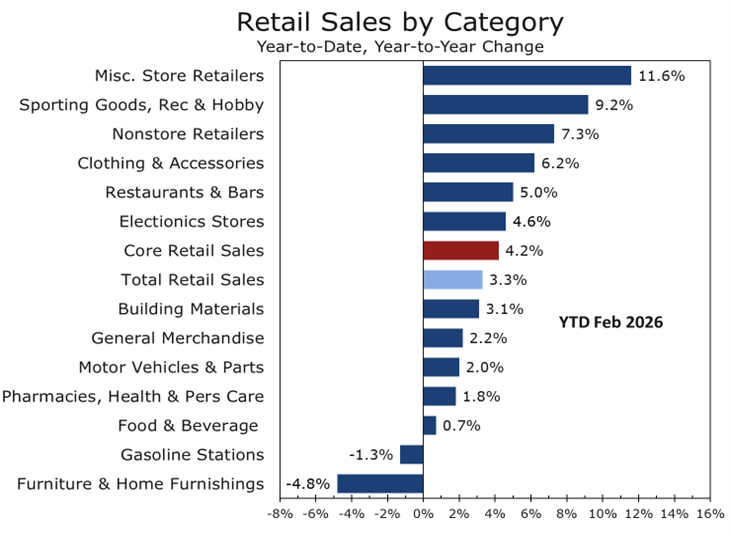
Full Category Breakdown — February 2026
| Category | MoM Change | YoY Change |
| Total Retail & Food Services | +0.6% | +3.2% |
| Control Group | +0.4% | +3.5% |
| Motor Vehicles & Parts Dealers | +1.5% | +2.8% |
| Food & Beverage Stores | –0.3% | +2.9% |
| General Merchandise Stores | +0.2% | +2.6% |
| Clothing & Accessories | +1.5% | +3.8% |
| Health & Personal Care | +1.7% | +4.5% |
| Nonstore Retailers (e-Commerce) | +0.8% | +10.9% |
| Food Services & Drinking Places | +0.5% | +4.2% |
| Gasoline Stations | +0.9% | –2.1% |
| Furniture & Home Furnishings | –1.0% | –0.4% |
| Electronics & Appliances | +0.3% | +1.8% |
| Building Materials & Garden | +0.8% | +2.3% |
Key Signal
Control Group at 6-Month High: PCE Pointing to +0.2% Real Gain in February
The control group — ex-auto, gasoline, building materials, and food service sales — rose +0.4% in February, its strongest reading since August 2025. Combined with our estimate of services outlays, this points to a +0.6% nominal and +0.2% real increase in PCE for February. For Q1 as a whole, real consumer spending is tracking an annualized rate of approximately 1.5%, consistent with our previously published forecast. This metric feeds directly into the BEA’s GDP consumption estimate and is the single most important data point in the retail report for near-term GDP tracking.
Forces Shaping the Consumer Outlook
The February retail print is constructive at face value. However, three forces are converging to pressure consumer spending through the spring and into summer: the U.S./Israel war with Iran and the attendant energy price shock, continuing tariff passthrough into consumer goods prices, and a bifurcation in real income growth that is concentrating spending gains at the upper end of the income distribution. Recent financial market volatility and disruptions around spring break travel may also sideline some discretionary spending by upper-income households in the near term.
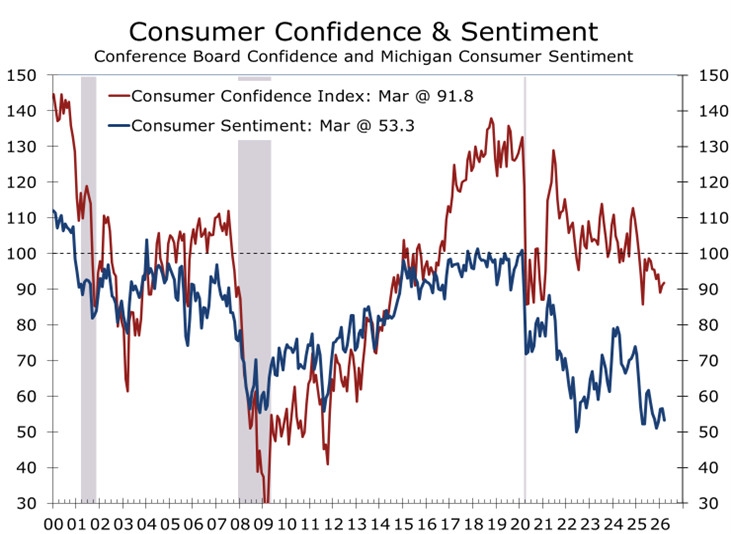
Consumer confidence data presents a mixed picture. The University of Michigan Consumer Sentiment Index has plummeted in recent months, while the Conference Board Consumer Confidence measure has shown more resilience. We suspect that concerns about rising gasoline prices and uncertainty about what the war’s implications for supply chains and inflation will weigh on actual spending this spring, even among households whose balance sheets remain relatively healthy.
The War with Iran: A More Immediate Risk to Consumer Spending
The U.S./Israel war with Iran introduces a risk that is more immediate in its consumer spending impact than tariff pressures. Gas prices averaged approximately 75 cents per gallon higher in March compared to February — a swift, regressive increase in household energy costs. Higher energy prices should become evident in the March retail sales data, with spending on durable goods and discretionary services bearing the brunt of the adjustment. We left our consumption forecast unchanged, however, as we had already assumed a substantial pullback in spending would take hold in March and persist through much of the second quarter.
The near-term impact is cushioned by a powerful, if unusual, buffer: income tax refunds. Refund issuance is running approximately +12.5% YoY through late March, a notable departure from the typical pattern in which the YoY increase peaks early in the filing season and then fades. The One Big Beautiful Budget Act is expected to generate a jump in refund issuance of approximately 20% for the full year. Crucially, the increase is occurring more gradually than usual, meaning a disproportionate share will accrue to upper-income households who tend to file later in the season.
| Risk Factor
War and Tariffs: Twin Pressures Compressing Real Spending Power Import prices jumped +1.3% in February 2026 — the largest monthly increase since March 2022 — even before the Iranian war’s energy price shock has fully registered. Gasoline prices will likely remain elevated through Memorial Day, weighing on consumer spending through at least mid-Q2. The Yale Budget Lab estimates current tariffs represent a 9.8–13.7 percentage point increase in the effective U.S. tariff rate, the highest since 1941, creating an effective cost burden of $600–$1,300 per household annually. Lower-income cohorts bear approximately three times the proportional tariff burden of top-decile earners, underscoring the regressive nature of the combined energy and trade policy shock. |
The Tax Refund Buffer: Buying Time, Not Immunity
The unusual pattern of tax refund issuance is central to understanding why consumer spending has held up despite sharply deteriorating sentiment and rising energy costs. In a typical year, the YoY increase in cumulative refund issuance peaks early in the filing season — when lower-income households, who tend to file first, receive their refunds — and then gradually fades. In 2026, the opposite is occurring: the YoY increase has been rising through late March, reaching approximately +12.5% compared to the same period in 2025.
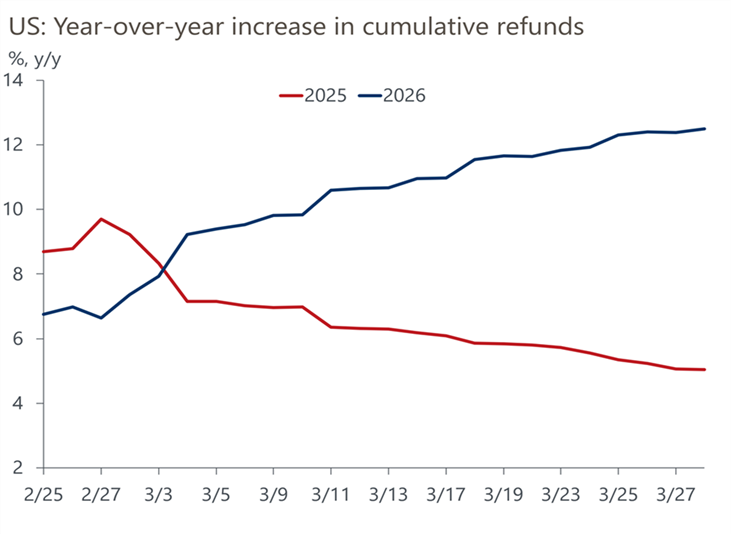
This pattern has significant distributional implications. A disproportionate share of the 2026 refund increase will accrue to upper-income households who file later in the season. The One Big Beautiful Budget Act created a structural increase in refund issuance estimated at approximately 20% for the full year. Higher-income filers receiving larger-than-normal refunds is providing support for spending in premium retail and warehouse-club formats even as lower-income cohorts face simultaneous tariff, energy price, and food inflation pressures. This dynamic reinforces the K-shaped character of the current consumer environment: aggregate spending metrics hold up reasonably well, while conditions for a large share of American households are materially more difficult.
The structural shift toward e-commerce continues to shape the distribution of retail gains. Nonstore retailers posted +10.9% YoY growth in the latest reading, maintaining substantial outperformance over brick-and-mortar formats. Q4 2025 e-commerce reached $316.1 billion seasonally adjusted — equivalent to 16.6% of total retail sales, up from 15.8% a year earlier. This channel shift has important implications for commercial real estate, logistics infrastructure, and labor demand across the retail sector.
| Structural Context
E-Commerce and Income Bifurcation Are Reshaping the Retail Landscape Full-year 2025 U.S. e-commerce totaled approximately $1.23 trillion, up +5.4% from 2024. NRF data indicate that the top 10% of earners now account for approximately 50% of all U.S. consumer spending. Clothing (+1.5% MoM) and health and personal care (+1.7% MoM) led the February gains, categories that skew toward higher-income consumers. Meanwhile, furniture (–1.0% MoM) and grocery stores (–0.3% MoM) — categories more broadly consumed across the income distribution — were the only segments to register outright declines. These divergences will likely widen as the energy price shock from the war with Iran takes hold in coming months. |
Conclusion: Consumer Resilience in a Crosscurrent Environment
The February 2026 Advance Retail Sales report underscores the fundamental resilience that has characterized U.S. consumer spending throughout this economic cycle. A broad-based +0.6% headline gain, a six-month high in the control group measure, and an Oxford Economics PCE nowcast pointing to +0.2% real consumer spending growth confirm that the January weakness was weather-driven rather than structural. The consumer entered the spring in solid shape.
Our assessment of Q1 GDP and the near-term outlook remains constructive. Real PCE is tracking a 1.5% annualized rate in Q1 2026, consistent with our previously published forecast, and underpins our Q1 real GDP forecast of 2.0% annualized. We expect growth to strengthen modestly in Q2 as the tax refund buffer continues to support upper-income spending, and we look for the economy to end 2026 with solid momentum as energy prices gradually recede and real incomes recover.
| Never Underestimate the American Consumer
“The American consumer has repeatedly defied expectations of a meaningful slowdown. Despite declining sentiment, rising energy costs, and the cumulative weight of tariff-driven price increases, aggregate spending has remained positive. February’s broad-based rebound reinforces our view that the structural foundation of consumer spending — employment, income growth, and household net worth — remains sufficiently intact to sustain positive growth through 2026.” — Mark P. Vitner, Chief Economist, Piedmont Crescent Capital |
Three considerations shape our near-term outlook. First, the energy price shock from the war with Iran will be visible in the March retail data, and we expect it to restrain discretionary spending through at least Memorial Day. Second, the tax refund buffer — while real and meaningful — is a stock rather than a flow; once deployed, households will face the underlying pressures of elevated goods prices and rising energy costs without this cushion. Third, the coincidence of tariff passthrough and energy inflation creates a compounding price burden that falls most heavily on lower- and middle-income consumers, limiting the breadth of any spending recovery.
| The Economy Keeps Chugging Along, Despite Significant Drags from the War and Tariffs
“We are maintaining our forecast for Q1 real GDP growth of 2.0% annualized, supported by a 1.5% annualized gain in real consumer spending and 4.7% rise in business fixed investment. Looking ahead, we expect growth to strengthen modestly in Q2 as refund-supported spending by upper-income households partially offsets the energy price drag, and to build further into year-end as oil prices gradually recede and real household income growth resumes a more supportive trajectory. The full year is shaping up to be one of moderate but durable expansion.” — Mark P. Vitner, Chief Economist, Piedmont Crescent Capital |
Key data releases to monitor: March retail sales (April 16) will provide the first direct measure of the war’s impact on consumer spending; the Q1 GDP advance estimate (April 30) will confirm whether the February control group strength flowed through to final demand; April CPI will indicate the velocity of energy and goods price passthrough; and the Federal Reserve’s May communications will clarify whether policymakers intend to ‘look through’ the war- and tariff-driven inflation or respond to it.
mark.vitner@piedmontcrescentcapital.com
(704) 458-4000
April 1, 2026
Disclaimer: This publication has been prepared for informational purposes only and is not intended as a recommendation offer or solicitation with respect to the purchase or sale of any security or other financial product nor does it constitute investment advice.
April 1, 2026
Mark Vitner, Chief Economist
(704) 458-4000

Home Prices: Losing Momentum, but Still Rising, and Splitting Along Regional Lines
Key Takeaways
-
- Home price appreciation continued to decelerate in early 2026, with both S&P CoreLogic Case-Shiller Home Price Index and FHFA House Price Index showing low-year-to-year single-digit gains.
- Monthly momentum is soft. Prices are drifting higher on a seasonally adjusted basis but slipping slightly on an unadjusted basis.
- Regional divergence has widened. The Midwest and Northeast are now leading, while several Sun Belt markets are flat to declining. Florida is a notable soft spot.
- Real home prices are falling modestly as inflation runs ahead of nominal appreciation.
- The housing market remains constrained by affordability. Higher mortgage rates are offsetting any benefit from slower price growth.
Price Growth Is Positive, But Fading
January’s data reinforces a theme that has been building for several quarters: the housing market has cooled but the overall supply of homes for sale remains tight, which is supporting home prices.
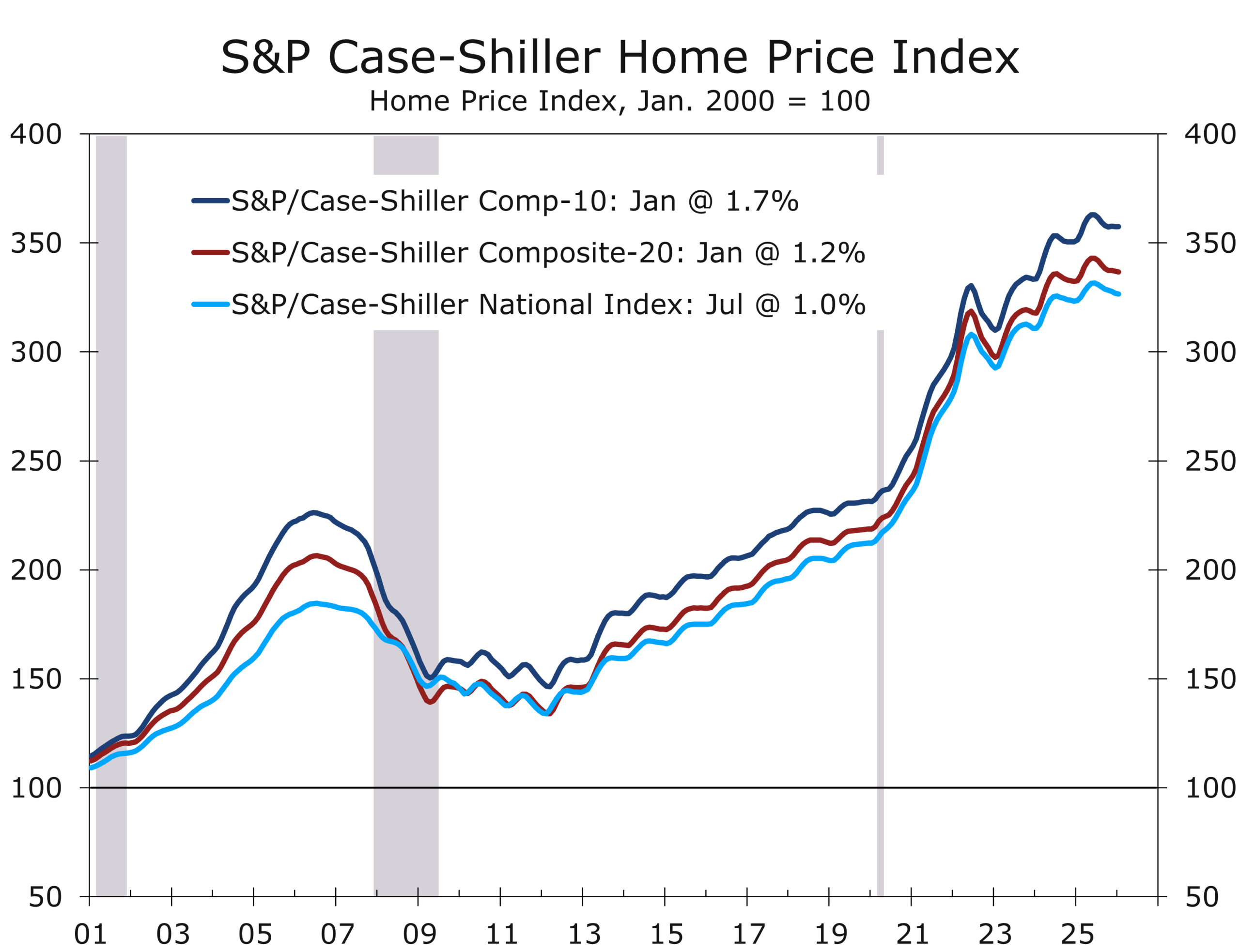
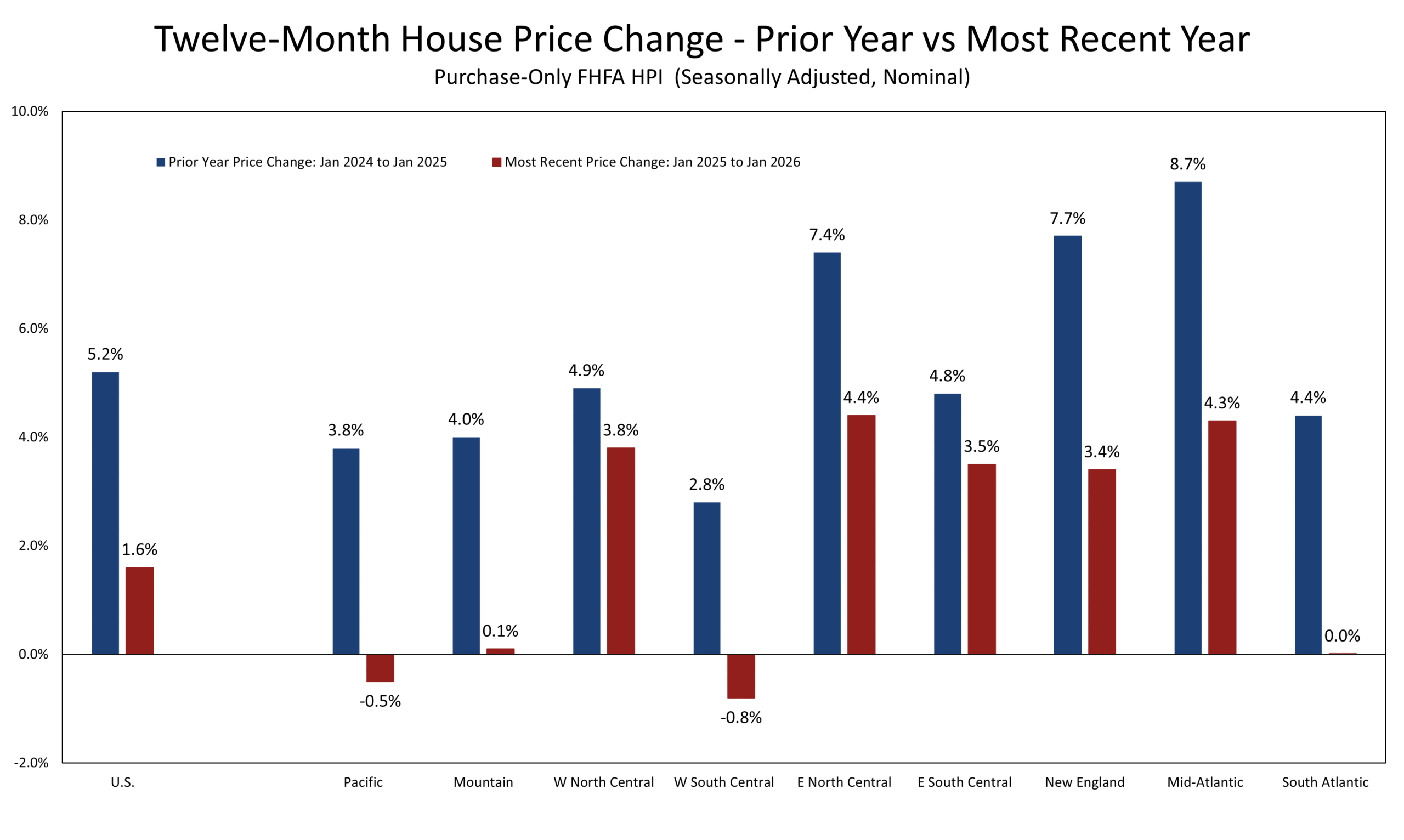
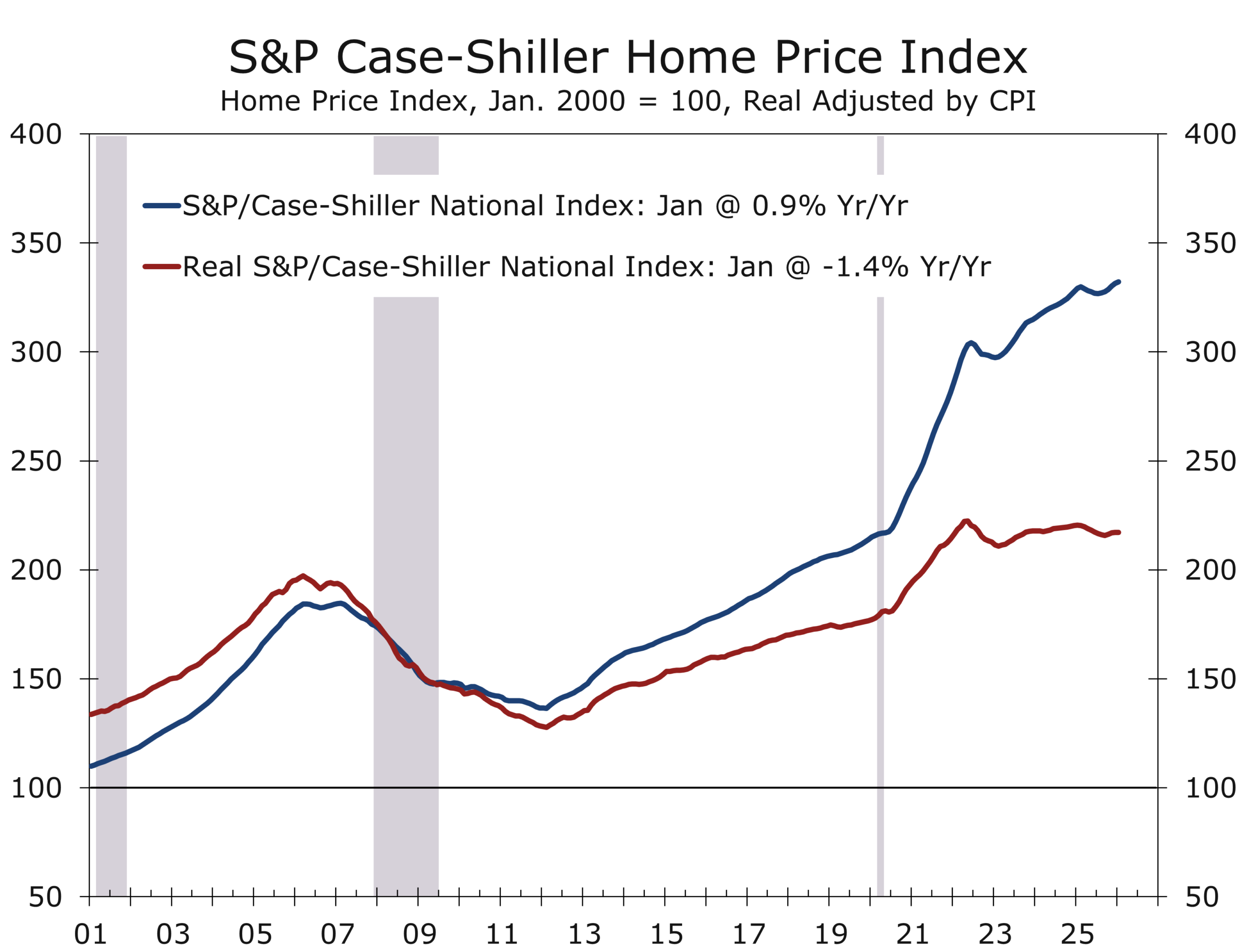
The S&P CoreLogic Case-Shiller Home Price Index rose 0.9% year over year in January, down from 1.1% in December. The 10-city and 20-city composites slowed to 1.7% and 1.2%, respectively. The FHFA House Price Index showed a similar pattern, rising 1.6% year over year, with a modest 0.1% monthly gain.
The signal is clear. Home prices are still rising, but only marginally. The market has shifted from strong price appreciation to something closer to stall speed as demand remains constrained by affordability constraints and a weaker job market
Nominal home price appreciation has slowed enough that inflation is now outpacing home prices.
On a monthly basis, the Case-Shiller national index declined slightly on a non-seasonally adjusted basis and rose just 0.2% after seasonal adjustment. FHFA reported a similarly modest 0.1% increase.
This is not the profile of a market under stress. It is the profile of a market constrained to the point that it is stalling. Buyers are sensitive to monthly payments, not just prices, and the recent back up in mortgage rates has likely caused many would-be buyers to pause.
The result is a low-velocity market. Transactions are limited, inventories are gradually rising off historically low levels, and prices are drifting rather than moving decisively in either direction.
Regional Divergence Is Now the Defining Feature
Variations in regional price performance offer confirming evidence on the most recent Census data, which should population growth remaining strong Texas, the Mountain West and the Southeast, with the exception of Florida. The Midwest is showing more resilience, as housing is relatively more affordable compared to other regions. New York’s prices reflect the full return to the office amid a scarcity of homes available for sale.
In the Case-Shiller 20-city index, New York, Chicago, and Cleveland posted the strongest gains, while Tampa remained firmly negative year-over-year. Prices were flat or down in several formerly high-flying Sun Belt markets, including Phoenix, Dallas, and Seattle.
Leadership has shifted from Sun Belt hot spots to the Midwest, Northeast, and more affordable parts of the South.
FHFA’s regional data tell the same story. The East North Central division posted the strongest annual gains, while West South Central, which includes Texas, was negative. The East South Central, which includes Tennessee and Alabama, shows more resilience, however.
The pandemic-era leaders are no longer carrying the market. Instead, price growth has rotated toward regions where affordability remains less strained, and valuations did not overshoot as dramatically.
Real Prices Are Quietly Declining
With the CPI running above the pace of home price appreciation, inflation-adjusted values have edged lower over the past year. This marks a notable shift from the prior two years, when housing was a primary driver of household wealth gains.
Real home prices are declining modestly, even as nominal prices remain positive.
This adjustment is doing some of the work that outright nominal declines would otherwise accomplish. It is easing valuation pressures, albeit slowly and unevenly.
Despite the moderation in price growth, affordability has not meaningfully improved. Mortgage rates remain elevated, and in recent weeks have moved higher alongside Treasury yields. That keeps monthly payments high and limits the pool of qualified buyers.
This dynamic explains why slower price growth has not translated into stronger activity. The constraint is not price levels alone, but the cost of financing those prices. The market is caught between two forces: limited supply from rate-locked homeowners and constrained demand from payment-sensitive buyers.
Disclaimer: This publication has been prepared for informational purposes only and is not intended as a recommendation offer or solicitation with respect to the purchase or sale of any security or other financial product nor does it constitute investment advice.
March 31, 2026
Mark Vitner, Chief Economist
(704) 458-4000
A Breaking Population Wave: MSA Population Growth in 2024–25: Overall Deceleration, the Immigration Inflection, and a Historic Redistribution of Wealth
Key Takeaways
- Metro Growth Rate: Fell from 1.1% (2023–24) to 0.6% (2024–25) — the sharpest single-year deceleration of the post-pandemic period, with metros adding only 1.7M residents vs. ~3.2M the prior year.
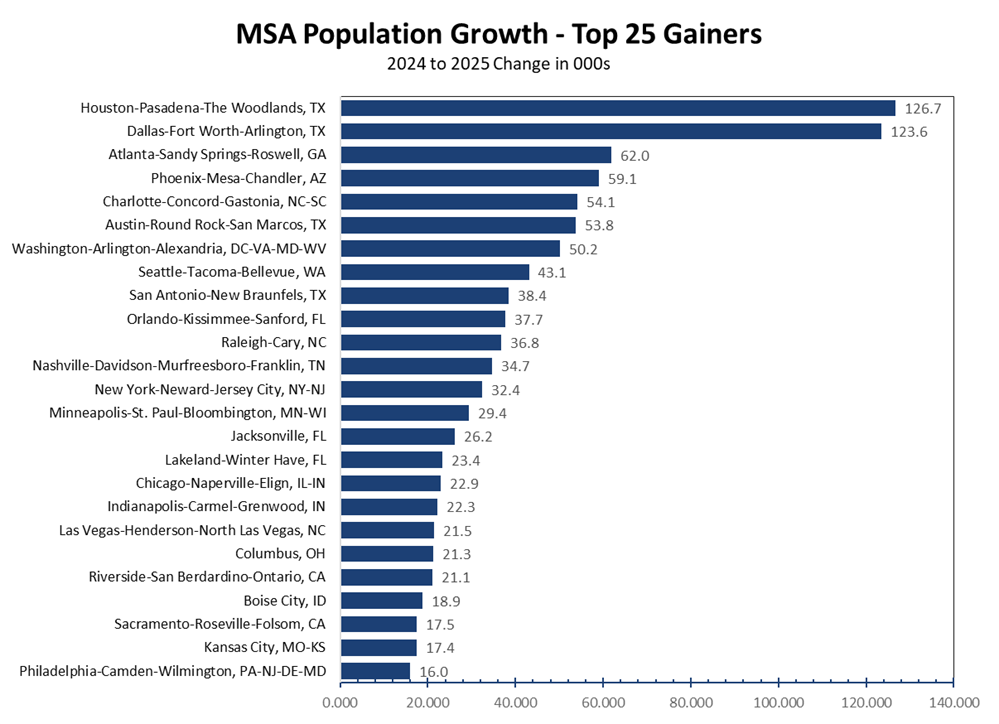
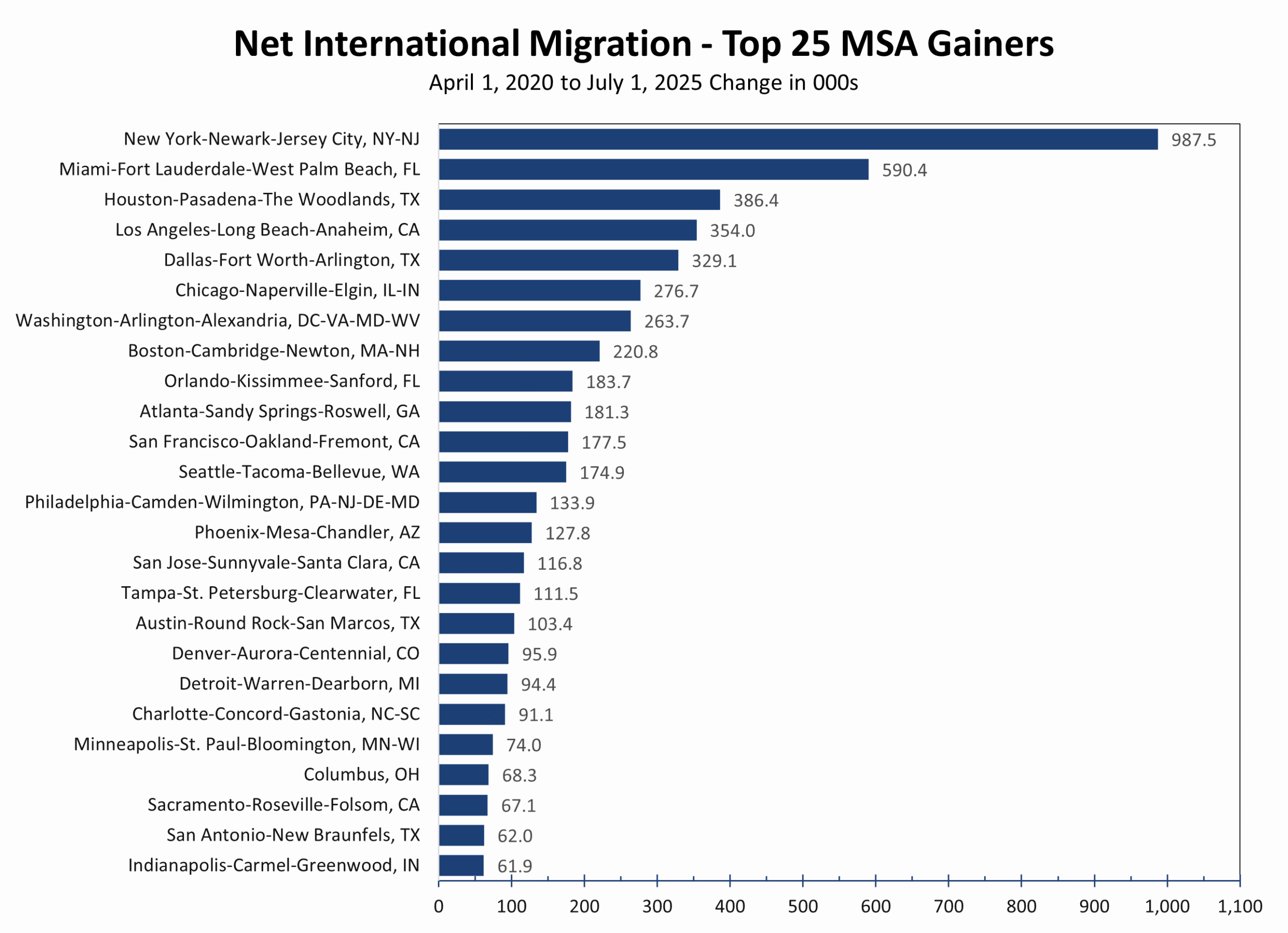
- Top Numeric Gainers: Houston, Dallas-Fort Worth, Atlanta, Phoenix, Charlotte — all in the South/Sun Belt corridor. Texas alone claimed four of the top nine metros by numeric gain..
- Top % Growth: Ocala, Myrtle Beach, Spartanburg, Lakeland, Punta Gorda, Huntsville — smaller markets riding domestic inflows as primary Sun Belt hubs fill in and costs rise..
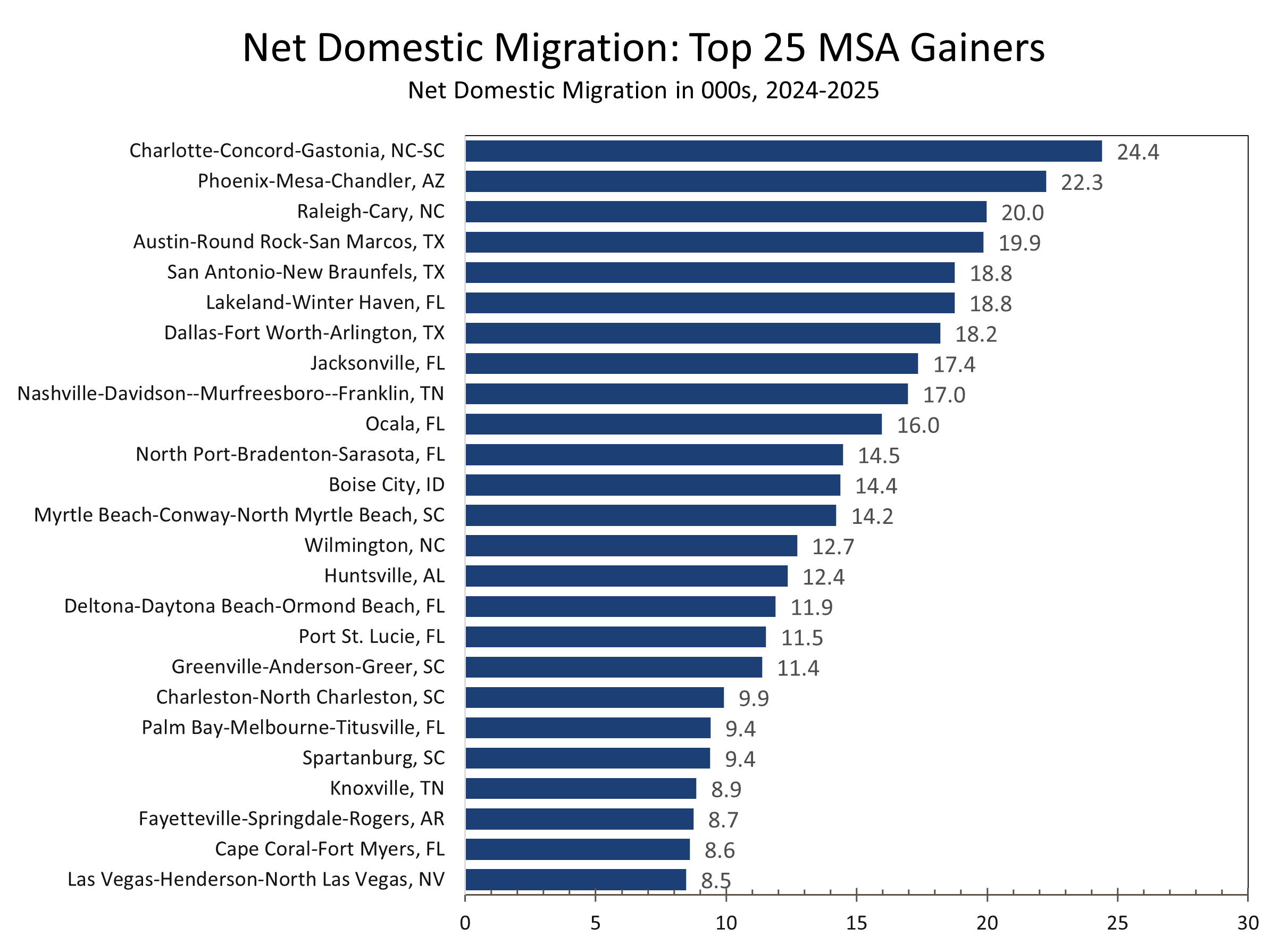
- Domestic Migration: Charlotte led all 387 MSAs in net domestic in-migration; Phoenix, Raleigh, Austin, San Antonio follow. NC ranked 3rd nationally in IRS net migration (79,317 individuals on 40,999 returns).
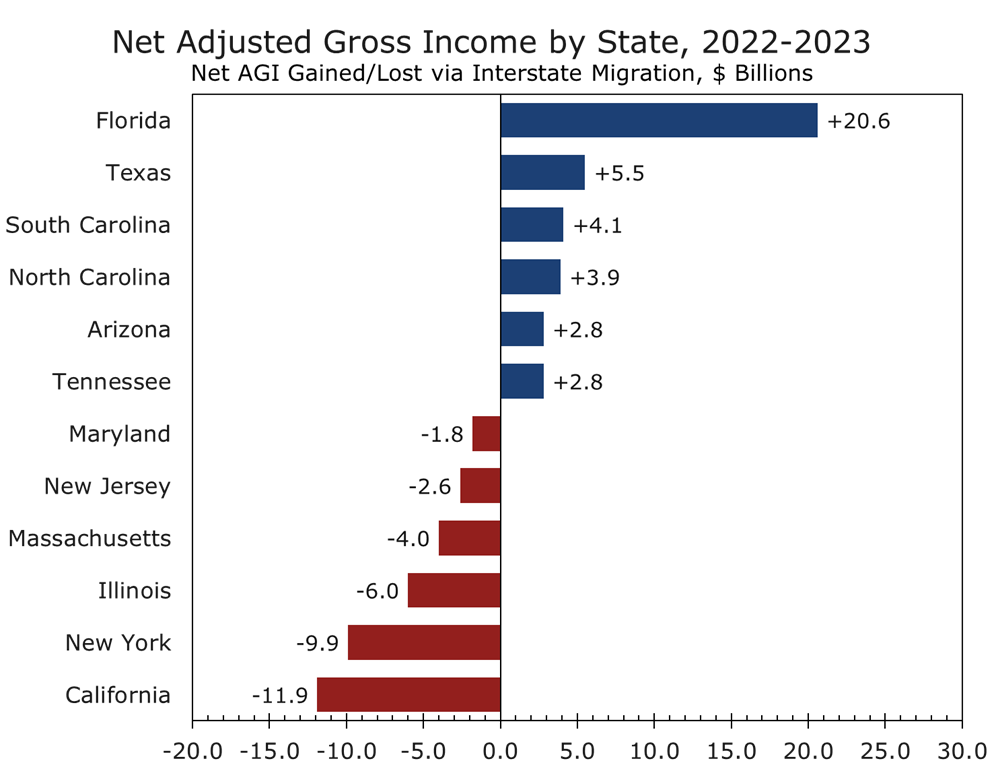
- Wealth Redistribution: IRS data confirm this is not just a headcount story: NC gained $3.9B and SC gained $4.1B in net AGI in 2022–23. The Carolinas combined captured $8.0B — trailing only Florida and Texas. NY lost $9.9B. CA lost $11.9B..
- Gateway Metros: Los Angeles, Miami-Dade, and the NYC metro are losing population or stagnating as immigration recedes. New York fell from 1st to 13th in numeric gains in a single year..
- Border MSAs: Laredo (3.2%→0.2%), Yuma (3.3%→1.4%), El Centro (1.2%→-0.7%) — sharpest growth-rate collapses; these border markets lead the national immigration trend by 6–12 months.
- Piedmont Corridor: Charlotte, Raleigh-Durham, and the resurging Piedmont Triad form one of the most durable growth corridors in the Southeast, confirmed by both Census headcount and IRS income-flow data.
- Key Risk: Nine of ten U.S. counties recorded lower net international migration in 2024–25. The trend is accelerating under the current enforcement policy and will take 12–24 months to fully manifest.
Data Note: This report draws on two complementary datasets released in March 2026: (1) U.S. Census Bureau Vintage 2025 population estimates, which measure headcount migration through July 2025; and (2) IRS Statistics of Income (SOI) Migration Data for Filing Year 2022–2023, which captures AGI flows, household counts, and migrant age profiles. Together they provide both the current population trajectory and the income quality of the migration.
The Wave Has Broken
Population growth is among the most consequential first-order economic variables in any analytical framework. It shapes labor supply, household formation, and long-run consumer demand. The latest Census Bureau data (the Vintage 2025 estimates released in March 2026) make three things clear: the post-pandemic surge in metropolitan area growth is over, the deceleration is broad-based, and the geography of American expansion is narrowing. The IRS’s newly released migration data for 2022–23 reveal a crucial second dimension: the people who are moving are not a random cross-section of the population. They are disproportionately working-age and above-median income — and where they go, economic capacity follows.
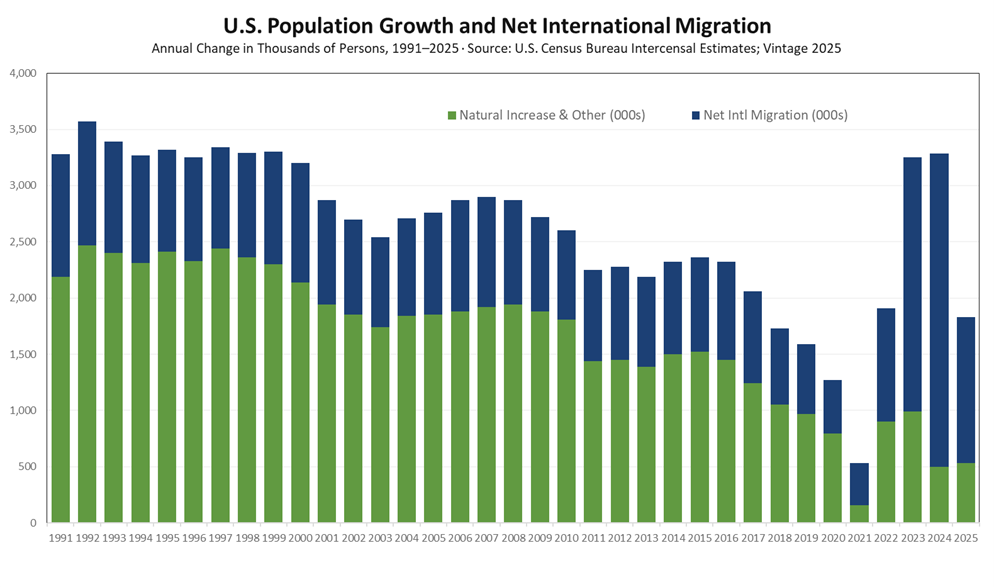
Metro areas as a whole grew 0.6% between July 2024 and July 2025, exactly half the 1.1% rate recorded in the prior year. In absolute terms, U.S. metros added roughly 1.7 million residents, down from nearly 3.2 million the year before. That comparison captures the scale of the deceleration. Growth did not just slow; it was cut in half.
| 0.6%
Metro area population growth rate, 2024–25 — half the prior year’s 1.1% pace |
1.7M
Net new metro residents added in 2024–25, down from 3.2M the prior year |
The proximate cause is well-documented: net international migration (NIM) collapsed. Nine out of ten U.S. counties recorded lower NIM in 2024–25 than in 2023–24; the remaining tenth saw essentially no increase. The Biden administration began tightening border security in the second half of 2024, and enforcement tightened considerably further under President Trump. Border metros felt it first and most acutely, but the effect has radiated outward to nearly every major immigration hub in the country.
What makes this cycle particularly instructive is the contrast with 2023–24. That year, post-pandemic normalization of global mobility produced an unusually large immigration surge — approximately 2.7 million net international migrants flowing into metro areas alone. That surge temporarily reversed population losses in several major gateway metros that had been bleeding residents for years. New York, Los Angeles, Chicago, San Francisco, Washington, Miami: all posted gains. For many, that story read like a comeback. It was not. The reprieve was a temporary bridge, and that bridge has now been removed.
What lies beneath that bridge is the structural reality many large gateway cities had been deferring: persistent domestic outmigration that immigration was masking but not curing.
Three Forces, One Direction
Population change in any MSA is the arithmetic sum of three components: net international migration, net domestic migration, and natural increase (births minus deaths). Understanding 2024–25 requires understanding what each is doing — and why the balance has shifted so decisively.
International Migration: The Dominant Variable, Now Contracting
NIM has been the swing factor in U.S. metro growth since the pandemic ended. Its rise from 2022 to 2024 inflated national growth rates and masked divergences between metros that were organically healthy and those merely benefiting from their geography as immigrant entry points.
The contraction now underway is structural, not cyclical. Tighter border enforcement has reduced new arrivals. Elevated deportation activity and the chilling effect on would-be migrants compound this. The Census Bureau’s own demographers flagged border metros as the clearest leading indicator: Laredo’s growth rate fell from 3.2% to 0.2% in a single year. Yuma dropped from 3.3% to 1.4%. El Centro went negative at -0.7%. These are not rounding errors — they are collapses.
| Border Metro Collapse: A Leading Indicator
The three sharpest single-year growth-rate declines among all U.S. MSAs are in border communities: Laredo (−3.0 ppts), Yuma (−1.9 ppts), and El Centro (−1.9 ppts, now shrinking). These markets lead the national trend by 6–12 months. What is happening at the border today will be visible in gateway metro data by mid-2026. |
Gateway metros saw the same dynamic play out at larger scale. Miami-Dade — the second-largest county gainer in the entire country in 2023–24 — lost more than 10,000 residents in 2024–25. Many residents are simply moving to other parts of South Florida, however, particularly Broward and Palm Beach counties. Los Angeles County continued its decade-long decline. New York City, which had briefly re-entered growth mode on immigration inflows, resumed contraction. The data reflect only the early phase of tighter enforcement; the full effect will take 12 to 24 months to fully manifest.
One facet of immigration often overlooked — and that is essential for correctly reading the domestic migration data in the next section — is that a person is counted as an immigrant when they first relocate to the country. When they subsequently move from their initial landing spot (typically one of the nation’s largest gateway cities) they appear in the data as a domestic out-migrant from that area. This secondary dispersal is one reason most large gateway metros have recorded persistent domestic outflows even during periods of strong overall immigration. It also means the domestic outmigration figures for cities like New York and Los Angeles understate the degree to which those metros’ populations have become dependent on continuous fresh immigration just to hold their footing.
Domestic Migration: Where the Real Votes Are Cast — and the Money Follows
Net domestic migration is one of the most revealing signals in demographic data. It reflects active, discretionary decisions by households, people choosing to leave one place and move to another. It responds to wages, housing costs, tax burdens, labor market conditions, and quality of life. And as the newly released IRS data make clear, what is migrating is not just population — it is purchasing power, tax base, and entrepreneurial capital.
The Census Bureau counts tell part of the story: the country’s fifty most populous counties collectively lost 637,634 residents to domestic outmigration in 2024–25. But the IRS data for 2022–23 tell us what those people earned. California lost $11.9 billion in net adjusted gross income (AGI) to outmigration — the largest income loss of any state. New York lost $9.9 billion. Illinois shed $6.0 billion. Massachusetts lost $4.0 billion. New Jersey, $2.6 billion. These are not budget rounding errors; they are structural fiscal wounds that compound annually.
| -$11.9B
California net AGI lost to outmigration, 2022–23 |
-$9.9B
New York net AGI lost to outmigration, 2022–23 |
| -$6.0B
Illinois net AGI lost to outmigration, 2022–23 |
-$4.0B
Massachusetts net AGI lost to outmigration, 2022–23 |
On the receiving end of these flows, the picture is equally clear. Florida gained $20.6 billion in net AGI — the largest income gain of any state. Texas gained $5.5 billion. North Carolina gained $3.9 billion, and neighboring South Carolina added $4.1 billion. Tennessee captured $2.8 billion. Arizona gained $2.8 billion. The directional pattern is consistent, persistent, and policy-linked: states with lower tax burdens, more competitive regulatory environments, and a more cooperative relationship between business, government, and labor are capturing income, investment capital, and the entrepreneurial activity that accompanies high-earning households.
| +$20.6B
Florida net AGI gained from in-migration, 2022–23 |
+$5.5B
Texas net AGI gained from in-migration, 2022–23 |
| +$4.1B
South Carolina net AGI gained, 2022–23 |
+$3.9B
North Carolina net AGI gained, 2022–23 |
Massachusetts offers a particularly instructive case study in policy-driven migration. In 2022, the state enacted a 4% tax surcharge on income exceeding $1 million, raising its top marginal rate to 9%. In the subsequent filing year, taxpayers earning more than $200,000 accounted for 70% of the state’s net outflows — roughly double their share in 2019. New Hampshire, the state’s zero-income-tax neighbor, captured nearly $900 million of that income directly from former Massachusetts filers. Washington state offers a comparable cautionary tale: after enacting a 7% capital gains tax in 2021, the state shifted from being one of the country’s largest income gainers to recording a net outflow of approximately $500 million in 2022–23.
| The High-Earner Flight Premium
Among taxpayers with $200,000 or more in AGI, the most attractive destination states in 2021–22 were Florida, Texas, North Carolina, South Carolina, and Arizona. The least attractive: California, New York, Illinois, Massachusetts, and New Jersey. Florida alone gained 29,771 affluent filers in a single year — adding $28.7 billion to its AGI base. California lost 24,670 of them, removing $16.1 billion. The migration of high earners is not incidental to the reallocation; it is the dominant driver of it. |
Charlotte led all 387 metro areas in net domestic in-migration in the Census data. The IRS data provide the income context behind that ranking. North Carolina ranked third nationally in net IRS migration with 79,317 individuals on 40,999 returns in 2022–23, trailing only Florida and Texas. Critically, 55.4% of those arriving in North Carolina were between the ages of 26 and 44 — prime working-age, household-formation years. These are not retirees or students; they are earners, spenders, and taxpayers arriving in concentrated form. This age and income profile makes North Carolina an unusually attractive destination for employers seeking skilled labor in a tight market, and for builders and retailers tracking where household formation demand will concentrate over the next decade.
Natural Increase: Stabilizing, Not Driving
Natural increase (the excess of births over deaths) contributed roughly 614,000 to metro population in 2024–25. That figure has improved from the pandemic low, when mortality spiked and fertility was suppressed. But approximately 65% of U.S. counties still experience natural decrease — more deaths than births — reflecting the ongoing aging of the baby boom cohort. Natural increase can pad the growth calculation; it is not the engine.
| Natural Increase: A Floor, Not an Engine
65% of U.S. counties record more deaths than births annually — a figure that has held steady for three consecutive years. Natural increase contributes roughly 614,000 metro residents per year nationally, cushioning the deceleration but unable to offset the loss of 2+ million in annual NIM. The math improves with younger in-migrant populations, which is precisely why the IRS age data matters: domestic migration destinations are receiving disproportionately young, working-age arrivals who will improve natural increase over time. |
Where Growth Is Actually Occurring – Absolute Leaders: Scale Compounds
In terms of raw numeric growth, the top MSAs reinforce a now-familiar hierarchy. Houston led all metro areas in 2024–25, followed by Dallas-Fort Worth, Atlanta, Phoenix, and Charlotte. Together, these five markets account for a disproportionate share of net new metro population, and Texas alone had four of the top nine fastest-growing metros by population.
Houston deserves particular mention. It is one of the few large metros where international migration remains robust even as the national trend weakens: a reflection of its longstanding role as a major immigrant destination tied to energy, medicine, and international trade. That combination of strong domestic inflows and continued immigration makes Houston’s growth profile more resilient than most peers at its scale.
Dallas-Fort Worth continues its trajectory as one of the great economic absorbers of the American economy, drawing corporate relocations, logistics investment, and a steady stream of working-age migrants from the coasts. Dallas has been the biggest winner from the out-migration of businesses from California, with more choosing to locate in the greater Dallas area than any other metro in the U.S.
The suburbs around Dallas are booming. Princeton, Texas, grew its population by nearly one-third in a single year. Forney, Texas (21 miles from downtown Dallas) has more than 25,000 future residential lots in the pipeline. The IRS data reinforce why: Texas gained $5.5 billion in net AGI in 2022–23, and among high-income filers nationally it ranked as the second-most-attractive destination in the country.
Percentage Leaders: Where Momentum Is Building
Percentage growth leaders tend to be smaller markets where a modest population base amplifies migration impact. Ocala, Florida and Myrtle Beach-Conway, South Carolina led all metros in growth rate — both driven overwhelmingly by domestic in-migration. Spartanburg, Lakeland, Punta Gorda, and Huntsville round out the fastest-growing tier. Retirees account for much of the growth in Ocala, Myrtle Beach, Lakeland, and Punta Gorda; in Spartanburg and Huntsville, however, industrial development is the primary driver: a distinction with meaningfully different long-run economic implications.
All these markets share several traits: proximity to larger metros, housing availability, lower costs of living, and in some cases proximity to military or industrial employment anchors. They represent the overflow valve from the larger Sun Belt hubs as prices rise and supply tightens in primary markets. The IRS data confirm that secondary Sun Belt markets are not just receiving people — they are receiving migrants with the same income profile as those heading to larger neighbors, but at a lower cost basis. The investor implication is less the growth rate itself and more what it signals about the diffusion of demand across regional secondary markets.
A note on Florida: hurricanes Helene and Milton complicated the state’s demographic picture in 2024–25. Pinellas County lost nearly 12,000 residents — the second-largest numeric decline in the country — as storm displacement compounded an already difficult demographic structure (deaths exceed births in Pinellas by the widest margin of any U.S. county). The Miami metro posted a 0.1% population decline. Twenty of Florida’s twenty-two metros still grew, but the hurricane effect is a reminder that the state’s story is more layered than it appears. Rising insurance costs are causing some potential migrants to re-evaluate Florida alternatives in neighboring states, most directly South Carolina and Georgia. Notably, Florida’s $20.6 billion net AGI gain in the IRS data predates these storms — the state’s income attraction fundamentals remain intact, but the geographic distribution of that attraction is shifting.
| Florida: Two Stories in One State
Hurricane displacement subtracted an estimated 15,000–20,000 residents from Southwest Florida in 2024–25 — a disruption that is partly temporary, but whose insurance cost aftermath is structural. Investors should disaggregate storm-affected coastal counties (Pinellas, Charlotte, Sarasota, Lee) from inland and Northeast Florida, which continued growing normally. Miami-Dade’s decline is immigration-driven, not weather-related: a distinction with materially different long-term implications. |
The Piedmont Corridor: Charlotte, Raleigh, and a Rising Third Node
No region better illustrates the intersection of scale and momentum than the Piedmont Crescent — the arc connecting Charlotte and Raleigh-Durham across central North Carolina. Both metros are performing at the top of national rankings on multiple dimensions simultaneously, and a third node is emerging between them. Critically, this outperformance is confirmed by two independent data sources: the Census Bureau’s population counts and the IRS’s income-flow data point in exactly the same direction.
Charlotte: The Migration Leader — in Headcount and Income
Charlotte’s leadership in net domestic migration is not a surprise to anyone who has watched the region’s corporate development pipeline, but the breadth of inflows is worth emphasizing. Households are arriving from the Northeast, neighboring states, the Midwest, and the West Coast. The IRS data confirm that North Carolina’s in-migrants skew young and working-age: 55.4% of individuals moving to NC in 2022–23 were between 26 and 44 years old, compared to just under 50% for Florida and South Carolina. This age profile matters for long-run demand — it implies accelerating household formation, rising school enrollment, and a tax base that will compound for decades.
| Charlotte: The Convergence of Headcount and Income
Census data: #1 MSA nationally in net domestic migration, 2024–25. Lancaster County, SC: 2.7% growth rate — fastest of all 11 MSA counties. IRS data: NC ranked #3 nationally in net AGI gained ($3.9B); SC gained $4.1B — Carolinas combined $8.0B, trailing only FL and TX. Age profile: 55.4% of NC in-migrants aged 26–44 — highest working-age share among top destination states. Employment: Charlotte nonfarm payrolls +2.7% YoY through Nov 2025, adding ~37,800 net new jobs — outpacing Atlanta, Dallas-Fort Worth, and Miami. |
North Carolina as a whole ranked third nationally in IRS net migration with 79,317 individuals on 40,999 returns — and $3.9 billion in net AGI gained. Charlotte accounts for a disproportionate share of that figure. The region’s income attraction is not incidental; it is a function of its employment base. Charlotte remains the second-largest U.S. banking center, with Bank of America, Truist Financial, and several major domestic and foreign-bank regional operations anchoring a financial ecosystem that is expanding, not contracting.
Recent corporate commitments reinforce this trajectory. Capital Group’s planned East Coast hub will create approximately 600 jobs. Scout Motors selected Charlotte for its new corporate headquarters, expected to generate roughly 1,200 positions. These additions build on a formidable established base: Charlotte is home to seven Fortune 500 companies (Bank of America, Lowe’s, Honeywell, Nucor, Duke Energy, Truist, and Sonic Automotive) and nineteen Fortune 1000 companies in total, including Ingersoll-Rand, Coca-Cola Consolidated, and Sealed Air, spanning financial services, energy, industrial manufacturing, specialty chemicals, and logistics. Few cities of Charlotte’s size can match the depth or diversification of that corporate roster. The Charlotte Douglas International Airport, which consistently ranks as one of the nation’s busiest by passenger traffic, is a major draw, as is the availability of skilled workers that continue to relocate to the area.
Charlotte also possesses a structural geographic advantage that peers lack. The final leg of Charlotte’s beltway, I-485, did not open until 2015, effectively unlocking vast tracts of land for development just as the national migration toward the Sun Belt accelerated. Unlike most metros that grow primarily in one direction, Charlotte expands in all four — and uniquely among major U.S. metros, it straddles a state line. The Charlotte-Concord-Gastonia MSA spans eleven counties across both North Carolina and South Carolina, and in 2024–25 it was the South Carolina counties that posted the fastest percentage gains within the metro.
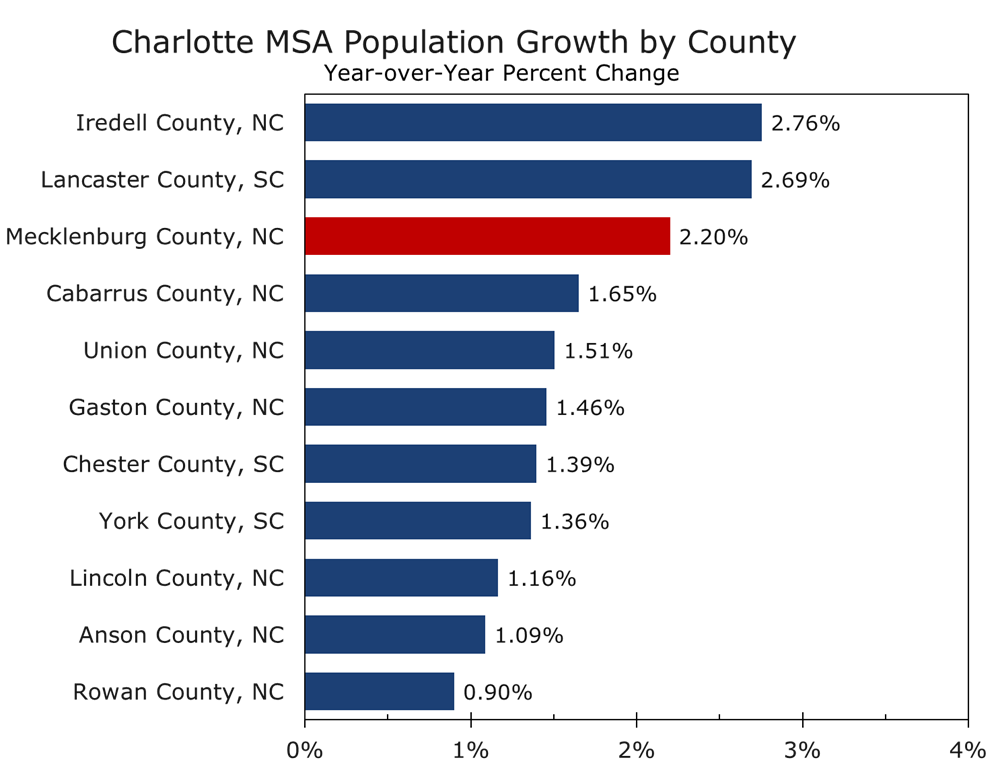
Lancaster County, SC — anchored by the rapidly growing unincorporated community of Indian Land and a constellation of active adult and retirement communities — grew 2.7% in 2024–25, adding nearly 3,000 residents and recording the second fastest growth rate of any of the MSA’s eleven counties. York County, SC, home to Rock Hill and Fort Mill, has added approximately 25,000 residents since the 2020 Census. The pattern is consistent with what is seen across the Sun Belt: as core counties fill in and prices rise, growth cascades outward into adjacent counties with more land, lower costs, and direct access to the core employment base. Charlotte’s bi-state geography gives it an unusually wide spillover zone — and South Carolina’s competitive tax environment accelerates it.
The IRS data confirm this dynamic at the state level: South Carolina gained $4.1 billion in net AGI from in-migration in 2022–23, actually exceeding North Carolina’s $3.9 billion gain despite having a smaller population base. The Carolinas together captured $8.0 billion in net income from domestic migration in a single filing year — a combined figure that places this bi-state corridor among the most powerful wealth-attraction zones in the country, trailing only Florida and Texas. Markets that can build can sustain growth. The Charlotte metro, sprawling across two growth-oriented states, is building on both sides of the border.
Raleigh-Durham: The Innovation Anchor
A note on Census geography is warranted before discussing this region’s population dynamics. The Census Bureau defines the Raleigh-Durham area as two separate Metropolitan Statistical Areas: the Raleigh-Cary MSA (Wake and Johnston counties) and the Durham-Chapel Hill MSA (Durham, Orange, and Chatham counties). These are treated as distinct geographies in population tallies, which creates an analytical gap that can mislead: the two metros are highly economically integrated and are far better understood together. Research Triangle Park (the 7,000-acre research campus that is the region’s dominant employment hub) sits mostly in Durham County but extends into Wake County, physically straddling both MSAs. No serious economic analysis of the region treats the MSA boundary as a meaningful divide.
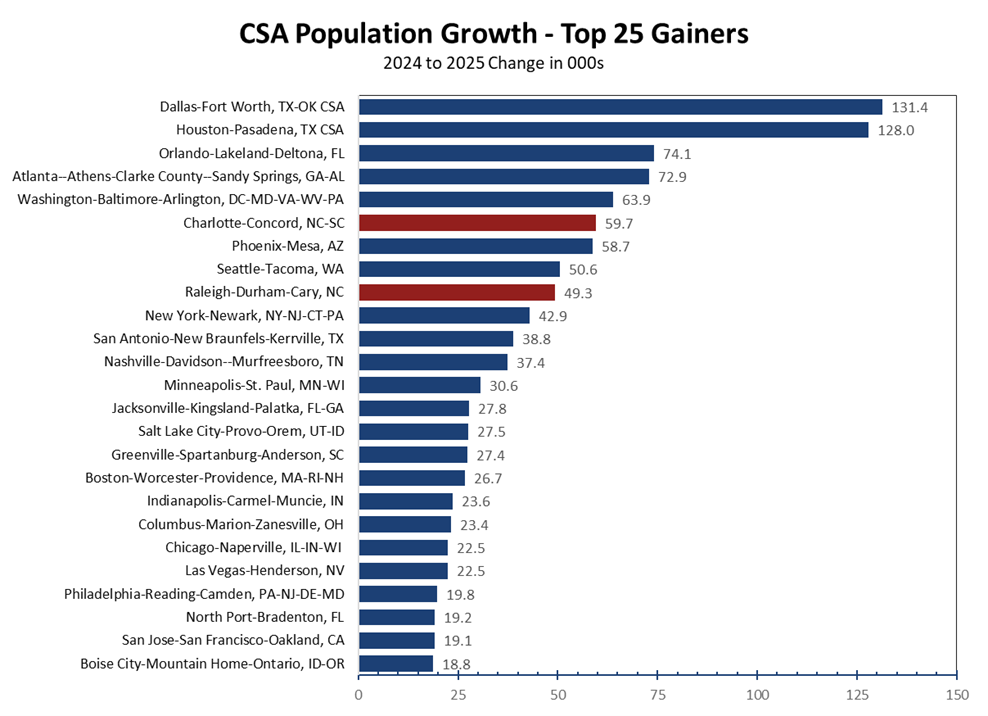
The more analytically useful geography is the Raleigh-Durham-Cary Combined Statistical Area (CSA) — a Census-defined framework that groups two or more adjacent MSAs with demonstrated economic and social linkages, as measured by commuting flows and employment ties. Where an MSA captures a single core urban area and its immediate labor shed, a CSA captures how multiple cores function as a single integrated regional economy. The Raleigh-Durham-Cary CSA encompasses Wake, Johnston, Durham, Orange, and Chatham counties, stretching roughly 60 miles from the northern edge of the Research Triangle to the southeastern suburbs of Johnston County, a crescent of rapidly growing communities connected by I-40, U.S. 1, and the regional rail corridor. The region is known colloquially as the Triangle, a name that references its three anchor universities: Duke University in Durham, the University of North Carolina at Chapel Hill, and North Carolina State University in Raleigh.
On a combined basis, the Raleigh-Durham-Cary CSA totaled approximately 2.48 million residents as of the most recent estimates — making it the 30th largest CSA in the country and the fifth largest in the Southeast behind Atlanta (7.43M), South Florida (7.26M), Central Florida (4.74M), and Charlotte (3.53M). Looking at the component MSAs: the Raleigh-Cary MSA reached nearly 1.60 million people by mid-2025, having grown 12.9% since the 2020 Census — roughly four times the national average over that span and one of the strongest five-year growth rates of any large metro in the country. The Durham-Chapel Hill MSA reached just over 625,000, growing 6.2% over the same period. The combined five-year addition of roughly 220,000 residents places the Triangle among the most consequential growth stories in modern American demography.
On net migration, both components of the CSA performed strongly relative to national peers. Raleigh-Cary added over 39,000 residents in 2023–24, growing at 2.6% — among the highest rates of any metro with more than one million residents. Both Raleigh and Durham ranked in the top 25 fastest-growing places nationally for 2023–24 in U.S. News analysis using Census net migration data. Durham-Chapel Hill’s educational attainment profile has also sharpened dramatically as migration has accelerated: the share of adults with a bachelor’s degree or higher rose eight percentage points to 53.4% between the 2015–2019 and 2020–2024 ACS estimates, the highest rate of improvement among major North Carolina metros. This is a signal of the quality, not just the quantity, of the in-migration flow.
The economic character of the Triangle is distinct from Charlotte’s financial and industrial identity and distinct from the Triad’s manufacturing transformation. It is an innovation economy in the strictest sense — one where proximity to Duke, UNC, and NC State generates a continuous pipeline of research commercialization, startup formation, and specialized talent that compounds over time. Life sciences anchor the employment base: GlaxoSmithKline, Biogen, Pfizer, and Novo Nordisk all maintain significant Research Triangle Park operations, and the region has become one of the top five U.S. destinations for biopharma capital deployment. Recent major commitments in semiconductor-adjacent manufacturing deepen a clustering dynamic that is self-reinforcing: talent and capital attract further talent and capital.
Supply has kept pace with demand across the Piedmont Corridor in a way that most high-growth markets cannot claim. North Carolina ranked third nationally in housing unit growth in 2023–24 at 1.9%, trailing only Idaho and Utah. Charlotte and Raleigh are both expanding in multiple directions from their urban cores. The primary risks to the broader Piedmont region’s outlook are federal funding exposure, particularly for the Triangle’s research institutions, and the broader deceleration in immigration that reduces the overall labor pool available to employers. Both are real. Neither, in our view, alters the region’s structural position.
The Piedmont Triad: An Ascending Third Node
Lying between Charlotte and Raleigh-Durham, the Piedmont Triad — the Greensboro–Winston-Salem–High Point–Burlington Combined Statistical Area — is a region whose manufacturing legacy in textiles, furniture, and tobacco is being rapidly displaced by a new industrial identity centered on aerospace and advanced manufacturing. The Triad’s higher education sector is a meaningful contributor to this evolution: Wake Forest University, ranked 51st nationally by U.S. News, anchors a research and medical ecosystem in Winston-Salem that includes the Wake Forest School of Medicine (ranked 48th in research programs) and the Wake Forest Institute for Regenerative Medicine, an international leader in tissue engineering and bioprinting. High Point University and Elon University have both expanded substantially in enrollment and programmatic breadth over the past decade, adding to a talent pipeline that also draws from UNC Greensboro and North Carolina A&T State University, the nation’s largest HBCU. In total, more than 30 post-secondary institutions serve the Triad region, enrolling over 60,000 students.
The investment pipeline at Piedmont Triad International Airport (PTI) is among the most consequential in the American Southeast. Boom Supersonic completed its $500 million Overture Superfactory at PTI in June 2024, establishing the world’s first dedicated supersonic commercial aircraft manufacturing facility. Honda Aircraft Company remains headquartered at the airport, producing its HondaJet line. In June 2025, aerospace startup JetZero announced a $4.7 billion investment for a commercial all-wing aircraft production facility at PTI — the largest economic development commitment in North Carolina history by job count, with a pledge of more than 14,000 positions. Marshall Aerospace USA has also committed to the campus. In total, PTI-area companies have pledged more than 20,000 jobs and $5.3 billion in capital investment, with potential for further clustering as the campus fills.
| Piedmont Triad Aerospace Cluster: Scale of Commitment
$5.3B in capital pledged at PTI · 20,000+ jobs committed · JetZero $4.7B = largest NC economic development commitment by job count ever · Toyota EV battery plant (Liberty, NC): ~$14B investment, initial production underway 2025 · Siemens Energy: $421M expansion in Winston-Salem (gas turbine parts) and Charlotte (power transformers) · Nucor Steel Lexington: $350M plant in Davidson County, 180 jobs averaging ~$100K · Siemens Mobility: $220M rail manufacturing hub in Lexington, 500 jobs · approximately 200 aerospace companies now operating across the Triad |
Complementing the aerospace cluster, Toyota Battery Manufacturing North Carolina, located in Liberty just east of the Triad, is ramping its nearly $14 billion electric-vehicle battery plant, with initial production underway in 2025 and a commitment of more than 5,100 jobs at full build-out. The broader regional capital commitment now spans aerospace, rail, advanced steel, energy infrastructure, and EV batteries: a diversification that insulates the Triad from any single sector’s cycle.
The Triad’s competitive advantages — lower housing costs than Charlotte or Raleigh, proximity to both markets, a deep technical education ecosystem, and a deep manufacturing culture — position it as a credible long-term beneficiary of the regional capital wave. It is no longer riding the coattails of its larger neighbors; it is building its own industrial identity. Population growth has lagged its larger neighbors but is accelerating. Burlington, the Triad’s fastest-growing node, expanded at a 1.5% rate in 2024–25, led by domestic in-migration, and the broader CSA posted its strongest five-year growth since the early 2010s. As with the Triangle, the best way to view the Piedmont Triad’s economy is by looking at the Combined Statistical Area, which includes Greensboro-High Point-Winston-Salem-Burlington. The 10-county region boasts a 2025 population of 1.78 million and has added 81,281 residents since the 2020 Census.
The Gateway Metro Problem
The large coastal gateway metros (New York, Los Angeles, San Francisco, Chicago, Miami, Washington) occupy a structurally different position. For most of the 2010s, they were losing population through domestic outmigration. The post-pandemic immigration surge interrupted that trend and produced what looked like a recovery.
That recovery was real but temporary. As immigration decelerates, the underlying domestic outmigration dynamic is reasserting itself. Los Angeles has been losing residents every year for a decade; no immigration volume was ever going to fix the structural cost and governance problems driving those outflows. New York briefly led the country in numeric gains in 2023–24, adding over 213,000 residents — then fell to thirteenth place the following year as immigration dried up.
The IRS income data reframes this problem in fiscal terms. New York lost $9.9 billion in net AGI to outmigration in 2022–23. California lost $11.9 billion. Illinois shed $6.0 billion. These are not merely population trends; they are annual revenue-base erosions with compounding consequences. Each year’s outflow reduces the income tax base, raises per-capita fixed costs, and creates pressure for higher rates — which accelerate the next year’s outflow. The gateway metro fiscal problem is self-reinforcing in a way that headcount data alone do not fully capture.
| The Gateway Fiscal Feedback Loop
Stagnant or declining population creates a compounding fiscal problem: fewer taxpayers, maintained pension obligations, slower property tax base growth, and pressure to raise rates — which accelerates further outmigration. New York, Chicago, and Los Angeles are at varying stages of this cycle. The IRS data put the scale in plain terms: New York and California together lost over $21 billion in annual AGI to outmigration in a single filing year. That is not a gap that retaining a few corporate headquarters can close. |
The gateway metros most exposed are those with the weakest domestic migration trends and the highest immigration dependency. Los Angeles and Miami-Dade fit that profile squarely. New York is a close third. San Francisco has shown some domestic migration resilience in the most recent period, possibly reflecting the growth spurt tied to AI. Housing constraints remain severe in the Bay Area, however, and the region’s recovery is not yet durable.
What Comes Next
The data we are analyzing reflect, at most, the first several months of the current immigration enforcement regime. Deportation volumes, legal immigration processing slowdowns, and a broader chilling effect on migration intent will take 12 to 24 months to fully manifest in population estimates. The direction of travel is not ambiguous — NIM will continue to weaken in 2025–26. The question is how steep and for how long.
The IRS data add an important forward dimension to the Census deceleration story. The wealth redistribution captured in the 2022–23 IRS data did not begin with the pandemic and will not end with the immigration pullback. It reflects a durable structural shift in where high-income households choose to live — driven by tax differentials, regulatory environments, housing affordability, and quality of life. The immigration reversal reduces total migration volume, but it does not alter the direction of the income flows captured by the IRS. If anything, it concentrates the domestic migration premium into fewer, stronger destination markets.
For investors, corporate site selectors, and municipal strategists, the most powerful analytical frame combines both datasets: use the Census Bureau numbers to assess current momentum, and the IRS income flows to assess the quality and durability of that momentum. Markets with strong domestic in-migration and high average AGI per arriving return are the most defensible positions. Charlotte, Raleigh, the broader Carolinas corridor, Dallas-Fort Worth, and Houston score well on both dimensions. The Piedmont Triad is ascending into that tier.
The wave of post-pandemic population growth has broken. What remains is a more selective, more structurally revealing distribution of American economic momentum — and with the IRS data now in hand, a clearer picture of where that momentum is carrying not just people, but wealth. The markets capturing both are not doing so by accident. They built it through business environment, infrastructure investment, and housing policy. The markets losing ground are discovering that deferring those choices has consequences that immigration can postpone but not eliminate — and that the IRS confirms, year after year, in the returns.
The geography of U.S. growth has not changed. The rules governing who participates in it have — and the IRS data now tell us how much it costs to be on the wrong side of that divide.
Important Disclosures & Data Notes: This publication has been prepared for informational purposes only and is not intended as a recommendation, offer, or solicitation to purchase or sell any security or other financial instrument, nor does it constitute investment advice.
This report draws on two primary data sources: (1) U.S. Census Bureau Vintage 2025 population estimates (released March 2026), covering July 2024 to July 2025; and (2) IRS Statistics of Income (SOI) Migration Data for Filing Year 2022–2023 (released March 2026), reflecting tax year 2022 income reported on 2023 returns. IRS data cover approximately 70–80% of the U.S. population (tax filers only) and are subject to an 18–24 month lag relative to current Census estimates. Beginning with the 2022–2023 release, SOI enhanced its matching methodology, resulting in approximately 5% more returns than prior vintages. Adjusted Gross Income (AGI) figures represent net flows (inflows minus outflows) and are stated in nominal dollars.
Statements regarding future conditions reflect the views of our analysts and are subject to uncertainty and change. Past demographic trends are not indicative of future outcomes. Recipients should conduct their own independent analysis and due diligence before making any investment decisions.
March 30, 2026
Mark Vitner, Chief Economist
(704) 458-4000

A View from the Piedmont: Our Weekly Commentary on Money, Credit, Exchange Rates & Geopolitics – Risky Shoals and a Shrinking Policy Cushion
Highlights of the Week
- The expansion remains intact but is navigating a materially narrower channel as the Iran shock evolves from event to constraint.
- Markets have repriced toward policy-constraining inflation, not a classic growth scare.
- The Fed is on hold and the bar to easing this year has risen meaningfully.
- The labor market remains stable on the surface but fragile underneath.
- The energy shock is broadening into a multi-channel supply disruption beyond oil, encompassing chemicals, fertilizer and key industrial materials.
- The apparent pause in the escalation of the Iran conflict appears credible, though fragile, with recent developments suggesting at least a temporary halt to planned strikes and tentative movement toward negotiations. This pause may open the door to a Venezuela-style outcome, where sustained pressure redirects an ongoing conflict toward a negotiated equilibrium, even as U.S. forces and assets continue to build in the region.
Unknown Unknowns in Narrower Water
The past week marked a decisive turn in the cycle. What began as a central-bank-dominated narrative has been overtaken by energy, geopolitics, and the reintroduction of constraints. The Federal Reserve may still set the policy rate, but it is no longer setting the tone. That role now belongs to geopolitics, where oil flows and shipping lanes are only part of the equation, and where markets are increasingly forced to price the harder-to-quantify variables, namely President Trump’s often opaque strategic calculus and the uncertain present and future leadership of Iran.
Three weeks into the Iran shock, markets have stopped reacting and started repricing. The distinction matters. Initial reactions tend to overshoot and reverse, particularly on Fridays and Mondays. Repricing embeds. Oil, the dollar, equity markets, and Treasury yields are no longer moving independently. They are moving as a system, and that system is signaling something unambiguous: the path forward for policy has narrowed.
“There are known knowns…there are known unknowns…but there are also unknown unknowns—the ones we don’t know we don’t know.” — Donald Rumsfield
This is increasingly a market defined by what Donald Rumsfeld once called the “unknown unknowns,” where the greatest risks are not the ones investors can model, but the ones they cannot yet fully see.
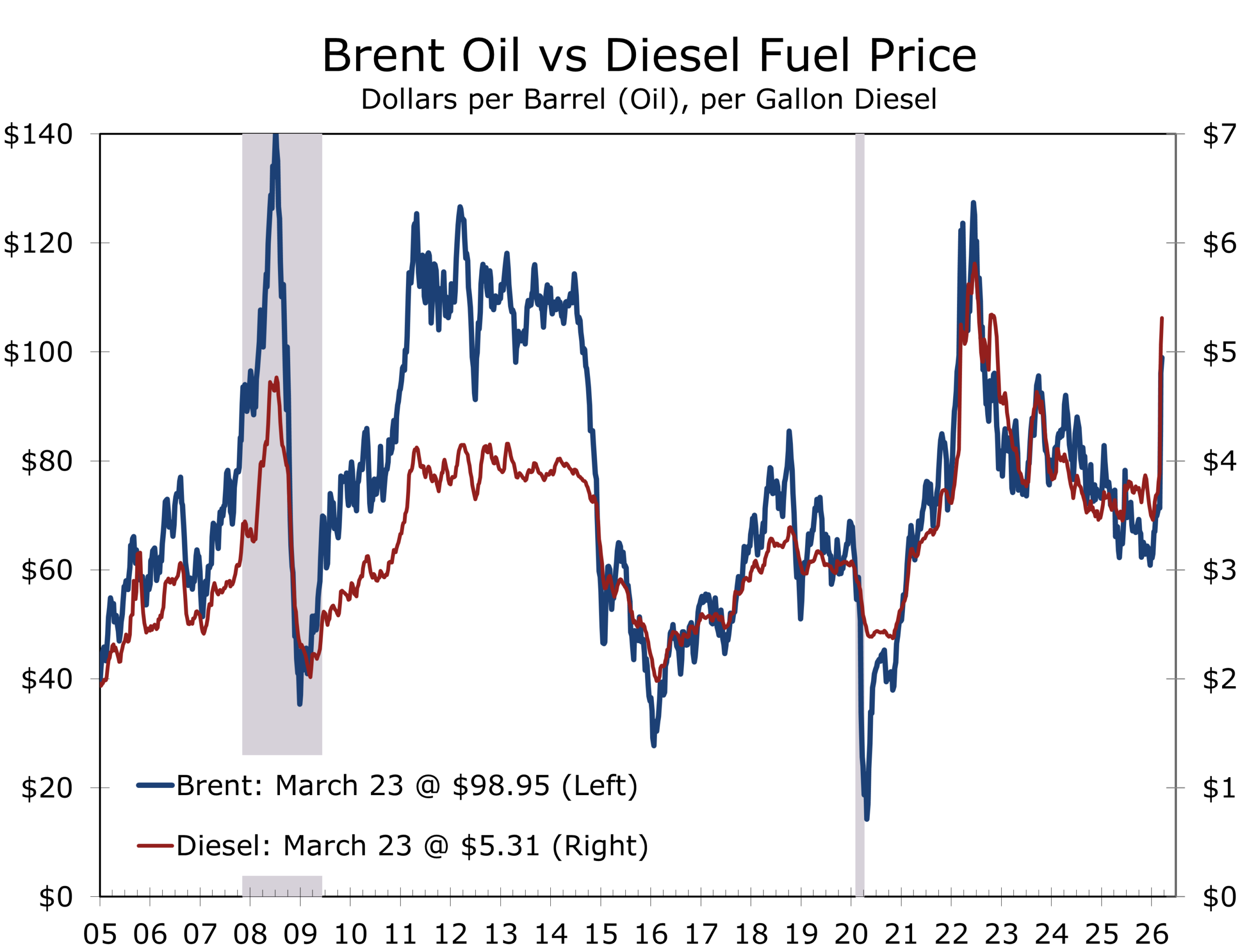
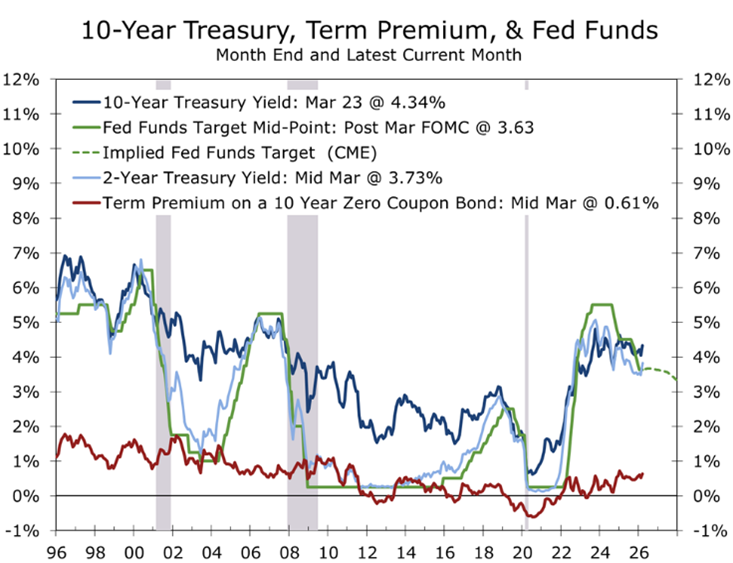
This is not a classic risk-off environment. It is something more nuanced and more challenging. Markets are not primarily pricing a collapse in growth. They are pricing a constraint on policy. Oil has risen enough to lift near-term inflation expectations, but not enough to immediately crush demand. Yields have moved higher, not lower. The dollar has firmed. Even gold has struggled to behave like a traditional haven, reflecting higher real rates rather than panic. Taken together, this is the signature of a stagflation scare in its early, more subtle phase. The first casualty is not growth, but flexibility, meaning the ability of policymakers to ease, of markets to rally on weaker data, and of households and businesses to absorb higher costs without cutting back somewhere.
The Federal Reserve finds itself in a familiar but unenviable position. It held rates steady at its March meeting and emphasized uncertainty tied to developments in the Middle East. The tone was more cautious than dovish or hawkish. Policymakers explicitly acknowledged the risk that higher oil prices could feed into inflation expectations, even as the labor market shows signs of softening beneath the surface. The result is a policy stance that is neither tightening nor easing but rather waiting for more information. In this instance, “Wait and see” is less of a placeholder and more of a strategy for now. The futures market does not see another cut until the middle of 2027.
History offers a useful frame for understanding the moment, and it is not a comfortable one. The current posture sits somewhere between Chamberlain’s “peace for our time” and Kennedy’s pledge to pay any price and bear any burden in defense of strategic interests. An early capitulation, or TACO moment, would carry series long-term negative implications for the security of the Middle East, Asia and U.S. homeland. The decision to pay any price and bear any burden comes down to U.S. taxpayers picking up the tab for stakes and burdens than impact much of the world and energy-dependent Europe in particular.
This puts the situation somewhere in the middle defined by caution but shadowed by the risk of escalation. Policymakers are attempting to avoid overreaction while recognizing that underreaction carries its own costs. There is also, still at the far edge of the distribution, the possibility of something closer to a Venezuela-style outcome, where the current conflict is redirected, under sustained external pressure, toward a negotiated equilibrium rather than further escalation. That framework aligns with President Trump’s stated objective of bringing Iran’s enriched uranium under control and establishing joint oversight of the Strait of Hormuz, a solution that would seek to convert military leverage into a new geopolitical arrangement.
For now, the energy shock is doing what energy shocks typically do. It is acting like a tax on the global economy. Higher gasoline and diesel prices are already eroding purchasing power, particularly for lower-income households, while also raising costs across transportation, logistics, and production. Airlines, railroads and trucking firms are already making hard choices to control cost. The more important development, however, is that the shock is broadening. This is no longer just about oil and diesel fuel. Fertilizer, liquefied natural gas, industrial gases, and shipping costs are all being drawn into disturbance. When supply shocks move beyond a single commodity and into the wider production network, they tend to persist longer and prove more difficult to unwind, particularly if fears of shortages and higher prices become embedded in decision-making.
The labor market, at least on the surface, continues to hold. Initial jobless claims remain low, and layoffs are contained. Yet the underlying dynamics are less reassuring. Hiring has slowed materially, and much of the apparent stability reflects a lack of firing and reduced voluntary turnover rather than resilient demand. This “no-hire, fewer-quits, no-fire” equilibrium is consistent with a productivity-driven expansion, where firms are producing more with fewer workers, supported by capital investment and technological gains. With turnover down by roughly one-third from its prior norm, businesses not only need to hire fewer workers but also spend less on training and onboarding, while benefiting from a more experienced workforce. This is an equilibrium that can shift quickly, however, if demand weakens further.
Housing offers a similar story. Earlier in the year, lower mortgage rates provided a modest lift, raising hopes that the sector might stabilize. That window now appears to be closing. Rising Treasury yields have pushed mortgage rates higher again, affordability remains stretched, and inventories are beginning to build. Housing does not need to lead the expansion, but it does need to find a floor. For now, higher rates are delaying that process. As a result, residential investment is likely to remain a modest drag on growth in the near term rather than the source of support seen in prior cycles.
Globally, the constraint is more pronounced. Europe remains particularly exposed due to its reliance on imported energy and a more fragile industrial base. Central banks are responding accordingly. The ECB has shifted in a more hawkish direction, the Bank of England is warning of renewed inflation pressures, and even in Japan the tone is beginning to change. The common thread is clear: higher energy prices are limiting the ability of central banks to support growth.
This tension between sustaining growth and preventing a supply shock from evolving into broader inflation is now the defining feature of the cycle. The broader framework we have outlined in recent months still holds. This remains a capital-led expansion, driven by infrastructure, reshoring, and artificial intelligence. Productivity gains are real and continue to support output, but they are unevenly distributed. Capital spending can remain firm, supported by long lead times and strategic investment decisions, even as consumer spending becomes more volatile. The result is a two-speed economy, where strength at the top coexists with increasing strain at the household level.
Looking Ahead
Looking ahead, the usual calendar of economic data matters, but it is no longer the primary driver. Productivity, consumer sentiment, and inflation expectations will provide important signals, but markets are taking their cues from a different set of variables. Oil prices, the dollar, long-term yields, equity market breadth, and inflation expectations measures now form the core dashboard. These are the indicators that will determine whether the current shock stabilizes, intensifies, or begins to fade.
The range of outcomes is relatively clear. A de-escalation in the Middle East would allow oil prices to stabilize, financial conditions to ease, and the Federal Reserve to regain some flexibility. A prolonged disruption would keep inflation elevated and growth below trend, forcing policymakers to remain cautious for longer. A further escalation, particularly one that damages energy infrastructure or meaningfully impairs shipping through the Strait of Hormuz for an extended period, would force difficult trade-offs for businesses and policymakers and further narrow the margin for error.
For all the disruption stemming from the Iran crisis, the expansion is still underway. The underlying structure remains intact. Jobless claims are low, capital investment is firm, and productivity gains continue to support output. But the environment has changed. The system is more sensitive, and the buffer provided by stable energy prices, easing inflation, and improving financial conditions has diminished.
The global economy is still moving forward. It is simply doing so in shallower water, with less room to maneuver, more complex trade-offs, and a policy cushion that is thinning by the week.
Disclaimer: This publication has been prepared for informational purposes only and is not intended as a recommendation offer or solicitation with respect to the purchase or sale of any security or other financial product nor does it constitute investment advice.
March 23, 2026
Mark Vitner, Chief Economist
mark.vitner@piedmontcrescentcapital.com
(704) 458-4000
A 21st-Century Energy Shock
A 21st-Century Energy Shock: A Stress Test for the West
- The joint U.S.–Israeli strikes against Iran and the expanding conflict involving Hezbollah in Lebanon have introduced a new geopolitical shock to the global economy. The principal transmission channels are higher energy prices, tighter financial conditions, weaker consumer confidence, larger budget deficits, and greater uncertainty around capital investment.
- The confrontation stems from a long-running regional conflict that intensified following the October 7 attacks on Israel. Iran’s support for militant proxy networks across the Middle East and its direct role in planning and training the October 7 attacks made a direct confrontation inevitable, particularly after Israel systematically dismantled Iran’s key proxies: Hamas and Hezbollah.
- The shock remains largely concentrated in energy markets. Higher oil prices will likely lift headline inflation during the first half of the year while slowing economic growth modestly.
- Headline PCE inflation could run roughly 5 percentage point higher than previously expected, while core PCE may rise about 0.2 to 0.3 percentage points more than earlier thought. The increase is meaningful but not transformative, particularly since most of the adjustment occurs early in the year.
- Economic growth is likely to slow modestly, reflecting softer consumer spending on durable goods and some delays in capital investment.
- Structural changes in the global economy should limit the risk of a sustained inflation spiral. The U.S. economy is far less energy-intensive than in the 1970s and domestic energy production is far higher. Moreover, today’s modern monetary policy framework emphasizes maintaining inflation credibility.
- One secondary risk lies in credit markets. Elevated energy prices and tighter financial conditions amplify the ripples with private credit and modestly restrain capital investment.
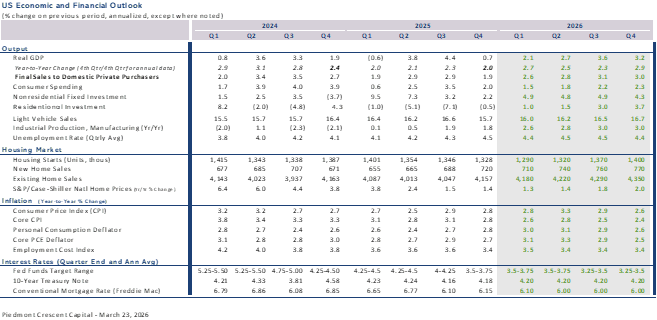
- Our baseline outlook remains one of continued expansion, though with slower growth, fewer near-term rate cuts, and greater financial market volatility. Real GDP is expected to rise 2.9% in 2026, while the headline PCE deflator rises 2.6% and the core PCE deflator rises 2.5% (all Q4/Q4 basis).
The Geopolitical Shockwave
The joint U.S.–Israeli military campaign against Iran and the widening conflict involving Hezbollah in Lebanon have introduced a new layer of uncertainty into the global economic outlook. The macroeconomic consequences are being transmitted primarily through higher energy prices, tighter financial conditions, declining consumer confidence, increased budget deficits and Treasury issuance, and greater uncertainty surrounding business investment decisions.
The risk is not today’s oil spike, but tomorrow’s supply disruption
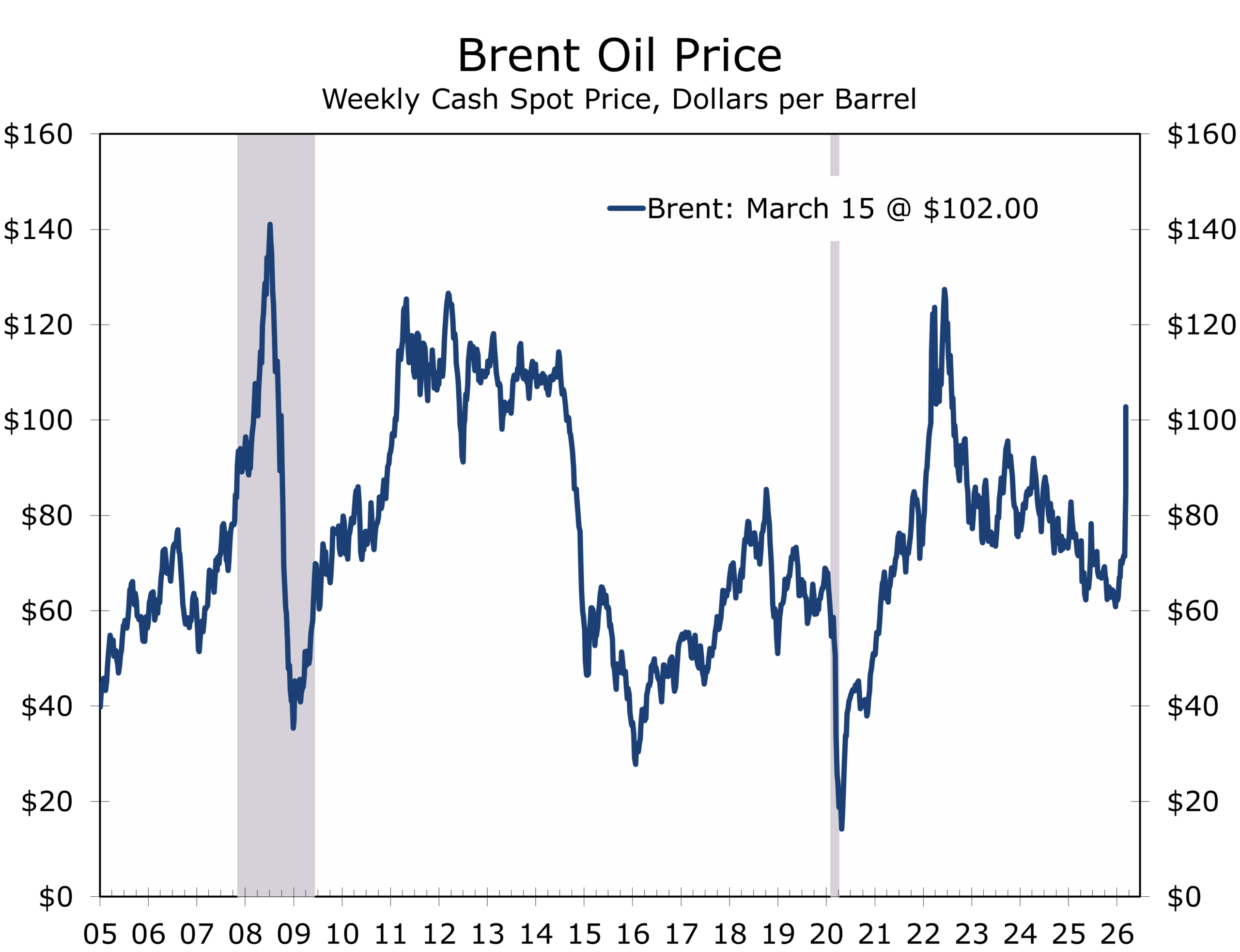
The key question is not whether the shock will affect the global economy but whether it remains contained within energy markets. Financial markets have spent the past few weeks debating whether the conflict could evolve into a broader disruption to global supply chains and financial conditions. Those concerns appear overstated for now. Energy markets entered the crisis oversupplied, a factor that has kept oil prices from surging beyond roughly $120 per barrel.
The conflict itself has deep roots. Iran has spent decades cultivating proxy forces throughout the region, including Hezbollah in Lebanon and Hamas in Gaza. Regular readers of our publications will note that we have long warned that a direct conflict between the U.S. and Iran was a virtual certainty. The October 7 attacks crossed many lines, dramatically escalating tensions and accelerating a trajectory toward direct confrontation that had been building for years. While Israel is the primary target today, a similar attack in the U.S. is a key Iranian objective.
The regional dimension of the conflict is already evident. Hezbollah has launched rockets into northern Israel from Lebanon, while Israeli forces have conducted retaliatory strikes against Hezbollah positions across southern Lebanon and areas surrounding Beirut. The conflict now effectively spans multiple fronts across the region.
The economic implications extend far beyond the battlefield. The Middle East remains central to global energy markets and international shipping routes. Roughly one-fifth of global oil flows pass through the Strait of Hormuz, making it one of the most strategically significant energy chokepoints in the world. A durable resolution to the conflict will ultimately require removing this threat permanently.
For now, spillovers beyond energy markets remain limited. Oil prices have risen sharply, but the broader global supply chain disruptions seen during the pandemic have not reappeared and are unlikely to do so. Shipping costs outside tanker markets remain relatively stable, and industrial supply chains remain largely intact.
Energy shocks tend to lift headline inflation quickly but fade over time. The expected increase in inflation this year appears meaningful but temporary, concentrated primarily in the first half of the year.
Even so, higher energy prices will push inflation somewhat higher and slow growth modestly. Headline PCE inflation may run roughly half a percentage point higher than previously expected, while core inflation may rise about 0.2–0.3 percentage points faster than previously expected. Most of the adjustment is likely to occur during the first half of the year.
The U.S. economy entered this episode with more underlying momentum than recent headline data suggest. Real incomes continue to rise, the labor market remains stable, and layoffs remain historically low. The January data might overstate the economy’s resilience, however. Personal income has a tendency to rise solidly in January and give back most of those gains in following months. The seasonal quirk is likely a legacy of the Pandemic. Hence, recent after-tax income growth and saving rate may currently overstate the resilience of consumer spending.
Momentum remains intact, but seasonal noise and demographics are distorting the data
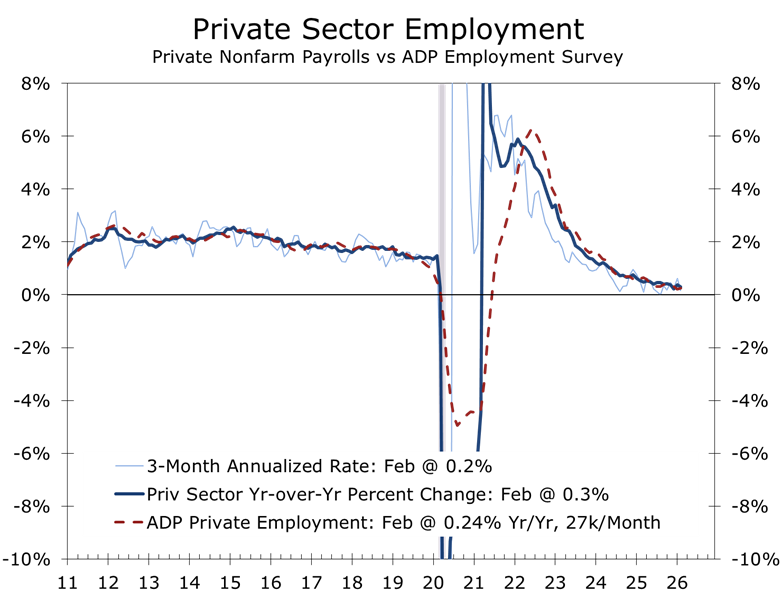
February’s payroll numbers nearly reversed all of January’s downwardly revised gain. Hiring was impacted by the return of winter weather, strikes in the healthcare sector, and some larger than expected reversals in sectors boosted by the holiday season, such as couriers and delivery workers. The data are also being weighed down by federal retirements. We believe the ADP private sector payroll data, which rose by 63,000 in February and an average of 27,000 jobs per month over the past year and are less impacted by strikes and some season distortions, currently provide a better read on the state of the labor market.
While hiring has slowed, Demographic forces are reshaping the labor market. Slower population growth and reduced immigration have reduced the supply of labor, lowering the pace of payroll gains required to maintain a stable unemployment rate. In this environment, slower job growth does not necessarily signal economic weakness. A low unemployment rate, however, does not necessarily signal a strong labor market.
The bottom line for consumers and the broader economy is that higher energy prices reduce real purchasing power (income effect) and complicate the task facing central banks. Monetary policymakers must balance the inflation impulse from energy prices against the risk that tighter financial conditions slow economic activity. We feel the Fed is still likely to ease, with its primarily motivation being to return monetary policy to neutral. Right now, the next Fed rate cut looks like it will be in September, but an earlier cut is possible if the job growth begins to lose significant momentum.
Transmission Channels
Energy shocks affect the economy through several key mechanisms. In economics the key terms are the income effect and substitution effect.
The most immediate transmission channel is oil prices. Energy markets responded quickly to the escalation of hostilities, reflecting both supply risks and concerns about shipping through the Strait of Hormuz. Even with ample current supplies, markets are forward-looking, effectively pricing the next marginal barrel of oil or shipment of natural gas.
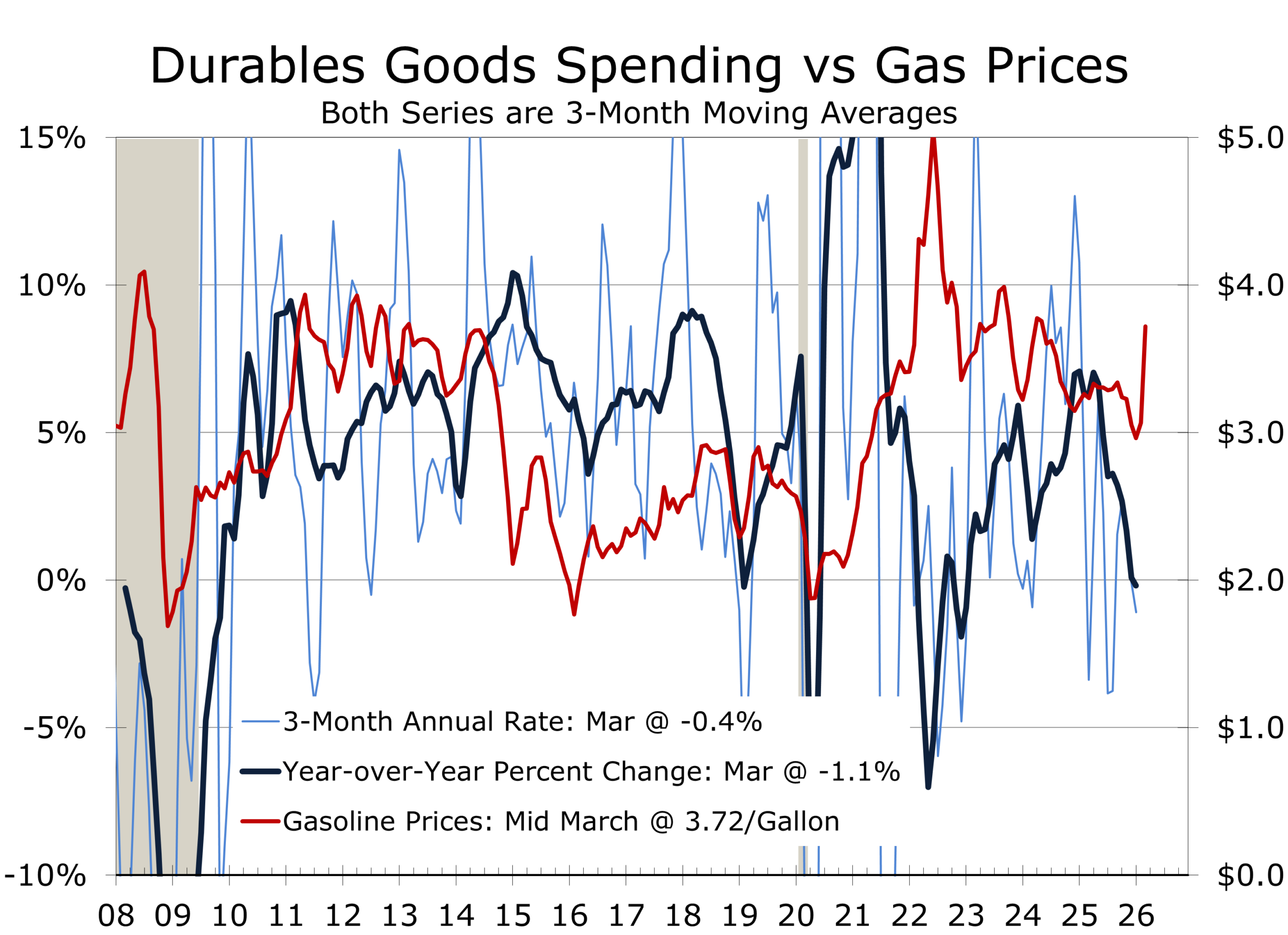
Energy shocks historically weaken durable goods demand first, as households postpone large purchases such as vehicles, furniture and appliances.
Higher gasoline and utility cost’s function much like a tax on economic activity. They reduce household purchasing power and shift spending away from discretionary categories (Income effect).
Durable goods spending is particularly sensitive to these shifts. Purchases of vehicles, appliances, and other large-ticket items often weaken when energy prices rise (Substitution effect).
A second transmission channel is consumer confidence. Energy prices are highly visible and often shape household perceptions of the broader economy.
A third channel involves business investment. Firms frequently delay or stage large capital expenditures during periods of geopolitical uncertainty.
Finally, financial conditions can tighten as investors reassess risk and Treasury issuance increases to finance to war, pushing borrowing costs higher across credit markets.
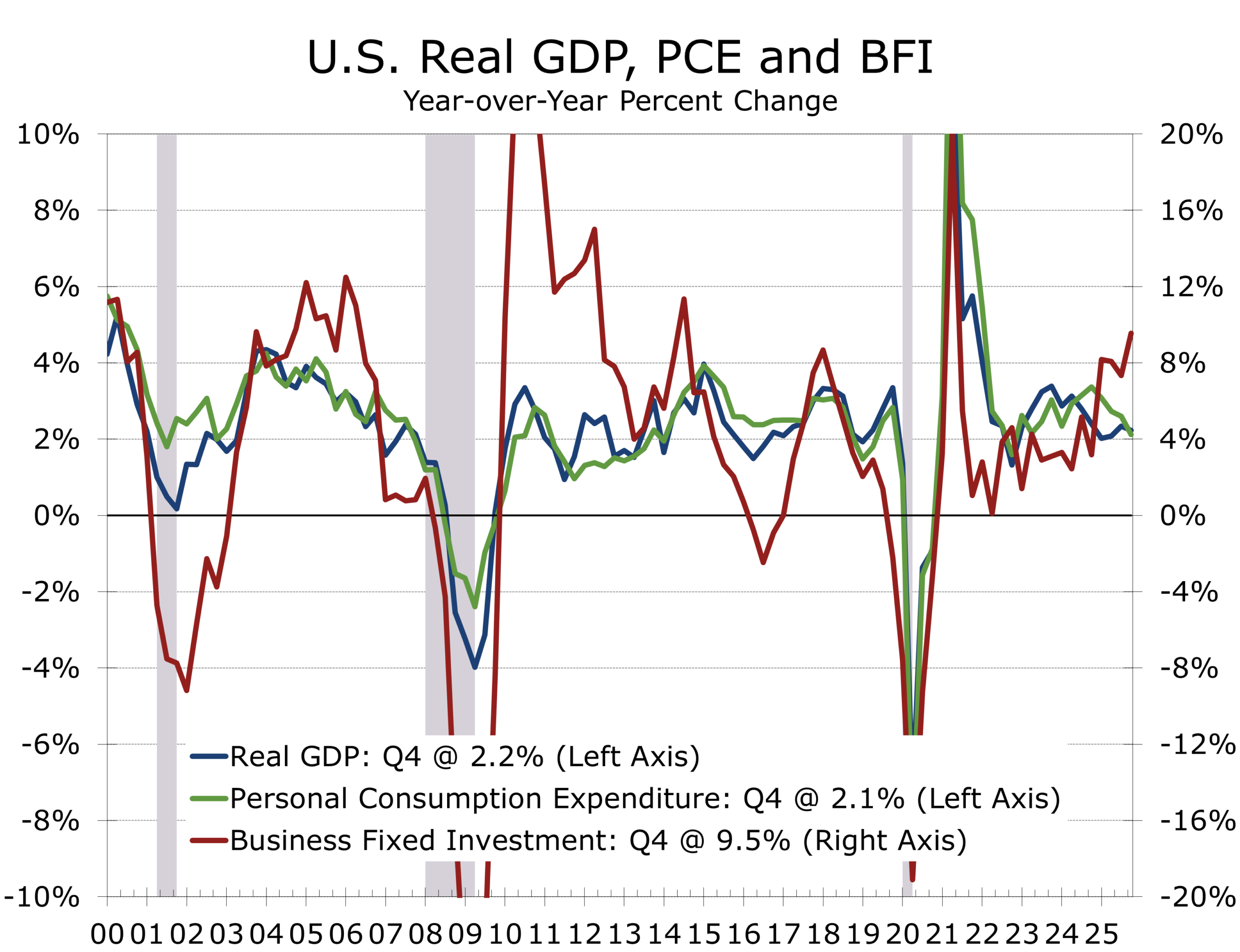
Private domestic final sales rose at a 1.9% annual rate in Q4 and are up 2.5% year-to-year, only modestly below the pace in the third quarter. Consumer spending slowed but remained positive. Business fixed investment increased at a solid clip, led by intellectual property and equipment. Residential investment continued to contract, underscoring that housing remains a lagging sector in this cycle. The composition of growth matters more than the disappointing 1.4% headline Q4 real GDP growth print.
Capital deepening is the primary growth engine, resulting in a capital-led, job-light expansion
This is increasingly a capital-heavy, job-light expansion. Equipment, software, and R&D spending remain firm, particularly in AI-linked sectors. Hiring, by contrast, has moderated materially. Job growth in 2025 was the weakest of any non-pandemic year since 2009, yet output continues to expand near trend. That divergence is the defining feature of this cycle and, in part, reflects payback from the post-pandemic labor surge.
Productivity gains are allowing firms to generate higher output without proportional increases in headcount. Returns to physical capital, intellectual property, and specialized skills are rising faster than aggregate wage income. Higher-income households, which disproportionately own financial assets and benefit from equity market strength tied to AI investment, are capturing a larger share of income growth. Meanwhile, lower- and middle-income households, which are more dependent on wage gains and more exposed to goods inflation, are experiencing less improvement in purchasing power.
This dynamic is often described as a K-shaped economy: aggregate growth continues, but the distribution of gains is uneven. This is not unusual during periods of structural transformation. As tariff distortions fade and fiscal incentives broaden equipment spending, capital deepening should remain a central theme in 2026. Lower interest rates should eventually support key cyclical sectors that have been lagging, particularly interest-sensitive areas such as housing, durable goods consumption, and capital spending by small and mid-sized businesses that have been constrained by many of the same forces weighing on consumers.
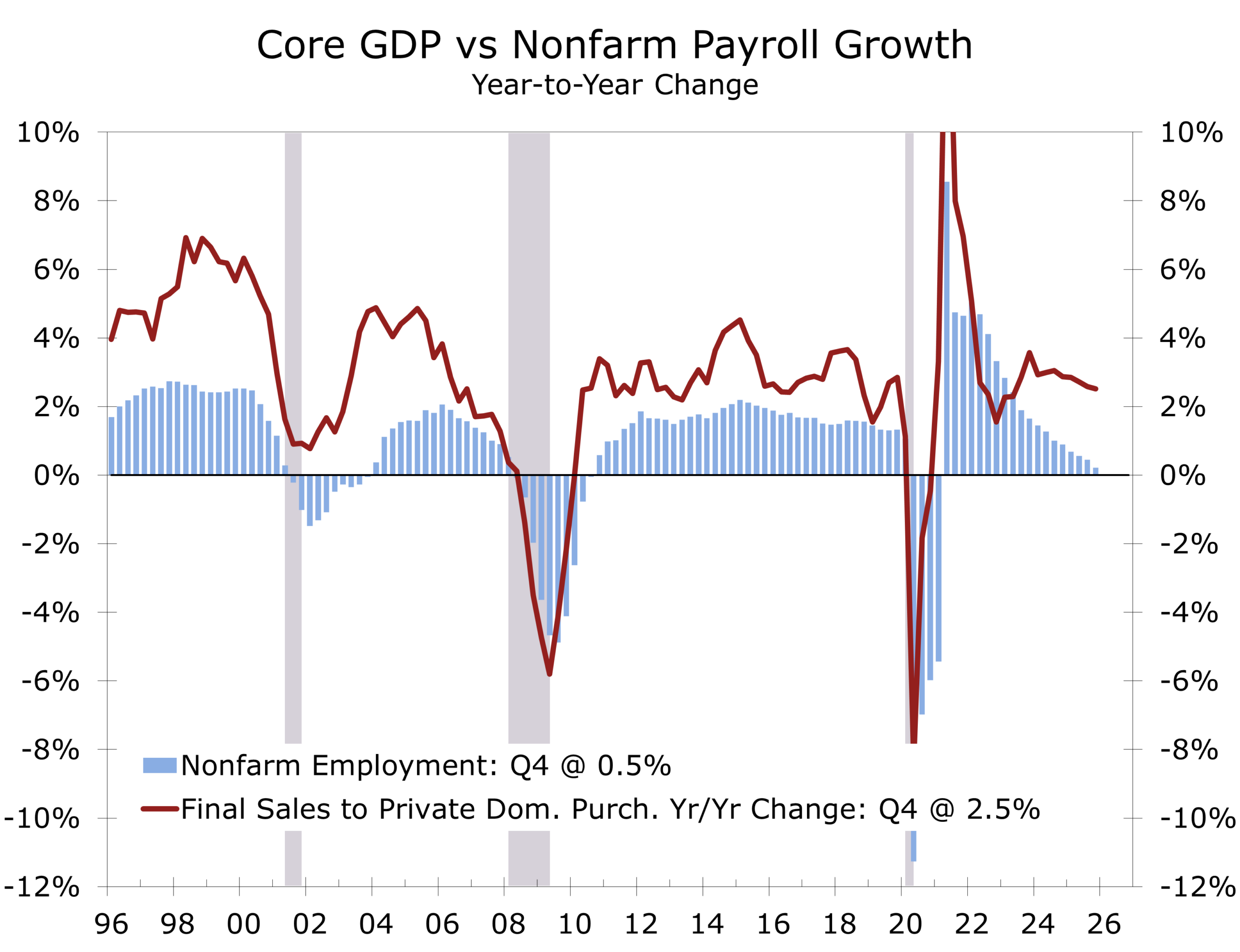
Capital Investment and Credit
Capital spending remains the key driver of the medium-term economic outlook.
Investment in artificial intelligence infrastructure, semiconductor manufacturing, energy systems, commercial aviation, and advanced manufacturing continues to reshape the global economy. Reshoring is also contributing more meaningfully to growth, with gains likely to become more visible over the coming year, particularly in pharmaceuticals, medical technology, and semiconductors.
Private credit has emerged as an important financing channel for capital investment as bank lending has become more constrained. Its expansion has supported investment momentum but has also increased sensitivity to financial conditions. Further tightening in credit markets could slow private credit growth and delay capital spending at the margin.
Geopolitical uncertainty is increasingly influencing the timing and composition of investment. Firms are staging or delaying projects until financing conditions stabilize and supply chains become more predictable. Uncertainty surrounding U.S.-China relations remains a key variable. A delay in high-level engagement, including a potential summit between Xi Jinping and Donald Trump, would likely postpone progress toward broader trade normalization.
At a structural level, U.S.-China tensions reflect a deeper strategic divide that extends beyond trade. China’s use of industrial policy, state support, and geopolitical alignment remains central to negotiations. The policy path will shape trade restrictions, capital flows, and supply chain realignment over the medium term.
Taken together, capital spending remains supported by strong structural demand tied to technology, infrastructure, and reshoring, but the pace is increasingly sensitive to financial conditions and geopolitics.
Inflation and Monetary Policy
Energy shocks present a complicated challenge for central banks.
Higher oil prices raise headline inflation while often weakening economic growth. Policymakers must therefore balance the risk of tightening policy too aggressively against the risk of allowing inflation expectations to drift higher. For the Federal Reserve, this currently implies a more cautious pace of easing than underlying demand conditions would otherwise warrant.
Importantly, energy price increases function more like a tax on economic activity than a traditional demand-driven inflation shock. Rising gasoline and utility costs reduce real purchasing power and tend to slow consumer spending.
While energy prices ripple through the economy, they primarily affect relative prices rather than the overall price level. Sustained inflation typically emerges only when monetary policy accommodates the shock.
The experience of the 1970s illustrates the risk. When monetary policy remained overly accommodative following oil shocks, inflation became entrenched. Modern policy frameworks were shaped by that episode, and today’s Federal Reserve is far less likely to repeat that mistake.
Oil shocks force central banks to choose between fighting inflation and protecting growth
The current energy shock appears more likely to produce a temporary increase in headline inflation than a sustained acceleration in core inflation. The key risk is not the initial price spike, but whether it begins to influence inflation expectations or wage-setting behavior.
Policy is therefore likely to remain data-dependent, with the timing and pace of easing driven more by core inflation and labor market conditions than by movements in headline inflation.
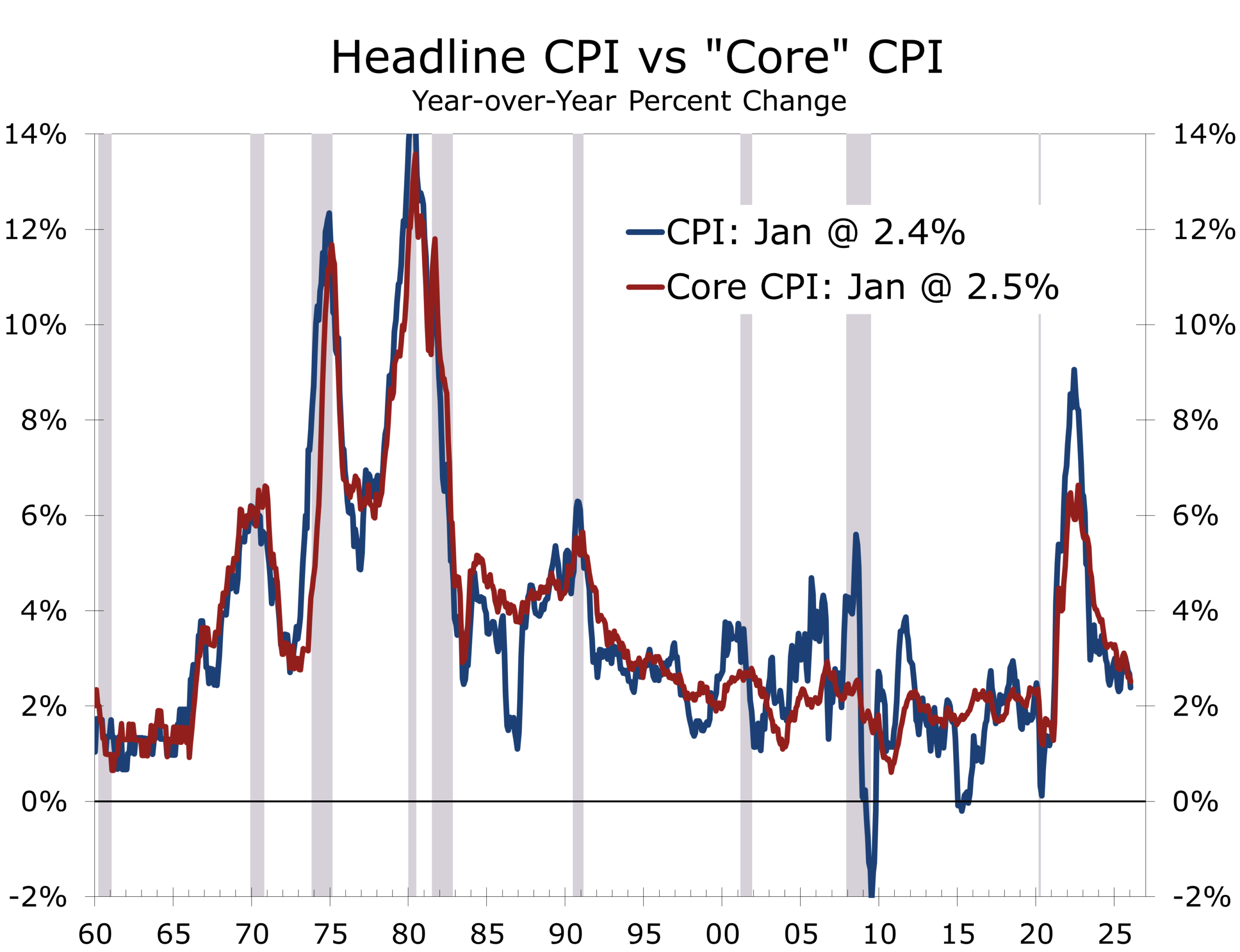
The Political Clock – Geopolitical Implications
The outcome of the Iran conflict will have implications far beyond the Middle East.
A decisive weakening of Iran’s ability to project power could reshape the regional balance and potentially accelerate diplomatic normalization between Israel and several Arab states under the framework established by the Abraham Accords. A less conclusive outcome, however, would risk slowing or reversing that momentum and prolonging regional instability.
The stakes extend far beyond Iran. The outcome will shape the global balance of power
The implications extend well beyond energy markets. The outcome may influence geopolitical alignments across multiple regions, from Eastern Europe to the Indo-Pacific.
The conflict also carries broader implications for the global balance of power. China and Russia are closely monitoring developments. In Asia, the outcome may influence perceptions of U.S. strategic credibility, particularly in the context of rising tensions surrounding Taiwan.
In Europe, the conflict intersects with the ongoing war in Ukraine. Higher energy prices and shifting strategic attention could influence the trajectory of that conflict, particularly if resource flows or policy priorities are redirected.
The geopolitical stakes therefore extend well beyond the immediate battlefield, with potential implications for global alliances, capital flows, and long-term investment decisions.
A prolonged or inconclusive outcome could also increase domestic policy uncertainty in the United States, potentially affecting fiscal priorities, regulatory direction, and the broader policy environment.
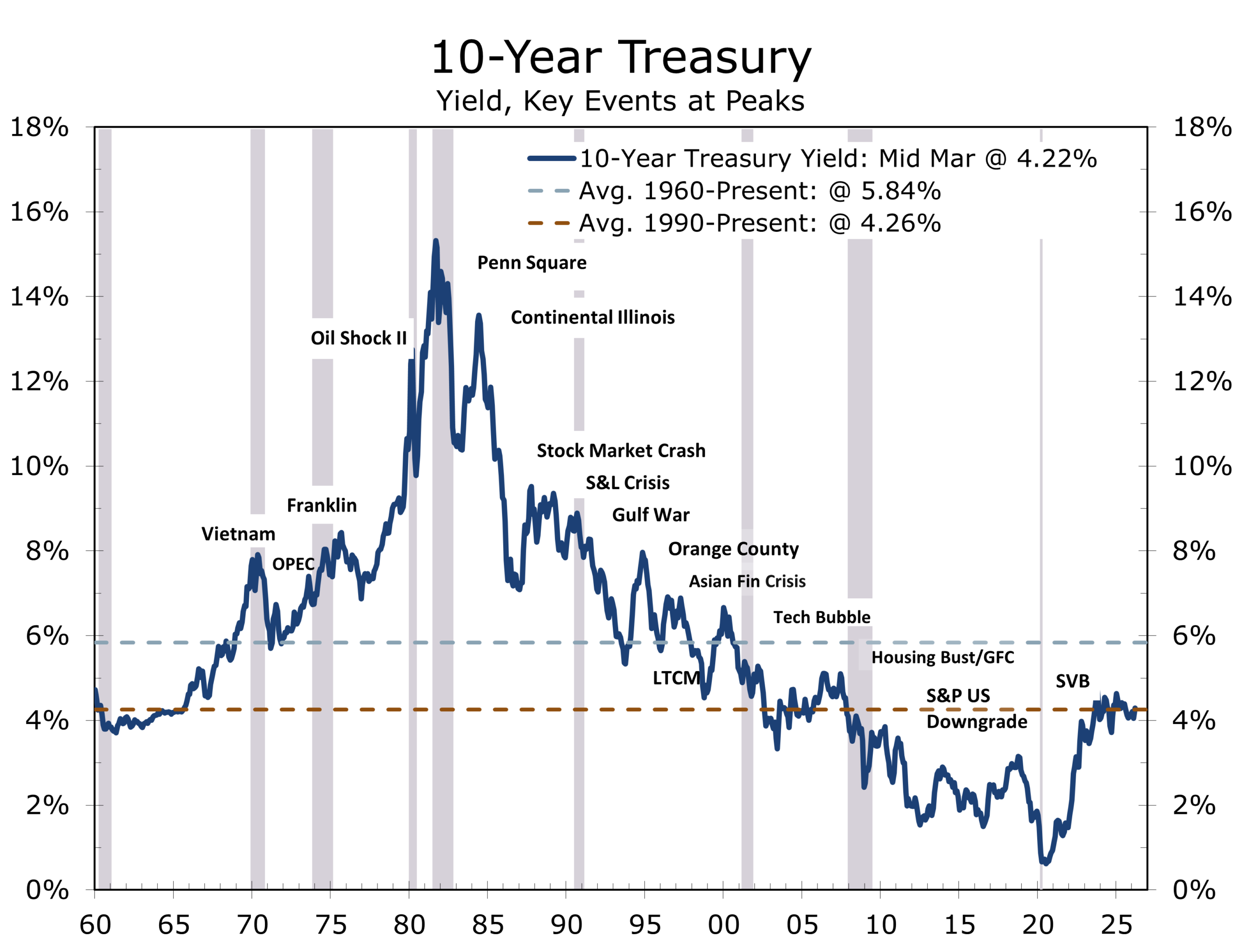
Review and Outlook
The baseline outlook remains one of continued economic expansion, though with slower growth and heightened volatility. First-quarter GDP has shown a recurring tendency to come in softer than underlying fundamentals would suggest, and that risk remains in place this year. Our 2.1% Q1 real GDP forecast is currently below consensus and below the latest point estimate from the Atlanta Fed GDPNow, which calls for 2.7% growth.
Markets are overpricing inflation risk and underpricing the durability of growth
Higher energy prices are likely to restrain consumer spending, particularly on durable goods, while geopolitical uncertainty may delay some capital investment. Even so, the expansion should remain intact and continue to be led by productivity-enhancing investment.
The U.S. economy retains important structural advantages, including deep capital markets, flexible labor markets, and sustained investment in advanced technologies, all of which should continue to attract global capital. The advantages reassert themselves in times of economic stress.
Monetary policy is likely to remain cautious as policymakers assess whether the energy shock generates more persistent inflation pressures. Our base case remains that the Federal Reserve will ease policy gradually, with scope for two 25 basis point rate cuts over the course of the year. We currently view September as the most likely timing for the next move, although an earlier adjustment is possible if geopolitical risks recede and labor market momentum softens more quickly or more dramatically.
Financial markets are likely to remain volatile as investors reassess the balance between inflation risks and slowing growth. In our view, markets are placing too much weight on inflation risks—which are likely to prove more contained than in prior energy shocks—and too little on the near-term implications for growth. While growth may soften in the near term, the drag is likely to be manageable and should ease as financial conditions stabilize and investment remains firm. This suggests that periods of market volatility may present opportunities as the underlying expansion remains supported by structural investment and resilient fundamentals.
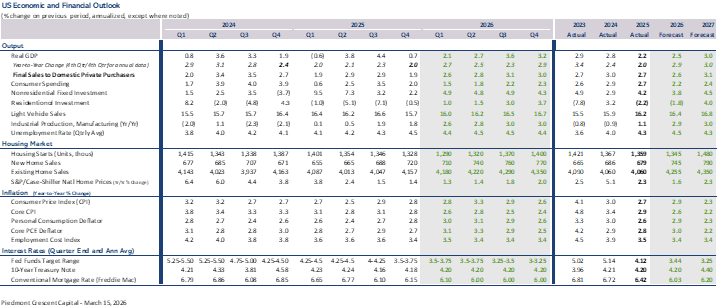
Strategic Takeaway
The conflict with Iran represents more than a regional security event; it is a test of the geopolitical framework underpinning the global economy. It is also a test of strategic resolve among the United States and its allies, Iran’s regime, and key external actors, particularly Russia and China.
A decisive outcome stabilizes the outlook. An inconclusive one prolongs uncertainty
While Russia and China are less directly committed to Iran than the United States is to Israel, both are closely monitoring the conflict’s trajectory. The outcome will help shape perceptions of U.S. strategic credibility and influence broader geopolitical calculations, particularly in regions where deterrence and alliance structures are already under pressure.
Russia, in particular, has an interest in sustained geopolitical friction, as elevated instability in the Middle East can support energy revenues and divert Western attention. China’s posture is more complex, balancing its economic interests in stable energy markets with its longer-term objective of reshaping the global order. In both cases, the conflict’s outcome will inform how these countries assess the durability of U.S. leadership and the cohesion of Western alliances.
A decisive outcome that materially weakens Iran’s ability to project power could reshape the regional balance and reinforce broader deterrence. Such an outcome could reduce a persistent source of regional instability, support renewed diplomatic engagement, and improve the medium-term outlook for global energy markets and capital flows.
A more prolonged or inconclusive outcome, however, would likely have broader implications. Sustained uncertainty could weigh on investment, tighten financial conditions, and increase the risk of spillovers into other geopolitical theaters, including Eastern Europe and the Indo-Pacific. It could also contribute to a more fragmented global environment, with greater emphasis on security, supply chain realignment, and regional blocks.
If the conflict stabilizes and energy markets normalize, the global economy should be able to absorb the shock and continue expanding, supported by underlying strength in investment and productivity. If not, the interaction between geopolitical uncertainty, financial conditions, and policy constraints could become a more binding headwind for growth.
The expansion remains intact, but with a narrower margin for error and greater sensitivity to geopolitical outcomes. In that sense, the economic outlook will be shaped not only by traditional macroeconomic forces but also by the evolving structure of the global geopolitical landscape.
Disclaimer: This publication has been prepared for informational purposes only and is not intended as a recommendation offer or solicitation with respect to the purchase or sale of any security or other financial product nor does it constitute investment advice.
March 18. 2026
Mark Vitner, Chief Economist
704-458-4000
February 2026 Existing Home Sales: Affordability Improves but Housing Turnover Remains Constrained
Improving Affordability is Bringing Buyers Back
-
- Existing-home sales rose 1.7% in February to a 4.09-million-unit annual rate
- Sales remain 1.4% below year-ago levels, reflecting still-muted housing turnover.
- Inventory increased 2.4% to 1.29 million units, equal to a 3.8-month supply. A 4.5 to 5-month supply would be more normal.
- The median existing-home price rose 0.3% year-over-year to $398,000, marking the 32nd consecutive year-over-year increase.
- Single-family sales increased 2.5%, while condo and co-op sales fell 5.3%.
- Housing affordability improved for the eighth straight month, reaching its highest level since early 2022.
- Despite February’s rebound, sales remain well below pre-pandemic norms due to limited inventory and the mortgage-rate lock-in effect.
Harsh Winter Weather Had Little Impact on Closings
The housing market may finally be stirring from its winter lull. Existing home sales rose 1.7% in February to a 4.09-million-unit annual rate, a modest but encouraging gain following two years of unusually weak housing turnover. The increase came despite harsh winter weather in parts of the country and slightly exceeded expectations, suggesting that underlying demand remains stronger than the recent pace of sales might imply.
Existing home sales reflect closings on contracts that were signed several weeks earlier, meaning the severe January weather likely has had less impact than feared. January sales were also revised higher to 4.02 million units, lifting the combined January–February pace to roughly 4.06 million units, slightly stronger than expected for the first quarter.
Improving affordability is bringing buyers back, but millions of homeowners remain reluctant to part with their ultra-low mortgage rates.
Even so, the housing market remains constrained. The U.S. economy now supports more than six million additional jobs than it did in 2019, yet annual home sales remain roughly one million units below pre-pandemic norms. The primary culprit remains the mortgage-rate lock-in effect, which continues to discourage homeowners with sub-4% mortgages from selling and taking on higher borrowing costs.
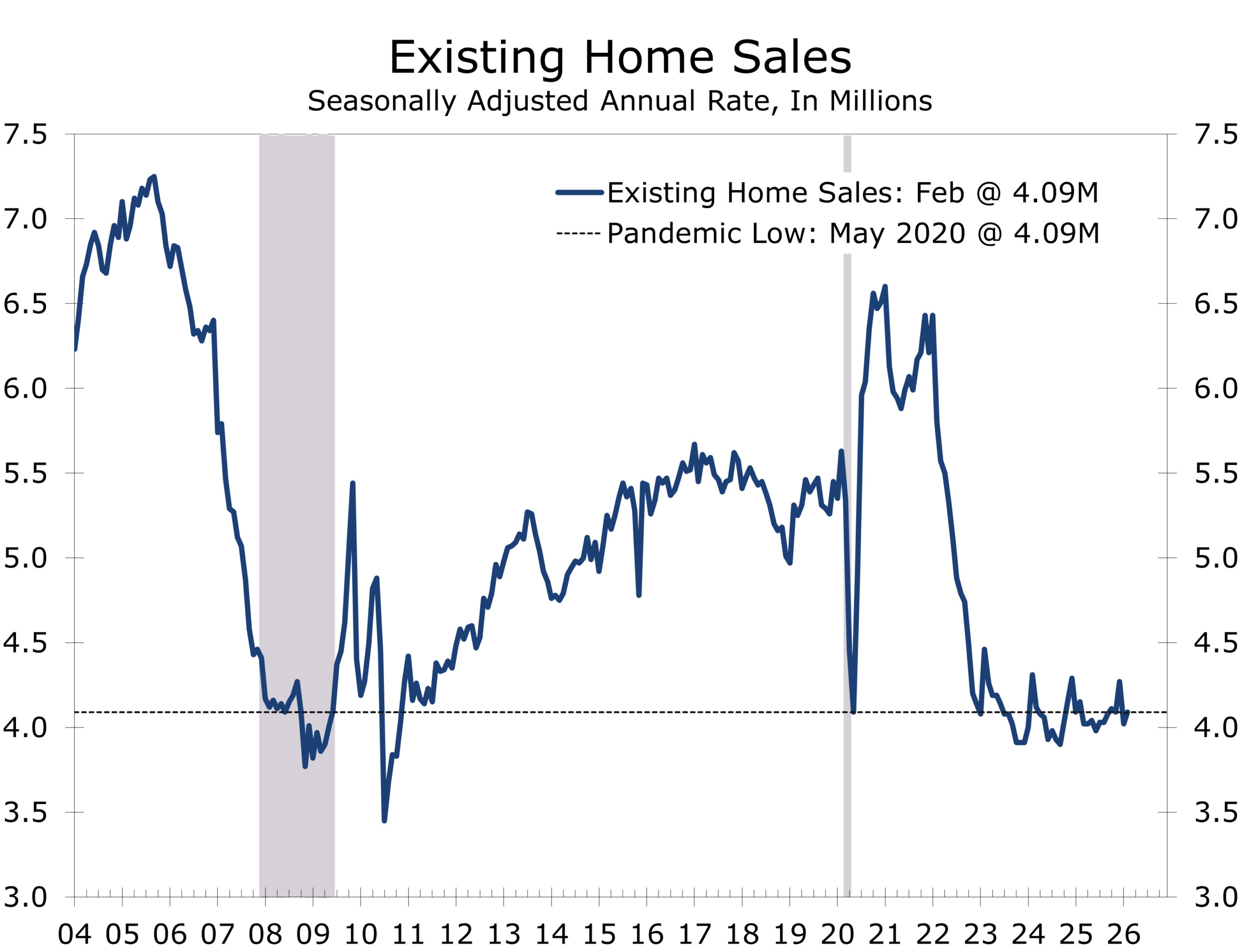
Affordability is gradually improving, offering some hope that activity may begin to recover. The Housing Affordability Index rose to 117.6 in February, the eighth consecutive monthly increase and the highest reading since early 2022. Mortgage rates averaged 6.05% in February, down from 6.84% a year earlier, while wage growth has recently begun to outpace home price appreciation. These shifts have modestly improved purchasing power, although affordability remains far from pre-pandemic levels. We expect this improvement to continue and help resurrect home sales this spring and summer.
Affordability is improving, but existing home sales remain constrained by limited inventory.
Home price growth has cooled but remains positive. The median existing home price rose 0.3% yr/yr to $398,000, extending the streak of yr/yr gains to 32 consecutive months. Price trends, however, are diverging across regions. The Northeast and Midwest continue to see modest gains, while price growth in the South has flattened and prices in the West have edged lower, reflecting the larger pandemic-era price surge in those markets. Sellers in the South face competition from new homes, with many builders slashing prices to clear new home inventories.
Existing home inventories remain too low but are beginning to recover, albeit gradually. The number of homes available for sale rose 2.4% in February to 1.29 million units, translating to a 3.8-month supply at the current sales pace. Inventory is now 4.9% higher than a year ago, suggesting supply constraints are easing modestly as the spring selling season approaches.
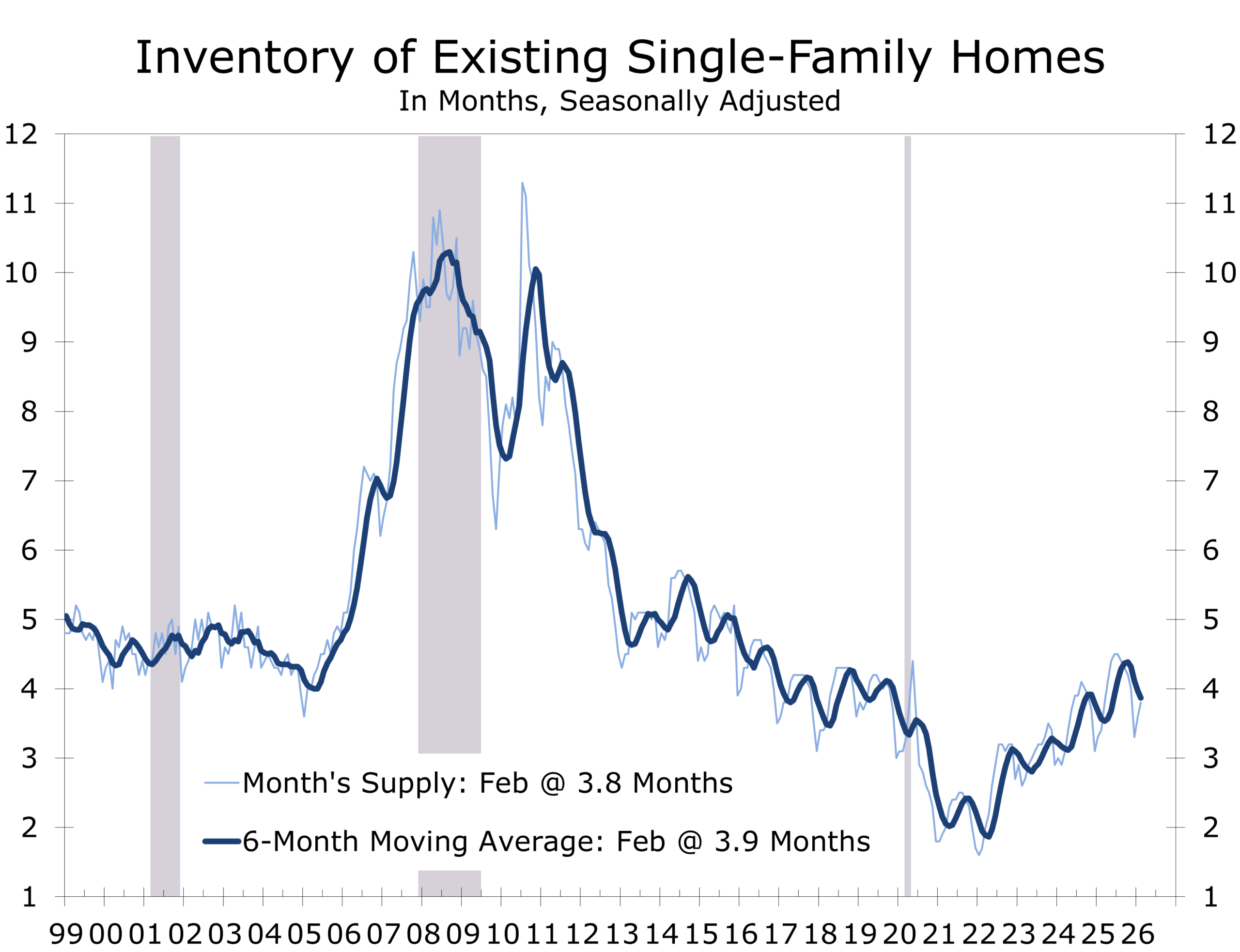
Some homeowners who previously pulled their listings appear to be returning to the market. Roughly 45,000 sellers who delisted their homes last year re-listed in January, an unusually large number and a potential sign that supply could increase further.
Regional trends were mixed. Sales rose 8.2% in the West, reflecting a rebound in the most rate-sensitive region. Sales increased 1.6% in the South and 1.1% in the Midwest, while sales in the Northeast fell 6.0%, likely reflecting the greater impact of winter weather.
First-time buyers accounted for 34% of purchases, up from 31% in January, while cash sales represented 31% of transactions. Investors and second-home buyers accounted for 16% of sales. Homes remained on the market for 47 days, up slightly from a year ago, likely signaling less competition among buyers.
Looking ahead, existing home sales are expected to gradually improve through the end of this year, assuming mortgage rates remain near current levels, and the broader economy remains resilient. However, the outlook is not without risks. The past couple of days have seen a great deal of volatility in energy prices and the financial markets more broadly. We feel the worst of this has now passed and look for mortgage rates to remain near 6% going into the key Spring Selling Season.
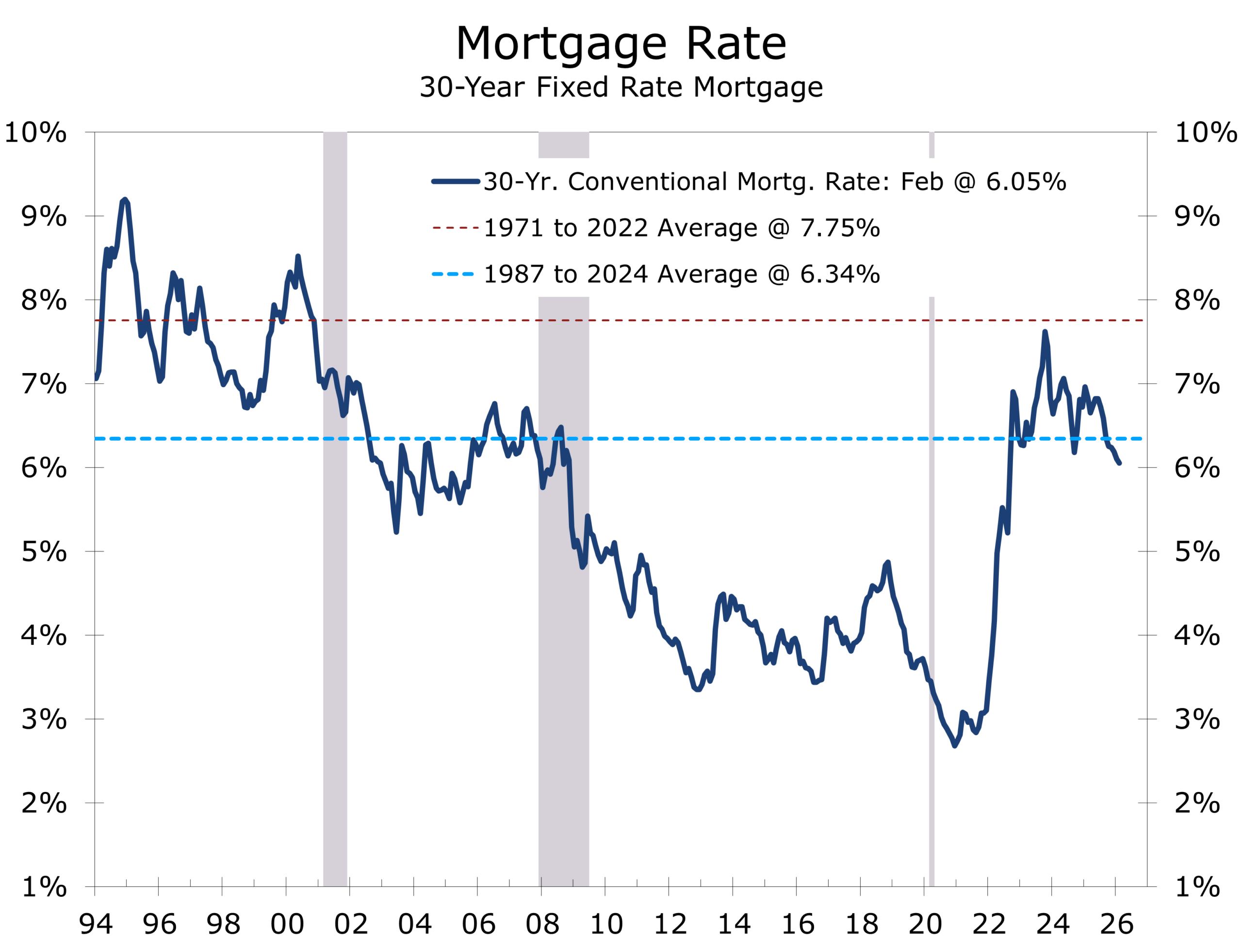
Disclaimer: This publication has been prepared for informational purposes only and is not intended as a recommendation offer or solicitation with respect to the purchase or sale of any security or other financial product nor does it constitute investment advice.
March 10, 2026
Mark Vitner, Chief Economist
(704) 458-4000
A View from the Piedmont: Our Weekly Commentary on Money, Credit, Exchange Rates & Geopolitics – The Peacemaker’s Dilemma: Deterrence, Duration and the Oil Shock
Highlights of the Week
- Brent and WTI briefly traded near $120 on Monday as the Hormuz disruption deepened and Gulf producers began trimming output. Markets are now pricing a genuine supply shock, not merely shipping friction.
- February payrolls were soft, but the details were firmer than the headline. Wage growth stayed solid, the unemployment rate was unchanged, and strike distortions likely exaggerated the weakness in the establishment survey.
- Europe is emerging as one of the clearest economic pressure points. Qatar’s LNG shutdown and low regional gas storage leave Europe exposed to another power-price squeeze just as growth was trying to stabilize.
- The dollar has firmed, equities have wobbled, and break-evens have moved higher. The first market response has been inflation repricing and selective de-risking rather than a full-blown growth panic.
- The Federal Reserve’s room to ease has narrowed materially. Energy shocks only become persistently inflationary if validated by monetary accommodation, but the policy margin for error is now much thinner.
From Tail Risk to Market Reality
The war with Iran moved from tail risk to market fact pattern over the past ten days, and the economic conversation changed with it. What began as a geopolitical shock is now an inflation, funding, and confidence shock as well. Our thoughts remain first with those in harm’s way, especially U.S. personnel and allies operating in an increasingly fluid theater.
Markets are no longer pricing a modest disruption. They are pricing a serious supply shock with an uncertain self-life. Reuters reported Monday that crude briefly traded near $119.50 per barrel, Gulf producers have begun cutting output as shipments stall, and G7 governments are weighing emergency stock releases. Wall Street sold off early, the dollar strengthened, and bond markets repriced inflation risk faster than growth risk. Attitudes improved in the afternoon as President Trump signaled that the conflict is closer to an end than it appears.
The U.S. economy entered this episode in better shape than many feared. Friday’s February employment report was weaker on the surface but less alarming underneath. Nonfarm payrolls fell 92,000, the unemployment rate held at 4.4%, average hourly earnings rose 0.4% on the month and 3.8% from a year earlier, and participation held at 62.0%. Healthcare strike effects, federal cutbacks, and prior downward revisions made the headline softer, but the labor market still looks more cooled than cracked.
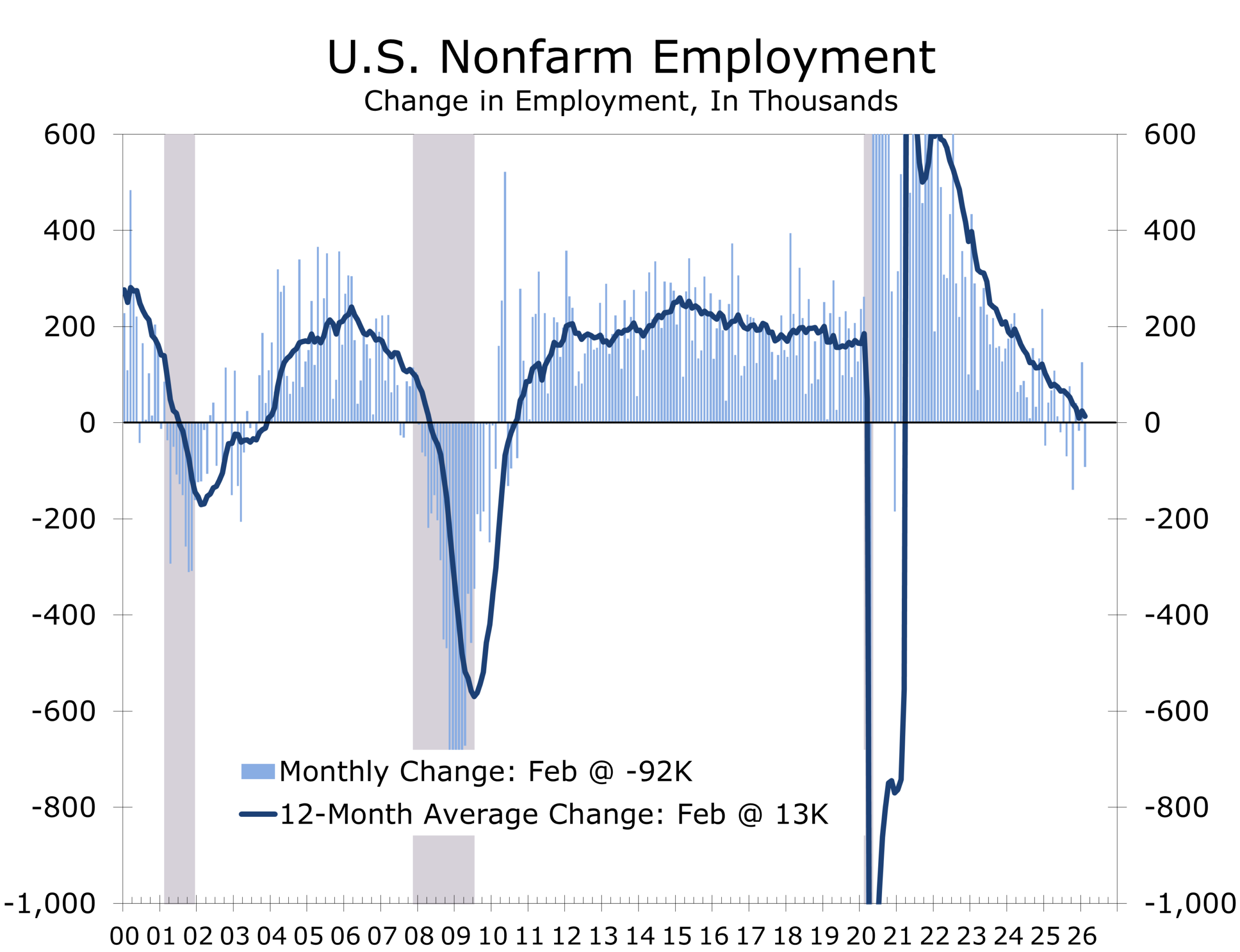
Hormuz: From Friction to Shock
The situation in the Strait of Hormuz increasingly resembles the central tension in the George Clooney film The Peacemaker: preventing a crisis before it becomes irreversible. As Clooney’s character notes, if you want to stop catastrophe, you cannot wait for the mushroom cloud. Markets are now grappling with that same question of timing and duration.
The Strait of Hormuz has moved well beyond a friction story. Ship traffic remains nearly paralyzed, hundreds of tankers are idle, and Saudi Arabia has begun diverting exports toward Red Sea routes. Iraq, Kuwait, Qatar, and the UAE have also curtailed output as storage fills and logistics snarl. Brent briefly touched $119.50 and WTI traded near similar levels. That is no longer low-to-mid-$80s disruption pricing. It is the market’s way of signaling that duration now matters as much as magnitude.
Prices stabilized near $90 per barrel late Monday afternoon after President Trump suggested the United States might move to secure the Strait of Hormuz, easing fears of a prolonged shipping shutdown.
The volatility reflects uncertainty more than a definitive loss of supply. The key distinction is between temporary seizure and structural destruction. Strategic petroleum reserves, spare production capacity, elevated inventories, and the flexibility of U.S. shale still provide a substantial cushion. But once physical flows are impaired and major producers begin cutting output, the path to normalization becomes longer and more uncertain.
Eighty-dollar oil signals volatility. One-hundred-twenty-dollar oil signals that markets are beginning to price regime change and the possibility of a longer disruption to global energy supply chains.
The psychological dimension should not be underestimated. Videos circulating over the weekend showing burning oil storage facilities outside Tehran carried an unmistakably apocalyptic tone. In the absence of hard information about how long shipping through the Strait of Hormuz might be disrupted, those images likely amplified investor anxiety and helped fuel the earlier spike in oil prices.
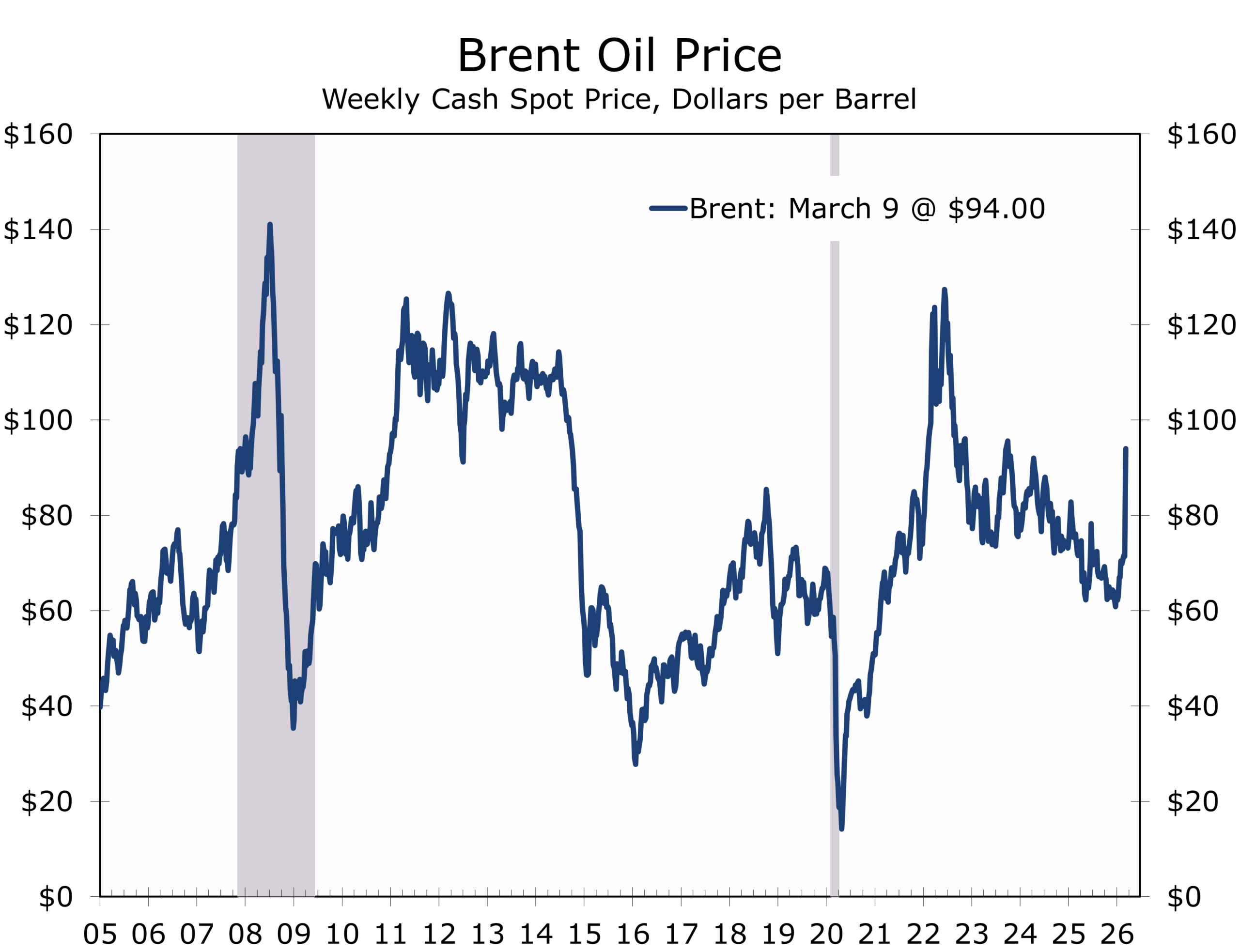
Labor Market: Softer Headline, Firmer Core
Friday’s employment report looked alarmingly weak at first glance, but the internals argue for moderation rather than collapse. Payrolls fell 92,000 in February after a downwardly revised 126,000 gain in January, with healthcare employment dragged down by strike activity and federal government payrolls continuing to trend lower. Revisions lowered December and January payrolls by a combined 69,000. Even so, the unemployment rate edged up only to 4.4%, participation held at 62.0%, average hourly earnings rose 0.4% on the month, and aggregate hours worked increased modestly.
One factor largely overlooked over the weekend is that January and February payroll data are often highly volatile due to swings in holiday-related hiring. In the past those swings were concentrated among retailers. Today they are more often found among restaurants, delivery services, and couriers. The return of winter weather also reversed earlier gains in construction payrolls that had benefited from relatively mild conditions in December and early January. Annual updates to the methodology BLS uses to compile the monthly data further complicates monthly comparisons and this year also has the added burden of government shutdowns and outsized reductions in the federal workforce.
As we cautioned last month, the January payroll numbers were ultimately not likely to be as strong as the headlines suggested. Even so, the three-month trend, which smooths many of these distortions, suggests hiring has slowed to a crawl. The ADP data point to a slightly firmer underlying trend, and we remain encouraged by the improvement in the employment diffusion index, which shows a broader array of industries adding jobs. That improvement is echoed in both the ISM Manufacturing and Services surveys, which have also shown gradual improvement in recent months. Given current conditions, we feel the best measure of underlying job growth is provided by measures of private sector growth from the BLS and ADP.
For the Federal Reserve, the result is an awkward combination: labor market conditions are soft enough to invite discussion of easing, but wage growth remains firm enough to complicate any response to an energy-driven inflation impulse. For now, the Fed likely has time to let the data clarify the underlying trend. Aggregate hours and productivity trends suggest real GDP is still expanding at roughly a 2.5% pace in the first quarter.
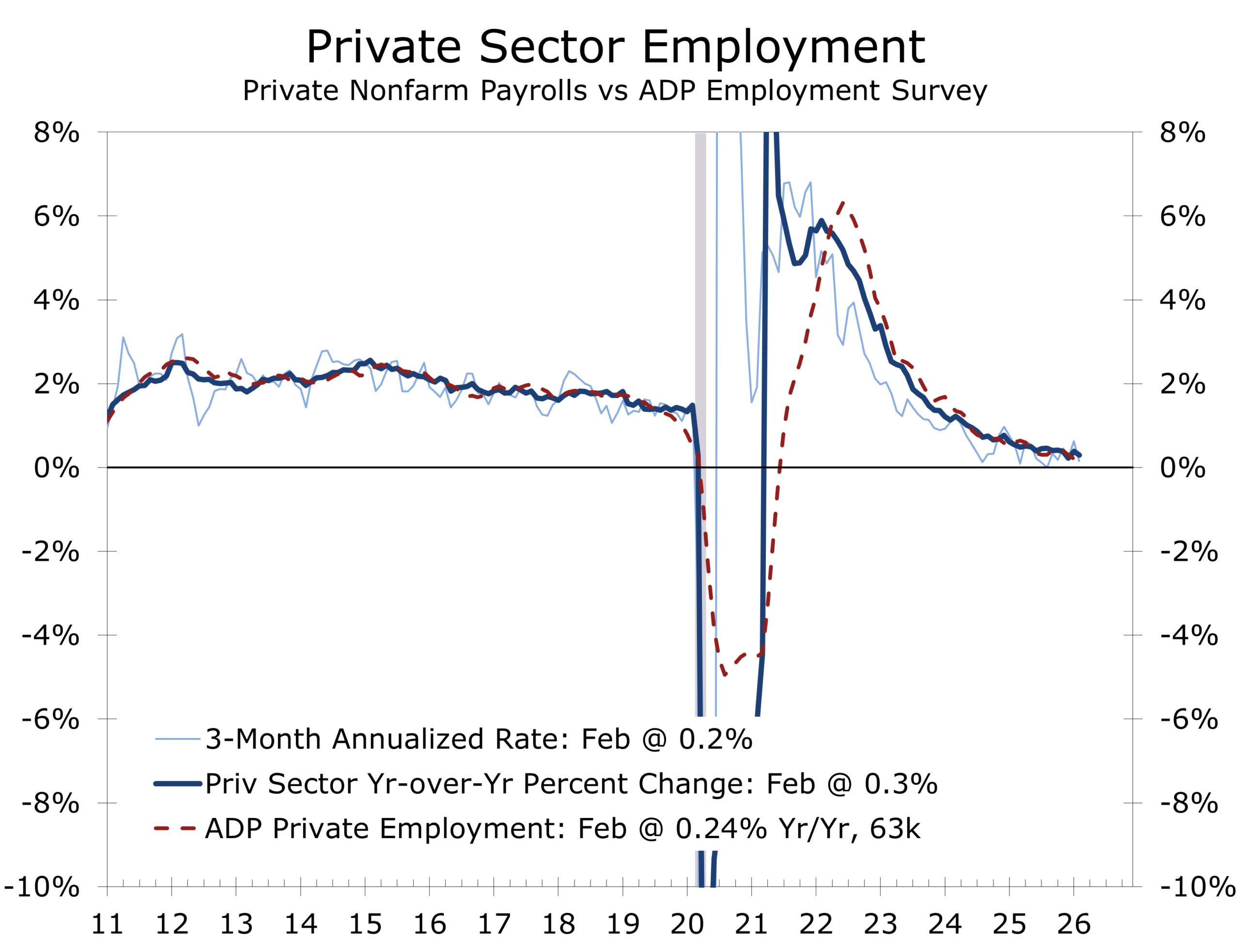
Europe: Energy Shock, Strategic Squeeze
Europe looks especially exposed. Qatar’s production halt has intensified competition for LNG cargoes, European benchmark gas prices jumped more than 30% after the attack on Qatar’s LNG facilities, and major gas storage levels across Europe are near 30% full versus roughly 54% typical for early March. Germany’s inventories are only about 27% full and the Netherlands is near 10%. Statkraft also warned that higher gas prices are already pushing up power costs in Germany, France, and the U.K.
That leaves Europe squeezed from both directions. It remains strategically dependent on the United States for security while once again confronting an imported energy shock that threatens industrial competitiveness. The old continent spent the better part of three years learning that energy dependence is destiny. Iran has now handed it a refresher course.
Markets: Inflation Repricing, Growth Questions Next
Financial markets are behaving as one would expect in the early stages of an oil shock. Wall Street fell Monday before paring losses, the dollar strengthened as a source of liquidity, and Treasury yields jumped and then partially retraced as investors debated whether higher energy prices mean tighter financial conditions or simply more inflation. Gold even fell on Monday as the stronger dollar and reduced expectations for near-term easing overwhelmed the usual haven bid.
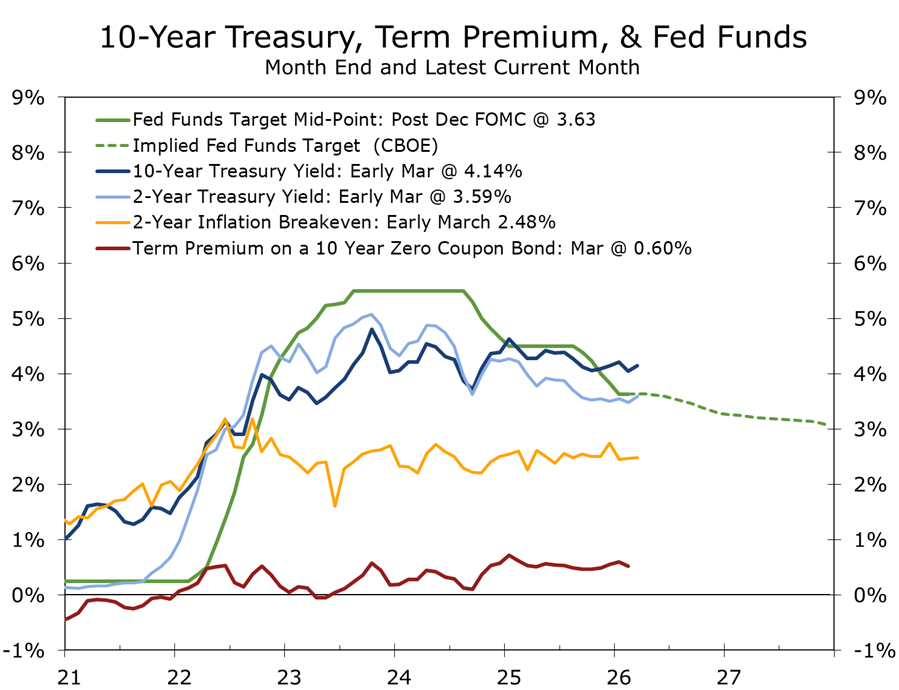
ISM and Cyclicals: Still Expanding, Less Comfortable
The ISM surveys remain among the cleanest read-throughs on cyclical momentum, and they continue to point to expansion. Manufacturing has held above 50 for a second consecutive month, with new orders and backlogs improving from previously depressed levels. The Services survey has also remained comfortably in growth territory. That is the good news.
The less comforting news lies in costs. Tariffs, metals prices, AI-related equipment demand, and now energy are all pushing input costs higher at the same time. Firms can manage one cost shock. Several arriving simultaneously begin to squeeze margins, slow hiring, and delay discretionary spending. The industrial upswing remains intact, but it is now running into a much harsher cost backdrop.
Regular readers know we place substantial weight on manufacturing because it provides the cyclical impulse for the broader economy. The recent improvement in factory activity, defense production, aerospace output, data-center construction, and reshoring still argues for solid underlying growth later this year. The latest data show a clear improvement, with orders up sharply. The risk is that oil and LNG could do to 2026 what tariffs alone could not: turn what had been shaping up as a classic cyclical rebound story into a much messier inflation story.
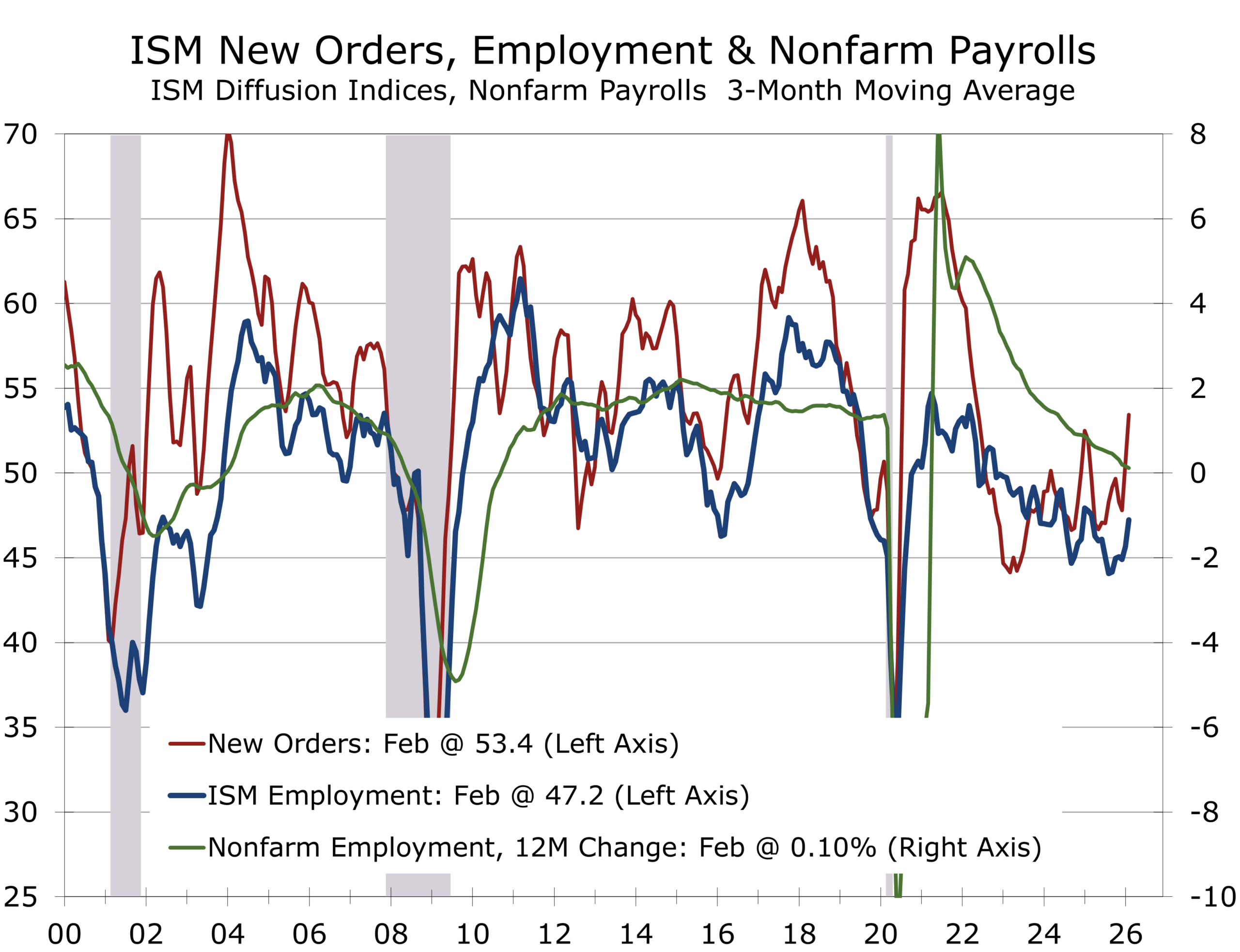
Piedmont Perspective: Deterrence, Duration, and Europe’s Dilemma
Much of the public discussion still treats the current conflict as a sudden rupture. Strategically, it is better understood as a continuation of a long-running confrontation that prior administrations were often reluctant to fully acknowledge. Since 1979, Iran’s regime has defined the United States as its principal adversary and has pursued that objective through both direct actions and a network of regional proxies. For markets, the key issue is not rhetoric but duration. Temporary conflicts can be traded around. Prolonged wars reshape inflation psychology, investment timelines, supply chains, and alliance structures.
Israel has long been Iran’s second primary adversary. Tehran has waged a sustained campaign against the Jewish state through regional proxies, including Hamas, Hezbollah, elements of the Muslim Brotherhood network, and the Houthis, as well as through covert operations. Iran has provided funding, training, and strategic support to these groups, and U.S. and Israeli intelligence assessments indicate Iranian backing for the October 7 attacks on Israel. From Israel’s perspective, that attack fundamentally altered the strategic calculus, strengthening the case for dismantling the regional architecture that Iran has built under the leadership of Supreme Leader Ali Khamenei.
It is worth remembering that relations between Israel and Iran were not always hostile. Prior to the 1979 revolution, the Persian monarchy maintained quiet but meaningful ties with Israel. A resolution that ultimately replaces the current theocratic regime with a government willing to normalize relations with its neighbors would significantly alter the Middle East’s economic trajectory, opening the door to broader regional integration and growth.
Europe now finds itself in a familiar and uncomfortable position. It speaks with moral clarity but possesses limited hard power while remaining heavily exposed to global energy markets. A prolonged Middle East disruption would indirectly strengthen Russia through higher energy prices, complicate Europe’s support for Ukraine, and remind investors that the continent has yet to close the gap between its geopolitical ambitions and its strategic capabilities. History has a habit of sending the bill twice.
Looking Ahead
This week’s calendar arrives at an awkward moment. On Tuesday, investors will parse the New York Fed’s Survey of Consumer Expectations, the rescheduled January Existing Home Sales report, and the delayed fourth-quarter retail e-commerce release. Wednesday brings the February CPI report, the week’s key macro event. Thursday includes initial claims and the February PPI. Friday is crowded: the second estimate of fourth-quarter GDP, personal income and the PCE deflator, JOLTS, and the preliminary March University of Michigan consumer sentiment survey.
Under ordinary circumstances the CPI would dominate. This week it shares the stage with oil, gasoline, shipping disruptions, and consumer psychology. If inflation data run hot while gasoline prices keep climbing, markets will further reduce the odds of near-term Fed easing. If sentiment sours sharply, growth fears will move up the list.
Funding Fundamentals
Front-end relief can no longer be assumed. Oil in the $90 range, firmer wage growth, and a still-expanding services economy complicate the path to easier policy. Funding windows may remain open, but they are likely to be more episodic and more dependent on intraday market tone. Refresh liquidity forecasts, revisit commodity and transport exposures, and be realistic about working-capital pressure if energy and freight costs remain elevated. Opportunistic issuance on rallies still makes sense, but the comfort of a steadily declining rate path has faded.
Bottom Line
The U.S. economy entered the Iran shock with more resilience than the headlines suggest, but resilience is not immunity. As Clooney’s character observes in The Peacemaker, “Once it starts, you don’t control it.” Markets are hoping that deterrence still works before the current conflict reaches that stage. Friday’s employment report reiterates that the labor market has limited room for error, but it is not collapsing either.
Monday morning’s oil market initially signaled that the geopolitical shock was intensifying, before reconsidering that view by mid-afternoon. The oil market remains well supplied overall, but a prolonged disruption could easily see those earlier price highs revisited. Europe’s renewed energy vulnerability raises the global stakes, and this week’s inflation and activity data will help determine whether the macro backdrop can absorb another oil spike.
Economic growth remains solid, even if it is moderating somewhat. Real GDP appears to be tracking near a 2.4% annualized pace in the first quarter, reflecting the combined effects of winter weather and the early stages of geopolitical uncertainty weighing on consumer spending and capital investment.
Markets began the year expecting a friendlier mix of moderating inflation, modest policy easing, and steady growth. They are now being asked to contemplate something less comfortable: respectable growth, stubborn inflation, and a war whose duration may matter almost as much as its outcome.
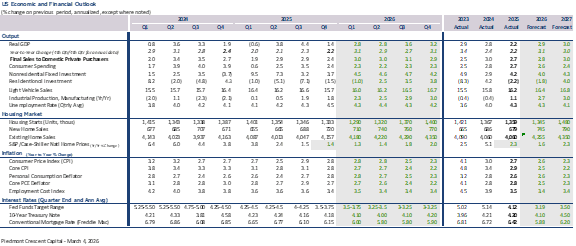
Disclaimer: This publication has been prepared for informational purposes only and is not intended as a recommendation offer or solicitation with respect to the purchase or sale of any security or other financial product nor does it constitute investment advice.
March 9, 2026
Mark Vitner, Chief Economist
mark.vitner@piedmontcrescentcapital.com
(704) 458-4000
A View from the Piedmont: Our Weekly Commentary on Money, Credit, Exchange Rates & Geopolitics – Data Drift, Softer GDP Growth, and Strategic Pressures
Highlights of the Week
- Q4 2025 GDP was distorted by the government shutdown, contributing to volatile quarterly readings, though underlying growth remains resilient.
- Consumer spending remains resilient but faces headwinds from slower job growth and tariff adjustments, with imports and inventory dynamics shifting post-Supreme Court ruling.
- Consumer sentiment remains subdued amid geopolitical tensions and policy fog, though it has rebounded slightly from historic lows.
- Business activity is expanding at a moderate pace, with signs of stabilization in the labor market and broadening capital spending.
- Strategic geopolitical pressures continue to pose cascading risks to confidence, markets, and economic stability, amplified by recent tariff resets and the escalation in Iran-US tensions.
A Blizzard of Economic Data Ahead of the Blizzard
Government statistical agencies are still diligently working to catch up on lost time from the shutdown, resulting in the latest data reflecting a mix of tail-end Q4 2025 and early Q1 2026 figures. While headline growth was softer than anticipated—partly due to the shutdown subtracting from activity—underlying final demand showed resilience. We estimate that the end of the shutdown will add a 1.3pp boost to Q1 2026 growth, pushing our tracking estimate to 3.4% annualized. Real final sales to domestic purchasers advanced solidly, climbing at a 2.4% annual rate. While that is a touch below its recent trend, it is strong enough to support a continued broadening in economic gains.
The shortfall in Q4 growth is not a warning about slower economic growth. Instead, it is evidence that growth faced temporary drags from the government shutdown. The underperformance will likely continue in Q1 due to losses tied to unusually harsh winter weather across much of the U.S. during February. Even with weather distortions, continued productivity gains from AI investment will provide a strong counterbalance to these distortions, and we expect strong Q1 GDP growth.
Consumer spending has shown resilience, supported by strong household balance sheets and wealth effects from asset markets. Spending has been bolstered by higher-income households, while broader outlays face pressure from lingering inflation and policy fog. Recent data, however, indicate narrowing breadth. Retail sales ended 2025 on a soft note, and weekly tracking data from the Chicago Fed point to a slight decline in retail sales in January. The Supreme Court’s February 20, 2026, ruling striking down IEEPA tariffs reduced the effective tariff rate from 12.7% to 8.3%, offering a modest boost, though offset by President Trump’s announcement of a new 10-15% global tariff under Sec. 122.
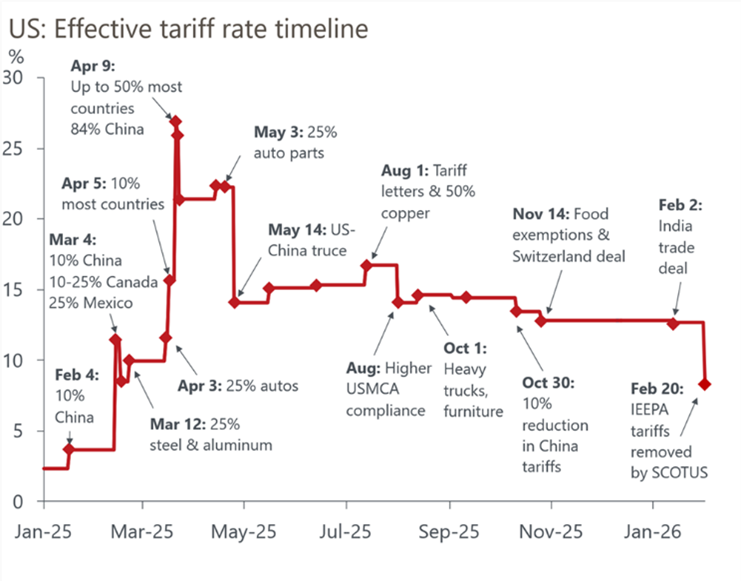
There has been a great deal of discussion recently on who bears the burden of tariffs. We continue to believe the burden has been shared between producers, shippers and wholesalers, retailers, and consumers. Inflation ran about 0.4 percentage points higher in 2025 than it would have otherwise. Nearly all of that showed up in higher prices for goods. The substitution effect has reduced the overall impact. Monetary policy has also remained tight. As a result, higher prices for imported have left consumers with less to spend on other goods and services, which has reduced inflation in these categories.
The bulk of tariff passthrough is now behind us, and we estimate it increased core PCE prices by about 0.7% through January, with a further 0.1% increase in the remainder of 2026. We expect the burden from tariffs to diminish this year and look for inflation to gradually decelerate back to the Fed’s 2% target by year-end.
Sentiment: Subdued and Uneven
Measures of consumer confidence have stabilized but remain historically low. The two most widely followed measures from the Conference Board and University of Michigan are roughly 15-20% below their year-ago levels amid slower job growth, reflecting the lingering effects of prior inflation, slower job growth, and ongoing geopolitical tensions. Recent improvements reflect the waning impact of tariffs and diminished inflation overall, particularly in gasoline prices and grocery prices other than beef products.
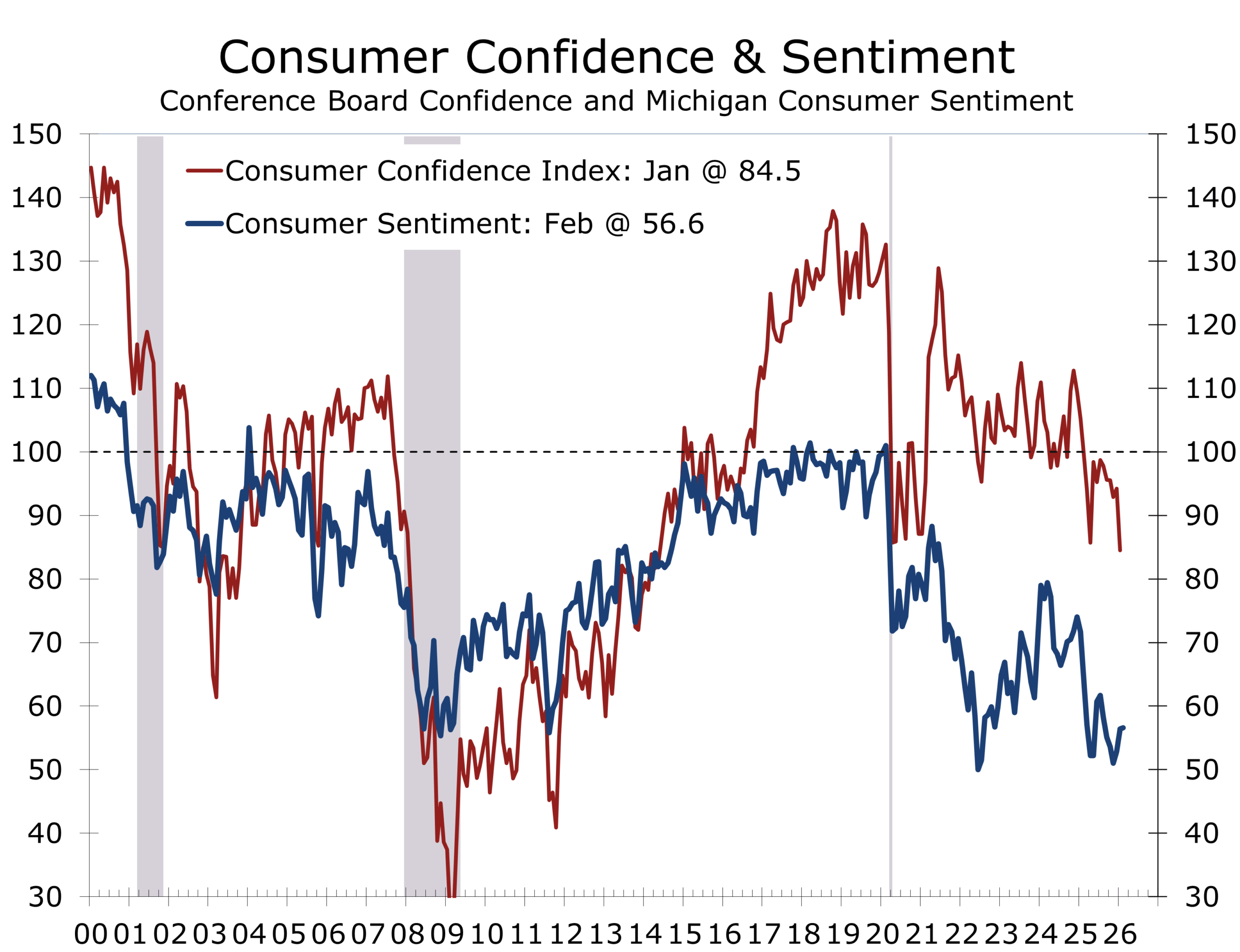
Business Activity: Green Shoots?
Recent PMI readings and industrial production data show the factory sector improving. The ISM Manufacturing index rose to its highest level since 2022 in January, while manufacturing payrolls posted their first increase in 14 months and gains were broad-based, with the diffusion index for manufacturing employment rising back above the key 50 level. The diffusion index, like the ISM Manufacturing survey, is a measure of the breadth of the strength in the factory sector. A reading above 50 means more industries are expanding and adding to their payrolls than are contracting or reducing staffing.
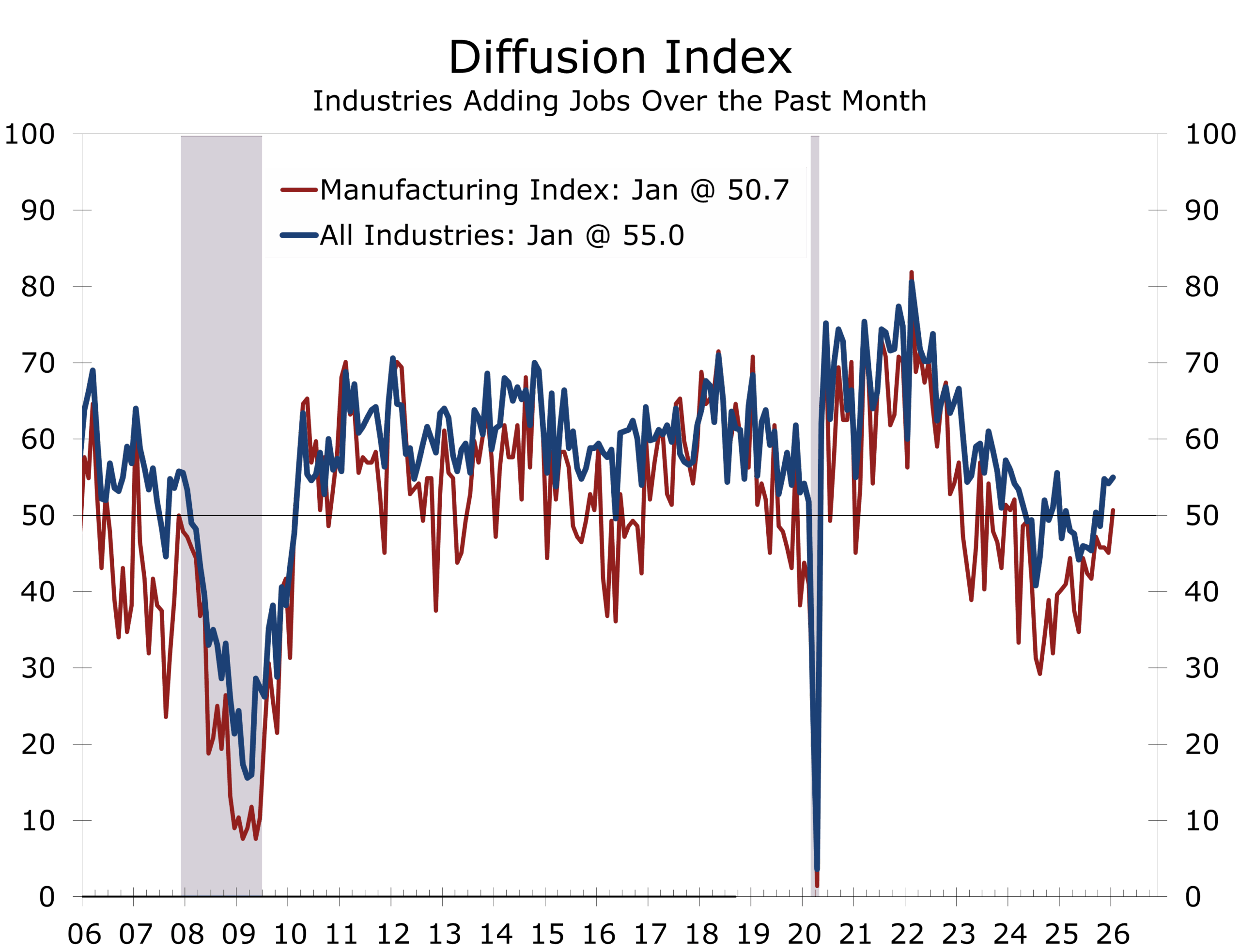
Consumer and Housing: Weather, Not Weakness
Consumer spending softened at the start of the year, but the weakness appears more short-term oriented. Overall retail sales were flat in December and core retail sales fell 0.1%. Even after the cooldown, holiday retail sales turned in a solid performance, rising 3.7%. December’s drop reflects payback effects from earlier strength and harsh winter weather weighing on activity. Final demand remains supported by steady employment and easing inflation, limiting downside.
This looks like weather distortion and seasonal payback, not a demand pullback.
Housing activity also started 2026 on a weak note. Existing home sales fell 8.4 percent in January to a 3.91 million annual pace, well below expectations, with prior months revised lower. Harsh winter weather likely contributed to the decline, and tight inventories compounded the slowdown. For-sale supply slipped again in January and remains constrained, though inventory typically improves heading into spring.
Median home prices fell 2 percent and are up just 0.9 percent over the past year. As mortgage rates ease and labor markets stabilize, sales should gradually climb back. We are looking for a solid spring selling season and look for housing to add to economic growth in the second half of 2026.
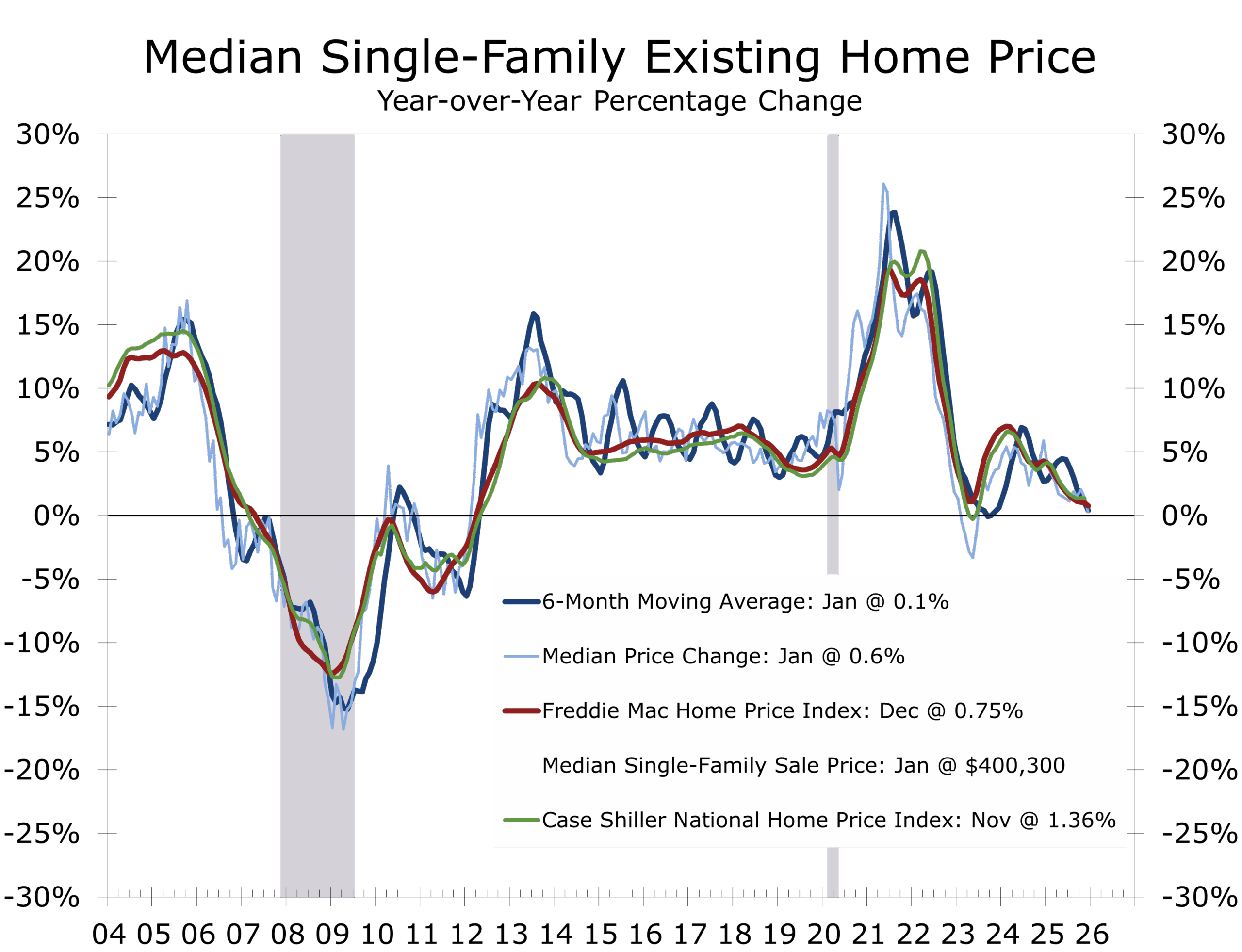
The advance PMIs for February released this past week fell back slightly, possibly impacted by the harsh winter weather, but remain in expansion territory. Both the manufacturing and services indices dipped slightly during the month, but both remained above the key 50 break-even level that signals growth in the factory sector.
Core factory orders also remain solid, although the headline data continues to be battered around from month-to-month by swings in orders for commercial aircraft. Shipments were up solidly in December, which means the factory sector likely entered this year with solid momentum.
The apparent improvement in the factory sector is a green shoot worth watching. We have been expecting to see a rebound in the most cyclical parts of the economy, which were hit hard by tariff uncertainty and inflation fatigue among consumers. We expect that rebound to become apparent later this spring or early this summer. The January data suggest the rebound might come even earlier.
Blizzard Navigation: Interpretation
Three themes emerge from the data:
- Momentum Is Moderating, Not Collapsing. Household consumption is positive but facing tariff-related headwinds. Despite the slowdown in headline GDP growth, the economy is still growing solidly. Final Sales to Domestic Purchasers rose at a 2.4% pace in Q4 and rose 2.7% Yr/Yr in Q4. For 2026, real GDP is likely to rise 3.3% Q4/Q4, thanks to the lower comp, while Final Sales to Domestic Purchasers rises at the same 2.7% pace it did this past year.
- Income and Wealth Divergence Matter. Spending strength is concentrated among wealthier households, while middle- and lower-income segments continue to exhibit caution. This pattern has implications for durable goods, housing, and discretionary services, especially with AI-driven productivity offsetting some labor pressures.
- Policymakers Are Flying Through Fog. With core inflation still above target and growth stabilizing, the Fed faces a delicate balance: ease too soon and risk reaccelerating prices amid tariff volatility; wait too long and risk tightening into a slowdown. FOMC minutes from January highlight hawkish tones, with some members open to hikes if inflation persists. We believe such talk is simply the Fed’s Open Mouth Policy intended to reassure the bond market.
Businesses, investors and consumers are behaving like drivers in heavy snow. They have slowed down, are proceeding more cautiously, and remain overly responsive to short-term visibility changes rather than structural conditions.
The Piedmont Perspective
Strategic Pressure: Why Weakness on One Front Would Likely Snowball Across All Fronts
The economy today is not just an aggregation of GDP figures and spending patterns. It is tightly connected to the strategic pressures facing U.S. policymakers—and investors are pricing that in. The Trump Administration’s emphasis on tariffs and trade deals blends seamlessly into geopolitics, often touted as a tool for ending conflicts or pressuring adversaries toward negotiations. This heightened role of trade and tariffs is critical to understanding the current long list of global hot spots, where economic leverage intersects with security concerns.
President Trump’s emphasis on tariffs and trade deals blends seamlessly into geopolitics.
Across multiple theaters—Venezuela, Iran, Taiwan, Russia/Ukraine, Israel-Hamas-Hezbollah, and most recently Mexico’s drug cartel crisis—the U.S. faces simultaneous stress tests. Each region bears its own risks, but they are interrelated in ways that amplify economic uncertainty.
- Venezuela’s Output and Oil Dynamics. Persistent instability keeps global oil markets on edge. The recent departure of Cuban advisors from Venezuela marks a potential shift, reducing some foreign influence and creating an opening for U.S. engagement. This has been framed as a “stand tall” moment in broader negotiations with China, which has significant investments in Venezuelan oil. The current Venezuelan regime is working closely with the Administration, which could aid supply normalization. The seizure of sanctioned tankers is also helping ease supply concerns at the margin.
- Iran and the Gulf. Escalating tensions, including Iran’s military drills restricting parts of the Strait of Hormuz, elevate risk premia. Disruptions in the Strait or Red Sea corridors ripple through global supply chains and commodity markets—impacting prices, production costs, and confidence. Brent prices rose 6% last week amid these tensions, though we expect easing once de-escalation occurs. Negotiations remain fraught, with tariffs positioned as leverage to curb Iran’s nuclear ambitions and regional influence.
- Taiwan and the Tech Supply Chain. Taiwan remains the central node in global semiconductor production, particularly in advanced logic chips critical to AI infrastructure, cloud computing, and next-generation defense systems. Any escalation in cross-Strait tensions would represent more than a geopolitical flashpoint; it would constitute a direct supply-side shock to the capital investment cycle that has underpinned recent productivity gains.
The current AI build-out is capital-intensive and hardware-dependent. A disruption to Taiwanese semiconductor output would slow equipment investment, compress earnings expectations across the technology complex, and raise global risk premia. Financing conditions would tighten not because of monetary policy alone, but because uncertainty would lift required returns on capital.
Trade agreements and semiconductor partnerships serve a dual function: economic integration and strategic deterrence. The deeper the cross-border commercial ties, the higher the cost of escalation.
Reports that Beijing is pressing Washington to delay or dilute an agreed arms package to Taiwan—using the prospect of postponing high-level meetings as leverage—introduce an additional layer of uncertainty. Markets will focus less on the diplomacy itself and more on the signal. A perceived weakening of deterrence would likely raise volatility across technology equities, defense names, and Asia-linked assets. Reinforcement would signal policy consistency and reduce tail risk.
From a macro perspective, Taiwan is not a peripheral issue. Stability in the Taiwan Strait underpins a substantial portion of global capital formation, productivity growth, and equity market valuation. Credibility in that theater carries economic consequences within and well beyond the region.
- Russia/Ukraine and Energy/Defense Markets. The prolonged conflict keeps energy markets and defense spending elevated. Escalation or stalled diplomacy maintains high risk premia, diverts capital toward safe assets, and compresses risk-asset valuations. Wheat prices have tracked higher due to geopolitical risk premiums from this flashpoint. Tariffs on Russian goods amplify economic isolation as a strategy to weaken resolve.
- Israel-Hamas-Hezbollah Centrifuge. The Middle East remains a powder keg. An expanded conflict could shock oil markets, complicate U.S. force deployments and alliances, and reinforce economic caution in corporate boardrooms globally.
The risk here mirror those with Taiwan/China. The buildup of U.S. forces in the region suggests a major intervention is likely soon. Iran will likely respond violently as the regime’s survival would be at stake. Iran would likely strike oil facilities in the Arabian Gulf, which would send oil prices higher but not threaten energy supplies in the U.S., which is amply supplied. Ultimately, we expect the Iranian region to be toppled this year. Anything less than that would make a Chinese move against Taiwan more likely.
- Mexico, Cartels, and Border Economics. Security instability along the southern border affects labor markets, supply chains, and cross-border commerce. Firms factor these into investment decisions and logistics costs, exacerbated by recent tariff changes on Mexico. The situation has intensified following the killing of a powerful drug lord by the Mexican military. The cartel has responded violently, but mostly by destroying property and overrunning airports in tourism-centric parts of Mexico.
Taken together, weakness on any one of these fronts would cascade:
- Commodity Price Shock → Feed inflation → Fed policy tightening or delayed easing
- Supply Chain Shock → Raise costs → Consumer price pressures → Consumer spending slows
- Risk Premia Shock → Raise discount rates → Lower asset valuations → Lower wealth effects
- Corporate Caution → Delay hiring & capex → Softening growth cycle
- The U.S. opts for Expediency: Effectively Showing Weakness → Emboldening China on Taiwan and Russia with Ukraine → Further Increasing Global Geopolitical Instability → Raising risk premia
In chess, a weakness on one flank invites attack across the board. In macro-geopolitics, a breakdown in any of these theaters tightens financing conditions, weakens confidence, and slows growth globally.
Today’s market blizzard isn’t snowflakes—it is the accumulation of strategic pressures with cross-linked knock-on effects, now compounded by the Supreme Court tariff ruling and policy responses.
Looking Ahead: The Week in Data and Policy
This week’s economic calendar features several key data releases that could provide further insights into the trajectory of growth, inflation, and labor market stability. On Monday, factory orders for December are expected to show a modest decline, reflecting ongoing manufacturing softness amid trade uncertainties. Tuesday brings housing market indicators with the S&P Cotality and FHFA home price indices for December, anticipated to post small gains, alongside Conference Board consumer confidence for February, which may edge higher following last month’s plunge. Thursday’s initial jobless claims will offer a timely read on labor market health, while Friday’s PPI report for January, which is projected to rise 0.3%, will be closely watched for signs of persistent price pressures, especially in core measures excluding food and energy. Construction spending data for December and November revisions round out the week, which should show weakening residential building and some stability in nonresidential construction.
Fed speakers will dominate the policy landscape, with multiple officials providing updates on monetary policy amid the tariff reset and geopolitical fog. Governor Waller speaks twice on Monday and Tuesday, likely reiterating his view that rates should move closer to neutral given inflation nearing target ex-tariffs. Other notable appearances include Governors Cook and Bowman, as well as regional presidents like Goolsbee, Collins, Bostic, Barkin, Schmid, and Musalem, many emphasizing caution on inflation risks despite labor market weakness. Adding to the week’s significance, President Trump delivers the State of the Union Address on Tuesday evening at 9 p.m. ET, where he is expected to outline priorities on the economy, trade deals, tariffs as a geopolitical tool, and ongoing conflicts, potentially influencing market sentiment and policy expectations.
Final Thought
Economic data from last week confirms a key theme: visibility has become a greater concern than slower growth. Growth is stabilizing, sentiment remains subdued, and consumer strength is uneven—making for tough sledding ahead—while strategic risks from oil to semiconductors to geopolitical flashpoints add layers of complexity that markets are pricing defensively.
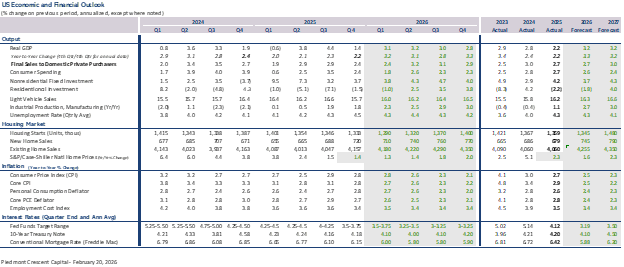
Disclaimer: This publication has been prepared for informational purposes only and is not intended as a recommendation offer or solicitation with respect to the purchase or sale of any security or other financial product nor does it constitute investment advice.
February 23, 2026
Mark Vitner, Chief Economist
mark.vitner@piedmontcrescentcapital.com
(704) 458-4000
Discipline Over Design in 2026
A Conflict of Visions: Growth, Credibility, and the Political Clock
- The expansion remains intact, but its composition continues to shift. January brought solid job gains, firmer manufacturing surveys, and housing starts that ended 2025 stronger than expected. Existing home sales weakened in January, however, reflecting tight inventories and the return of harsh winter weather.
- Q4 GDP resets expectations. Headline growth came in at a 1.4% annualized pace, well below the 3.0% consensus and our 2.8% call. Composition matters more than the headline: the shortfall stemmed largely from a larger-than-expected 1.2-percentage-point hit from the federal government shutdown. Private final domestic demand rose 2.4%, matching our estimate. Advance data put 2025 GDP growth at 2.2%, down from 2.8% in 2024; private final domestic demand grew 2.7% in 2025, down from 3.1% the prior year.
- Inflation continues to drifting lower. Accelerating productivity growth and decelerating shelter costs are driving the improving trend. Core measures cooled as the impact from tariffs fade and unit labor costs stabilize at a slower pace. Q4 saw a bit of an uptick, with the Gross Domestic Purchases price index rose 3.7% (up from 3.4% in Q3), PCE prices +2.9% (from 2.8%), but core PCE +2.7% (down from 2.9%).
- Markets continue to price a quarter-point rate cut in June followed by another in September. We view that timetable as appropriate, but meaningful Q1 softness might pull the first move into May.
- Treasury supply and geopolitics keep term premia sticky. Oil’s risk premium and heavy issuance limit long-end rate relief. A direct conflict with Iran would likely prove more disruptive than recent military actions and could initially trigger a flight to safety even as energy prices rise, possibly opening a window to lock in lower rates.
- The State of the Union accelerates the political clock. Midterm dynamics compress the timeline for visible economic gains. We look for Trump to pivot on immigration and trade.
- As Thomas Sowell articulated in A Conflict of Visions, durable expansions respect constraints rooted in incentives and institutional limits, rather than unconstrained attempts to design outcomes. This framework, which highlights hard trade-offs over pronouncements and grand visions, applies aptly during Black History Month, reminding us that sustainable progress emerges from disciplined processes, not from platitudes or engineered utopias. Attempts to outrun economic arithmetic will always eventually meet up with market realities.
The Expansion is Evolving
The economy entered 2026 with more underlying momentum than year-end forecasts implied, and with more steam than the 1.4% advance Q4 GDP print suggests. A flurry of delayed releases following the government shutdown has filled in important details, but the story is far from complete.
Nonfarm payrolls rose 130,000 in January, with private payrolls up 172,000 and government employment declining. Healthcare and social assistance continued to lead hiring, but construction and manufacturing also added jobs. Manufacturing payrolls increased for the first time in 14 months. While gains were modest, they were broad-based and consistent with firm national and regional surveys and improving factory output.
Industrial production rose 0.7% in January, with manufacturing output up 0.6%. Durable goods industries posted widespread gains, and the share of manufacturing subsectors contracting year over year has fallen to its lowest level since early 2022. Both the ISM index and payroll diffusion measures moved back above 50. Output now stands near its highest level since mid-2019. We would label this as a legitimate green shoot.
Capital spending ended 2025 on solid footing. Core capital goods orders rose 0.6% in December and core shipments—what feeds directly into GDP—rose 0.9%. Aircraft volatility distorted the headline durable goods data, but underlying investment trends strengthened. AI-related equipment remains a clear tailwind, yet investment gains are gradually broadening beyond technology-linked sectors, supported by fiscal incentives, healthy margins, and expectations of eventual rate relief. Imports tied to AI infrastructure widened the December trade deficit, temporarily obscuring underlying strength in Q4.
Housing remains uneven. Housing starts ended the year at a 1.404 million annual rate, with upward revisions to prior months, and permits suggest stabilization in single-family construction. Mild December weather likely boosted late-year activity, while January storms dampened home sales, starts, and consumer spending. Existing home sales weakened in January. New home sales slipped 1.7% in December after a sharp November gain and finished the year at a solid 745,000 annual pace. Inventories declined but remain elevated at a 7.6-month supply. Builders must work through completed inventories before sustained acceleration resumes.
Wintertime data are unusually noisy. Utilities output surged while mining fell due to weather disruptions, distorting the industrial production headline. Strip out the volatility, however, and the factory sector is improving. Greater clarity around tariff policy, even if duties persist under alternative authorities, reduces one source of hesitation for manufacturers. We expect a cyclical recovery to take hold this year as supply chains normalize, inventories rebuild, and housing turnover stabilizes.
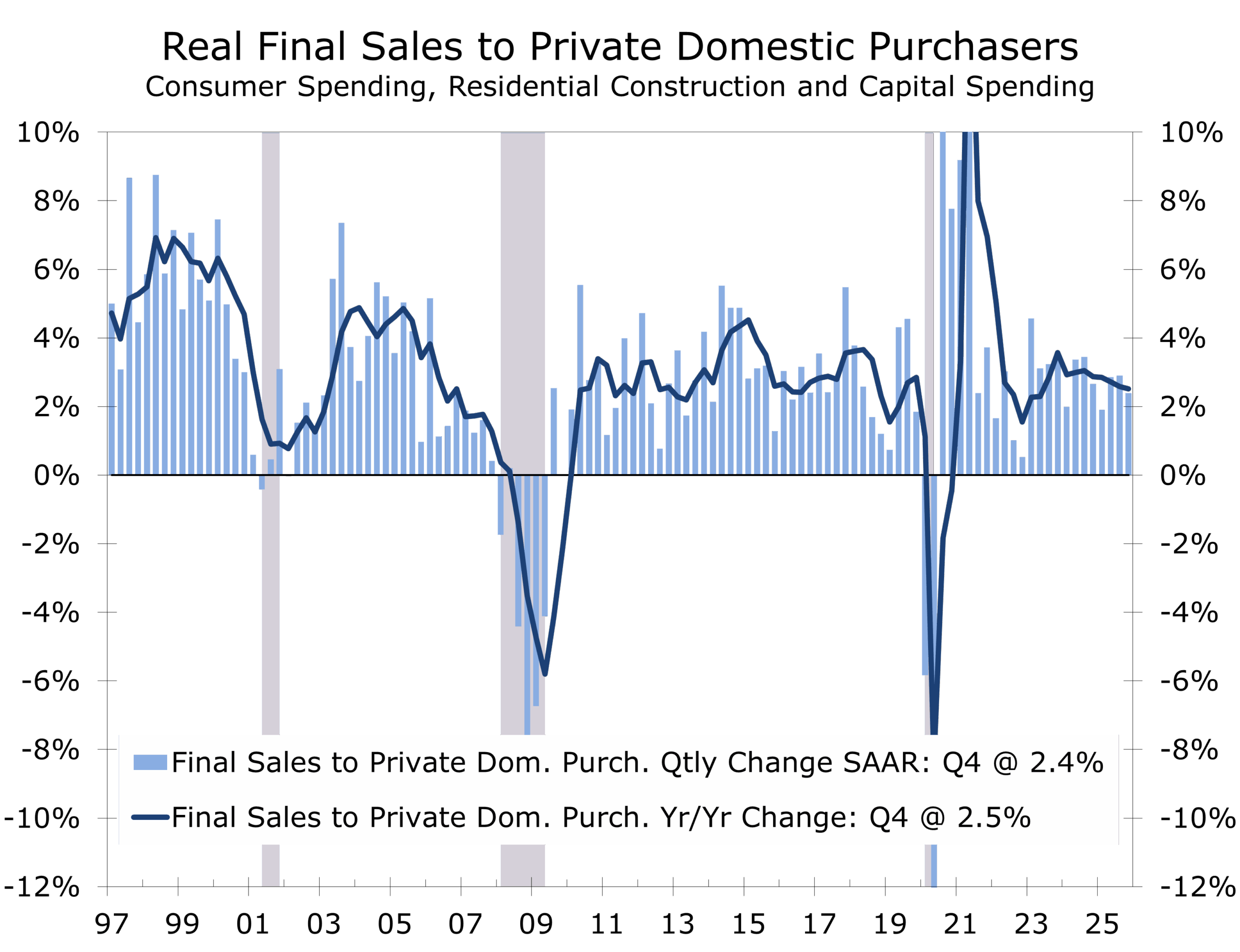
The December FOMC minutes included discussion of possible additional tightening should the deceleration in inflation stall. While that risk appears low, it cannot be dismissed outright. Broader economic data does not point to the economy overheating or anything near that. Cyclical segments—durable goods consumption, housing turnover, and non-AI capital spending—remain soft, with only tentative signs of improvement. The parts of the economy that are growing primarily reflect structural shifts toward AI-driven productivity, healthcare demand, and energy infrastructure.
At the same time, the economy is not deteriorating. The moderation in job growth reflects slower labor supply growth as much as softer demand. Layoffs remain low, with weekly initial unemployment claims hovering just above 200,000. Private-sector hiring remains sufficient to keep the unemployment rate near current levels, which are widely viewed as consistent with full employment.
Productivity growth is improving, supported in part by AI-driven efficiency gains extending beyond technology into logistics, manufacturing, finance, and professional services. Growth is rotating away from lower productivity sectors, reflecting the impact of tighter immigration enforcement on the labor supply, while rotating toward higher productivity sectors in AI, life sciences and aerospace and defense.
Inflation Is Moderating, But Not Smoothly
Inflation continues to ease, though the progress remains uneven. Slower job growth has restrained consumer spending, contributing to softer new and used vehicle sales and easing used car prices. Housing demand has similarly cooled, tempering home price appreciation, while a surge in apartment completions has generated rental concessions across much of the country, helping moderate shelter inflation. January CPI came in at 2.4% year over year on the headline and 2.5% on core, broadly in line with expectations and consistent with gradual disinflation. Inflation expectations have also eased.
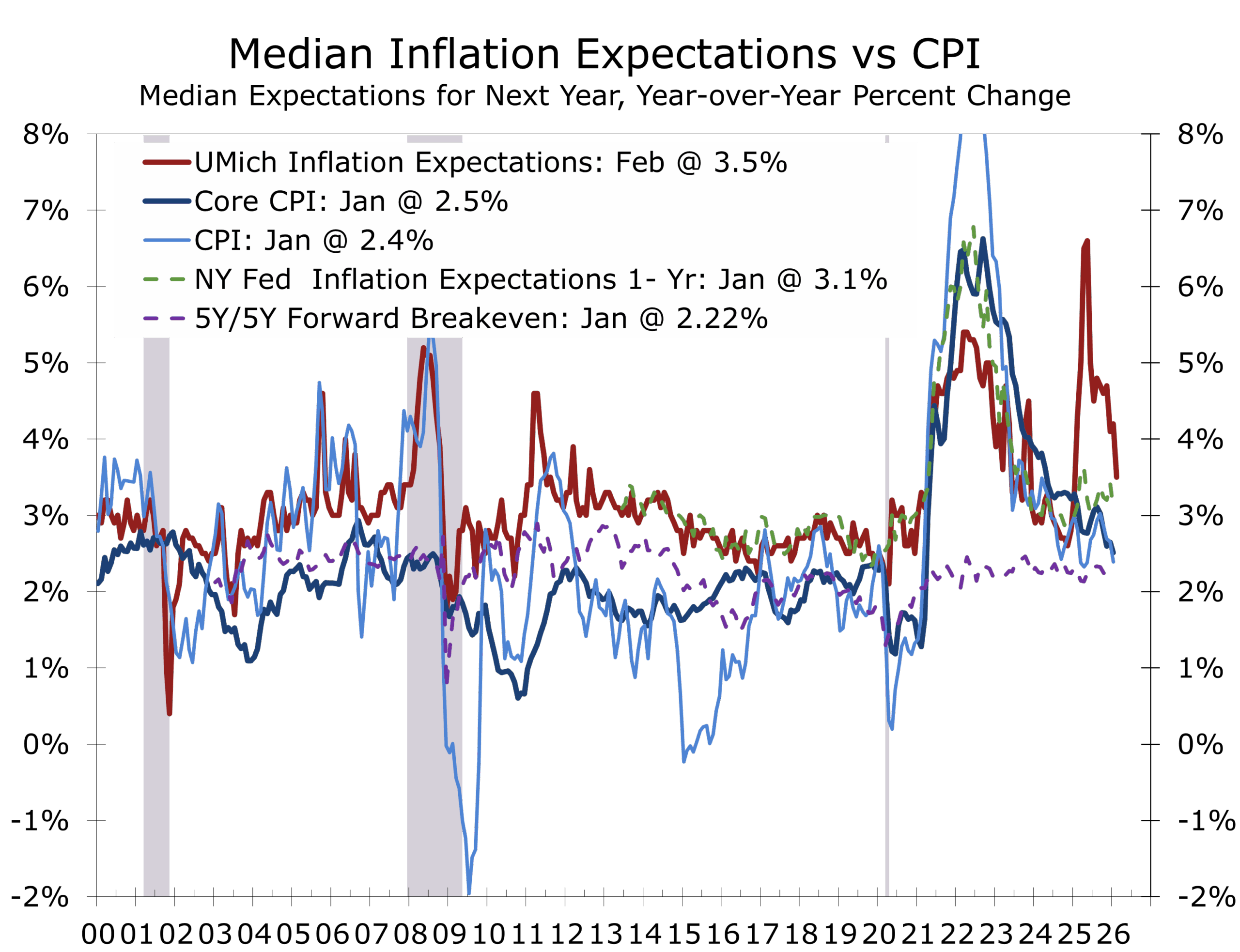
The year-end PCE data came slightly hotter than expected. December core PCE rose 0.36% month over month and accelerated to 3.0% year over year, slightly above consensus expectations. Headline PCE also rose 0.36% in December and stands at 2.9% year-over-year. The Q4 GDP report showed the gross domestic purchases price index rising at a 3.6–3.7% annualized pace, reflecting firmer consumption and government deflators.
The divergence between softer CPI readings and firmer PCE measures reflects weighting differences and temporary distortions. The PCE has recently run hotter than CPI in part due to housing measurement effects and stronger financial services inflation. Non-housing services’ inflation remains elevated, but unit labor costs are drifting lower amid moderating wage growth and improving productivity.
Goods inflation, which re-accelerated in 2025 due to tariff passthrough, now appears to be moderating. We expect the headline PCE to decline toward 2.0% by year-end. We estimate that tariffs added roughly 0.4 percentage points to headline inflation over the past year. Absent that effect, the deflators would likely be closer to target already. The impact from tariffs will partially reverse this year.
The broader takeaway is that disinflation is occurring through normalization in demand and supply rather than forced through tighter credit and weaker economic growth. The shutdown-related drag directly subtracted roughly 1.15 percentage points from Q4 growth and should at least partially reverse in Q1. As tariff effects fade and productivity improves, growth can remain positive without reigniting broad price pressures. This means the Fed can cut interest rates before inflation moves back to its 2% target.
Q4 GDP: Resetting the Mix, Not the Cycle
Fourth-quarter real GDP rose 1.4% annualized. The headline was disappointing, but much of the weakness reflected the temporary drag from the federal shutdown, which depressed government spending and will likely reverse in Q1. Strip away that distortion and the underlying economy remains on a stable footing.
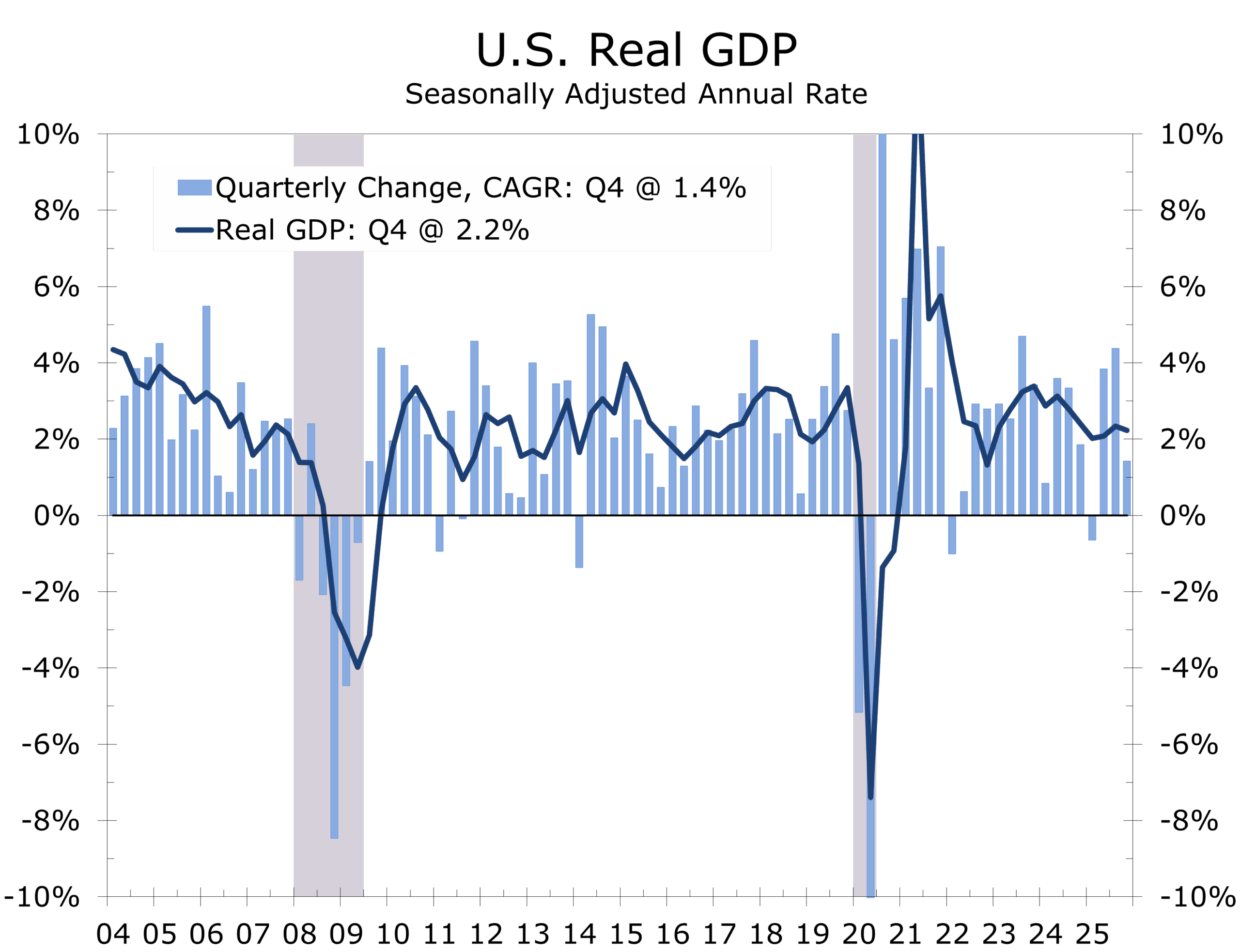
Private domestic final sales rose 2.4%, only modestly below Q3’s pace. Consumer spending slowed but remained positive. Business fixed investment increased at a solid clip, led by intellectual property and equipment. Residential investment continued to contract, underscoring that housing remains a lagging sector in this cycle. The composition matters more than the disappointing headline 1.4% print.
This is increasingly a capital-heavy, job-light expansion. Equipment, software, and R&D spending remain firm, particularly in AI-linked sectors. Hiring, by contrast, has moderated materially. Job growth in 2025 was the weakest of any non-pandemic year since 2009, yet output continues to expand near trend. That divergence is the defining feature of this cycle and partly reflects payback for the COVID period.
Productivity gains are allowing firms to generate higher output without proportional increases in headcount. Returns to physical capital, intellectual property, and specialized skills are rising faster than aggregate wage income. Higher-income households, who disproportionately own financial assets and benefit from equity-market strength tied to AI investment, are capturing a larger share of income growth. Meanwhile, lower- and middle-income households, which are more dependent on wage gains and more exposed to goods inflation, are experiencing less improvement in purchasing power.
This dynamic produces what is often described as a K-shaped outcome: aggregate growth continues, but the distribution of gains is uneven. This is not unusual for periods in which the economy endures a transformational shift. As tariff distortions fade and fiscal incentives broaden equipment spending, capital deepening should remain a central theme in 2026. Lower interest rates should eventually lift key cyclical sectors that have been lagging, particularly interest-sensitive areas like housing, consumer spending on durables and capital spending by small and mid-sized businesses that have been squeezed by many of the same forces squeezing consumers.
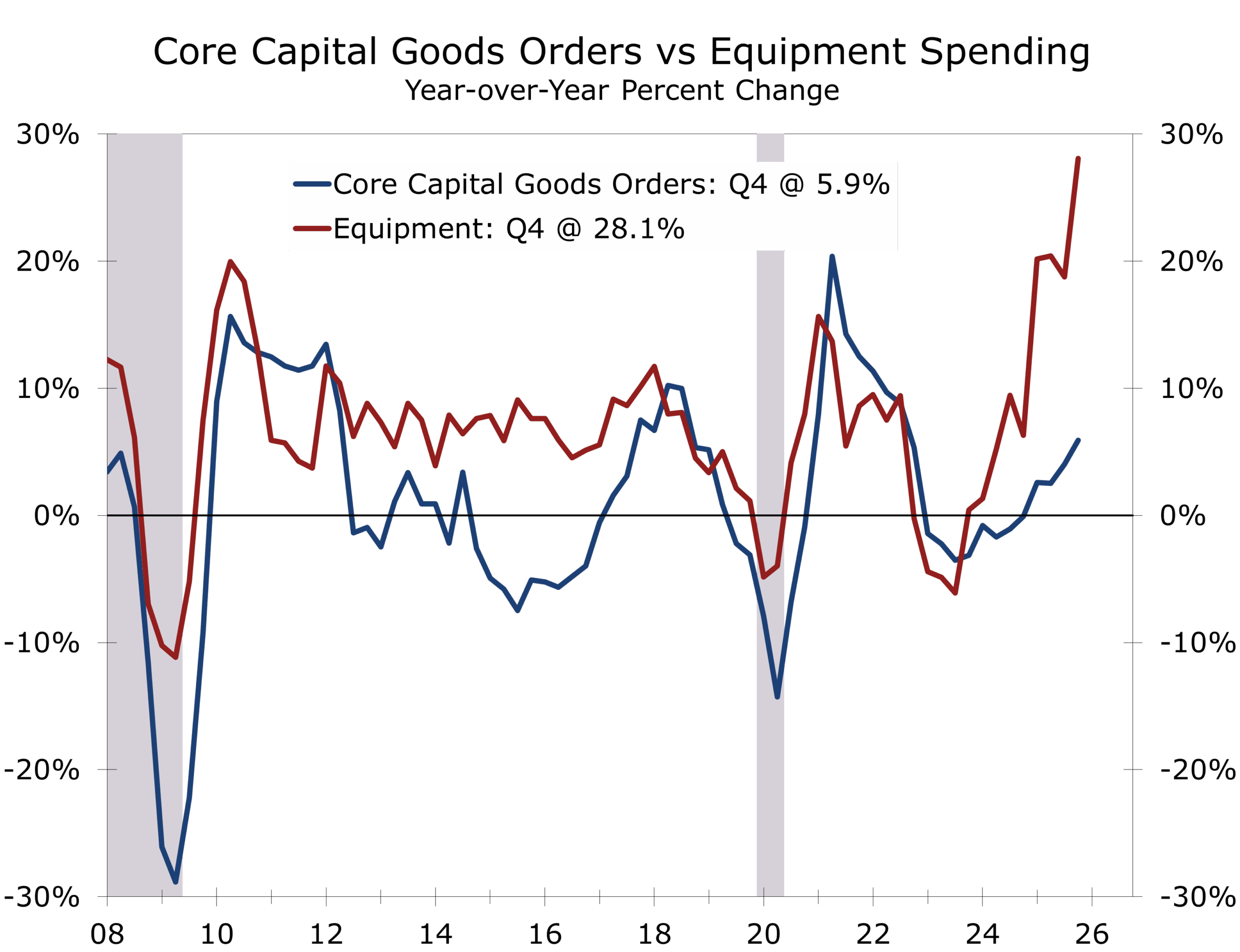
Full-year 2025, 2.2% real GDP growth marks a moderation from 2024 but remains consistent with an economy expanding within labor-force and productivity constraints.
The takeaway is straightforward. The economy is not rolling over. It is rebalancing. Growth is being driven more by capital formation and efficiency gains than by payroll growth or credit expansion. That mix supports continued expansion with less inflation risk.
The Fed Path: Cuts in a Volatile Policy Backdrop
Markets continue to price the next Fed cut in June, followed by another in September. That path aligns with moderating inflation, a stabilizing labor market, and growth that is steady but no longer accelerating. The January FOMC minutes show a divided Committee—several participants are prepared to ease if disinflation continues, while others prefer patience until further confirmation emerges. The bias remains toward waiting for clearer evidence.
Our base case is two 25bp cuts beginning in June. Inflation is drifting lower, tariff pass-through is fading, and productivity gains are containing unit labor costs. At the same time, labor conditions have stabilized. Claims remain low, yet hiring is measured and increasingly concentrated in healthcare and services. This is not an overheating economy or anything approaching that. Talk of rate hikes is extremely premature.
The Supreme Court’s ruling striking down portions of the administration’s IEEPA tariffs temporarily lowers the effective tariff rate and marginally improves the 2026 growth and inflation outlook. Lower input costs reduce pressure on goods prices and ease the Fed’s burden at the margin. However, the administration retains alternative trade tools and has already signaled potential new levies. Policy uncertainty therefore remains elevated. For the Fed, this argues for maintaining flexibility rather than becoming more reactive.
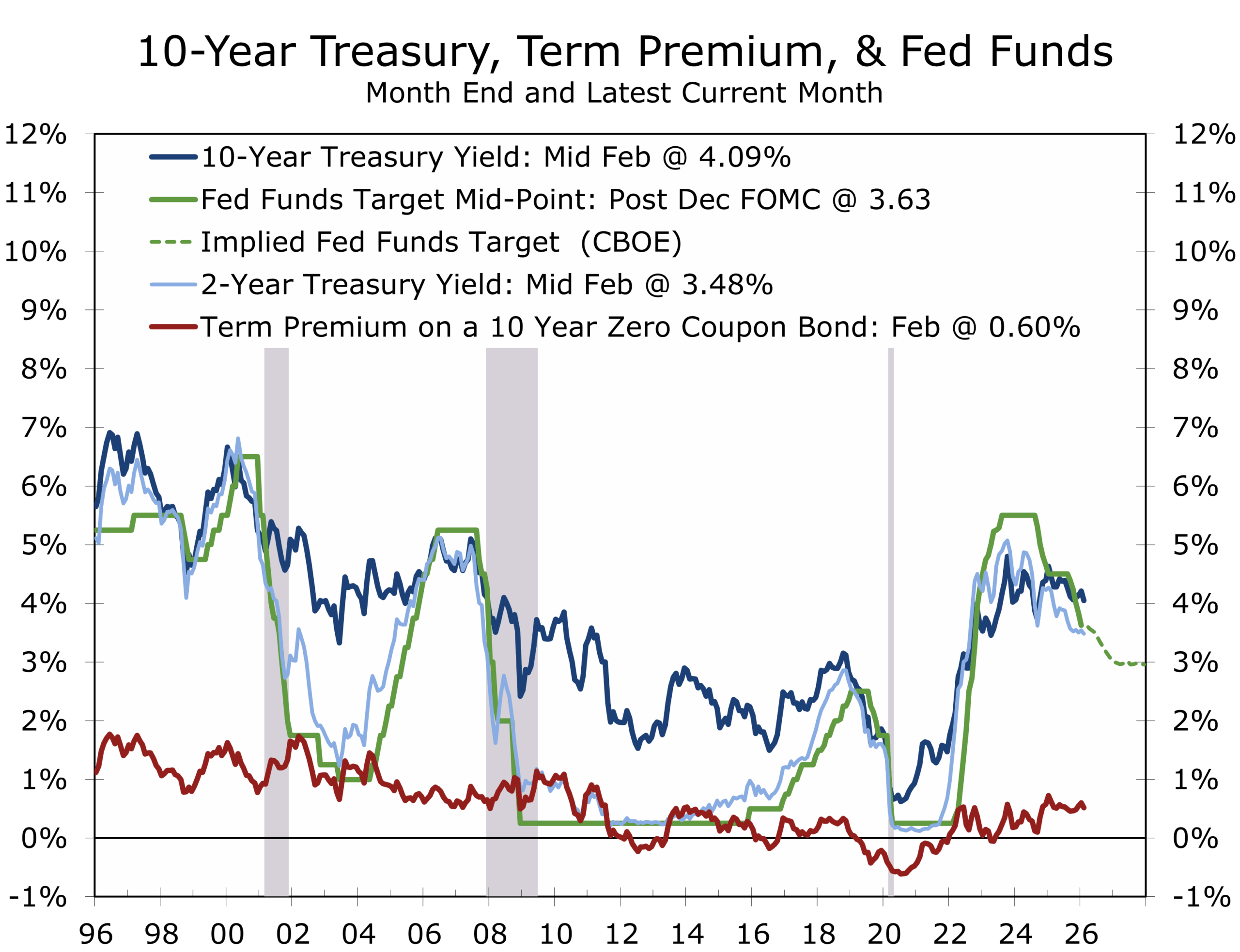
Risks to our call skew slightly toward an earlier move, particularly if Q1 data softens materially. But absent a clear labor-market break, June remains the most credible starting point. Expect a Warsh-led Fed to emphasize institutional credibility and measured adjustments over forward-guidance activism. Two cuts to roughly 3%–3.25% remains the central path; more would require cleaner evidence that core PCE is sustainably at or below 2%, which very well could happen.
Funding & Issuance: Why the Long End Won’t Cooperate
Even if the Fed trims short rates, the long end faces structural constraints. Fiscal deficits near $2 trillion imply sustained Treasury issuance, while global sovereign supply also remains heavy. The result is a firm term premium and 10-year yields holding near 4%–4.25%, despite cooling inflation.
The tariff ruling modestly reduces near-term inflation risk, but it also injects fresh uncertainty. If the effective tariff rate ultimately settles lower, that supports disinflation and growth. If alternative tariffs are imposed, which appears likely, volatility returns. Markets will need to price that optionality.
Geopolitical tensions, particularly around Iran and energy supply routes, add another layer of caution. Oil risk premia can flatten the curve initially through flight-to-safety flows, but sustained energy shocks would ultimately push inflation expectations and long yields higher. A successful resolution to the Iran situation would benefit markets. An unsuccessful one could prove unfriendly or even ugly.
The message is straightforward: front-end relief does not guarantee long-end relief. Opportunistic issuance on rallies makes sense, but duration exposure should be managed carefully. Ladder maturities. Maintain liquidity. Do not underwrite financing plans on the assumption of aggressive easing.
In a capital-heavy expansion, funding discipline matters as much as rate levels.
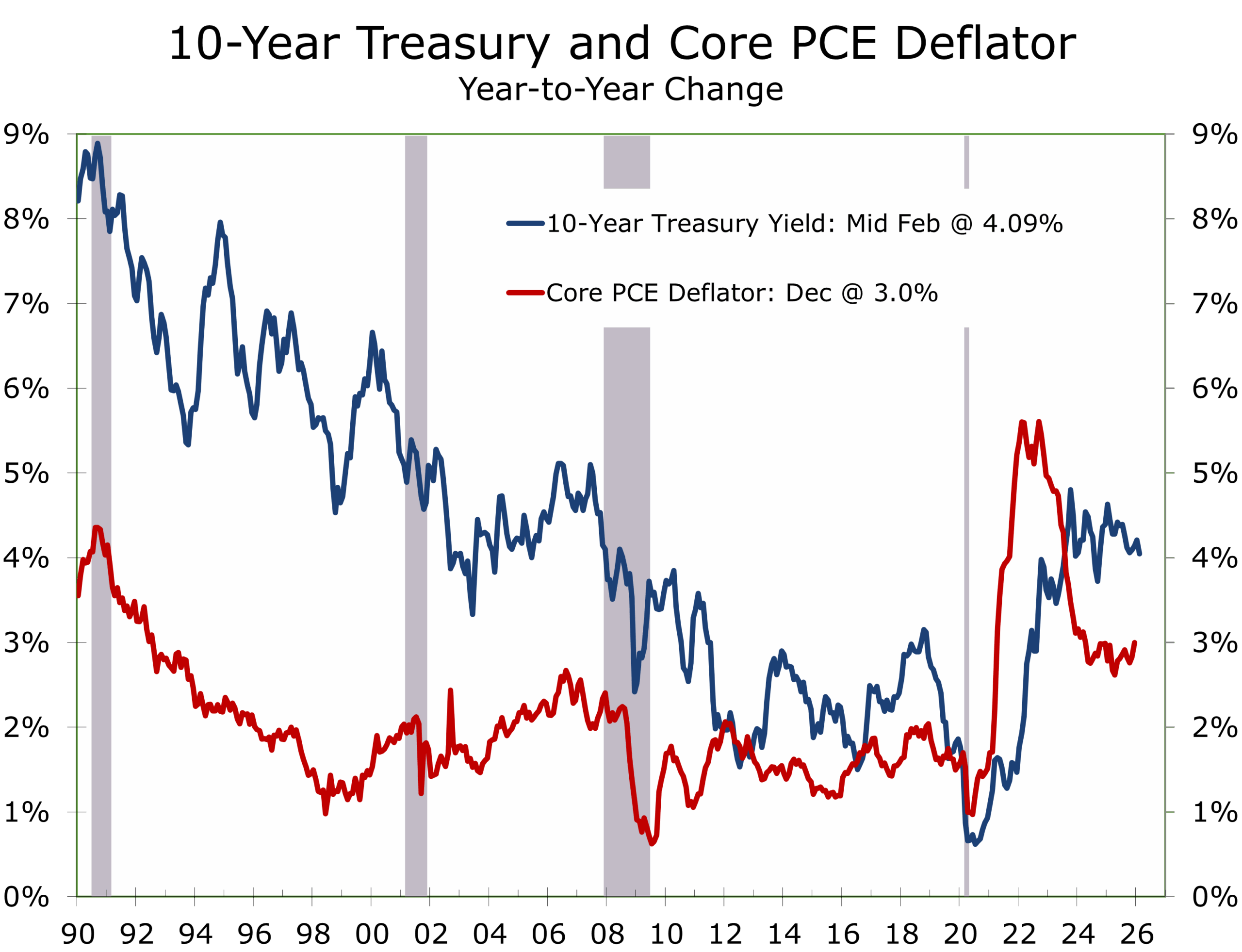
The Political Clock
The January employment report points to early stabilization in the labor market. Payrolls rose 130,000 and the unemployment rate edged down to 4.3%. Hiring outside healthcare and social services remains uneven, but layoffs are low and labor supply growth has slowed materially, with net immigration running near 0.2 million annually. That reduces the breakeven pace of job creation to roughly 50,000 per month by year-end. Against this backdrop, we expect the unemployment rate to remain in a 4.0–4.5% range in 2026. Growth near 3.0% this year is supported by fading tariff drag, steady fiscal support, and easier financial conditions, even as elevated valuations and AI-related uncertainty contribute to periodic volatility. At 6.7%, the Misery Index is well below its post-pandemic peak, reinforcing that the macro backdrop is stable, not strained.
The political calendar now matters more. As the midterm elections approach, the window for policy experimentation narrows. Durable initiatives—reshoring, infrastructure, energy expansion, AI investment—typically take time to yield visible results. Those results are currently visible in business fixed investment and should become increasingly across the board visible by this summer. A stronger-than-expected economy reduces the urgency for short-term stimulus and shifts the focus toward sustaining momentum rather than engineering an acceleration.
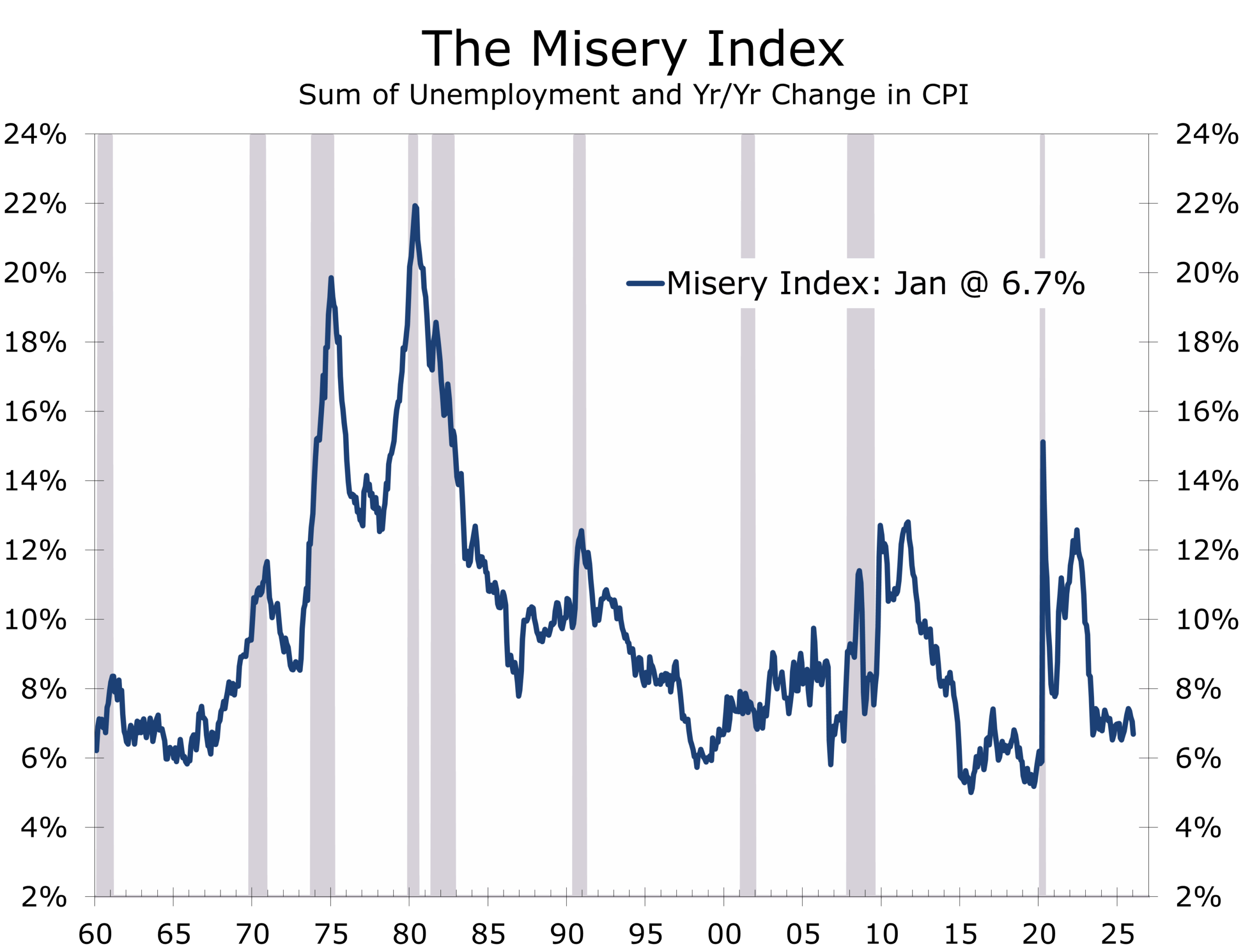
The Supreme Court’s decision to strike down key tariffs under IEEPA served as an important check on trade policy. President Trump responded strongly, criticizing the ruling and vowing to use alternative authorities for tariffs. This highlights a key risk: policy volatility. Markets now must price in possible tariff relief alongside the chance of new levies under different laws. We believe existing trade deals will hold. Leaders know provoking
President Trump is unwise and often counterproductive. Overall, uncertainty increases, even if the economic impact stays modest.
That said, our base case sees the administration nearing a pivot. As midterms approach, trade and immigration policies should become less disruptive. Incentives will favor stability and clear economic wins. Less policy friction lets fiscal measures and private capital spending drive growth. Uncertainty premiums should then ease, not rise.
This supports our positive 2026 outlook. We currently track Q1 growth near 3.1%, which is where the Atlanta Fed GDPNow also begins the quarter, and expect full-year GDP around 3%. Real GDP looks stronger in the first half, while private final domestic demand picks up in the second half. Inflation heads toward the Fed’s 2% target with moderating shelter costs and broader productivity gains. As inflation cools and rates dip, cyclical sectors like housing, manufacturing, and capital goods outside the AI boom stand ready to rebound. The expansion’s next stage focuses less on credit and more on productive capital use. As far as staffing goes, companies are increasingly focused on putting the right person in role rather than simply hiring more staff. If policy volatility fades as anticipated, the economy gains a second wind: stronger, balanced, and less reliant on heavy fiscal or monetary support—echoing Thomas Sowell’s constrained vision in A Conflict of Visions, where sustainable progress respects incentives and limits over engineered designs.
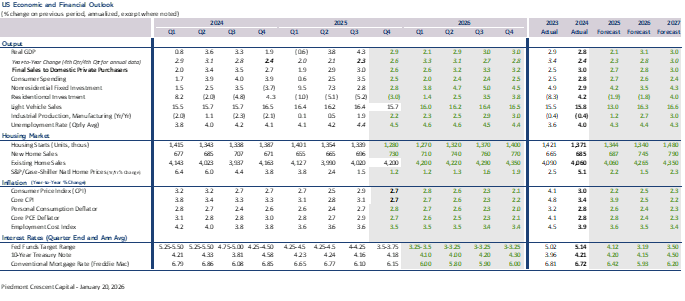
Disclaimer: This publication has been prepared for informational purposes only and is not intended as a recommendation offer or solicitation with respect to the purchase or sale of any security or other financial product nor does it constitute investment advice.
February 23. 2026
Mark Vitner, Chief Economist
704-458-4000
December 2025 Housing Starts: A Stronger Than Expected to Finish to 2025
Upside Surprise, Gradual Rebalancing Ahead
-
- Housing starts rose 6.2% in December to 1.404 million (SAAR), with upward revisions to prior months.
- On a November–December average basis, starts increased 5.1%, well above expectations, adding support to our above-consensus Q4 2.8% annual rate GDP call.
- Permits rose 1.3% across November and December, also beating consensus.
- Full-year 2025 starts totaled 1.36 million, down 0.6% from 2024.
- Single-family starts fell 6.9% in 2025, while multifamily rose 17.4%.
- Builder sentiment slipped again in February amid affordability pressures.
- Remodeling remains structurally stronger than new construction, benefiting from reduced housing turnover.
- Homebuilding finished 2025 on a strong note, but activity is likely to pause in the first half of this year as builders work to reduce elevated inventories.
A Firm Close to a Mixed Year
Housing starts ended 2025 with more momentum than previously believed. Total starts rose to 1.404 million at an annual rate in December, and prior months were revised higher. Averaging November and December together, starts increased 5.1%, comfortably exceeding expectations. October was revised up meaningfully to 1.272 million, reinforcing the view that the fourth quarter ended on firmer footing than initially reported.
Both major components contributed. On a two-month average basis, multifamily starts increased 5.9%, while single-family starts rose 4.8%. Regionally, activity rose sharply in the West and posted gains in the South and Northeast, though the Midwest declined. The geographic dispersion suggests broad improvement rather than a single-region anomaly, though weather likely amplified the December print. Favorable conditions likely pulled some activity forward, suggesting potential payback in January.
December’s strength improves Q4 growth optics but likely reflects partial weather distortion.
For 2025 overall, total housing starts were 1.36 million, down 0.6% from 2024. The modest decline masks meaningful internal rotation. Single-family construction totaled 943,000 units, down 6.9% year-over-year, reflecting persistent affordability constraints. Multifamily starts rose 17.4% for the year, supported by projects initiated during the earlier rent-growth cycle and relative strength in low-rise formats.
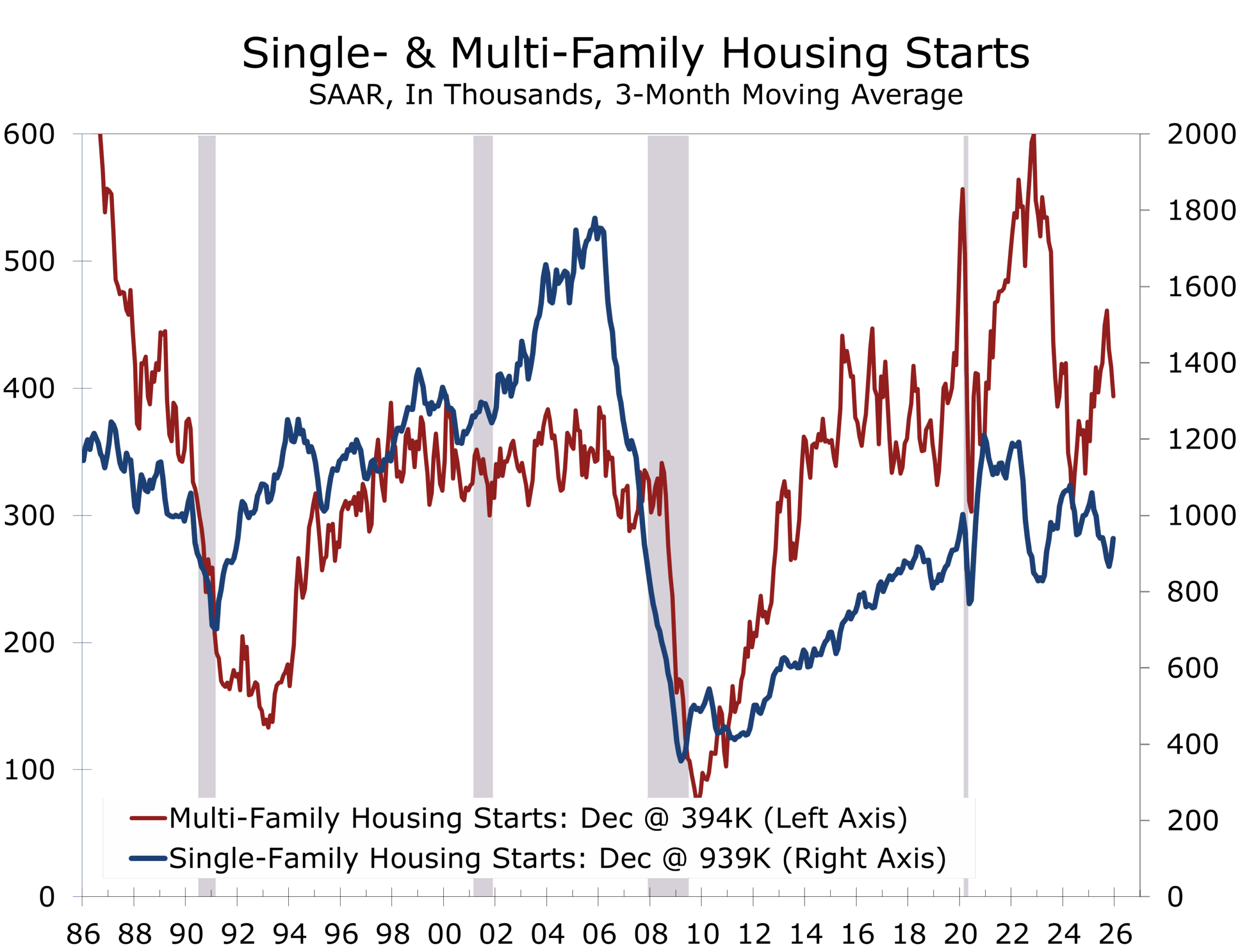
Permits also surprised modestly to the upside. Averaging November and December, building permits rose 1.3% to 1.448 million, above consensus expectations. Multifamily permits increased 3.8% over the two-month period, while single-family permits edged up 0.2%. Regionally, permits rose in the Northeast, Midwest, and West but slipped slightly in the South. The stabilization in permits suggests the downturn in housing is behind us, though not yet replaced by broad-based acceleration.
This remains a payment-constrained cycle, not a credit-driven downturn.
Single-family construction remains constrained by affordability. Elevated mortgage rates, high price-to-income ratios, and cost pressures continue to limit first-time buyers. February’s NAHB/Wells Fargo Housing Market Index underscores that reality. Builder confidence slipped to 36. Traffic of prospective buyers fell further, and builders continued to rely on incentives, including price reductions and financing concessions, to close transactions. The market is functioning, but it remains highly payment sensitive.
Multifamily construction is entering a normalization phase. December’s 11.3% increase brought the pace to 423,000 at an annual rate. However, rising completions and slower rent growth are shifting the focus from expansion to absorption.
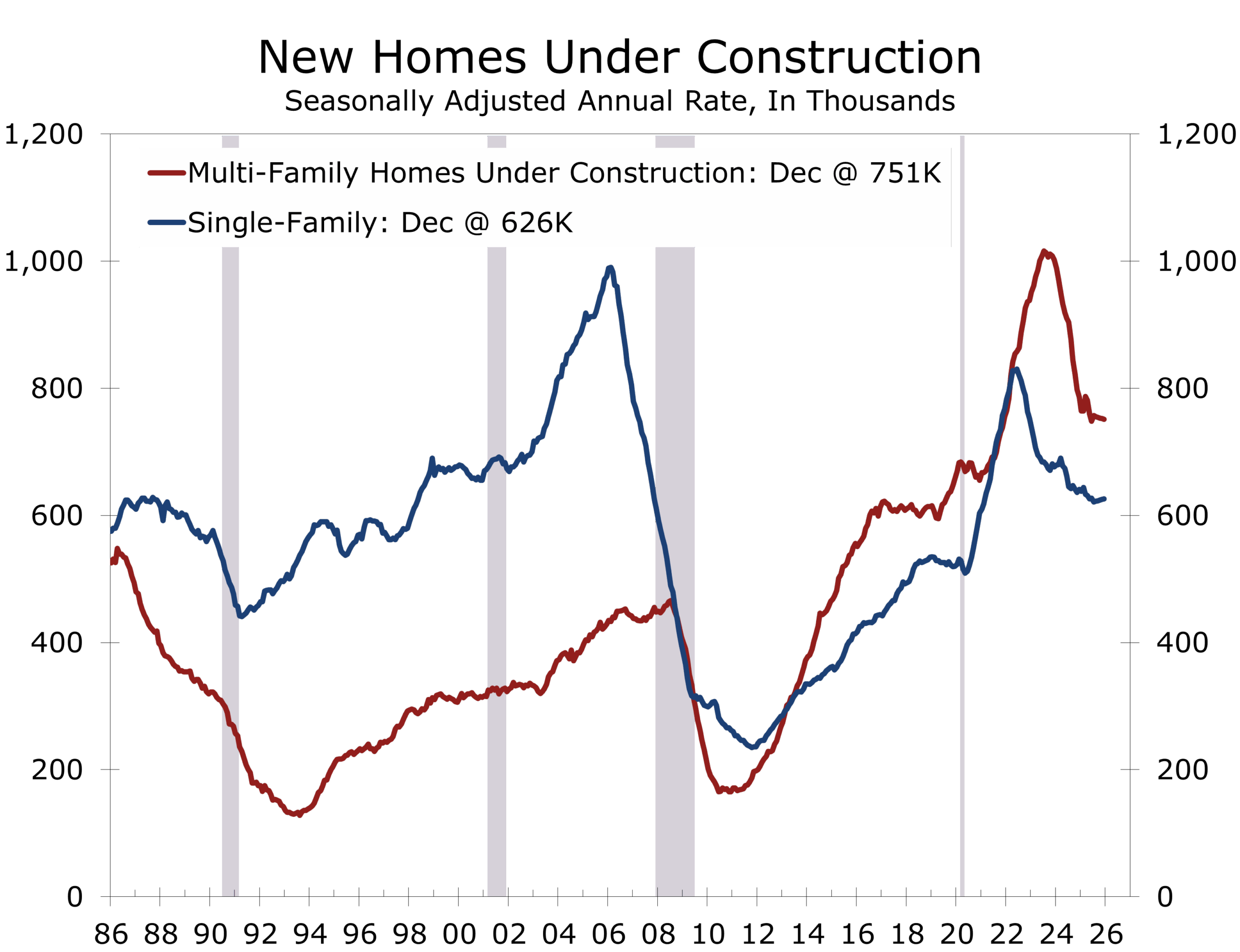
One notable divergence within residential construction is the sustained strength in remodeling. While new construction sentiment has softened, the NAHB Remodeling Market Index has remained above 50 for 24 consecutive quarters. Structural forces continue to support this segment. The housing stock is aging, the mortgage rate lock-in effect continues to discourage mobility, and elevated home equity provides financing capacity for improvements.
Housing is no longer subtracting from GDP, but it is not yet driving growth.
Remodeling now represents a materially larger share of residential construction than in prior cycles. NAHB expects real remodeling activity to grow modestly in both 2026 and 2027. In this environment, renovation has become the primary outlet for housing demand constrained by interest rates.
Regional performance in 2025 reflects cyclical rebalancing. The Northeast and Midwest posted gains for the year, while the South and West softened modestly. The pandemic-era surge into the Sunbelt has cooled cyclically, though longer-run demographic fundamentals remain intact. Relative affordability remains a key driver with migration patterns shifting away from previously overheated Sunbelt markets toward more affordable and less congested areas in the Carolinas, eastern Tennessee, Alabama, Mountain West, and portions of the Midwest.
Taken together, the housing market is stabilizing rather than reaccelerating. December’s strength supports our above consensus call for 2.8% Q4 real GDP growth and suggests that the worst of the housing slowdown is behind us. Yet affordability constraints, elevated inventory levels, and incentive-driven sales dynamics indicate that the next phase will be gradual.
Housing is recalibrating as homeowners and buyers reassess what the future path of mortgage rates is likely to be. Mortgage rates remain below their long-run historical norm, but we expect them to hover near 6% in the near term, with only brief breaks below that level possible this spring. A sustained acceleration in homebuilding will require meaningful improvement in affordability, not simply favorable weather or short-term inventory adjustments.
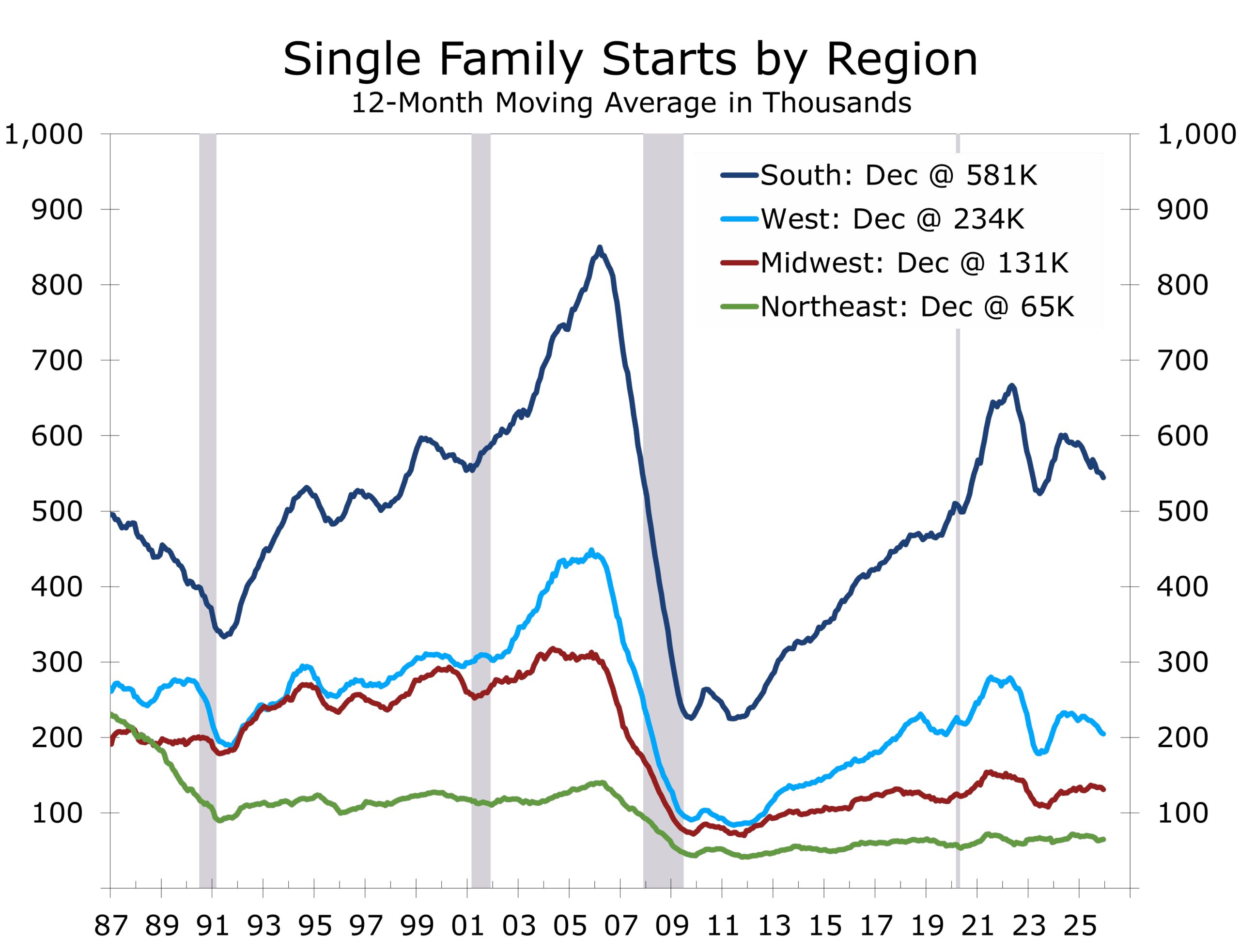
Disclaimer: This publication has been prepared for informational purposes only and is not intended as a recommendation offer or solicitation with respect to the purchase or sale of any security or other financial product nor does it constitute investment advice.
February 18, 2026
Mark Vitner, Chief Economist
(704) 458-4000