
A View from the Piedmont — Our Weekly Commentary on Money, Credit, Exchange Rates & Geopolitics
The Economy Was Stronger Than First Reported
A government revision just told us the expansion was stronger, and more capital-intensive, than anyone had been measuring, even as a soft September jobs report drew the week’s attention. It did not change the character of the recovery. It confirmed it.
Editor’s note: Our latest issue covers the Bureau of Economic Analysis’s annual national accounts revision and third estimate of second-quarter GDP (September 30), the September employment report (October 2), second-quarter state GDP and personal income by state (September 30), Hormuz shipping and Iranian government statements, OPEC+’s November output decision and Monday’s oil-market action, Brazil’s October 4 first-round presidential vote, and the week’s data-center permitting news, through October 5.
Market Dashboard
(as of Friday, October 2 close, unless noted)
| Rates & Credit | Rates & Credit | Equities & Commodities | Equities & Commodities |
|---|---|---|---|
| Fed funds target range | 3.75%-4.00% (effective rate 3.88%) | S&P 500 | 7,722.72 (+0.7% Fri, -0.3% wk) |
| 10-yr Treasury | 5.24% (Oct 1 constant maturity) | Dow Jones Industrial Average | 51,176.96 (+0.5% Fri, -1.3% wk) |
| 30-yr Treasury | 5.61% | Nasdaq Composite | 27,190.86 (+1.2% Fri, +0.5% wk) |
| 2-yr Treasury | 4.78% | Brent crude (Dec) | $102.25 (little changed) |
| 2s-10s spread | 46 bp | WTI crude (Nov) | $91.11 |
| Core PCE inflation (Aug, y/y) | 3.0% (revised from 3.3%) | Gold (Dec) | ~$4,205/oz |
| Unemployment rate (Sept) | 4.2% | Atlanta Fed GDPNow (Q3) | 3.7% (Oct 1, from 5.0% Sept 25) |
| Nonfarm payrolls (Sept) | +29,000 (3-mo avg +51,000) | Brent-WTI spread | ~$11/bbl |
Note: Treasury yields are the Federal Reserve’s H.15 constant-maturity series for Thursday, October 1, the most recent full curve available at this writing. Equity, Brent, WTI and gold levels are Friday, October 2 close. Brent and WTI are shown against the contract months currently trading nearest the front of the curve.
Summary
A Bureau of Economic Analysis revision released alongside the third estimate of second-quarter GDP raised the growth rate for the first half of 2026 by the most in years, and roughly two-thirds of the upward move originated in categories tied to the AI buildout: data centers, power facilities and the equipment that they operate. Real GDP now stands at a 2.2 percent annual rate for the second quarter, versus 1.5 percent previously, and the first quarter was revised to 2.5 percent from 2.1 percent. Private data-center construction ran at an $85.0 billion annual rate in August, up 73.2 percent from a year earlier. The revision confirms what we have been describing all year: an economy spending readily on capital but sparingly on headcount.
The labor market told the other half of the story three days later. Nonfarm payrolls rose only 29,000 in September, the unemployment rate edged up to 4.2 percent. We feel it is better to view these numbers over time, however, as this past summer saw a great deal more volatility than past summers have. The three-month payroll average of 51,000 sits above our own breakeven estimate of zero to 40,000 a month but remains well south of what an economy growing at 2.5 percent-plus would ordinarily produce. Real consumer spending kept pace through August, rising 0.6 percent on the month, but income did not. The saving rate fell to 4.1 percent from a revised 4.6 percent, and the extra cushion still sits mostly with households living off pensions, interest and dividends, not paychecks. Re-emphasizing another key point we continue to make, that rising tide of retirees is responsible for much of the resiliency in the K-shaped economy. The revision also revealed that underlying inflation was slightly lower, with core PCE now 3.0 percent over the year rather than 3.3 percent, though diesel and a second-order list of refined products are still working their way toward the grocery aisle.
Outside the country, the shipping lanes are open but more expensive. An Iraqi state tanker completed an independent two-million-barrel transit past Hormuz on October 3, Middle East crude exports rose above prewar levels on four of the last seven days of September, and OPEC+ held its November output targets steady on October 4; war-risk premiums and rerouting costs are the tax now, not a blockade, and diesel, not crude, is the tight market.
Brazil’s October 4 first-round vote sends Lula into an October 25 runoff against Flávio Bolsonaro, who outpolled him 47.0 percent to 45.2 percent, and the U.S. midterms are four weeks out with the generic ballot and prediction markets both pointing toward divided government in Washington next year. Inside our own footprint, the same capital that is lifting the national accounts is running into power, water and local permitting limits faster than it is running into a shortage of money: Texas halted new data-center permits pending a grid audit, and Prince William County, Virginia cut its by-right development overlay by nearly two-thirds. We expect new policies to be enacted regarding data centers after the election, which will require hyperscalers to produce more tangible benefits to the local economy and provide assurances that they will not drive up energy costs.
We still look for at least two more quarter-point increases in the federal funds rate this cycle, one in December and at least one other in 2027. A reacceleration in core inflation or a further squeeze in diesel markets would put the October 28 meeting back in play, though we doubt a Committee that would rather not be seen meddling in politics a week before the midterms moves on it. A formal halt to the Hormuz traffic now moving would break our broader call on growth, which we discuss in Risks to our view, below.
This Week’s Argument
The books caught up to the buildout
Real GDP rose at a 2.2 percent annual rate in the second quarter, revised up 0.7 percentage point from the 1.5 percent pace in both the advance and second estimates. First-quarter growth was revised to 2.5 percent from 2.1 percent. The increase was led by consumer spending, investment and exports, while a larger rise in imports subtracted from the headline. Consensus expectations ahead of the release had anticipated no revision at all. Real final sales to private domestic purchasers, consumer spending plus gross private fixed investment, rose at a 4.6 percent annual rate, up from 4.2 percent and the strongest quarterly gain in that measure since the first quarter of 2023. Real gross domestic income rose 2.6 percent, revised up from 2.2 percent, leaving the average of GDP and GDI at 2.4 percent; in the first quarter, real GDI was revised to 2.5 percent from 1.2 percent. The income-side shortfall that had nagged the expansion was largely closed in the first half.
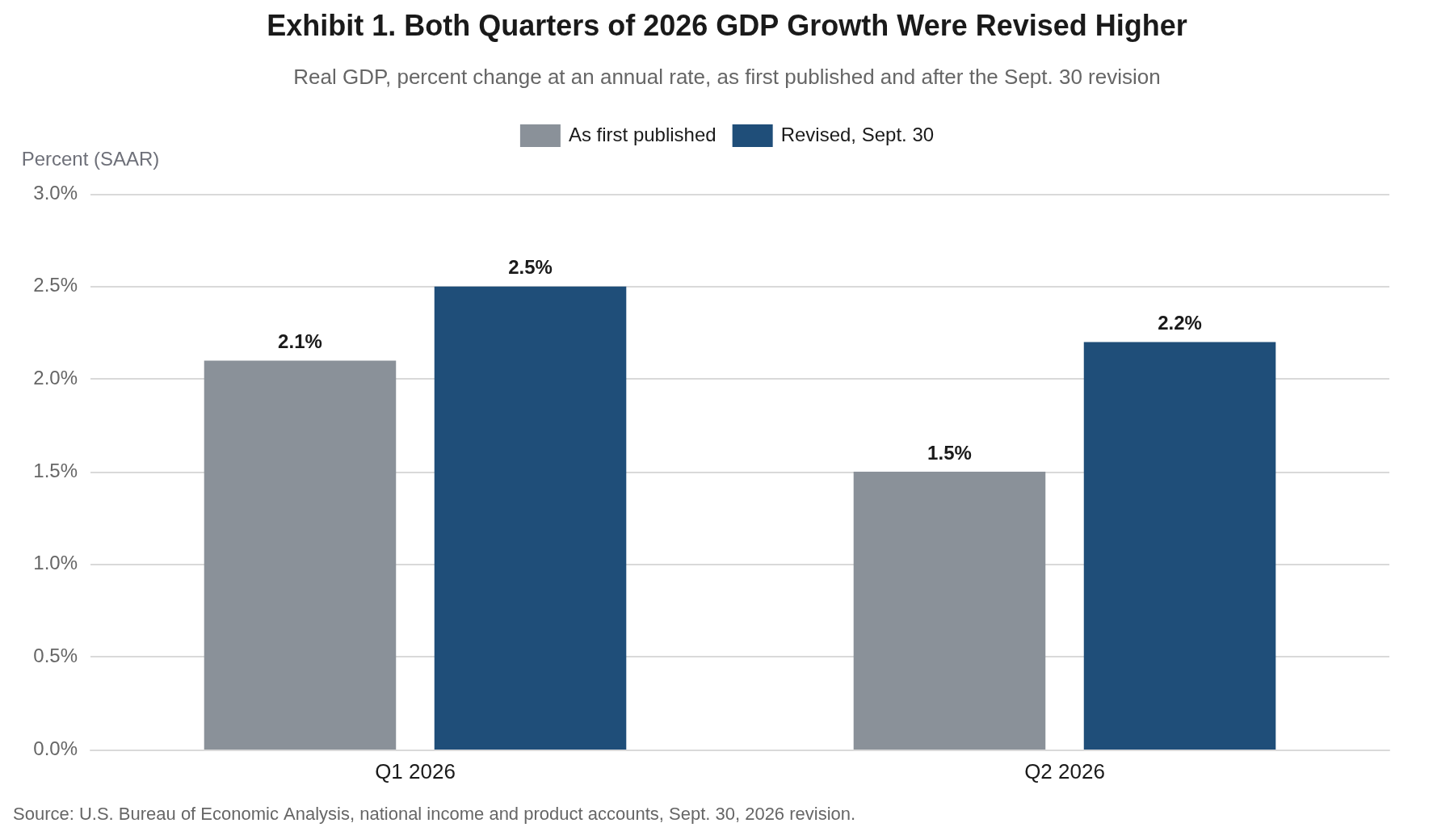
The annual figures carry the same story in smaller type. Real GDP growth in 2024 is now 3.0 percent, and 2025 growth is 2.3 percent, up from the 2.1 percent previously published. The 2023 estimate is unchanged at 2.9 percent. Compensation, drawn largely from new Quarterly Census of Employment and Wages data, led the first-quarter GDI revision, additional evidence that the income side had been understating activity rather than revealing a hidden slowdown.
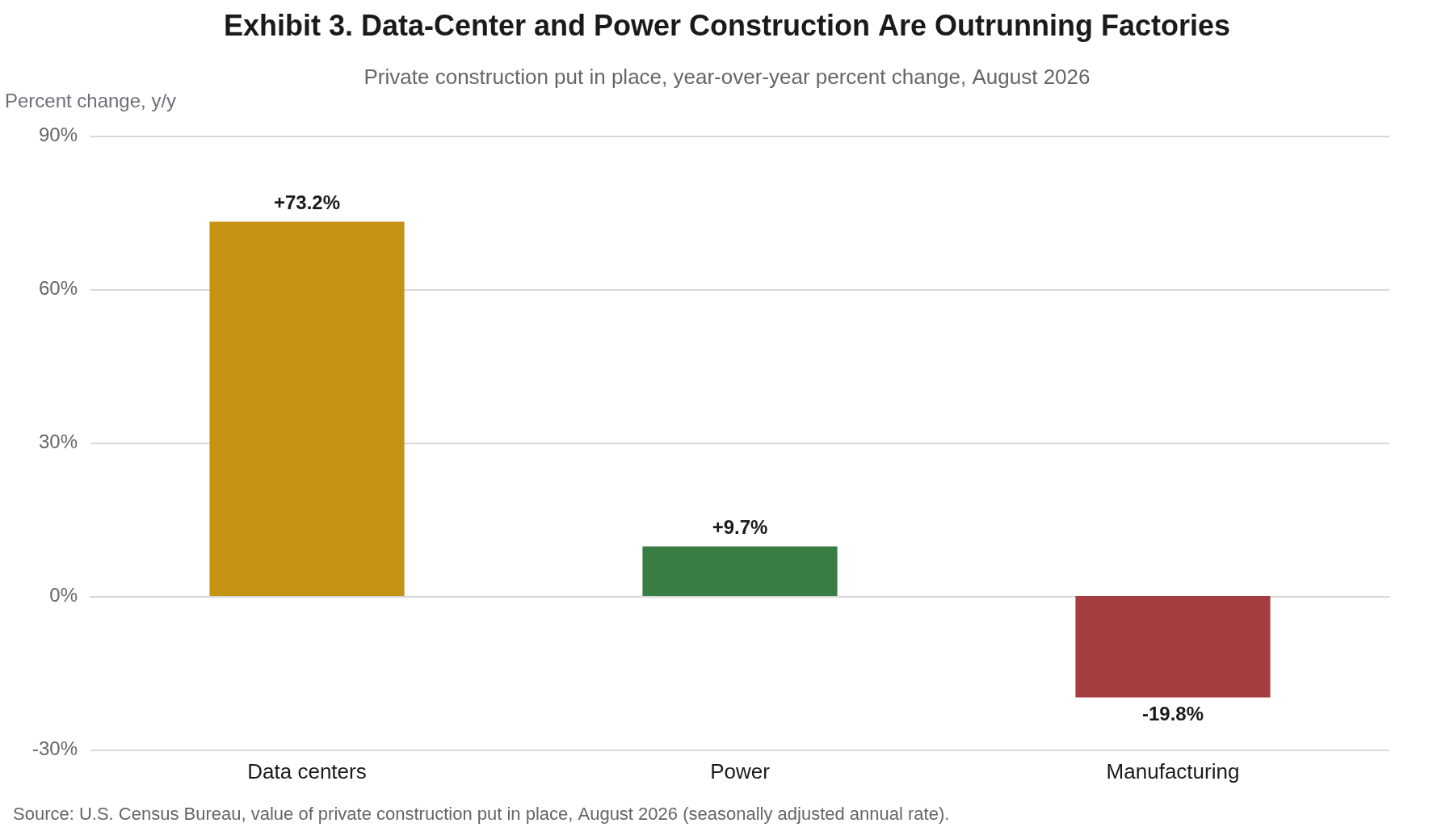
The composition of the second-quarter revision fits the capital-heavy expansion we have been describing. BEA traced the upward revision in nonresidential structures to commercial and health-care construction, mainly data centers, using revised Census value-of-construction data for May and June. Private inventory investment was also revised higher, and equipment spending held at a double-digit pace. The revision shows up in the building, not in the servers. Census put private data-center construction at an $85.0 billion annual rate in August, up 73.2 percent from $49.1 billion a year earlier, with the pace rising from $61.9 billion in April. Data centers were about 63 percent of private office construction. General office construction fell 9.7 percent. Power construction, the companion line, was $165.9 billion, up 9.7 percent. Manufacturing construction, the offset, was $168.2 billion, down 19.8 percent, with computer and electrical plant down 45 percent. Construction of microchip plants had surged earlier in the decade, driven by the Chips and Science Act. An $85 billion construction pace is roughly three-tenths of one percent of GDP; the chips, the switchgear and most of the cooling equipment sit in equipment, not in structures.
Capital spending is accelerating well ahead of hiring. September payrolls rose only 29,000, and the unemployment rate edged up to 4.2 percent. August payrolls were revised to 133,000 net new jobs from 162,000 earlier, and July was revised to a loss of 10,000, leaving the three-month average at 51,000, above our own breakeven estimate of zero to 40,000 a month but short of the gain we had looked for after August’s initially reported increase. Average hourly earnings rose 3.0 percent over the year, the slowest pace since May 2021. That is how real GDP can run near a 2.5 percent pace while hiring stalls out. Real value added rose 2.5 percent among private services-producing industries and 2.3 percent among private goods-producing industries, while government was essentially flat; real estate and rental and leasing, information, durable-goods manufacturing and finance and insurance led the increase, while transportation and warehousing, retail trade and nondurable-goods manufacturing were the principal offsets.
Real consumer spending rose at a 3.8 percent annual rate in the second quarter, revised up from 3.4 percent, after a 0.7 percent pace in the first quarter, and August extended the pattern: current-dollar personal consumption expenditures rose $190.8 billion, or 0.9 percent, and real PCE rose 0.6 percent, the largest monthly gain since March 2025. Income did not keep up. Personal income rose 0.2 percent, disposable income rose 0.3 percent, and real disposable income was unchanged. The saving rate fell to 4.1 percent, from a revised 4.6 percent in July rather than the 3.0 percent previously published. That is a yellow flag, not a red one. The upper end of the K-shaped consumer still has equity gains, interest income and accumulated wealth to draw on; lower- and middle-income households have less room. We expect real spending to cool toward income growth over the next couple of months unless equity gains continue to fill the gap. A second soft month for real disposable income would turn the yellow flag red.
The price revisions moved the other way. First-quarter PCE inflation was revised to 4.2 percent from 4.6 percent, and core PCE to 3.9 percent from 4.4 percent. Second-quarter headline PCE inflation was revised to 5.0 percent from 5.3 percent, and core to 3.3 percent from 3.6 percent. August headline PCE rose 0.3 percent and 3.4 percent from a year earlier, down from 3.7 percent in July. Core PCE rose 0.2 percent and held at 3.0 percent from a year earlier, where it has sat since June. Some of that improvement is measurement: BEA changed its methods for several PCE components, including portfolio-management services, legal services and computer software and accessories, and the annual update folds in more complete source data. The broader message still holds. Core inflation shows modest improvement. Headline inflation is still being pushed around by energy and by events well outside the Federal Reserve’s reach. Policy can restrain domestic demand. It cannot reopen the Strait of Hormuz, restore lost refining capacity or bring down tanker insurance premiums.
Behind the Numbers
The maritime story has shifted: the question is no longer whether ships can get through, but at what cost. On October 3 the Iraqi Oil Tankers Company completed the transit of a chartered very large crude carrier carrying two million barrels past Hormuz, the first independent crude movement of that kind by the state shipper in decades, and Middle East crude exports ran above prewar levels on four of the last seven days of September. The next day Iran’s parliament speaker said the strait will not reopen until seven conditions in the June Islamabad memorandum are met, and OPEC+ held its November production targets unchanged, deferring any further adjustment into next year. A lane does not have to close to produce an economic shock; war-risk premiums, elevated tanker rates and rerouting are a tax on trade whether or not a barrel actually gets through. Venezuela’s crude exports fell almost 9 percent in September, to 1.08 million barrels a day, as traders pressed PDVSA for steeper discounts to cover freight, and an Aframax from Jose to the U.S. Gulf Coast was recently quoted near $3.5 million, about $5 a barrel, against roughly $1.35 million at the start of the year. Crude is responding to the easier flows: Brent eased to $101.82 and WTI to $89.61 in Monday trading, both down from Friday’s close, as better Middle East loading data and the prospect of the G7 reserve release outweighed OPEC+’s decision to hold supply flat. Diesel has not followed crude down, and that gap is this week’s more important story.
Diesel is the fuel that is actually biting, and the reason is refining chemistry, not crude supply. A barrel of crude is not a barrel of diesel: a refinery yields roughly 11 to 13 gallons of distillate per 42-gallon barrel, a ratio set by equipment that takes years and billions of dollars to change, and U.S. refineries are already running near 96 percent of capacity, with capacity itself down roughly 250,000 barrels a day from 2025. On the supply side, Russia has restricted product exports to protect its own refineries from Ukrainian strikes, Middle Eastern distillate exports are running thin on the same conflict taxing crude shipping, and China has suspended most fuel exports to rebuild its own stockpiles; U.S. refiners have answered by exporting record diesel volumes to capture the higher global price, which keeps the domestic cushion thin even as crude eases. Distillate inventories are below their five-year average and are on track to stay under 100 million barrels through 2027, the first time in more than two decades, which is why an ordinary refinery outage or a cold snap now reads as a price spike. The G7’s planned release of up to 100 million barrels of crude and diesel over the next four months works on the margin of that cushion. It does not rebuild it.
Two elections now sit on our calendar, and both bear on the policy backdrop we are forecasting into. Brazil’s October 4 first round sent Flávio Bolsonaro to an October 25 runoff against President Lula, 47.0 percent to 45.2 percent, on turnout the lowest since 1998; the Ibovespa rose 2.6 percent Monday and the real held steady near 5.16 as markets absorbed the result. Closer to home, the November 3 midterms are four weeks away. Our own framework reads a midterm as a referendum on the incumbent party’s economy, run through real after-tax income growth rather than the headline numbers, and this cycle’s income growth has been running on the soft side of that test, which is consistent with the signal in both the polling and the money. The RealClearPolitics generic-ballot average had Democrats ahead by 8.3 points as of October 1, and prediction markets price Democratic control of the House near 93 percent. A result anywhere close to that shifts the fiscal and regulatory debate in Washington before the new Congress is even seated.
In our own neighborhood, residents are arriving faster than income. In the 16 states we define as the South, real GDP rose at a 2.1 percent annual rate in the second quarter, against 2.3 percent elsewhere, and income per person rose 3.6 percent against 4.4 percent in the rest of the country as population grew faster than paychecks. Southern markets should keep generating volume, with less room to raise prices, rents and fees than the headline growth implies.
The binding constraint on the buildout has shifted from capital to power, water and local consent, which is the local version of the same story the revised national accounts just told. Governor Abbott directed Texas to halt data-center permits while agencies complete a power and water audit that ERCOT says will run at least into December. Prince William County ended by-right data-center development and cut its overlay from about 9,700 acres to 3,500. ERCOT has fielded some 474 gigawatts of connection requests, close to 90 percent of them from data centers. Applied Digital’s $3.2 billion Tuscaloosa campus works out to $32 million per permanent job. A data center is a tax-base strategy, not an employment strategy, and that is the regional expression of the capital-heavy, employment-light expansion the revised GDP accounts just confirmed nationally. The forces we have been tracking showed up. Hiring did not.
Our call runs ahead of a Street that just turned more dovish
The September 30 inflation revision and the soft September jobs report moved the policy debate, not just the headline numbers. Expectations for an October rate hike have been scaled back since the jobs report, as well as more cautious remarks from New York Fed President Williams. Some forecasters have not only dropped October from their forecast but see the FOMC holding steady in December as well. We have some sympathy for that view, given that a few IPOs have been put on hold, which is a sign of tightening financial conditions. The Fed clearly has more work to do, however, and it is too early to take a December hike off the table. Vice Chair Jefferson split the difference: he backed the September hike as an anchor for expectations, said future moves should follow the data and the balance of risks, and flagged that energy prices and AI-related building costs could still spill into broader inflation. We are the hawkish outlier, and the week’s data back it up. An economy just revised to be spending more on data centers, power and defense than any estimate showed a month ago has less slack than a reaction function built on the old numbers would assume. Every one of these calls, ours included, is ceteris paribus. Something keeps changing: since September 16 it has moved toward more inflationary pressure in energy and refined products.
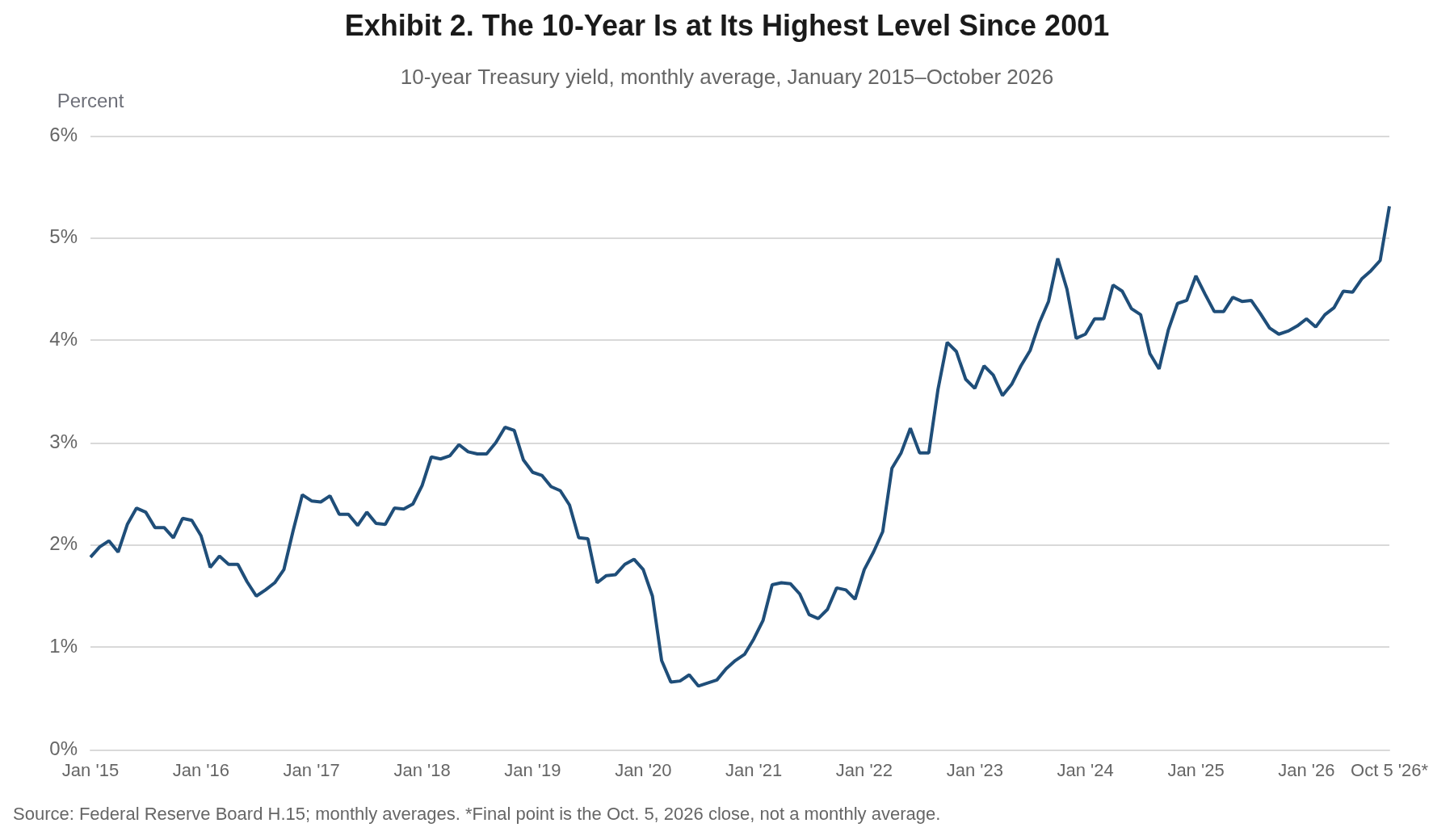
The 10-year’s own history makes the point better than any single comparison: at 5.24 percent Thursday, and above 5.30 percent Monday, the 10-year is at its highest level since 2001, a 25-year high, not a one-quarter overshoot. Our current table puts the 10-year at 5.10 percent by year-end; one major Street rates desk, positioned for duration on French fiscal stress and a softening U.S. labor market, has it at 4.76 percent. The market is already running above both.
Oil shows a version of the same gap: published year-end Brent forecasts cluster in the mid-$80s to high-$80s against a $102.25 spot. Our current table looks for Brent crude to gradually fall back toward $86 a barrel by the end of next year.
Bottom Line
The revised national accounts strengthen the central theme: the economy is growing faster than the labor market suggests, investment, particularly the AI-related buildout in structures and equipment, is doing more of the lifting, and consumers are still spending readily even though income growth is no longer keeping pace. The principal threat to that domestic picture comes from outside the United States. The sea lanes are mostly functioning, but the hazards have multiplied and the cost of avoiding them is still rising. The Atlanta Fed’s GDPNow tracking estimate for the third quarter is 3.7 percent as of October 1, down from 5.0 percent on September 25, with a larger net-export subtraction doing most of the work. Our own forecast pegs Q3 growth about a percentage point slower at 2.7%, which would still mark a strong quarter.
We still look for at least two more quarter-point increases in the funds rate, one before year-end and at least one in 2027, which would put the rate at 4.25 to 4.50 percent or higher by the end of next year. The September employment report makes the case for waiting until December, not for stopping at one. We expect real growth to hold near a 2.5 percent pace into year-end if private domestic demand does not give back the second-quarter gain.
| Call | Made | Check date | Status |
|---|---|---|---|
| At least two more quarter-point hikes (Dec 2026 and ≥ 1 in 2027) | Sept 16, 2026 | Dec 9, 2026 FOMC | On track; Street desks have moved more dovish since Sept 30, sharpening the test. |
| Real growth holds near 2.5% into year-end | Oct 4, 2026 | Oct 29, 2026 advance GDP | GDPNow fell to 3.7% (Oct 1) from 5.0% (Sept 25); watch the net-export drag. |
| Partial Hormuz traffic continues; no formal halt | Oct 4, 2026 | Ongoing | Supports call; independent Iraqi tanker transit Oct 3 is the latest data point. |
Scorecard tracks our own live, falsifiable calls, scored against the data every issue, not just when they are going our way.
Risks to our view
A reacceleration in core inflation. A hotter core PCE print, or a further squeeze in diesel and other refined products, would put the October 28 FOMC meeting back in play on the data alone, whatever the Committee’s appetite for acting on it.
A formal halt to Hormuz traffic. The lanes are open and more expensive, not closed. An actual halt to the traffic now moving would break our growth call, not just our rate call.
A sharper AI capital-spending slowdown. A pullback in hyperscaler spending would show up directly in the GDP accounts that just got revised higher on its account, and in the regional construction and power-demand pipelines we track across the South.
A second soft month for real disposable income. Income growth, not spending, is the weak link in the consumer; a second month like August would turn our yellow flag red and pull forward the slowdown we do not yet see in the data.
CFO and Treasurers Corner
- Term out ahead of a long end that is already running hot. The 10-year ended the day Monday at around 5.30%, well above just about every published year-end forecast, ours included. Waiting for a pullback that the market has not delivered since the September 16 hike is a bet, not a plan; lock in financing against today’s curve. Rates are being pulled higher by strong demand for capital and growing concern about fiscal deficits around the world.
- Watch the lending-standards lag, not just the spread. Bank credit standards were still accommodative before the latest back-up in yields, and the usual lag into loan growth is a couple of quarters. Commercial real estate and residential mortgages are first in line for a tighter book; budget a stricter bid on any financing that comes up for renewal in 2027 now, not after it arrives.
- Budget diesel separately from crude. The G7’s release of up to 100 million barrels, weighted toward diesel, is a near-term offset to tight product markets, not a fix. Distillate stays tight on lost Russian refining capacity and constrained Middle Eastern exports even on days crude eases, and food inflation is not expected to peak until the middle of 2027 on the diesel pass-through.
- Treat the data-center buildout as a capital-markets event, not only a construction story. Hyperscaler capital spending scenarios for 2027 run from roughly $920 billion on a consensus basis to $1.4 trillion on an aggressive one, and the largest spenders are approaching the limits of low-cost incremental investment-grade issuance. Expect more joint-venture project finance and private infrastructure capital funding the next leg, with financing terms that look different from a straight corporate bond.
- Underwrite the permitting timeline, not just the financing. Texas’s data-center permit halt and Prince William County’s zoning reversal are a preview of what capital-intensive projects elsewhere in our footprint should expect. Power, water and local consent are now the binding constraint on a project’s timeline more often than the cost of capital is.
- Budget the maritime tax as a standing cost of doing business, not a temporary spike. War-risk premiums, tanker rerouting and longer transit times are running as long as Hormuz stays formally closed on Iran’s own terms, regardless of how much oil is actually moving through it. Price freight and insurance accordingly for any shipment where the routing math was close before this year.
Piedmont Perspective
The Piedmont Perspective: The Buildout Shows Up in the Books
The annual accounts revision confirmed, in official data, the capital-heavy, employment-light pattern we have argued since the start of the year.
The annual revision moved the official story toward ours. A single data point rarely does that. For most of this year we have described an economy that is more capital intensive than it used to be, more protein and less carbs, with investment in AI-related equipment, data centers and power doing a disproportionate share of the work while payrolls barely move. The revised national accounts now say that was understated, not overstated. Second-quarter real GDP is 2.2 percent, not 1.5 percent, and roughly two-thirds of the upward move landed in categories tied directly to the buildout.
Construction of buildings moved first in the data; the servers were always going to follow. Census put private data-center construction at an $85.0 billion annual rate in August, up 73.2 percent from a year earlier, and data centers now account for about 63 percent of all private office construction nationally, a category that barely existed as a line item a decade ago. Power construction rose alongside it, up 9.7 percent to $165.9 billion. Manufacturing construction, the prior cycle’s capital story, fell 19.8 percent over the same period, with computer and electrical plant down 45 percent, as investment shifted from building the factories that make equipment to building the places that run it.
Wall Street’s own capital-spending scenarios have not caught up to what has been booked. Hyperscaler capital spending for 2027 carries a consensus estimate near $920 billion, with scenarios built on cash flow and investment-grade borrowing capacity running as high as $1.4 trillion. Backlogs at the largest cloud providers more than doubled in a single quarter earlier this year, and analysts generally do not expect supply and demand in AI infrastructure to balance before the second half of 2027 at the earliest. Enterprise adoption, by contrast, is still early: the Census Bureau’s own survey work puts firm adoption of AI tools at under 20 percent currently, rising toward 23 percent within six months, mostly as a supplement to a narrow set of tasks rather than a wholesale change in how a business runs. The spending is real and arriving faster than the official estimates had captured. The payoff, in measured productivity and earnings, is still mostly ahead of us.
The revision has a regional reading as well as a national one. The same week the national accounts moved in our direction, Texas halted new data-center permits pending a power and water audit, which is the regional expression of the same capital-heavy, employment-light expansion the revised GDP accounts just confirmed nationally. See Behind the Numbers for the Texas, Virginia and ERCOT detail.
A slowdown in AI capital spending would not stay contained to technology stocks. An AI capital-spending slowdown, should one arrive, would not just dent a few technology stocks; it would show up directly in the GDP accounts that just got revised higher on its account, in the regional construction pipelines we track across the South, and in the power-demand forecasts utilities are already building their own capital plans around. We do not see that slowdown in this week’s data. We do see an expansion that is asking a shrinking pool of workers to do more with a rapidly growing pool of capital, which is the same story the labor market has been telling us all year from the other direction. The national accounts finally caught up to it.
The Week Ahead
Monday: ISM Services index for September.
Tuesday: August trade balance.
Wednesday: Minutes from the September 15-16 FOMC meeting, the first look at how broadly the Committee’s hawkish minority was shared; August consumer credit.
Thursday: Weekly initial jobless claims; August wholesale trade. Earnings from Delta Air Lines, the first major read on travel demand into year-end.
Friday: Preliminary University of Michigan consumer sentiment for October. Applied Digital, PepsiCo, Constellation Brands and Levi Strauss also report this week; Applied Digital’s results are the one to watch against this issue’s Tuscaloosa data-center discussion above.
What would move us: FOMC minutes showing more than a handful of participants already arguing for an October move would pull our second hike forward from December. A services ISM or trade report that reinforces the net-export drag behind this week’s drop in GDPNow would argue for trimming our third-quarter growth estimate rather than defending the 2.7 percent pace we are currently carrying.
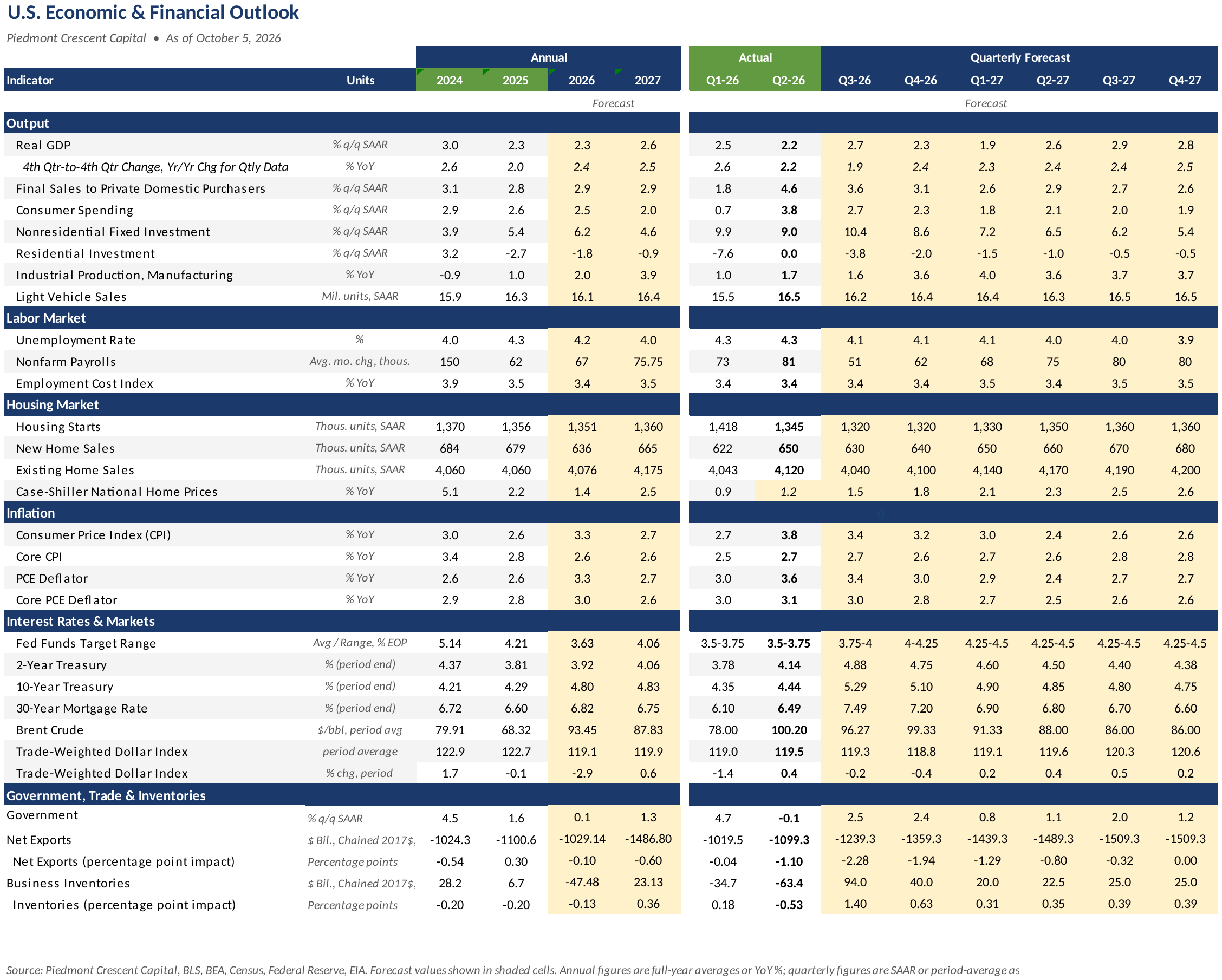
U.S. Economic & Financial Outlook
The annual national accounts revision changed actual history more than it changed any single forecaster’s forward path. Real GDP growth is now 3.0 percent for 2024 and 2.3 percent for 2025, both revised up, with 2023 unchanged at 2.9 percent. Our full multi-year outlook, updated as of October 5, is below.
Sources and Notes
Sources. U.S. Bureau of Economic Analysis (annual national income and product accounts revision and third estimate of second-quarter GDP, September 30, 2026; second-quarter state GDP and personal income by state, September 30, 2026); U.S. Bureau of Labor Statistics (Employment Situation, September 2026, released October 2, 2026); U.S. Census Bureau (value of private construction put in place, including data-center and power categories, through August 2026); Federal Reserve Board (H.15 Selected Interest Rates, October 1, 2026); Federal Reserve Bank of Atlanta (GDPNow, October 1, 2026); Oxford Economics (U.S. weekly research, October 2, 2026); Office of the Texas Governor (data-center permit directive); Prince William County Board of Supervisors (data-center overlay rezoning); ERCOT (large-load interconnection queue); Applied Digital Corporation (Tuscaloosa, Alabama project disclosure); U.S. Energy Information Administration and refining-industry reporting on U.S. refinery utilization, capacity and distillate inventories, October 2026.
Geopolitical and political. Reuters and Al Jazeera (Iraqi Oil Tankers Company Hormuz transit, October 3, and Iranian parliament statement on strait conditions, October 4); OPEC+ (November production decision, October 4); shipping and tanker-market reporting on Middle East loading rates, Venezuelan crude exports and Jose-to-U.S. Gulf Coast freight rates, late September and early October; Brazil’s electoral authority and wire reporting on the October 4 first-round vote; RealClearPolitics (generic ballot average, October 1) and prediction-market pricing on 2026 House control.
Market data as of Friday, October 2, 2026 close, unless noted: Federal Reserve Board H.15 (Treasury yields, Thursday, October 1); major U.S. equity indices; ICE Brent and NYMEX WTI futures; COMEX gold. Monday, October 5 Brent, WTI and Brazilian market levels are intraday quotes, labeled as such where cited.
A View from the Piedmont is published weekly by Piedmont Crescent Capital for informational purposes only and does not constitute investment, legal, or tax advice. Views expressed are those of the author as of the date of publication and are subject to change. © 2026 Piedmont Crescent Capital, LLC. All rights reserved.