
A View from the Piedmont — Our Weekly Commentary on Money, Credit, Exchange Rates & Geopolitics
The Growth Scare Lasted a Week
Hot Inflation, a Hawkish Fed, a Founder’s Exit and a Series of Mid-Month Mishaps
The 10-year Treasury yield was about 5.12% at Monday’s close, at our year-end forecast six weeks early, after October consumer prices rose 0.35%, which rounded up to 0.4%, and Fed officials lined up behind a December hike. The S&P 500 fell 1.92% on Monday and Nvidia fell 4.12% before its first report without Jensen Huang, as software failures at Chase and United Airlines followed last week’s Microsoft outage and a nationwide FAA ground stop.
This issue covers the October CPI and PPI, the Fed’s repricing, Monday’s selloff, the Huang resignation, the outages at Microsoft, the FAA, Chase and United Airlines, and the New Orleans riverboat collision, plus Boeing, defense orders, pharmaceutical plants and the APEC summit in Shenzhen. A short ledger checks last week’s calls against the data. Thursday’s Treasury yields are the Federal Reserve’s official H.15 closes; Monday’s index closes, yields, oil and gold are wire quotes from the close.
Market Dashboard
(as of Monday, November 16, unless noted)
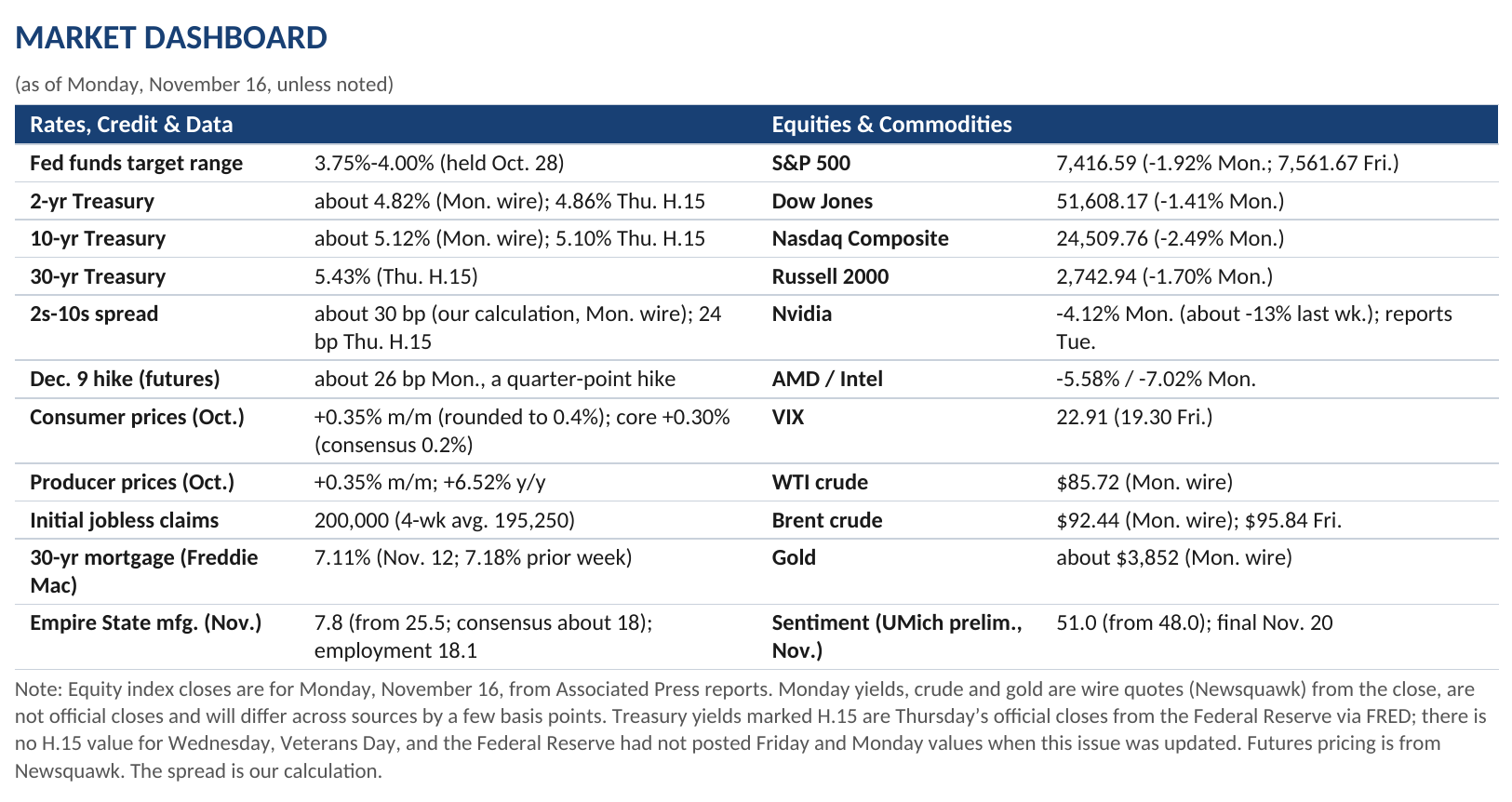
Note: Equity index closes are for Monday, November 16, from Associated Press reports. Monday yields, crude and gold are wire quotes (Newsquawk) from the close, are not official closes and will differ across sources by a few basis points. Treasury yields marked H.15 are Thursday’s official closes from the Federal Reserve via FRED; there is no H.15 value for Wednesday, Veterans Day, and the Federal Reserve had not posted Friday and Monday values when this issue was updated. Futures pricing is from Newsquawk. The spread is our calculation.
Summary
Two forces we have written about for weeks collided this week: the price of capital and the politics of AI. October consumer prices rose 0.35%, which the Bureau of Labor Statistics rounded up to 0.4%, against a consensus of 0.3%, and core prices rose 0.30% against a consensus of 0.2%, a miss that rounding did little to change. Producer prices rose 0.35% after a September revision to 1.41%, and the 6.52% year-over-year rise in the PPI is running well ahead of the CPI, which puts profit margins under pressure. Fed officials spent the week saying they would hike, and the 10-year Treasury yield rose from 4.86% to 5.10% on the H.15 basis through Thursday (about 5.12% on Monday’s wire quote) while the 2-year rose 35 basis points. Last week’s growth scare lasted a week, and the inflation problem did not go away with it.
Stocks held up last week and gave way on Monday. The S&P 500 gained 2.5% for the week, its first weekly gain in five weeks, then fell 1.92% to 7,416.59 on Monday, with the Nasdaq Composite down 2.49%, the Dow down 1.41%, the Russell 2000 down 1.70% and the VIX up to 22.91. Chips led the decline, and Nvidia lost about 13% last week after Jensen Huang resigned as chief executive and director on Thursday, when the board opened an investigation into press reports about his personal conduct and ties to China, then fell another 4.12% on Monday ahead of its earnings report on Tuesday, the first without him, and AMD fell 5.58%, Intel 7.02% and Dell 6.96% after debt warnings, while reports of new restrictions on AI chip exports to Southeast Asia added to the pressure. Manufacturing sent a mixed signal, as the Empire State index fell to 7.8 from 25.5 against a consensus of about 18, although its employment index of 18.1 was the highest since June 2022 and prices paid rose to 45.9, and the survey is volatile from month to month. Cleveland Fed President Hammack said she prefers smaller, incremental rate hikes, and futures, which had briefly priced in a 50 basis-point hike last week, have settled back to a quarter-point hike, pricing about 26 basis points for December 9 on Monday.
Technology failures continue to pile up. A Microsoft 365 outage began on Thursday and on Friday the FAA ordered a nationwide ground stop that lasted more than four hours, the third in U.S. history after September 11, 2001 and January 2023, which later reports traced to a router problem during system upgrades that flooded the system with data. On Monday a software bug in on-premises hardware took down Chase’s online and mobile banking, customers of other banks reported delays in payments involving Chase, Zelle’s operator Early Warning said its network was operating normally, and a systemwide outage at United Airlines grounded departures. Chase said it was not a cyberattack, United has not made a cause public, and press reports found no common technical fault among any of these failures. On Friday on the Mississippi River at New Orleans, an asphalt tanker that apparently lost steering struck the docked river cruise boat American Heritage, which capsized. There were roughly 200 passengers on board, with 32 hospitalized. Voters told pollsters on November 3 that they were worried about political corruption, affordability and technology, and all these mishaps in quick succession add to the consumer anxiety about technology that showed so clearly in the midterms. APEC leaders meet in Shenzhen on Wednesday and Thursday, and we expect a restated trade truce and talk about rare earths but no change in chip policy. Our call is unchanged: a quarter-point hike on December 9 to 4.00%-4.25%, a hold in January and another quarter point in March to 4.25%-4.50%, with the 10-year at 5.10% at the end of 2026 and 4.80% at the end of 2027. This week’s Piedmont Perspective, abridged below, asks what Huang’s departure means for AI in the United States.
The Week’s Key Insight
The 10-year reached our year-end forecast six weeks early, and the reason is inflation
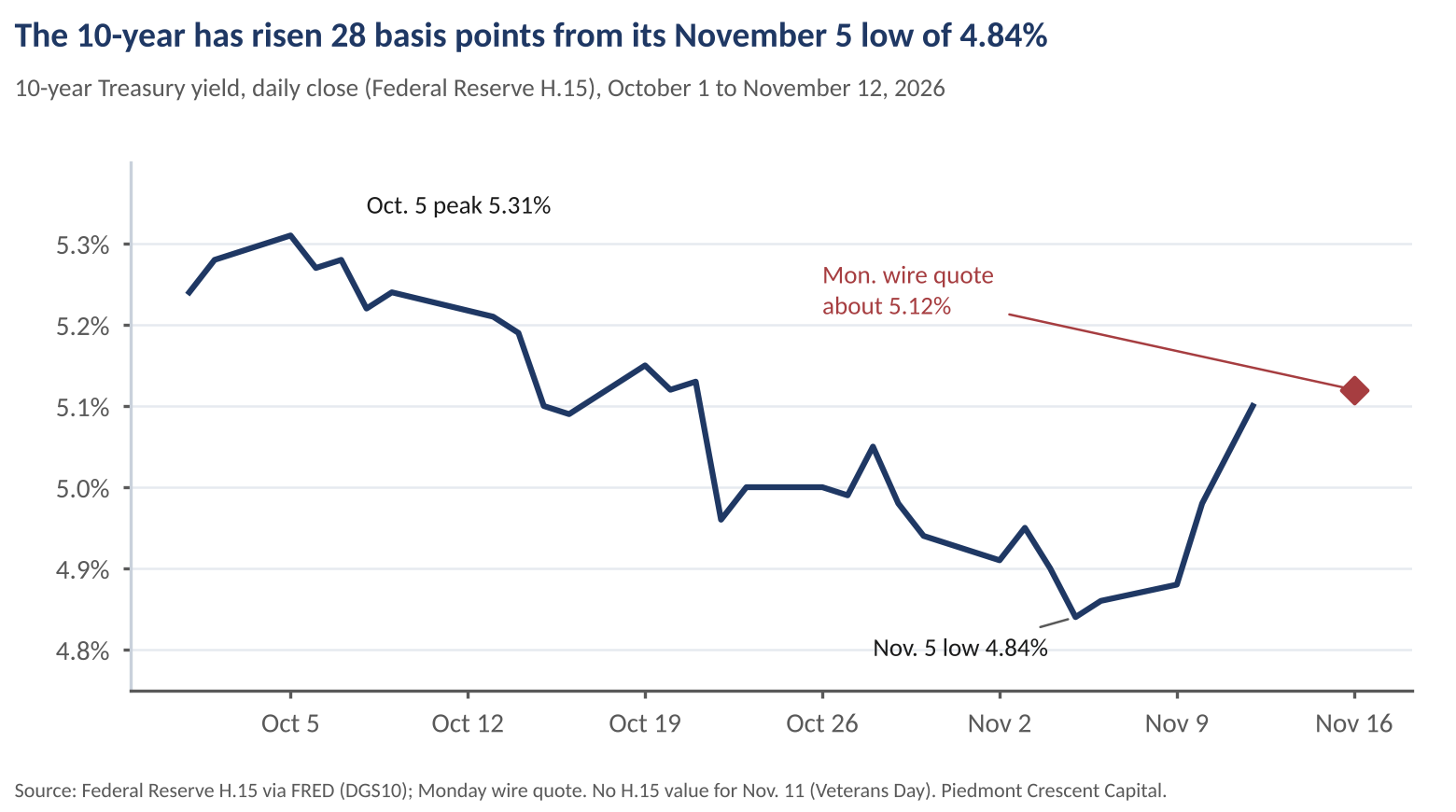
Last week we argued that the 10-year yield, then 4.84% on the H.15 basis, was pricing scarce capital and not a growth scare, and that a close below 4.60% would tell us otherwise. The market went the other way. The 10-year closed at 5.10% on Thursday, up 24 basis points from the prior Friday, and the wire quote was about 5.12% on Monday, but the 10-year is still 19 basis points below the October 5 peak of 5.31% (Exhibit 1). Five things drove the 10-year higher.
- The inflation data came in hot. October consumer prices rose 0.35%, which rounded up to 0.4%, against a consensus of 0.3%, and core rose 0.30%, against a consensus of 0.2%. The headline CPI was only modestly higher than expected, but the core miss was real and rounding had little to do with it. Core has now risen 0.29%, 0.33% and 0.30% in the last three months, and shelter, up 0.3%, accounted for more than 30% of the headline increase. There is no year-over-year figure for October because the shutdown left a gap in the October 2025 survey, and the last reading, for September, was 3.72%.
- Producer prices confirmed it. The October PPI rose 0.35% after September was revised up to 1.41%, and the year-over-year rate of 6.52% is the highest since November 2022. Goods prices rose 0.5% for the month and 10.2% over the year.
- The Fed said what it would do. Waller said a 50 basis-point hike should be on the table if core inflation is running near 0.3% a month, Logan said she expects at least two more quarter-point hikes, Collins and Daly favored hiking and Goolsbee called the inflation data “borderline disturbing.” On Monday Hammack said she prefers smaller, incremental hikes.
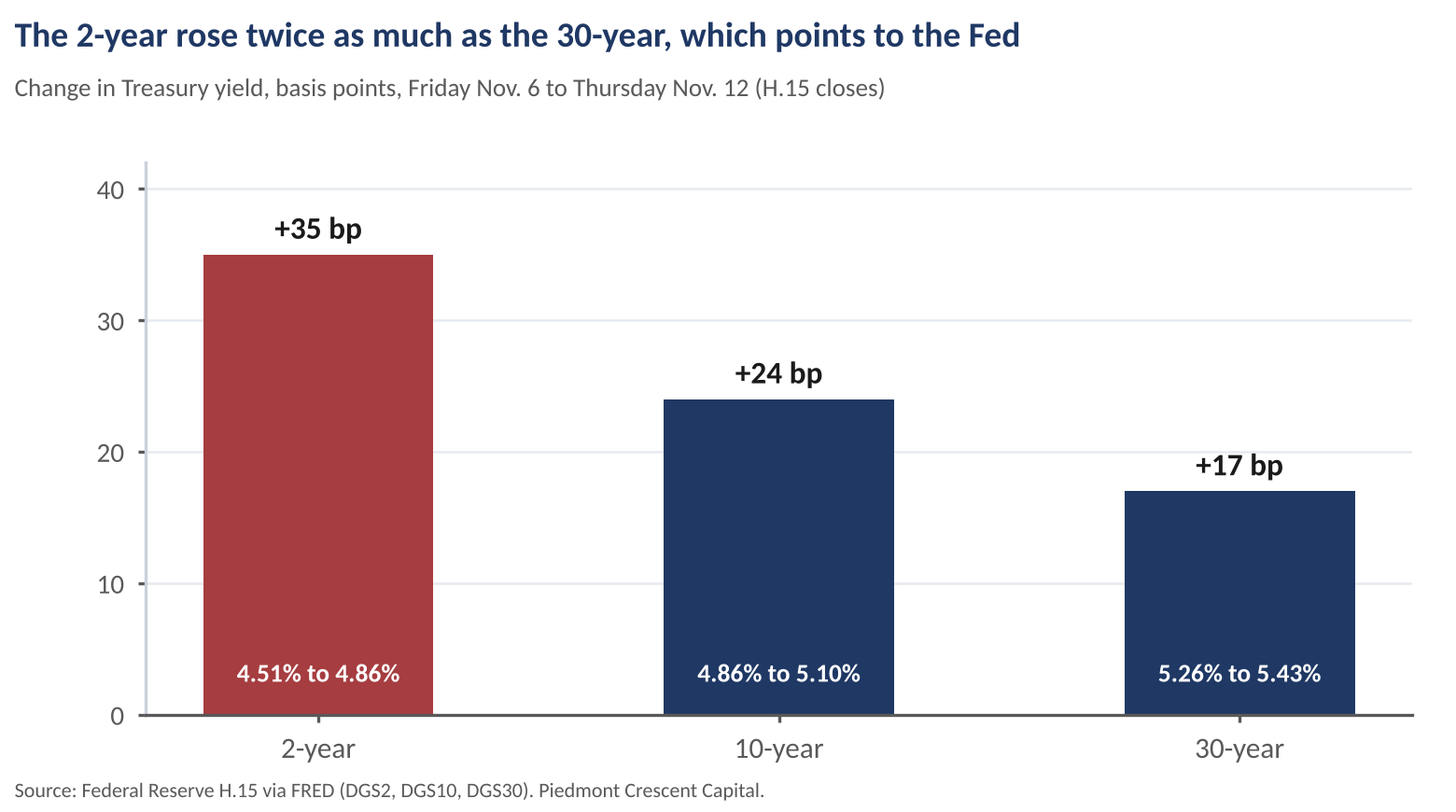
- Short rates moved most. The 2-year rose 35 basis points on the H.15 basis, to 4.86%, against 24 for the 10-year and 17 for the 30-year, which makes this a story about the Fed and not about the long-term fiscal outlook (Exhibit 2).
- Supply was soft. The Treasury sold $42 billion of 10-year notes on Tuesday at a high yield of 5.02%, and press reports described a wide tail and weak foreign demand, which added to the pressure in the days that followed.
The yield on the 10-year is now at our forecast for year-end, and the market has moved toward our funds-rate path faster than we expected. Futures put the odds of a December hike near 100%, up from about 75% last week, and on Friday put the odds of 50 basis points of hikes by January at 67%, up from 16% a week earlier. That pace is faster than ours, because we expect the Fed to hold in January. Our logic is that monetary policy works with long and variable lags. If the Fed hikes by 50 basis points on December 9, it will face the same question in January if the inflation data look even worse, because rate moves will not begin to affect inflation for at least a year and probably longer.
We do not read the move as a break in the economy. Payrolls rose 165,000 in October, claims were 200,000 for the week ended November 7, and the Michigan sentiment index of 51.0 is up from 48.0 even as 57% of respondents in last week’s survey cited eroded living standards. What changed is that the inflation reports removed the argument that the Fed could look through an energy shock, and Brent at $92.44 on Monday is about 22% below its late-October high of roughly $118.
Margins are likely the next casualty. The PPI is up 6.52% over the year through October, while the CPI was up 3.72% through September, the last year-over-year reading available. When producer prices run ahead of consumer prices, firms either pass the difference on or absorb it, and with the Michigan index at 51.0 and affordability the issue that decided the midterms, pricing power is limited. Profit margins are likely to come under pressure, most of all in goods-heavy industries, and fourth-quarter guidance is where it should show up first.
The risk to this view is a faster move in core prices. Core inflation of 0.4% or higher in November, due December 10, the day after the Fed meets, would make a 50 basis-point move a more serious possibility, and we describe our new tripwire for it in the Bottom Line.
The Fed, Inflation and the 50 Basis-Point Question
Futures have caught up with a December hike and now ask how large the next one is
Three months of core readings at 0.3% do not look like acceleration, but they do look like a floor. October’s 0.30% core print (0.296% unrounded) was the third in a row near 0.3%, and consensus had been 0.2%. Shelter accounted for more than 30% of the headline increase, and shelter costs are perking up, as RealPage shows same-store asking rents up 0.9% from a year ago in August, with rent growth spreading to more markets and starting to firm in some Sun Belt markets that added significant new supply, although San Antonio, Charlotte and Houston were still cutting rents in the third quarter. Our own estimate of monthly core inflation runs from 0.2% to 0.5%, and 0.3% sits in the lower half of that range.
The producer data add to that, as the PPI shows pipeline pressure in the goods economy: goods prices rose 0.5% in October and are up 10.2% over the year, the producer index rose 0.35% for the month, truck freight rose 3.9% and food rose 1.3%. Services prices rose only 0.2%, which is why core PPI was 0.3% and not higher. The core PCE deflator looks like it will post a 0.3% rise in October.
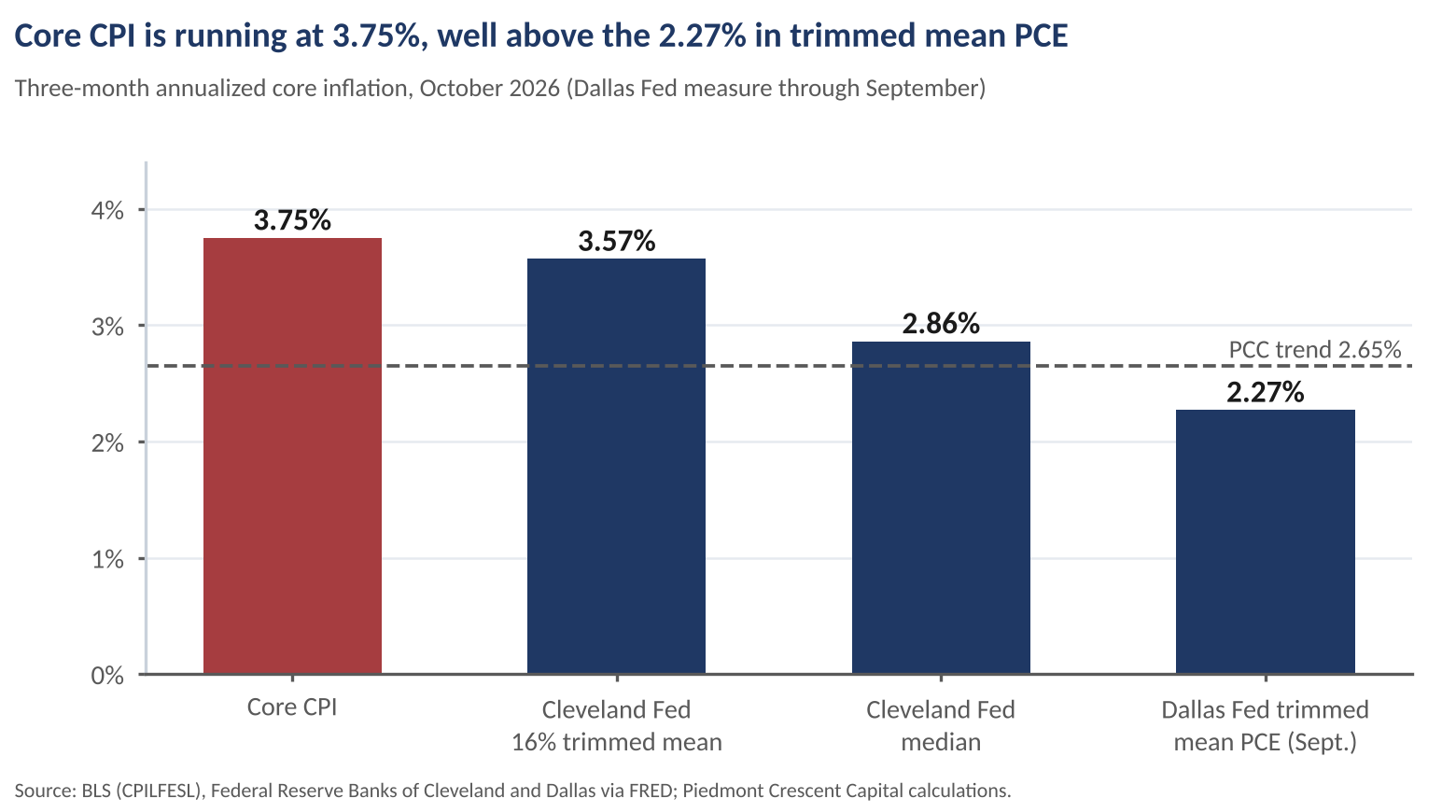
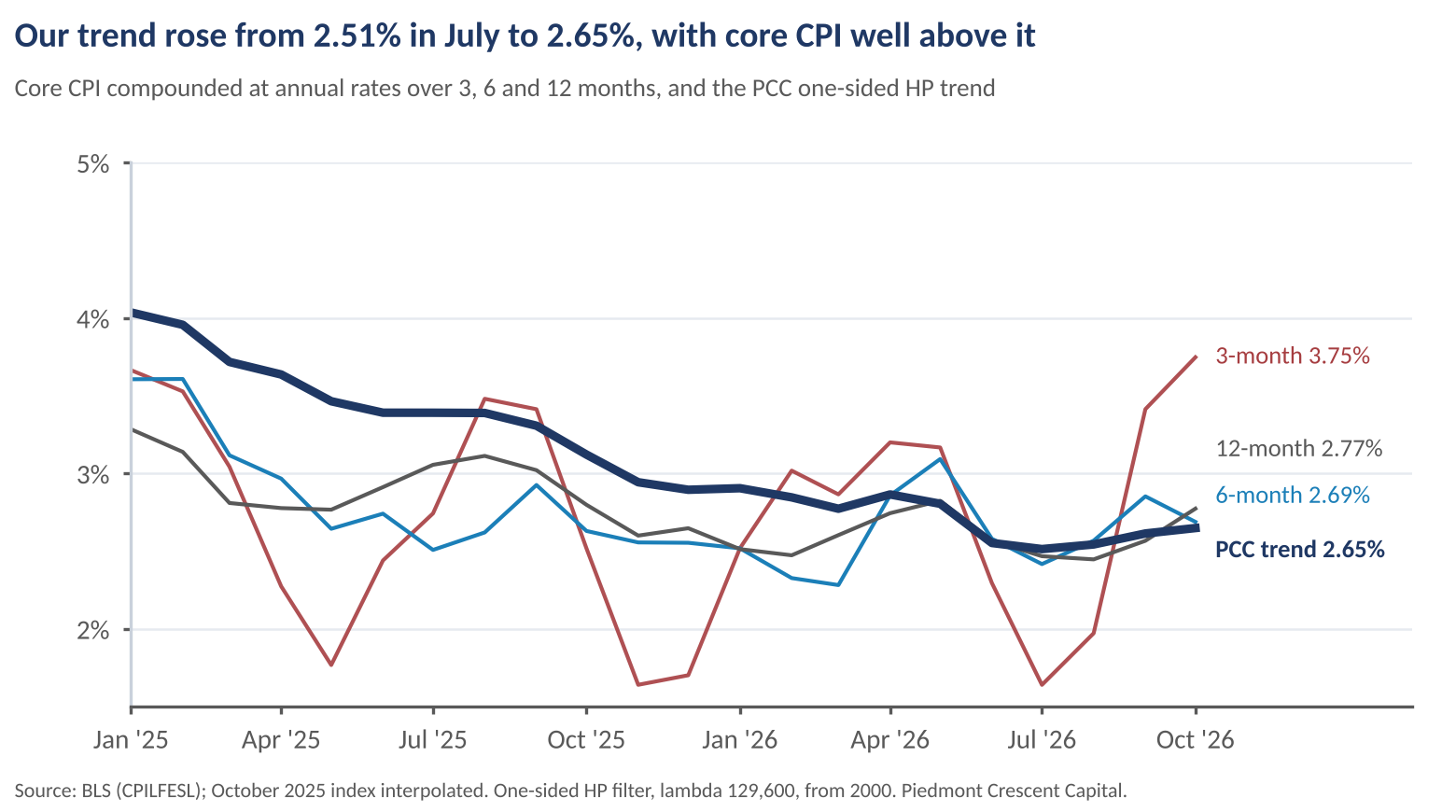
Other measures of core inflation say the same thing, with one exception (Exhibit 4). Over the past three months core CPI is running at a 3.75% annualized rate, the Cleveland Fed’s 16% trimmed mean at a 3.57% pace and its median at a 2.86% pace, while the Dallas Fed’s trimmed mean PCE, available through September, is 2.27%. Our own trend, a one-sided Hodrick-Prescott filter that never revises, was 2.65% in October. The trend is 47 basis points below its level a year ago, but it has edged higher every month since a low of 2.51% in July, and core CPI is now running well above it over the most recent three months (Exhibit 5).
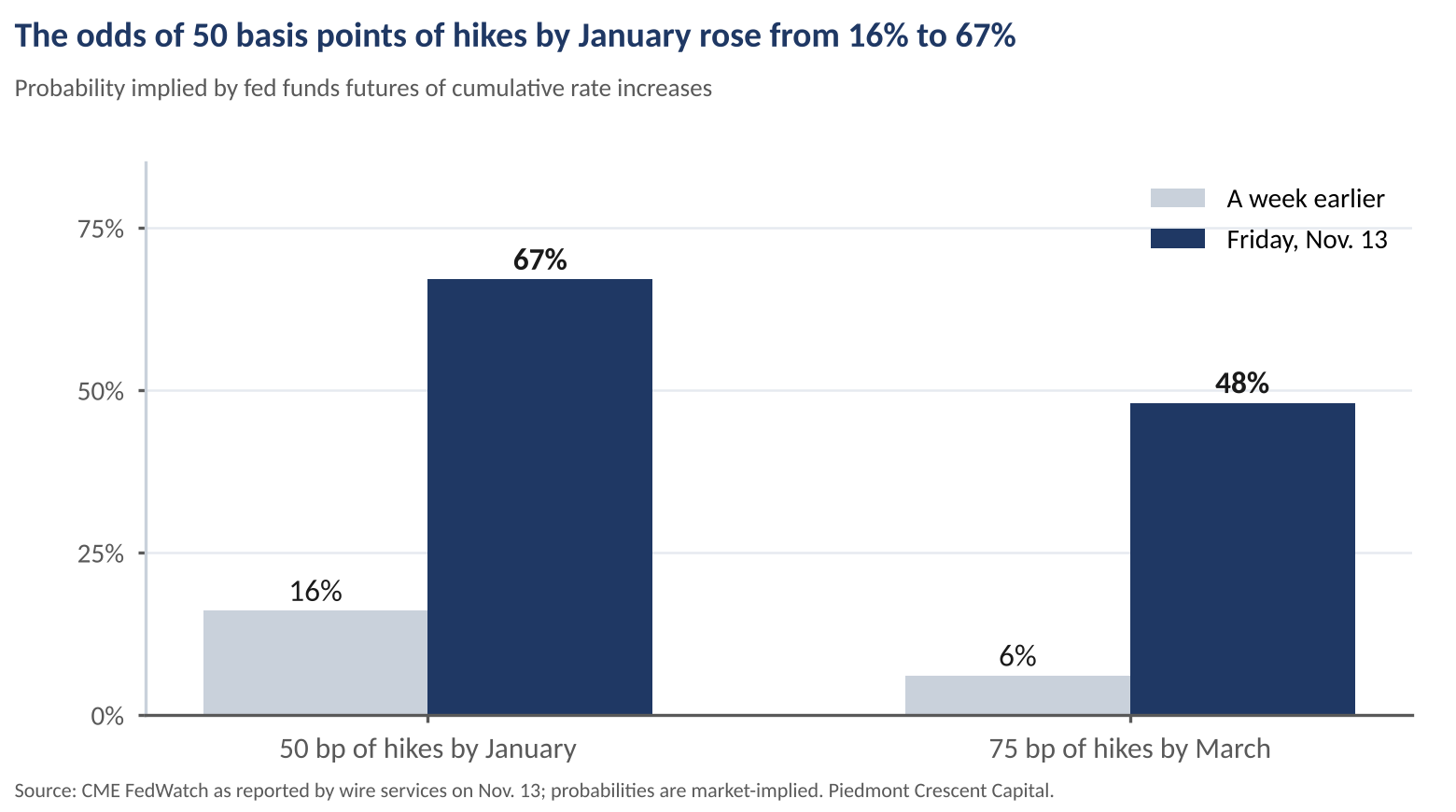
The preponderance of evidence pointing to a reacceleration in inflation has turned the debate into a question of timing and pace. Fed officials spent the week saying so in public, and the futures market moved with them (Exhibit 3). By Friday the probability of a hike on December 9 went to about 100%, with about 86% for 25 basis points and about 14% for 50, and futures briefly priced in a 50 basis-point move last week before settling back to a quarter-point hike, about 26 basis points, on Monday, and the probability of 75 basis points of hikes by March rose to 48% from 6%, which implies quarter-point hikes at the December, January and March meetings. Bowman said inflation is broadening, and Barr warned that AI adoption could cause serious short-term disruptions to employment, which is a reminder that the Fed is hiking into a labor market that is changing.
We think the market is right about December and ahead of us on January. Our path holds the funds rate at 4.00%-4.25% in January and raises it to 4.25%-4.50% in March, and futures gave 67% odds on Friday to 50 basis points of hikes by January. We regard a 50 basis-point move as a risk and not as a forecast, because three months of 0.3% core is steady and not accelerating, and we would need to see more acceleration, or an energy price shock from the Strait of Hormuz, before we moved. Where we may be wrong is in assuming the Fed prefers a gradual path: Warsh called the October hold a hawkish hold, and Waller has put the larger move on the table, although Warsh made no comment on policy in his remarks on AI on Monday and Hammack said she prefers smaller, incremental hikes.
There is also a political clock. The midterms were about the lack of real income growth, and we expect Congress to look to the Fed for tangible results on prices by 2028, which gives this Fed a reason to act now and a reason to be seen acting. Our 10-year forecast is 5.10% at year-end and 4.80% at the end of 2027, a decline of 30 basis points that depends on the hikes working. With the 10-year already at 5.10%, the next move in our forecast is down only if core inflation slows, and the first evidence will be the November CPI.
Our Seven Themes: This Week’s Scorecard
Our seven themes are the investments and demographic shifts that are largely responsible for producing the economy’s above-average growth. The scorecard below checks each against this week’s news.
| Theme | This week’s evidence | Exposure and our read |
|---|---|---|
| The AI Buildout | Huang resigned Thursday; Nvidia lost about 13% last week, fell 4.12% Monday and reports Tuesday; hyperscaler spending guidance is intact. | Policy and financing risk rose. Demand risk did not, in our view, and the buildout is supply-constrained. |
| Electric Grid Upgrade | Georgia Democrats won a Public Service Commission majority for the first time since 1995; Loudoun County, Va., votes Tuesday on a pause of up to 12 months. | Power costs are where local opposition to data centers is concentrated, and utility commissions are the gate. |
| Defense Replenishment | The Iran war and Hormuz standoff continue. Raytheon’s $22.9B seven-year Tomahawk award (Aug. 17) targets more than 1,000 missiles a year, up from about 60. | Multiyear munitions contracts are the capital spending signal; lame-duck defense and funding fights come before December 11. |
| Aerospace and Next Generation Defense | Boeing will cut about 5% of its Commercial Airplanes workforce (Nov. 9). Friday’s FAA ground stop, the third nationwide stop in U.S. history, was traced to a router problem during upgrades, and a United Airlines outage grounded departures Monday. | Boeing is cutting jobs while its 737 ramp lags. The FAA’s failure adds to the case for air traffic control modernization. |
| Reshoring of Critical Industries and Materials | October PPI goods prices up 0.5% and 10.2% over the year; truck freight up 3.9%. | Tariffs and the U.S.-China truce, which expires January 10, set the cost of reshoring. |
| Pharmaceutical and Medtech Buildout | Lilly broke ground Nov. 12 on a $3.5B injectables plant in Pennsylvania, operating about 2031. | Tariff exemptions tied to U.S. plants drive siting. |
| Peak 65 (Senior Housing, Condos, and Longevity & Functional Health) | The 30-year mortgage rate fell to 7.11%, its fourth straight decline, from 7.18%, against 6.24% a year ago. | Financing costs are the constraint on senior housing and condo construction. |
Source: Piedmont Crescent Capital, BLS, Federal Reserve, wire reports, U.S. News, Goldman Sachs.
The AI buildout and the grid face their principal risks at the state and local level, and neither showed a break this past week. We see signs that data center developers are looking to friendly states in the South and Mountain West, and the Carolinas, Tennessee, Arkansas, Mississippi, Oklahoma, Wyoming and Idaho are all likely to see more interest from hyperscalers. New projects are still limited by the availability of power, computing power and a whole host of building materials and equipment that are in short supply.
Behind the Numbers
Jobs and claims. Initial claims for the week ended November 7 were 200,000, with the prior week revised down to 191,000 and a consensus of about 194,000, and the four-week average was 195,250. Last week’s Bureau of Labor Statistics report put October payrolls at 165,000 and the unemployment rate at 4.1%, so the labor market is a low-hire, low-fire one that has not cracked. Barr’s warning about AI and short-term employment disruptions is the part we would watch as the Fed hikes.
Treasuries and the long end. The 3-year auction on Monday was soft and the 10-year auction on Tuesday cleared at 5.02%, and the 30-year yield was 5.43% on the H.15 basis on Thursday. The 2s-10s spread was 24 basis points on Thursday’s H.15 and about 30 on Monday’s wire quotes (2-year 4.82%, 10-year 5.12%). A 6-month bill yielded 4.45% and a 1-year bill 4.61% on Friday wire quotes, which is where the market is placing the next two funds-rate hikes.
Households and housing. The preliminary Michigan sentiment index was 51.0 against 48.0 in October, and the final reading is due November 20. The Freddie Mac 30-year mortgage rate was 7.11% on November 12, its fourth straight weekly decline, and the 15-year was 6.45%. With the 10-year back above 5%, we expect that decline to end in the next survey.
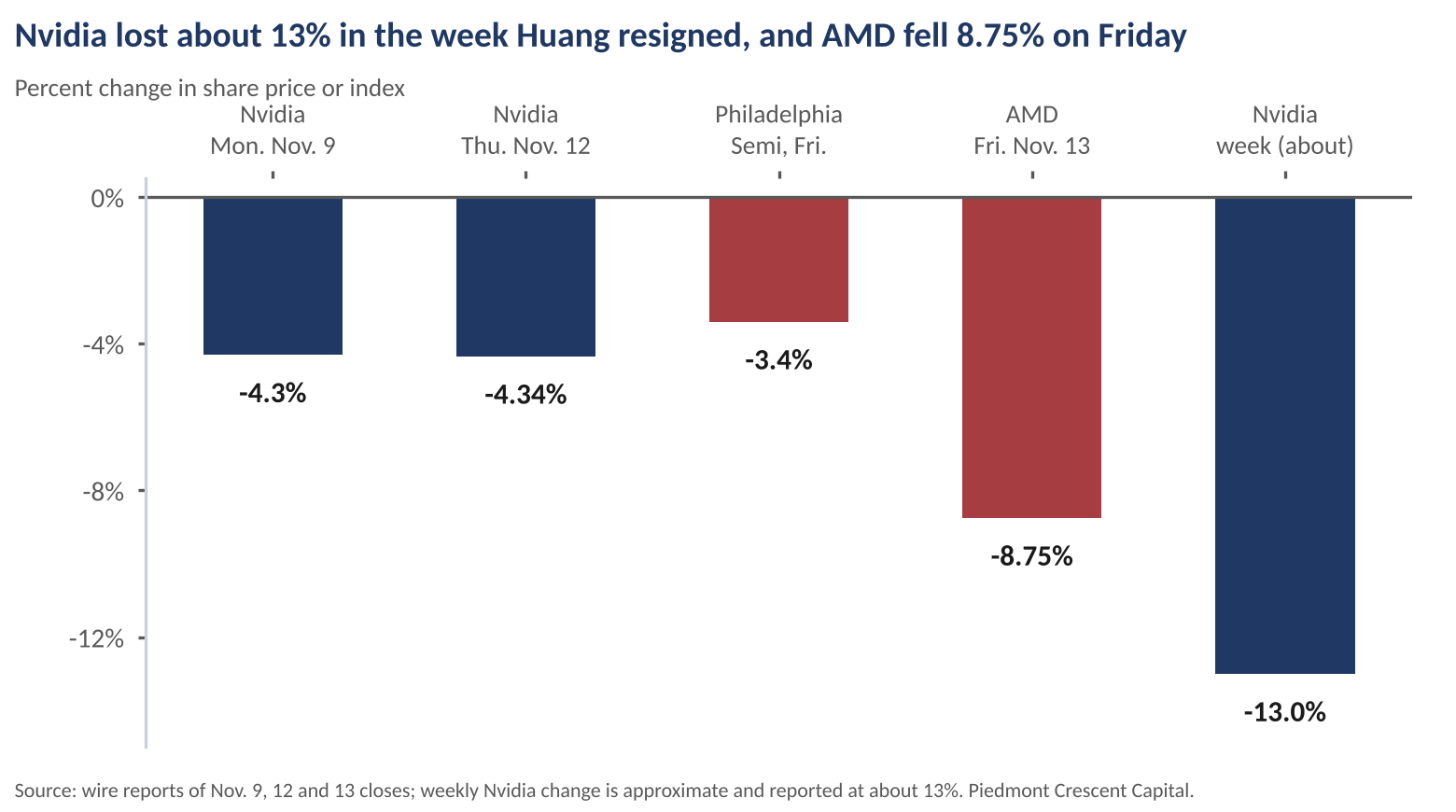
Chips and AI equities. Nvidia lost about 13% in its sixth straight weekly decline, with declines of 4.3% on Monday and 4.34% on Thursday, when the market value fell below $4 trillion for the first time since July 2025, and AMD fell 8.75% on Friday after rising about 17% from Monday to Thursday (Exhibit 6). Baird cut its price target and TD Cowen dropped Nvidia as a top pick. On Monday Nvidia fell another 4.12% ahead of its report, AMD fell 5.58%, Intel 7.02% and Dell 6.96% on debt warnings, and reports of new Southeast Asia AI chip export restrictions added to the pressure. Last week we called the November 5 selloff forced liquidation and positioning. This week’s declines followed governance and policy news, and we address what that means for our view in this week’s Perspective.
Data centers and the states. At least 10 incoming governors have pledged pauses or moratoria on new data center approvals, including Texas, Georgia, Ohio and Maine, according to U.S. News, and Senator Sanders has called for a national moratorium. Pledges are not law, however, and most need to enact legislation through a divided legislature. Goldman estimates that just under half of planned data center capacity is in states where Democrats could restrict it, with Texas about 25%, and Data Center Watch counts $64 billion of projects blocked or delayed over two years. A new Congress could also pursue bipartisan permitting reform, which would work in the other direction. Hearings and subpoenas are 2027 events, and any economic effect is more of a 2028 risk, although the fallout in the financial markets would occur sooner than that.
Energy, gold and the dollar. President Trump wrote on Thursday that the U.S. does not need a deal with Iran, and Iran says Hormuz stays shut until its demands are met, so Brent’s January contract rose 3.3% on Thursday to $95.82 and was $95.84 on Friday. On Monday Brent slipped to $92.44 and WTI settled at $85.72, and gold, which fell about 4% last week, was near $3,852.
Boeing and aerospace. Boeing will cut about 5% of the workforce at Boeing Commercial Airplanes, Stephanie Pope told employees in a November 9 memo, through a mix of attrition and involuntary layoffs with notices beginning in December, as the 737 MAX ramp runs behind plan. That is about 2,500 jobs by press estimates. Boeing expects to miss its 2026 target of 500 737 deliveries.
Defense orders. The Navy’s seven-year, $22.9 billion Tomahawk contract with Raytheon was announced August 17 and illustrates how defense orders now work: a multiyear commitment to take output from about 60 missiles a year to more than 1,000. The Navy has asked for $8 billion to buy 785 Tomahawks in fiscal 2027, after the Iran war drew down stockpiles. Lockheed Martin has booked a seven-year modification worth up to $53.9 billion for PAC-3 interceptors and a $35 billion THAAD contract from June.
Pharmaceutical expansion. Eli Lilly broke ground on November 12 on a $3.5 billion plant in Fogelsville, Pennsylvania, for injectable medicines including retatrutide, an investigational drug still in trials, with operations expected by 2031. The plant is part of $27 billion for four new U.S. sites and more than $50 billion in U.S. commitments. Tariff policy is the driver: companies that sign most-favored-nation pricing deals and onshoring agreements are exempt from Section 232 pharmaceutical tariffs, nine mid-sized drugmakers pledged at least $19.6 billion on August 31, and Health Secretary Kennedy says the industry has agreed to invest more than $600 billion. That $600 billion figure seems credible, but the spending is likely to come over several years, as new plants take years to build.
An uncomfortable series of mishaps (or possibly mischief). Microsoft’s 365 and Exchange Online services, including Outlook, Teams and Copilot, began failing globally on Thursday. At 3:54 p.m. Eastern on Friday the FAA ordered a nationwide ground stop on departures, which was lifted about 8:15 p.m., the third nationwide stop in U.S. history after September 11, 2001 and January 2023. Later reports attribute it to a router deployment problem during system upgrades that flooded the air traffic control system with data, and Transportation Secretary Duffy said he saw no evidence of a cyberattack. Earlier on Friday in New Orleans, the tanker Atlantic Asphalt, which apparently lost steering, struck the docked river cruise boat American Heritage, which capsized, and nearly 200 people aboard survived, with 32 hospitalized. The Coast Guard and the NTSB are investigating and the Coast Guard has reopened the Mississippi to limited traffic. On Monday, a software bug in on-premises hardware knocked Chase’s online and mobile banking offline, and Chase said it was not a cyberattack and aimed to restore service by the end of the day. Customers of other banks, including U.S. Bank, Wells Fargo, Bank of America and Citi, reported delays in payments involving Chase, and Zelle’s operator Early Warning said its network was operating normally. A systemwide United Airlines outage also grounded departures, and the airline has not made a cause public. Press reports found no common technical fault among the failures, Homeland Security Secretary Mullin says the collision and the ground stop were unrelated, and we see no link among them. Each reminded households and businesses how much of daily life depends on technology and infrastructure, and together they add to the consumer anxiety about technology, AI and data centers that showed up so clearly in the midterms.
Central banks. Chair Warsh spoke on AI and productivity at a San Francisco Fed conference on Monday and did not comment on policy, Cleveland Fed President Hammack said she prefers smaller, incremental hikes, and Jefferson, Collins and Schmid spoke about inflation. The minutes of the October 28 meeting will be released Wednesday.
Bottom Line
We continue to expect the Fed to raise the funds rate a quarter point to 4.00%-4.25% on December 9, hold in January and raise it again in March to 4.25%-4.50%. We expect the 10-year at 5.10% at the end of 2026 and 4.80% at the end of 2027, and with the 10-year at about 5.12% on Monday, the first of those numbers is already in hand. The October inflation reports and a week of hawkish speeches support the call, and our one concession is that futures have moved ahead of us on January.
What would change our mind is a change in the underlying inflation trend. Core CPI of 0.4% or higher on December 10, or an energy price shock from Hormuz, would raise the odds of a 50 basis-point hike, which we see as a risk. There has not been much buy-in for 50 basis points on December 9. Futures briefly priced it in last week and settled back to about 26 basis points on Monday, Hammack said she prefers smaller, incremental hikes, and we do not expect it. On the other side, an unemployment rate of 4.4% or higher, wider high-yield spreads that turn into failed issues, or a core reading of 0.2% would move us toward a pause.
Our tripwire resets from 4.60% to 5.31%. The prior level was set when the 10-year was 4.84%, and with the yield at about 5.12% on Monday it can no longer be tested. A close above the October 5 peak of 5.31% before December 9 would tell us the market is pricing a larger hike or a rise in term premium, or some combination of the two, and we would revisit our 50 basis-point odds and our year-end forecast. A close below 4.84%, last week’s low, would revive the growth-scare reading and we would put our December hike at even odds.
Last Week’s Calls, Checked
- A December 9 hike, with futures near 75%. Confirmed so far. Futures priced about 26 basis points at Monday’s close, a full quarter-point hike, after briefly pricing in 50 last week.
- A 4.60% tripwire on the 10-year. Not triggered. The 10-year was about 5.12% on Monday, more than 50 basis points above the tripwire.
- The AI buildout has a very long tail. Intact so far. Hyperscaler spending guidance is unchanged, and the governors’ pledges are not yet law. Our list of what would change our mind left out founder, governance and export-policy risk, which we address in this week’s Perspective.
- Core CPI inside our 0.2% to 0.5% range. Confirmed. Core rose 0.30% against a consensus of 0.2%.
CFO and Treasurers Corner
- Take the next tranche of fixed-rate funding after December 9. Last week we suggested locking a third of 2027 maturities while the 10-year was 47 basis points off its peak, and the yield has since risen 26 basis points. We have the 10-year at 4.80% at the end of 2027, so waiting for the rest is a bet on next year, and we would take the second third after the Fed meets and the third after the March meeting.
- Price your floating-rate debt at 4.50% by March. Our path puts the funds rate at 4.25%-4.50% in March, and futures put the odds of 50 basis points of hikes by January at 67% on Friday. Ask what an additional 25 basis points costs in interest expense and covenant headroom.
- Review key-person and continuity terms with your AI infrastructure suppliers. If you buy chips, servers or capacity that depend on Nvidia, ask for supply commitments through the leadership transition and look at alternatives. Management has said supply is the constraint, and the written commentary due Tuesday afternoon is the first public test.
- Build an out-of-band plan for email, payments and logistics. Microsoft 365 failed for much of Thursday, the FAA grounded departures on Friday, and on Monday a software bug took Chase’s online and mobile banking offline, slowed payments involving Chase at other banks and a United Airlines outage grounded departures. Confirm that treasury, payroll and approvals can run if your email or your bank’s portal is down, keep a second bank relationship and a backup payment channel for payroll and critical vendors, ask your carriers how they re-route around a ground stop or a river restriction, and check what your business interruption coverage pays for a supplier outage.
- Hedge energy in layers. Brent was $92.44 on Monday, about 22% below its late-October high of roughly $118, and Iran says Hormuz stays shut. A large amount of crude is still leaving the Gulf each day, but how much and for how long are key unknowns. Add to first-half 2027 fuel and freight hedges in equal pieces and keep part of the budget open.
- Put the next dates in your calendar. Nvidia reports on Tuesday, the Fed meets December 8-9, CPI is December 10, the government funding deadline is December 11 and the U.S.-China tariff truce expires January 10. One prediction market put the odds of a December 12 shutdown near 39% on November 16.
Piedmont Perspective
A Founder Leaves, the Buildout Stays: What Huang’s Exit Means for American AI
An abridged version of this week’s standalone Perspective
Jensen Huang resigned as Nvidia’s chief executive and as a director on Thursday, and the stock fell 4.34%. The board had announced an independent investigation on Sunday after press reports that he had a relationship with a woman whom U.S. intelligence officials believe was recruited by China’s Ministry of State Security. China called the report a smear, and we still treat the allegations as allegations. Chief Financial Officer Colette Kress is interim CEO, Harvey Jones is the first chair of the board and the search is open to outside candidates. Nvidia fell another 4.12% on Monday ahead of its report.
The departure does not end the AI buildout. The demand comes from hyperscalers that buy against capacity plans set a year or more ahead, Nvidia has guided third-quarter revenue to $108 billion plus or minus 2%, and management has said supply is the constraint. The first test is written commentary from Kress on Tuesday afternoon, ahead of the 5 p.m. call.
The change that matters is in Washington. The administration approved H200 sales to China in December 2025 in exchange for a 25% cut, Senator Wyden and Representative Neal have opened a probe of those approvals and Representative Mast, who chairs House Foreign Affairs, says Huang is willing to testify as soon as next week. The commercial stakes are small, as Nvidia has said H200 shipments to China were under 1% of data center revenue last quarter, so the stakes are precedent and policy, and the larger consequences are a 2027 event. The Trump-Xi meeting in Shenzhen on Thursday is the first test of that policy.
The second change is the price of financing the buildout. The 10-year at 5.10% raises the cost of the debt and equity that fund it, and a founder’s exit under investigation raises the premium investors ask. That fits the mood of the midterms, in which 76% of voters in NBC’s exit poll opposed new data centers in their own communities, and the week’s outages, from Microsoft and the FAA to Chase and United Airlines on Monday, and the Mississippi collision added to it.
Our call has two checks. Nvidia will report third-quarter revenue of at least $105.8 billion, the low end of its guide, and guide the fourth quarter above the third on Tuesday, and Washington will approve no new advanced-chip sales to China before the truce expires on January 10. If either fails, we are wrong about what this departure changes, and the full Perspective sets out where our published view is under strain.
You can access our full report at: The Piedmont Perspective Archives – Piedmont Crescent Capital
The Week Ahead
Tuesday: October retail sales at 8:30 a.m. (consensus +0.2%, from +0.8%) and industrial production at 9:15 a.m., with Home Depot before the open. Nvidia reports third-quarter results after the close, with written commentary from Kress about 4:20 p.m. Eastern and a 5 p.m. call (consensus is about $108.8 billion of revenue and $2.47 a share). Loudoun County, Virginia, votes on a pause on data center approvals of up to 12 months. What would move us: a retail sales gain well above 0.2% would be nominal strength fed by prices and would harden the December case, a decline would revive the growth scare, and a fourth-quarter guide below the third-quarter level would be the first crack in the buildout.
Wednesday: October housing starts and permits at 8:30 a.m. (September starts were 1.221 million and permits 1.398 million), and the minutes of the Fed’s October 28 meeting at 2 p.m. Anthropic, PBC expects to price its Nasdaq IPO of 825 million shares, at an expected $70 to $78 a share, a test of investor appetite for AI equity. What would move us: minutes that show a larger share of participants favoring 50 basis points, and starts below 1.25 million, which would fall short of our fourth-quarter forecast of 1.32 million and say that 7.11% mortgages are doing their work.
Thursday: Initial jobless claims and the Philadelphia Fed manufacturing survey at 8:30 a.m. (prior 20.9), and the first day of trading for Anthropic’s shares under the ticker ANT. What would move us: claims back above 230,000 would be the first sign that the labor market is softening.
APEC in Shenzhen, Wednesday and Thursday: Leaders of the 21 APEC economies meet on November 18 and 19 under Xi’s chairmanship, after a CEO summit on November 17 and 18. President Trump is scheduled for a bilateral meeting and working lunch with Xi on Thursday, and the White House says Trump, Xi and Putin will hold the first three-way meeting among the three leaders the same day, with nuclear arms and the Iran war on the agenda and Ukraine left off it. Rare earths, advanced chips, tariffs, artificial intelligence and U.S. arms sales to Taiwan are expected to be discussed, and the trade truce, now extended to January 10, is the clock. Expectations are low: APEC works by consensus and its commitments are voluntary, analysts say both sides are falling short on commitments to extend the truce, and press reports say Washington regards export controls as off the table while Beijing has warned of rare-earth retaliation if chip curbs tighten. We expect a restated truce and talk about rare earths, with no change in chip policy before January 10, which is the second check on this week’s Perspective. What would move us: a longer truce or a rare-earth supply commitment would ease pressure on goods prices and margins, a breakdown would do the opposite, and any statement on Iran would matter for Brent.
Friday: The final November reading of Michigan sentiment (consensus about 52, from the 51.0 preliminary). What would move us: year-ahead inflation expectations above last week’s 4.3%.
Watch also for the root causes of Monday’s outages at Chase and United, for Huang’s possible testimony before House Foreign Affairs, which Representative Mast says could come as soon as next week, for the response to President Trump’s remarks on Iran and for the lame-duck session’s first moves on the December 11 funding deadline.
U.S. Economic & Financial Outlook
Our November 15 forecast trims the housing outlook again. Housing starts are 1.32 million in the fourth quarter, from 1.34 million, and 1.28 million in the first quarter of 2027, from 1.33 million. New home sales are 643,000 in 2026 and 625,000 in 2027, from 645,500 and 637,500, and existing home sales are 3.98 million and 3.90 million, from 4.01 million in both years. Residential investment falls 1.5% in 2027, not 1.1%, CPI inflation ends 2027 at 2.1%, from 2.6%, with core CPI at 2.3%, from 2.8%, and Brent in the fourth quarter is $102, from $105. The Fed path is unchanged, and the 10-year at about 5.12% is near our year-end number.
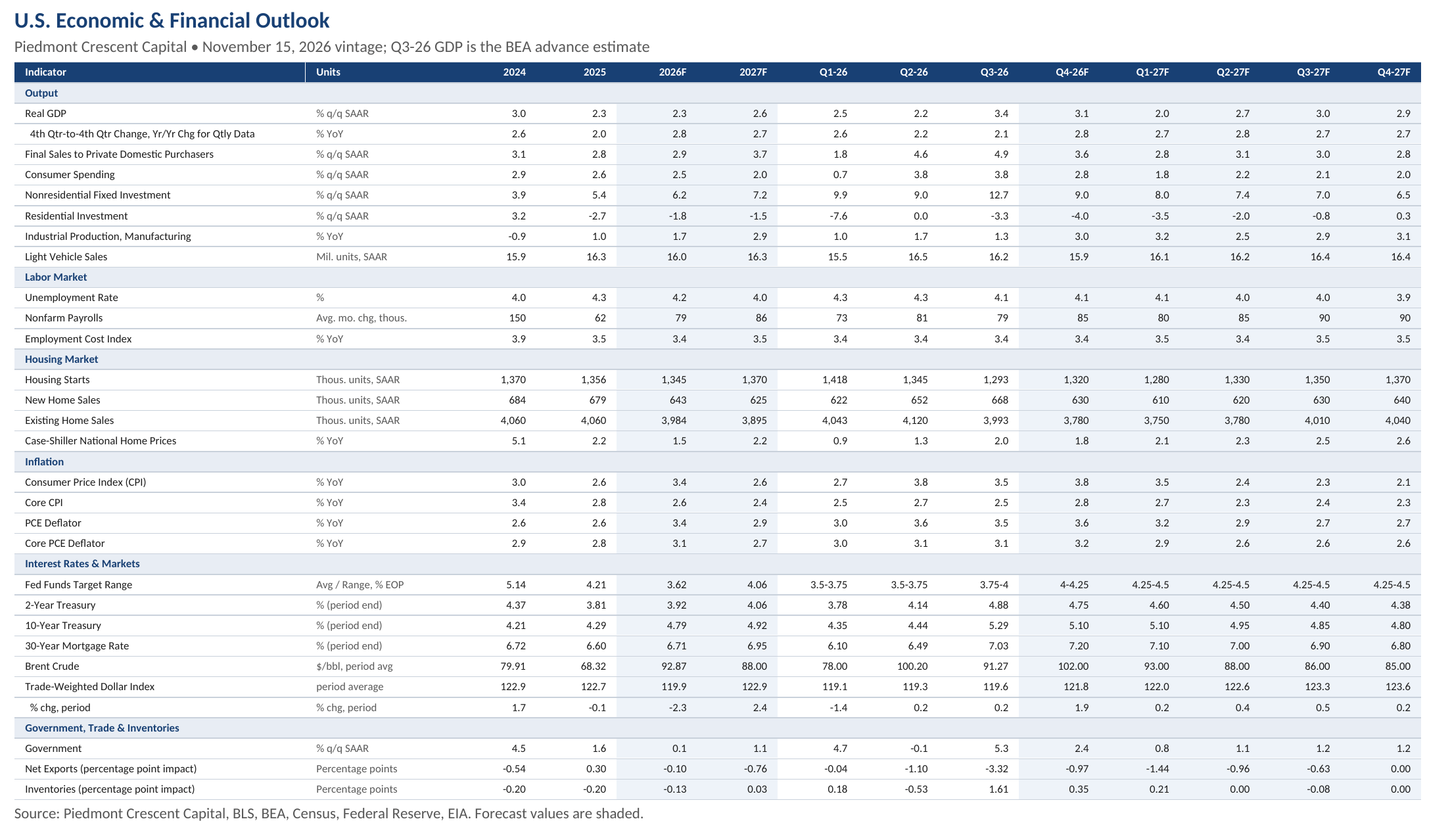
Source: Piedmont Crescent Capital, BLS, BEA, Census, Federal Reserve, EIA. Forecast values are shaded. November 15, 2026 vintage; third-quarter 2026 GDP is the BEA advance estimate. Annual figures are full-year averages or year-over-year percent changes except where the units say otherwise, and quarterly figures are seasonally adjusted annual rates, year-over-year changes where the units say so, or period averages and period-end levels for rates.
Sources and Notes
Sources. Bureau of Labor Statistics (Consumer Price Index, October 2026, November 10, 2026; Producer Price Index, October 2026, November 13, 2026; Employment Situation, October 2026), as reported by wire services; Department of Labor (weekly claims, November 12, 2026); Federal Reserve (H.15 selected interest rates via FRED, series DGS2, DGS10, DGS30; FOMC statement, October 28, 2026); University of Michigan (preliminary November survey); Freddie Mac (Primary Mortgage Market Survey, November 12, 2026); NVIDIA Corporation (conference call notice, October 28, 2026); CME FedWatch as reported by wire services; press reports from The New York Times, Axios, CNN, Reuters and others on Nvidia, Congress and the FAA; U.S. News & World Report (governors’ data center pledges); Data Center Watch; NBC News (exit poll); the AP Voter Poll (midterm voter concerns); RealPage and CRE Daily (apartment rents); Boeing memo as reported by the press; U.S. Navy and RTX (Tomahawk contract, August 17, 2026); Defense Blog (PAC-3 awards); Pharma Manufacturing and the White House (MFN fact sheet, August 31, 2026); NPR, MPR News, Al Jazeera, NBC News, ABC News, WDSU and U.S. News & World Report (FAA ground stop and the New Orleans collision); NVIDIA Board statement (November 8, 2026); Market Chameleon (earnings dates); Reuters, Quartz, NordFX and Moomoo (Monday pre-open quotes and calendar estimates, November 16, 2026); Anthropic IPO site and Reuters (IPO timing); FinViz (prior-period releases); Goldman Sachs Global Investment Research (state data center capacity, November 2026, and core PCE estimate, November 13, 2026); Reuters, Business Standard, TRT World, MarketScreener and BBN Times (APEC); the Federal Reserve Banks of Cleveland and Dallas via FRED (median and trimmed-mean CPI, trimmed-mean PCE); the Associated Press (Monday index closes); Newsquawk and Yahoo Finance (Monday yields, crude, gold and company moves); CNBC, ABC News, WBAL, The National and ClickHouston (Chase, Zelle, United and the FAA cause); the Federal Reserve Bank of New York (Empire State Manufacturing Survey, November 2026); and our November 8 View.
Market data. Equity index closes for Monday, November 16 are from the Associated Press, and Friday closes cited in the text are from wire reports. Thursday Treasury yields are the Federal Reserve’s H.15 series via FRED; there is no H.15 observation for Wednesday, November 11, a federal holiday. Monday and Friday yields, oil and gold are wire quotes and not official closes. Nvidia’s weekly decline is approximate and reported at about 13%. The 10-year auction result of 5.02% and its tail are from press reports.
Calculations. The 24 basis-point rise in the 10-year, the 35 and 17 basis-point rises in the 2-year and 30-year (November 6 to November 12, H.15), the 24 basis-point 2s-10s spread, the 26 basis-point rise since last week’s lock suggestion the 30 basis-point Monday spread and the percentage of Brent below its October high are our calculations. The low end of Nvidia’s guide ($105.8 billion) is $108 billion less 2%. Monthly changes in the CPI and PPI are computed from index levels to two decimals, and the three-month rates in Exhibit 4 are annualized from index levels or averaged from monthly annualized readings. The PCC trend is a one-sided Hodrick-Prescott filter (lambda 129,600) estimated on seasonally adjusted monthly annualized CPI from January 2000, with the missing October 2025 index interpolated.
A View from the Piedmont is published weekly by Piedmont Crescent Capital for informational purposes only and does not constitute investment, legal, or tax advice. Views expressed are those of the author as of the date of publication and are subject to change. © 2026 Piedmont Crescent Capital, LLC. All rights reserved.