
Housing Starts Fall Less Than Expected
- Housing starts fell 1.4% to a 1.382-million-unit pace in December. Starts in November and October were also revised lower.
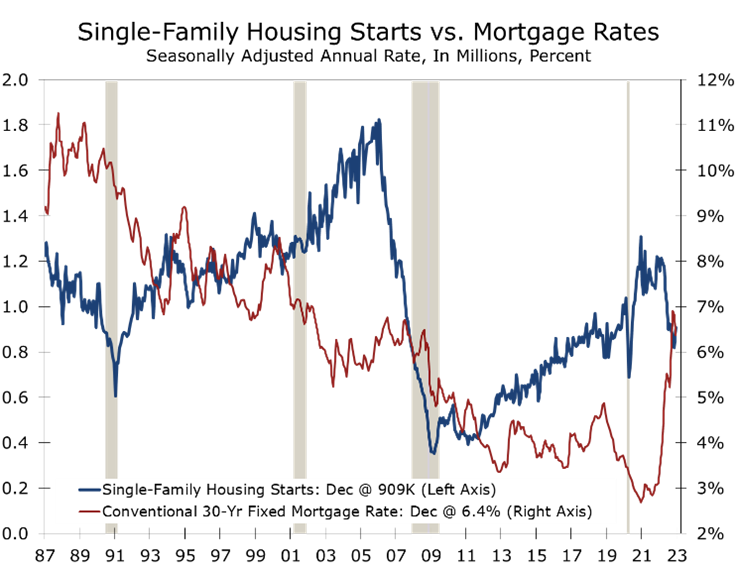
- Single-family starts rose 11.3% in December, ending the year at a 909,000-unit pace, which is down 25% from last December.
- Multi-family starts fell 19% and are down 14.9% from last December.
- Building permits fell 1.6% and ended the year at a 1.33-million unit pace. Permits for single-family homes fell 6.5%, while permits for multi-family homes rose 5%, with all the gain coming in projects with 5 units or more.
- The number of single-family homes under construction edged 0.3% higher in December but fell slightly in Q4 and is down 0.1% from last December.
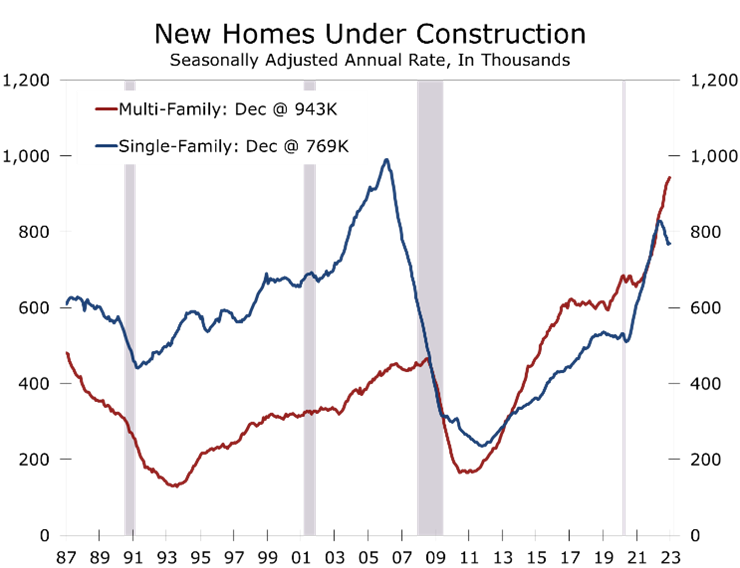
- Apartment construction continued to rise at yearend, with the number of units under construction up 24.8% from last December.
The recent pullback in mortgage rates combined with aggressive discounting by home builders has helped curb the slide in housing starts. Starts fell just 1.4% in December and ended the year at a 1.382-million unit pace. Single-family starts rose slightly, while multi-family starts fell. The better news on single-family starts follows Wednesday’s report from the National Association of Home Builders, which showed a slight rise in buyer traffic and home sales.
While the slide in housing starts appears to be slowing, the housing market is expected to remain challenged in 2023. The surge in home buying following the reopening of the economy in 2021 led to a spike in home prices. Affordability took another hit in 2022 as mortgage rate shot higher. The share of median family income needed for principal and interest payments rocketed to 27.4% in October, which was 1.2 points higher than it was at the peak of the housing bubble.
Mortgage rates have declined half a percentage point since late October and builders have offered aggressive discounts, which has improved affordability and brought some buyers back into the market. Even with this improvement, affordability remains a challenge, particularly for first-time buyers.
While December’s smaller drop in housing starts is encouraging, there is one notable caveat. Housing starts declined in every region except the Northeast, where they more than doubled to 212,000 units. Without the spike in the Northeast, overall housing starts would have fallen 10% in December. Seasonal adjustment for the Northeast is extremely large, so even small actual changes can trigger exceptionally large seasonally adjusted gains.
The divergence between starts and permits in the Northeast suggests December’s spike in housing starts will almost certainly be reversed next month. While that certainly takes some of the shine off today’s better-than -expected data, there are plenty of other encouraging aspects to December’s report. Single-family starts rose in the South and West, rising 4.4% and 6.7%, respectively. These two regions accounted for nearly 81% of all single-family starts in 2022.
Builders also appear to be making some headway working down their backlogs. The number of single-family homes authorized but not yet started fell 4.9% in December to 137,000 units. That marks the lowest level since March 2021. The number of homes where permits have been issued but construction had not started had risen substantially after the economy reopened in Mid-2020 due to supply shortages and staffing issues at local government building agencies.
Buyer traffic has also improved. The National Association of Home Builders/Wells Fargo Housing Market Index (HMI) rose 4 points in January 35, marking its first increase in a year. A reading above 50 means more builders rate conditions as ‘good’ than rate them ‘bad’. This past month’s gain was evident in all three key components, with present sales rising 4 points to 40 and future sales rising 2 points to 37. Prospective buyer traffic rose 3 points to 23.
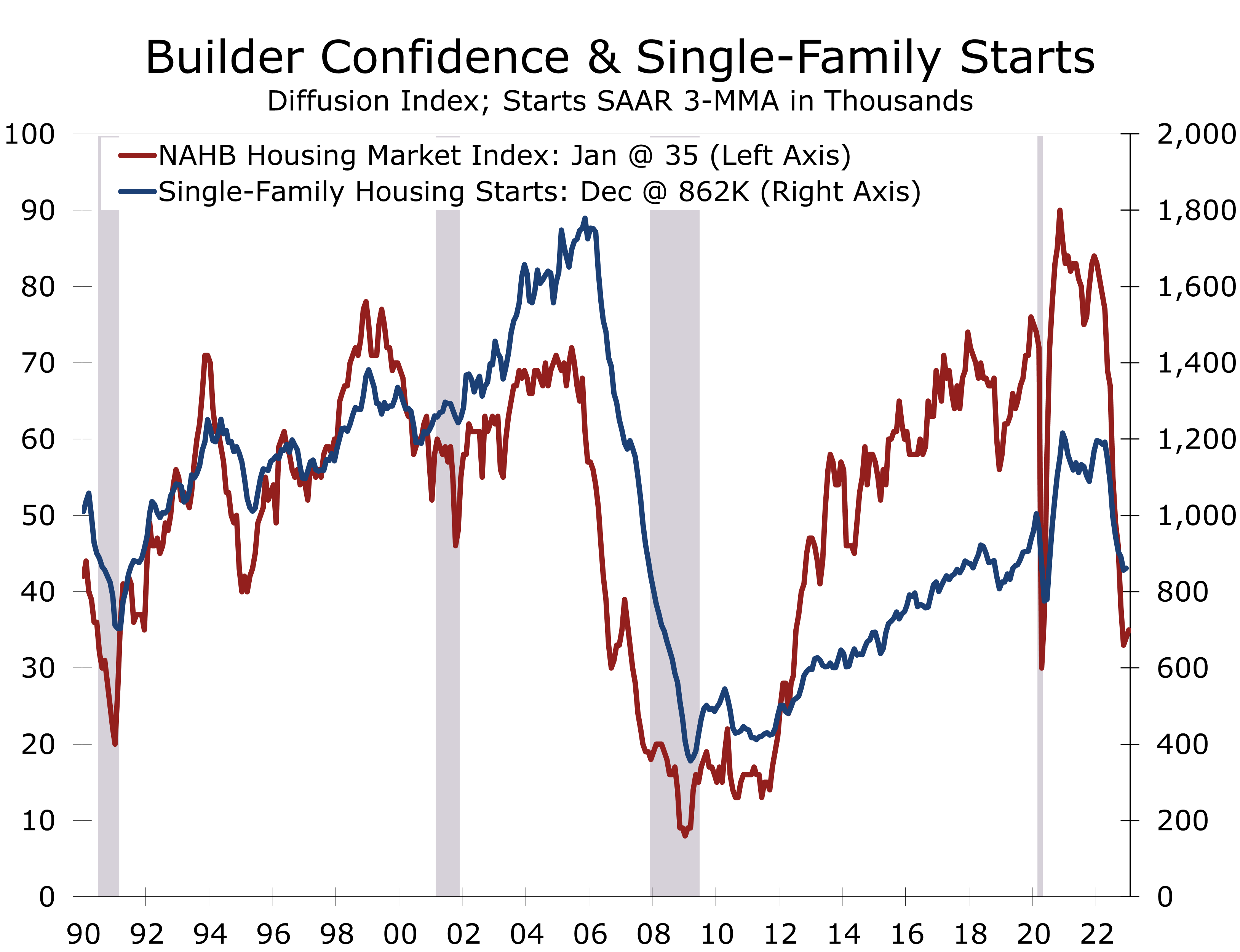
While January’s increase in the HMI comes off some very low levels, the rise is encouraging in that it was evident across all three components of the index and across all four regions of the country. The regional HMIs rose 4 points in both the South and West and climbed 2 points in the Northeast and Midwest. Conditions improved even though the weather in late December and early January was unseasonably cold and wet in many parts of the country.
Harsh winter weather reduced home completions in December.
The harsh weather likely played a role in reducing the number of new homes completed in December. Completions of single family homes fell 8%, while completions of apartments declined 12.1%.
With completions down, the number of homes under construction rose. Multi-family units accounted for most of the increase, most of which are apartments. The number single-family homes under construction rose 0.3% to 769,000 units. The backlog of single-family homes under construction topped out in May, however, and is now declining as builders strive to clear inventory ahead of a further weakening in sales.
Disclaimer: This publication has been prepared for informational purposes only and is not intended as a recommendation offer or solicitation with respect to the purchase or sale of any security or other financial product nor does it constitute investment advice.