Small Business Confidence is Getting Squeezed
- The NFIB’s Small Business Optimism index fell 1.1 points in April to 89.0, marking the 16th consecutive month the index has remained below its long-term average of 98.
- The proportion of owners expecting the economy to improve over the next six months fell 2 points to a net -49%.
- Six of the index’s 10 components fell in April, led by a 6-point drop in the current inventory series, which means more firms feel they have too much inventory.
- Labor quality remains the top concern of business, cited by 24% of firms, followed by inflation at 23%.
- Expected credit conditions improved by 1 point, partially reversing the prior month’s drop. More firms also report they are borrowing regularly.
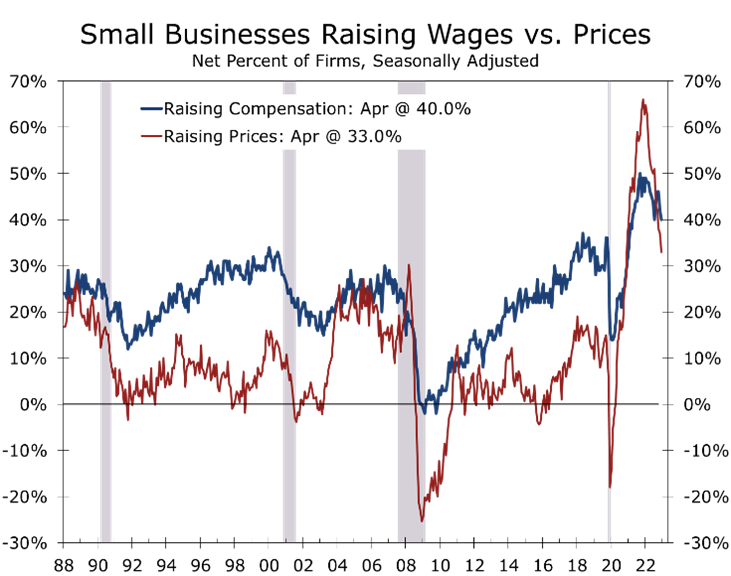
- The net share of firms raising prices fell 4 points to a still historically high 33%, continuing its recent string of improvement.
- A net 40% of business owners reported raising compensation in April, down 2 points from April. Labor quality is a much greater concern among owners than compensation.
The latest survey data from the National Federation of Independent Business (NFIB) provide another glum assessment of current and future economic conditions. The NFIB Small Business Optimism Index fell 1.1 points to 89, hitting its lowest level since January 2013.
Small business owners continue to get squeezed by rising costs, slowing sales, and diminishing pricing power. The banking crisis impacting some specialty lenders, predominantly on the West Coast, appears to be having only a modest impact on small businesses, with only 2% of firms reporting all their credit needs were not currently being met. A net 6% of firms report their last loan was more difficult to get than previously, down 3 points from March. More firms report they are borrowing regularly, however, so higher interest rates are taking a larger bite out of operating income.
Only 2% of small business owners reported all their credit needs were not satisfied in April.
The issues dogging small businesses are more fundamental: sales are slowing, and costs are rising. The net share of small business owners reporting sales improved fell 3 points in April to -9%. Moreover, the share of owners expecting sales to improve fell 4 points to -19%. With sales slowing, the share of businesses reporting they have too much inventory rose 6 points in April to a net 5%, which is one reason more firms report they are borrowing regularly. The share of firms borrowing regularly rose 1 point in April to 31% and is up 5 points over the past year.

Borrowers are paying higher interest rates than they were a year ago and are likely experiencing a little more difficulty in securing loans. The share of regular borrowers reporting they are paying higher interest rates has risen 10 percentage points over the past year to 26%. Over this time, the average short-term interest rate for regular borrowers has risen 320 basis points to 8.5%.
Labor quality has eclipsed inflation as a business’s top concern, with 24% of owners citing labor quality as their number one problem. Labor quality is a catch-all description for labor issues and differs from labor costs. The share of firms citing labor costs as their top concern fell 2 points to 9% in April.
Concerns about labor quality are mostly due to the poor quality of job applicants and new hires. Forty-five percent of owners reported job openings they could not fill in April, up 2 points from March. Construction, transportation, and manufacturing reported the greatest difficulty. On an overall basis, however, 92% of firms trying to hire workers reported few or no qualified applicants for the jobs they were trying to fill.
The lack of qualified workers is apparent in the poor first quarter productivity data, which showed nonfarm productivity tumbling at a 2.7% annual rate. Weaker productivity is driving operating costs higher and causing firms to lose business.
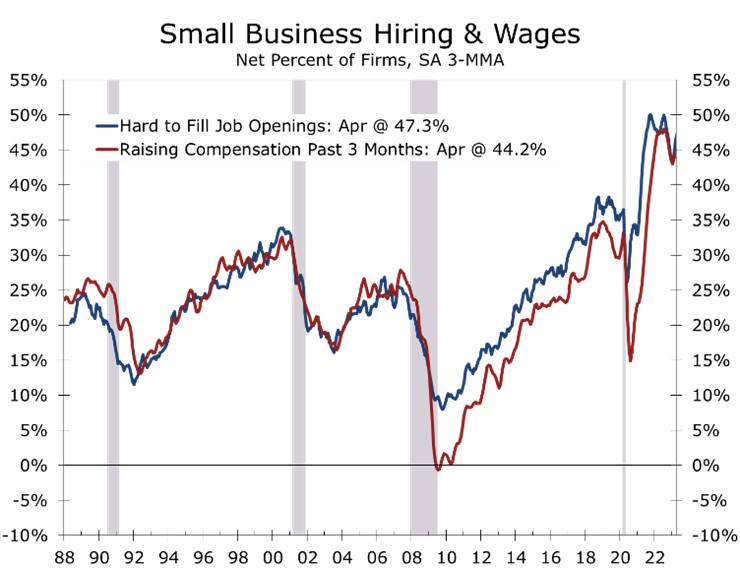
The high level of concern small business owners are voicing about labor quality comes at a time when the labor market is giving mixed signals. Layoff announcements have clearly risen, yet the unemployment rate has returned to its multi-decade low of 3.4%. The proportion of the prime working-age population that is currently employed or looking for work has also risen back above its pre-pandemic level, suggesting business owners are not likely to see any improvement in the quality of job applicants in coming months.
Heightened concerns about labor quality are a warning about corporate earnings more broadly.
Our read on small businesses heightened concerns about labor quality is that earnings are likely to come under stress more broadly throughout the economy. Remember, the NFIB survey was prescient in identifying the threat intensifying inflation posed to the broader economy at a time when the Fed was firmly holding onto its transitory line. Progress at reducing inflation will also likely lessen, as fewer firms are able to avoid passing on rising compensation costs. This is another data point suggesting the Fed may need to hike rates further and/or hold rates higher for longer.
Disclaimer: This publication has been prepared for informational purposes only and is not intended as a recommendation offer or solicitation with respect to the purchase or sale of any security or other financial product nor does it constitute investment advice.