
Higher Interest Rates Sideline Buyers and Sellers
- Existing home sales fell 3.3% in June to a 4.16 million-unit pace. Sales are down 18.9% from last June and have fallen on a year-to-year basis for the past 23 months.
- Inventories of existing homes remain exceptionally lean at just 1.08 million units, which translates into a 3.1-month supply.
- The median price of an existing home rose 3.6% NSA to $410,200 from May, the second highest price on record. The record high is $413,800, which was hit last June.
- Homes are selling quickly, with homes remaining on the market for just 18 days in June, which was the same as in May.
- Sales fell 5.4% in the South and 5.1% in the West but were unchanged in the Midwest and rose 2% in the Northeast.
- Existing home sales continue to be limited by exceptionally low inventories and reduced affordability. With supplies so tight, prices are being bid higher, which is pricing out first time buyers and also sending more would-be buyers into the new home market.
Existing home sales fell 3.3% in June to a 4.16-million-unit annual pace. Sales continue to be limited by exceptionally low inventories of homes for sale and diminished affordability. There were just 1.08 million existing homes for sale at the end of June, which was the same as the prior month, but 13.6% less than it was a year ago.
Lean inventories have led to intense competition among buyers, which has pulled prices higher. The median price of an existing home rose 3.6% in June on a non-seasonally adjusted basis, to $410,200, which is the second highest level on record. The highest was hit last June at $413,800. Home prices had generally fallen from the middle of last year until early this year. Prices have been rising since February and have nearly regained their previous highs.
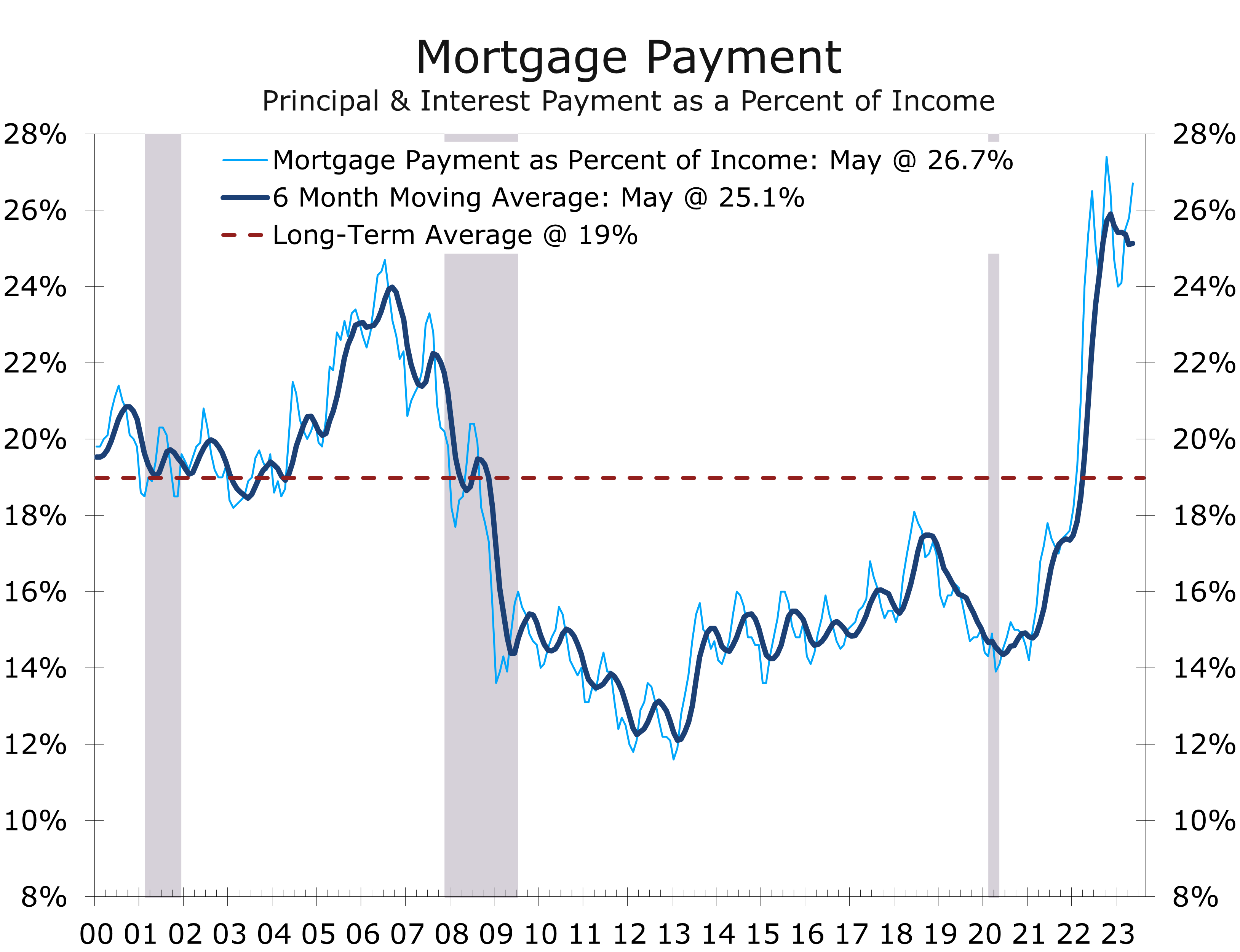
Higher prices combined with higher mortgage rates have further eroded housing affordability. The proportion of median household income needed to make principal and interest payments on a median priced home rose to 26.7% in May, which is the second highest share on record. That number is likely to rise even further, as mortgage rates rose further in June and have remained higher.
Existing home sales are being restrained lean inventories and reduced affordability.
Existing home sales have been under pressure for quite some time. After rebounding 13.8% off its recent low in February, existing home sales have fallen in 3 of the past 4 months and have fallen the past 23 months on a year-to-year basis.

Sales of single-family homes fell 3.4% in June to a 3.72 million-unit pace, while sales of condominiums and co-ops fell 2.2% to a 440,000-unit pace.
The inventory of existing single-family homes rose slightly in June to 960,000 homes, which equates to a 3.1-month supply at the current sales pace. Inventories have improved slight this year, after bottoming out at 850,000 homes in December. Even with the improvement, however, the number of homes available for sale is 13.5% below its year ago level.
The lack of homes available for sale is largely due to the sharp rise in mortgage rates over the past 18 months, climbing from 3.10% in December 2021 to nearly 7% today. Sixty percent of homeowners with a mortgage have a mortgage rate below 4% and 80% of first-lien mortgages carry a rate of 5% or less. Homeowners with mortgages at those low levels would be hard pressed to find a home where their principal and interest payments would not be significantly higher than they are today, so most homeowners are staying put.
Higher mortgage rates are encouraging many current homeowners to stay put.
Higher home prices are pushing many would-be buyers to the sidelines. First-time buyers accounted for just 27% of sales in June, down from 28% in May and 30% in June of last year.

Sales fell in the South (-5.4%) and West (5.1%), were unchanged in the Midwest and rose 2.0% in the Northeast. Sales are down sharply on a year-to-year basis in all four regions.
The South and Midwest both continue to benefit from an affordability migration from other parts of the country. The median home price in the South remains 10.6% below the national median and a whopping 40% lower than prices in the West. The price break is even greater for buyers migrating to the Midwest. The South is accounting for the bulk of state-to-state migration, however, with the bulk of new arrivals settling in Texas, Florida, the Carolinas, Georgia, and Tennessee.
The influx of home buyers into the South and Midwest is one reason why sales of homes priced above $750,000 are holding up better in those regions than they are elsewhere. Many of these buyers are paying cash for their purchases, as they had substantial equity in the homes they sold out West or in the Northeast.
We expect existing home sales to weaken further, as affordability worsens. In addition to high principal and interest payments, insurance costs have also risen substantially, particularly in Florida and along the coast in the South, where many new residents are settling.
Disclaimer: This publication has been prepared for informational purposes only and is not intended as a recommendation offer or solicitation with respect to the purchase or sale of any security or other financial product nor does it constitute investment advice.