
PIEDMONT CRESCENT CAPITAL
The Piedmont Perspective | November 23, 2026
The Right Problem, an Uneven Toolkit
China forced a break with the postwar playbook well before this administration arrived. The open question is whether the tools now in use serve a strategy or simply extend the reach of the state.
Greg Ip’s column in Saturday’s Wall Street Journal, “American State Capitalism Helped Produce the Nvidia Scandal,” is right that Washington has moved away from the arm’s-length model that governed U.S. commercial policy for most of the postwar era. Ip first applied the label “state capitalism with American characteristics” to this administration in August 2025, and the evidence has piled up since. In May, Air Force One stopped in Anchorage so that Nvidia’s Jensen Huang could board for the flight to Beijing, one of more than a dozen chief executives on the first presidential visit to China in nearly a decade. The delegation included the heads of Citi, Goldman Sachs, Qualcomm, Micron and GE Aerospace, and Mr. Trump told Xi Jinping they had come to “pay respects to you and to China.”
The arrangements that followed blur the line between public policy and a private negotiation. Nvidia won permission to sell advanced chips to China in exchange for a share of the proceeds going to the Treasury, and the company committed $25 million to the White House ballroom project. Washington had also taken direct stakes in roughly ten companies as of April, among them Intel, several producers of rare earths and other critical minerals, and a $1 billion convertible preferred investment in L3Harris’s missile propulsion business.
The roots of this shift run back more than a decade, and China is the reason. During the Cold War, containment and commerce could be handled separately. CoCom restricted sales of dual-use technology to the Soviet bloc, and the Soviet economy was too small and too closed to compete with the West in commercial markets. After 1991 the United States made a different bet, that trade and investment would pull China toward markets and the rule of law. Permanent normal trade relations in 2000 and WTO membership in December 2001 put that bet into practice. It paid off for consumers and for many exporters, but Autor, Dorn and Hanson estimate that import competition from China cost the United States between 2.0 million and 2.4 million jobs from 1999 to 2011. We argued in August that this first China shock, a surge of labor-intensive imports, has largely run its course.
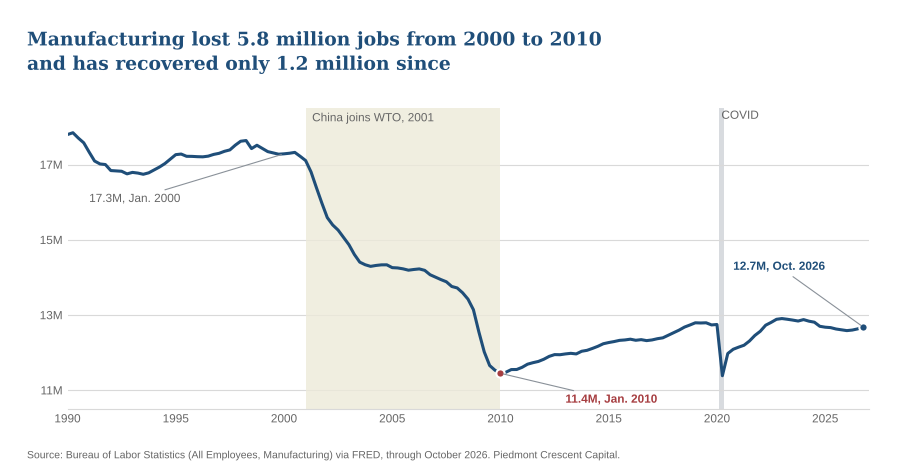
The second China shock is of a different kind, and it is still arriving. Chinese producers have moved up the value chain into vehicles, batteries, solar panels, ships and, increasingly, semiconductors, with heavy support from state credit. China’s trade surplus reached a record $1.19 trillion in 2025 even as shipments to the United States fell, because exporters redirected goods to other markets. Auto exports alone rose 21 percent to more than seven million vehicles, led by electric and plug-in hybrid models. That is a direct challenge to the industries where advanced economies expected to keep their lead, and it falls on our allies as well.
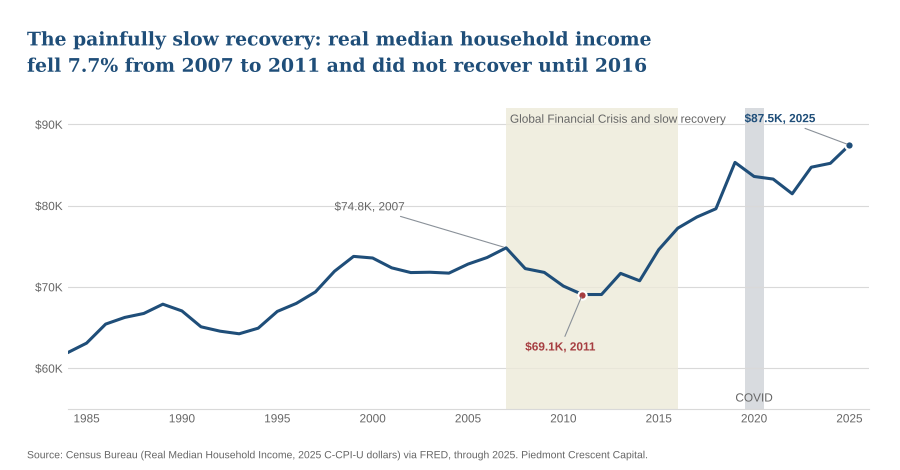
The Global Financial Crisis, and the painfully slow recovery from it, is where the old consensus lost its footing. Western governments rescued banks and automakers, which weakened the argument that markets should be left alone to sort winners from losers. China answered the crisis with a 4 trillion yuan stimulus in late 2008 and recovered quickly, which made its state-directed model look durable. Real median household income fell 7.7% from 2007 to 2011 and did not regain its 2007 level until 2016, and the doubts emanating from the crisis and that painfully slow recovery left voters looking for explanations. Imports from China made an easy one. The first policy responses were still built around coalitions and rules. The Obama administration pivoted toward Asia and negotiated the Trans-Pacific Partnership, and Beijing’s Made in China 2025 plan, published in 2015, put its technology ambitions in writing.
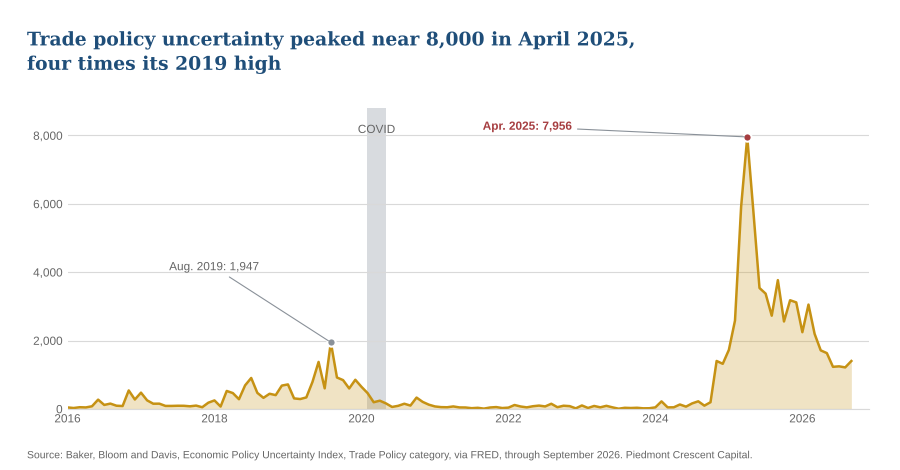
Populism turned a gradual drift into a change of policy. Brexit and Mr. Trump’s election in 2016 signaled that voters in the United States and Europe no longer accepted integration on the old terms, and governments have acted accordingly. Washington imposed Section 301 tariffs on Chinese goods in 2018. The Biden administration kept them, added export controls on advanced chips in October 2022 and passed the CHIPS and Science Act. The European Union put investment screening in place and in 2024 imposed duties on Chinese electric vehicles. When a policy survives a change of party in Washington and spreads to Brussels, the underlying facts have changed.
A market-oriented economist should accept that premise and be demanding about the instruments. Adam Smith, no friend of mercantilism, wrote in 1776 that defense is “of much more importance than opulence,” and he endorsed the Navigation Acts on that ground. Security carve-outs sit inside the free-market tradition, which leaves the burden of proof with the intervention. We would put four questions to any instrument. Does it address a specific chokepoint where the security cost is large? Is it written as a rule, preferably by Congress, and applied to every firm rather than negotiated one company at a time? Does it preserve competition and price signals among domestic firms? And is it coordinated with allies, who control much of the equipment and know-how that matter?
By those four questions, part of what has been done is defensible and part is not. Equity stakes in rare-earth magnet makers and in missile propulsion address chokepoints where China holds a commanding position, and the L3Harris investment is designed to convert to common equity when the unit goes public. Those are narrow and, in principle, temporary. Chip licenses sold for a share of the proceeds are weaker, because they turn a security judgment into a revenue question. Records that House Foreign Affairs Chairman Brian Mast released on November 19 show Commerce approved licenses for more than 879,000 Nvidia and AMD chips for Chinese buyers between December 2025 and May 2026, although none had shipped as of May 11. Delegations, ballroom donations and Oval Office involvement in mergers make access to the president a factor in competition, which rewards the best-connected firm and not necessarily the best one.
The Nvidia episode shows where the correction is coming from, and it is Congress. Mr. Huang resigned on November 12 after reports of an extramarital relationship that raised national-security concerns. Within days, House Speaker Mike Johnson and Senate Majority Leader John Thune signaled support for tighter chip export controls, and lawmakers of both parties are pressing to attach chip-export bills, three of which the Senate version of the defense authorization bill already carries, to the final bill, which Congress is expected to take up in December. That is not a done deal. The White House helped keep a similar chip-export provision out of the 2025 defense bill, and the final text is written in conference. A rule written into law and applied to every company sits much closer to the arm’s-length tradition than a license negotiated one firm at a time.
The data-center proposal rests on a real risk and answers it with a blunt instrument. On Friday the president said the United States would not allow companies to build data centers abroad and would impose a “tremendous tax” on those that do, arguing that China would otherwise take them all. The concern is legitimate. Data centers built overseas could quickly become dominated by China, and AI is both a dual-use technology and the principal driver of the capital-intensive expansion now carrying growth. The mechanism is the problem. A federal tax requires Congress, and the president did not say whether he would seek its approval. A blanket ban also treats a facility in an allied country, built to meet local data-residency rules and serve local customers, the same as one in a country that would hand Beijing access. Conditions on where American firms may build, who owns and can reach the facilities, and which chips go into them would address the risk without penalizing the buildout in allied markets. Commerce showed what that looks like on November 16, when it issued an interim rule requiring a license for any overseas data center that supplies large amounts of advanced computing to Chinese-headquartered firms, with a 90-day window for sites already serving them. That rule goes after the Chinese customer and leaves the allied host alone. The administration’s own AI Action Plan and a July 2025 executive order called for exporting the American AI technology stack to allies, and Commerce was still building out that program last week.
The binding constraints on AI construction are at home, and a tax on building abroad does nothing about them. Power, grid interconnection and local approval limit how quickly data centers can be built in the United States. NBC News reports that a majority of Americans oppose them, and The Wall Street Journal has reported that more than ten states have paused or canceled data-center tax exemptions. If the objective is to keep the buildout here, the better lever is to reduce the cost and shorten the time to build: faster interconnection, predictable permitting and more generation. The Senate moved in that direction on November 19, passing the bipartisan American Affordability and Jobs Act of 2026, a permitting and transmission overhaul, by a vote of 62 to 33. Penalizing firms that build elsewhere adds uncertainty to an investment cycle that has carried growth and is now being tested by tighter financial conditions, and it could invite other governments to answer in kind.
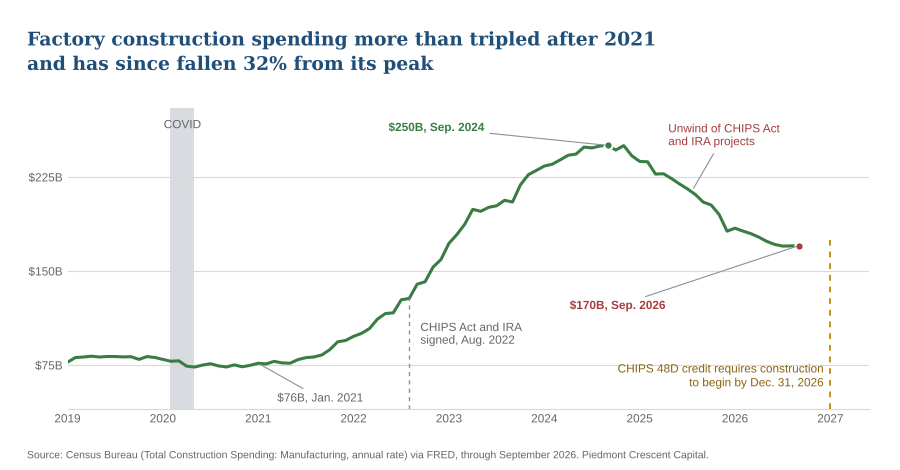
Subsidy deadlines are already steering factory investment, and a statute would steer it better. Factory construction spending more than tripled from January 2021 to a peak of $250 billion in September 2024. The CHIPS Act and the Inflation Reduction Act, both signed in August 2022, extended a cycle that had already begun, and spending has since fallen 32% as the first wave of those projects wound down. Dodge Construction Network reports that manufacturing starts jumped in October, led by a handful of very large projects, including a $16.8 billion Tesla semiconductor plant in Texas. Total starts rose 22.8%, but Dodge notes that excluding manufacturing they fell 1.1%. One reason may be Section 48D, which pays a 35 percent credit on qualified chip-plant investment but only for projects that begin construction by December 31, 2026. Our data cannot separate that deadline from other motives, and the administration’s push to reshore critical industries and materials points toward a rebound in spending. But a credit that expires on a fixed date rewards firms for breaking ground on time and leaves them guessing about what Congress does next. Starts timed to a deadline can fade once it passes. Firms deciding where to build a plant that will run for decades need rules that outlast the calendar.
A durable strategy would look more like a rulebook than a deal book. It would write controls on frontier chips and the tools that make them into statute and coordinate them with the Netherlands, Japan, South Korea and Taiwan. It would limit government equity to narrow supply-chain gaps, with a stated exit. It would rebuild the trading coalition that the Trans-Pacific Partnership represented, which Washington abandoned in January 2017, and it would spend political capital on energy, permitting and skilled labor at home. And it would keep the price discipline that made American firms worth protecting, which means no support without competition and no export license without a published rule.
We hold two views at once, and we think the evidence supports both. China is a competitor unlike any the United States faced in the Cold War or the unipolar decades that followed. The Soviet Union was an adversary but never a major trading partner, and Japan was a commercial rival under the American security umbrella. China is at once a rival, a supplier and a customer, and a strategy built for the old problems will fall short. The best response keeps the features that made the American economy hard to match: open competition, the rule of law and prices that carry information. State direction without China’s scale and control risks importing its costs without its benefits. The goal is to protect the few chokepoints that matter and leave the rest to markets.
Our call is that Congress, and not the executive branch, sets the next phase of policy. We will watch the defense authorization bill this December, and we expect it to carry statutory limits on exports of advanced chips to China. We will also watch whether the House takes up the permitting bill in the lame-duck session, because faster approvals do more to keep the buildout here than a tax on building abroad. We do not expect a federal tax on overseas data-center investment to become law in 2027.
Sources: Greg Ip, “American State Capitalism Helped Produce the Nvidia Scandal,” The Wall Street Journal, November 21, 2026; White House delegation list and pool reporting via Reuters, CBS News and the Washington Post; U.S. Department of Defense and L3Harris announcements of January 13, 2026; China General Administration of Customs via Reuters and the Associated Press; Autor, Dorn and Hanson, The China Shock (Annual Review of Economics, 2016); Adam Smith, The Wealth of Nations (1776); Reuters, CNBC, Semafor, Axios and NBC News on chip export controls and the November 20 remarks; House Foreign Affairs Committee license release of November 19, 2026; Commerce Bureau of Industry and Security interim final rule “Addressing Remote Access to Advanced Semiconductors,” November 16, 2026; Executive Order 14320 (July 28, 2025); Bloomberg, December 3, 2025; U.S. Census Bureau construction spending and Bureau of Labor Statistics, Census and Baker, Bloom and Davis data via FRED; Dodge Construction Network, October 2026 construction starts (November 20, 2026); Holland & Knight on Section 48D (October 5, 2026); Roll Call and CNBC on the Senate permitting vote of November 19, 2026.
© 2026 Piedmont Crescent Capital. All rights reserved.