
PIEDMONT CRESCENT CAPITAL
A View from the Piedmont | Our Weekly Commentary on Money, Credit, Exchange Rates & Geopolitics
The Selloff Reaches the Financing Channel
A Tech Rout, Tighter Financial Conditions and a Fed That Can Stop at a Quarter Point
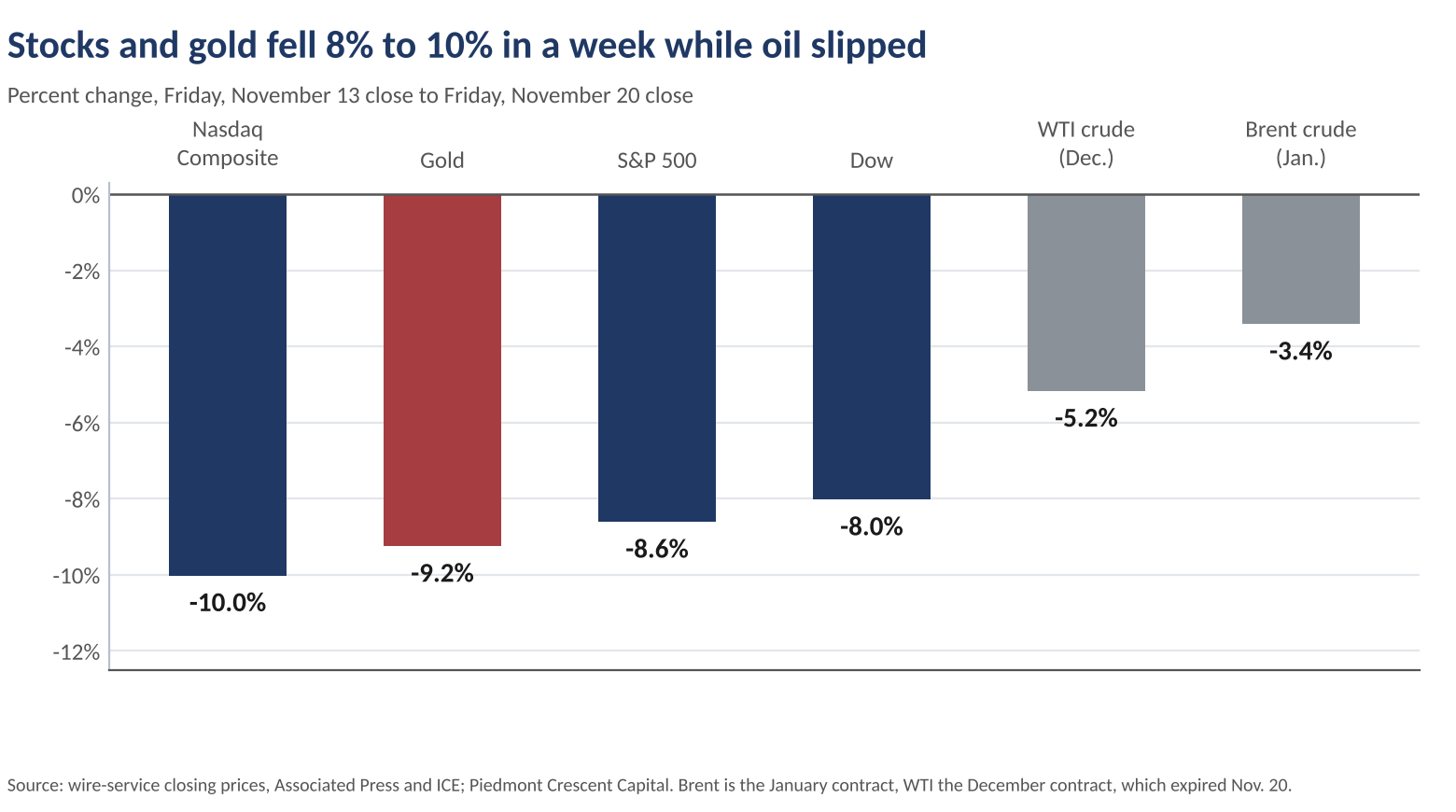
Stocks lost 8% to 10% in five sessions and financial conditions have tightened considerably, which we think limits the Fed to a quarter-point hike on December 9, while futures point to a sharp rebound on Monday.
This issue covers the major economic and geopolitical events of the past week and includes our updated forecast.
Market Dashboard
(as of Friday, November 20, unless noted)
| Rates, Credit & Data | Equities & Commodities | ||
|---|---|---|---|
| Fed funds target range | 3.75%-4.00% (held Oct. 28) | S&P 500 | 6,910.39 (-8.6% wk.); Dec. futures about +2% Sun. |
| 2-yr Treasury | 4.63% (Fri. wire); 4.76% Thu. H.15; -25 bp vs. 4.88% Nov. 13 | Dow Jones | 48,147.33 (-8.0% wk.); futures about +1.4% Sun. |
| 10-yr Treasury | 4.92% (Fri. wire); 5.04% Thu. H.15; -23 bp vs. 5.15% Nov. 13 | Nasdaq Composite | 22,617.73 (-10.0% wk.); Nasdaq-100 futures about +2.8% Sun. |
| 30-yr Treasury | 5.40% (Thu. H.15); 5.47% Nov. 13 | VIX | 35.89 (19.30 Nov. 13) |
| 2s-10s spread | about 29 bp (Fri. wire, our calculation); 28 bp Thu. H.15 | Nvidia | about -14% Fri.; record Q3 revenue $115.8B |
| Dec. 9 hike (futures) | a quarter-point hike; half-point odds 5.3% (Nov. 19) | Semiconductor ETF (SOXX) | about -11% Fri. |
| Retail sales (Oct.) | +0.2% m/m (from +0.8%); control group +0.6% | Anthropic (IPO) | $88.91 (-8.5% Fri.); $97.17 day-one close; priced $83 |
| Initial jobless claims | 203,000 (4-wk avg. 197,750); continuing 1.763 mil. | WTI crude (Dec.) | $83.98 (expired Fri.); -5.2% wk. |
| 30-yr mortgage (Freddie Mac) | 7.28% (Nov. 19; 7.11% prior week) | Brent crude (Jan.) | $92.57; $95.84 Nov. 13; third weekly decline |
| GDPNow (Q4) | 3.2% (Nov. 18); 3.4% Nov. 17 | Gold | $3,525 (-9.2% wk.) |
Note: Friday Treasury yields, equity closes, crude and gold are wire quotes and closes from press reports, not official Federal Reserve data. Thursday yields are the Federal Reserve’s H.15 series via FRED. Weekly changes compare Friday, November 20 with Friday, November 13; yield changes use the H.15 close on November 13. Futures are December contracts as of about 7 p.m. Eastern on Sunday, November 22, per CNBC, and will have moved.
Summary
Wall Street lost 8% to 10% in five sessions, and Treasuries were the only haven that worked. The S&P 500 fell 8.6% to 6,910.39, its largest weekly decline since April 2025, after a seventh straight daily loss. The Nasdaq Composite dropped 10.0% to 22,617.73, which erased its 2026 gain. The Dow Jones Industrial Average fell 8.0% into a correction, and the Nasdaq and the Dow each had their worst week in more than six years. The VIX closed at 35.89, up from 19.30 a week earlier. Chipmakers took the worst of it. Nvidia fell about 14% on Friday and the main semiconductor exchange-traded fund about 11%, even after Nvidia reported record revenue of $115.8 billion on Tuesday and guided to $130 billion for the fourth quarter. Anthropic’s record initial public offering priced at $83 a share to raise $81.3 billion, a total that reached $93.5 billion when the underwriters exercised their option. The shares opened at $111.50, closed their first day at $97.17, up 17%, and fell 8.5% to $88.91 on Friday, which left them 7% above the offer price. Gold fell 9.2% to $3,525 an ounce, and the 10-year Treasury yield fell 23 basis points on the week to about 4.92%. Futures point to a sharp rebound on Monday. When trading resumed Sunday evening, December S&P 500 futures were up about 2% near 7,070, Nasdaq-100 futures were up about 2.8% and Dow futures about 1.4%.
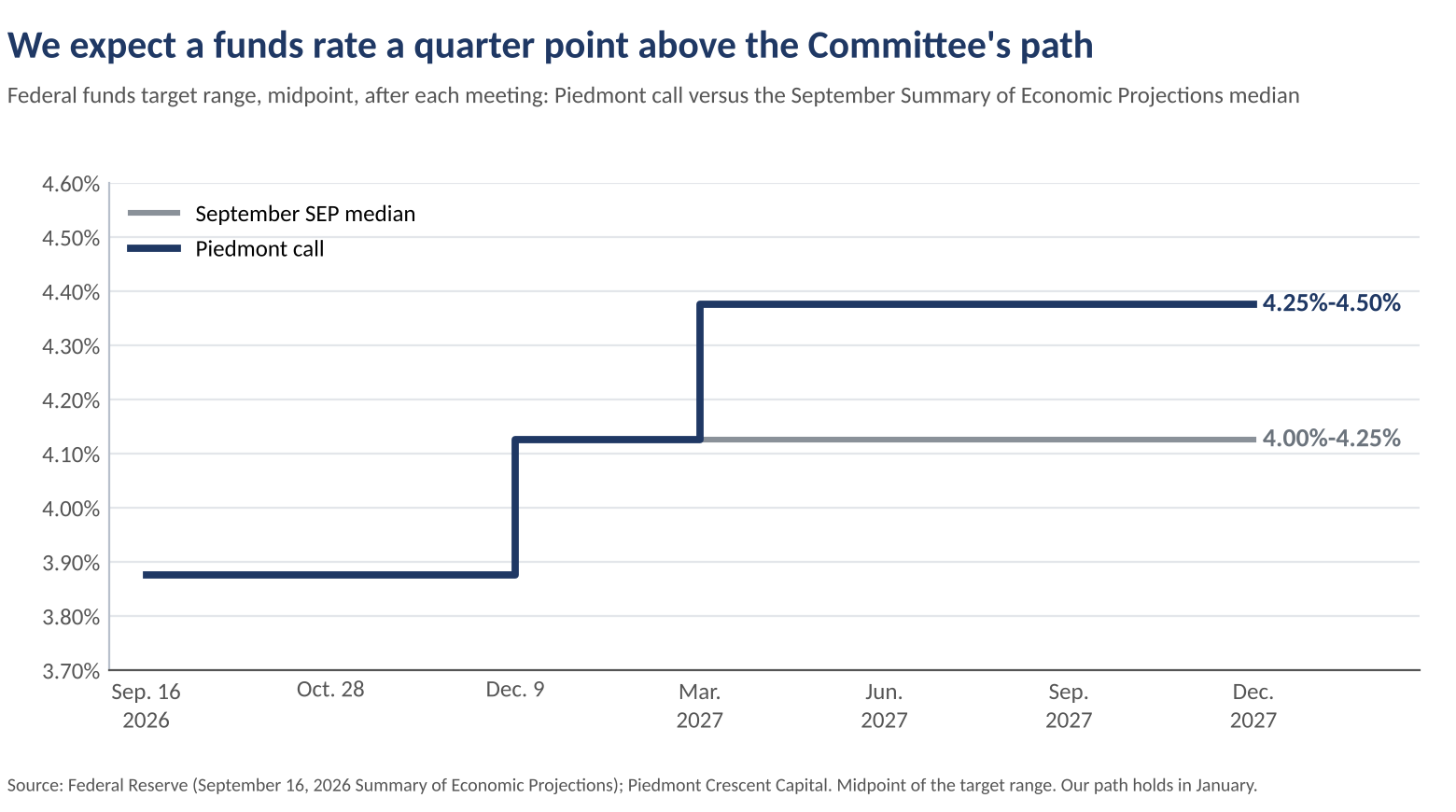
The economic data still describe a solid, capital-led expansion, and the Fed remains on a hiking path that financial conditions have just made shorter. The Atlanta Fed’s GDPNow estimate of fourth-quarter growth is 3.2%, against our forecast of 3.0%. October retail sales rose just 0.2%, but the control group that feeds GDP gained 0.6% after a 0.5% increase in September. Initial jobless claims were 203,000, and continuing claims jumped 70,000 to 1.763 million, the largest increase since January 2024. The minutes of the October 27-28 meeting show nearly all participants judging further increases likely to be appropriate, and Governor Waller favors a half-point move unless the Committee signals another hike in January, and he sees several more increases than most economists forecast. Financial conditions have tightened considerably, with equities in a correction, the VIX near 36 and the 10-year about 95 basis points above its February low, and because an economy built on capital spending is highly susceptible to tightening financial conditions, we think that limits the Committee to a quarter-point hike at each of its next meetings. Our call is unchanged: a quarter-point hike on December 9 to 4.00%-4.25%, a hold in January and another quarter point in March to 4.25%-4.50%, with the 10-year at 5.10% at the end of 2026 and 4.80% at the end of 2027. We also trimmed our 2027 growth and housing forecasts slightly.
Policy and geopolitical news added to the volatility without changing the macro picture. APEC leaders in Shenzhen adopted the Shenzhen Outlook and a voluntary trade digitalization framework, and the U.S.-China trade truce still expires on January 10, 2027. Brent crude settled at $92.57 a barrel for January delivery, its third straight weekly decline, as the International Energy Agency projected a fourth-quarter surplus. Ukraine struck the Kerch Bridge and Russian missiles hit two of Kyiv’s main bridges. A string of outages at Microsoft, the FAA, JPMorgan, Apple and the NSA drew cyberattack fears, and officials found no sign of an attack. In this week’s Piedmont Perspective, abridged below, we ask how the president’s threat to tax or ban overseas data centers fits the broader shift toward state capitalism in U.S. policy.
The Week’s Key Insight
The selloff reached the financing channel before it reached the spending channel
The usual reading of a 10% equity drop focuses on household wealth, and that reading misses where this expansion is most exposed. Consumers are still spending. October’s control group rose 0.6% for the month and 5.6% from a year earlier, the largest 12-month gain since October 2022, and initial jobless claims sit near the bottom of a range that has held since 2021. The exposure is in business investment, which has carried an economy that adds capital faster than it adds workers. We have described this economy all year as more protein and less carbs, and protein has to be financed. A selloff that makes capital harder to raise reaches the buildout directly and well before retail sales or payrolls (Exhibit 1).
Anthropic’s prospectus shows how tightly the financing is woven together. The company disclosed roughly $900 billion in computing commitments extending through 2045, and an operating profit of $974 million in the second quarter became an operating loss of $567 million in the third. It raised $26 billion in a private placement alongside the IPO, and the buyers named in the filing include Nvidia, Google, AMD, Broadcom, Micron, Microsoft and TSMC, the firms that supply its chips, memory and cloud capacity. Several of those suppliers, including Nvidia and AMD, fell on the day Anthropic closed up 17%, and Hunterbrook Capital’s short position in AMD, which argues that circular deals now inflate the sector, arrived the same day. When the buyers of a company’s shares are also its suppliers, the share price is also a purchase order. A falling supplier stock weakens the customer’s ability to place the next order.
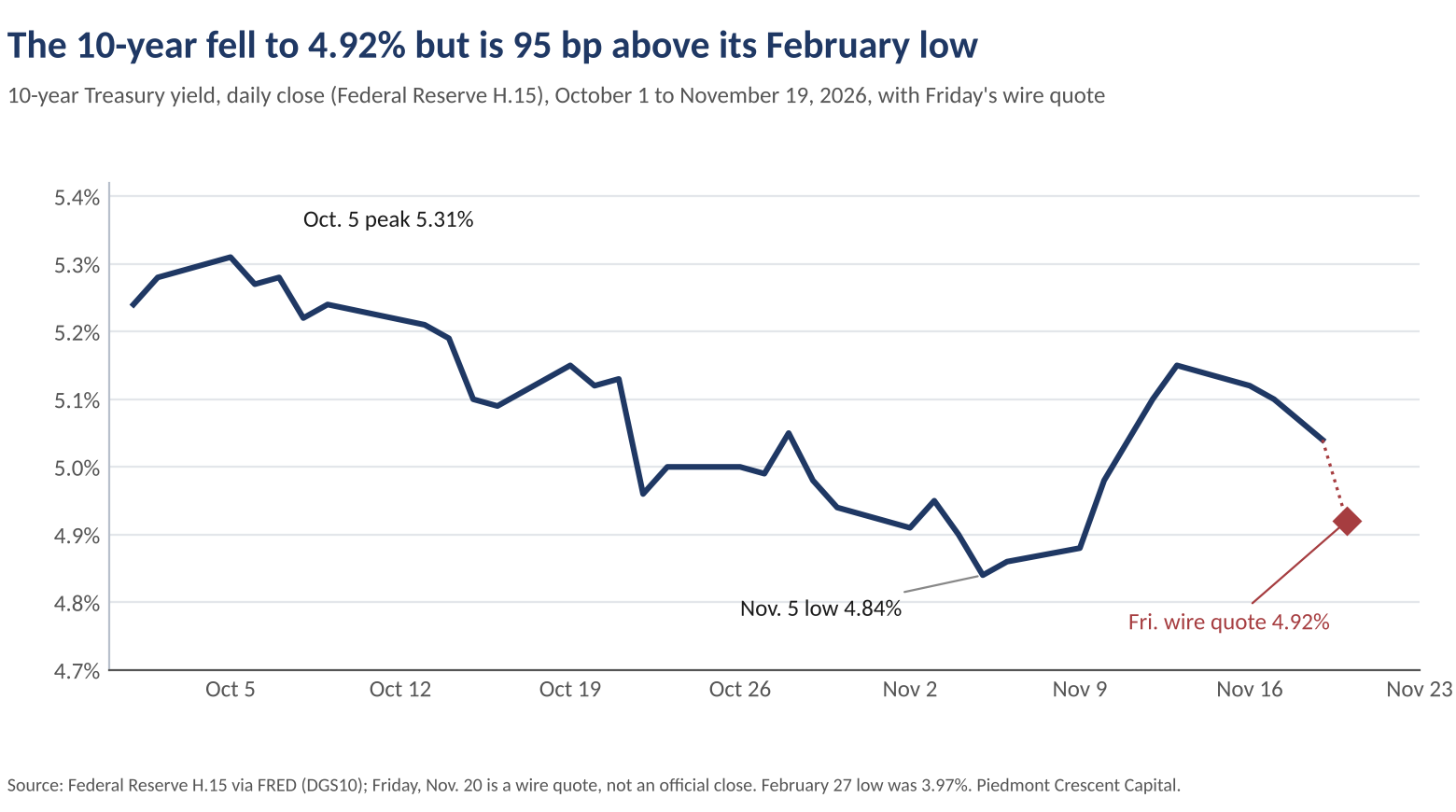
The cost of capital is rising while the equity window narrows. The 10-year yield reached 5.31% on October 5 and, even after Friday’s rally to about 4.92%, it remains 95 basis points above its February 27 low of 3.97% (Exhibit 2). We expect the funds rate to rise from 3.75%-4.00% to 4.25%-4.50% by March. CoreWeave and Nebius fell 5.0% and 7.8% on Thursday, OpenAI has postponed its own offering until next year, and Bloomberg’s reading is that investors will still back the likely winner but are getting pickier about debt-heavy builders. Investors are responding sensibly to the price of money, and the response points to slower data-center starts in 2027 even if demand for computing holds up.
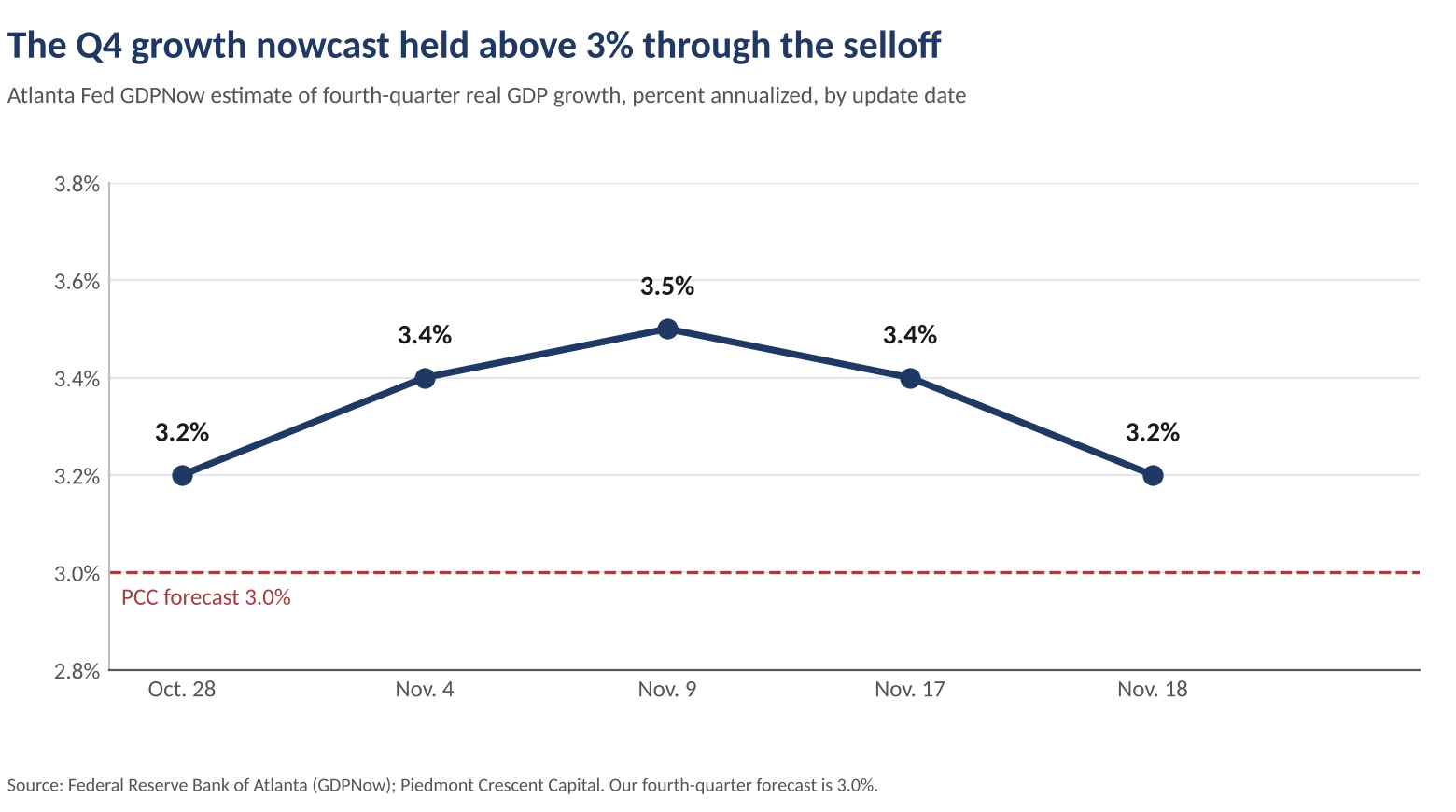
The spending channel remains intact, and we do not read this as the start of a recession. The Atlanta Fed’s nowcast for fourth-quarter growth has not fallen below 3.2% since its first estimate on October 28, against our forecast of 3.0% (Exhibit 3), and the control group rose 0.6% in October after a 0.5% gain in September. Households are paying higher prices and still buying. We will track the sequence from financing conditions to equipment and construction orders and only then to payrolls. The first link has already moved, and we expect the second to show up in hyperscaler orders and manufacturing starts in the first half of 2027, which is why we pay attention to the permitting and power questions in this week’s Perspective.
The risk to this view is a financing squeeze that spreads beyond the AI complex. Wider high-yield spreads that turn into failed issues, or a second week of declines of this size in equities, would move us toward a pause and would weaken the case for a March hike.
THE FED, FINANCIAL CONDITIONS AND THE QUARTER-POINT LIMIT
Tighter financial conditions have done part of the Fed’s work, which caps the next move at a quarter point
The minutes hardened the case for December, and the Committee’s center is now two more hikes. The Committee held at 3.75%-4.00% on October 28 by a 10-2 vote, with Governor Cook and Cleveland Fed President Hammack dissenting in favor of a hike. Nearly all participants judged further increases likely to be appropriate, and a vast majority worried that inflation could persist even as the effects of tariffs and the AI buildout fade. Waller favors a half-point move, or a quarter-point with a clear signal of another in January, and has warned that three hikes and perhaps more may be needed, Williams answered that the situation does not call for dramatic action, and Musalem and Daly lean toward further hikes. CME FedWatch put the odds of a half-point move on December 9 at 5.3% after the minutes.
Financial conditions have tightened considerably, and that limits the next move to a quarter point. The S&P 500 is down 8.6% on the week and in a correction, the VIX closed at 35.89, the 10-year yield is about 95 basis points above its February low, mortgage rates remain above 7% and the window for equity-linked issuers has narrowed, with OpenAI postponing its offering. Each of those does part of what a larger hike would do, and an economy built on capital spending is highly susceptible to tightening financial conditions. A Committee that has watched its tightening arrive through markets has less reason to add a half-point on top. A 50 basis-point move would need clear evidence that inflation is accelerating, and Waller would need more of the Committee than the minutes show.
Core inflation near a 3.75% annual rate keeps the hawkish case alive. Core CPI has run at a 3.75% three-month annualized rate through October and the Cleveland Fed’s 16% trimmed mean at 3.57%. Our Hodrick-Prescott trend, which never revises, was 2.65% in October, 47 basis points below its level a year ago but higher every month since a July low of 2.51%. Waller reports that businesses believe customers will accept price increases of about 3%. Lack of real income growth drove the midterm results, and we expect Congress to press the Fed for tangible progress on prices as the 2028 election approaches.
Our path parts company with the Committee’s median by a single quarter point. The September Summary of Economic Projections showed a median of one more hike in 2026 and no change in 2027 (Exhibit 4). We expect a second hike in March that takes the range to 4.25%-4.50%, with a third possible if inflation does not ease, and we hold in January. What would change our mind: core CPI of 0.4% or higher on December 10 would put a larger move back on the table, and a further fall in equities with wider credit spreads would move us toward a pause.
Our Seven Themes: This Week’s Scorecard
Our seven themes are the investments and demographic shifts that are largely responsible for producing the economy’s above-average growth. The scorecard below checks each against this week’s news.
| Theme | This week’s evidence | Exposure and our read |
|---|---|---|
| The AI Buildout | Nvidia reported record revenue of $115.8B on Nov. 17 and guided to $130B, then fell about 14% Friday. Anthropic raised $93.5B at $83 a share and closed Friday at $88.91; OpenAI postponed its offering. | Financing risk rose. The demand evidence did not weaken, and supplier-customer ties now link the share prices. |
| Electric Grid Upgrade | The Senate passed a permitting bill 62-33 on Nov. 19, and the House is next. The president threatened a ban or tax on overseas data centers Nov. 20. | Power and permitting at home are the binding constraints on AI construction. |
| Defense Replenishment | Russian missiles hit two Kyiv bridges Nov. 17 and Ukraine struck the Kerch Bridge. The Iran war began in February and no deal is in place. | Munitions orders continue; the December defense authorization bill is the next vehicle. |
| Aerospace and Next Generation Defense | The FAA’s Nov. 13 ground stop, which lasted more than four hours, was traced to a router upgrade; no cyberattack was found. | The failure adds to the case for air traffic control modernization. |
| Reshoring of Critical Industries and Materials | Dodge reports a jump in October manufacturing starts on a few very large projects. Section 48D requires construction to begin by Dec. 31. | The deadline pulls groundbreakings forward; the U.S.-China truce expires Jan. 10. |
| Pharmaceutical and Medtech Buildout | No new announcements this week. Lilly’s $3.5B Pennsylvania plant (groundbreaking Nov. 12) remains the marker. | Tariff exemptions tied to U.S. plants continue to drive siting. |
| Peak 65 (Senior Housing, Condos, and Longevity & Functional Health) | The 30-year mortgage rate rose to 7.28% from 7.11%, against 6.26% a year ago. | Financing costs are the constraint on senior housing and condo construction. |
Source: Piedmont Crescent Capital, Freddie Mac, Senate and Dodge Construction Network reports, wire reports.
The AI buildout and the grid are now a federal story as well as a state one, and the Senate’s 62-33 vote on a permitting overhaul moved the issue to the House for the lame-duck session.
Behind the Numbers
Retail sales slowed in October, but the detail was stronger than the headline. Total sales rose 0.2% to $748.2 billion after a 0.8% gain in September, and sharply lower auto sales held down the total. Excluding autos and gasoline, sales rose about 0.5%, and the control group gained 0.6%. The 12-month increase of 6.8% in total sales is the largest since October 2022, and higher gasoline prices contribute to it. Industrial production slipped 0.4%. Taken together, the report describes consumers who keep spending on goods while factory output cools, which fits an expansion led by investment, with little help from hiring.
Continuing claims, not initial claims, carry the labor-market signal. Initial claims rose just 1,000 to 203,000, the highest since September 5 and still near the bottom of a narrow range that has held since 2021. Continuing claims climbed to 1.763 million, the highest since the end of August, and Michigan drove most of the increase. The four-week average of initial claims is 197,750 and the insured unemployment rate holds at 1.1%. Employers are not laying off workers, and unemployed workers are taking longer to find jobs. The holiday week distorts the weekly figure, and we will rely on the four-week average through December 4, when the November employment report arrives.
Mortgage rates have not yet caught up with Friday’s rally. Freddie Mac’s survey put the 30-year fixed rate at 7.28% as of November 19, up from 7.11% a week earlier and from 6.26% a year ago. The survey reflects loan applications from before Friday’s flight to quality, and we expect some relief in the next reading. The mortgage rate sits roughly 236 basis points above Friday’s 10-year yield, which leaves room for improvement if volatility settles, but a 10-year yield near 5% keeps the floor for mortgage rates near 7%.
Nvidia reported record results and fell anyway. Revenue of $115.8 billion rose 103% from a year earlier against a consensus of about $109 billion, and the company guided to $130 billion, plus or minus 3%, for the fourth quarter without assuming any data center compute revenue from China. The shares still fell about 14% on Friday and 23% on the week, their worst week since 2008. Reports on November 17 that the SEC opened a civil probe of Nvidia’s disclosures after Huang’s November 12 resignation added to the pressure, and we address what Huang’s exit means for policy in this week’s Perspective.
APEC produced a framework for cooperation and no breakthrough on tariffs. Leaders of the 21 economies adopted the Shenzhen Outlook and a Trade Digitalization Cooperation Framework for 2027-2030, a voluntary agreement to ease cross-border trade procedures and not a free-trade pact. The U.S.-China truce, extended in the autumn, expires on January 10, 2027, and disagreements over rare earths, agricultural purchases and aircraft orders remain. We view January 10 as the next hard date for tariff risk, and it falls ten days after the December 31 deadline for Section 48D construction starts discussed in this week’s Perspective.
Oil is falling for the right reasons, and the geopolitical risk premium remains large. Brent for January delivery settled at $92.57 on Friday, down from $95.84 a week earlier and its third straight weekly decline, while WTI for December delivery expired at $83.98. The International Energy Agency expects the market to return to surplus in the fourth quarter as flows through the Strait of Hormuz recover. The Iran war began in February, the memorandum of understanding that paused it has lapsed, and the president said on Thursday that the United States does not need a deal. In Ukraine, Russian ballistic missiles struck two of Kyiv’s main bridges on November 17, and Ukraine answered with a drone and missile attack on the Kerch Bridge that its president described as unprecedented.
The outages were technical failures, and they carry an economic lesson. Microsoft 365 and Outlook went down on November 12 after a network capacity upgrade left more than 80% of gateway servers unresponsive. A router upgrade triggered the FAA’s nationwide ground stop on November 13, which lasted more than four hours and led to roughly 12,000 flight cancellations. JPMorgan Chase’s online banking faltered on November 16, and the NSA’s internal network and Apple’s services failed on November 17. Transportation Secretary Duffy and Homeland Security Secretary Mullin found no sign of a cyberattack.
Bottom Line
We continue to expect the Fed to raise the funds rate a quarter point to 4.00%-4.25% on December 9, hold in January and raise it again in March to 4.25%-4.50%. We expect the 10-year at 5.10% at the end of 2026 and 4.80% at the end of 2027, and with the yield at about 4.92% on Friday, the first of those numbers is 18 basis points away. Growth is running near 3%, consumers are spending and the labor market is loosening slowly. Inflation near 3.75% on a three-month basis keeps the Fed hiking, and tighter financial conditions keep each move to a quarter point. An economy built on capital spending is highly susceptible to tightening financial conditions.
Our call hinges on what happens when the Fed makes its next move: we expect a 25 basis-point increase on December 9, with the 10-year Treasury yield closing that day between 4.84% and 5.31%. A hold, a 50 basis-point increase or a close outside that band would tell us that the equity correction has altered the policy path or the bond market’s view by more than we expect. We will check the result on December 9, the day before the November CPI report.
Our tripwires hold. A close above the October 5 peak of 5.31% before December 9 would tell us the market is pricing a larger hike, a rise in term premium or both, and we would revisit our 50 basis-point odds and our year-end forecast. A close below 4.84%, the November 5 low, would revive the growth-scare reading and put our December hike at even odds. Friday’s wire quote of 4.92% sits just 8 basis points above the lower tripwire.
Last Week’s Calls, Checked
- A December 9 hike of a quarter point.Confirmed so far. Futures put the odds of a half-point move at 5.3% after the minutes, and a quarter-point hike remains the base case.
- The 10-year tripwires at 5.31% and 4.84%.Not triggered. H.15 closes ran from 5.04% to 5.12% through Thursday and the Friday wire quote was 4.92%.
- Nvidia reports third-quarter revenue of at least $105.8 billion and guides the fourth quarter above the third.Confirmed. Revenue was $115.8 billion and the fourth-quarter guide is $130 billion, plus or minus 3%.
- No new advanced-chip sales to China before the truce expires on January 10.Intact so far. Nvidia’s guidance assumes no China data center compute revenue.
- APEC restates the truce with no change in chip policy.Confirmed so far. The leaders adopted the Shenzhen Outlook and a voluntary trade digitalization framework, and the truce still expires January 10.
CFO and Treasurers Corner
- Take the second tranche of fixed-rate funding after December 9. Last week we suggested locking a third of 2027 maturities. The 10-year closed the week about 23 basis points below the prior Friday, but our forecast has it at 4.80% at the end of 2027. A 4% 10-year is not in our forecast, and waiting for it is a bet against our call. We would take the second third after the Fed meets and the last third after the March meeting.
- Budget the policy rate at 4.25%-4.50% from the second quarter of 2027. Each quarter-point increase adds $1.25 million a year in interest on $500 million of floating-rate debt. The December and March moves we expect add $2.5 million at that scale. We would treat June as an upside risk and not as the base case in the 2027 budget.
- Price bond deals before December 8 and avoid December 9 and 10. The FOMC decision comes on December 9 and the November CPI follows on December 10. Liquidity thins around Thanksgiving, and the bond market closes early on Friday, November 27. Equity-linked and speculative-grade issuers face a narrower window, with OpenAI deferring its offering and neocloud borrowers meeting pickier lenders. Investment-grade treasurers should treat the next two weeks as the open window.
- Keep part of your cash in bills out to 12 months. The bill curve already discounts roughly the hikes we expect. A ladder gives up little if we are right and protects the yield if the Committee stops sooner because financial conditions tighten further.
- Set 2027 price increases near 3% and expect them to stick. Waller reports that businesses believe customers will accept increases of about 3%, core inflation is running near 3.75% annualized and claims show no wave of layoffs to restrain wage demands. Labor-cost budgets should assume pay growth near the pace of inflation. The rise in continuing claims suggests recruiting will get a little easier even if layoffs stay low.
- Ask your utility where your interconnection and delivered power contracts stand before year-end. Power is the binding constraint on AI construction, and the Senate’s 62-33 vote on November 19 for a permitting overhaul moved the issue to the House. Large energy users may find utilities seeking multiyear commitments from customers with big loads, and a treasurer who locks in delivered power terms ahead of that wave moves a cost risk out of the 2027 budget.
Piedmont Perspective
The Right Problem, an Uneven Toolkit
An abridged version of this week’s standalone Perspective
Washington has moved away from the arm’s-length model that governed U.S. commercial policy for most of the postwar era. In May, Air Force One stopped in Anchorage so that Nvidia’s Jensen Huang could board the flight to Beijing, one of more than a dozen chief executives on the first presidential visit to China in nearly a decade. Nvidia later won permission to sell advanced chips to China in exchange for a share of the proceeds going to the Treasury, and as of April Washington held direct stakes in roughly ten companies, among them Intel, several producers of rare earths and other critical minerals, and L3Harris’s missile propulsion business.
The roots of this shift run back more than a decade, and China is the reason. The United States bet after 1991 that trade and investment would pull China toward markets and the rule of law, and permanent normal trade relations in 2000 and WTO membership in 2001 put that bet into practice. It paid off for consumers, but manufacturing employment fell by 5.8 million from 2000 to 2010 and has recovered only 1.2 million since. The second China shock is of a different kind. Chinese producers have moved up the value chain into vehicles, batteries, ships and semiconductors with heavy state support, and China’s trade surplus reached a record $1.19 trillion in 2025.
The Global Financial Crisis, and the painfully slow recovery from it, is where the old consensus lost its footing. Real median household income fell 7.7% from 2007 to 2011 and did not regain its 2007 level until 2016, and the doubts emanating from the crisis and that slow recovery left voters looking for explanations. Imports from China made an easy one. Brexit and Mr. Trump’s election in 2016 turned a gradual drift into a change of policy. Washington imposed Section 301 tariffs in 2018, and the Biden administration kept them, added chip export controls in 2022 and passed the CHIPS and Science Act. When a policy survives a change of party and spreads to Brussels, the underlying facts have changed.
A market-oriented economist should accept that premise and be demanding about the instruments. Adam Smith, no friend of mercantilism, wrote that defense is “of much more importance than opulence,” which leaves the burden of proof with the intervention. We would put four questions to any instrument. Does it address a specific chokepoint where the security cost is large? Is it written as a rule, preferably by Congress, and applied to all firms and not negotiated company by company? Does it preserve competition among domestic firms? And is it coordinated with allies? Equity stakes in rare-earth and missile-propulsion suppliers pass in part. Chip licenses sold for a share of the proceeds do not, because they turn a security judgment into a revenue question.
The data-center proposal rests on a real risk and answers it with a blunt instrument. On November 20 the president threatened a ban or a “tremendous tax” on U.S. data centers built abroad. The concern is legitimate, because those facilities could quickly become dominated by China. But a tax requires Congress, and a blanket ban treats an allied-country facility the same as one that would hand Beijing access. Conditions on where firms build, who owns and can reach the facilities, and which chips go in them would address the risk. The binding constraints on AI construction are at home, in power, interconnection and permitting, and the permitting overhaul the Senate passed 62 to 33 on November 19 addresses them directly.
Subsidy deadlines are already steering factory investment, and a statute would steer it better. Factory construction spending more than tripled to a $250 billion peak in September 2024 and has since fallen 32%. Dodge Construction Network reports that manufacturing starts jumped in October on a handful of very large projects, and one reason may be Section 48D, which pays a 35% credit on chip-plant investment only for projects that begin construction by December 31, 2026. Firms building plants meant to run for decades need rules that outlast the calendar.
Our call is that Congress, and not the executive branch, sets the next phase of policy. We will watch the defense authorization bill this December, and we expect it to carry statutory limits on exports of advanced chips to China. We will also watch whether the House takes up the permitting bill in the lame-duck session. We do not expect a federal tax on overseas data-center investment to become law in 2027.
The Week Ahead
Monday, November 23: Equity futures opened Sunday evening sharply higher, with December S&P 500 futures up about 2%. What would move us: a rebound that fades by midday would tell us financial conditions are still tightening.
Wednesday, November 25: The second estimate of third-quarter GDP, October personal income and the PCE price index, and weekly jobless claims all arrive ahead of the holiday. What would move us: a core PCE rise of 0.3%, as we expect, would keep the December hike on track, and 0.4% or higher would raise the odds of a larger move. Markets close Thursday for Thanksgiving and shorten Friday’s session, and thin liquidity can exaggerate moves.
Sunday, November 29: Our special View for the week after Thanksgiving looks at ten things to watch in 2027.
Friday, December 4: The October JOLTS report on Tuesday, December 1 shows whether openings are easing as continuing claims rise, and the November Employment Situation report arrives. We will focus on the three-month average of payrolls against breakeven growth of zero to 50,000 a month. What would move us: payrolls well above 100,000 with a falling unemployment rate would test our view that financial conditions hold the Fed to a quarter point, and an unemployment rate of 4.4% or higher would move us toward a pause.
Wednesday, December 9: The FOMC announces its decision and releases a new Summary of Economic Projections. We expect a quarter-point hike to 4.00%-4.25% and a median path that moves closer to ours for 2027. What would move us: a half-point increase or a hold would change our call on the pace of tightening.
Thursday, December 10: The November CPI report arrives. The three-month annualized core rate will shape the March decision.
Friday, December 11: The federal funding deadline arrives. It is the first test of the lame-duck session.
Thursday, December 31: Section 48D requires construction to begin by this date to qualify for the 35% credit on chip-plant investment. The deadline may bring a burst of groundbreakings and announcements. The U.S.-China trade truce expires on Sunday, January 10, 2027, and tariff risk returns to the forecast if the extension lapses.
U.S. Economic and Financial Outlook
We trimmed our 2027 forecasts slightly on weaker forward-looking housing data, tighter financial conditions, a tougher regulatory environment and the recent selloff. Growth over the four quarters of 2027 is now 2.3%, down from 2.7%, and housing starts average 1.18 million from 1.37 million. The Fed path holds at 4.00%-4.25% in the fourth quarter and 4.25%-4.50% from the first quarter of 2027, and our fourth-quarter GDP forecast of 3.0% sits just below the Atlanta Fed’s 3.2% nowcast. The 30-year mortgage rate of 7.28% is above our fourth-quarter forecast of 7.20%.
U.S. Economic & Financial Outlook. Piedmont Crescent Capital, November 22, 2026. Q3-26 GDP is the BEA advance estimate. Forecast values are shaded.
| Indicator | Units | 2024 | 2025 | 2026F | 2027F | Q1-26 | Q2-26 | Q3-26 | Q4-26F | Q1-27F | Q2-27F | Q3-27F | Q4-27F |
|---|---|---|---|---|---|---|---|---|---|---|---|---|---|
| Output | |||||||||||||
| Real GDP | % q/q SAAR | 3.0 | 2.3 | 2.4 | 2.5 | 2.5 | 2.2 | 3.4 | 3.0 | 2.1 | 2.3 | 2.5 | 2.3 |
| 4th Qtr-to-4th Qtr Change, Yr/Yr Chg for Qtly Data | % YoY | 2.6 | 2.0 | 2.8 | 2.3 | 2.6 | 2.2 | 2.1 | 2.8 | 2.7 | 2.7 | 2.5 | 2.3 |
| Final Sales to Private Domestic Purchasers | % q/q SAAR | 3.1 | 2.8 | 3.2 | 3.5 | 1.8 | 4.6 | 4.9 | 3.4 | 2.8 | 3.2 | 3.3 | 3.2 |
| Consumer Spending | % q/q SAAR | 2.9 | 2.6 | 2.5 | 2.6 | 0.7 | 3.8 | 3.8 | 2.6 | 2.0 | 2.5 | 2.6 | 2.4 |
| Nonresidential Fixed Investment | % q/q SAAR | 3.9 | 5.4 | 7.7 | 8.7 | 9.9 | 9.0 | 12.7 | 9.2 | 8.3 | 7.6 | 7.2 | 6.8 |
| Residential Investment | % q/q SAAR | 3.2 | -2.7 | -3.9 | -5.9 | -7.6 | 2.8 | -3.3 | -9.5 | -9.0 | -6.0 | -3.0 | -1.0 |
| Industrial Production, Manufacturing | % YoY | -0.9 | 1.0 | 1.7 | 2.8 | 1.0 | 1.7 | 1.3 | 3.0 | 3.1 | 2.4 | 2.7 | 2.8 |
| Light Vehicle Sales | Mil. units, SAAR | 15.9 | 16.3 | 16.0 | 16.3 | 15.5 | 16.5 | 16.2 | 15.9 | 16.1 | 16.2 | 16.4 | 16.4 |
| Labor Market | |||||||||||||
| Unemployment Rate | % | 4.0 | 4.3 | 4.2 | 4.0 | 4.3 | 4.3 | 4.1 | 4.1 | 4.1 | 4.0 | 4.0 | 3.9 |
| Nonfarm Payrolls | Avg. mo. chg, thous. | 150 | 62 | 79 | 86 | 73 | 81 | 79 | 85 | 80 | 85 | 90 | 90 |
| Employment Cost Index | % YoY | 3.9 | 3.5 | 3.4 | 3.5 | 3.4 | 3.4 | 3.4 | 3.4 | 3.5 | 3.4 | 3.5 | 3.5 |
| Housing Market | |||||||||||||
| Housing Starts | Thous. units, SAAR | 1,370 | 1,356 | 1,326 | 1,180 | 1,418 | 1,345 | 1,293 | 1,250 | 1,170 | 1,150 | 1,180 | 1,220 |
| New Home Sales | Thous. units, SAAR | 684 | 679 | 638 | 575 | 622 | 652 | 668 | 610 | 575 | 560 | 575 | 590 |
| Existing Home Sales | Thous. units, SAAR | 4,060 | 4,060 | 3,984 | 3,750 | 4,043 | 4,120 | 3,993 | 3,780 | 3,700 | 3,710 | 3,760 | 3,830 |
| Case-Shiller National Home Prices | % YoY | 5.1 | 2.2 | 1.4 | 1.0 | 0.9 | 1.3 | 2.0 | 1.6 | 1.2 | 0.9 | 0.8 | 1.0 |
| Inflation | |||||||||||||
| Consumer Price Index (CPI) | % YoY | 3.0 | 2.6 | 3.4 | 2.6 | 2.7 | 3.8 | 3.5 | 3.8 | 3.5 | 2.4 | 2.3 | 2.1 |
| Core CPI | % YoY | 3.4 | 2.8 | 2.6 | 2.4 | 2.5 | 2.7 | 2.5 | 2.8 | 2.7 | 2.3 | 2.4 | 2.3 |
| PCE Deflator | % YoY | 2.6 | 2.6 | 3.4 | 2.9 | 3.0 | 3.6 | 3.5 | 3.6 | 3.2 | 2.9 | 2.7 | 2.7 |
| Core PCE Deflator | % YoY | 2.9 | 2.8 | 3.1 | 2.7 | 3.0 | 3.1 | 3.1 | 3.2 | 2.9 | 2.6 | 2.6 | 2.6 |
| Interest Rates & Markets | |||||||||||||
| Fed Funds Target Range | Avg / Range, % EOP | 5.14 | 4.21 | 3.62 | 4.06 | 3.5-3.75 | 3.5-3.75 | 3.75-4 | 4-4.25 | 4.25-4.5 | 4.25-4.5 | 4.25-4.5 | 4.25-4.5 |
| 2-Year Treasury | % (period end) | 4.37 | 3.81 | 3.92 | 4.06 | 3.78 | 4.14 | 4.88 | 4.75 | 4.60 | 4.50 | 4.40 | 4.38 |
| 10-Year Treasury | % (period end) | 4.21 | 4.29 | 4.79 | 4.92 | 4.35 | 4.44 | 5.29 | 5.10 | 5.10 | 4.95 | 4.85 | 4.80 |
| 30-Year Mortgage Rate | % (period end) | 6.72 | 6.60 | 6.71 | 6.94 | 6.10 | 6.49 | 7.03 | 7.20 | 7.10 | 7.00 | 6.85 | 6.80 |
| Brent Crude | $/bbl, period avg | 79.91 | 68.32 | 92.87 | 88.00 | 78.00 | 100.20 | 91.27 | 102.00 | 93.00 | 88.00 | 86.00 | 85.00 |
| Trade-Weighted Dollar Index | period average | 122.9 | 122.7 | 120.0 | 123.6 | 119.1 | 119.3 | 119.6 | 122.2 | 122.8 | 123.3 | 124.0 | 124.3 |
| % chg, period | % chg, period | 1.7 | -0.1 | -2.2 | 3.0 | -1.4 | 0.2 | 0.2 | 2.2 | 0.5 | 0.4 | 0.5 | 0.2 |
| Government, Trade & Inventories | |||||||||||||
| Government | % q/q SAAR | 4.5 | 1.6 | 1.2 | 1.8 | 4.7 | -0.1 | 5.3 | 2.0 | 1.4 | 1.2 | 1.3 | 1.2 |
| Net Exports (percentage point impact) | Percentage points | -0.54 | 0.30 | -0.42 | -1.12 | -0.04 | -1.10 | -3.32 | -0.67 | -0.71 | -0.74 | -0.77 | -0.70 |
| Inventories (percentage point impact) | Percentage points | -0.20 | -0.20 | -0.07 | 0.24 | 0.18 | -0.53 | 1.61 | 0.32 | 0.08 | 0.04 | 0.07 | 0.03 |
Source: Piedmont Crescent Capital, BLS, BEA, Census, Federal Reserve, EIA.
Sources and Notes
Sources. Bureau of Labor Statistics (Employment Situation, October 2026; release calendar); U.S. Census Bureau (retail sales, October 2026); Department of Labor (weekly claims, November 19, 2026); Federal Reserve (H.15 selected interest rates via FRED, series DGS2, DGS10, DGS30; minutes of the October 27-28 FOMC meeting, as reported by the Associated Press); Federal Reserve Bank of Atlanta (GDPNow); Federal Reserve Banks of Cleveland and Dallas via FRED (median and trimmed-mean CPI, trimmed-mean PCE); Freddie Mac (Primary Mortgage Market Survey, November 19, 2026); CME FedWatch as reported by BeInCrypto; NVIDIA Corporation (third-quarter fiscal 2027 results, November 17, 2026); Anthropic’s registration statement as reported by Reuters, ITV, Decrypt and the Associated Press; Wall Street Journal reporting on the SEC inquiry into Nvidia; Asia-Pacific Economic Cooperation (2026 Leaders’ Shenzhen Outlook); International Energy Agency; Dodge Construction Network; Holland & Knight, Roll Call and CNBC (permitting bill); CNBC, Fortune, Seeking Alpha and MLQ (Sunday evening futures); Bloomberg, CNBC, Reuters, the Associated Press, Newsquawk and Dow Jones Newswires (market closes and commentary); and our November 16 View.
Market data. Friday, November 20 equity closes, crude and gold are from press reports, and Friday Treasury yields are wire quotes and not official closes, because the Federal Reserve does not publish Friday’s H.15 yields until Monday. Thursday yields are the H.15 series via FRED. Futures are December contracts as of about 7 p.m. Eastern on Sunday, November 22 and have moved since. Brent is the January 2027 contract and WTI the December 2026 contract, which expired on November 20. The 30-year mortgage rate is Freddie Mac’s survey as of Thursday, November 19. Retail sales and claims figures are as first reported, and the GDPNow figure is the November 18 estimate.
Calculations. Weekly yield changes compare Friday’s wire quotes with the H.15 closes of Friday, November 13 (10-year 5.15%, 2-year 4.88%), which gives declines of 23 and 25 basis points. The 95 basis-point gap to the February low compares 4.92% with the H.15 close of 3.97% on February 27. The 2s-10s spread is our calculation from wire quotes. The 8 basis-point distance to the lower tripwire compares 4.92% with 4.84%. Weekly equity, gold and crude changes compare Friday, November 20 closes with Friday, November 13 closes. The mortgage-to-10-year spread of about 236 basis points compares 7.28% with 4.92%.
© 2026 Piedmont Crescent Capital, LLC. All rights reserved. This publication is for informational purposes only and does not constitute investment advice.