The Committee Signals One, We Expect Two
The Piedmont Perspective
The Federal Reserve raised its target rate a quarter point today and penciled in only one more increase this year. We think the Committee’s own numbers argue for at least two more moves before this cycle is done.
The Argument in Brief
- The vote and the rate. The FOMC raised the federal funds rate a quarter point to 3.75 percent to 4.00 percent, 12 to 0, the first increase since July 2023. The statement dropped the clause blaming elevated inflation on supply shocks and widened “the conflict in the Middle East” to “geopolitical developments.”
- The SEP’s modest median. One more quarter-point increase this year, to 4.00 percent to 4.25 percent, then no change through all of 2027. Chairman Warsh again submitted no projections of his own.
- The hawks and the dispersion. Eight of eighteen participants see 4.375 percent or higher by the end of 2027, twice as many as by the end of this year, and the spread across all the dots widens from half a point in 2026 to a full point over the longer run.
- Inflation forecasts rose, not fell, in the same meeting rates rose. Headline and core PCE for 2026 and 2028 both moved up a tenth, while growth was revised up and unemployment revised down over the same horizon.
- Our call. At least two more quarter-point increases before this cycle ends, one later this year and one more in 2027, putting the funds rate at 4.25 percent to 4.50 percent or higher, inside the range the four-vote hawkish minority already occupies.
- The test, with dates. October data cooling erodes the case for a second hike this year. Payrolls and core inflation holding near their current pace through December delivers it, with more to come once 2027 arrives.
The Federal Open Market Committee raised the federal funds rate a quarter point today, to a target range of 3.75 percent to 4.00 percent. The first increase in the benchmark rate since July 2023, it was approved 12 to 0. The Board of Governors matched it with a quarter-point increase in the rate paid on reserve balances, to 3.90 percent, and in the primary credit rate, to 4.00 percent, both effective tomorrow, September 17. The post-meeting statement kept its description of the real economy unchanged from July: activity “expanding at a solid pace,” productivity growth “strong,” capital investment “robust,” and job gains keeping “pace with the workforce.” What changed was the sentence on prices. Inflation “remains elevated,” the Committee wrote, and “today’s policy action will support a timelier return to the Committee’s 2 percent goal.”
We had this move on the calendar before the Committee announced it. Markets spent the two weeks before the meeting pricing a hike as close to certain, and a Fed that has gone out of its way this cycle to avoid surprising markets was more likely to follow that pricing than fight it. Normalizing policy off an emergency-era stance always meant rates would settle higher, and today’s vote is the clearest evidence yet that the Committee agrees. The open question was never whether the next Fed move would be a hike, but how many more times the Committee would hike this cycle.
The Summary of Economic Projections gives a modest median answer. The median dot shows one additional quarter-point increase before year end, to a range of 4.00 percent to 4.25 percent, and then no change at all through 2027. The median path eases gradually after that, to 3.75 percent to 4.00 percent in 2028 and 3.50 percent to 3.75 percent in 2029, converging on a longer-run rate of 3.25 percent, itself nudged up from 3.06 percent in June. Chairman Warsh did not submit projections, as he did not in June, which leaves the Committee’s own account of its center of gravity built without the voice that sits at the head of the table.
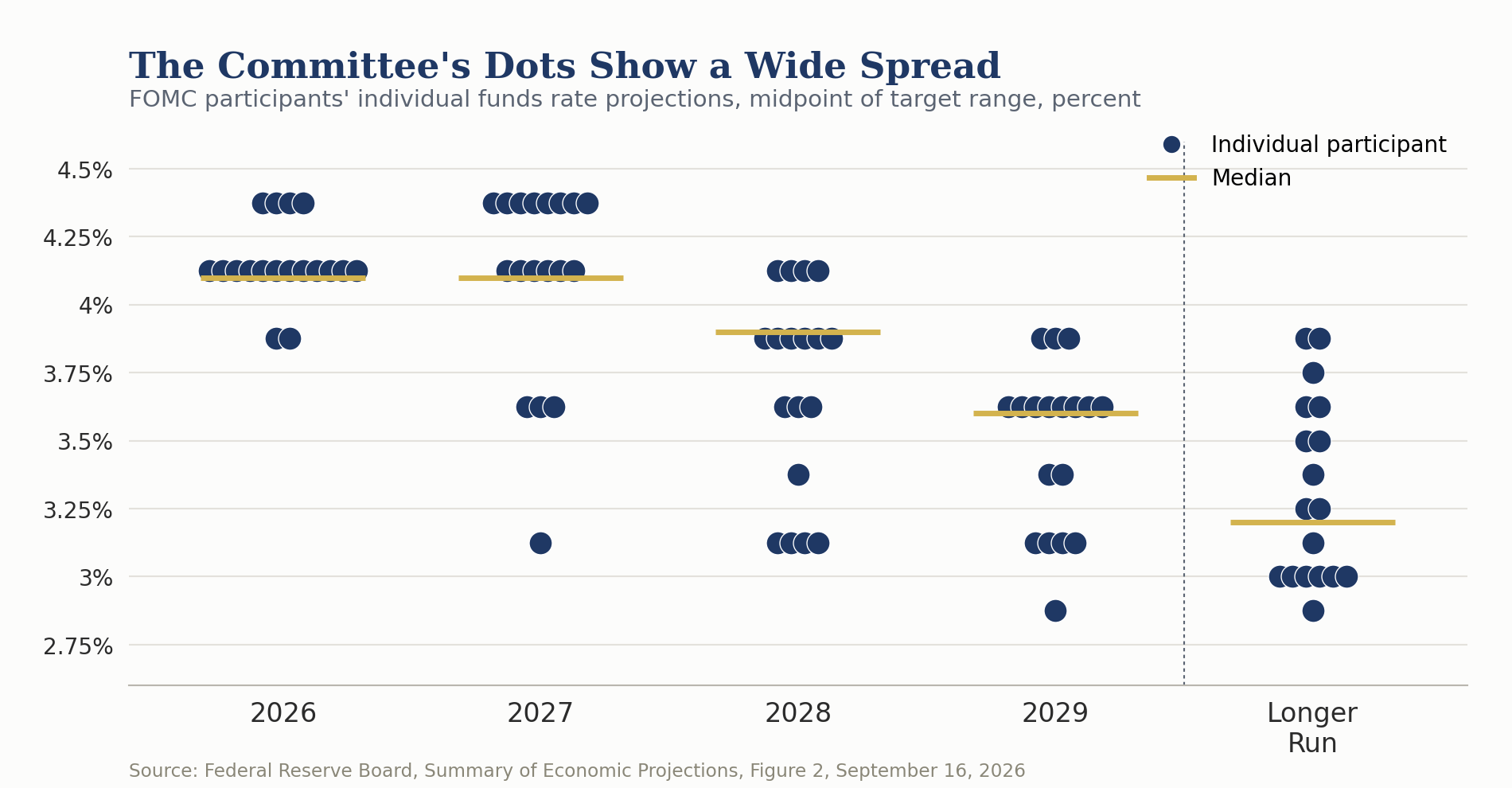
The dots also show where the Committee’s hawks expect the extra tightening to land. Eight of the eighteen participants put the funds rate at 4.375 percent or higher by the end of 2027, twice as many as project that level by the end of this year. Whatever the median implies about one hike and a pause, a meaningful bloc on the Committee is not finished after that move. They are pushing the second increase into 2027 rather than squeezing it into the final three months of 2026, which is the same conclusion our own call reaches by a different route.
The dispersion also widens the further out participants look. The 2026 dots span half a percentage point, from 3.875 percent to 4.375 percent. By the longer run, the spread is a full point, from 2.875 percent to 3.875 percent, and the largest single cluster sits at 3.00 percent, a level nobody on the Committee was writing down as recently as June. That spread is a disagreement about where the economy settles once this cycle ends, not just about the next few meetings, and it lines up with the same forces already stretching the long end of the curve. The AI buildup, the defense rebuild and reshoring are near-term claims on savings, but if AI’s productivity gains prove durable they raise the return on capital itself, and with it the interest rate the economy can sustain over time. A higher longer-run dot is a vote for a stronger long-run economy, not just a more hawkish Fed.
Every dot on that plot is a ceteris paribus forecast. Each participant is describing what he or she would do if nothing else changes between now and the date in question, and something else has not stopped changing all year. Growth has surprised to the upside more often than not, and inflation has been slower to retreat than the Committee expected as recently as June. If those two patterns hold, the something-else the median dot assumes away is exactly what keeps moving, toward more tightening.
The median hides a Committee that has a diverse mix of views. Of the eighteen participants who submitted projections, two see today’s move as the only increase this cycle needs. Twelve see one more before the year is out. Four see two more, which would put the funds rate above 4.25 percent by December. Two moves would mean the Fed would have to hike rates a week before the midterm election, a move the Fed has avoided in past election cycles, regardless of direction.
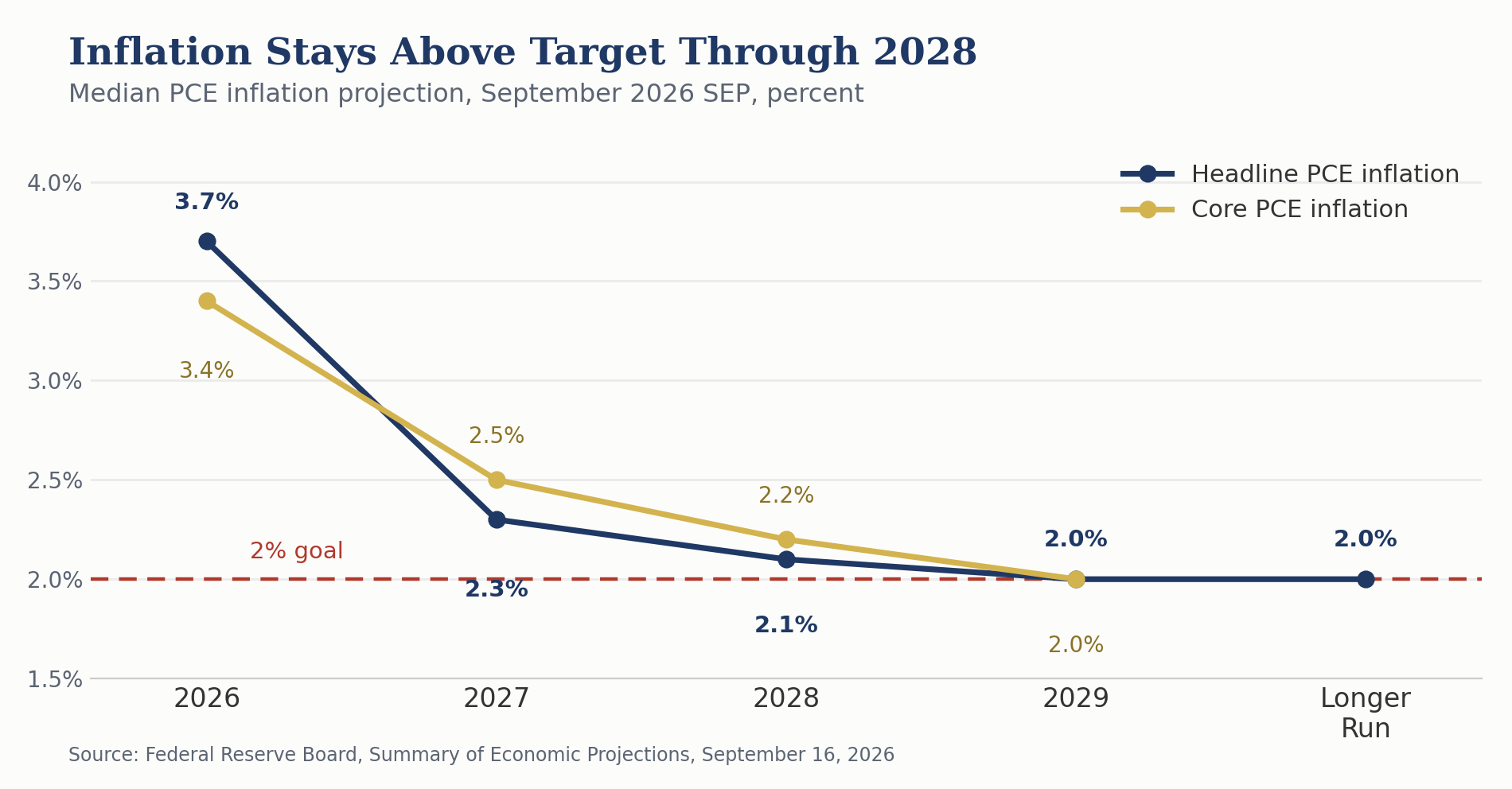
The Committee raised its own inflation forecast in the same meeting it raised rates. Median headline PCE inflation for 2026 moved up a tenth, to 3.7 percent, and core PCE moved up a tenth as well, to 3.4 percent. The 2028 forecasts for both measures moved up a tenth too, to 2.1 percent and 2.2 percent. None of that is consistent with an economy about to hand the Committee an easy path back to target. We read the upward revision as a sign the Committee expects little relief from the PCE index’s methodological changes due later this month, or simply left them out of the forecast. The Committee is paying closer attention to a succession of supply shocks that have proven longer lasting than advertised and increasingly threaten to bleed into other parts of the economy.
Growth and employment moved the same direction as inflation. GDP growth for 2026 rose a tenth to 2.3 percent and for 2027 rose a tenth to 2.4 percent. Our own numbers are 0.1 percentage points higher for both years, on a fourth quarter-to-fourth quarter basis. The unemployment rate for 2026 and 2027 both came down two-tenths, to 4.1 percent, with 2028 down a tenth to the same figure. We are at 4.1 percent in 2026, 4.0 percent in 2027 and 3.8 percent in 2028. A Committee raising its growth forecast and lowering its unemployment forecast in the same meeting it raises its inflation forecast is, by its own numbers, making the case that monetary policy needs to lean against the wind in a strengthening economy, even one where that strength is notably uneven.
We have long argued that a central bank should not tighten into a supply shock, and today’s statement shows the Committee has moved off that argument too. Compare today’s language with July’s. The prior statement said inflation remained elevated “relative to the Committee’s 2 percent goal, in part reflecting supply shocks that have driven price increases in certain sectors, including energy.” That clause is gone from today’s statement, which simply says inflation “remains elevated” and moves straight into the policy response. A Committee that keeps a supply-shock caveat in its statement is telling markets it plans to look through the shock. A Committee that drops the caveat is telling markets it does not, and that is as much a change in our own framework as it is in the Committee’s.
The clearest reason to abandon that argument is sitting at the pump and the truck stop. Diesel prices have surged in recent weeks, reflecting Ukraine’s targeting of Russian energy infrastructure. The higher cost of diesel shows up in the price of moving nearly everything, and it does not stay contained to energy. The impact is especially evident at the grocery store, particularly for bulky, light-weight, lower priced packaged goods that are staples of middle and lower income households. Whether it broadens into the rest of the basket depends on whether firms can pass it through, and they can only do that when demand lets them. That is what the data the Committee walked in with this morning showed. Retail sales excluding autos, gasoline and building materials rose 1.4 percent in August, close to three times the roughly half a point the consensus expected, and import prices climbed broadly, including a sharp jump in the cost of imported computer equipment. An economy with that much pricing power on the demand side is exactly the economy in which a supply shock stops behaving like a one-time relative price shift and starts behaving like a cost that gets built into everyone else’s price.
The energy shock is not an isolated event either, and the Committee’s own wording says so. July’s statement blamed elevated uncertainty in part on “the conflict in the Middle East.” Today’s statement widened that to “geopolitical developments,” plural, and dropped the specific reference. That is not a copy edit. The war in Russia and Ukraine is now well into its fifth year with no durable settlement in sight, and the conflict involving Iran has sharpened rather than faded since the summer. A single supply shock expected to pass is the textbook case for a central bank to look through it. A series of overlapping shocks that keep renewing themselves, each with its own claim on energy prices, shipping routes and commodity markets, is a different problem, and it is the problem the Committee’s own wording now describes.
We expect at least two more quarter-point increases before this cycle is finished, one later this year and at least one more in 2027. That would put the funds rate at 4.25 percent to 4.50 percent or higher by the end of 2027, a full quarter point above where the Committee’s median currently sits and squarely inside the range the four-vote minority on the Committee already occupies. Our reasoning is the same reasoning the Committee used to justify today’s hike. Policy works with long and variable lags, and an economy still generating above-forecast growth with inflation running above target on both the headline and core measures has not yet given the Committee reason to stop.
Here is the test, with dates. If the October employment and inflation reports show the labor market cooling and headline PCE tracking back toward the SEP path from below rather than holding above it, the case for a second increase this year erodes and our call for 2027 gets harder to defend on schedule. If instead payroll growth and core inflation hold near their current pace through the December meeting, we expect the Committee to deliver the second hike its own dot plot already shows a meaningful minority wants, and to keep going once 2027 arrives.
The bond market did not wait for us to make this case. The 2-year note, already trading near a fifty-two week high heading into today’s meeting, moved higher again after Chairman Warsh’s press conference. His remarks read more hawkish than the Summary of Economic Projections itself, and futures markets marked up the odds of additional hikes over the balance of this year and into 2027 within minutes of his final answer. Markets are pricing more tightening this afternoon than they were pricing this morning, before the Committee had said a word.
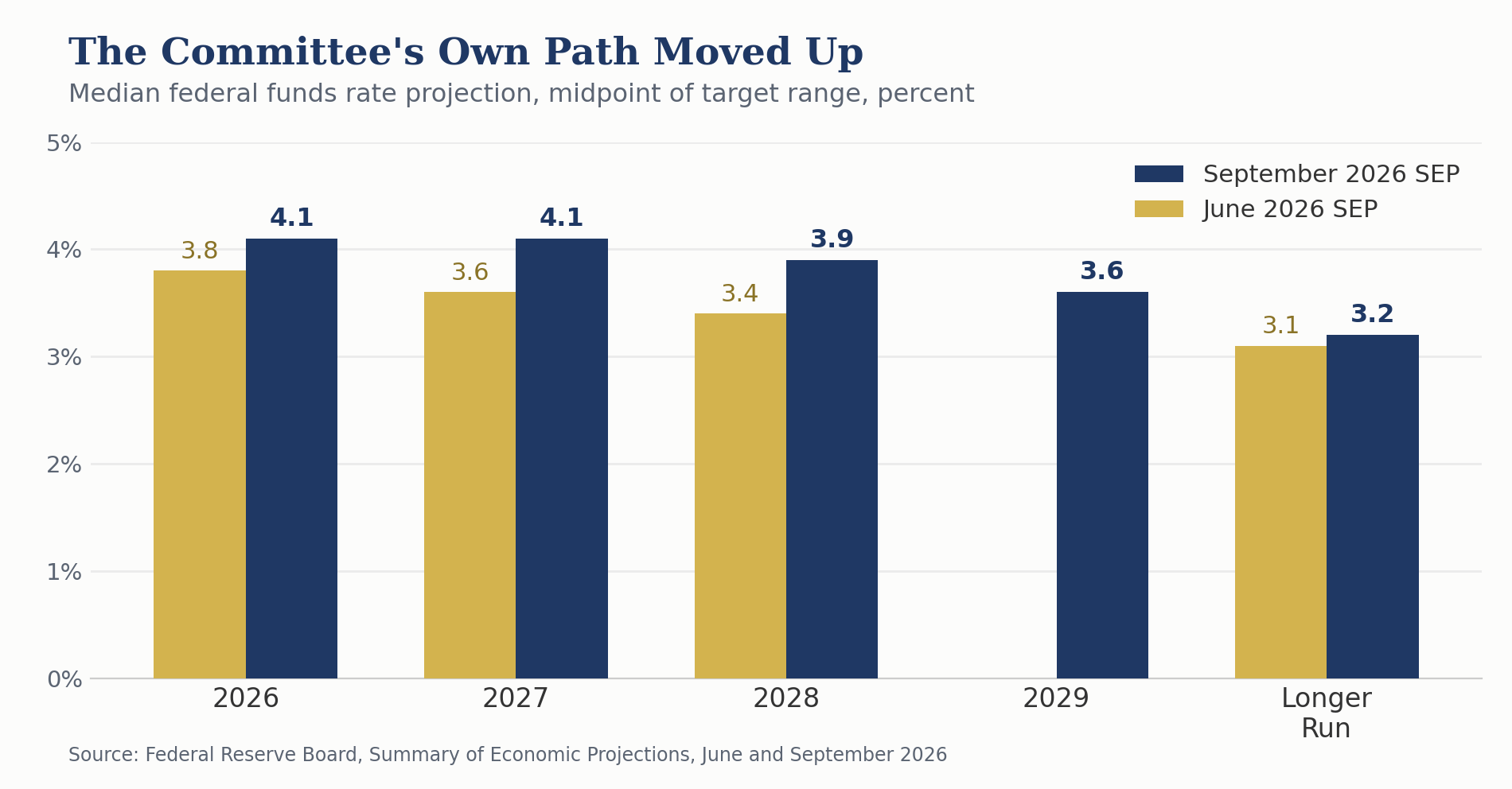
The chart tells the same story the bond market told this afternoon: the whole path moved, not just this year’s dot. Every year in the September SEP sits above where it sat in June, including the longer-run rate. That is the kind of revision that moves a 2-year note and a 10-year note on the same afternoon, because it says the destination changed, not just the pace of getting there. Markets appear to agree with the Committee’s direction. The question this afternoon is whether markets, like the median dot, are still underestimating the magnitude.
The 10-year note told a related but distinct story, trading back above 5 percent for the first time this cycle. Some of that move is the same repricing of the funds-rate path working its way out the curve. But the 10-year has been climbing for weeks on a story that has little to do with any single FOMC meeting: a higher inflation profile over the next several years, and heavy, simultaneous competition for capital from the AI buildup, from the rebuilding of depleted defense inventories, from reshored manufacturing capacity and from an expanding pharmaceutical buildout. Those are near-term claims on the same pool of savings, and they explain why the long end has moved more than the funds rate has. AI carries a second, longer-run effect pointing the same direction. To the extent it delivers the productivity gains its investors are underwriting, it raises the return on capital itself, and with it the interest rate that balances savings and investment over time. A more capital-intensive economy, one that increasingly runs on more protein and less carbs, is also a more capital-hungry one, and a more capital-hungry economy borrows at a higher rate.
Plan for a higher funds rate for longer than the Committee’s own median currently promises. Treasurers terming out debt, households budgeting a mortgage rate and businesses setting a hurdle rate on new investment should treat 4.00 percent to 4.25 percent as a floor for this cycle rather than a ceiling. The Committee said today that it will deliver price stability. We think it has at least two more quarter-point steps to take before it can credibly say that job is done.
Mark P. Vitner
President & Chief Economist, Piedmont Crescent Capital
mark.vitner@piedmontcrescentcapital.com · 704-458-4000
Sources: Board of Governors of the Federal Reserve System, Federal Open Market Committee, Statement, September 16, 2026, and July 30, 2026, and Decisions Regarding Monetary Policy Implementation, September 16, 2026; Federal Reserve Board, Summary of Economic Projections, September 16, 2026; U.S. Census Bureau, Advance Monthly Sales for Retail and Food Services, August 2026; U.S. Bureau of Labor Statistics, U.S. Import and Export Price Indexes, August 2026. © 2026 Piedmont Crescent Capital, LLC. All rights reserved.