
A View from the Piedmont — Our Weekly Commentary on Money, Credit, Exchange Rates & Geopolitics
Four Umpires, One Pitch
Governor Waller gave the market the strike zone Chair Warsh withheld, three colleagues called their own in the same week, and the front end repriced on every one. The August jobs report delivered the print we said the calendar owed us, and its composition argues for a hold. Hormuz escalated for real, and this week the bond market priced it as inflation. The pitch that decides September is the August CPI on Friday.
Market Dashboard
| Indicator | Level | This Week | Indicator | Level | This Week |
|---|---|---|---|---|---|
| Fed funds target range | 3.50 to 3.75% | Unchanged | S&P 500 | 7,718.60 | +0.1% |
| 2-year Treasury | 4.37% | +3 bp, 52-week high | Dow Jones Industrial Average | 53,414.25 | -0.3% |
| 5-year Treasury | 4.54% | +6 bp | Nasdaq Composite | 26,506.99 | +0.4% |
| 10-year Treasury | 4.78% | +5 bp | Brent crude, November | $96.28 | About +9%, October expired |
| 30-year Treasury | 5.24% | +2 bp | WTI crude, October | $91.48 | +9.7% |
| 2s-10s spread | 41 bp | +2 bp | Gold, December settle | $4,476.60 | -1.2% |
| 2s-30s spread | 87 bp | -1 bp | High yield OAS, Thursday | 265 bp | +2 bp |
| 5-year TIPS breakeven | 2.37% | +7 bp | Retail diesel, EIA, Aug. 31 | $5.599 | -5.3 cents; AAA record $5.85 Friday |
| 10-year TIPS breakeven | 2.35% | +4 bp | Distillate stocks | 104.2 mn bbl | 14% below 5-year average |
| 30-year fixed mortgage | 6.71% | +5 bp | Nonfarm payrolls, August | +162,000 | vs. 55,000 consensus |
| Sept. 16 hike odds | 58% | 63% Wed., 50% Thu. | ISM services prices paid | 72.6 | +2.3 points |
Treasury yields, real yields and implied breakevens are the official daily par yield curves for Friday, September 4; weekly changes are against August 28. Breakevens are the nominal par yield less the real par yield at the same maturity. Equity, energy and metals levels are Friday closes; gold is the COMEX December settlement. The October Brent contract expired August 31, so the weekly change on the November contract is approximate. Credit spreads are ICE BofA option-adjusted through Thursday. Hike odds are CME futures-implied as reported at the close; the intraday high after Friday's payroll release was about 65%.
Summary
- Governor Waller called his strike zone, and it is the reaction function Chair Warsh declined to give. Hold on September 16 if the August inflation data show continued progress; a "small adjustment" higher if they come in hot. Employment, he said, "will not deviate much" and is "not a large factor" in his vote. "To paraphrase John Lennon, I'm willing to give disinflation a chance." Futures took September hike odds from 63% to 50% within the hour.
- The August jobs report landed the call we published on August 10. Payrolls rose 162,000 against a consensus near 55,000, and June and July were revised up a combined 55,000. Two categories with distorted summer seasonals, restaurants and school districts, supplied 104,000 of the gain. The three-month average of 71,000 is the number to carry, hours worked jumped, wage growth slowed to 3.1%, and nothing in the report argues for moving in September.
- Four FOMC voters used their last public appearances before the blackout to describe four different reaction functions, and the front end repriced on each. Barr Tuesday, Williams Wednesday, Waller Thursday, Hammack Friday ("Now is the time to act. Policy isn't restrictive."). September odds ran 59, 63, 50, 65 and settled at 58. The 2-year closed at 4.37%, a 52-week high, and is up 90 basis points this year while the 30-year is up 38. The market has walked to the house call without a word of guidance. One reminder before anyone trades a reaction function: every one of them is ceteris paribus. Each voter told us what he or she would do if nothing else changed, and in the same week oil rose 9%, payrolls printed 162,000 and Canada retaliated. The conditions moved faster than the conditionals.
- The war in the Gulf escalated for real, and this week the bond market priced it as inflation. After the Larak Island strike, the United States hit roughly 100 targets on Tuesday and, for the first time, two Iranian government tankers. Iran hit bases in Jordan, Kuwait, Bahrain and the Emirates, and two Saudi-chartered VLCCs were struck in the strait, killing two crew. WTI rose 9.7% on the week, retail diesel set a record $5.85 on Friday, and the 5-year breakeven added 7 basis points. Last week's selloff was real rates. This week's was inflation compensation.
- Prices paid are rising faster than prices received, and the Beige Book says firms are eating the difference. ISM prices indexes printed 71.1 in manufacturing and 72.6 in services, while Richmond reported input costs growing just above 7% against prices received "relatively unchanged." That is a margin squeeze, and it is why Waller can say energy has not bled into goods and services "at least so far." The qualifier is the risk.
- Activity is fine and the import wedge is back. ISM services 55.4 with business activity at 61.7, its highest since November 2022; ISM manufacturing 54.6 with new orders and backlogs both down three points; GDPNow at 4.7% for the third quarter. The July trade deficit widened to $88.6 billion on a $14.4 billion jump in capital goods imports, most of it computers and accessories. The AI buildout inflates domestic demand and subtracts from GDP in the same month, again.
- Washington and the trade file both moved. Canada's counter-tariffs on C$27.6 billion of U.S. goods take effect at 12:01 a.m. Tuesday. The continuing resolution through December 11 is law, so the fiscal fight lands on the December 8 and 9 FOMC. The G20 chair's statement from Asheville called for "free, safe, and predictable navigation through the Strait of Hormuz," with China dissenting from four paragraphs. Witkoff and Kushner were in Moscow Saturday.
- Our call: hold on September 16, first increase December 9, one more in 2027 to 4.00% to 4.25%. The pitch is Friday's CPI. Core at or above 0.3% with core goods at 0.4% or more moves a September increase to our base case; anything less and the Committee holds with no more than three dissents.
Our Central Thesis
The week was an argument about what a central bank owes the public, and the market settled it in the Committee's absence. Chair Warsh's position from Jackson Hole is that the Fed owes a standard: underlying inflation "moving to our objective, clearly and at sufficient speed," and otherwise "we have work to do." No path, no reaction function, "a discipline, not a decision." Governor Waller's answer on Thursday was that a standard without a strike zone is not a discipline the players can use, and he gave his. This week's Piedmont Perspective is about that exchange. The thesis here is about what the exchange did to prices.
It did a great deal, and most of it happened at the front end. Four voters described four conditional policies in four public appearances, and the 2-year Treasury moved 4 to 6 basis points on each. It closed Friday at 4.37%, its highest in a year, having risen 90 basis points since January against 26 on the 3-month bill and 38 on the 30-year bond; the 10-year touched about 4.82% intraday on Wednesday before Williams and Waller pulled yields off the highs. The funds rate has not moved. The front end has done the Committee's tightening for it, in exactly the way Waller's own 2022 example describes, only this time without any guidance at all. Figure 1 shows the year. That is the discipline Warsh asked for, delivered by the market one strike zone at a time, and it is a large part of why we think September can wait.
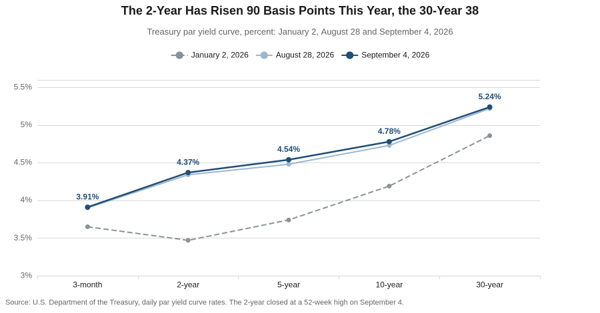
The long end did not move, and this week that is a different story from last week. On August 28 the 2-year rose 14 basis points on the Warsh speech while breakevens fell, which told us the market believed him. This week the 5-year breakeven rose 7 basis points and the 10-year 4 while real yields were flat to a basis point lower. The difference is oil. WTI rose 9.7% and November Brent settled at $96.28 after the largest U.S. strike package of the war and the first attacks on Iranian tankers. The move was inflation compensation, in the part of the curve no reaction function reaches. A 30-year at 5.24% is pricing a shipping lane, a fiscal deficit and a private credit boom, and none of the three answers to a quarter point in September.
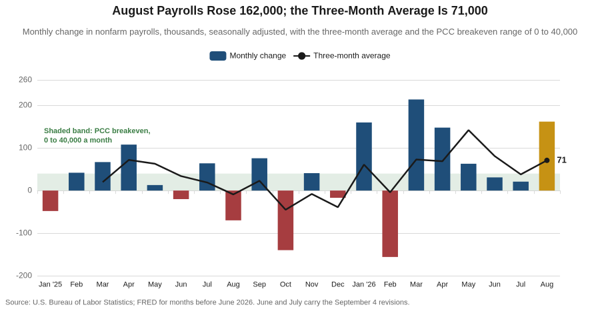
The jobs report is the piece of evidence that fits both sides, which is why it moved the market four points and then gave most of it back. August's 162,000 cleared the 125,000 bar we set on August 23, and it arrived in the two categories we said it would. Restaurants and bars had fewer summer workers to release because they hired so few in June and July, and seasonal factors built for a midsummer roll-off turned a flat month into a 59,000 gain; school districts swung back 42,000 after July's 57,500 drop. The three-month average of 71,000 sits above the zero to 40,000 breakeven we adopted on August 28, hiring breadth widened to 55.6 on the private diffusion index and 61.1 in manufacturing, and the workweek rose a tenth, worth roughly 400,000 jobs of labor input. Wage growth slowed to 3.1%, and unit labor costs are up 1.4% over the year. Employers are paying more people for more hours at a slower rate of pay growth, which is a labor market in balance, and the Committee's own dove said Thursday that employment is not a large factor in his vote. On the question in front of the Committee, which is inflation, the report leans the other way.
Positioning follows from the curve, not the calendar. We stay cautious on duration and prefer the belly. The 2-year at 4.37% pays for a reinvestment decision with almost no duration risk and now prices better than even odds of a September increase and, on Friday's close, something close to two moves over the next year. Eighty-seven basis points from the 2-year to the 30-year is thin compensation for a maturity whose marginal basis point was set this week by a tanker off Khasab. We would rather own the 5-year, which sold off 6 basis points on the week and carries the house call at 4.54%, than either wing. If the Committee holds on September 16 and explains why, the belly does best. If it holds without explaining, the July pattern returns, a bear steepening and a term premium build, and the belly still does least badly.
This Week's Argument
The calendar paid what it owed, and the composition says hold
We said on August 10 that a surprisingly strong employment report would arrive in August or September, and on August 23 we put the bar at 125,000. August cleared it by 37,000, and the two prior months were revised up a combined 55,000, so July's first print of minus 23,000 is now a gain of 21,000 and the first outright decline since February has been revised away. We would not, however, extrapolate this print any more than we extrapolated July's, and the reason is in the industry detail. Leisure and hospitality added 62,000 after revised declines of 54,000 and 21,000, so the industry has lost 13,000 jobs over the three months of a summer stretched to 105 days by the earliest Memorial Day and the latest Labor Day the calendar allows. Before seasonal adjustment restaurants and bars shed 700 workers in August against declines of 25,700 in 2023 and 9,700 in 2024, and factors built for a midsummer roll-off printed that as a 59,200 gain. Local government education added 41,900 after its 57,500 July drop, the second half of a swing BLS itself describes as largely offsetting. Set the two calendar categories aside and payrolls rose roughly 58,000, close to the 67,000 underlying pace we estimated for July and above the breakeven range. Figure 2 carries the three-month average, which is the line to read.
The parts of the report that were not calendar were better than the headline, and they were better in the right places. Manufacturing added 16,000 and has added 58,000 since December's low, with machinery up 6,100 and fabricated metals 5,700, the capital-goods end that answers to the orders and backlogs ISM reported through July. The one-month factory diffusion index jumped to 61.1 from 52.1, so roughly six of every ten factory industries added workers. Construction added 22,000, all of it nonresidential, with heavy and civil engineering up 4,400 on the month and 27,200 over the year, the payroll signature of the data center and transmission buildout. Health care added 12,900, a second month near 13,000 and well below its 32,000 monthly average of the prior year; a month in which restaurants, factories and construction sites did the hiring while hospitals took a smaller share is a better month than the same headline built the other way around. ADP's 38,000 for private payrolls, the weakest since January, is closer to the 58,000 ex-calendar pace than to the headline, and ISM's services employment index at 47.8, a second month in contraction beside business activity at 61.7, says the same thing from the other survey: activity up, headcount not, prices the problem. A Committee that hikes on inflation can point to that survey; one that would cut on jobs cannot. The weak spot was information, down 23,000 with computing infrastructure and data processing off 7,700 and computer systems design 31,300 below a year ago. The data centers going up across the Southeast are a construction story first and an information-sector payroll story hardly at all, and the firms building them are shedding people in the parts of the business that AI reaches first.
The household survey moved the same direction for once, and the wage and hours detail is where the Fed argument lives. The labor force rose 683,000 and household employment 569,000, so the unemployment rate held at 4.1% on flows in the right direction. After June's 720,000 labor-force drop we read the pair as partial payback and sampling noise, not a participation turn; the trend is still down half a point since January and it is still retirement. Participation rose to 61.6%, U-6 fell to 7.7%, and involuntary part-time work fell 414,000. The labor force is still 973,000 smaller than a year ago on a population 1.4 million larger, and the binding constraint is still supply. Average hourly earnings rose 0.3% and 3.1% over the year, the slowest of the year, against productivity growth of 2.2% and unit labor costs of 1.4% in Thursday's revised second-quarter figures. That combination is consistent with 2% inflation, and it is the table a Committee looking for a reason to hold can point to. The workweek rose to 34.4 hours after four months at 34.3 and the aggregate hours index rose 0.3% after readings of 0.0% and 0.1%, which is why third-quarter output is tracking better than the summer payroll prints implied. The September report, due October 2, carries Labor Day's half of the calendar, with the summer workforce held on payrolls through the survey week, and part of August's school-district gain should come back out. We would wait for it before calling the trend higher.
Four umpires, one front end
Waller's speech is the subject of this week's Perspective; the point here is what a week of reaction functions did to the curve. Governor Barr opened Tuesday with a conditional: "a bit more time" if inflation is moderating, act "decisively" if not. President Williams said Wednesday there were "no clear signs right now" whether the stance is sufficient, and put the rise in long yields down to "a strong U.S. economy" and AI investment. Waller said Thursday he would hold on continued progress and consider "a small adjustment" if August inflation came in hot. President Hammack said Friday, after the jobs report, "Now is the time to act. There's no tension in the mandate. Policy isn't restrictive." Each was internally consistent. Together they moved the odds of a September increase from 59% at the prior Friday's close to 63% on Wednesday, 50% after Waller, roughly 65% in the minutes after the payroll print, and 58% at the close (Figure 3). The 2-year fell 4.6 basis points on Waller and rose 4 on Friday, touching 4.42% intraday, its highest since January 2025. None of the four voters, however, said anything about the path beyond September, which is the point. The blackout began Saturday, so those five readings are the Committee's last word until the statement.
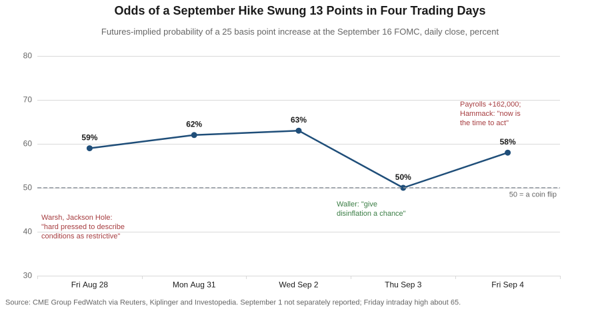
Warsh's objection to reaction functions is precisely this, and it deserves a fairer hearing than it got this week. One conditional statement from one voter is a strike zone. Four from four voters, each with a different threshold, are a path by another name, and a noisier one than any dot plot, because the market has to guess at the weights and because each one holds everything else constant. Waller's IF-THEN was written Thursday morning with Brent at $92 and payrolls unknown; by Friday's close both had moved, and so had his odds. That is the case for "a discipline, not a decision," and the week made it for him. The case against it is the same week. In the absence of any guidance, the market has repriced the front end 90 basis points this year and now carries something close to two increases over twelve months, which is the house call, arrived at without the Committee saying anything about the path. Waller's 2022 example was a 2-year that rose 200 basis points on guidance before liftoff. The 2026 version is a 2-year that rose 90 on nothing but conditionals. Either way the front end tightens ahead of the Committee, and a Chairman who cannot describe conditions as restrictive is looking at a policy rate when the restraint is in the maturities that price houses and plants.
Treasury's operations this week said the same thing from the supply side. Thursday's buyback in the 1-month to 2-year bucket drew $28.3 billion of offers against a $12.5 billion maximum and took the full amount, a 2.3 times cover, against an August 25 operation in 5- to 7-year paper that accepted only $1.19 billion of a $4 billion cap. Dealers will sell the front end to Treasury at these levels and will not sell the belly. The upsized long-end buybacks begin this week, at least $4 billion per operation in the 10- to 20-year and 20- to 30-year buckets, with the published schedule still showing $2 billion for Wednesday's 10- to 20-year operation against the August 19 announcement's $4 billion. We would verify the size before positioning around it, and we would note that Treasury did not fill the cap it already had in August.
Hormuz (and Russia) is back in the price, and this week the price was inflation
The war moved from a pause to a campaign in five days, and the tape followed. The Larak Island strike a week ago Sunday ended a 31-night pause on Iranian territory. On Tuesday U.S. forces hit roughly 100 targets, air defense, radar, mine-laying and launch sites at Sirik, Lavan and in Khuzestan and Kermanshah, and for the first time struck two Iranian government tankers anchored north of the blockade line under what Axios reported as a tanker-for-tanker policy. Iran answered with missile and drone strikes on King Hussein and Al-Azraq air bases in Jordan, Camp Titin, Sheikh Isa in Bahrain, bases in Kuwait and Erbil, and Ahmad al-Jaber and al-Minhad on Thursday night; Jordan intercepted eight missiles the first night and ten the second, and U.S. officials report no impacts on U.S. positions. Two Saudi-chartered VLCCs were hit in the strait, the Sidr with two Filipino crew killed and the Senegal Prosperity off Khasab on the Omani side of the channel, the side the August 26 Iran-Oman corridor was supposed to protect. Nothing in the record says that corridor has carried a ship. Iranian claims of a U.S. munition hitting a wedding at Kuhestak, with a death toll reported between four and eighteen, are unverified but were assessed as plausible by four independent weapons analysts, and CENTCOM says it never targets civilians. Vice President Vance said Thursday "I wouldn't call it a war" and that there would be no talks "unless they stop shooting at commercial shipping." There are no direct talks.
The transit data disagree by a factor of three to eight, and the disagreement is the trade. The administration's figures run from Secretary Bessent's "at least 10 million barrels a day" to Energy Secretary Wright's "more than 17 million" on Monday and the President's 18 million on Tuesday, with roughly 30 escorted ships a night; the joint maritime center counts 39 facilitated transits over August 30 and 31 and 44 on September 1 and 2. The trackers count Kpler at 5 to 11 vessels a day, Lloyd's List Intelligence at 12 to 14 non-Iranian-linked, and Windward at three transits in the 24 hours to Thursday evening, one of them dark, against a prewar baseline above 100. Independent analysts put late-August flows at 5 to 7 million barrels a day against roughly 20 before the war. Twenty-two tankers holding 22 to 25 million barrels of Iranian crude sat at Kharg with the berths empty. Whichever count is right, the price moved. WTI settled $91.48 Friday, up $8.08 on the week, November Brent $96.28 after touching $97 on Thursday, its highest since July 23, and the 5-year breakeven rose 7 basis points while real yields were flat. The President said the latest round would be short-lived. The market, however, treated that as a ceiling on the price and not a floor under it. OPEC+ meets online Sunday morning and is expected to leave October policy unchanged, having said itself that its supply decisions now have "more limited impact." The 2.2 million barrel a day voluntary layer finished unwinding with September; the second layer runs to year end.
Diesel is where the shock reaches a household, and it set a record on Friday. AAA's national average hit $5.85 on Friday, above the EIA's Monday reading of $5.599, which had eased 5.3 cents and will reverse in Tuesday's survey. The September ULSD contract expired at a post-war record $4.68 a gallon, the diesel crack against WTI touched $106 on Tuesday and settled near $100 on Thursday, and distillate stocks of 104.2 million barrels are the lowest for late August since 1982, with East Coast inventories the lowest since 1990 and refineries at 97.2% of capacity. The supply side is still Russia as much as the Gulf. Ukraine's General Staff says Lukoil's NORSI refinery, struck August 26, and Novatek's Ust-Luga condensate complex, struck Tuesday, have both halted, and Kirishi was hit for a sixth time a week ago; Russia extended its diesel export ban through September 30. This is the same energy channel that produced the spring CPI spike and the June energy refund, and a second refund is not the base case while diesel is making highs. None of this is reachable by a funds rate, which was last week's thesis and is still ours. What changed this week is that the bond market began charging for it in inflation compensation, and that is the one part of Warsh's standard, "clearly and at sufficient speed," that a supply shock can fail on its own.
The domestic evidence on pass-through cuts Waller's way, with a qualifier that is doing real work. The ISM prices indexes printed 71.1 in manufacturing, unchanged, and 72.6 in services, a fifth reading above 70 in six months. Both are diffusion indexes; they say that seven in ten purchasing managers paid more in August, and nothing about how much more or whether it was passed along. The Beige Book answered the second question. Boston reported that price sensitivity "was putting a limit on their ability to pass through input price increases," New York that firms were "absorbing cost increases rather than passing them through," and Richmond that input price growth had settled just above 7% while prices received were "relatively unchanged" and that one wood producer's customers "demanded price cuts following the Supreme Court tariff ruling." Cleveland's largest retailer contact reported petroleum-based product prices up more than 20% against 2 to 3% for everything else. A margin squeeze in the making is the mechanism behind Waller's line that his "earlier worry that higher energy prices would bleed into many goods and services prices hasn't come to pass, at least so far." Margins are finite, however, and if a hot number arrives this week it is likelier in Thursday's producer prices than Friday's consumer prices; the gap between the two is the number to watch.
Behind the Numbers
| Release | Reading | |
|---|---|---|
| ISM manufacturing, August | 54.6 vs. 55.2 consensus; new orders 53.7 (-3.0), backlogs 51.8 (-3.2), production 58.3, employment 51.2, prices 71.1; S&P Global final 53.9 | Eighth month of expansion and the confirmation test Chicago's 47.1 failed. Fifteen of eighteen industries grew; ISM's own translation is 2.4% annualized GDP. Supplier deliveries at 59.3 were the only headline component to improve, and customers' inventories at 42.8 are "too low" for a 23rd month, which is why production can keep expanding after orders slip. A softer August order book is a statement about fourth-quarter hiring |
| ISM services, August | 55.4 vs. 54.2; business activity 61.7, new orders 60.9, backlogs 55.6 (from 50.9), employment 47.8, prices 72.6; S&P Global services 56.5, composite 56.0 | Activity highest since November 2022 and orders since early 2023, with employment contracting a second month. Prices paid highest since August 2022, a fifth reading above 70 in six months and a 21st above 60; tariffs and the Middle East again the most-cited supply problems, with GPUs and steel added to the short-supply list. S&P Global's survey carries less price heat. A construction respondent: 30-year mortgage rates at 6.67% "moving prospective buyers back to the sidelines" |
| Employment, August | +162,000 vs. ~55,000; U-3 4.1%; AHE +0.3% and 3.1% y/y; workweek 34.4 | See the argument above. Strongest print since March; 12-month average 31,000 through July. The benchmark revision of -79,000 does not enter published data until February |
| JOLTS, July | Openings 7.27 million vs. 7.30; June revised down 177,000 | Hires 5.1 million, quits 3.1 million, layoffs 1.7 million. Professional and business services hires -188,000. A low-hire, low-fire market, unchanged |
| ADP, August | +38,000 vs. 47,000; weakest since January | Goods -10,000 with manufacturing -17,000; large firms +34,000, small +3,000. ADP and BLS rarely match when education and leisure seasonals dominate the establishment survey; ADP is closer to the 58,000 ex-calendar pace. They disagreed on manufacturing by 33,000, and we carry BLS |
| Claims | 206,000 initial; 1.779 million continuing | Below every calendar-year average since at least 1976. Challenger cuts 52,881, lowest August since 2022, with AI cited for 3,462 |
| Productivity, Q2 revised | +1.4% unrevised; unit labor costs +1.2% (from 1.3%); ULC +1.4% y/y | Manufacturing productivity revised up to 2.4% with unit labor costs -0.3%. The factory sector is producing more per hour and paying less per unit |
| Trade, July | Deficit $88.6 billion from $71.2 billion, widest in over a year; exports -$6.6 billion, imports +$10.8 billion | Capital goods imports +$14.4 billion: computers +$6.9 billion, accessories +$6.6 billion, semiconductors +$1.2 billion, with record monthly deficits with Mexico, Vietnam, Taiwan, Thailand, South Korea and Malaysia. The AI wedge, again: domestic demand up, GDP arithmetic down. Real petroleum imports were the lowest since April 2020, so July's oil story was volume down; that will not hold at $96 Brent. GDPNow 4.7% for Q3 |
| Construction spending, July | -0.5% vs. 0.0%, inside the ±0.8% confidence band; -3.8% y/y clears it | Factory construction -22.2% year to date and -32% from the September 2024 peak, 95% of it computer, electronic and electrical plants, while data centers ran $37.2 billion over seven months, +34.8% and 57% of private office construction. Core capital goods orders $85.9 billion in July, +12.9% y/y, a series high. Structures off, equipment on, as in Tuesday's report |
| Factory orders, July | +0.9% vs. 0.6%; unfilled orders up in 24 of 25 months | Core capital goods orders revised to flat. Backlogs at $1.6 trillion are why the factory workweek is 41.7 hours |
| Beige Book | Activity "increased modestly"; ten Districts slight to moderate growth; employment "rose very slightly" | Prices moderate in eight Districts. A Maryland construction firm gave a 35% raise to hold workers against data center competition. Richmond: freight moving from truck to rail on fuel costs |
| Vehicle sales, August | 16.8 million SAAR from 16.3 million; average payment $812, a record for August | BEV share 6.2% from 10.1% a year ago; hybrids 15.7%. Not the cold channel it was in the spring; new vehicle prices are still up only 0.5% over the year |
| Broadcom, fiscal Q3 | Revenue $29.6 billion, +86%; AI semiconductors $16.7 billion, +221% | Guided AI revenue to $21.7 billion for Q4 and "gated by land, power and shell." Stock fell 6% on margin mix. Demand exceeds supply; the constraint is the grid |
| Bank of Canada | Held 2.25%, seventh straight | Core near 2%, "little evidence" of energy spreading; warned the tariff exchange "could feed into consumer prices over time" |
| ECB, September 10 | Reuters poll: 65 of 65 expect +25 bp to 2.50% | Euro area August CPI 3.3% from 2.9%, core 2.4%, energy 14.3% from 10.3%. A hike from Frankfurt six days before the FOMC, on the same energy channel, is the backdrop for Warsh's "sufficient speed" |
| Japan, 30-year JGB | Auction "uneventful," 30-year closed 4.07% off a record near 4.15% | Gilts: 10-year 5.14%, markets fully price a Bank of England hike by year end. The global long end is one market |
| China, August PMIs | Official manufacturing 49.8, nonmanufacturing 49.0, lowest since December 2022; RatingDog 51.5 | Output prices cut for the first time this year. China dissented from the G20 paragraphs on imbalances, Hormuz and debt |
Sanctions and the dollar system are the other Iran policy, and they moved this week. Operation Economic Outcast, launched August 24, suspended five general licenses with a wind-down to September 8 and added roughly 60 designations; on Friday OFAC designated three Istanbul entities around Golden Global Investment Bank. Secretary Bessent told the G20 in Asheville that the United States would "economically asphyxiate" Iran, that it knows the trust accounts and "the $100 million houses," and that facilitators would be removed from the dollar system. China takes roughly 90% of Iran's crude exports, and China dissented. If that pressure works it is oil-positive, not negative, which is the same thing we said a week ago.
The G20 produced a chair's statement, as expected, and it is an American document. The global economy "has remained resilient"; structural impediments are regulation, taxation and labor supply; embrace AI; concern over "disruptions to energy trade"; a call for "free, safe, and predictable navigation through the Strait of Hormuz"; avoid export restrictions on energy, food, fertilizer and critical minerals; reaffirm the 2021 exchange rate commitment with no dollar language. Nothing on Treasury market functioning, which was the one tradeable output we were watching for. Warsh's own remarks were about growth: "a global investment surge," and whether the economy can grow faster than the 1.8% conventional forecasters assume. Chris Rugaber's account for the Associated Press has China alone dissenting from the paragraph on low-priced exports and imbalances.
Two dates in Washington and two abroad. The continuing resolution through December 11 passed the House 370 to 48 and is signed, so September 30 is a nonevent and the appropriations fight lands on top of the December 8 and 9 FOMC, which is also our meeting for the first increase. Canada's counter-tariffs take effect at 12:01 a.m. Tuesday, September 8, on C$27.6 billion of goods in tiers of 15%, 25% and 50% matching the U.S. rates on like products, with goods in transit exempt and a remission process open; Prime Minister Carney said Tuesday that talks resume when Washington stops "doing memes." Witkoff and Kushner arrived in Moscow Saturday with what were described as American proposals, the first envoy visit since January, with a Kyiv leg to follow; Putin said Thursday there was a chance of a deal. And the Department of Energy issued a Section 202(c) order Thursday directing Duke Energy Carolinas to run whatever it must through Labor Day, the second such order in the Carolinas this year, while PJM's large-load rule, which would require new loads above 50 megawatts after June 2027 to bring their own capacity or face early curtailment, closed for comment and is proposed to take effect October 12.
Bottom Line
We expect a hold on September 16, a first quarter-point increase on December 9, and one more in 2027 to a terminal 4.00% to 4.25%. Futures price 58% for September. We are under it, for the reasons in the Perspective and in the composition of Friday's report, and we would note that the Committee's most reliable hawk-turned-patient voter has told us his vote turns on one release.
The December date is a change from the Jackson Hole preview, which carried the first half of 2027, and the reasons are services prices at 72.6, Brent at $96 and a Chairman who says he has "work to do." None of those is the 162,000, which was two seasonal categories. Warsh also said at Jackson Hole that a couple of moderate summer prints "do not tell me that underlying trends have meaningfully improved." Another soft core on Friday tests that sentence; a hot core with diesel in the pipeline does not.
The condition that would flip us is five days away and it is unchanged. Core CPI at or above 0.3% on September 11, particularly with core goods above 0.4%, would mean the refining shock has reached the goods basket and would make a September increase our base case that morning. Thursday's producer prices are the earlier warning; the ISM prices indexes and the Beige Book say the pressure is in margins, and a producer price index that jumps while the consumer index does not would say margins are still holding.
| Call | Status | Where it stands |
|---|---|---|
| August or September payrolls above 125,000 | Landed | 162,000, with June and July revised up 55,000. September carries the second half of the calendar |
| 30-year 5.00 to 5.40% into Sept. 16 | On track | 5.24%; 44 consecutive trading days at or above 5% since July 7 |
| Brent $85 to $100 average through year end | On track, upper half | November $96.28; our $92.00 third-quarter mark now looks about right |
| ULSD crack above $60 through Q4 | On track | Near $100 Thursday; record $106 Tuesday |
| PCE components above 3% below 54% in January | Open | The Chairman's own gauge; no update until the August PCE report on September 25 |
| Hold on Sept. 16 with no more than three dissents | New | Scored September 16. A fourth dissent would say Hammack's zone is the majority's |
| MOVE above 70 into Sept. 16 | Unverified this week | No published Friday close available to us; last confirmed reading 73 in late August |
The risk to our call that is not the obvious one is the same as last week, and this week made it larger. A hold that reads as a close call, without a clear account of why, invites the July pattern back, bear steepening and a term premium build, at a moment when breakevens are already rising on oil. That is the scenario in which we are right on the decision and hurt on the positioning, and it is why we own the belly against both wings. The other risk is the one we state in the Perspective: if Waller's zone is the Committee's zone, our December increase is early.
This is still a capital-led, employment-light expansion, protein rather than carbohydrates. The trade report showed it in capital goods imports, Broadcom showed it in a $21.7 billion quarterly AI guide gated by power, and the payroll report showed it in heavy and civil construction hiring while information shed 23,000. What changed this week is that the Committee's last words before the blackout were four different strike zones, and the market decided the pitch is Friday's.
CFO and Treasurers Corner
Fix what you were going to fix before Friday, or wait until the 17th. The 2-year at 4.37% already carries better than even odds of a September increase and something near two moves over the next twelve months. If the CPI prints 0.2% on core, the front end rallies and you will have paid up; if it prints 0.3%, the hike is in the price by lunchtime. The asymmetry favors waiting for the number unless you cannot carry the exposure through a 0.4% surprise, in which case fix half now.
The issuance window is the narrowest of the quarter. Treasury sells 3s, 10s and 30s Tuesday through Thursday, the ECB meets Thursday, CPI is Friday, and the FOMC statement lands the following Wednesday, with the upsized 10- to 30-year buybacks starting Wednesday. Investment grade spreads at 81 basis points and high yield at 265 are a basis point or two wider on the week, not a problem, but rate volatility into Friday is. Price before Wednesday or after the 17th.
Budget diesel off the crack, not the barrel, and budget for the record. Crude rose 9.7% and diesel set an all-time high at the pump on Friday at $5.85, with distillate inventories the lowest for late August since 1982 and two Russian refineries reported halted. The crack near $100 is the input to hedge, and Sunday's OPEC+ meeting will not change it; the group has said as much.
Canada's counter-tariffs are live Tuesday, and they follow marking rules, not USMCA rules. The 15%, 25% and 50% tiers apply to goods eligible to be marked as U.S. origin under Canada's marking regulations, which means USMCA qualification does not exempt you; the U.S. Section 338 duties that provoked them do not exempt USMCA goods either. Goods in transit before 12:01 a.m. are exempt and remission requests are being accepted. If you ship dairy, steel and iron products, appliances, agricultural equipment, pulp and paper, electronics or cosmetics north, your landed cost changes Tuesday.
Set next year's wage budget at 3 to 3.5%, and stop worrying about it as an inflation risk. Average hourly earnings are up 3.1%, the slowest of the year; ADP's job-stayers are at 3.0% and job-changers at 4.7%; unit labor costs are up 1.4% over the year with productivity at 2.2%. The exceptions are technical trades near data centers, where a Maryland contractor told the Richmond Fed it paid a 35% raise to hold a crew, and health insurance renewals, which the Beige Book flagged in nearly every District.
Delivered power: the interconnection bill is coming due in PJM, and the emergency orders are now routine in the Carolinas. PJM's proposed rule would require any new load above 50 megawatts energizing after June 1, 2027 to bring its own capacity or accept early curtailment, effective October 12 if approved, and comments closed Thursday. The Department of Energy's Section 202(c) order for Duke Energy Carolinas over Labor Day is the second this year. If you are siting load in either territory, plan for capacity charges as a line item and for curtailment language in the contract.
Piedmont Perspective
The Umpire Defines His Strike Zone
Abridged from the standalone essay published today. The full version carries the three-part communication framework, the case against our own December call, and the test we would apply to Waller's consistency.
Two speeches six days apart asked what a central bank owes the public about its own future behavior, and gave opposite answers. Chair Warsh said from Jackson Hole that it owes a standard: forward guidance "has overstayed its welcome," no reaction function, "a discipline, not a decision." Governor Waller agreed on Thursday that forward guidance belongs at the zero bound, then argued that a reaction function is a different thing and gave his. "The pitcher is trying to strike out the batter, and the batter is trying to hit the ball or walk to get on base. Both want to play the ball, but they cannot do that until they know the umpire's strike zone." The players do not need a perfect zone, only "a rough idea of its parameters and some guarantee that it won't change much on every pitch."
The zone he called is narrow enough to use. Hold at 3.50% to 3.75% on September 16 if the August inflation data show continued progress; "a small adjustment" higher if they show the improvement "has been fleeting." Employment "will not deviate much" and is "not a large factor" in his vote. In the interview: "To paraphrase John Lennon, I'm willing to give disinflation a chance."
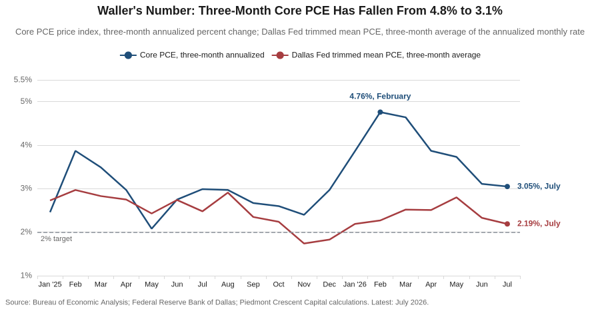
Inside his zone is a reading of the July price data that we share. He set aside twelve-month PCE at 3.7% and core at 3.3% as "not the best guide for where inflation is today." His number is three-month annualized core PCE, down every month since February from 4.76% to 3.05%, and Figure 4 plots it against the same window on the Dallas Fed's trimmed mean, which has run between 2.2% and 2.8% all year. He went further than any voter has in print: roughly half of July's core increase came from imputed nonmarket services, and "ignoring this one factor, my take is that underlying inflation is doing better than the core numbers suggest." That is the divergence we measured last week from the trimmed means, arrived at from the headline series.
Where we part company is one clause: policy is "only slightly restricting aggregate demand." We think the restraint is larger and has arrived without the Committee. The funds rate is 175 basis points below its August 2024 level while the 10-year is 81 basis points higher and the mortgage rate 17 on monthly averages, single-family starts fell to 808,000 in July, and core goods are up 0.8% over the year. If he is right, Friday's CPI carries most of the decision; if we are right, a September increase adds restraint to channels already carrying the adjustment, and that mistake takes eighteen months to show up.
A committee has twelve umpires, and four called pitches in one week. Barr, Williams, Waller and Hammack each gave a conditional, and September odds ran 59, 63, 50, 65 and 58. Four consistent conditionals from four voters add up to a path by another name, and a noisier one than any dot plot, because every reaction function is ceteris paribus and nothing else stayed put; that is Warsh's objection, and the week made it for him. The other half is that the 2-year has risen 90 basis points this year on no guidance at all, which is the tightening Waller's own 2022 example describes, delivered by the market instead of the Committee.
The honest test is to apply the zone to our own forecast, and it does not pass cleanly. We carry core PCE at 3.1% for 2026 and 2.7% for 2027, which is continued progress by Waller's definition, so his zone calls a ball in December as well as September. We expect a December increase anyway, because we think the majority is judging by Warsh's "clearly and at sufficient speed" and by the level, 64 months above target, not by the trend. If Waller's zone is the Committee's, our first hike is early. We would rather say so than pretend the framework and the forecast agree.
The falsifiable version has dates. Core CPI at 0.2% or below on September 11 and the Committee holds on the 16th with no more than three dissents. Core at 0.3% or above with core goods at 0.4% or more and a September increase becomes our base case that morning, on the rule we published August 30, and Waller's zone gets its first test of consistency. Our call is unchanged: hold on September 16, December 9 for the first increase, terminal 4.00% to 4.25%, and we own the tension between that date and the framework we have just praised.
The Week Ahead
| Date | Release or event | Consensus | Why it matters |
|---|---|---|---|
| Sun Sep 6 | OPEC+ core group, online | Hold October policy | The group says its decisions have "more limited impact" with Hormuz constrained. Watch for any Kharg language |
| Mon Sep 7 | Labor Day; U.S. markets closed | Latest Labor Day the calendar allows; the summer workforce is still on payrolls for the September survey week | |
| Tue Sep 8 | Canadian counter-tariffs take effect, 12:01 a.m.; NFIB small business, August; 3-year auction; consumer credit | NFIB 100.5 | Iran general license wind-down also ends. What would move us: an NFIB "higher selling prices" share jumping, which would say the margin squeeze is ending |
| Wed Sep 9 | Treasury buyback, 1-month to 2-year, $12.5 billion; 10-year auction; wholesale inventories | Verify whether the 10- to 20-year operation Thursday runs at $2 billion or the announced $4 billion | |
| Thu Sep 10 | August producer prices; ECB decision; 30-year auction; claims; buyback 10- to 20-year; GDPNow | PPI +0.3%; ECB +25 bp to 2.50% | The earlier pass-through test. A PPI jump with a tame CPI a day later says margins are still absorbing. A 30-year auction tail into a term premium build is the positioning risk |
| Fri Sep 11 | August CPI; Michigan sentiment, preliminary | Headline +0.4%; core +0.2% | The pitch. Core at or above 0.3% with core goods at 0.4% or more moves a September increase to our base case. Below that, Waller's zone and ours both call a ball |
| Tue Sep 15 or Wed Sep 16 | Retail sales, August (release date to be confirmed); Empire State; import prices; buyback TIPS | Prime Day moved to June; read August against a July that was distorted by it | |
| Wed Sep 16 | FOMC decision, statement and press conference; industrial production | Hold, 58% priced | Scored: hold with no more than three dissents. Warsh's first post-Jackson Hole press conference is the reaction-function question in public |
| Thu Sep 17 | Housing starts, August; Philadelphia Fed; buyback 7- to 10-year; blackout ends | Starts near 1.28 million | Single-family starts at 808,000 in July are the cold channel; a further decline is the cost of a September hike made visible |
Then: PCE and personal income September 25 with the test of the Chairman's 54% gauge; the September employment report October 2 carrying Labor Day's half of the calendar; FOMC October 27 and 28, six days before the November 3 midterms, which is why a September hold is a hold until December 8 and 9; the Court of International Trade hears the Section 301 case September 30; Boeing's SPEEA contracts expire October 6 with a 90% strike authorization already in hand.
U.S. Economic & Financial Outlook
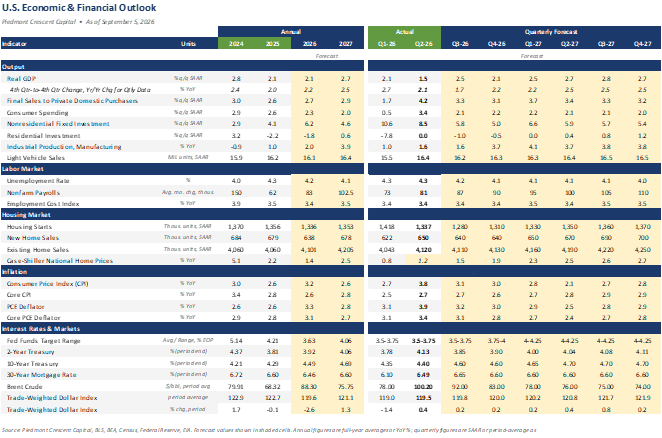
Latest readings referenced in the notes below are the Treasury par yield curve for Friday, September 4, the Freddie Mac survey rate for September 3, and the Friday close on the November Brent contract.
Three notes on how to read this table. First, the funds rate path carries a first increase on December 9, after the midterms, with one more in the first quarter of 2027 to the 4.00% to 4.25% terminal range; the August 30 issue showed the first quarter of 2027, and this issue supersedes it. Second, the market has moved past the rate rows: the 2-year at 4.37% sits 47 basis points above the 3.90% year-end cell, the 10-year at 4.78% is 18 basis points above its 4.60% cell and 8 above the 4.70% we carry for the end of 2027, and the mortgage rate at 6.71% is 11 basis points above 6.60%. We have not chased the market; the long end is pricing a term premium for a shipping lane and a deficit that we expect to give some of it back once the war premium fades, and a 30-year mortgage near 6.60% still leaves residential investment subtracting from growth through the fourth quarter. Third, Brent is running above the fourth-quarter assumption with a war that widened this week, and the scenario odds across a $70 to $100 band are unchanged at 45% base, 30% upside and 25% adverse.
Sources and Notes
Sources. Christopher J. Waller, "The Economic Outlook and Some Comments on My Policy Communication," Reuters NEXT, September 3, and the interview that followed; Kevin Warsh, "In Our Time," Jackson Hole, August 28, and G20 remarks, Asheville, August 31; Michael Barr, September 1; John Williams, CNBC, September 2; Beth Hammack, September 4 · Bureau of Labor Statistics for the Employment Situation, JOLTS, productivity and claims; Census Bureau and BEA for trade, construction spending and factory orders; Institute for Supply Management; ADP Research; Challenger, Gray and Christmas; NADA · Federal Reserve Board, Beige Book, September 2; Federal Reserve Banks of Atlanta, Cleveland, Dallas and Richmond · U.S. Department of the Treasury for par and real yield curves, buyback results and Operation Economic Outcast; OFAC; Finance Canada for the counter-tariff list; Bank of Canada; the G20 chair's statement of September 1 · CME Group settlements and FedWatch as reported by Reuters, Kiplinger and Investopedia; Freddie Mac; EIA Weekly Petroleum Status Report and retail price survey; AAA; ICE BofA index spreads via FRED · CENTCOM, Critical Threats Project Iran updates, USNI News, Al Jazeera, Axios, Windward, Kpler and Lloyd's List Intelligence on the Gulf; Ukrainian General Staff statements on Russian refineries · Associated Press, Reuters, PBS, American Banker, Bloomberg headlines · Broadcom investor relations · Department of Energy and PJM filings · Piedmont Crescent Capital, "August Employment Report: Not the Blowout It Appears," September 4; "Hiring Arrived Just as the Order Book Cooled," September 1; "A Wider Gap, a Narrower Problem," September 2026.
Notes. Treasury yields are the official daily par yield curve for Friday, September 4, which Treasury posted the same day; breakevens are computed as nominal par less real par at each maturity. Credit spreads are through Thursday, September 3, the latest published. The October Brent contract expired Monday, August 31, so the weekly change on November Brent is stated as approximate; the WTI change is on the October contract throughout. The diesel crack levels cited are as reported by Bloomberg and Cornerstone Futures on the days named and are approximate; Friday's ULSD settlement was not available from a source we could verify. The MOVE index reading is the last published figure available to us and is flagged as such in the scorecard. Hike odds are CME FedWatch figures as reported at the close on each day; Tuesday, September 1 was not separately reported and Friday's intraday high is as reported by Reuters. Iranian casualty claims at Kuhestak and Iranian claims of strikes on U.S. ships are unverified; U.S. official statements on intercepts are as reported. Hormuz transit counts are as published by each tracker and are not reconciled. The statement that two Russian refineries have halted is the Ukrainian General Staff's and is not independently confirmed. The three-month core PCE rate is the annualized change in the index over three months; the trimmed mean comparison is the three-month average of the Dallas Fed's annualized monthly rate. The forecast table is the PCC U.S. Economic and Financial Outlook as of September 5, 2026; quarterly Treasury and mortgage figures are period-end, GDP is the annual average and payrolls are the average monthly change in the quarter. All figures are subject to revision. For informational purposes only; not investment advice.
Mark P. Vitner
President & Chief Economist, Piedmont Crescent Capital
mark.vitner@piedmontcrescentcapital.com · 704-458-4000
A View from the Piedmont is published weekly by Piedmont Crescent Capital for informational purposes only and does not constitute investment, legal, or tax advice. Views expressed are those of the author as of the date of publication and are subject to change. © 2026 Piedmont Crescent Capital, LLC. All rights reserved.