
Israel’s Economy: Growth, Tech, and the Haredi Labor Shortfall
A young, tech-led economy has re-rated as the war wound down. The question with the longest bearing on its growth, whether the ultra-Orthodox go to work, is only half settled, and the October 27 election decides the rest.
The Call
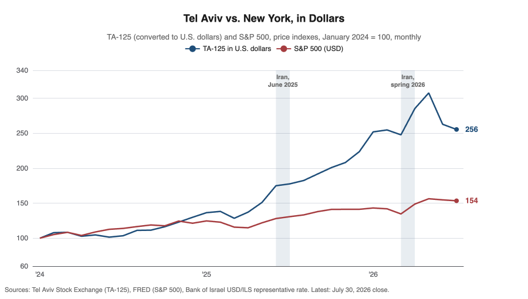
Israeli assets have re-rated sharply as the war wound down. The TA-35 returned roughly 73 percent to a dollar-based investor in 2025, and January’s sovereign issue priced at 102 basis points over comparable Treasuries against 154 on the 2024 deal. We expect Israel to outgrow both the United States and Europe over the balance of the decade, and we lean toward the Bank of Israel’s forecast of 4.0 percent GDP growth in 2026 over the IMF’s 3.5 percent. Equities have run ahead of the earnings, however: nearly all of the gains through May came from multiple expansion, which leaves the TA-125, the exchange’s broader index, priced about 52 percent above its ten-year average earnings multiple.
What the re-rating has not resolved is the question with the longest bearing on Israeli growth, which is whether the ultra-Orthodox go to work. Barely half of Haredi men hold jobs, the community is the fastest-growing in the country, and the state pays many of those who do not work to study full time instead. Two things keep them out of the labor force. The first is the army exemption, and the High Court has already stripped its legal basis; enlistment has more than doubled since the war began, and we expect the exemption to end whichever bloc wins. The second is the money, and that is what is actually on the ballot on October 27. The two front-runners sit on opposite sides of it: Gadi Eisenkot, the retired army chief, would cut the subsidies that support full-time study, while Benjamin Netanyahu depends on the ultra-Orthodox parties for his majority and would keep paying them. The Bank of Israel puts the saving from drafting 7,500 more men per cycle at 0.4 percent of GDP a year, rising to 0.7 percent if those men also find work.
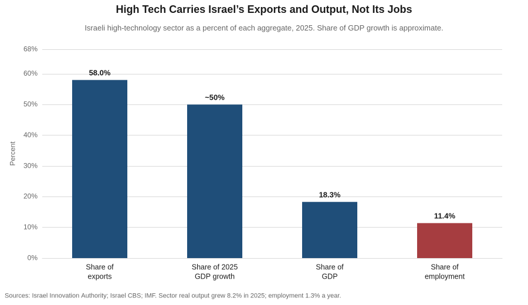
We would change this view if the ceasefires broke, or if the capital now flowing into technology worldwide turned around. High tech produces 18.3 percent of Israel’s GDP and 58 percent of its exports, and only Ireland runs a comparable concentration in the OECD.
At a Glance
| Indicator | Latest | Comparison | Source (as of) |
|---|---|---|---|
| Real GDP growth | 2.9% (2025) | 2026F: 3.5% IMF, 4.0% BoI | IMF Art. IV, Jul 2026 |
| GDP per capita, USD / PPP | $54,217 / $57,278 | EU $43,314 / $63,808 | World Bank WDI, 2024 |
| CPI inflation, y/y | 1.6% (June 2026) | 3.0% avg. 2025 | CBS; BoI, Jul 2026 |
| Policy rate | 3.50% | 4.25% end-2025 | Bank of Israel, Jul 2026 |
| Unemployment rate | 2.8% (May 2026) | US 4.2%; euro area 6.3% | CBS, 2026 |
| Deficit, % of GDP | 5.2% (2025) | 6.2% (2026F) | IMF Art. IV, Jul 2026 |
| Debt, % of GDP | 68.4% (2025) | 60.5% (2022) | IMF; Bank of Israel |
| Defense, % of GDP | 7.8% (2025) | 8.5% (2024 peak); 4.3% (2022) | SIPRI, Apr 2026 |
| Current account | $8.5bn surplus (2025) | $15.4bn (2024) | Bank of Israel |
| FX reserves | $238.7bn, end-June | 37% of GDP | Bank of Israel, Jun 2026 |
| Shekel per USD | 3.07 (Jul 30) | 4.08 (Oct 2023 low) | Market, Jul 30 2026 |
| New-issue spread | 102 bp (Jan 2026) | 154 bp (2024 issue) | Market, Jan 2026 |
| Ratings: M / S&P / F | Baa1 / A / A | Stable / stable / negative | Moody’s Jan 2026; S&P May 2026; Fitch Mar 2026 |
| TA-125 index | 4,022 | +10.0% YTD | TASE, Jul 30 2026 |
Market data as of the close on Thursday, July 30, 2026, unless otherwise noted. Economic indicators are dated to their reference period.
What We Are Watching
- The Bank of Israel’s (BOI) easing cycle has room left. Four cuts since November have taken the policy rate to 3.50 percent, and the BOI signals roughly 3.00 percent within a year with inflation at 1.6 percent, the low end of the 1 to 3 percent target band.
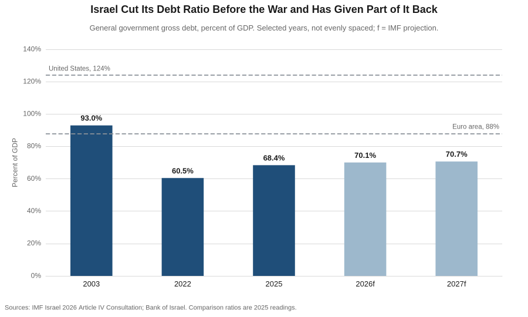
- The balance sheet absorbed the war. Public debt rose from 60.5 percent of GDP in 2022 to about 68 percent in 2025 with the deficit near 5 percent, against 124 percent in the United States and 88 percent in the euro area, and roughly 86 percent of it is held at home in shekels.
- Households have not felt the repricing yet. The public’s assets rose 15.5 percent in 2025, about double the decade average, but consumption per person remains about 16 percent below its pre-war trendline and economy-wide real wages gained only half a percent to one percent over the past year.
Between America and Europe
Israel is a hard economy to place. Its population of 10.2 million is almost exactly Michigan’s, and income per person sits above the European Union average in dollar terms ($54,217 against $43,314 in 2024) though below it at purchasing-power parity ($57,278 against $63,808), which is the comparison that takes Israel’s high cost of living into account. Its growth model, however, is closer to America’s than to Europe’s. Israel spends 6.8 percent of GDP on research and development, the highest share in the OECD, against 3.4 percent in the United States and 2.2 percent across the European Union.
Where Israel lags is output per hour, which runs about 17 percent below the OECD average and nearly 40 percent below the United States. Israelis close part of that gap with time on the job, working 1,881 hours a year against 1,751 in the United States and 1,606 across the European Union, which narrows the shortfall against the OECD average to about 9 percent per worker. The Bank of Israel’s research department traces most of the hourly gap to physical capital and the rest to the quality of workforce skills. Neither shortfall is spread evenly. The gap sits in the domestic, sheltered industries rather than in the export-facing technology sector, which is why a country at the top of the OECD on research spending sits well below its average on output per hour.
The Demographic Opposite of Europe
Israel’s population pyramid has no counterpart among wealthy industrial economies. Israeli women average 2.9 children against an OECD average of 1.5, the median Israeli is 29 years old against 39 in the United States and 45 in the European Union, and an old-age dependency ratio of 21 retirees per 100 working-age adults is projected to reach only 26 by 2050, still below America’s 28 today. Israel’s workforce is still arriving rather than shrinking, and growing faster than any other advanced economy’s.
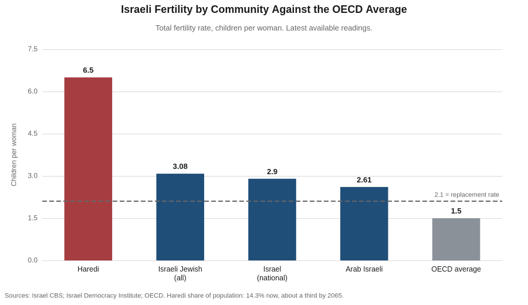
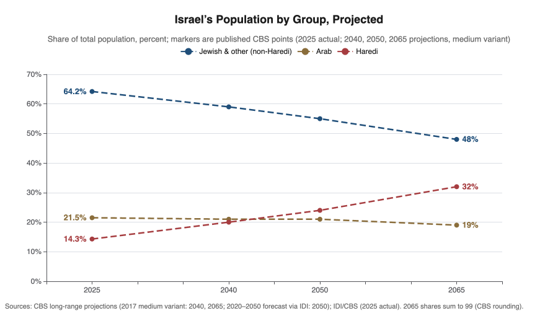
The advantage carries an asterisk, however, since population growth runs fastest in the least-employed communities. Ultra-Orthodox women average 6.5 children, and the Haredi share of the population, 14.3 percent today, is on track to roughly double by 2065. Haredi men’s employment stands near 53 percent and has not improved in a decade, and Haredim are 14 percent of the Jewish working-age population but account for about 4 percent of direct tax revenue. Arab fertility, by contrast, has fallen below the Jewish rate, to 2.61 children against 3.08, so that community holds near a fifth of the population. Roughly a third of Haredi households and 38 percent of Arab households live below the poverty line, which is why a national poverty rate of 20.7 percent ranks among the highest in the OECD even with unemployment under 3 percent.
The Start-Up Nation at the AI Frontier
Israel’s growth runs through one sector, and it is a large one. High tech produced 18.3 percent of GDP and 58 percent of exports ($85 billion) in 2025, employs about 400,000 people at wages nearly triple those of other workers, and accounted for roughly half of all Israeli GDP growth. Output in the sector grew 8.2 percent in real terms in a year when the rest of the economy grew below 2 percent. The IMF’s own 2026 staff analysis ranks Israel 18th globally on its AI Preparedness Index, ahead of Spain, France and Italy, and 39 percent of Israeli firms were already using AI as of early 2026. Venture funding reached $15.6 billion last year and exits set a record of about $84 billion, led by Google’s $32 billion purchase of Wiz and Palo Alto’s $25 billion purchase of CyberArk.
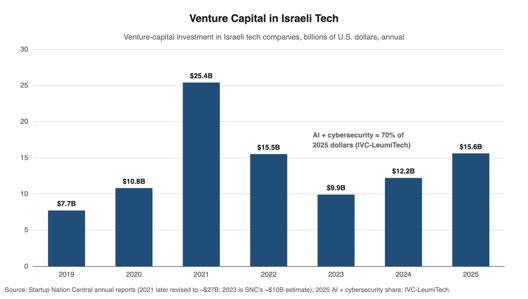
The boom has been far better at producing output than at producing jobs, however. Employment in the sector has grown 1.3 percent a year over the past three years against 1.8 percent economy-wide, which leaves the gains with the people already inside. In the OECD only Ireland runs a comparable export concentration, and a repricing of the global AI trade would land on Israeli output, foreign investment and household wealth at once, a risk the IMF now lists among the country’s largest.
Cheap at the Plug, Global at the Pump
Israel has reached American-style energy security by an entirely different route. Three offshore gas fields (Leviathan, Tamar and Karish) produced about 27 billion cubic meters in 2024, supplying roughly 70 percent of electricity under long-term domestic contracts, and pipeline sales to Egypt and Jordan have made gas an export business as well. Israeli households pay about $0.22 per kilowatt-hour against $0.33 across the European Union, an advantage that helped hold inflation inside the Bank of Israel’s 1 to 3 percent target band through a war and a global energy shock. The road is the exception, since Israel imports more than 90 percent of its petroleum and pump prices jumped nearly 15 percent in a single month during the spring conflict.
That energy position is part of why the easing cycle has room to run. We expect the Bank of Israel to keep cutting while output sits about 9 percent below its pre-war trend, unless the shekel or a renewed supply shock forces it to stop.
The Ledger
The war has been expensive, and Israel could afford it. Defense spending rose from 4.3 percent of GDP in 2022 to 8.5 percent in 2024, the second-highest share in the world that year, and is easing toward 7.6 percent in 2026 and a planned 5 percent or so by decade’s end. Broad estimates put the cumulative cost of the wars since October 2023 near 700 billion shekels (about $205 billion, roughly a third of a year’s GDP).
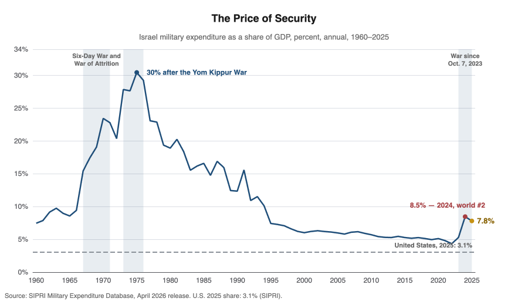
Israel went into the war having cut public debt from 93 percent of GDP in 2003 to 60.5 percent in 2022, which is what gave it the room to borrow. The current account runs a surplus and the reserve cushion, $238.7 billion at the end of June, or 37 percent of GDP, is intact.
The Vote and the Draft
Israelis vote October 27. An American reader would read all three front-running tickets, Prime Minister Benjamin Netanyahu’s Likud, the retired army chief Gadi Eisenkot’s Yashar and the joint slate of Naftali Bennett and Yair Lapid, as market and security-oriented conservatives who differ little on economics. What divides them is the ultra-Orthodox arrangement, and only half of it is still on the ballot.
The draft is all but settled. The High Court ruled unanimously in June 2024 that the blanket exemption has no legal basis, enlistment has already risen from about 1,800 ultra-Orthodox men a year before the war to more than 4,000, and with some 80,000 draft-eligible men still unserved and the army short 12,000 soldiers we expect the exemption to end whichever bloc wins. The Bank of Israel calculated in December that drafting 7,500 more per cycle saves the economy at least 9 billion shekels a year, 0.4 percent of GDP.
What the vote decides is the subsidies, and that is the larger number. The same calculation rises to 14 billion shekels a year, 0.7 percent of GDP, if employment rises alongside enlistment, and employment will not rise while the state pays men to study full time rather than work. Eisenkot would make an obligation to serve a condition of any coalition he leads, exempting only the top 3 percent of each cohort, and Bennett would end support for anyone who neither serves nor works, while another Netanyahu coalition would owe its majority to the ultra-Orthodox parties and keep paying.
The long-run figure is larger still. The Bank of Israel projects the loss of output per capita at about 6 percent by 2065 if Haredi employment and education levels never converge on those of non-Haredi Jews. Netanyahu himself cut the child allowances as finance minister from 2003 to 2005 and Haredi men’s employment climbed from 37 percent to 52 percent by 2015, so the lever is known to work.
The American Anchor
American sentiment toward Israel has been souring for years, and the shift has accelerated since 2023. Gallup’s favorability reading fell to 46 percent this February, just above its 1989 record low of 45 percent and down from 75 percent as recently as 2021, and the drift is deepest among Democrats, at 80 percent unfavorable in Pew’s reading, though Republican favorability has slipped to 58 percent as well. Actual policy has not shifted with the mood, however. The April 2024 aid package passed the House 366 to 58 and the Senate 79 to 18, and every resolution to block an arms sale has failed. The economics underneath the politics have also changed, since the memorandum of understanding provides $3.8 billion a year through fiscal 2028 but now equals about 0.6 percent of Israeli GDP against 10 to 15 percent in the decade through the mid-1990s, and two-way goods trade of $34.4 billion in 2025 runs nine times the aid check. Successor talks were meant to start at the beginning of 2026 and have slipped repeatedly since. We expect American support to continue at similar value well past 2028, likely as the technology partnership Netanyahu has proposed in place of direct financing, and we read the risk as generational rather than immediate.
What It Means for Markets
Equities
Investors have already rendered a verdict. The TA-35, Israel’s version of the S&P 500, rose 51.6 percent in shekels in 2025 and returned roughly 73 percent to a dollar-based investor as the currency strengthened, against 16 percent for the S&P 500. Nearly all of the gains through May, however, came from expanding valuation multiples rather than earnings, which leaves the TA-125 priced about 52 percent above its ten-year average earnings multiple. The index closed at 4,022 on July 30, up 10.0 percent for the year in shekels and 10 percent below the record it set in May. The exchange may be about to get more supply. The government is weighing the sale of 25 to 30 percent of Israel Aerospace Industries and of Rafael, the Iron Dome maker, though only the aerospace listing rests on a ministerial decision and the Finance Ministry has objected to the framework drawn up for Rafael. Rafael’s chief executive said in July that he was optimistic about an offering by year end while adding that neither the size of the stake nor the listing venue had been settled. We expect the repricing to continue, though a market that has re-rated this far on multiple expansion leaves little room for disappointment.
Currency
The shekel moved from 4.08 per dollar at its October 2023 low to under 3.00 in April 2026, the first time it had traded below that level since 1995, and 3.07 on July 30. Non-residents put a net $5.7 billion into Israeli shares in 2024 and $4.9 billion in 2025, after selling more than they bought in four of the six years before the war. The flow story and the current-account surplus both point the same way, and the constraint on further appreciation is the central bank’s easing path rather than the balance of payments.
Rates and Sovereign Credit
The bond market ratified the equity move. Israel raised $6 billion in January at 102 basis points over comparable Treasuries against 154 basis points on its 2024 issue, on $36 billion of demand. Roughly 21 basis points of that 52 was a market-wide move, since the ICE BofA single-A corporate index tightened by the same amount between the two pricing dates, which leaves about 30 basis points Israel earned on its own. Moody’s and S&P have restored stable outlooks, while Fitch affirmed its A rating with a negative outlook in March 2026. With 86 percent of the debt held at home in shekels and reserves at 37 percent of GDP, the funding position is not the vulnerability. The ratings risk is political, and Moody’s has named a weakening of the courts by legislation as one of three downgrade triggers.
The Household Transmission
The repricing lifted the value of what Israelis own well ahead of anything it did for what they earn, and the Bank of Israel’s own model attributes 1.7 percentage points of last year’s 2.6 percent consumption growth to the gain. Exposure runs unusually wide, since pension enrollment has been compulsory for every salaried employee since 2008 at contribution rates now above 15 percent of pay, so a Tel Aviv rally reaches ordinary retirement accounts and not only the portfolios of the wealthy. Pay has moved far more slowly, however. Economy-wide real wages gained about half a percent to one percent over the past year against roughly 4 percent in technology, and the Taub Center calculates that the high-tech premium over the rest of the workforce widened from about 120 percent in 2012 to 180 percent in 2024. We expect consumer sentiment, spending and wage growth to follow over the coming year as the rate cuts work through, though pay will be the last place it shows up.
The Outlook at a Glance
| 2025 (actual) | 2026F | 2027F | |
|---|---|---|---|
| Real GDP growth, % (IMF) | 2.9 | 3.5 | 4.4 |
| Real GDP growth, % (Bank of Israel) | 2.9 | 4.0 | 5.5 |
| CPI inflation, % annual avg. (IMF) | 3.0 | 2.3 | 2.1 |
| Bank of Israel policy rate, % | 4.25 | 3.50 | 3.0 |
| Government deficit, % of GDP (IMF) | 5.2 | 6.2 | 5.1 |
| Public debt, % of GDP (IMF) | 68.4 | 70.1 | 70.7 |
Source: IMF, Israel: 2026 Article IV Consultation, July 1, 2026, Tables 1 to 3 and the downside scenario at paragraph 10; Bank of Israel, Research Department Staff Forecast, July 2026. The policy-rate row is not a single forecast series: the 2025 cell is the end-period actual, the 2026 cell is the rate prevailing today and the 2027 cell is the Bank of Israel’s projected average for the second quarter of 2027.
Scenarios
| Scenario | What Happens | Market Implication |
|---|---|---|
| Base case | Ceasefires hold and supply constraints keep easing. Growth lands nearer the Bank of Israel’s 4.0 percent than the IMF’s 3.5 percent, and the policy rate reaches roughly 3.00 percent. The election ends the exemption but leaves the subsidies broadly intact. | Repricing continues but slows, and further gains have to come from earnings rather than a higher multiple. Shekel firm. Sovereign spreads grind tighter. |
| Upside | A coalition that ends payments for full-time study alongside the draft. The Bank of Israel’s saving rises from 0.4 to 0.7 percent of GDP a year, and the 2065 output gap begins to close. | Ratings outlooks improve toward upgrade. Curve bull-steepens. A faster growth path gives the multiple more to stand on, though it stays rich against its own history. |
| Downside | Renewed fighting, a reversal of the capital flowing into technology, or both. On the IMF’s downside scenario, which pairs renewed hostilities with a severe global recession, growth runs near 2.75 percent this year and 1.5 percent next and defense spending returns toward 9 percent of GDP. | The multiple is the first thing to go, at 52 percent above its ten-year average earnings multiple. Shekel retraces. Fitch’s negative outlook becomes a downgrade. |
Signposts
| Date | Event | Why It Matters |
|---|---|---|
| Oct 27, 2026 | Knesset election | Decides the ultra-Orthodox subsidies. The Bank of Israel’s saving rises from 0.4 to 0.7 percent of GDP a year if employment rises alongside enlistment. |
| Sep 1, 2026 | Next Bank of Israel rate decision | Tests the path to roughly 3.00 percent that the July decision signaled. |
| By year-end 2026 | Rafael partial offering; Israel Aerospace approved, timing not set | New supply to a market trading 52 percent above its ten-year average earnings multiple. Listing venue not settled. |
| Ongoing | Successor MOU talks, began June 2026 | The current $3.8 billion a year runs through fiscal 2028, and a technology partnership in place of direct financing is the likeliest successor shape. |
| Ongoing | Next Fitch review | Fitch is the one agency still on negative outlook, affirmed at A in March 2026; a downgrade would break the stable-outlook run at the other two. |
| After the vote | Judicial legislation | Moody’s names weakening the courts by legislation as one of three downgrade triggers. |
Our Call
We expect Israel to outgrow both America and Europe over the balance of the decade in percentage terms. The Bank of Israel and the IMF differ mainly on how fast the supply constraints that have held output about 9 percent below its pre-war trend unwind, and we lean toward the Bank of Israel’s side of the range. Inflation sits at the low end of the target band, the current account runs a surplus and the reserve cushion is intact.
Two risks would spoil the story, and the market has largely priced neither of them. The first is renewed fighting, where the IMF’s downside scenario cuts growth to about 2.75 percent this year and 1.5 percent next and pushes defense spending toward 9 percent of GDP. The second is the AI trade itself, since a technology sector this dominant transmits any global correction directly home. A market that has re-rated this far on multiple expansion has little room for either.
What the market has not paid for is the half of the ultra-Orthodox labor question the October vote decides. Ending the payments for full-time study is what lifts the Bank of Israel’s figure from 0.4 percent to 0.7 percent of GDP a year in the near term, and it is what closes the far larger gap the bank projects by 2065. Israeli coalitions rarely last a four-year term, however. This is the first Israeli government since 1973 to complete one and the first election held on schedule since 1988, and Israelis voted five times between April 2019 and November 2022, so no single result is final.
Chase Greenberg – Research Analyst, Piedmont Crescent Capital
Mark P. Vitner – Chief Economist, Piedmont Crescent Capital
mark.vitner@piedmontcrescentcapital.com · (704) 458-4000
Disclaimer: This report is provided for informational purposes only and does not constitute investment, legal, tax, or accounting advice, nor an offer or solicitation with respect to the purchase or sale of any security or other financial product. Information has been obtained from sources believed to be reliable, including the Tel Aviv Stock Exchange, the Bank of Israel, the Israel Central Bureau of Statistics, the International Monetary Fund, the OECD, the World Bank, the Israel Innovation Authority, the Taub Center, the Israel Democracy Institute and the SIPRI Military Expenditure Database, but Piedmont Crescent Capital does not warrant its accuracy or completeness. Opinions and estimates are as of the date of this report and are subject to change without notice.