
Its Crunch Time for College Football
- Conference realignment continues to produce marquee matchups each week.
- Week 7 saw #2 Oregon edge out Ohio State 32-31, and #3 Penn State battle back to defeat Southern Cal 33-30 in overtime.
- This week brings another slate of key games, with #5 Georgia traveling to Austin to take on the #1-ranked Texas Longhorns.
- Our featured matchup features Rice traveling to New Orleans to face the Tulane Green Wave. Both programs have a rich history but have faced challenges returning to the upper ranks of college football.
- Houston, the energy capital of the world, has maintained one of the nation’s strongest economies over the past 25 years.
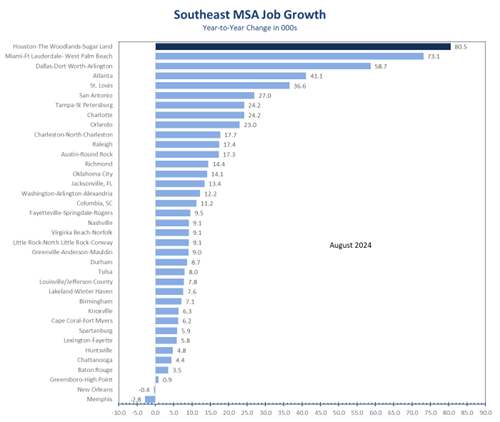
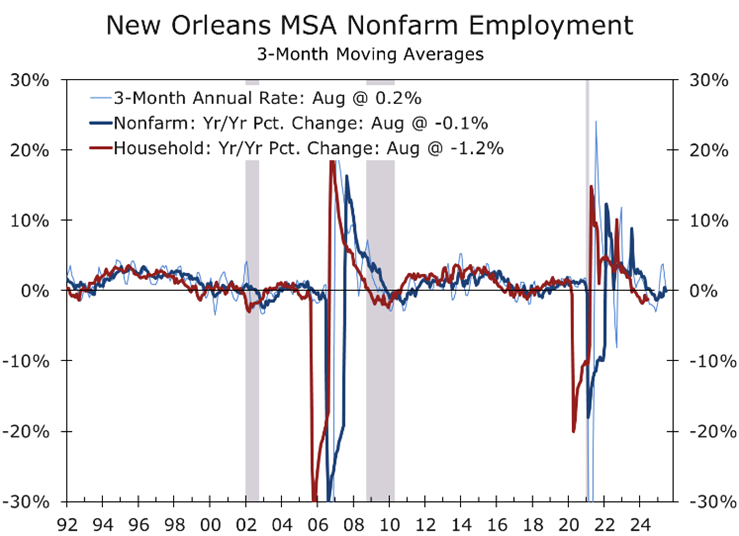
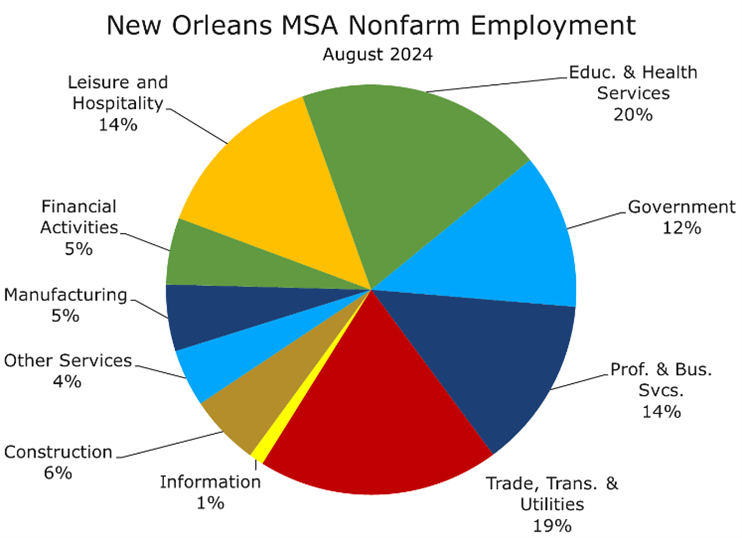
- New Orleans has struggled since Hurricane Katrina but is seeing improved momentum as it focuses on the Eds and Meds sectors to grow its economy.
- Tulane (4-2) is a three-touchdown favorite against Rice (2-4) and is undefeated in the AAC. The Green Wave’s two losses were to Kansas State and Oklahoma. Rice is coming off a 29-27 victory over UT-San Antonio.
Mid-October may very well bring an end to many schools’ playoff hopes as the season reaches a critical juncture. The SEC is home to two crucial matchups this week, with 5th-ranked Georgia making its first visit to Austin in 66 years to take on the top-ranked Texas Longhorns. Texas has looked like a number one team for much of this year, albeit against relatively light competition. Coming into the game, Texas is a 5-point favorite, marking the first time the Dawgs have been underdogs since 2021, ending a streak of 49 games. This matchup not only holds playoff implications but also serves as a litmus test for both programs, as Georgia aims to prove its mettle against a top-tier opponent.
The other significant game in the SEC features 7th-ranked Alabama traveling to Knoxville to take on the 11th-ranked Tennessee Volunteers. Alabama is still reeling from its last trip to Tennessee, where it lost to Vanderbilt in Nashville two weeks ago. The Crimson Tide enters this matchup as a 3-point favorite, but the stakes are high; the loser of this game may very well be eliminated from at-large consideration for the 12-team playoff. This game is crucial not only for postseason aspirations but also for maintaining pride within the storied programs.
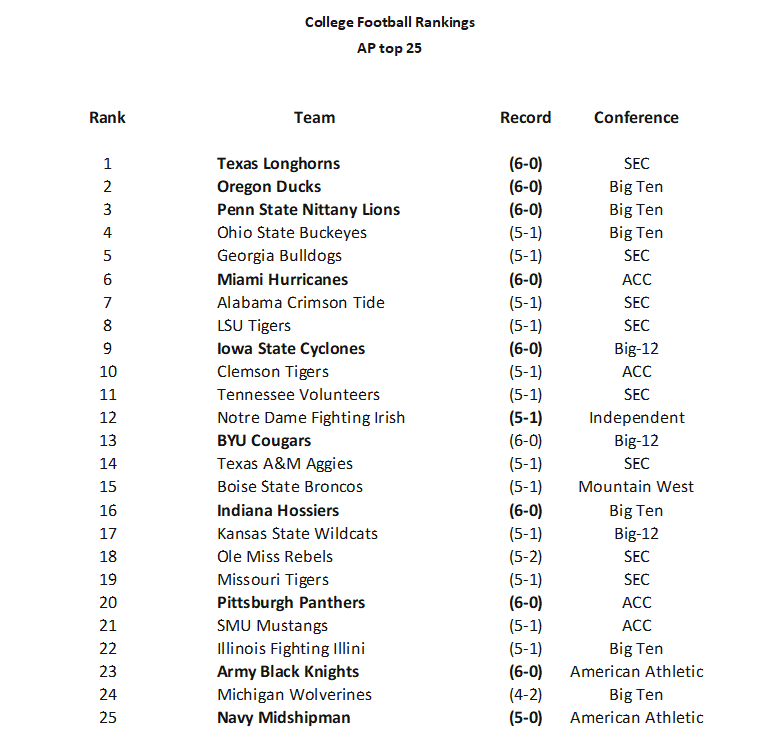
Another game to keep an eye on this week is 12th-ranked Notre Dame traveling to Atlanta to face a much-improved Georgia Tech (3-2) team. The Fighting Irish will look to solidify their position in the playoff race against a Yellow Jackets squad that is gaining momentum. Meanwhile, the Big Ten features several intriguing second-tier matchups, including Nebraska traveling to undefeated and 16th-ranked Indiana, and 2nd-ranked Oregon visiting Purdue on Friday night. These games could significantly impact the rankings and playoff landscape as teams vie for position and respect in their respective conferences.
Southern ‘Ivy League’
Our matchup focuses on two of the Southern Ivies – Rice and Tulane. The two programs have a storied past and have had some success in recent years. As always, we look at the history of the two programs and the local economies – Houston and New Orleans.
The Wall Street Journal recently highlighted the growing trend of high school seniors from the North choosing to attend colleges in the South since the COVID-19 pandemic. This trend is most apparent at state schools such as Clemson, Georgia Tech, Alabama, and South Carolina. Several factors drive this shift, including lower tuition, warmer weather, less political polarization, and the vibrant social and sports culture often showcased on social media.
Enrollment of Northerners at Southern public universities has surged dramatically over the past two decades, with some schools seeing increases of over 600%. The pandemic accelerated this trend as Southern schools maintained fewer restrictions, attracting students disillusioned with lockdowns in the Northeast. This shift has significant long-term implications for Southern economies, as many graduates tend to stay in the region for work. However, the growing enrollment also presents challenges for infrastructure and campus capacity.
There is a group of schools in the South that has long been favored by Northerners and is informally known as the “Southern Ivy League.” While there is no formal list, these institutions are recognized for their rigorous academics, strong alumni networks, and influential roles in the region’s educational landscape. While mostly private, the list also includes a few public institutions. Some of the universities often associated with the “Southern Ivy League” include:
Duke University (Durham, North Carolina)
Vanderbilt University (Nashville, Tennessee)
Rice (Houston, Texas)
Emory University (Atlanta, Georgia)
University of Virginia (Charlottesville, Virginia)
Davidson College (Davidson, North Carolina)
Wake Forest University (Winston-Salem, North Carolina)
University of North Carolina at Chapel Hill (Chapel Hill, North Carolina)
Washington & Lee University (Lexington, Virginia)
William & Mary (Williamsburg, Virgina)
Tulane (New Orleans, Louisiana)
Southern Methodist University (Dallas, Texas)
Furman University (Greenville, South Carolina)
Sewanee: The University of the South (Sewanee, Tennessee)
Rhodes College (Memphis, Tennessee)
The term “Southern Ivy League” is a colloquial expression that acknowledges the high caliber of these institutions compared to Ivy League schools in the Northeast. This label reflects the growing recognition of Southern universities as leaders in higher education, emphasizing their commitment to academic excellence, innovative research, and vibrant campus life. These institutions boast competitive admissions and attract top students from around the world.
Tulane University
Tulane was founded in 1834 as the Medical College of Louisiana by seven New Orleans doctors. At the time, it was only the second medical school in the South, created to train doctors to combat outbreaks of smallpox, cholera, and yellow fever in the growing New Orleans region. The school expanded in 1847 when the Louisiana state legislature established the University of Louisiana, combining the medical school with a new law department. An academic school was added in 1851, transforming it into a more traditional university. Early financial struggles were exacerbated by limited funding from the state legislature and donors. Dr. Francis Lister Hawks, the first university president, was hired largely for his ability to support himself financially, as the school could not provide a salary.
Before the university could overcome its financial troubles, the Civil War broke out. With no hope of securing government funds and over three-quarters of the student body leaving to join the war effort, the school closed in 1862. Though it reopened in 1865, the financial challenges persisted due to the South’s agricultural depression and limited public funding. The university was saved by a $1 million endowment from New Orleans merchant Paul Tulane, which inspired further donations, including millions from Josephine Louise Newcomb.
Paul Tulane’s legacy, however, is marred by racism and discrimination. His endowment stipulated that the university only admit white students, and he successfully lobbied for a Louisiana law to codify this condition. In 1884, to avoid integration, the University of Louisiana was privatized and renamed Tulane University of Louisiana.
In 1885, the H. Sophie Newcomb Memorial College was founded as the first coordinate college for women in the U.S., a model that inspired institutions like Barnard College at Columbia and Pembroke College at Brown. Tulane expanded in the late 19th and early 20th centuries, adding schools of engineering, architecture, commerce, pharmacy, and dentistry, with the goal of becoming the premier university in the Deep South.
During World War II, Tulane participated in the V-12 Navy College Training Program, which trained officers for the U.S. Navy and Marine Corps. Tulane’s “24th General Hospital,” composed of 30 graduates and 10 faculty members from its School of Medicine, treated 31,640 casualties with only 83 deaths during the war. A similar unit was created by Tulane’s Dr. Rudolph Matas in World War I.
Tulane desegregated in 1963, a decade after the Brown v. Board of Education ruling. Barbara Guillory Thompson and Pearlie Elloie were the plaintiffs in the lawsuit to desegregate Tulane, marking the end of the university’s exclusionary policies.
Today, Tulane enrolls over 7,000 undergraduates and is regarded as one of the premier institutions in the South.
The Tulane Green Wave
Tulane University’s football program has a rich history that reflects the broader evolution of college football in the South. Established in 1893, the Green Wave initially competed as an independent. In the early years, Tulane achieved moderate success, but the program struggled to find national recognition.
In the 1930s, Tulane became a charter member of the Southern Conference and later joined the Southeastern Conference (SEC) in 1933, one year after its founding. The Green Wave enjoyed some success in the SEC during this era, earning a Rose Bowl invitation in 1949, where they played against the University of California, Berkeley. The team struggled to be a consistent competitor, leading to an eventual departure from the SEC in 1966.
After leaving the SEC, Tulane’s football program faced various challenges, including fluctuating success and financial difficulties. The program had its share of ups and downs, often fluctuating between conference affiliations and dealing with the realities of competing against larger programs.
A significant turnaround came under head coach Willie Fritz, who took the helm in 2016. Under his leadership, Tulane engineered a rapid transformation from mediocrity to national prominence. The Green Wave achieved a remarkable feat in the 2022 season by winning the American Athletic Conference (AAC) championship and earning a prestigious bid to the Cotton Bowl. Tulane faced a formidable USC team led by 2022 Heisman Trophy winner Caleb Williams in this highly anticipated matchup.
In a dramatic game, Tulane trailed 45-30 with under five minutes left in regulation. With the odds stacked against them, the Green Wave managed to score a touchdown, pulling within eight points. An improbable turn of events unfolded when Tulane’s kickoff pinned USC deep, leading to a misplayed ball and a safety that narrowed the deficit to six points. Seizing the opportunity, Tulane mounted a final drive, scoring a touchdown in the last seconds to clinch a stunning 46-45 victory, capturing the attention of the nation as an underdog capable of overcoming any obstacle. Tulane finished 12-2 that year and ranked 9th in the nation.
Fritz’s successful tenure brought renewed hope to the program, but following another strong season in 2023 where they won a share of the AAC title, he accepted a coaching position at the University of Houston. This left Tulane facing the challenge many smaller schools encounter when a highly successful coach departs—how to find another coach capable of sustaining their recent gains who does not view the head coaching position as a steppingstone to greener pastures.
New Orleans
Located along the Mississippi River, New Orleans is the most populous city in Louisiana, with nearly 400,000 residents. The broader metropolitan area boasts a population of 1.24 million. New Orleans plays a key role in offshore energy exploration, oil refining, petrochemical production, and oil and gas distribution. Once the dominant economy of the South, New Orleans’ role has diminished. Despite this long-running decline, the city remains a cultural center, known for its unique French influence and bustling port.
New Orleans was originally founded in 1718 near a Native American trading route, offering easy access to the Gulf of Mexico. In 1803, Napoleon sold New Orleans to the United States as part of the Louisiana Purchase. In the years that followed, the city experienced rapid growth. The Haitian Revolution brought thousands of immigrants to the area, and New Orleans became a safe haven for displaced Francophones. After the War of 1812, new settlers arrived, and the city grew to become the third-largest in the United States.
During the Civil War, New Orleans was an early target for Union forces and was captured without significant battle. Union General Ben Butler abolished French language instruction in New Orleans schools during the war, leading to the gradual decline of French usage over the next century. After the war, the Port of New Orleans thrived as the city invested in new drainage, electrification, and transportation infrastructure.
During World War I, the Mississippi River experienced a revival as new traffic surged to meet manufacturing demands. Similarly, World War II saw a boom in manufacturing and shipbuilding, bringing tens of thousands of workers to manage logistics at the Port of New Orleans. However, manufacturing declined after the war, leaving New Orleans in need of a new industry to take its place.
Oil and gas extraction became a key focus of the Louisiana economy. In 1934, the Texas Company, which would later become Texaco, drilled an oil well off the Louisiana shore, marking the beginning of the offshore drilling industry. Offshore drilling saved Louisiana’s economy after World War II and has played a critical role in New Orleans’ economy ever since. Today, the Louisiana Offshore Oil Port is the nation’s only deepwater oil port and handles 13% of the United States’ foreign oil. The benefits of this oil economy have spread to sectors such as banking and real estate, though the region has faced economic hardships during downturns in the oil industry.
In response, policymakers have worked to diversify its economy through tourism. After the “oil bust” of the 1980s, city leaders implemented reforms to attract visitors, increasingly marketing Mardi Gras and promoting the city as the “birthplace of jazz.” Today, tourism is a $5.5 billion industry, accounting for close to 40% of local tax revenues.
Despite the growth in tourism, New Orleans has faced economic struggles in recent years. Louisiana has one of the nation’s highest unemployment rates, and New Orleans’ economy has steadily declined as the oil industry has struggled with volatile energy prices and shifting politics surrounding natural gas production and exports. Houston’s success often comes at the expense of jobs and industry in New Orleans.
Tulane- A Reason for Optimism
Tulane represents a bright spot for New Orleans. An economic impact report released this past summer quantified Tulane’s contribution to the Louisiana economy at $5.2 billion. By 2030, enrollment is expected to increase by over 25%, and the school’s budget is projected to rise by 9%. This expansion is particularly important at a time when New Orleans has lost over 45,000 residents in the past three years.
Policymakers and business leaders have been concerned about a “brain drain,” with educated professionals leaving the region for greener pastures, such as Houston. Education and healthcare—often referred to as “Eds and Meds”—are critical components of efforts to reinvigorate the New Orleans economy. Tulane has been instrumental in combating this brain drain by supporting over 17,000 local jobs, many of which are high paying, thanks to Tulane’s $600 million investment in downtown New Orleans.
This growth is significant. In 2019, Tulane’s economic impact was $3.14 billion. The nearly 40% increase in economic activity should encourage New Orleans residents and underscore how vital Tulane has been in offsetting the city’s economic decline. The next step will be to form partnerships that attract new industries to the region.
Rice University
Rice University owes its creation to the death of William Marsh Rice, a Texas businessman who made his fortune in real estate, railroads, and cotton. In 1891, Rice chartered the William Marsh Rice Institute for the Advancement of Literature, Science, and Art. The terms of the charter specified that the institution would be created upon Rice’s death, after which nearly all of his considerable estate would fund the creation of the school. Rice was found dead in 1900 and was initially presumed to have died peacefully in his sleep. However, controversy arose shortly after when Rice’s lawyer, Albert Patrick, announced that Rice had changed his will to leave his fortune to Patrick. An investigation revealed that Patrick, along with Rice’s valet and butler, had conspired to kill Rice while he slept and forge his signature to create a fake will. Ultimately, Rice University opened in Houston in 1912 under the guidance of former Princeton professor Edgar Odell Lovett.
William Rice specified that the institution created upon his death must be “a competitive university of the highest grade.” Additionally, his will made clear that only white students would be allowed to attend. While the university was in its planning stages, President Lovett toured nearly 80 universities across the world in an attempt to incorporate the best qualities of each into the new university.
The university was co-educational from its inception, with 48 male and 29 female students in the inaugural class of 1912. In the 1920s, much of the student body was associated with the local Ku Klux Klan. A 1922 yearbook photo went viral in 2019, depicting over 20 students dressed in white Klan robes. Racist imagery was common in the school’s early yearbooks, including a photo of a Black man captioned with the n-word and pictures of students wearing blackface.
President Lovett stepped down in 1946, and under new President William Vermillion Houston, the school expanded significantly. After World War II, the G.I. Bill brought in new students, and Rice expanded to offer more degrees in the sciences and engineering. In 1962, John F. Kennedy gave a now-famous speech at Rice in support of space exploration, memorably stating, “We choose to go to the Moon in this decade and do the other things, not because they are easy, but because they are hard.” A year later, Rice founded the nation’s first Space Science Department. One of NASA’s largest research centers and the center for human spaceflight is located in Houston, Texas, not far from Rice. The Rice Space Institute maintains a close partnership with NASA to this day.
During the Civil Rights era, Rice faced a unique obstacle to desegregation. The school’s original charter only allowed Rice to admit white students, tuition-free. In September 1962, the Rice Board of Governors unanimously passed a resolution in support of desegregation. However, to officially desegregate, Rice filed a lawsuit to amend the charter. The university had to wait two years until the first Black student, Ph.D. candidate Raymond Johnson, stepped onto campus. A group of alumni intervened in court, attempting to block Rice’s change to the charter, but a trial verdict eventually sided with Rice and Johnson in 1964. In addition to removing racist language from the charter, the lawsuit allowed Rice to begin charging students tuition for the first time in 1965.
As Rice begins its second century, William Marsh Rice’s vision of creating an elite learning institution has been achieved. However, despite playing a key part in the university’s creation, the school has attempted to distance itself from the racist past of its founder and early students. As of 2024, Rice is ranked as the 17th best university in the nation by U.S. News and World Report.
Rice University Owls Football
The late 1950s and early 1960s were the golden years for Rice football. Under head coach Jess Neely, the Owls achieved significant success, winning the SWC title in 1957 and 1958. In 1954, Rice reached the Cotton Bowl Classic for the first time, defeating the University of Alabama. The 1960 season saw the Owls finish with a strong record and earn a trip to the Bluebonnet Bowl, where they faced the Florida Gators.
The 1970s and 1980s were challenging for Rice football, with inconsistent performance and a general decline in competitiveness. The Owls experienced coaching changes and struggled to maintain their previous level of success. In 1983, Rice became an Independent after the dissolution of the SWC, further complicating its ability to compete at a high level.
In the mid-1990s, Rice began to rebuild its program, and in 1996, it joined Conference USA (C-USA). The team experienced a resurgence under coach Ken Hatfield, culminating in a 10-1 season in 1997, which included a victory in the 1997 Mobile Alabama Bowl. However, inconsistent performances returned in the early 2000s, leading to more coaching changes.
In 2013, Rice achieved a significant milestone by winning the C-USA Championship and participating in the Liberty Bowl, where they secured a victory over Mississippi State. Under head coach David Bailiff, the Owls began to solidify their presence in C-USA.
Rice has focused on enhancing its recruiting efforts and infrastructure, seeking to compete effectively in a challenging conference landscape. The 2020 season marked a pivotal moment as the Owls hired Mike Bloomgren as head coach, aiming to establish a culture of competitiveness and resilience. The Owls joined the American Athletic Conference in 2023.
Houston Economy
Houston developed as a port city in the late 1800s, but it was not until oil was discovered in the area in 1901 that Houston truly ascended to become an economic juggernaut in the South. Today, a significant portion of Houston’s economy is based on the energy industry due to its substantial oil reserves. In addition to energy, the city has large healthcare and aerospace industries. Houston’s metropolitan area has a gross domestic product (GDP) of $537 billion. That figure is greater than the GDP of 37 U.S. states, and if Houston were a country, it would have the 25th largest economy in the world, ahead of Argentina and behind Poland. It would be an understatement to say Houston is extraordinarily fortunate that a drilling crew discovered one of the largest oil reserves in the world over a hundred years ago.
By the end of World War II, Houston became the center of oil production in the United States, with the largest concentration of oil refineries and petrochemical plants in the world. In 1850, Houston’s population was barely 2,000, but by 1950, that number had jumped to 596,000. During the early oil boom in the area, production was dominated by many small companies. However, by the Depression years, ten companies produced the majority of the oil in Texas. The oil industry grew so much in the early 1900s that Houston was referred to as the “city the Depression forgot.” During this time, Houston emerged as the dominant transportation hub in Texas, expanding its port and rail infrastructure to support its growing economy. The Port of Houston is now one of the top five busiest ports in the United States.
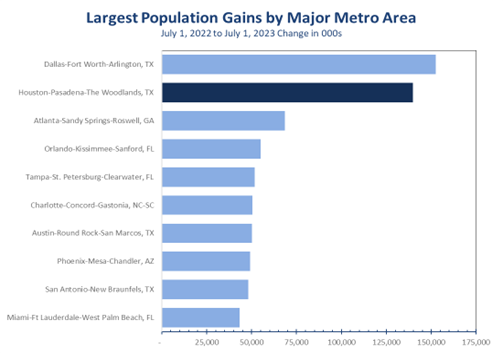
Today, Houston is experiencing tremendous growth. It is the second-fastest-growing metropolitan area, currently home to 7.3 million people. Part of this growth can be attributed to its low cost of living, as costs are 4.7% below the national average and over 20% below the average for the top 20 metropolitan areas. Additionally, because Texas does not have a state income tax, many families find it easier to save and stretch their dollars during periods of high inflation.
Despite this growth, Houston faces challenges in its office market. The office vacancy rate rose to 26.7% at the end of the first quarter. Leasing activity is also slow as the post-pandemic economy has struggled to bring Houstonians back to the office. Many tenants are trying to save costs by moving into smaller office spaces. As a result, vacancies are expected to rise over the coming year as larger spaces remain vacant and companies continue to downsize.
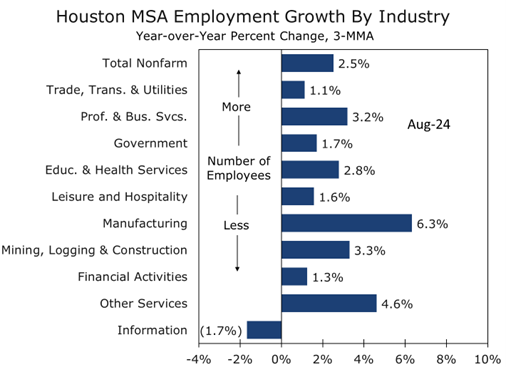
Despite this, there are reasons for optimism. Inflation has subsided considerably in recent months, exports are increasing, and construction has picked up in both the suburbs and the city center. While the economy isn’t growing at the rapid pace it was two years ago, Houstonians are hopeful that the end of 2024 will bring a return to growth after a nationwide slowdown.
Rice – Center of Innovation
Rice has played a key role in scientific discoveries that have helped develop the greater Houston area. The Rice Space Institute has partnered with NASA to create the first department of space medicine in the world. Additionally, Rice’s Kavraki Lab has developed a motion planning framework for the Robonaut 2, a robot designed to assist astronauts aboard the International Space Station.
Innovation at Rice extends beyond the Space Institute. In 2019, Rice announced the construction of the Rice Innovation District, also known as the Ion District. The project, which opened in 2021, is a joint initiative between Rice and the City of Houston. Formerly a Sears store, the technology park is now home to notable tenants such as Chevron and Microsoft. The Ion has built community partnerships with NASA’s Johnson Space Center to establish an aerospace engineering accelerator, providing startups with funding and experienced mentors. Rice has used the park as an opportunity to connect its students with high-paying employers in the Houston area, further cementing its reputation as one of the most innovative universities in the country.
The Tulane Green Wave will look to take another step toward competing for the AAC Championship, securing bowl eligibility, and cracking the top 25 as they face off against the Rice Owls this Saturday. Despite their 2-4 record, Rice leads the AAC with 20 sacks and ranks among the top ten programs nationally with 49 tackles for loss. The Owls’ aggressive defense has consistently disrupted opponents, with undefeated Army being the only team so far this season to avoid a sack.
Tulane’s offensive line has been equally impressive, not allowing a sack on quarterback Darian Mensah since their loss to Oklahoma. As always, the key to this game will be winning the battle at the line of scrimmage. That, along with avoiding turnovers and preventing big plays, will be crucial for Tulane to improve to 3-0 in AAC play.
Rice, despite their 2-4 record, has been competitive. They are coming off a tight 29-27 victory over UTSA and narrowly missed a chance for back-to-back AAC wins after missing 40-yard field goal late against Charlotte. The Owls’ hard-hitting defense, particularly their ability to generate pressure from the defensive line and a talented group of linebackers, will challenge Tulane’s offense.
For Tulane to succeed, they must avoid long-yardage situations on third down and maintain control of the clock. While the Green Wave have been productive on offense, success will hinge on Mensah’s ability to remain composed under pressure and release the ball quickly.
Rice will be competitive, as the Owls are better than their 2-4 record suggests. With bowl eligibility in sight and the opportunity to continue their undefeated run in conference play, the Green Wave will need to take Rice seriously this Saturday. Expect a close contest, but Tulane should come away with a narrow win.
Disclaimer: This publication has been prepared for informational purposes only and is not intended as a recommendation offer or solicitation with respect to the purchase or sale of any security or other financial product nor does it constitute investment advice.
October 16, 2024
Mark P. Vitner, Chief Economist
mark.vitner@piedmontcrescentcapital.com
Chief Economist (704) 458-4000
Ethan Jacobs
Economic Analyst Intern
Economic Analyst Intern