New Home Sales Rise in July, But Mortgage Applications Plummet as Mortgage Rates Rise
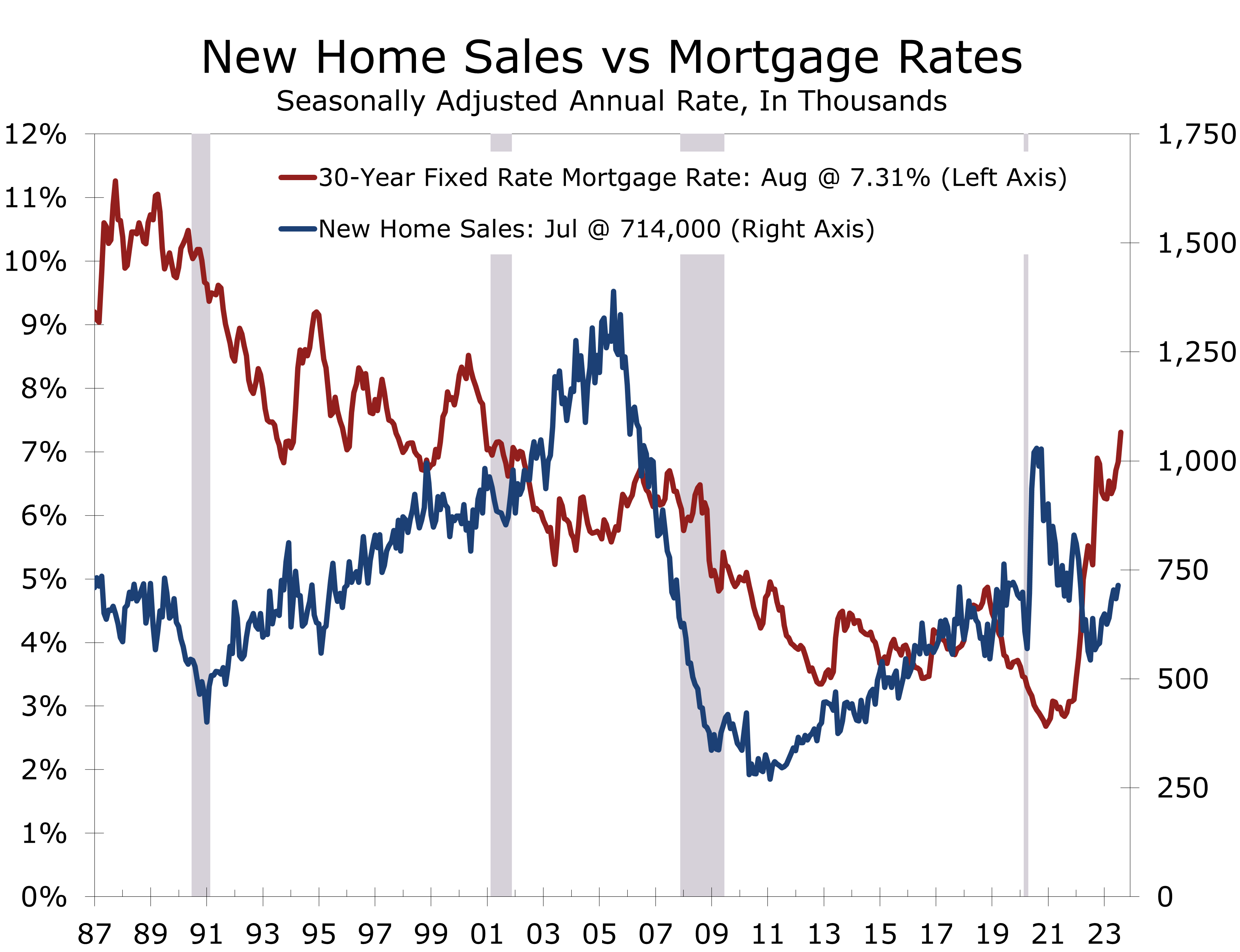
- New home sales rose 4.4% in July to a 714,000-unit annual rate, the highest level since February of last year.
- Sales for the prior two months were revised slightly lower. On a year-to-date basis, new home sales are now running 0.4% ahead of their year-ago pace.
- July’s increase was driven by large gains in the West (+32K) and Midwest (+27K). Sales fell in the South (-28K) and Northeast (-1K).
- The number of new homes available for sale rose 2.1% to 437,000 units. The rise in sales, however, reduced the more closely watched months’ supply figure to 7.3-months.
- The median price of a new home rose 4.8% from the prior month to $436,700. The median home price for July, however, is 8.7% below its year-ago level.
- July may prove to be a high water mark for new home sales. Mortgage rates have spiked in recent weeks and mortgage applications for the purchase of a home have plummeted to their lowest level since May 1995. Builders have also reported a drop in buyer traffic.
New home sales rose modestly in July, climbing 4.4% to a 714,000-unit pace. While the increase topped market expectations, sales for the prior two months were revised slightly lower. Moreover, the Mortgage Bankers Association reported mortgage applications for home purchases fell 5% in mid-August and are now at their lowest level since May 1995.
With July’s gain, new home sales are now at their highest level in 17 months. On the surface, demand for new homes appears to be defying gravity, as sales are 23.7% higher than they were in October of last year, which is when mortgage rates broke above 7% for the first time this cycle.
We suspect July will be the high water mark for new home sales. Home builder confidence dipped notably in August, with the Wells Fargo/NAHB Housing Market Index falling 5 points to 50. A reading above 50 means more builders rate current market conditions as good rather than as poor.
Builders are cutting prices and using incentives to bolster new home sales.
All three subcomponents of the index weakened in August, with present sales falling 5 points to 57, future sales falling 4 points to 55 and prospective buyer traffic falling 6 points to 34. The share of builders reducing prices to bolster sales rose for the first time in 5 months, climbing 3 percentage points to 25%.
Builders are also increasingly using incentives to support sales. Typical incentives are mortgage rate buydowns, which help reduce the sting from higher interest rates. The share of builders using incentives to bolster sales rose 3 percentage points in August to 55%. There is a good chance the share of builders offering incentives will soon top December’s mark, when the share rose to 62%.
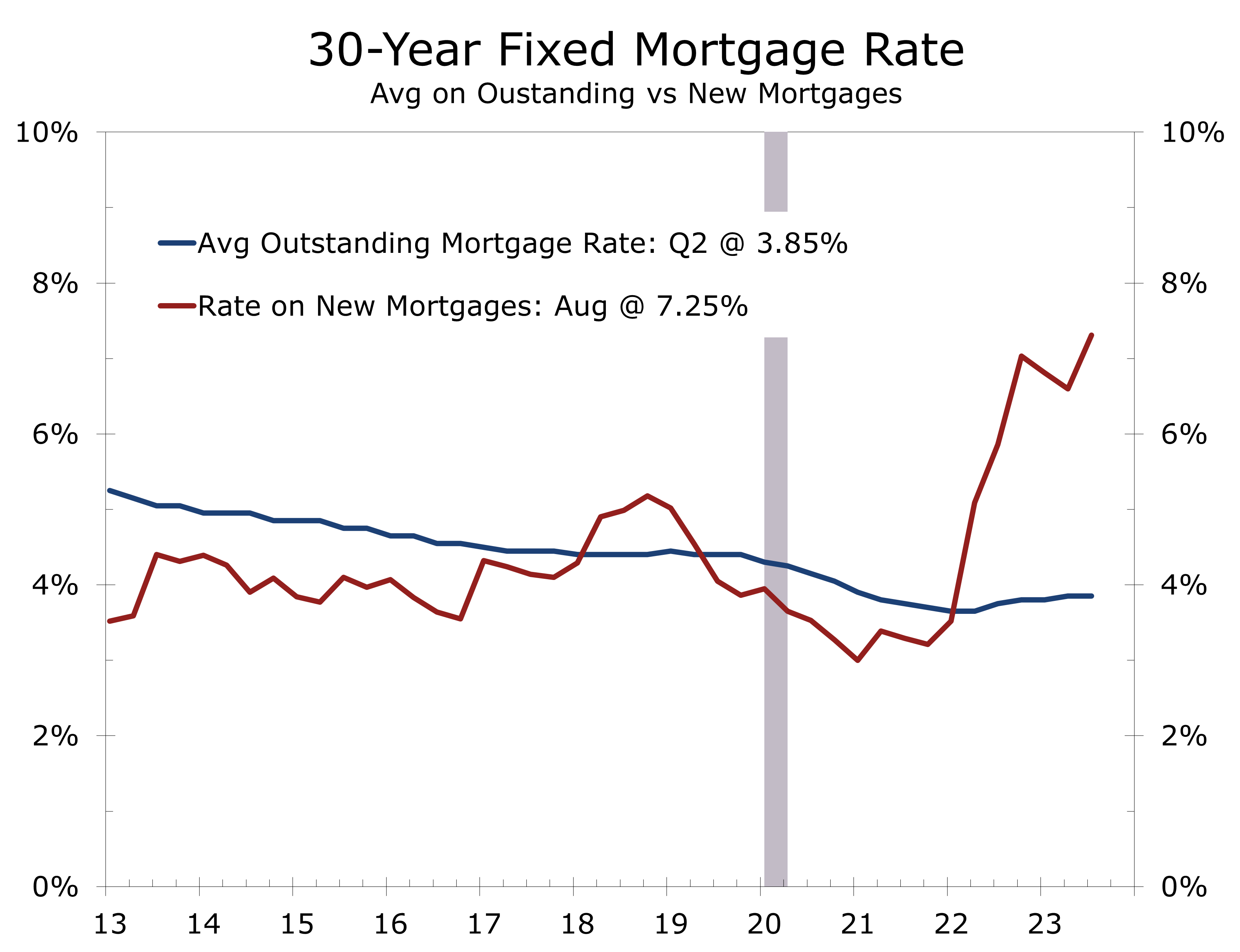
July’s rise in new home sales confirms that demand remains strong despite higher mortgage rates. Demand for new homes is being bolstered by buyers shifting away from the existing home market, where inventories remain scarce. Fewer homeowners are willing to sell today because they do not want to lose their current low-rate mortgage. Eighty percent of existing mortgages have an interest rate below 4%.
Mortgage rates are just part of the equation, new home prices have fallen in recent months, and are 8.7% below their year ago level. Affordability remains a formidable hurdle for many would-be buyers. One way around affordability hurdles is to sell a home in a higher priced market and buy a home where prices are lower. This arbitrage works best for folks relocating from the West Coast and Northeast to the South and Midwest. Home buyers are also pushing out to the furthest reaches of rapidly growing metro areas, where land costs are lower.
The boost to home sales from the affordability migration appears to be losing momentum. With more businesses requiring workers to be back in the office full-time, commuting long distances begins to look less appealing. Moreover, the massive in-migration into Florida and parts of the Southeast has driven prices up to the point that many native buyers have been priced out of the market.
The Midwest was responsible for the bulk of July’s rise in new home sales, with sales surging 47.4% from the prior month to an 84,000-unit annual rate. Sales also jumped 21.5% in the West but fell 6.3% in the South, which is the largest region for new home sales, and fell 2.9% in the Northeast.
We expect new home sales to decline by about 10% over the next six to nine months.
We expect new home sales to decline at least 10% by yearend. The huge spike in the Midwest will almost certainly be reversed next month and rising mortgage rates and diminishing affordability will push more would-be buyers to the sidelines. We look for new home sales to slide to under a 650,000-unit pace late this year. Prices will fall somewhat, and more builders will offer incentives to help counter the slide in sales.

Disclaimer: This publication has been prepared for informational purposes only and is not intended as a recommendation offer or solicitation with respect to the purchase or sale of any security or other financial product nor does it constitute investment advice.