Small Business Confidence Improves Slightly
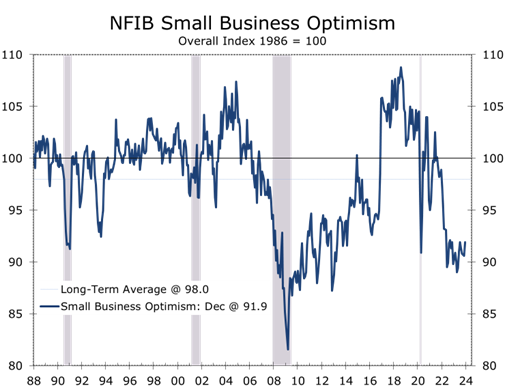
- The NFIB Small Business Optimism Index rose 1.3 points to 91.9 in December, its highest in the past five months.
- The improvement coincides with decline in interest rates and rise in stock price following the December 13 FOMC meeting.
- Five of the index’s 10 components rose in December, led by a 7-point improvement in earnings trends and share of business owners expect the economy to improve.
- Despite the recent improvement, earnings trends (-25%) and the net share expecting the economy to improve (-36%) remain extremely weak and near recession levels.
- Business owners remain concerned about inflation and hiring challenges, although these concerns have eased somewhat.
- Continued pressure from rising operating costs may push inflation higher.
- December’s rise in Small Business Optimism further supports the growing consensus for a soft landing. While moderating final demand is limiting pricing power, rising wage pressures might still push inflation higher if the Fed eases too aggressively.
Small business confidence closed the year positively, with the NFIB Small Business Optimism Index rising 1.3 points to 91.9 in December, marking its highest level in five months. Despite this improvement, the index has remained below its 50-year average of 98 for the past 24 months. The index last reached or exceeded the average back in December 2021.
This boost in optimism corresponds to the substantial decline in interest rates and a subsequent rise in stock prices following the Federal Reserve’s FOMC meeting on December 13, where the Fed stated they had likely finished raising interest rates for this cycle and attention shifted toward rate cuts. The Santa Claus rally ended before New Year’s Day, however, and markets have experienced a partial retracement as bond yields rebounded.
Small business confidence got a boost from improved financial conditions during December.
Small business owners remain concerned about inflation and continue to face challenges hiring qualified staff, although both concerns have eased somewhat in recent months. Apprehension about sustaining profit margins amidst continually rising operating costs is also weighing on confidence, a challenge that likely intensified as the minimum wage rose across various states and municipalities at the start of the year. The capacity to offset these higher costs has diminished as demand has cooled.
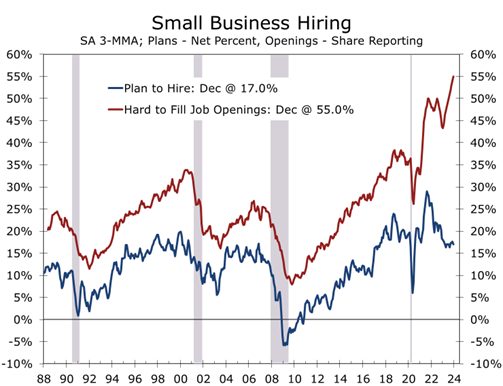
Small businesses are grappling with ongoing challenges in the labor market, as 40% of business owners report having unfilled job openings. This breakdown includes 33% seeking skilled workers and 14% seeking unskilled labor. Particularly noteworthy are the acute difficulties faced by construction firms and smaller trucking companies in filling positions.
Fifty-five percent of small businesses reported hiring or trying to hire in December, up 1 point from November. Forty-nine percent (89% of those hiring or trying to hire) of owners reported few or no qualified applicants for the positions they were trying to fill (down 1 point). Twenty-eight percent of owners reported few qualified applicants for their open positions (up 2 points) and 21 percent reported none (down 3 points).
Small business owners are less willing to compromise on qualifications and experience.
Given the cost constraints small businesses face, many owners seem to be choosing not to fill open positions unless there is a fully qualified applicant. There has been a steady decline in owners’ intentions to fill open positions in recent months, even as the share of businesses reporting they have open positions continues to rise. Additionally, businesses are paying more, with 36% of owners raising compensation and 29% planning to raise pay over the next three months.
The reluctance small business owners show in adding staff comes at a time when labor markets are giving off mixed signals. Although the headline nonfarm employment numbers have exceeded expectations, job figures have consistently been revised lower. Other employment measures, including the household employment survey and ADP survey, suggest that hiring has been less robust. This gap will likely be reduced once the Bureau of Labor Statistics (BLS) releases their annual revisions along with the January employment data on February 2nd.
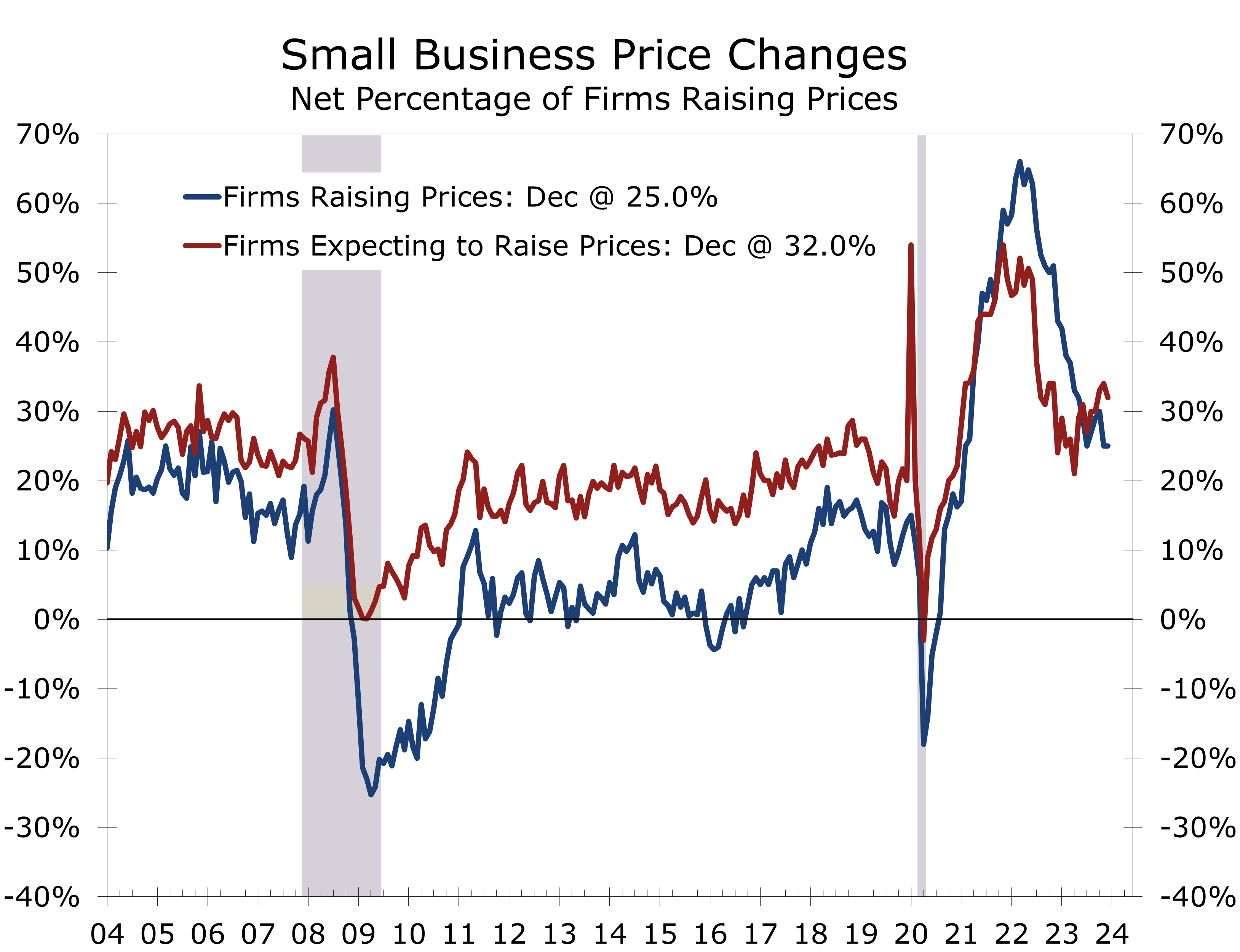
Small business owner have seen their pricing power diminish as economic growth has slowed.
Continued pressure from rising operating costs may push inflation higher. The proportion of firms expecting to raise prices is trending higher again, even as the share of those actually raising prices continues to trend lower. This split reflects the diminished pricing power that small businesses currently have. The divide is also a concern for policymakers. If the Fed cuts interest rates too aggressively, demand would likely strengthen to the point that businesses would once again pass their higher costs onto consumers.Top of Form
Disclaimer: This publication has been prepared for informational purposes only and is not intended as a recommendation offer or solicitation with respect to the purchase or sale of any security or other financial product nor does it constitute investment advice.