Operating Margins Continue to Get Squeezed
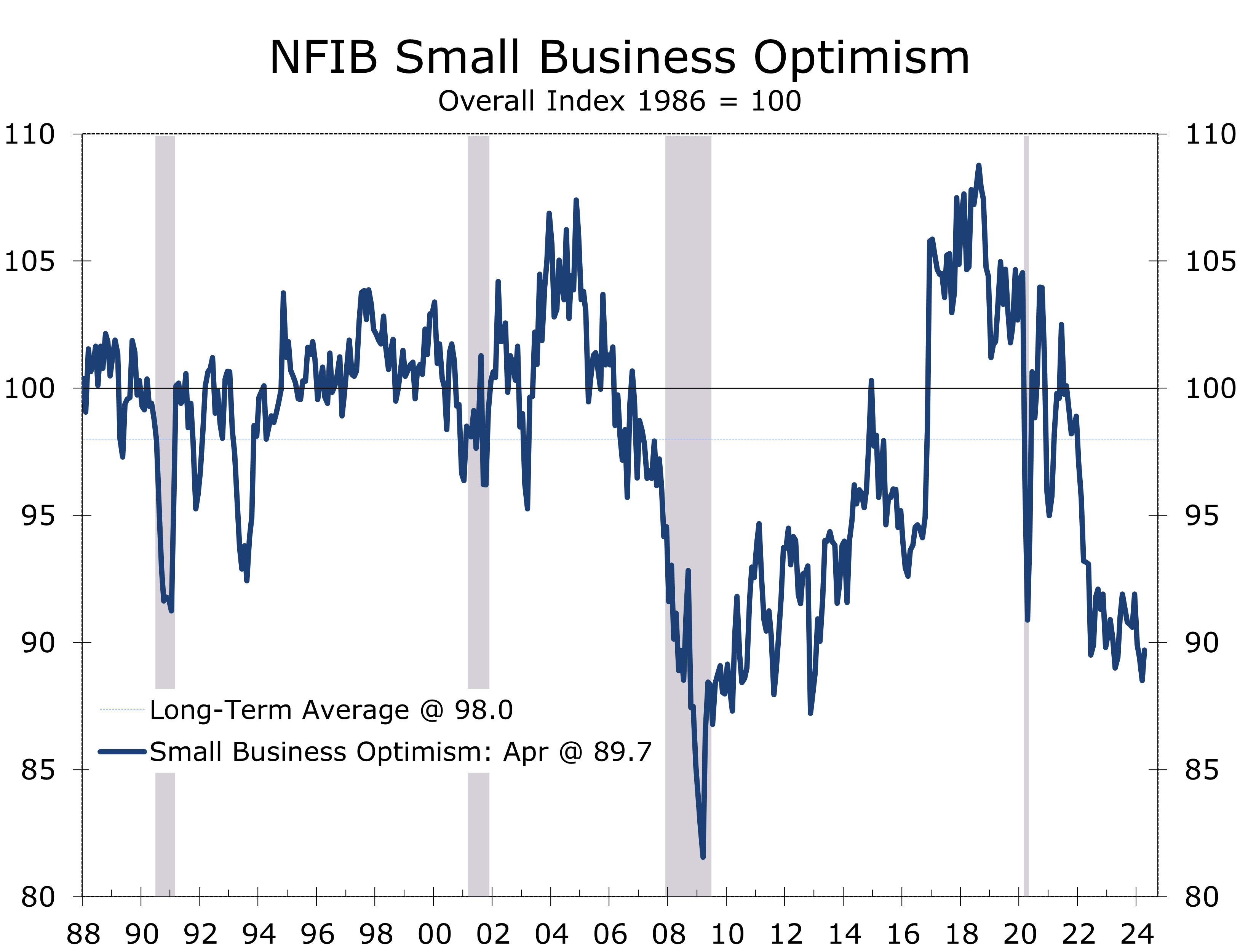
- The NFIB Small Business Optimism Index rose 1.2 points to 89.9 in April, marking its first increase this year.
- Seven of the 10 components rose in April, led by a 6-point jump in sales expectations.
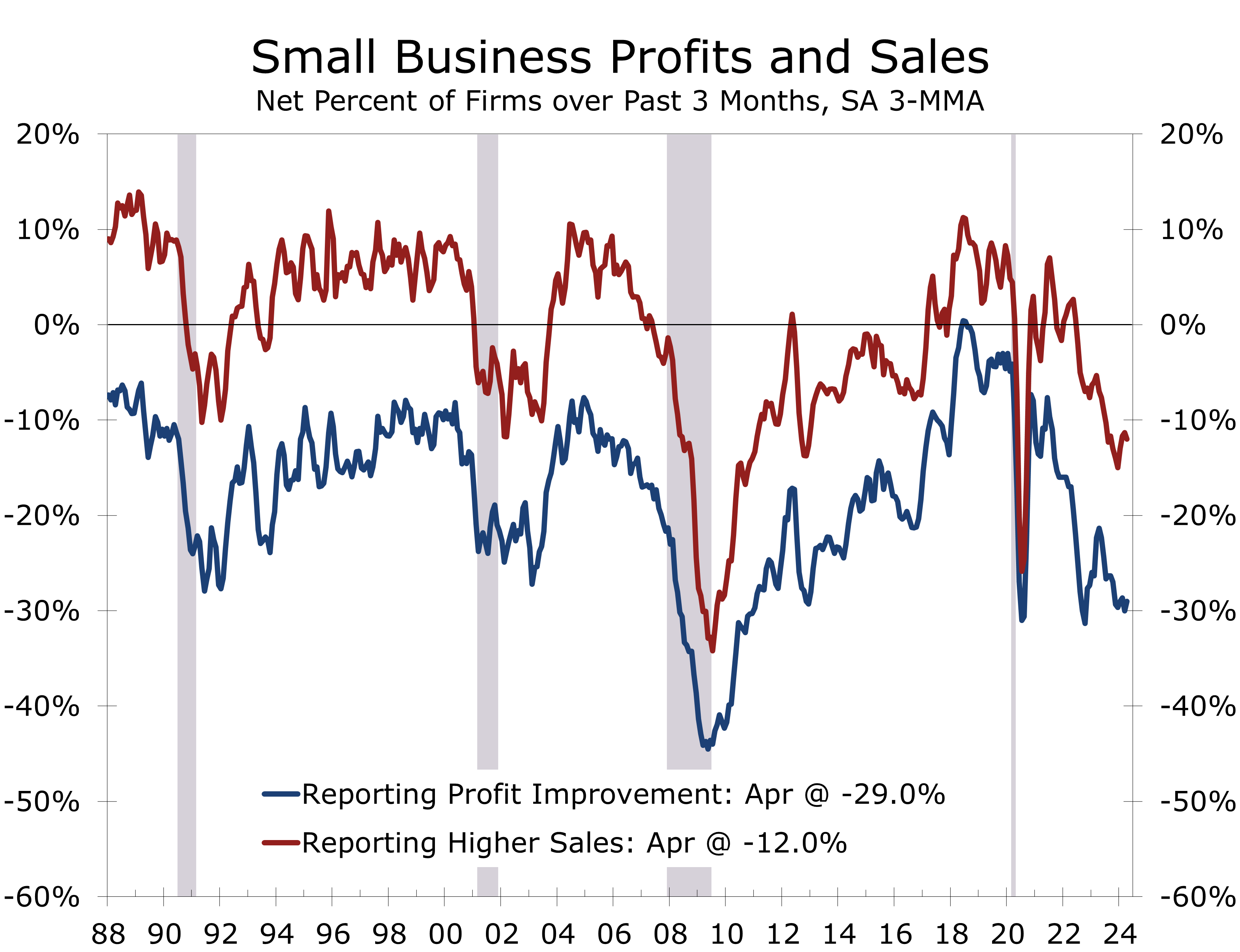
- Sales expectations remain negative, however, at -12, and the net share of owners reporting higher sales over the past 3 months fell 3 points to -13.
- Small businesses continued to get squeezed by rising operating costs that they are only partially able to pass onto their customers.
- Profits remain under pressure, with a net 27% of business owners reporting deteriorating profit trends.
- Despite the squeeze on operating margins, the share of business owners planning to raise prices fell 7 points in April to 26%.
- The share of business owners that feel now is a good time to expand remains low at just 4%, versus 26% prior to the pandemic.
- Small business owners have dealt with a persistent squeeze on operating margins since the pandemic. Labor costs, insurance and raw materials are all rising faster than selling prices, squeezing operating margins and weighing on growth, hiring and capex.
Small business optimism improved slightly in April, rising 1.2 points to 89.9. This marked the first increase this year and left the index close to its post-pandemic lows. Small Business Optimism has averaged 90.6 for the past 2 years, well below its long-run average of 98.
Seven of the index’s 10 components rose in April, led by a 6-point jump in sales expectations. Hiring plans rose 3 points, while earnings trends and capital spending plans edged up 2 points. All rose off of very low levels, however, and remain exceptionally weak.
Small business owners have been facing difficulties since pandemic relief ended. The Payroll Protection Program offered significant support during the economic lockdown. However, over the past two years, operating margins have been squeezed as wages, material costs, and insurance expenses have risen much faster than business owners can pass these higher costs onto their customers.
Small Business operating margins have been squeezed persistently over the past two years.
The persistent squeeze on operating margins has led to a huge pullback in the share of owners that feel that now is a good time to expand. Only 4% feel now is a good time to expand, with the 32% of respondents citing poor economic conditions and 11% citing an unfavorable political environment as the key reasons.
A net negative 13% of all owners reported higher nominal sales in the past three months, down 3 points from March. The drop in sales is expected to reverse, as the net share of small business owners expecting higher real sales volumes over the coming month rose 6 percentage points to a net negative 12%. Both sales reading are relatively weak, however, which a big reason why small businesses are having such a hard time passing along their higher costs.
With operating margins under pressure, owners are being more selective about hiring and capex.
The share of small businesses reporting improving profit trends was a net negative 27% in April, which is 2 points better than March but still very weak. Among those reporting lower profits, 33% blamed weaker sales, 14% pointed to rising material costs, 13% cited usual seasonal changes, and 12% attributed it to labor costs. Conversely, among those reporting higher profits, 43% credited increased sales volumes, 26% cited usual seasonal changes, and 11% attributed it to higher selling prices.
With operating margins under pressure, small businesses are being more selective about hiring and capital spending. Plans to hire edged up 1 point to 12% but remain well below recent years. Hiring plans averaged 17% last year and 21% in 2022.
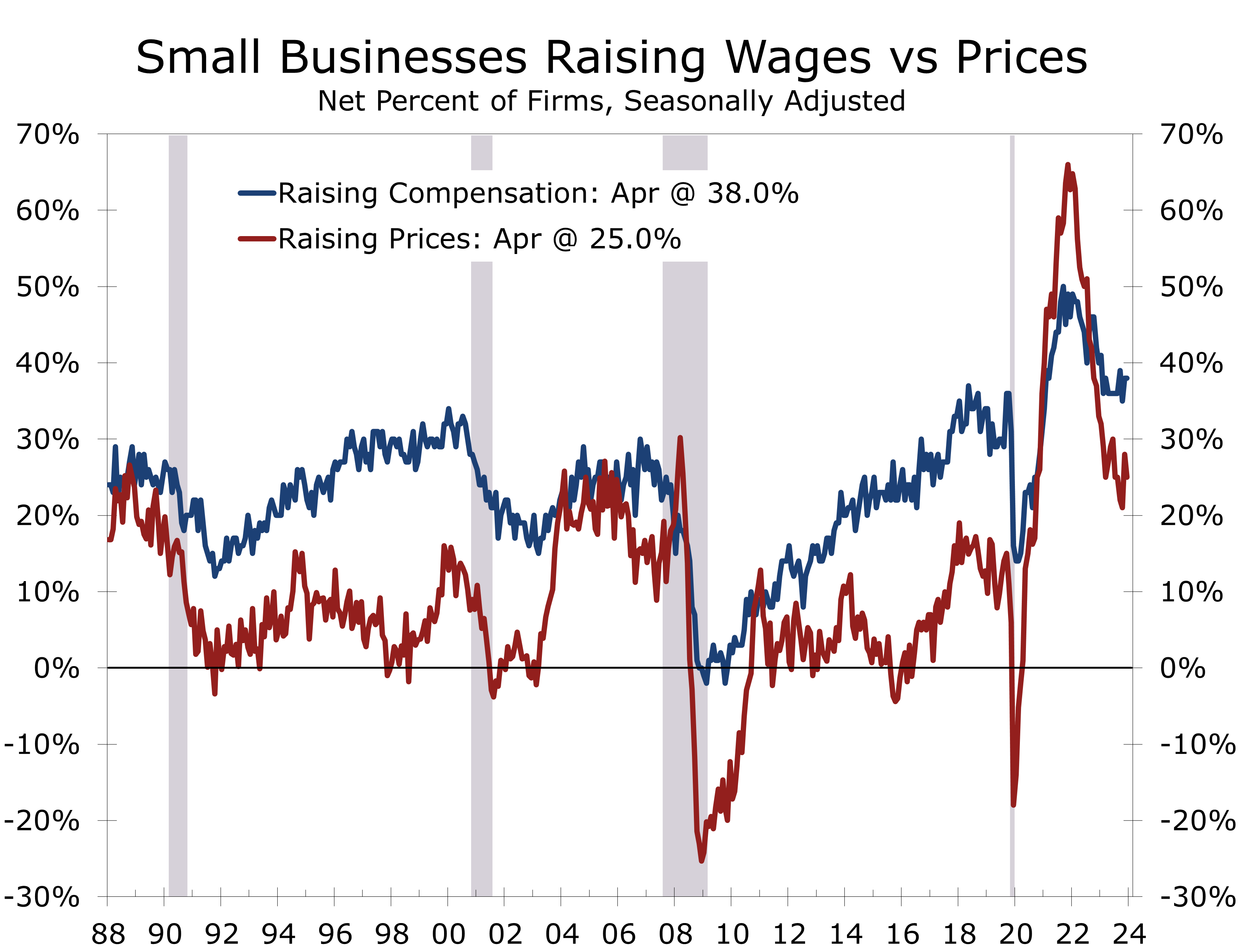
A net 38% of small businesses reported raising compensation over the past 3 months, the same as in March. Additionally, a net 21% plan to raise compensation over the next three months, also unchanged from March. Labor costs were cited as the top business problem by 11% of owners, an increase of 1 point from March and just 2 points below the peak of 13% recorded in December 2021. Meanwhile, 19% identified labor quality as their top business issue, up 1 point, and ranking just behind inflation (22%) as their most significant concern.
One reason higher compensation costs are so troubling is they are rising much faster than their ability to boost prices. This is particularly troubling for operators of retail shops and restaurants, where wages have spiked much more than they have for the overall economy.
The net percentage of business owners raising selling prices fell 3 points, reaching a seasonally adjusted net 25%. Moreover, a net 26% of owners plan to raise prices in April, down 7 points and marking the lowest level since last April. While the drop in pricing plans is good news for inflation, it also suggests businesses will pull back on hiring and capital spending, leading to slower economic growth ahead of the election.
Disclaimer: This publication has been prepared for informational purposes only and is not intended as a recommendation offer or solicitation with respect to the purchase or sale of any security or other financial product nor does it constitute investment advice.
April 14, 2024
Mark Vitner, Chief Economist
mark.vitner@piedmontcrescentcapital.com
(704) 458-4000