
Inflation Perks Back Up in January
- The Consumer Price Index rose largely in line with market expectations. The headline index rose 0.5% and the core rose 0.4%.
- The slide in inflation, so apparent during the second half of last year, is now moderating.
- The BLS updated the weights assigned to various components of the CPI to reflect the most recent survey of consumer spending patterns and updated their seasonal factors.
- Revisions to the seasonal factors slightly reduced inflation in the first half of last year and slightly raised it during the second half.
- Prices for food and energy items picked up in January, with food costs climbing 0.5% and energy prices rising 2%.
- Prices for labor-intensive services rose notably, including hotels (1.5%), nursing homes (1.4%), car repair (1.3%) and food away from home (0.6%).
- The January inflation data is supportive of recent Fed statements that “ongoing increases” in the federal funds rate target would be appropriate.
The monthly Consumer Price Index report continues to rival the employment report as the key piece of information released each month. The latest report came in close to expectations, which had been prepared for firmer price hikes by last week’s release of revised seasonal factors and component weights for the index. Those revisions had taken the shine off the lighter inflation numbers initially reported late last year. Most notably, December’s previously reported 0.1% drop in the headline CPI is now a 0.1% increase.
The adjustments to the seasonal factors and component weights will make the inflation data more relevant with current economic behavior. The shelter categories have been slightly increased, while weights for used cars and some other core goods – which saw prices fall last year – have been slightly reduced.
Shelter costs, which account for 43% of the core CPI, remain problematic. Rent and owners’ equivalent rent each rose 0.7% in January, even though market measures of asking rent for new tenants have eased considerably. The CPI measure of rents includes rents for new tenants and renewals of existing residents, the bulk of which are seeing significant increases due to earlier spikes in asking or market rents. Prices for hotel and motel rooms rose 1.5% in January, following a 1.2% rise the prior month and is up 8.5% year-to-year.
Residential rent and owners’ equivalent rent each rose 0.7% in January.
The bulk of the deceleration in inflation last year came from falling energy prices and lower prices for used cars. Further progress on each will be difficult this year.
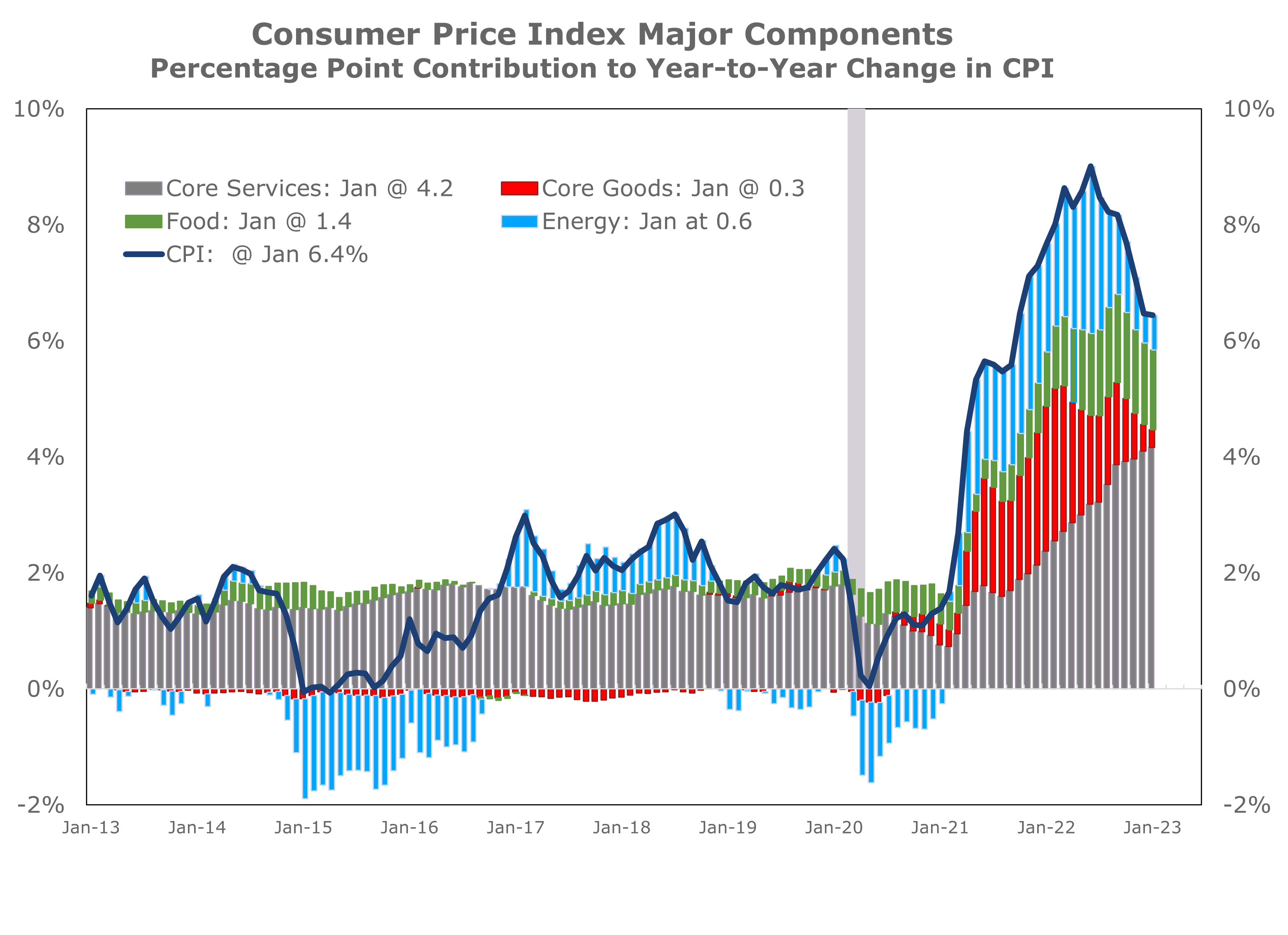
Energy prices fell sharply during the second half of 2022, benefitting from the record drawdown of reserves from the Strategic Petroleum Reserve and warmer than usual winter weather in Europe and the Northeast U.S. With heightened geopolitical pressures around the world, the now severely depleted Strategic Petroleum Reserve will need to be refilled, which will effectively put a floor under oil prices.
Used car prices will also provide less help in containing inflation. While used car prices fell 1.9% January, the Manheim used car price index edged higher, signally the bulk of price declines are behind us. Moreover, new car inventories remain exceptionally low, which should continue to divert demand to used cars. Higher vehicle prices are also fueling steep price gains for auto insurance, with the cost of vehicle insurance rising 1.4% in January and climbing 14.7% over the past year.
Higher vehicle prices are fueling steep price increases for auto insurance.
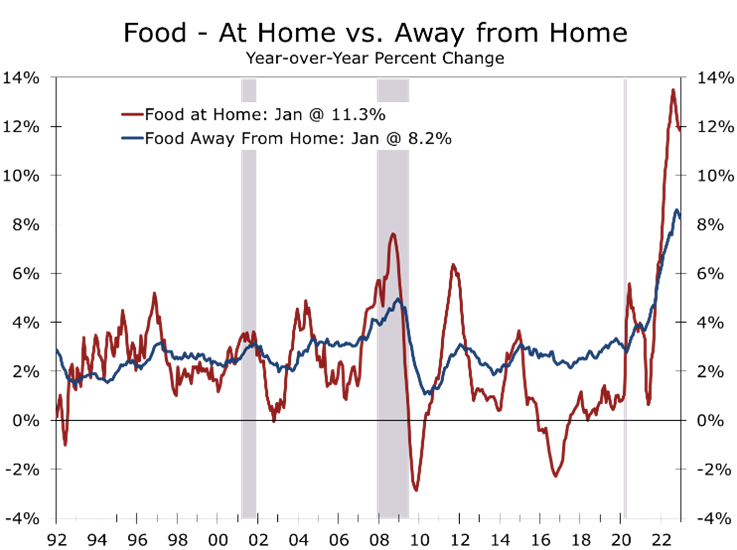
Food prices most likely head the list of consumers’ frustration today. Prices for food at home, which is mostly groceries, have spiked 11.3% over the past year. Eggs are the greatest source of pain, with prices surging 8.5% in January and 70.1% over the past year. Prices for many other food items, including meats (0.0%), pork (0.0%), poultry (-0.1%) and fish (-0.1%) all moderated in January, continuing recent trends.
The most problematic area for inflation remains core services, which include shelter as well as several labor-intensive categories. There has been considerable blowback at the BLS for how shelter costs are measured, with the BLS measuring rents paid for rental housing and the implied rent paid by homeowners. We feel the BLS’s measure is correct, with the 34% weight in the CPI closely corresponding with the share of income households devote to rent or its equivalent.
While the CPI rent measure lags several market measures, it does a good job of capturing actual changes in housing costs. Renters are facing steep increases as leases renew. Moreover, with more than a third of expenses tied to rent, higher residential rents feed back into wage demands.
With more than a third of expenses tied to rent, higher rents feed back into wage demands.
January’s CPI data, combined with the earlier reported stronger jobs data, have cleared the way for the Fed to move forward with hiking interest rates. Market expectations for the federal funds rate are now in line with the Fed’s, calling for at least two more quarter-point rate hikes this year and anticipating no cuts in interest rates until 2024 or later.

Disclaimer: This publication has been prepared for informational purposes only and is not intended as a recommendation offer or solicitation with respect to the purchase or sale of any security or other financial product nor does it constitute investment advice.