
The Biggest Game of the 2024 Season, So Far
- College football get real this week, with the 2nd-ranked Georgia Bulldogs traveling to Tuscaloosa to take on the 4th-ranked Alabama Crimson Tide. Both teams enter the game a ‘perfect’ 3-0.
- Georgia began the season strong, with a convincing 34-3 victory over currently 17th-ranked Clemson but struggled in its most recent game, winning 13-12 at Kentucky.
- Alabama has had a slower start, struggling to put points on the board early against relatively weak opponents in the first two weeks of the season before ultimately winning convincingly. The Tide looked much better in their most recent game, defeating Wisconsin 42-10.
- The Georgia economy has been on a roll recently, with huge investment in electric vehicle plants, battery plants, and green energy helping drive construction and manufacturing.
- The automotive sector has also been a key contributor to Alabama success. The state is also enjoying strong in-migration, particularly in Huntsville, Birmingham and along the Gulf Coast.
Unforeseen complications with travel, combined with an unusually busy schedule, forced us to call an audible last week and take Week 4 off from our nearly weekly football series. We had planned to cover the JMU-UNC matchup, which turned out to be one of the more notable blowouts of the week.
The most consequential game of Week 4 saw Tennessee visiting Oklahoma for the Volunteers’ first significant SEC test. Winning on the road is always difficult in the SEC, but the Volunteers passed the test convincingly, winning 25-15. Questions remains, however, whether Oklahoma is simply a middling SEC team. The Sooners had not previously been tested.
Week 5 brings a crucial top five matchup as #2-ranked Georgia visits #4-ranked Alabama.
Among several exciting Week 5 matchups, Georgia travels to Tuscaloosa to face Alabama. Both teams had byes last week, so they should be well-rested and healthy. Alabama has dominated Georgia in recent years and has benefitted from a significant edge in favorable calls and no-calls during legendary coach Nick Saban’s tenure. he Crimson Tide is now under the leadership of Kalen DeBoer, who guided Washington to the College Football Playoff last year. Georgia, which was ranked preseason number one, slipped to number two following their narrow 13-12 win over Kentucky in Week 3.
We have two reports this week. The first is a preview of the #2-ranked Georgia vs. #3 Alabama game, set for Saturday evening on ABC. This game should set the tone for the SEC race this year. Georgia faces one of the toughest regular season schedules ever devised, with road games against #4 Alabama, #1 Texas, and #5 Mississippi, before returning home to face #6 Tennessee. Alabama’s road ahead is slightly less daunting, as they host #2 Georgia, then go on the road to face #5 Tennessee, #16 LSU, and #15 Oklahoma, before returning home to host #7 Missouri.
The matchup between the nation’s second and fourth-ranked teams is expected to draw the largest television audience for a college football game so far this season. ESPN College Football GameDay will be in Tuscaloosa for the event. The game will be televised on ABC, with kickoff at 7:30 PM. Georgia and Alabama games have consistently ranked among the most-watched in the regular season, and their SEC Championship and playoff matchups rank among the most-viewed. On a historical note, the Georgia-Alabama matchup was the first college football game ever televised by ABC, and this year’s game will likely be the biggest one they have broadcast since winning the SEC contract from CBS.
Our second report attempts to make amends for last week and previews the UNC-Duke matchup. While a basketball contest between these two schools might be more enticing, this football matchup should be high scoring as well. UNC displayed little defense in their lopsided 70-50 loss to James Madison. Duke, meanwhile, has looked impressive so far this year, beating Middle Tennessee State 45-17 last week and edging out Big Ten academic powerhouse Northwestern 26-20 in overtime earlier this season. We will write more about James Madison later this year when they host the Marshall Thundering Herd in late November.
History of the University of Georgia
The University of Georgia (UGA), founded in 1785, holds the distinction of being the oldest public university in the United States. Established by the Georgia legislature in Athens, UGA was initially focused on classical studies and law. It later expanded its curriculum to include agriculture and mechanical sciences, particularly after receiving federal funding in 1872. Over the years, UGA has evolved into a major research institution with 17 different schools and a commitment to public service, boasting over 320,000 living alumni.
Spanning 762 contiguous acres, the UGA campus spreads southeast of its iconic Arch in downtown Athens. In 2011, the university acquired the 58-acre Navy Supply Corps School, enhancing its facilities. The Prince Avenue Campus now houses the Augusta University/UGA Medical Partnership and the College of Public Health, further broadening the university’s academic reach.
In the 19th century, UGA played a pivotal role in shaping higher education in the South. Despite facing significant challenges during the Civil War, including temporary closures, the university rebounded during the Reconstruction era by emphasizing inclusion and access to education. The mid-20th century marked another transformative period for UGA, particularly highlighted by the enrollment of its first African American students, Hamilton Holmes and Charlayne Hunter, in 1961. This event was a significant milestone in the ongoing struggle for equality in education.
Today, UGA is renowned for its strong programs in law, business, education, bioscience, and agriculture, having achieved Research I status due to its robust focus on research and innovation. The Terry College of Business, established in the late 20th century, has become one of the Southeast’s leading business schools. It is currently ranked among the top 15 public business schools in the nation, with 11 programs recognized nationally, including eight in the Top 10. The college emphasizes experiential learning through initiatives such as a student-managed investment fund and a variety of specialized master’s programs. Its state-of-the-art $140 million Business Learning Community, completed in 2019, is a campus unto itself and exemplifies UGA’s commitment to providing a premier educational environment.
The John M. Godfrey Department of Economics also contributes significantly to UGA’s academic offerings, producing rigorous research in public policy, labor economics, and monetary theory.
One of the newest schools is also one of the fastest growing: the UGA College of Engineering, established in 2012, which has grown to 2,400 students.
With a vibrant student body exceeding 42,000, UGA also boasts a rich athletic tradition, particularly in football, while playing a crucial role in the local economy by driving workforce development and public service throughout Georgia. Its enduring legacy continues to shape the educational, cultural, and economic landscape of the state and beyond.
Athens, Georgia
Athens is a quintessential college town located about 70 miles northeast of Atlanta. The four-county Athens-Clarke County MSA has a population of 222,060, while the state’s flagship university has over 42,000 enrolled students. Sanford Stadium seats 93,033. Construction of the stadium, which is built in the valley of a creek near the center of campus, began in 1928, and the first game was played on October 12, 1929, against Yale. The Bulldogs won that game 15-0, and Yale donated their share of the gate receipts to the University to help repay the stadium construction loans. Georgia has long had a close connection with Yale, one of the early powerhouse football programs that helped spread the sport nationwide. Yale’s visit to Athens marked their first game in the South, drawing a record 30,000 fans who paid $3 each—the largest crowd for a football game in the South at the time.
The famous hedges around Dooley Field, named for Coach Vince Dooley, have been a part of the stadium since its opening, except for two key moments. In 1996, the hedges were removed to host soccer matches for the Atlanta Olympics, but new hedges were replanted using 2,100 clippings from the originals. They were also temporarily relocated during the construction of a new locker room and scoreboard on the west end. This year, the hedges planted after the Olympics began being gradually replaced with clippings from the originals once again.
The Athens MSA is part of the much larger Atlanta-Athens-Clarke County-Sandy Springs Combined Statistical Area (CSA), which boasts a 2023 population of 7.2 million and is the economic heart of the Southeast. While part of the broader CSA, Athens is far enough away from Atlanta that it has its own distinctive vibe and is a regional hub in its own right. Its vibrant downtown is full of restaurants, bars, and entertainment establishments, reflecting the growth of its influential music scene that produced leading-edge bands such as the B-52’s, R.E.M., Widespread Panic, Pylon, and the Drive-By Truckers.
The Birthplace of Alternative Rock
The music scene has been a significant cultural force in Athens since the 19th century, evolving through various styles and genres to create a unique sound known as the “Athens Sound.” This scene is notable for its influence on alternative rock and new wave music, producing globally recognized bands and a vibrant local culture.
The music scene in Athens traces back to Native American influences from the Creek and Cherokee tribes. By the time the city was chartered in 1806, it began to grow as a musical hub, particularly during the Civil War when it attracted major touring acts. The Morton Theatre, founded in the early 20th century, quickly became a cornerstone for African American performers and the local music scene, highlighting the city’s rich cultural tapestry.
The 1950s and 1960s music scene was characterized by dance events featuring popular bandleaders. Notable venues included Allen’s Hamburgers and the Canteen, where bands like The Jesters performed. By the late 1960s, the emergence of local bands marked a shift to more original acts. This period saw bands like the Normaltown Flyers and Dixie Grease gain prominence, setting the stage for a more diverse rock scene.
The B-52’s, formed in 1977 after a Valentine’s Day party, brought a campy, new wave aesthetic that would define Athens’ quirky style. Their hits like “Rock Lobster” and “Love Shack” garnered international attention. R.E.M., founded in 1980, quickly became the defining band of the Athens Sound. Their early hit “Radio Free Europe” was a breakthrough hit that eventually led to mainstream success with albums like “Out of Time” and “Automatic for the People.” Their blend of jangle pop and lyrical depth solidified Athens’ reputation as a rock hub. Pylon, formed in 1979, was integral to the local scene, known for their danceable sound and influence on the post-punk movement.
The 40 Watt Club, founded in 1978, became a central location for indie rock performances. Other notable venues include the Georgia Theatre, Caledonia Lounge, and the Foundry Music Venue. The Georgia Theatre has a storied history, having reopened in 2011 after a devastating fire. Events like AthFest and Athens Popfest celebrate local talent and foster a sense of community within the music scene.
The 1990s saw the Athens sound go mainstream, with bands evolving into a more eclectic style that melded numerous genres, most notably the grunge/alternative genre, which took off in Seattle. Some of the top bands of the era include Elf Power, Neutral Milk Hotel, and Of Montreal. While indie rock, punk, and pop music tend to typify the music scene, Athens has also birthed numerous bluegrass and folk artists and played a key part in the emergence of the Americana genre. Bands like the Drive-By Truckers and the Holman Autry Band have incorporated elements of country and rock, enriching the local musical landscape. Recent years have seen the rise of a Latin music scene, along with significant contributions from singer-songwriters and contemporary Christian artists.
Some of the top Athens-based music acts today include the Asymptomatics, Hotel Fiction, Dawes, and Wim Tapley & The Cannons. Athens recently landed a minor league hockey team that will debut this season in the brand-new Akins Ford Arena in downtown Athens. The team, dubbed the Athens Rock Lobsters in homage to the B-52s, is likely the band most responsible for kicking the Athens music scene into higher gear, which really took off with the rapid success of R.E.M.
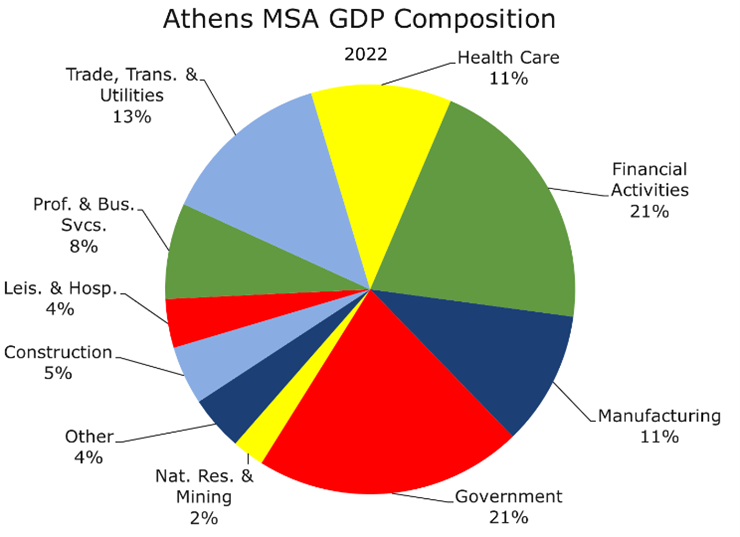
The Athens economy has shifted from its manufacturing and agriculture roots to an “eds and meds” strategy, typical of many college towns. The largest employers today are the University of Georgia, Piedmont Athens Regional Medical Center, Athens-Clarke County government, and St. Mary’s Health Care System. The University of Georgia is also establishing its own medical school, set to open by 2026, to address the state’s physician shortage, with about a third of Georgia’s doctors nearing retirement.
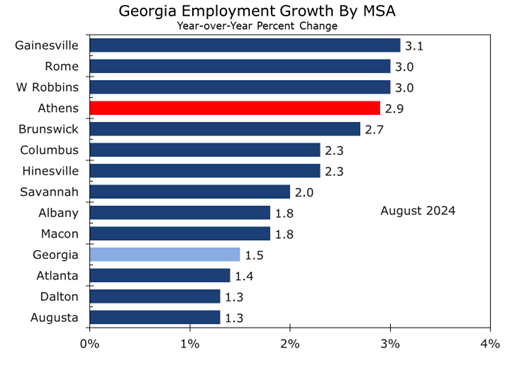
While the University’s ties are deep, private employment has been growing at an average 2.2% annual pace over the past year. Major private employers include Caterpillar, whose 1,000-employee Bogart plant is the area’s largest manufacturing employer, Pilgrim’s, DialAmerica, and Carrier Transicold. Business-friendly regulations and low costs are assets for small businesses. Athens also saw its first major film studio open this past year, Athena Studios.
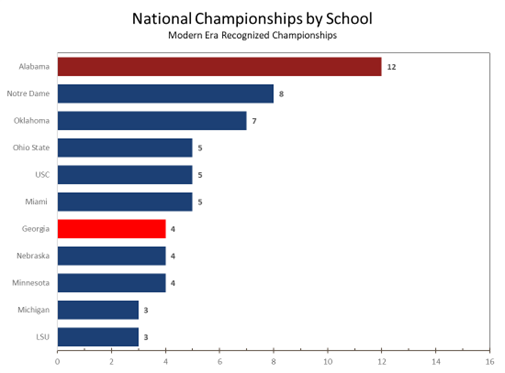
Georgia began playing football in 1892 and can lay undisputed claim to four national titles—1942, 1980, 2021, and 2022. The NCAA officially recognizes Ohio State as the national champion for 1942. The Buckeyes went 9-1 that year, with wins over #4 Michigan and #13 Illinois but a mid-season loss at #6 Wisconsin. Georgia finished that season 11-1 and shut out six of its 12 opponents, including a 34-0 thumping of #2-ranked Georgia Tech. Georgia also defeated #3-ranked Alabama that year. Georgia’s lone loss was to unranked Auburn.
The final AP poll was taken in late November of that year, well before the bowl games, and Georgia finished closely behind Ohio State. Georgia went on to defeat #13 UCLA in the Rose Bowl, and every major poll except the AP recognized them as national champion. Our count of national champions corrects this historic error. The 1942 team featured Heisman Trophy winner Frank Sinkwich, and Charlie Trippi was one of the best Georgia teams of all time. The 1980 team, which won an undisputed national championship, featured future Heisman Trophy winner Herschel Walker. The 2021 and 2022 teams featured Stetson Bennett, the former walk-on who won numerous awards and was the MVP of every college playoff game he played.
Four other Georgia teams can also lay some claim to being national champions, including the 1920 team headed by first-year coach Herman Stegeman, which went 8-0-1 and was the first Georgia team to go undefeated, outscoring opponents 250-17. The Bulldogs have 844 wins, the 11th most all-time. The team’s beloved live mascot is Uga XI, the eleventh English bulldog of the same lineage to represent the university’s sports teams.
UGA X is the all-time winningest bulldog, with the Dawgs going 91-18 under his watch, including back-to-back national championships. UGA wears a spiked collar and a red jersey and is considered a member of the team. He gets slightly better treatment than the players, however, with an air-conditioned doghouse on the sidelines to cool off during those hot early game days. One of the Bulldogs’ more recent traditions, begun under coach Mark Richt, is the Dawg Walk, when the players march from the buses on Lumpkin Street between two lines of fans into Sanford Stadium.
History of the University of Alabama
The University of Alabama (UA), founded in 1831 in Tuscaloosa, is the flagship institution of higher education in Alabama and one of the oldest public universities in the U.S. Initially offering a classical education, it was among the first five schools in the nation to provide engineering classes. The university faced significant challenges during the Civil War, including substantial damage to its campus, but continued to grow during Reconstruction, adding a law school in 1872 and the College of Engineering and School of Education in 1909.
Throughout the 20th century, UA became a focal point in the Civil Rights Movement, desegregating its campus in 1963 with the enrollment of African American students Vivian Malone and James Hood. Today, UA has approximately 38,000 students and is classified as a Very High Research Activity institution by the Carnegie Classification System. It is known for its strong academic programs in law, business, engineering, and the sciences, along with a vibrant athletic tradition, particularly in football, boasting multiple national championships. The University of Alabama continues to play a vital role in workforce development and innovation, upholding its legacy as a leading institution in the South and beyond.
Alabama Football History
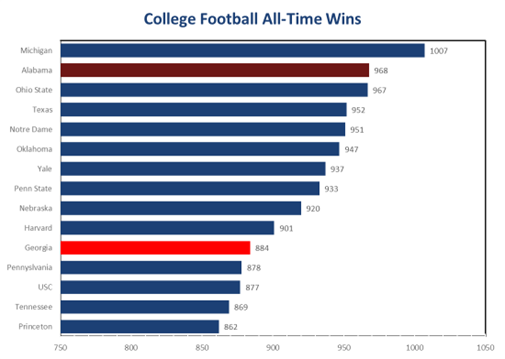
The University of Alabama football program, established in 1892, is one of the most storied in college football history. Since the inaugural season, the Crimson Tide have accumulated 968 wins, 18 national championships (xx in the modern era), and a record 73 bowl appearances. Legends of the program include coach Paul ‘Bear’ Bryant, Joe Namath, Bart Starr, Shaun Alexander, and Heisman Trophy winners Mark Ingram and Derrick Henry. In recent years, the program has been a dynasty, winning national titles in 2009, 2011, 2012, 2015, 2017, and 2020.
Under the leadership of legendary coach Paul “Bear” Bryant from 1958 to 1982, Alabama became a dominant force, securing six national championships during his tenure. The tradition of success continued with coaches like Gene Stallings, who led the Crimson Tide to a national title in 1992, and Nick Saban.
Nick Saban became the head coach of the University of Alabama football team in January 2007, following an uncharacteristically down period for the program. His tenure has included six national championships (2009, 2012, 2015, 2017, 2020, and 2021), establishing Alabama as a perennial powerhouse. Saban’s teams consistently finish in the top 10, excelling in player development, with numerous NFL talents, including multiple Heisman Trophy winners. His emphasis on discipline and preparation, known as “The Process,” has influenced coaching strategies nationwide. Additionally, Saban’s recruiting dominance has secured top-ranked classes, while many of his former assistants have launched successful coaching careers, further cementing his legacy as one of college football’s most celebrated coaches.
Alabama has produced numerous star athletes who have left an indelible mark on the sport. Notable players include Joe Namath, Johnny Musso—a standout running back from the 1960s—and defensive legends like Derrick Thomas and Cornelius Bennett. More recently, stars such as Mark Ingram, the 2009 Heisman Trophy winner; Derrick Henry, the 2015 Heisman Trophy winner; DeVonta Smith, the 2020 Heisman Trophy winner; and quarterbacks Tua Tagovailoa, Mac Jones, and Bryce Young, the 2021 Heisman Trophy winner, have furthered Alabama’s legacy.
The Crimson Tide’s success is underscored by their record 18 national championships and a reputation for producing NFL talent, consistently ranking among the top programs in the country. Alabama’s rich football history is marked by intense rivalries, particularly with Auburn in the Iron Bowl, and a passionate fan base that fills Bryant-Denny Stadium, making it a pillar of college football culture.
The university’s Center for Business and Economic Research estimates its statewide impact at $2.9 billion and nearly 14,000 jobs. Each of the seven home games last year, where fans flooded into Tuscaloosa to fill the 101,821-seat Bryant-Denny Stadium, generated $20 to $25 million in economic activity for the metro area. Unsurprisingly, Alabama has the third most financially valuable football program, behind Texas and Notre Dame.
Tuscaloosa Beyond Football
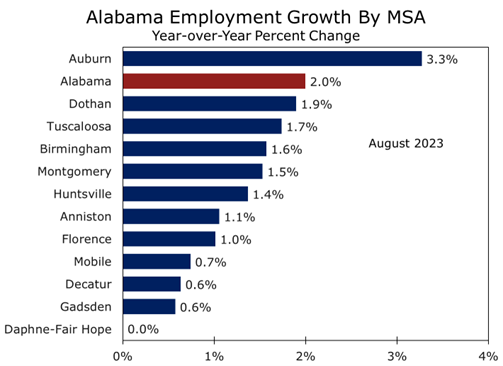
Tuscaloosa serves as the economic heart of west-central Alabama, located about 60 miles southwest of Birmingham. The metro area has a population of approximately 278,290 residents. Founded in 1819, the city initially thrived on agriculture and trade, benefiting from its location along the Black Warrior River. The establishment of the University of Alabama in 1831 solidified its economic significance, providing jobs and attracting students and faculty.
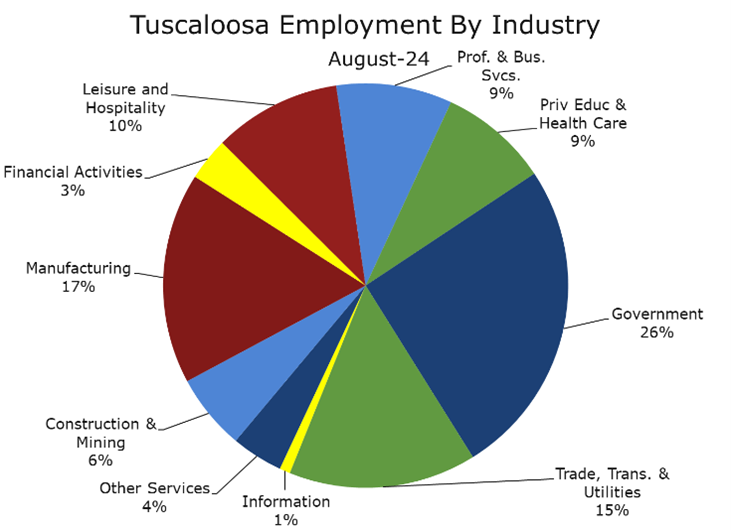
Throughout the 20th century, Tuscaloosa transformed into a manufacturing hub, with industries such as textiles, steel, and automotive taking center stage. The arrival of Mercedes-Benz in 1993 marked a pivotal moment, as it opened its first U.S. plant in the area. This facility not only established Tuscaloosa as a major auto production center but also paved the way for the state to become a significant producer and exporter of light vehicles and trucks.
Mercedes-Benz’s operations have expanded significantly since its initial $400 million investment, with a goal of hiring 1,500 workers. The project quickly exceeded these expectations, transforming the state’s economy and marking a turning point in Alabama’s industrial development. There is a clear pivot in Alabama’s economy between the period before Mercedes established its plant in Tuscaloosa and afterward, highlighting the state’s shift from its historical reliance on textiles and apparel to automotive, aerospace, and other areas of advanced manufacturing.
Mercedes-Benz has now invested over $7 billion in its Alabama operations, with its workforce growing to more than 6,300 employees. The Tuscaloosa plant, which initially produced the M-Class SUV, has manufactured over 4 million vehicles and is now a major hub for producing the GLE, GLE Coupe, and GLS SUVs, as well as the luxury EQS and EQE electric SUVs.
Mercedes-Benz’s decision to establish operations in Alabama paved the way for other automakers, including Honda, Hyundai, and Mazda-Toyota, to build manufacturing plants in the state. Collectively, Alabama’s auto industry has seen around $15 billion in investments, supporting over 50,000 direct jobs. Vehicle production capacity now exceeds 1.3 million units annually, earning Alabama a Top 5 ranking in U.S. auto production. In 2023, Alabama-made motor vehicle exports reached $11.2 billion, solidifying the state as a leading exporter of automobiles.
As the auto industry evolves toward electric vehicles (EVs), Mercedes-Benz is again at the forefront. In 2022, the company invested $1 billion to launch EV production at its Tuscaloosa facility, including the construction of a battery assembly plant. The site now produces both the EQS and EQE electric SUVs, underscoring Mercedes-Benz’s leadership in Alabama’s shift toward sustainable automotive production.
Alabama’s commitment to workforce development, exemplified by initiatives such as the $30 million EV-focused training center in Decatur, ensures that the state remains a key player in the global auto industry. Mercedes-Benz’s presence in Tuscaloosa has undoubtedly positioned Alabama as an automotive powerhouse with a bright future, driven by continuous innovation and investment.
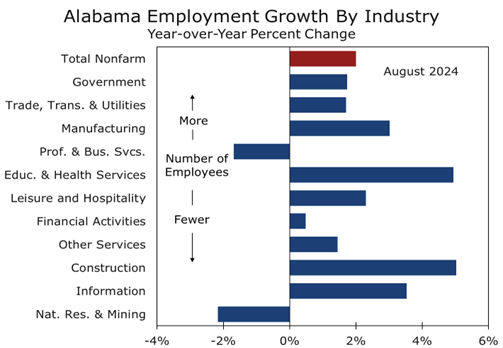
Alabama’s economy has been thriving recently, driven by continued investment in the automotive industry and strong growth in the aerospace and healthcare sectors. The state’s steel industry is also performing well, benefiting from the influx of companies opening plants in Alabama and across the South. However, agriculture has faced challenges due to higher operating costs and extreme weather.
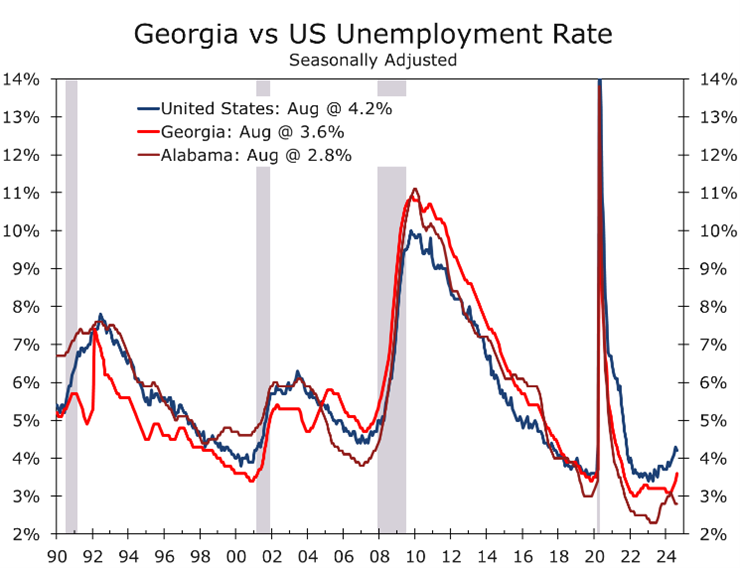
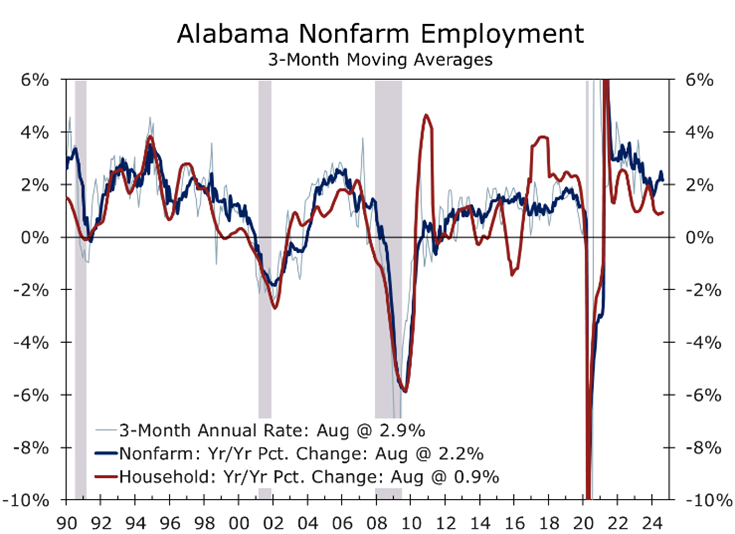
Nonfarm employment has increased by 2.2% over the past year (based on a three-month moving average), with job growth accelerating to a 2.9% pace in the past three months. This contrasts sharply with the national trend, where job growth has slowed to 1.5% annually, with employers adding just 116,000 jobs per month on average, equating to a modest 1.0% growth rate.
In the past 12 months, Alabama has added 43,200 net new jobs, mostly in the private sector. Healthcare and manufacturing were the standout sectors, with healthcare providers adding 12,000 jobs and manufacturers contributing 8,500 new positions. Within manufacturing, the biggest gains were seen in transportation equipment, fabricated metals, and food processing.
Week 5 features a highly anticipated top-five showdown as Georgia heads to Tuscaloosa to face Alabama. The advent of the expanded College Football Playoff, now including 12 teams instead of 4, and conference expansions to the Big Ten and SEC slightly diminish the stakes, as the loser will likely still be in contention for a playoff spot and potentially an SEC Championship berth. That said, winning this game may be more critical for Georgia, as winning on the road in the SEC is always difficult. The Dawgs will also have to travel to Austin and Oxford to face the #1-ranked Longhorns and #5-ranked Rebels.
Georgia comes into the game a bit banged up, missing one of its key transfers, wide receiver London Humphreys from Vanderbilt, who was a standout in Georgia’s opening-day win over Clemson. Quarterback Carson Beck is also nursing a sore shoulder on his non-throwing arm, and the offensive line is without key player All-American guard Nate Ratledge. Alabama has a few players with nagging injuries but appears to be at full strength for the game.
There has already been considerable talk about this game possibly being a preview of future matchups, with Alabama and Georgia potentially meeting three times (SEC Championship and College Football Playoffs). Such speculation focuses too much on “ifs” and imagined scenarios. Make no mistake—this game is critical. The winner will be in the driver’s seat for the SEC Championship, while the loser will have to tread carefully to avoid another loss.
Georgia enters as a 2.5-point favorite but appears thin and banged up. The Georgia defense, which hasn’t allowed a touchdown in the first three games and has given up just 18 points, must stop Alabama’s rushing attack, made more challenging by talented dual-threat QB Jalen Milroe.
Georgia must also avoid turnovers, something they have done well this season, despite recovering several of their own fumbles. The Dawgs’ running game needs to step up, especially with a thinner offensive line. Protecting Carson Beck is crucial, giving him time to distribute the ball to Georgia’s talented receivers and tight ends.
Alabama’s key to victory lies in controlling the game’s tempo by establishing the run and managing the clock to limit Georgia’s scoring opportunities. If successful, Milroe should find chances to throw deep, where he has excelled.
This early-season top-five matchup is a highlight for fans in the new era of college football, with NIL deals and the transfer portal creating a form of free agency. Several teams, including half the SEC and Ohio State, now have deep rosters full of future NFL draft picks, making this game all the more exciting.
Former President Donald Trump plans to attend, in what could be the most-watched college football game of the season. Trump, a big fan of the sport, was also present at the classic 2017 National Championship game, where Alabama came from behind at halftime and won in overtime with a long pass from Tua Tagovailoa to DeVonta Smith. Trump is a close friend of Herschel Walker, the former Heisman Trophy winner who left Georgia a year early to play for Trump’s New Jersey Generals in the USFL. While Trump has no personal favorite in this game, he generally supports whichever team wins. That said, the election race is expected to be extremely close in Georgia, while a Trump victory is virtually assured in Alabama. Since both teams share the color red, he will likely just don his MAGA hat.
Disclaimer: This publication has been prepared for informational purposes only and is not intended as a recommendation offer or solicitation with respect to the purchase or sale of any security or other financial product nor does it constitute investment advice.
September 26, 2024
Mark Vitner, Chief Economist
Piedmont Crescent Capital
mark.vitner@piedmontcrescentcapital.com
704-458-4000