GDP Report: Third-Quarter Growth Revised Up to 4.3%, but October Spending Stalls
Real GDP growth was revised up 0.9 point to 4.3% and corporate profits rose another $206 billion, but real consumer spending was flat in October and core inflation held at 0.3% for the month.
EARLY SIGNAL
- Real GDP was revised up to a 4.3% annual rate in the third quarter. The advance estimate was 3.4%, so the revision added 0.9 point, with investment and consumer spending accounting for most of it. Nominal GDP rose a solid 6.2%, up from 5.6% in the advance estimate.
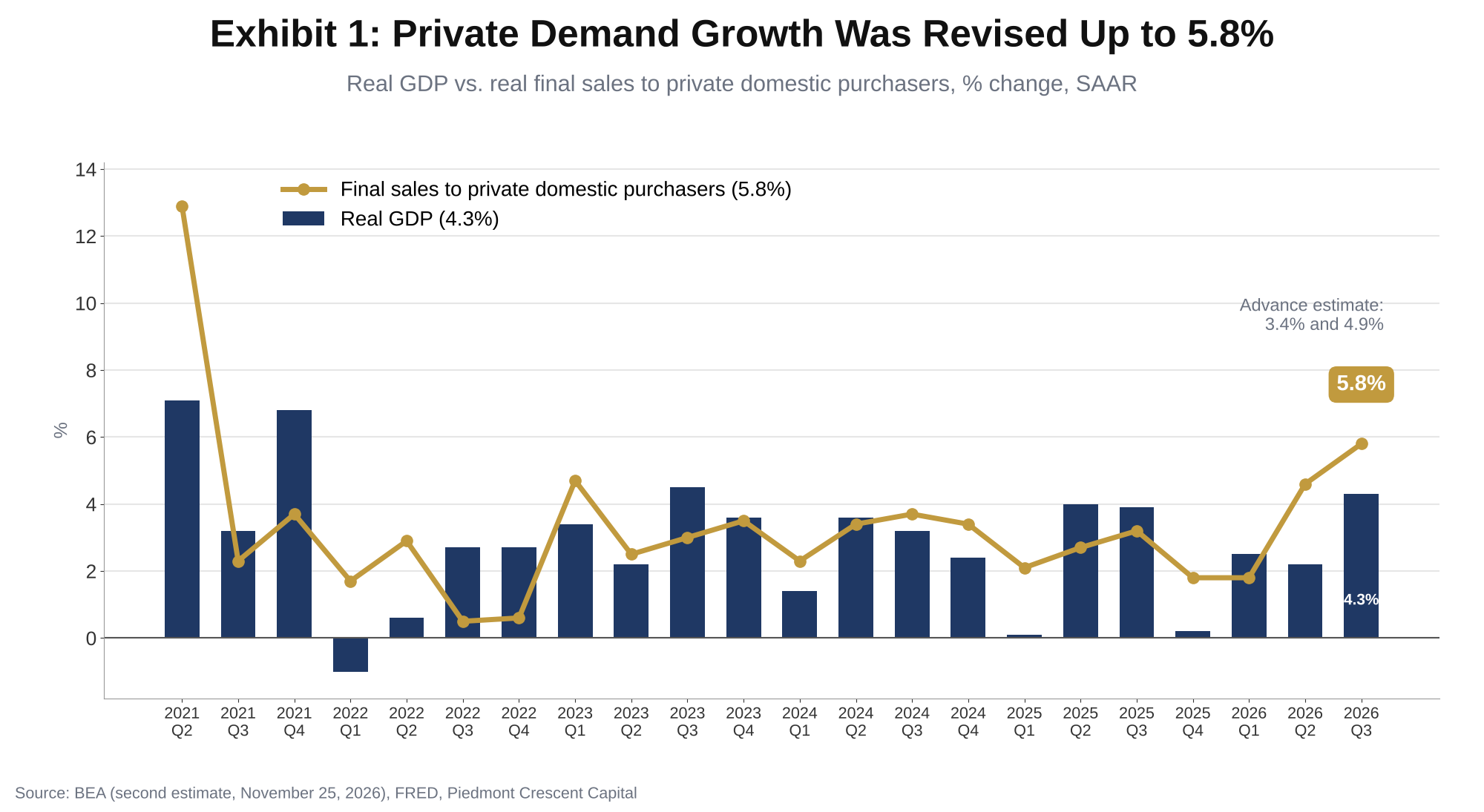
- Real final sales to private domestic purchasers rose 5.8%. That is up from 4.9% in the advance estimate and 4.6% in the second quarter, and it is the fastest pace since the second quarter of 2021, during the pandemic recovery. It remains our preferred measure of underlying demand and makes a strong case for a December rate hike.
- The income side of the accounts agrees with the spending side. Real gross domestic income rose 4.4%, up from 2.3% in the second quarter, and the average of real GDP and real GDI also rose 4.4%.
- Business fixed investment has risen to 15.0% of GDP. Nonresidential fixed investment was $4.96 trillion at an annual rate, up from 14.5% of GDP in the second quarter and 14.2% a year ago. It is the highest share since early 1982.
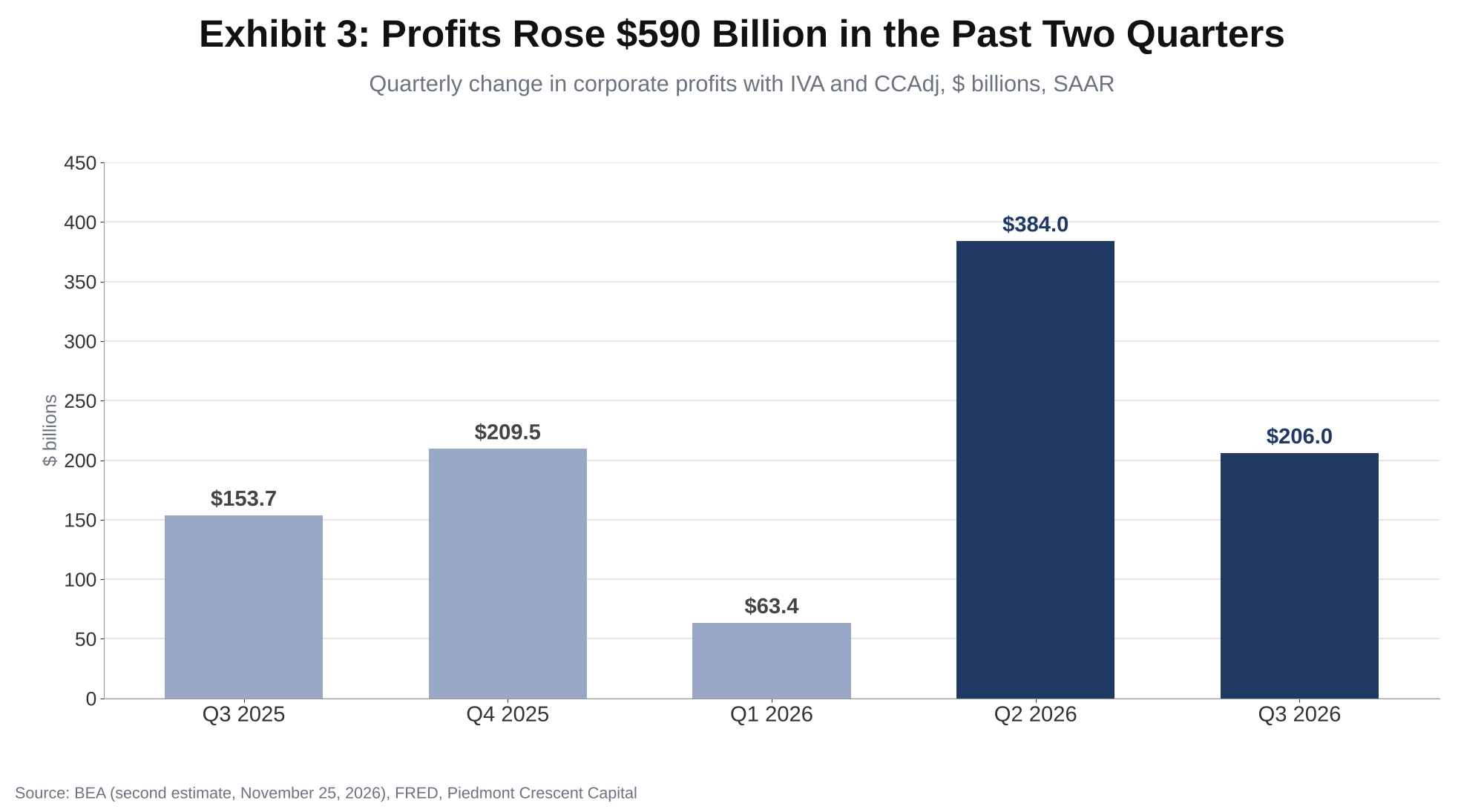
- Corporate profits rose $206.0 billion. That follows a $384.0 billion increase in the second quarter, and profits are up about 21% from a year ago. By our calculation they now equal about 14.9% of GDP, up from 13.0% a year earlier.
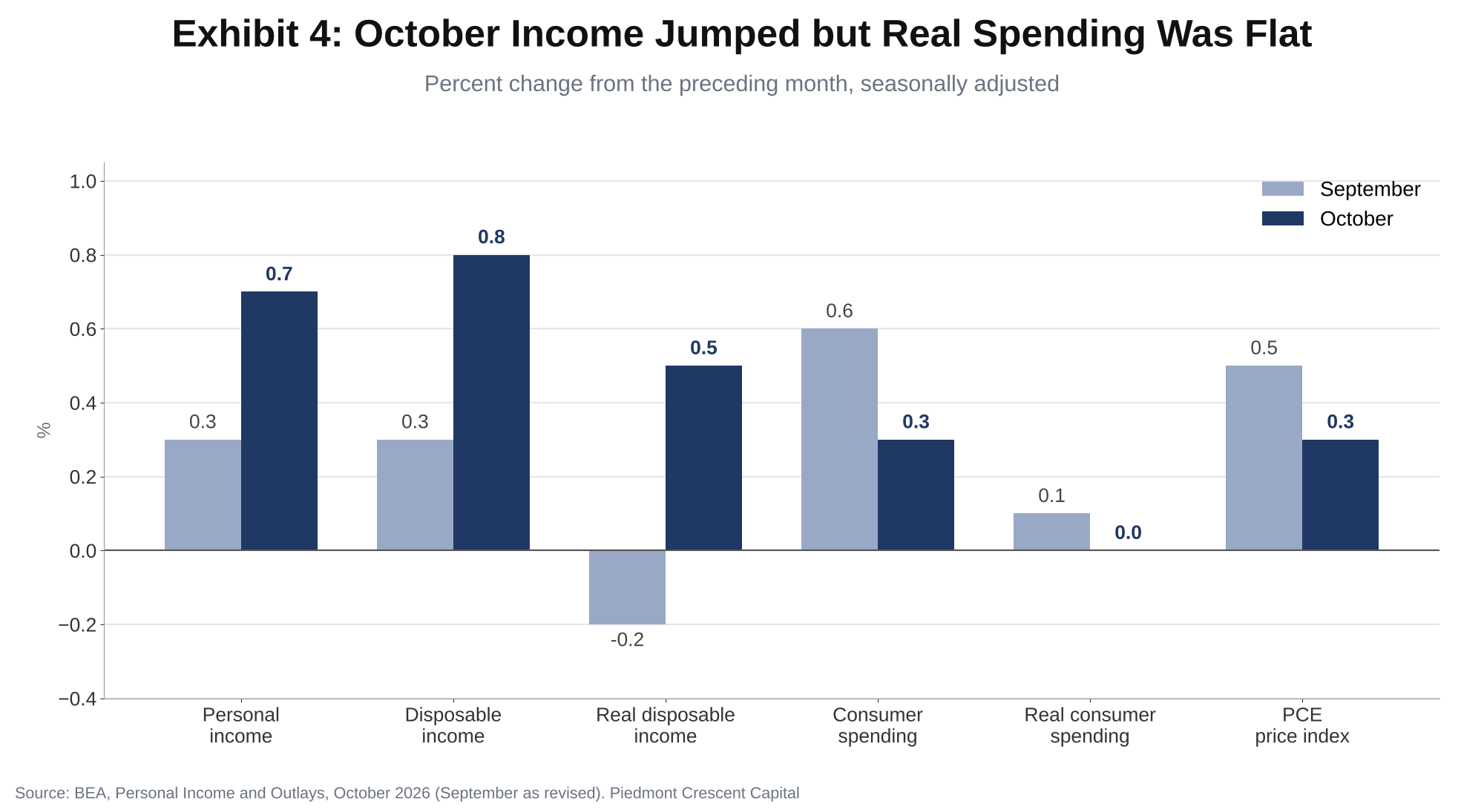
- Personal income rose 0.7% in October, but real consumer spending slipped. Income rose $201.8 billion, helped by a one-time Medicare premium rebate. Real consumer spending fell $5.8 billion, and the saving rate was 4.1%.
- Inflation held at a firm pace. The PCE price index rose 0.3% in October, as did the index excluding food and energy, leaving them 3.8% and 3.3% above a year ago.
OVERVIEW
Real GDP rose at a 4.3% annual rate in the third quarter, 0.9 point faster than the advance estimate. The second estimate incorporates Census services data and revised price indexes that were not available a month ago. BEA also released the first estimate of third-quarter corporate profits, and this morning's October personal income and outlays report gives us a first read on the fourth quarter.
We matched the 3.4% advance estimate on October 29 and noted that the first estimate is not the last. The 0.9 point revision fits the capital-led expansion we have described all year.
Private demand grew 5.8% in the third quarter, and the income side of the accounts also grew solidly.
WHAT CHANGED IN THE REVISION
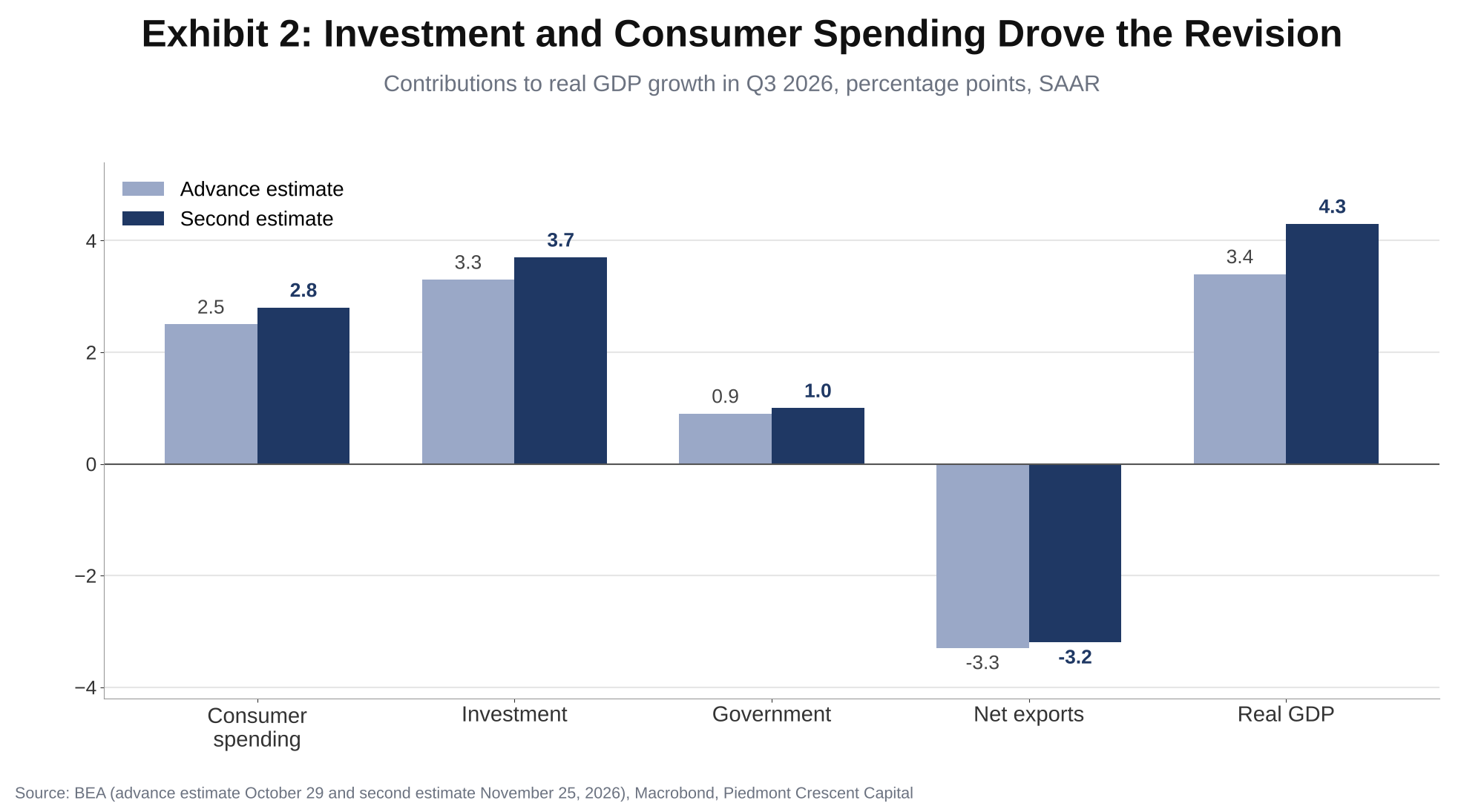
Investment and consumer spending did the lifting. Investment contributed 3.7 points, up from 3.3 in the advance estimate, and consumer spending contributed 2.8 points, up from 2.5 (Exhibit 2). Government added 1.0 point, up from 0.9, and net exports subtracted 3.2 points, 0.1 less than before.
The investment revision was led by software. BEA revised intellectual property products, notably software, based on revisions to the producer price index for software publishing. The price index for gross domestic purchases was revised down 0.3 point to 2.7%, while nominal GDP growth was revised up 0.6 point to 6.2%. Roughly two-thirds of the 0.9 point revision to real growth therefore came from higher nominal spending and one-third from lower measured prices. Software is part of the AI buildout we have emphasized. Nonresidential (business) fixed investment now stands at 15.0% of GDP, the highest share since early 1982, which supports our view that the economy is more capital intensive than it used to be.
Today's durable goods report was mixed on the surface and strong underneath. Orders rose 0.2% in October as a 0.3% decline in the volatile transportation series weighed on the headline. Core capital goods orders, which exclude transportation, rose 1.2% and machinery orders rose 1.8%. The strength is likely tied to the data center buildout, defense replenishment and the booming space economy. We read the transportation weakness as noise and see business fixed investment remaining exceptionally strong. We have slightly increased our estimate for fourth-quarter capital spending and see all three components of business fixed investment (equipment, structures and intellectual property products) growing solidly during the period.
Consumer spending was revised up for goods and down for services. Goods were revised up, led by pharmaceuticals, recreational goods and vehicles (mainly computer software and accessories), and gasoline and other energy goods. Services were revised down, led by health care, after newly available Census third-quarter services survey data. The health care revision trims the Peak 65 contribution to the quarter but does not undo it.
CORPORATE PROFITS
Profits from current production rose $206.0 billion in the third quarter. That follows a $384.0 billion gain in the second quarter, so profits have added $590 billion in two quarters (Exhibit 3). Adding the third-quarter gain to the second-quarter level from the Federal Reserve Bank of St. Louis puts profits at about $4.92 trillion at an annual rate, up 21% from a year earlier. Nominal GDP rose 6.0% over the same period by our calculation, and profits rose from 13.0% of GDP to about 14.9%.
Profits are growing more than three times as fast as nominal GDP.
The release carries no detail by industry or on taxes, dividends and retained earnings. BEA publishes that detail with the third estimate on December 23, and we will use it to see whether the gain was concentrated in a few sectors.
The gain also bears on our view of the labor share. We have argued that the global labor supply shock behind the long decline in labor's share of income is over and that the mechanism should now run in reverse, with compensation's share of national income higher in 2027 than the 61.7% recorded for 2025. Third-quarter profits growing far faster than output is not yet evidence of that reversal, and we will check the call against the annual revisions next September.
OCTOBER PERSONAL INCOME AND SPENDING
Personal income rose $201.8 billion, or 0.7%, in October, and disposable income rose 0.8%. Real disposable income rose 0.5% after falling 0.2% in September. BEA attributes the gain to compensation, government social benefits and dividends. Within social benefits, the increase was led by one-time payments associated with the Medicare Improvement Fund premium rebate, so we would not carry October's pace of income growth forward.
Spending did not follow. Consumer spending rose $63.8 billion, or 0.3%, in nominal terms, with $11.8 billion in goods and $52.1 billion in services. Prices rose 0.3%, so real spending fell $5.8 billion, less than 0.1%, after rising 0.1% in September (Exhibit 4). Other nondurable goods, mainly pharmaceuticals, added $17.9 billion and final expenditures of nonprofit institutions added $14.8 billion, while motor vehicles and parts subtracted $13.9 billion.
Households saved the difference. Disposable income rose $200.5 billion and outlays rose $69.3 billion, which leaves about $131 billion more going to saving. Personal saving was $1.00 trillion and the saving rate was 4.1%. The last release put September at 3.8%, though BEA revised estimates for April through September today, so the comparison is approximate. Real spending needs to rebound in November and December for the fourth quarter to match the roughly 2.8 points that consumers contributed to third-quarter growth.
October's income gain leaned on a one-time Medicare premium rebate, and spending barely responded.
Monthly inflation remains firm. The PCE price index rose 0.3% in October, and so did the index excluding food and energy. A 0.3% monthly gain is about a 3.7% annual rate, faster than the 2.5% core pace for the third quarter as a whole. From a year ago the indexes rose 3.8% and 3.3%. The cooling in the quarterly data that we welcomed on October 29 has not yet carried into the monthly readings, which were 0.3% for core in both September and October.
THE FED AND RATES
Strong private demand, a profits boom and core inflation running 0.3% a month leave the Committee with little reason to pause. We continue to expect a quarter-point increase on December 9, to 4.00%-4.25%, followed by another in March, with June a toss-up. A 50 basis point move is a risk, though we doubt it without more signs of accelerating inflation. The One Big Beautiful Bill Act is working as expected, but one of its unintended results is that the surge in capital spending is pulling interest rates higher and worsening affordability challenges for consumers. The strength in October core capital goods orders and the decline in motor vehicle spending illustrate this point.
We have raised our fourth-quarter growth forecast. With the revised third-quarter data in hand and today's durable goods report, where core capital goods orders, which exclude the volatile transportation series, were strong, we now look for real GDP to grow 3.2% at an annual rate in the fourth quarter, up from 2.8%. These changes also lift our 2026 growth forecast, which we will update with our next forecast vintage. Our Fed call is unchanged: a quarter-point increase on December 9 and another in March.
We will watch consumer spending. We will closely watch the November report to see whether real spending rebounds from a flat October. Earlier strength in consumer spending leaves October's level 0.3% above the third-quarter average, which gives the fourth quarter a head start even after October's small decline. If real spending is flat again in November, we will take our fourth-quarter growth forecast lower. We are anticipating only modest real spending gains of 0.2% in November and 0.3% in December. Regular gasoline has fallen to $3.64 a gallon from $4.27 four weeks ago, which might boost spending this holiday season and create some upside risk to that forecast. For now we are holding our fourth-quarter growth forecast at 3.2%.
BOTTOM LINE
The revision strengthens the case that this is a capital-led expansion with healthy income and profits behind it. Private demand grew 5.8%, GDI confirmed the GDP figure and profits rose another $206 billion. The caution comes from the consumer. October's income gain leaned on a one-time Medicare premium rebate, real spending was flat and the saving rate is about 4%. Monthly inflation is running firmer than the third-quarter average, and that keeps the Fed on track for a hike on December 9.
WHAT WE ARE WATCHING
- The December 23 releases: the third estimate of GDP arrives with profits by industry and state GDP, and the November personal income and outlays report arrives the same morning.
- Real consumer spending in November: a second flat month would put our fourth-quarter consumer forecast at risk, particularly with the saving rate near 4%.
- The November CPI: it arrives before the December 9 FOMC meeting and will show whether the 0.3% monthly gain in core PCE inflation is broad.
- The December 9 FOMC meeting: we expect a quarter-point increase to 4.00%-4.25%.
Chief Economist, Piedmont Crescent Capital
mark.vitner@piedmontcrescentcapital.com | 704-458-4000
Sources: U.S. Bureau of Economic Analysis, GDP (Second Estimate) and Corporate Profits, Third Quarter 2026, and Personal Income and Outlays, October 2026, both released November 25, 2026; Federal Reserve Bank of St. Louis, FRED (corporate profits, gross domestic product and weekly gasoline prices); U.S. Census Bureau, durable goods orders, October 2026; Macrobond; Piedmont Crescent Capital, GDP Report, October 29, 2026, and forecast vintage of November 25, 2026.
© 2026 Piedmont Crescent Capital, LLC. For informational purposes only. Not investment advice.