
Piedmont Crescent Capital
A View from the Piedmont | Our Weekly Commentary on Money, Credit, Exchange Rates & Geopolitics
Full Count
The rule we published relative to the inflation data two weeks ago cleared half of its own bar, hike odds hit roughly 90% anyway, and a presidential ultimatum on Iranian infrastructure now lands on the FOMC's own first meeting day. Goldman Sachs, which like us did not see a hike before the midterms, flipped to a hike on an argument its own economists say the data does not support. A handful of economists are still calling for the Fed to hold. We are not among them. We see a hike as more likely than not because we believe a majority of the FOMC will not want to surprise the markets when fed funds futures assign nearly a 90% probability of a quarter point hike.
Market Dashboard
| Indicator | Level | This Week |
|---|---|---|
| Fed funds target range | 3.50 to 3.75% | Blackout; decision Wed. 2:00 p.m. |
| 2-year Treasury | 4.56% | +13 bp |
| 5-year Treasury | 4.75% | +14 bp |
| 10-year Treasury | 4.95% | +12 bp, ~4.96-4.97% Fri. close* |
| 30-year Treasury | 5.37% | +9 bp |
| 2s-10s spread | 39 bp | -1 bp |
| 2s-30s spread | 81 bp | -4 bp |
| 30-year fixed mortgage | ~6.75% | Little changed, still 14-mo. highs |
| High yield OAS | 267 bp | No new observation this week |
| Investment grade OAS | 81 bp | No new observation this week |
| S&P 500 | 7,656.98 | +0.9% Fri., first gain in 5 sessions |
| Dow Jones Industrial Average | 52,573.29 | +1.0% Fri. |
| Nasdaq Composite | 26,333.04 | +1.0% Fri. |
| CBOE Volatility Index (VIX) | 15.84 | -11.2% Fri., back under 16 |
| WTI crude, October | $99.10 | -3.3% Fri. |
| Brent crude, November | ~$103.80 | -3.5% Fri., to $107.82 intraday Mon. |
| Gold, December settle | ~$4,390 | -0.4% Fri. |
| Retail diesel, AAA national avg. | Record, above $6.00 | New record, still climbing |
| Core CPI, y/y | 2.4% | -0.1 pt vs. July; core goods +0.1% m/m, bar was 0.4% |
| Sept. 16 hike odds | About 90% | +20 pts Fri., +32 pts vs. a week ago |
*Treasury yields are Thursday, September 10 closes (Federal Reserve H.15) against last week's edition; the 2-year and 10-year moved further at Friday's post-CPI close, to roughly 4.63% and 4.96% to 4.97%, per secondary providers we could not reconcile against Friday's own H.15 print. Equity, VIX and gold levels are Friday closes; oil levels are Friday, ahead of the weekend's escalation. Credit spreads have not been refreshed since September 8. Hike odds are CME futures-implied, intraday Friday. Brent traded to nearly $108 intraday Monday on a vessel attack in the Strait of Hormuz and a drone strike on a Saudi pipeline, not incremental OPEC+ supply; that level and Monday's Treasury close were still moving as this draft closed.
Summary
The flip rule we set two weeks ago just returned a split verdict, and on our own arithmetic that verdict is a hold. August core CPI rose 0.3% m/m, 0.29% unrounded, clearing the first half of our threshold. Core goods, the second half, rose just 0.1% m/m, a quarter of the 0.4% bar we set before we had the number. Headline CPI rose 0.4% m/m and 3.4% y/y, with gasoline's 3.9% jump doing over a third of the increase, per BLS. Taken literally, our framework still says September 16 should be a hold.
The most important rule we follow in regard to the following the Fed is to separate what we believe the Fed should do from what we think they will do. CME-implied odds of a hike reached roughly 90% intraday Friday, up from 70% Thursday and 58% the week before, and Goldman Sachs flipped to a 25bp hike that afternoon. But Goldman's economists remain conflicted: their own note says the August CPI report "only raised our August core PCE forecast slightly to 0.26%" on the month, well short of a strong data case for tightening, and "has not changed our fundamental inflation view." Goldman hikes anyway because it expects the Committee "will want to avoid the market reaction that would likely follow from remaining on hold when the market is pricing a nearly 90% chance of a hike." Our own logic is slightly different. We see inflation near an inflection point, with underlying price pressures, which have been moderating, likely to be pulled higher over the next 18 months by the ongoing AI buildout and a strengthening manufacturing sector.
Only a handful of analysts have the Fed holding rates steady in September. We have a lot of sympathy for this view, as higher rates will do relatively little to curb inflation. Brent cleared $107 intraday Monday on a vessel attack in the Strait of Hormuz and a drone strike on a Saudi pipeline, and a 45-day Hormuz ceasefire proposal collided with a presidential ultimatum on Iranian infrastructure landing Tuesday, the FOMC's first meeting day. Diesel is now over $6 a gallon, hitting trucking and farmers hard at a critical time for their business. Our technical call had been for the Fed to hold September 16, increase a quarter point on December 9, and hike one more in 2027 to 4.00% to 4.25%. We now see a September hike as more likely than not, even though we would vote against it if the Fed gave us a vote. The most interest rate sensitive parts of the economy, housing, consumer durables and light vehicles, are already reeling. Higher rates will cool demand further. Higher rates will do some good, however, as they will slow final demand for consumer, making it more difficult for firms to pass along their higher costs (diesel being one of the biggest), impacting profit margins and likely rocking an already nervous stock market. We doubt this will have much impact on diesel, however, as prices are being driven by Ukraine's relentless attacks on Russia's energy infrastructure and Iran's proxies attacks on Saudi oil pipelines. Data centers will continue to run their diesel generators until the weather cools later this fall and opens up room on traditional energy grids. The data center influence is also pulling natural gas prices higher. The Fed's move is then a containment strategy rather than an inflation fighting strategy.
This Week's Argument
The flip rule, half right
Core CPI cleared our bar. Core goods were particularly well behaved, which is surprising given the persistence of tariffs. Core services were not as well behaved. Wireless phone services jumped 5.9% m/m, adding about 10bp to core CPI; airfares and lodging rose 2.7% and 2.4%, adding 4bp apiece. Shelter ran cooler than expected, however, with OER and rent each up just 0.2% m/m, holding shelter to 3.0% y/y. Core goods, commodities excluding food and energy, rose only 0.1% m/m and 0.7% y/y. If tariffs and the war were broadening into the price of things people buy off a shelf, core goods would show it first, and it did not. That argues against raising interest rates this week, particularly given that the reason tariffs are not being passed along is that interest-sensitive parts of the economy (housing, light vehicles, furniture and appliances) remain weak.
Governor Waller's own assessment from his September 3 remarks, that his "earlier worry that higher energy prices would bleed into many goods and services prices hasn't come to pass, at least so far," survives another month. We believe Waller will dissent in favor of leaving interest rates unchanged. As far as our forecast goes, the earlier Fed move produces only a modest drag on our above consensus forecast. Higher rates will create a greater pullback in single-family starts than we had earlier projected and higher long-term rates will keep buyers on the sidelines for longer. Asking prices are coming down across the country, particularly in the South, which we believe will bring buyers back into the market, provided mortgage rates fall back under 7%.
Core Goods Stayed Cool While Core CPI Cleared Our Bar
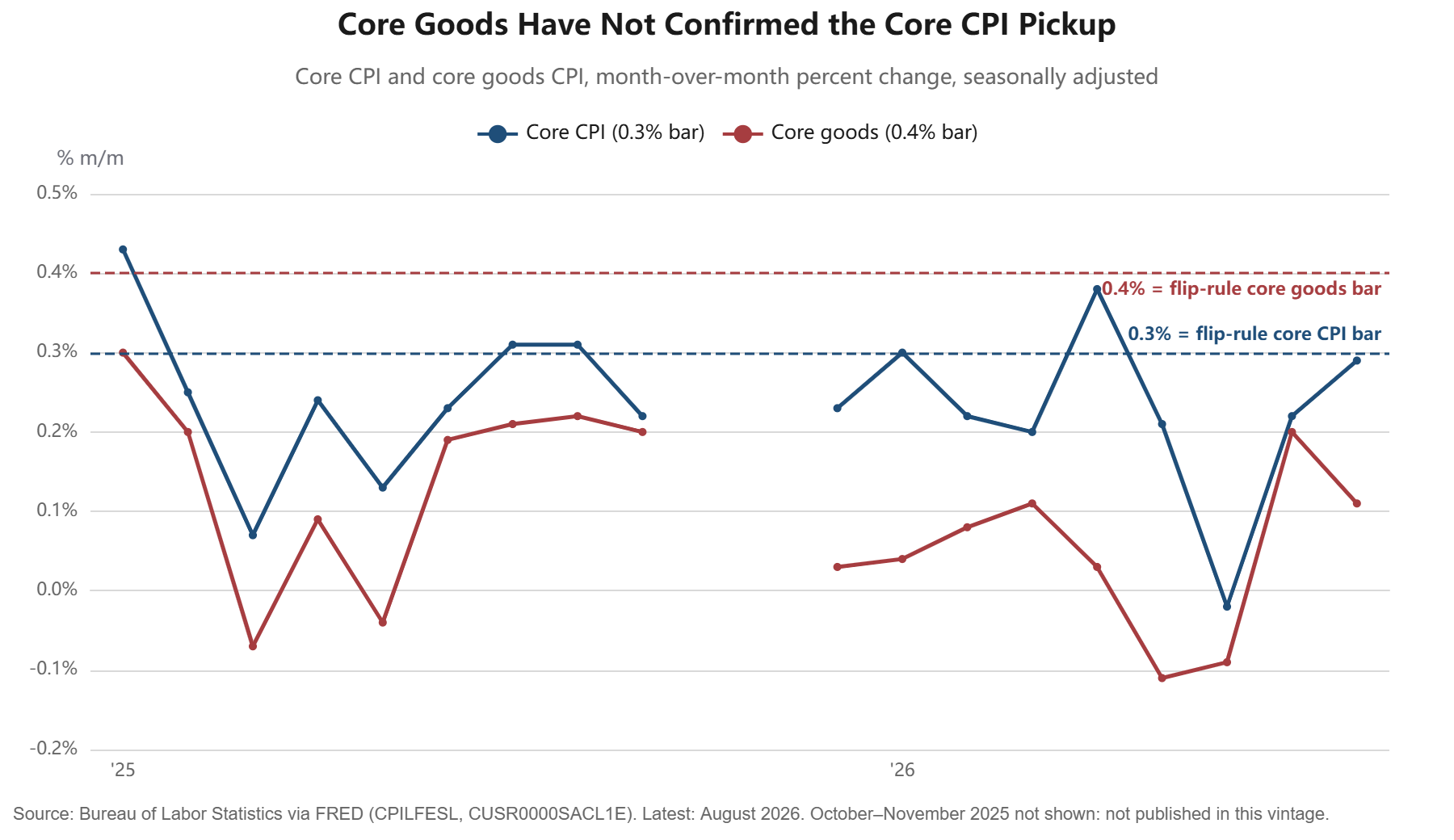
Core CPI versus core goods, monthly, January 2025 through August 2026, with the flip rule's 0.3%/0.4% thresholds marked.
The case the rule can't see
Our flip rule was built to catch whether the energy shock was broadening into the price of goods within a month. It was not built to catch a Committee that hikes to protect the credibility it spent August building, and it was not built to catch an inflation problem forming over the next eighteen months rather than the last thirty days. Both are live, and each is a separate reason to expect a hike Wednesday even though our own rule says hold. Chair Warsh's Jackson Hole language left the market pricing a hike unless the inflation news came in clean, and August's report, hot on the headline if not on the composition, was not clean enough to change that pricing. We think a majority of the Committee would rather hike than disappoint a market assigning nearly 90% odds to one, and that disappointing it without a clear inflation justification is its own kind of communication risk, exactly the one Chair Warsh has spent the year trying to avoid rather than invite. Oxford Economics is holding the other side of that bet, keeping its own baseline call for a hold this week on the expectation that core PCE stays benign; we think that reading, even if it comes in as they expect, will not be the deciding input this time.
The second reason is ours, and it does not depend on what we think the Fed thinks. This remains a capital-led, employment-light expansion, protein rather than carbohydrates, and the sectors carrying it are the ones a quarter point does the least to cool. Manufacturing payrolls have turned positive after two years of decline, capital goods orders are running double digits above a year ago, and the scarcity running through semiconductors, electronic components and the other categories the AI buildout is consuming has not eased and will not until the buildout does; ISM's own Prices Index has signaled rising input costs for twenty-three straight months. None of that shows up in a single month of core goods CPI, because none of it moves goods prices the way a demand shock would, in one month; it moves them the way capital investment always does, slowly at first and then all at once. We think the underlying pressure this expansion has built, most of it outside the reach of the fed funds rate, is closer to the surface than August's print alone would suggest, and that a Committee looking eighteen months out has more reason to move now than a rule built for a one-month test can show.
We've closed most of the gap to the curve
The 10-year at 4.95% to 4.97% is now just above our own forecast, not dramatically past it. We raised our own path this week to 4.88% for the third quarter and 4.85% for the fourth, up sharply from the 4.60% we had going into the meeting, which leaves a residual gap of only 9 to 12 basis points rather than the 35-plus we were looking at a few days ago. The backup in long rates is already doing some of the Committee's own work for it, tightening financial conditions before Wednesday's vote is even cast. We still own the belly, where the 5-year near 4.75% is the least exposed of the three main tenors to being wrong about Wednesday in either direction.
Equities rallied Friday, which is its own kind of data point. The S&P 500, Dow and Nasdaq each rose roughly 1% on the day, the first gain in five sessions, and the VIX fell more than 11% to back under 16, even with a hot core print and oil climbing toward $108 over the weekend. Credit spreads have not printed a fresh reading since our last edition, but nothing in the equity or volatility reaction argues for stress building underneath the Fed debate. Markets are still pricing this as a Fed-and-oil repricing rather than a growth scare.
We've Closed Most of the Gap to the Curve
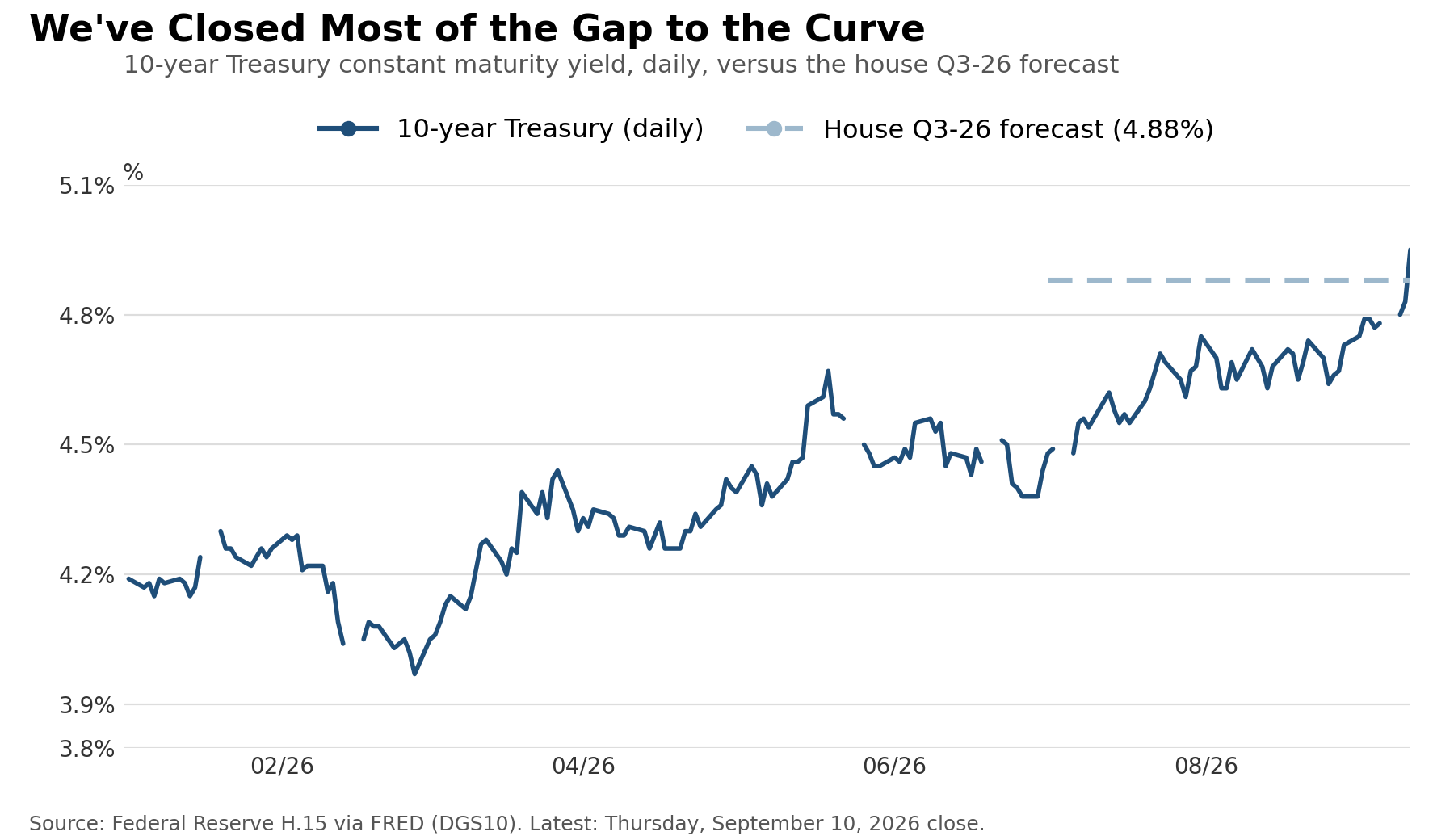
The 10-year Treasury yield against the house Q3-26 forecast path, the gap now near 9 to 12 basis points.
Consumer Sentiment's K-Shaped Split
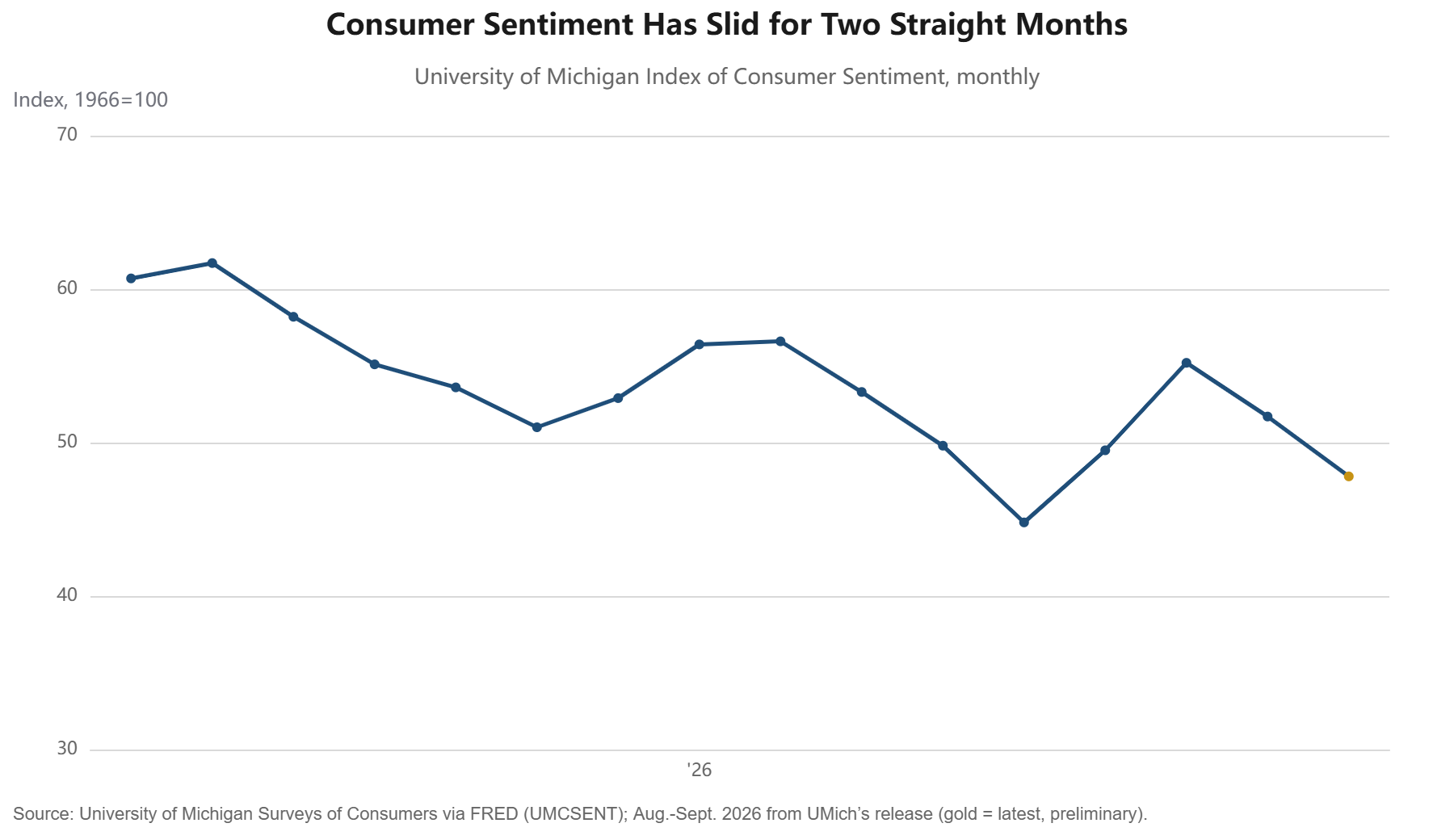
University of Michigan Index of Consumer Sentiment, monthly, June 2025 through September 2026; the September reading is preliminary.
Behind the Numbers
Not only did consumer sentiment fall sharply in early September, but the split between higher and lower income households also became sharper. The University of Michigan's September preliminary index dropped to 47.8 from 51.7. One-year inflation expectations jumped to 4.6%; five-to-ten-year expectations rose to 3.4%. Sentiment fell for lower- and middle-income households and rose for upper-income households. This is the K-shaped economy that so many are experiencing and talking about. One aspect that is often overlooked is that wealth rises with age and the growing share of retirees is helping drive spending on the top half of the K. We have trimmed our forecast but still have consumption growing at around a 2% pace through year-end even as lower-income households absorb the gas-price hit directly. The same squeeze shows up in housing, where higher mortgage rates have pushed the payment on a median-priced home up nearly $300, or 15%, since the war began.
The oil shock is now a supply story running on at least two tracks. A vessel attack in the Strait of Hormuz threatens the shipping lane itself, while Saudi exports have taken a separate, direct hit from Red Sea and Houthi threats. Saudi output is expected to remain below 7 million barrels a day for the rest of the year. Gulf foreign ministers are reportedly meeting Iranian counterparts on an Oman-brokered arrangement for interim Strait management, the logic behind Monday's ceasefire proposal. Our oil price forecast for Q4 Brent currently sits at $92 a barrel, which is about $15 below the current spot price. We are expecting supply issues to remain in place through the election and then ease considerably in 2027. Brent crude is expected to end 2027 at around $75 a barrel.
A fiscal tail risk worth naming and not overweighting. President Trump has proposed $5,000 dividend checks to all adult citizens if Republicans hold both chambers after the midterms, a measure that would potentially cost $1.25 trillion, or 3.8% of GDP, more than Treasury will spend this year on defense, Medicare, or debt interest combined. The odds of a Republican sweep are low today and we doubt the dividend would pass even with a GOP controlling both houses of congress. The economics of such a deal are dubious at best, with a short-term boost to consumer spending no lasting benefit and a much larger national debt that is harder to paper over.
Bottom Line
We now see a hike as more likely than not on September 16, even though our own flip rule, taken literally, still says hold. Core CPI cleared the 0.3% bar we had set; core goods missed the 0.4% bar by three-quarters. That is the whole test we set for ourselves based on Warsh's recent statements two weeks ago, and on that test alone the case for holding is not close. We are overriding our own rule for reasons it was never built to weigh: a Committee that spent August guiding markets toward a hike and would rather deliver one than explain why it did not, an oil shock that builds a risk-management case with nothing to do with core-goods breadth, and our own view that this expansion's underlying inflation pressure is closer to the surface, on an eighteen-month horizon, than one month of goods prices can show.
We would not vote for this hike if the Fed gave us a vote. Higher rates will do little to curb an inflation problem running through energy, tariffs and AI-driven capital scarcity, none of which a quarter point touches, while the parts of the economy still sensitive to rates, housing, consumer durables and light vehicles, are already reeling; a hike now cools demand further where it can least be afforded and squeezes the margins of firms already absorbing higher costs, and we would expect it to rattle a stock market that has traded the last several sessions as though the decision were a formality. Fed funds futures assign roughly 90% to a hike, more conviction than we have ourselves, though this is the first meeting this year where we lean toward one, and a hold that surprises pricing that heavy would be its own event, one we would expect Chair Warsh to spend the press conference explaining. Check this against Wednesday's vote count and how he frames the neutral-rate question, not against Friday's headline alone. A hike leaves open whether the Committee treats it as the first of two moves this year or one it can pause after; a hold leaves our December 9 call and the 4.00% to 4.25% terminal rate for 2027 standing as before.
CFO and Treasurers Corner
If you were waiting for the print to fix the position, the print already told you what it can, and the decision is two days out. The 2-year sits at 4.56% to 4.63% depending on the day's close, already pricing most of a hike and a real share of a second within the year. We now see a hike as more likely than not, which leaves less room for the front end to rally than our old call implied, and little room at all if the Committee delivers and signals more to come. Fix now if you cannot carry the position through either Wednesday outcome.
Issuance windows are tight heading into Wednesday, before the decision lands. The FOMC meets the same week Treasury typically returns to the belly and long end with fresh coupon supply, and rate volatility historically peaks into the statement. Investment-grade spreads at 81 basis points and high yield at 267 are not the obstacle; funding-cost uncertainty into Wednesday is. Price before the meeting or wait until Thursday.
Budget diesel off a crack that just moved again and stop treating $6 as a ceiling. Brent cleared $107 intraday Monday on the Hormuz vessel attack and the Saudi pipeline strike, up from the low $100s a week ago, and diesel has moved above $6 a gallon, past April's high. A Tuesday strike on Iranian infrastructure would add fresh upside. Hedge the crack, not the barrel.
The dollar's rate-differential story is waiting on the same Wednesday decision as everything else. A Fed on hold while an already-hiking ECB and a live Canadian tariff dispute sit on the other side of the ledger keeps one rate gap narrow and the other wide; a hike closes both at once. Reassess hedge ratios on European and Canadian exposure together once Wednesday's outcome is known.
Hold the wage budget at 3 to 3.5% but budget the bifurcation into discretionary-spend assumptions. Wage data has not moved this week. What has moved is the split inside the University of Michigan's index: lower- and middle-income households absorbing the gas-price shock directly, upper-income households still spending on the wealth effect. If your base skews toward the former, build more caution into discretionary categories than the aggregate wage number suggests.
The October 12 PJM deadline for delivered power is four weeks out, and nothing this week moved it. PJM's rule requiring new loads above 50 megawatts energizing after June 2027 to bring their own capacity or accept curtailment still takes effect October 12 if approved as filed. Treat the capacity charge as a line item and the curtailment language as a negotiating point now.
Piedmont Perspective
Twenty-Five Years Ago: My Perspective from Three World Trade Center
Abridged from the standalone essay published today.
Twenty-five years ago I was in a hotel ballroom at Three World Trade Center when the first airplane hit. I am told now that no airplanes hit the towers, and that America had it coming. This is what I saw, and what the record shows.
I was in the back of the ballroom at the New York Marriott World Trade Center, wedged between the towers and joined to the north tower below ground, attending the annual meeting of the National Association for Business Economics. Robert Scott of Morgan Stanley was about ten minutes into a talk on financial services when we heard a boom, then a rattle across the roof like machine-gun fire, then three or four thunderous concussions, and the room shook like an earthquake. None of us knew that pieces of the north tower were landing on our building, and that the ceiling was holding.
Nothing of that hotel survived the day. The south tower crushed its middle at 9:59; the north tower took nearly all the rest at 10:28. Forty-three people inside were killed, including two employees who stayed behind to get guests out. Staff led the rest of us out a side door onto the West Side Highway, a fireman timing our exits between falling debris.
I did not see the first plane; I saw the second. I was five hundred feet from the south tower when an engine screamed off the glass towers, then came an explosion, and we watched the impact in a building's reflection before hitting the ground. Close to a hundred cameras caught that airplane before it struck; a wing section turned up blocks away in 2013. Thirty-seven telephone calls came off United 93 before it crashed five minutes later. If none of it happened, those thirty-seven people invented their last conversations, and the family that fed me dinner that night was grieving a man, an Oracle account manager named Todd Beamer, who had not died.
I got out on a tugboat, walked into New Jersey, and a Sprint representative named Bob drove me to Princeton, rented me a car, and sat a stranger at his family's dinner table. Along the way, at a pushcart near the site, a man I took to be an Arab immigrant handed out water to anyone who passed, refusing to meet anyone's eye, clearly afraid the crowd might turn on him. It did not. In the whole of that day I never once heard a negative or threatening word said against Arabs or Muslims.
Twenty-five years is long enough for the argument about a day to replace the day. A National Institute of Standards and Technology investigation running six years found no evidence of controlled demolition; a 2023 survey still found twenty percent of American adults believe our own government was behind the attacks, a share that reached twenty-seven percent of Gen Z in a survey three years later. I have come to read that instinct less as an argument about steel and fire than as a posture toward whoever is doing the explaining, and it travels easiest to people with no particular reason to trust anyone who was there.
New York's medical examiner is still identifying the dead by name, one at a time, twenty-five years on; 1,099 of the 2,753 killed at the Trade Center have never been identified at all. Anyone prepared to argue that any of it was deserved, staged, or invented should be willing to make that case in a room with them.
Read the full essay: Twenty-Five Years Ago, My Perspective from Three World Trade Center →The Week Ahead
| Date | Release or Event | Consensus | What Would Move Us |
|---|---|---|---|
| Tue Sep 15 | FOMC meeting begins; retail sales, Aug.; import/export prices, Aug.; NAHB housing index; the President's stated Truth Social deadline on Iranian infrastructure also lands today | Modest retail sales gain expected | A soft retail sales print given the fuel-price hit, or any stand-down on the Iran deadline before the Fed decides, would both matter |
| Wed Sep 16 | FOMC decision and press conference, 2:00 p.m.; housing starts and permits, Aug. | Closer to a coin flip than a hold; market pricing near 90% for a hike | The dissent count, Chair Warsh's framing of the decision, and any change to the neutral-rate estimate all matter more than the vote itself |
| Thu Sep 17 | Initial jobless claims; Philadelphia Fed index; Freddie Mac PMMS | Little changed | A break above 220,000 in claims would be the first labor-side crack in a month of stable readings |
| Fri Sep 18 | Existing home sales, Aug.; Conference Board leading index | Roughly flat to down | A drop toward the low end of our 2026 range, given mortgage rates near 6.75% and the payment shock Behind the Numbers describes |
| Mon Sep 21 | Oxford Economics midterms preview | Not applicable | Any sharpening of trifecta odds bears on the plausibility of the $5,000 dividend proposal |
| Ongoing | Strait of Hormuz: 45-day ceasefire proposal versus the President's Tuesday ultimatum; Oman-brokered Gulf-Iran talks | No resolution as of this writing | Any confirmed halt to tanker or infrastructure strikes, or a diplomatic breakthrough, would be the first sign the acute phase is ending |
US Economic and Financial Outlook
This table reflects an updated, September 11 vintage. The 2-year at 4.56% to 4.63% remains well above our Q3-26 call of 3.85%, while the 10-year at 4.95% to 4.97% is now within about 10 basis points of our updated 4.88% estimate for the quarter, after we raised that path to reflect the backup in long rates. The 30-year fixed mortgage near 6.75% now sits just under our updated Q3-26 estimate of 7.00%. Brent's move past $107 sits above our updated Q3-26 average of $98.00, and we have already raised our Q4-26 estimate to $92.00 from $83.00 to reflect the escalation.
Key Q3-26 / Q4-26 forecast levels, as of September 11, 2026:
10-Year Treasury: 4.88% / 4.85% | 30-Year Mortgage: 7.00% / 6.80% | Brent Crude: $98.00 / $92.00 | Fed Funds Target Range: 3.75-4.00% / 4.00-4.25%
The complete annual (2024-2027) and quarterly (Q1-26 through Q4-27) outlook tables, covering output, labor, housing, inflation and rates, are in the full report.
Notes. Treasury yields are Thursday, September 10 H.15 closes; Friday's post-CPI 2-year and 10-year (roughly 4.63% and 4.96% to 4.97%) come from secondary providers we could not reconcile against Friday's own H.15 print, and Monday's session was still underway as we finalized this piece. Brent's move past $107 on the Hormuz attack and the ceasefire proposal are moving in real time; treat the levels here as our best read as of Monday morning, not as settled by the time this reaches you. Equity, VIX, gold and oil levels are Friday closes as reported by the cited outlets and have not been independently verified against settlement data. Credit spreads have not been refreshed since September 8. All figures are subject to revision. For informational purposes only; not investment advice.
© 2026 Piedmont Crescent Capital, LLC. All rights reserved.