
Employment Rises Solidly in February
- Job Growth Remained Strong in February
- Employers added 311,000 net new jobs in February, which was above market expectations but in line with the average gain for the past six months.
- Job gains continue to be led by a resurgence in hiring at restaurants, bars, hotels, and entertainment venues – where payrolls still remain 2.4% below pre-pandemic levels.
- Hiring also continues to bounce back in other sectors that have been slow to recover, including health care, childcare, personal services, and local government.
- The most cyclical parts of the economy show a bit more weakness. Manufacturers cut 4,000 jobs, while trucking and warehousing lost 21,500 jobs. Construction payrolls, however, added 24,000 jobs.
- The unemployment rose 0.2 percentage points to 3.6%, while average hourly earnings rose just 0.2%.
February’s larger than expected 311,000-job rise in nonfarm payrolls did not settle the question whether the Fed will raise rates by a quarter or a half of a point at their March 22 FOMC meeting. While the headline came in hot, the gain was below the average for the past 6 months and the underlying details show clear signs of deceleration. Moreover, the unemployment rate rose 0.2 percentage points to 3.6% and average hourly earnings rose a smaller than expected 0.2%.
The employment data were eclipsed by the abrupt collapse of Silicon Valley Bank and worries about the potential fallout. Concern about secondary impacts has triggered a flight-to-quality, which has pulled share prices lower at banks, tech firms and the stock market more broadly. Bond yields have also tumbled, despite ongoing inflation concerns.
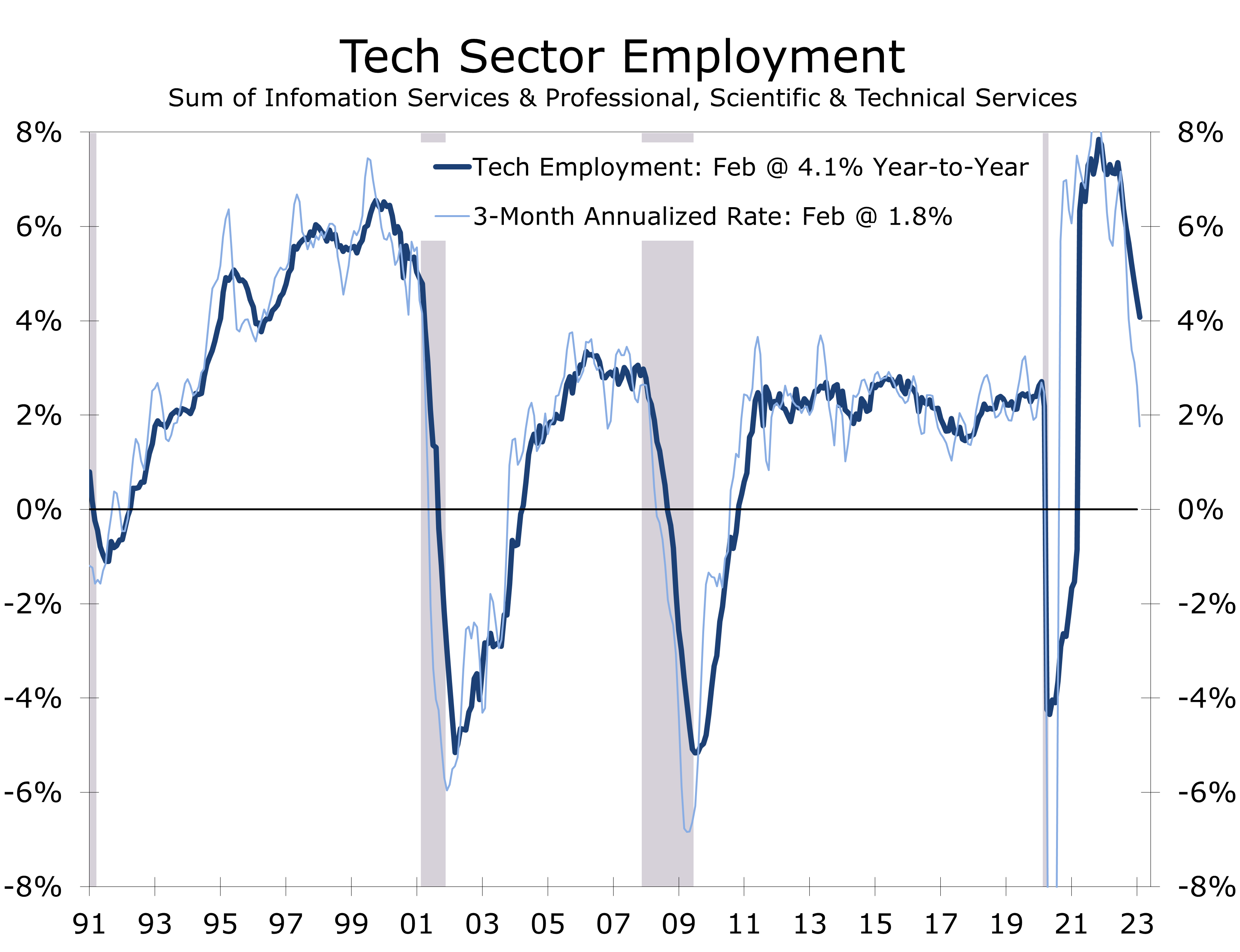
The collapse of Silicon Valley Bank and heightened uncertainty at some West Coast specialty lenders is tied to the ongoing correction in the tech sector. Private equity values have tumbled as exits for startups have become more difficult due to the sell-off in tech shares and heightened scrutiny nearly every merger and acquisition faces today. The only recourse for young firms is to cut costs and those cutbacks are now readily apparent in the jobs data.
Private equity values have tumbled as exits for startups have become more difficult.
The information sector lost 25,000 jobs in February and has cut 54,000 jobs over the past 3 months. Hiring in professional, scientific, and technical services is also decelerating. The most tech-centered subcomponent – computer systems design and technical consulting – lost 2,400 jobs in February. These two sectors provide a timely but imprecise measure of tech payrolls.
Job growth remains exceptionally strong on an overall basis, although a deceleration is also now readily apparent. Employers added 311,000 jobs in February, which was 86,000 more than market consensus. Hiring continues to be driven by the recovery of jobs in the leisure and hospitality sector, which added back 105,000 jobs in February. Health care and social assistance (62,800), retail trade (50,100) and professional and business services (45,000) all posted strong gains during the month. Construction payrolls also rose by 24,000 jobs, hinting that mild weather may have also bolstered the headline increase.
In addition to the earlier noted 25,000-job loss in the information sector, job losses were also reported in trucking and warehousing (-21,500) and manufacturing (-4,000). The weakness in the goods sector likely reflects the pullback in consumer goods purchases. Within manufacturing, plastics and rubber products (-4,700), furniture (-2,800), and textile and apparel (-3,100) all posted notable job losses.
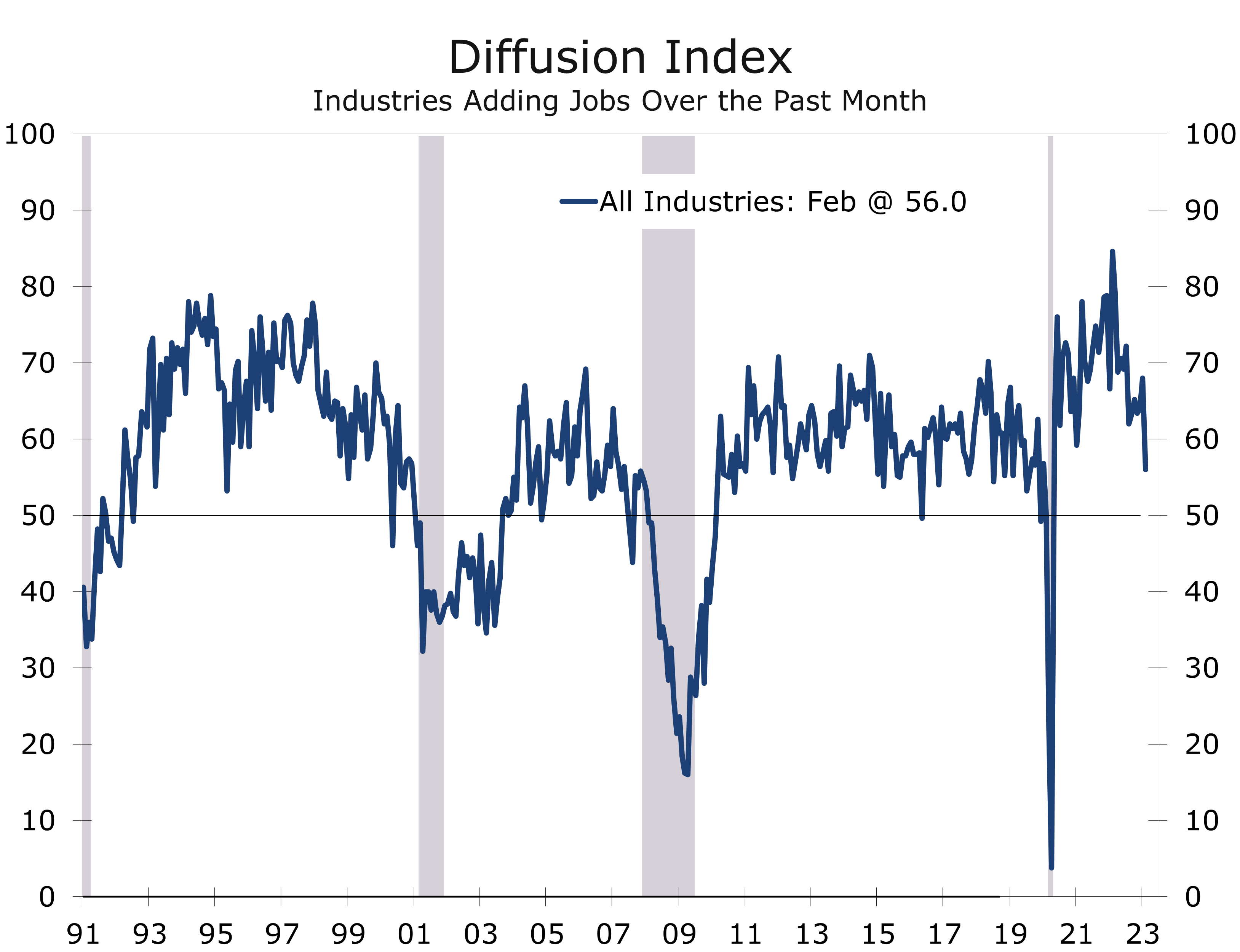
Overall job growth for the prior two months was also revised slightly lower. Payrolls now show a gain of 504,000 jobs in January and 239,000 in December, a combined 34,000 fewer jobs than earlier reported. The breadth of overall job gains was also the weakest since the lockdowns at the start of the pandemic, with the diffusion index falling 12 points in February to 56.
The weakness in the goods sector likely reflects a renewed emphasis by retailers and manufacturers to clear inventories ahead of what is widely expected to be a softer second half of 2023. Trucking and warehousing firms have cut 42,000 jobs since October.
Construction was a notable bright spot in February, with builders adding 24,000 jobs. That gain may have been bolstered by unseasonably mild weather. Nearly half the gain was in residential specialty trade contractors. Home builders are working feverishly to reduce their work-in-process inventory, which remains near a multi-decade high. Heavy and civil engineering construction added 7,700 jobs, benefitting from rising spending for road and bridge projects.
The unemployment rate rose 0.2 percentage points to 3.6% in February, as a 177,000 increase in household employment was more than offset by a 419,000 rise in the civilian labor force. Average hourly earnings came in slightly below expectations, rising just 0.24%, and is now up 4.6% year-to-year. The smaller than expected increase reflects the larger share of job gains occurring in lower paying industries. Average hourly earnings for production and non-supervisory workers rose 0.46% in February and are up a larger 5.3% year-to-year.

Disclaimer: This publication has been prepared for informational purposes only and is not intended as a recommendation offer or solicitation with respect to the purchase or sale of any security or other financial product nor does it constitute investment advice.