
Retail Sales Declined Slightly in October
- Retail sales declined 0.1% in October, following a 0.9% rise the prior month.
- Sales at motor vehicle dealers fell 1.0% and lower gasoline prices helped pull gasoline station sales down 0.3.
- Sales excluding motor vehicles and gasoline rose 0.1%. Core retail sales, which also exclude sales at home improvement centers and grocery stores, rose 0.2% and are now up just 3.5% year-to-year.
- After adjusting for the better inflation news, including this morning’s 0.5% drop in the PPI, we calculate real retail sales fell 0.2%, while real core retail sales rose 0.1%
- Only a handful of core retail categories posted gains, however, led by health and personal care (+1.1%), electronics and appliance stores (+0.6%), and non-store retailers (+0.3%).
- Retail sales are yet another data point suggesting economic growth downshifted in October. Sales in many credit-driven sectors was particularly weak, including furniture & home furnishings (-2.0%) and autos (-1.1%).
October appears to have been a transformation month for the U.S. economy. Real economic growth appears to have downshifted amidst higher interest rates and tightening credit. We expect spending to remain soft going into the holiday season and see holiday retail sales rising 3.2% from their prior year’s level, which would be toward the lower end of the forecast issued earlier by the National Retail Federation. Sales are struggling the most in credit-dependent sectors and those areas that cater to middle-income households.
Even though retail sales fell in October, they outperformed expectations. Gasoline prices were reported to have fallen 5% in October, which was expected to produce a larger drag on the headline retail sales figure. Instead, gasoline prices fell by an inconsequential 0.3%. Sales excluding gasoline, fell 0.1%, which was the same as overall sales.
Retail sales were weaker in October but still more in line with a soft landing than a recession.
While retail sales are volatile on a monthly basis and prone to substantial revisions, October’s data exceeded expectations. Core retail sales rose 0.2% in nominal terms and 0.1% in real terms. Real personal consumption expenditures are likely to rise at around a 2.5% annual rate in the current quarter.
Although spending remains solid, it is losing momentum. Only five of the thirteen major categories saw sales rise in October. Clothing stores were unchanged, while the seven remaining categories posted declines. Auto dealers led the drop (-1.0%), followed by furniture stores (-2.0%) and gasoline stations (-0.3%).
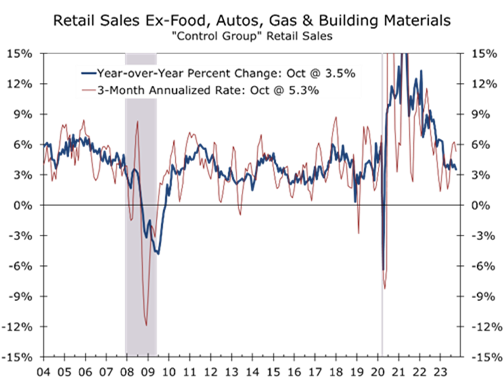
While weaker, retail sales are still more in line with a soft landing than a recession. On the plus side, spending rose 1.1% at health and personal care stores, 0.6% at electronics and appliance stores and 0.3% at non-store retailers, most of which are online retailers.
October, positioned between back-to-school and holiday sales, is a transitional period for retailers. Stores are increasingly launching holiday promotions earlier, however, with many displaying holiday items before Halloween. In October, sales at general merchandise stores fell 0.2%, department stores saw a more substantial 1.2% drop, while sales at clothing shops were unchanged, following a 0.8% drop in September.
Higher interest rates and tighter credit are dampening credit-dependent spending.
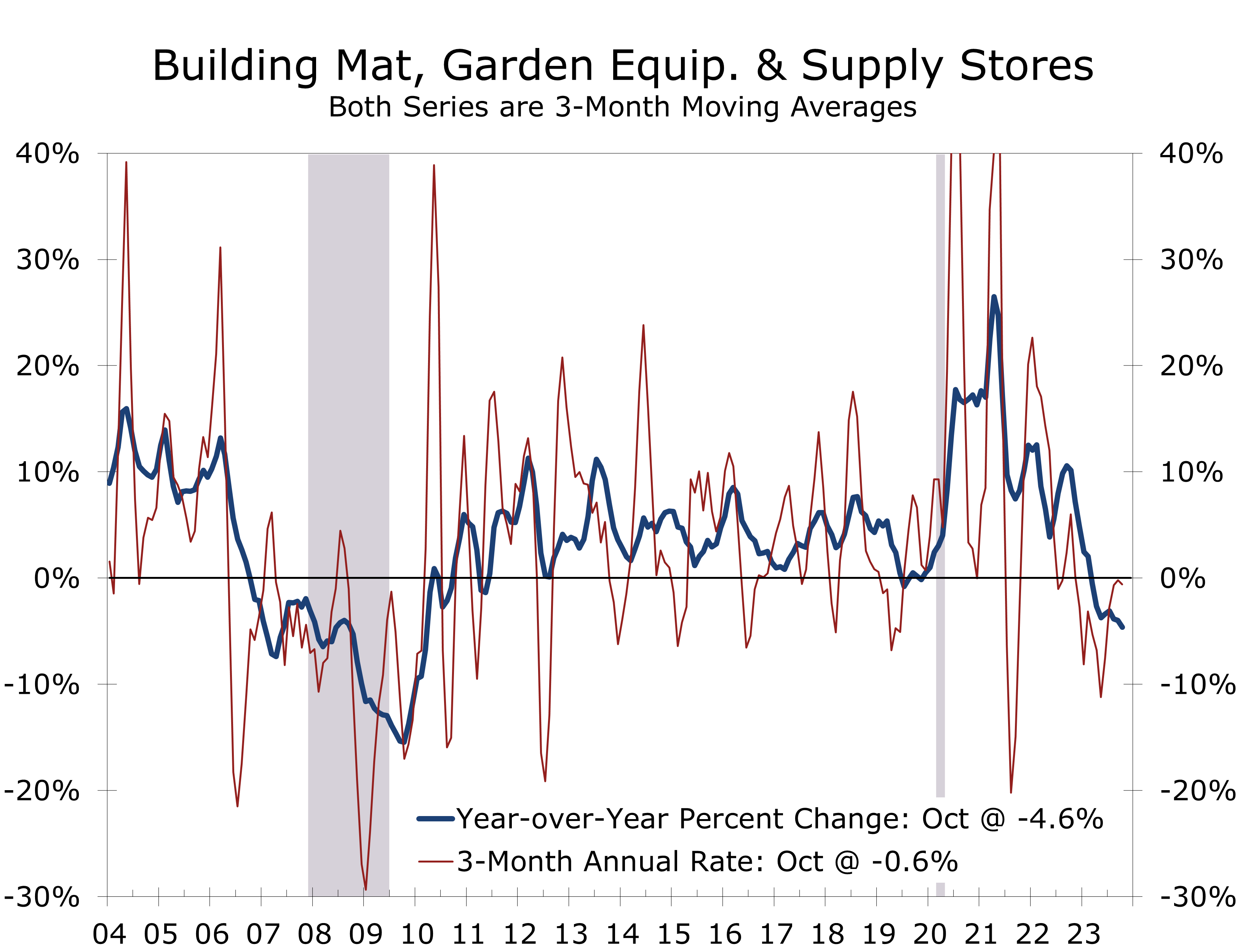
The ongoing decline in existing home sales remains a formidable headwind for home improvement stores. Spending at building material, garden, and home improvement stores fell 0.3% in October and is down 5.6% over the past year. This spending is closely tied to existing home sales, as homeowners tend to make improvements before selling, and buyers often upgrade and customize their new homes.
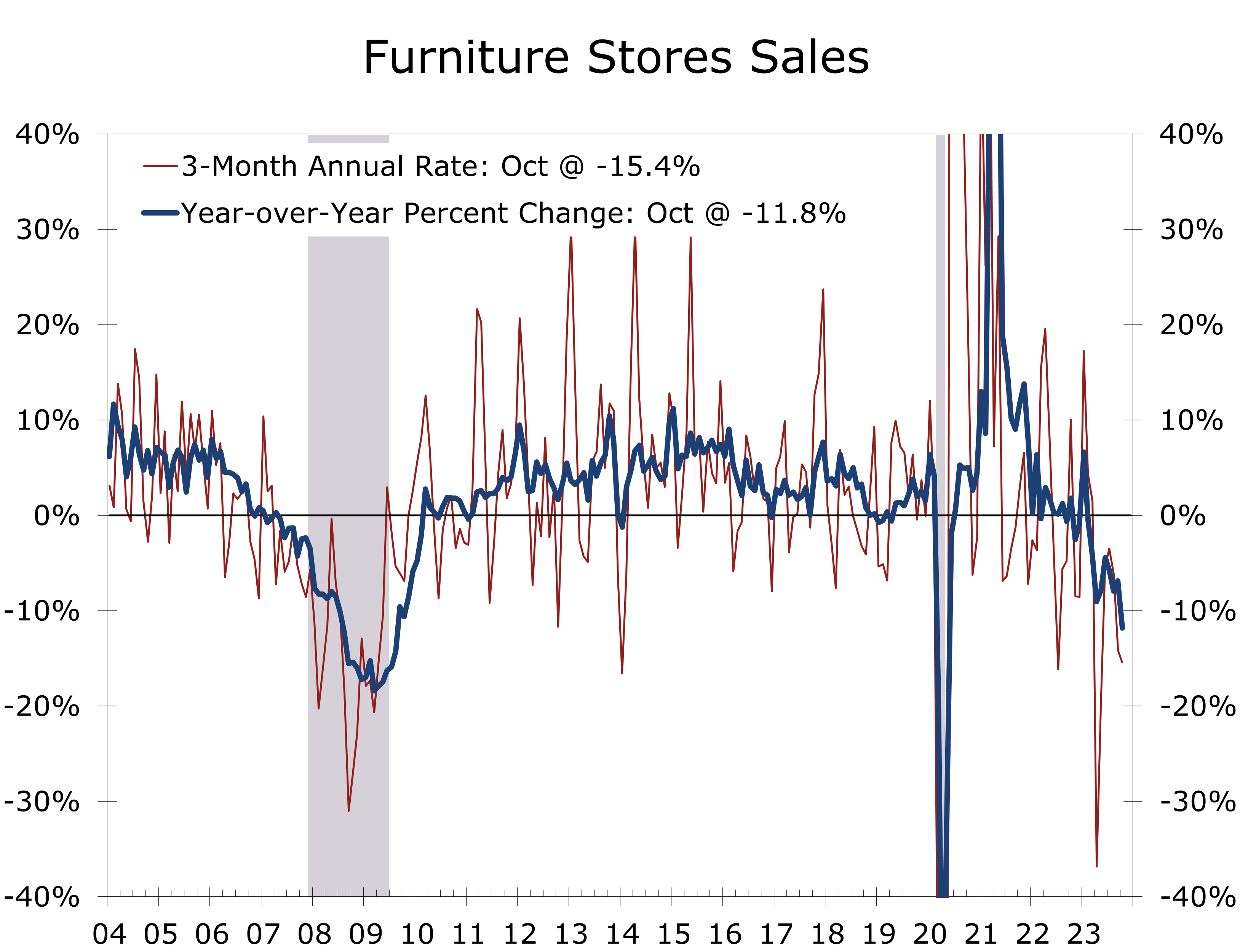
Furniture sales also remain under pressures. Sales at furniture stores fell 2% in October and are down nearly 12% over the past year.
The persistent weakness in furniture sales reflects some payback from the pandemic when consumers purchased furniture to accommodate remote work and remote learning. The weakness in furniture sales has fallen back on manufacturers, leading to a handful of plant closures and bankruptcies.
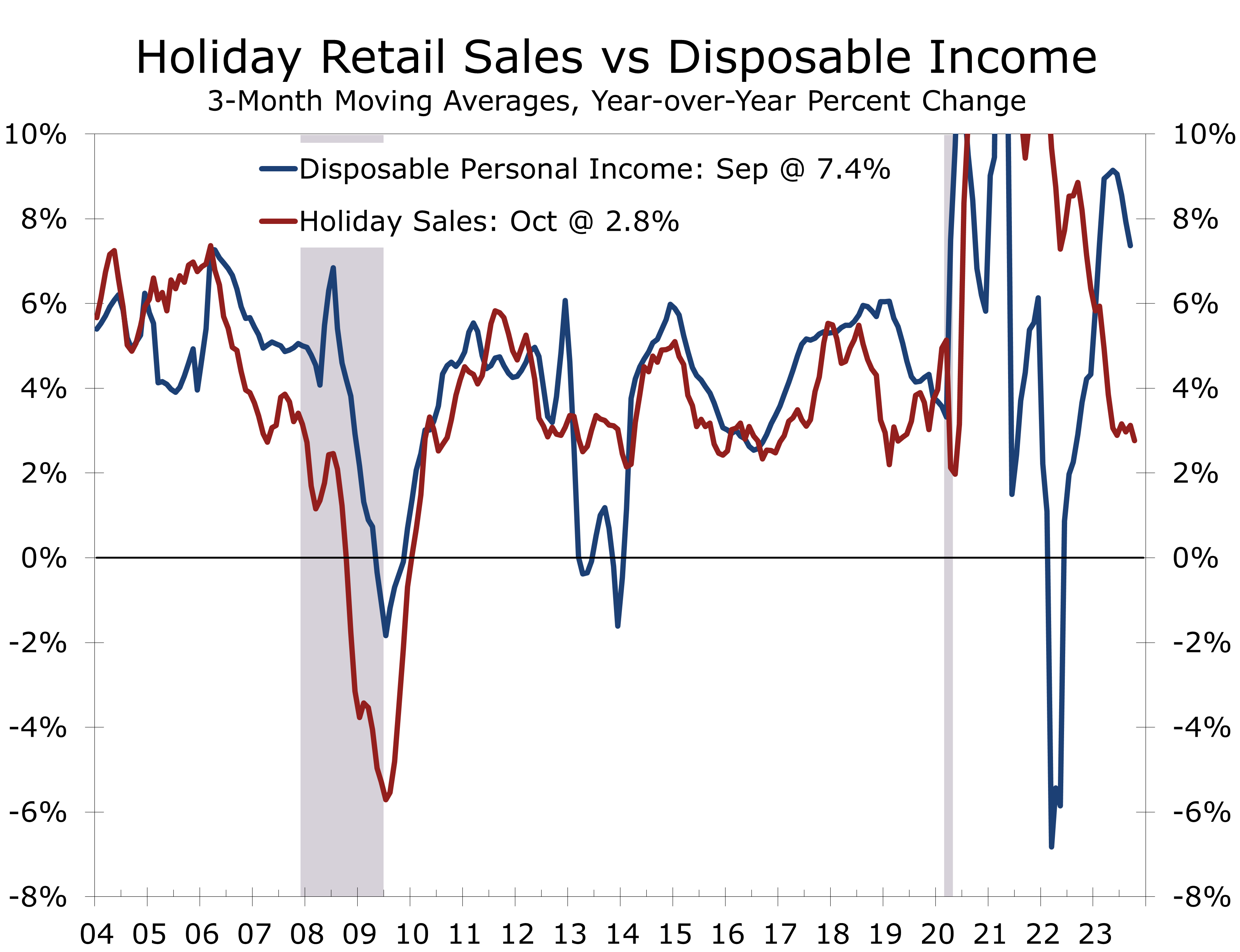
We are looking for only modest gains in holiday retail sales, reflecting slowing income growth.
The latest retail sales figures are likely to be scrutinized for any clues about the upcoming holiday season. Aside from recession periods, holiday sales rise nearly every year. This year should be no exception, with sales expected to rise 3.2% from the prior year. That increase is toward the lower end of the forecast from the National Retail Federation, which called for holiday retail sales to rise between 3% and 4% this year. The average gain from 2010 to 2019 was 3.6%.
October’s soft retail sales report is more consistent with a soft landing than a recession. Consumers have become frugal, however, and are cutting back on credit-dependent purchases, such as furniture, and spending at home improvement stores, which is closely tied to sagging existing home sales.
Disclaimer: This publication has been prepared for informational purposes only and is not intended as a recommendation offer or solicitation with respect to the purchase or sale of any security or other financial product nor does it constitute investment advice.