
Housing Starts Rebound Less Than Expected
- Housing starts rebounded 7% in September to a 1.358-million-pace but starts were revised lower for both August and July.
- Permits fell 4.4% to a 1.473-million unit pace, with single-family permits rising 1.8% and multi-family permits falling 14.3%.
- Single-family permits are running roughly even with starts, while multi-family permits are running about 115K ahead of starts.
- Housing starts rose in every region except the Northeast (-24.5%). The Midwest was an outlier, with starts surging 35.3%. Starts rose 6.5% in the South and 5.6% in the West.
- Leading indicators for the housing market all point to softening conditions, with mortgage applications plunging 11.7% over the past 4 weeks and home builder confidence falling in each of the past three months.
- The slide in mortgage applications comes is consistent with the most recent data from the NAHB survey. Builders report slowing sales, diminishing buyer traffic, and have lowered expectations for sales over the next six months. With short-term rates up, builders are also slowing new construction.
Housing starts rose 7% in September to a 1.358-million unit pace. Both single-family (+3.2%) and multi-family starts (+17.6%) rose in September and starts increased in every region except the Northeast. Despite the increase, home building is clearly losing momentum. Building permits fell 6.4% and other leading indicators, such as mortgage applications and home builders’ confidence also declined.
Single-family starts rose 3.2% in September to a 963,000-unit pace. Starts rose in every region except the Northeast, where they fell 19%. The Northeast is the smallest region for single-family home building and monthly changes are often extremely volatile. Single-family starts rose solidly in the Midwest (+14.2%) and also rose solidly in the West (+5.2%) and South (+2.8%).
Permits for new single-family homes also increased, edging up 1.8% to a 965,000-unit pace. All of September’s increase came in the South, which is by far the largest region for new home construction. The South accounts for just over 61% of single-family home building, reflecting the region’s strong population growth and lower land costs.
While single-family starts and permits increased in September, we expect home building to slow. The latest NAHB Home Builders’ Survey reported home builder confidence fell 4 points in October to 40 and has declined 16 points over the past three months. Mortgage applications also continue to trend lower, with purchase applications falling 6% this past week and falling 21% over the past year.
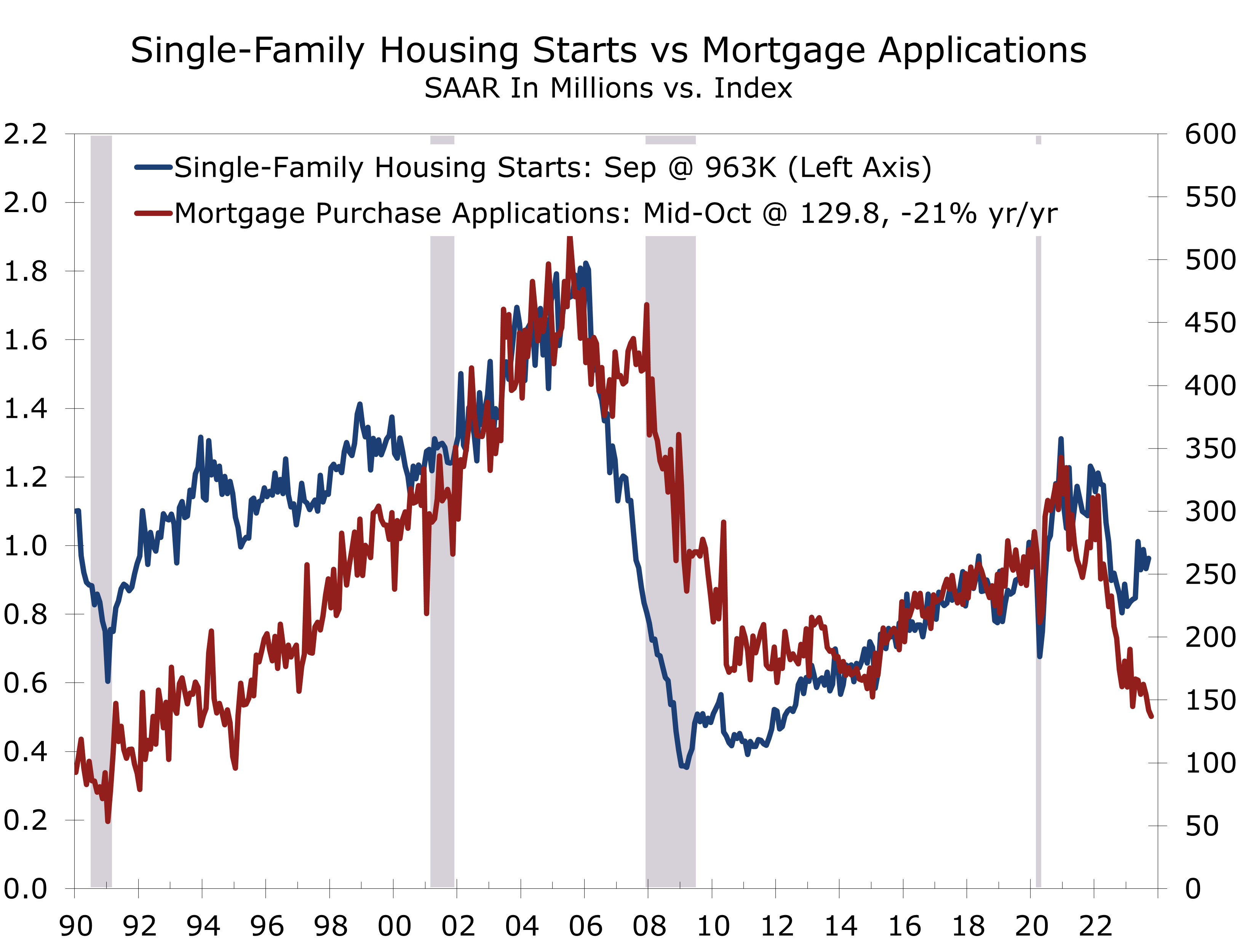
Single-family housing starts averaged a 961,000-unit pace over the past three months, while permits averaged a slightly lower 947,000-unit pace. We expect single-family starts to decline over the next few months and average a 930,000-unit pace in Q4 and 860,000 unit pace during the first half of 2024. Relative to past cycles, this would mark a soft landing for single-family home building, which remains chronically undersupplied. The primary challenge is affordability, which will not meaningfully improve until mortgage rates decline back in line with their long-run norms.
Completions of single-family homes rose 5.3% in September and have been running ahead of starts the past the past 15 months. With completions outpacing starts, the backlog of single-family homes under construction has been significantly reduced.
Completions of single-family homes have outpaced starts for the past 15 months.
Prior to the pandemic, single-family starts took roughly six months to complete, which kept a tight relationship between starts and completions. Widespread building materials and labor shortages caused cycle times to lengthen, however, lifting starts well above completions throughout 2021 and the first half of 2022. Completions have been running ahead of starts since then, however, as builders looked to take advantage of the shortage of existing homes for sale.

The backlog of multi-family projects under construction has finally begun to decline, with completions of apartments running slightly ahead of starts the past two months. There are still roughly 1 million multi-family homes currently under construction, most of which are rental apartments. Completions of multi-family projects rose 9.6% in September to a 455,000-unit pace, compared to 395,000 multi-family starts.
The housing market is one area where the Fed’s rate hikes are cooling demand.
Permits for multi-family homes fell 14.3% in September to a 508,000-unit pace but are still running well ahead of starts. We suspect apartment developers are rushing to begin projects before credit tightens further. Starts are increasingly being delayed and many projects will likely be put on hold until interest rates decline and credit eases up.
We are looking for a harder landing for apartment construction in 2024, with starts declining 32% to around 310,000 units. The slide in starts should allow builders to make significant headway in clearing what had been a record backlog of projects.

Disclaimer: This publication has been prepared for informational purposes only and is not intended as a recommendation offer or solicitation with respect to the purchase or sale of any security or other financial product nor does it constitute investment advice.