
This essay expands on themes from this week’s A View from the Piedmont
A Conflict of Visions in Munich
The 62nd Munich Security Conference (February 13-15, 2026) felt less like a diplomatic forum and more like an inflection point. The Munich Security Report, released ahead of the conference, described the era as one of “wrecking-ball politics,” a time when established rules are no longer tweaked at the margins but openly contested and demolished. The post-1945 security order is not merely under stress. It is being fundamentally renegotiated.
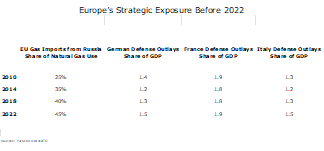
That renegotiation is long overdue. The Cold War ended over three decades ago, yet Europe structured its economic and security architecture around the hope of permanent convergence with Russia rather than the risk of renewed rivalry. Integration deepened. Defense spending declined. Energy interdependence was treated as a stabilizing influence rather than an existential risk. The expectation was convergence. The reality has been heightened rivalry.
The situation in which Europe finds itself today reminds me of Thomas Sowell’s classic work A Conflict of Visions. The earlier post-Cold War norm reflected a largely unconstrained vision: institutions, markets, and goodwill could gradually reshape incentives and diminish the role of hard power. For a time, that assumption appeared validated. Russia’s invasion of Ukraine made clear it no longer is and Munich 2026 is focusing attention on what must come next.
The Munich Security Conference was never simply about NATO budgets or Ukraine aid. It was about how long political will is able to outrun capacity before provoking domestic pushback.
Ukraine as Mirror
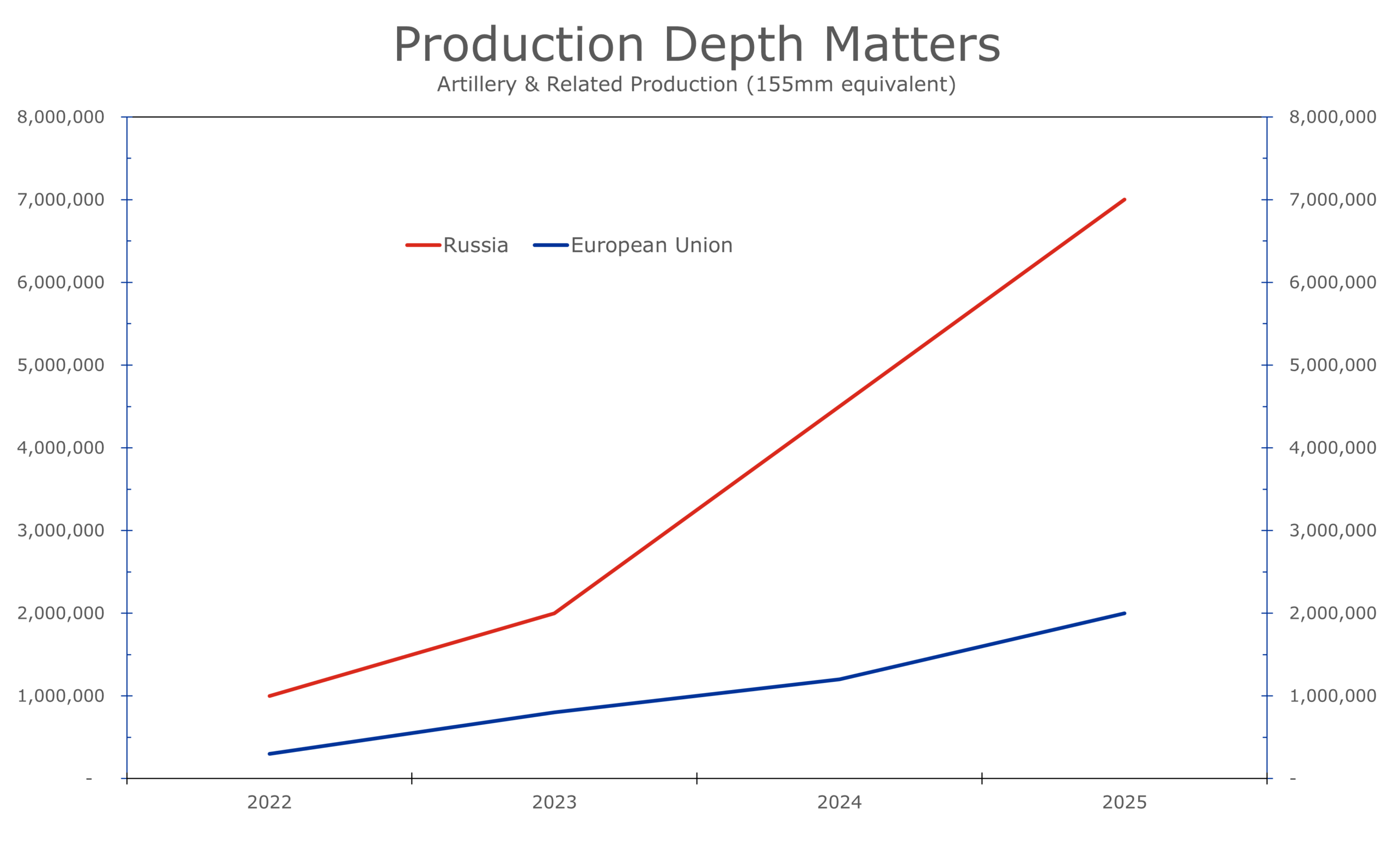
For nearly four years, Ukraine has served as both battlefield and mirror. Russia’s full-scale invasion laid bare Europe’s energy dependence, munitions shortages, and industrial gaps. The gap was not a failure of resolve, but rather a lack of vision and failure of preparation. Political commitments were lofty. Industrial capacity was not.
Ukraine did not expose a lack of resolve. It exposed a lack of capacity.
Munich 2026 made this reality perfectly clear. Europe’s security challenge is no longer abstract. It is measured in artillery shells, production lines, and hardened infrastructure.
Europe reduced defense spending and deepened energy dependence for more than a decade, as it assumed strategic convergence was the new norm.
.
Energy, Exposure, and Tradeoffs
Europe’s energy policy illustrates the tension most sharply. Ambitious climate targets accelerated the phase-out of coal and nuclear power before securing viable alternatives. Natural gas became the bridge fuel, much of that bridge depended on the good graces of Moscow. When Russia invaded, environmental ambition collided with strategic exposure. Dependence did not just raise prices; it narrowed options at the worst possible moment. Sanctioning Moscow imposed immediate costs. Industrial competitiveness weakened. Households absorbed the shock.
The Industrial Contest
Russia’s war is not simply a moral struggle. It is an industrial contest. Moscow has shifted to full war-economy mode, devoting extraordinary resources to defense. Hybrid operations, cyber intrusions, and infrastructure sabotage now extend across Europe. The battlefield is no longer confined to Ukraine’s front lines.
Endurance favors those who can produce, not merely those that can pronounce.
Strategy ultimately rests on sustained production capacity. The key is always balancing defense needs without crowding out growth elsewhere.
The American Dimension
The United States sits at the center of its own conflict of visions, particularly with regards to how it allocates resources to secure its allies’ security. President Trump interprets his mandate through an “America First” lens, focusing on rebuilding the U.S. economy to compete with China’s rise and countering asymmetric threats promoted by China and Russia through proxies. America First does not mean disengaging from Europe. Instead, it encourages Europe to shoulder more of its own defense costs, protect its borders, and preserve the shared cultural heritage between Europe and America.
Secretary of State Marco Rubio reaffirmed that the U.S. and Europe “belong together.” He described America as “a child of Europe” and emphasized shared civilizational roots. The tone was measured and reassuring, and European leaders responded cautiously but positively.
Yet anxieties linger. Recent U.S. pressure on Greenland has heightened concerns across Europe. The effort echoes earlier warnings from the first Trump administration about Europe’s dependence on Russian gas and NATO burden-sharing. Those warnings, once dismissed as abrasive, now appear prescient. The underlying question remains: does Europe possess the military and industrial capacity to defend strategically significant North Atlantic territory if deterrence fails?
The transatlantic alliance is no longer debating values. It is debating burden, capability and resolve.
American figures shaping the 2028 conversation signaled alternative futures. Governor Gavin Newsom emphasized institutional continuity panes and transatlantic stability. He reassured allies that the current U.S. administration is “temporary” and that enduring partnerships, especially on climate action and clean energy, would persist despite federal policy shifts. Representative Alexandria Ocasio-Cortez framed foreign policy through democratic accountability, working-class needs, and moral clarity, though her response to questions on U.S. commitments to defend Taiwan struck some observers as evasive and created confusion by lacking a clear stance. Both reflected an unconstrained vision that leadership, institutional reform, and moral vision can reshape outcomes, even against hard economic and geopolitical limits.
Defining Limits
The constrained vision asks the harder questions. Can Europe rebuild its defense base quickly enough to deter further aggression? Can the United States sustain multi-year support for Ukraine across political cycles? Can energy security be strengthened without sacrificing industrial competitiveness? Can alliances endure if voters absorb prolonged strain?
These limits are not philosophical abstractions. They are quantifiable and measurable.
| Constraint | Key Variables |
| Industrial Capacity | Munitions output, defense production, supply chains |
| Fiscal Space | Persistent deficits, rising debt levels, reduced budget flexibility |
| Energy Security | Supply diversity, grid resilience |
| Military Readiness | Equipment, training, logistics |
| Political Cohesion | Electoral durability, public support |
For markets, that shift is decisive. Defense spending reshapes industrial policy. Energy security alters supply chains. Fiscal commitments influence capital allocation and interest rates.
Geopolitics is no longer episodic volatility. It is a permanent structural macroeconomic input.
Munich 2026 was not simply about Ukraine. It was about whether the West can reconcile aspiration with capacity. Sowell’s framework transcends partisanship: the unconstrained vision inspires with moral ambition and faith in human potential; the constrained vision disciplines with respect for trade-offs, incentives, and accumulated wisdom from real-life experience.
A society without ideals is hollow. A society that refuses to acknowledge limits is reckless. Durable strength requires both heart and discipline.
The transatlantic alliance’s durability will depend less on speeches than on sustained production, secure energy systems, and political realism. An effective strategy is not declared. It is built through clear objectives, disciplined execution, and institutions strong enough to enforce accountability even when the headlines fade.
Disclaimer: This publication has been prepared for informational purposes only and is not intended as a recommendation offer or solicitation with respect to the purchase or sale of any security or other financial product nor does it constitute investment advice.
February 16, 2026
Mark Vitner, Chief Economist
Piedmont Crescent Capital