
A capital-intensive expansion needs more capital just as governments across the developed world borrow more, and the collision is lifting long-term yields around the world. The labor market is strong enough that the Fed has room to talk tough and hike rates modestly. The capital crunch is worsening sovereign debt issues, however, which will likely keep the Fed from becoming too aggressive.
Our latest issue covers the collision between capital-intensive growth and government borrowing that is lifting yields worldwide, the September employment report’s labor-force details, the September ISM Services reading, the October 9 preliminary Michigan sentiment reading, energy and diesel pass-through, Hurricane Isaias and the Gulf supply chain, the midterm prediction-market versus poll divide, and a shorter view of last week’s note on measured Fed guidance, through the open on October 12.
SUMMARY
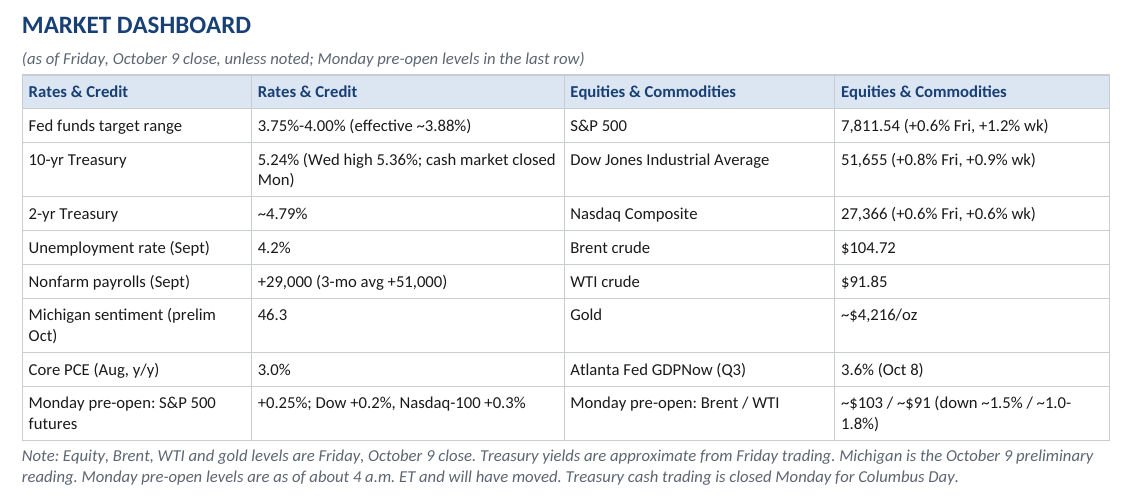
Stock futures are modestly higher and oil is lower going into Monday’s open, even after a bad weekend in the Gulf. S&P 500 futures were up about 0.25 percent and Dow futures about 0.2 percent in early trading, after the S&P 500 finished Friday less than 0.1 percent below its record close and gained 1.2 percent on the week. Brent is near $103 a barrel and WTI near $91, down from Friday’s settles of $104.72 and $91.85, after President Trump said Russia would supply more than 300,000 metric tons of diesel immediately and 500,000 more in November, and announced an energy ceasefire between Russia and Ukraine that Moscow has not confirmed. A Houthi attack on Riyadh’s airport on Saturday killed 12 and injured 309, the third attack there in a week, and Trump said of joining Saudi strikes on the Houthis, “We may. We’re going to look at it.” Iran’s top security official called the U.S. response to its Hormuz proposal insufficient on Sunday. The Treasury market is closed for Columbus Day, so the 10-year yield stays at Friday’s 5.24 percent until Tuesday, and the dollar index sits near 102.2 after its longest weekly rise since early 2025.
The most important development of the week was global. Long-term yields reached multi-decade highs in the United States, the United Kingdom, France and Japan at nearly the same time. The 10-year Treasury touched 5.36 percent on Wednesday, its highest since 2002, after rising 87 basis points in the third quarter, its steepest quarterly climb since 1994. The 30-year gilt is near 6 percent, a level last seen in 1998. The French 10-year reached 4.96 percent, a 2002 high, and the 10-year Japanese government bond crossed 3 percent in September for the first time since 1996.
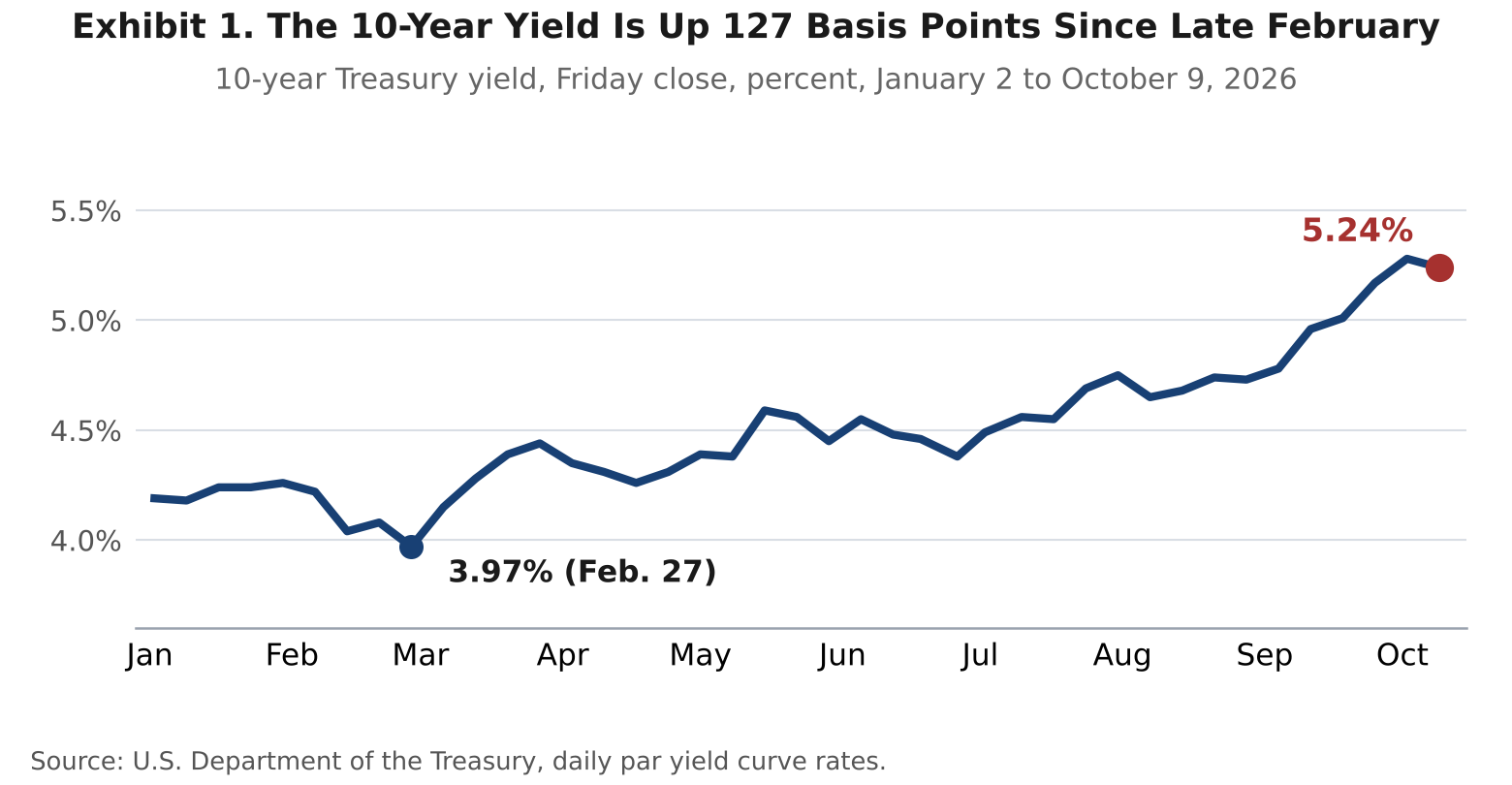
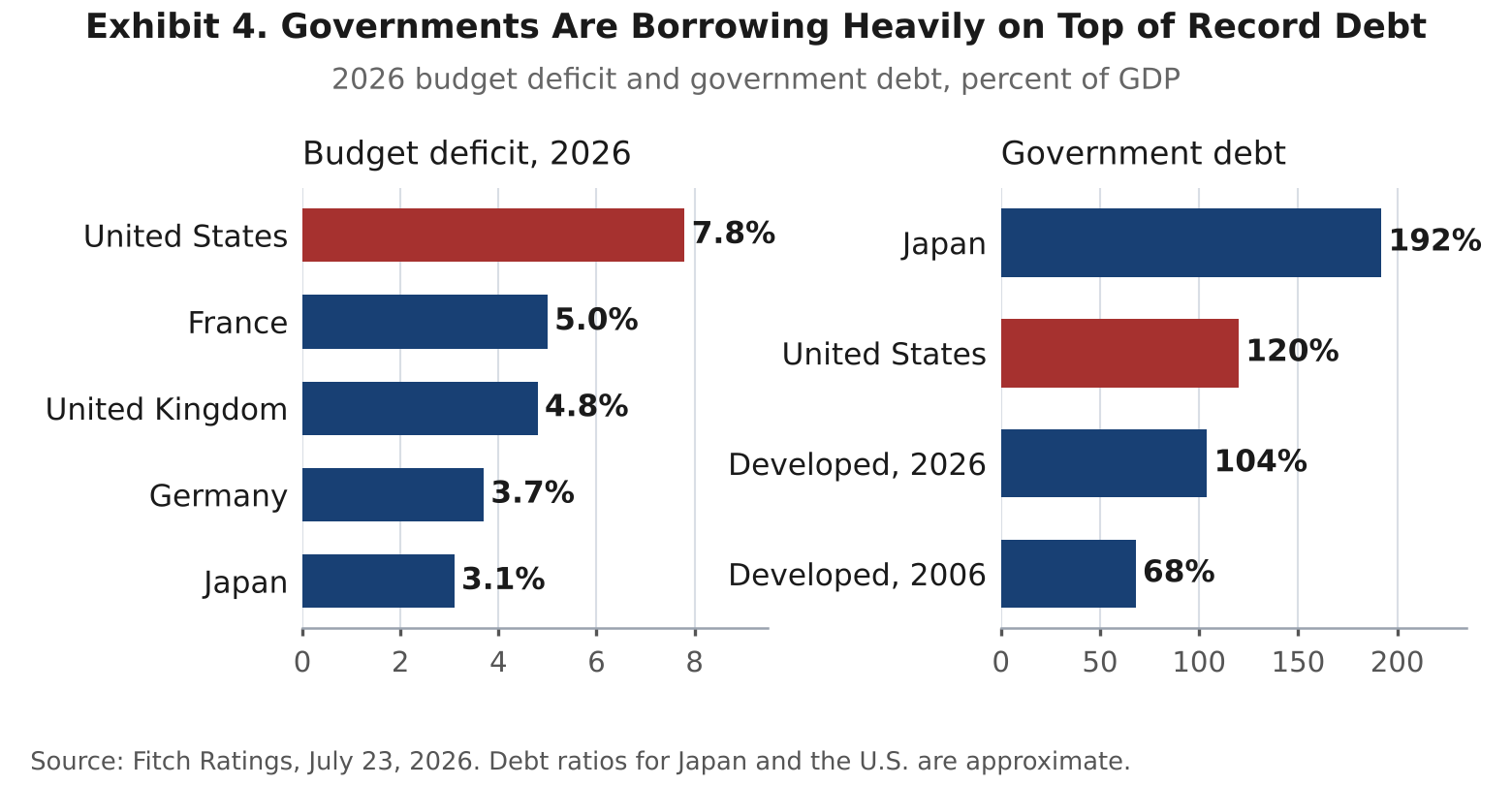
Two forces are colliding. The first is the demand for capital. In a capital-intensive expansion, the four largest hyperscalers alone plan about $725 billion of capital spending in 2026, and Nvidia’s chief financial officer put broader hyperscaler spending above $800 billion this year and $1.3 trillion in 2027. Data centers, power generation, grid upgrades, next generation aerospace and the private space industry, advanced manufacturing and pharmaceutical reshoring, and defense rearmament all compete for the same pool of long-term saving. The second is the government. Fitch Ratings projects 2026 budget deficits of 7.8 percent of GDP in the United States, 5.0 percent in France, 4.8 percent in Britain, 3.7 percent in Germany and 3.1 percent in Japan, and puts developed-market government debt at a record $75.8 trillion, or 104 percent of GDP against 68 percent 20 years ago. When private investment and public borrowing both claim savings, the price of capital has to rise. Energy-driven inflation and central bank tightening are also pushing yields higher, with markets expecting more European Central Bank hikes and a Bank of England move in November, and the AI capital cycle is still largely concentrated in the United States but increasingly showing up elsewhere. The common thread is a higher price for capital, and in the United States most of the rise since late February has come in real yields. That also explains why yields rose even though September payrolls increased only 29,000.
The September employment report showed a gain of only 29,000 jobs and 60,000 in downward revisions, but the three-month average of 51,000 is still enough to hold the unemployment rate at 4.2 percent or less while the labor force expands. All of the September rise in the unemployment rate, from 4.1 percent to 4.2 percent, came from reentrants and new entrants. Job losers declined. Participation rose to 61.8 percent and the labor force grew 485,000. Household employment rose 406,000. The latest unemployment claims data show the labor market continuing to improve.
We see job growth increasing from here, and we also see workers returning. Manufacturing rehires are drawing people into the workforce in rural areas and smaller MSAs across the South and Midwest, where factory hours are already at a seven-year high and payrolls have risen three months running. Legal immigrants who dropped out of the labor force amid aggressive immigration enforcement are gradually returning as well. Both groups add to the labor force at the same time that hiring is firming, which is why the unemployment rate can stay near 4.2 percent even as hiring edges higher. The consensus has treated the soft three-month average as a signal that the labor market is loosening. We read it as a market that is absorbing reentry without a rise in joblessness. That is the key difference in our forecast.
The September ISM Services report pointed the same way. The headline reading of 54.9 stayed comfortably in expansion territory, with business activity cooled to 56.5 from 61.7 and new orders eased to 59.8 from 60.9. The employment component rose to 50.1 from 47.8, right on the dividing line between expansion and contraction. Prices paid rose to 74.0, a four-year high, which is consistent with the energy and diesel pressure already visible in manufacturing prices and Michigan inflation expectations. Second-order effects from the Hormuz shock have not yet appeared in broader consumer prices, and the September CPI due Wednesday is expected to show headline inflation near 3.6 percent on gasoline with core near 2.5 percent. Growth is solid but is not producing the broad labor-market tightness that would force a more aggressive Fed path.
Energy remains the outside force the Fed cannot fully offset, and this week it hit from two directions. Brent spent most of the week above $100 and settled Friday near $105 as the IRGC claimed a strike on the tanker Sun Shine, another tanker was hit north of Qatar and an LPG carrier burned off the UAE, with Iran saying it will pursue ships it deems in violation beyond the strait. Hurricane Isaias then shut in roughly 63 percent of Gulf of Mexico oil output by Thursday and came ashore near Destin, Florida overnight, with about 500,000 barrels a day of refining capacity in or near its path. Retail diesel was already $6.20 a gallon on October 5. Natural gas has topped $3, which we read as stronger industrial demand and winter stockpiling, a positive for energy production and pipeline traffic. The ISM Prices Index and Michigan year-ahead inflation expectations both moved higher largely on the visible rise in gasoline and diesel. The Michigan survey has long been sensitive to energy swings, which helps explain why households are more concerned about the economy than about their own finances. Spending has not followed sentiment lower.
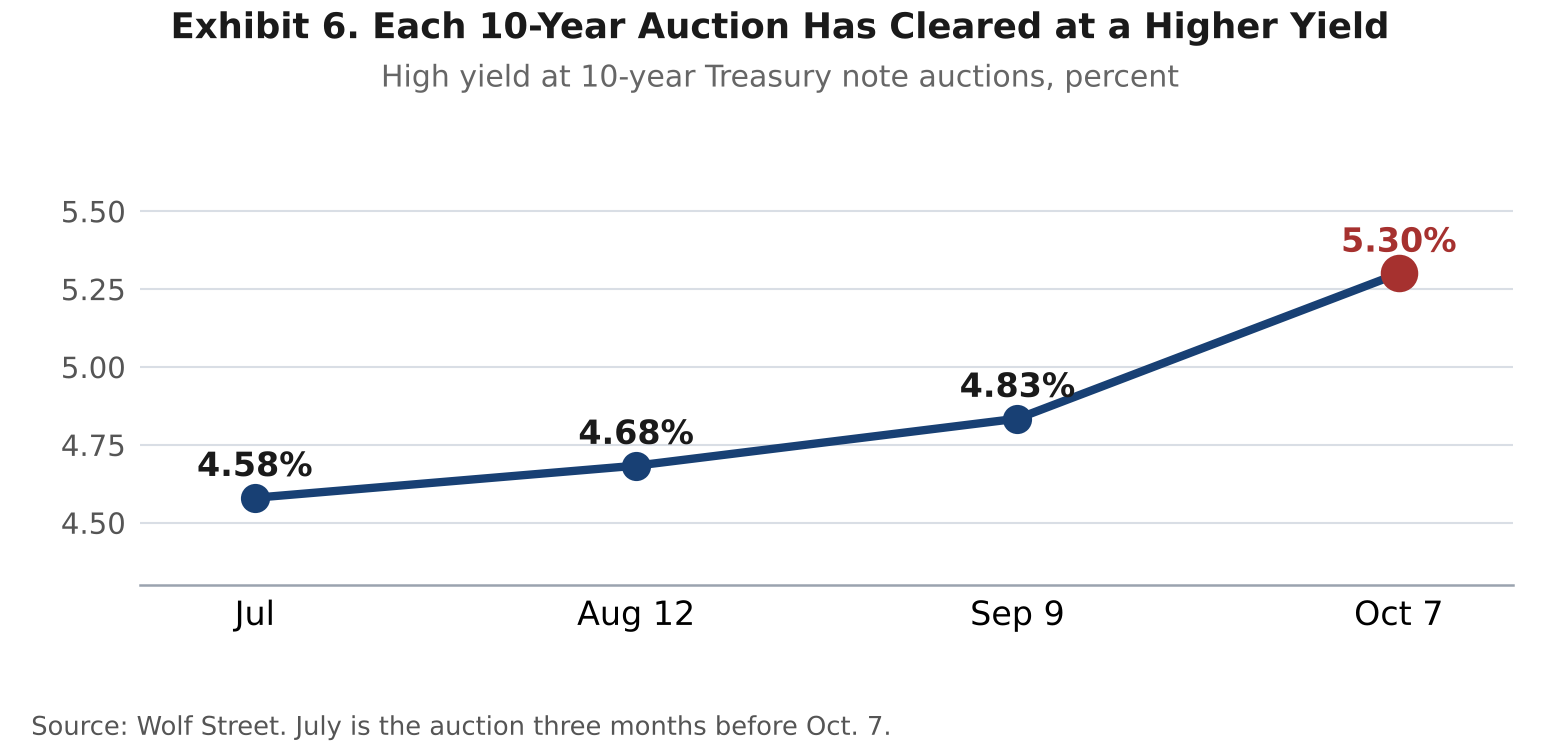
Most of the rise in the 10-year Treasury yield since late February has come in the real component rather than breakeven inflation expectations. That is a growth signal, which supports earnings and helps explain why the Nasdaq is at a high and the S&P 500 is near one even with yields above 5.2 percent. The 10-year touched 5.36 percent on Wednesday, its highest since 2002, and the $39 billion 10-year auction that day cleared at 5.30 percent, the highest auction yield since 2000. Demand held up: the auction stopped through by 1.7 basis points with a 2.77 bid-to-cover and indirect bidders taking 80.3 percent. The equal-weight S&P 500, however, is roughly 6 percent below its August peak. That gap is the market expression of the same K-shaped pattern we have been describing: capital spending and AI-related activity continue, while interest-sensitive and more labor-intensive sectors feel the higher cost of capital. The relevant threshold is whether real yields remain below potential growth, roughly 2 percent on CBO estimates, or move above it for a sustained period. Below that level the net effect on equities has historically been positive. Above it, marginal borrowers begin to struggle and the pressure spreads.
Prediction markets put the odds of a Democratic Senate majority near 65 percent and a House gain of at least three seats above 90 percent. We expect Democrats to take the House by a few seats and Republicans to hold the Senate, for reasons we lay out below.
We still look for a pause on October 27-28 and a quarter-point increase on December 9 to 4.00 to 4.25 percent, with at least one further increase fairly early in 2027. The September minutes are consistent with that path: all 19 participants backed the increase and most judged another one likely appropriate by year end. Williams and Jefferson have said there is no urgency, and futures put the odds of an October move at roughly 20 to 25 percent. Interest-sensitive sectors are already weakening, and the backup in yields plus a stronger dollar are self-limiting to some degree. There is only so much monetary policy can do about oil and diesel. The labor-force reentry we have highlighted keeps the unemployment rate from rising even with modest payroll growth, so the Fed does not get a clear signal that the labor market is cracking.
THIS WEEK'S ARGUMENT
Yields are rising in every major bond market
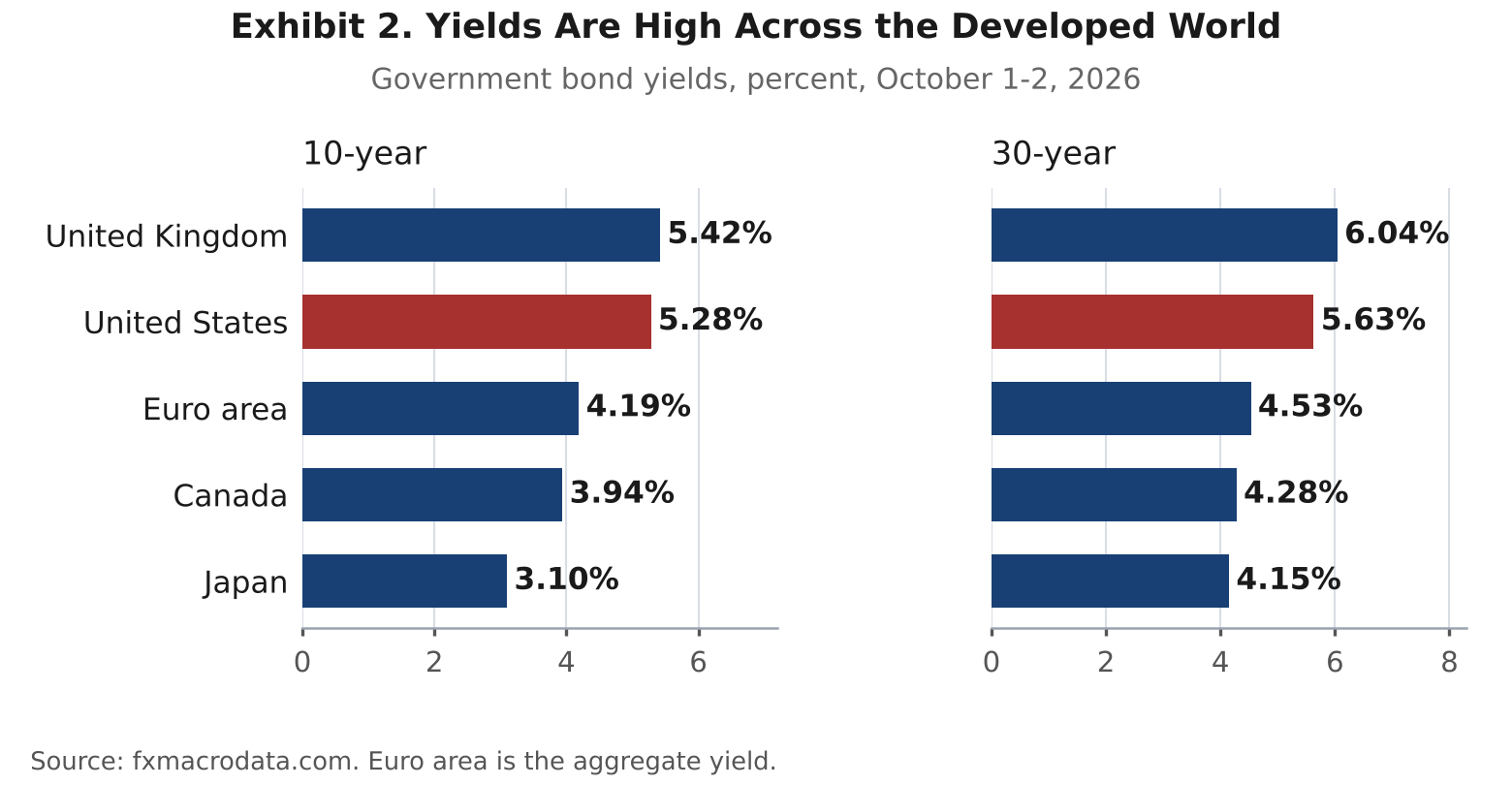
Start with the price of capital. On October 1 and 2, 30-year yields were 6.04 percent in the United Kingdom, 5.63 percent in the United States, 4.53 percent in the euro area, 4.28 percent in Canada and 4.15 percent in Japan. At 10 years the United Kingdom was at 5.42 percent and the United States at 5.28 percent. No major developed bond market is offering relief.
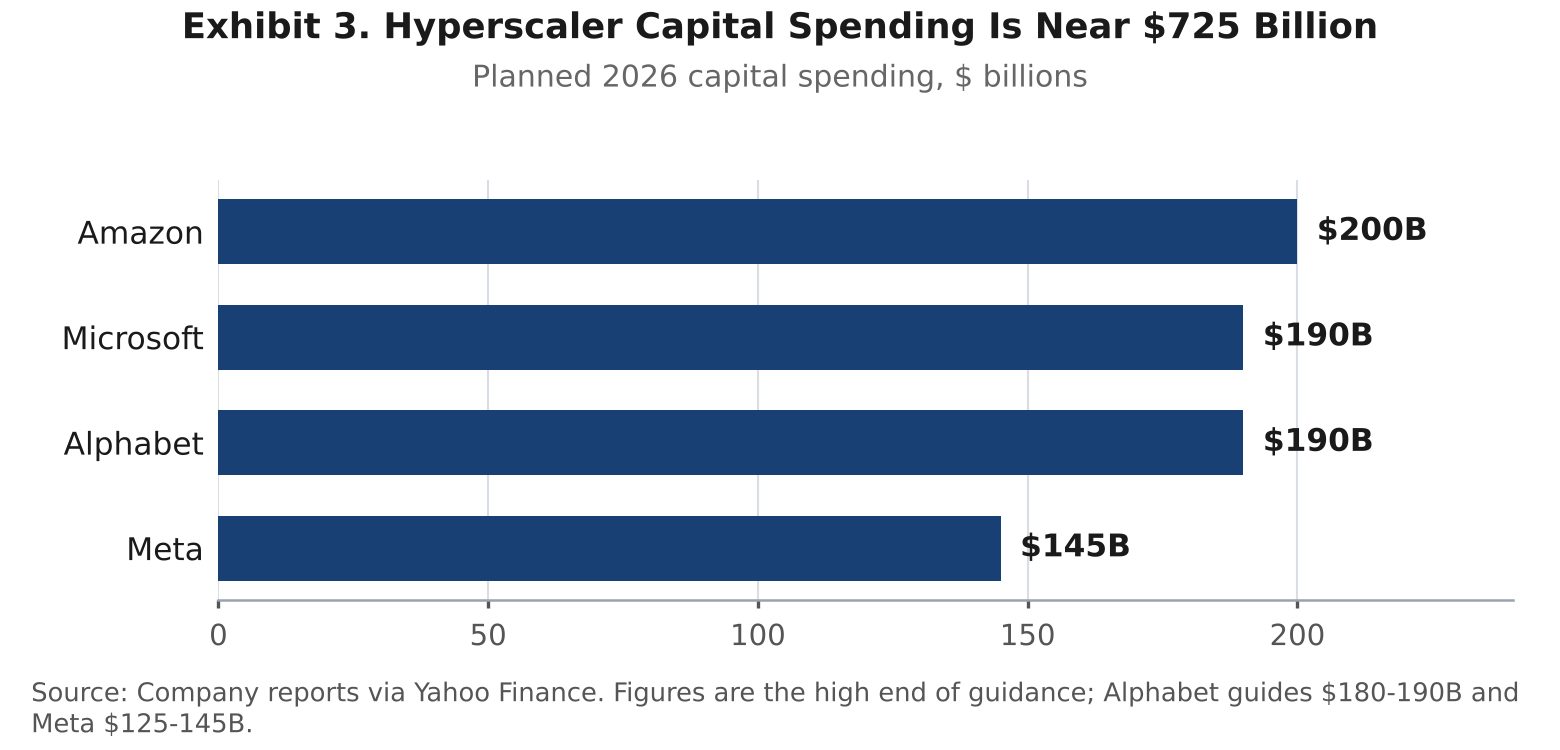
The demand for capital is the first force. The four largest hyperscalers plan about $725 billion of capital spending in 2026, up from about $670 billion earlier this year. Amazon is near $200 billion, Microsoft near $190 billion, Alphabet $180 billion to $190 billion and Meta $125 billion to $145 billion, and Alphabet expects to raise spending significantly in 2027. The spending is concentrated in the United States, but it is financed in global markets and it competes with the power, grid, manufacturing and defense projects that also need long-dated funding. Because this is a capital-heavy, employment-light expansion, the demand shows up in the bond market before it shows up in payrolls.
Governments are drawing on the same savings. Fitch projects 2026 deficits of 7.8 percent of GDP in the United States, 5.0 percent in France, 4.8 percent in Britain, 3.7 percent in Germany and 3.1 percent in Japan. Developed-market government debt will reach a record $75.8 trillion by the end of 2026, up $4.2 trillion this year, and equal to 104 percent of GDP against 68 percent in 2006. CBO estimates the U.S. deficit for fiscal 2026 at $2.0 trillion, $218 billion more than in fiscal 2025. Higher yields compound the problem because maturing debt is refinanced at today’s rates, and the auctions show it: the 10-year Treasury auction on October 7 cleared at 5.30 percent, the highest 10-year auction yield since 2000.
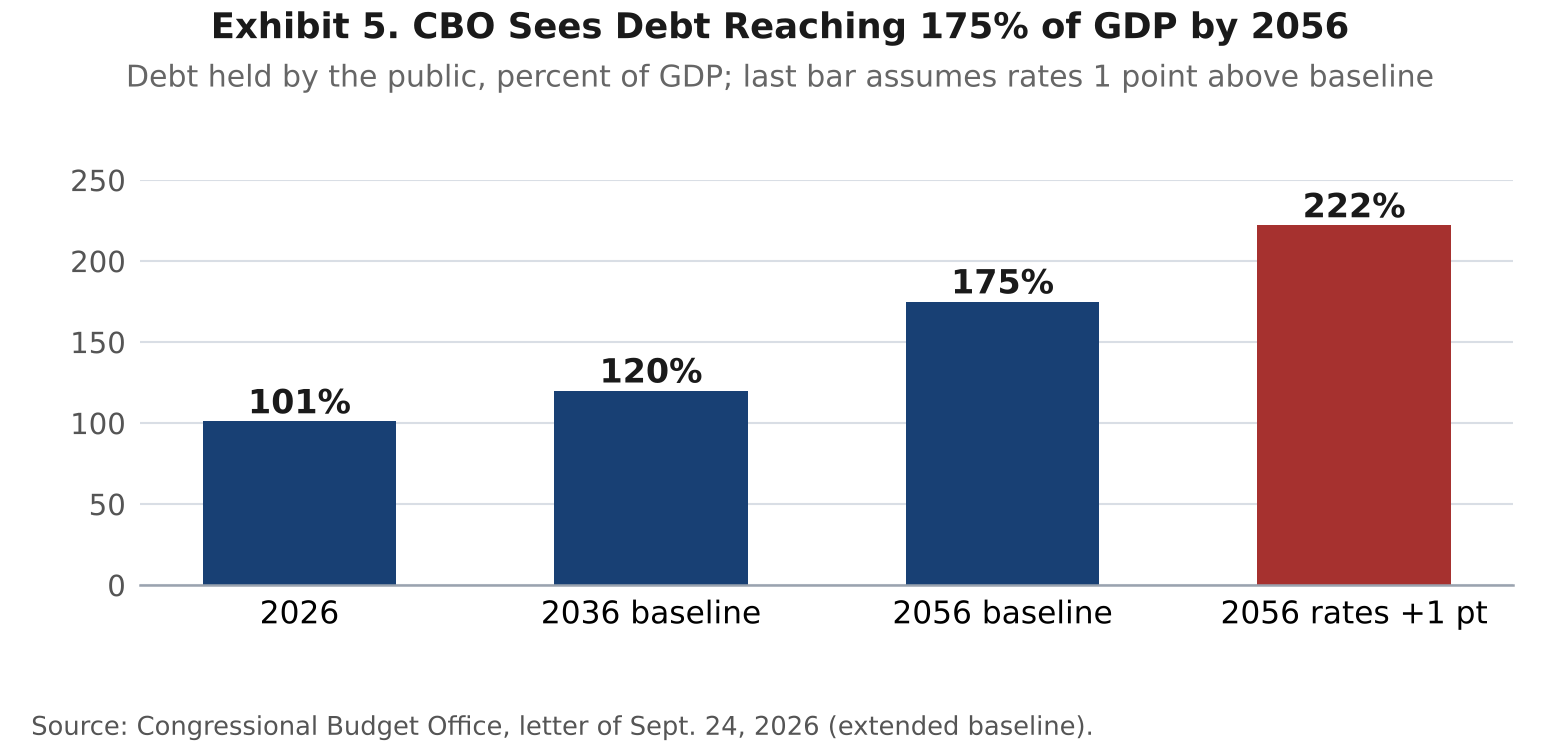
CBO’s own arithmetic says growth cannot do this alone. In its September 24 letter, CBO shows debt held by the public rising from 101 percent of GDP in 2026 to 175 percent in 2056 under its extended baseline, with primary deficits, which exclude interest, averaging 2.1 percent of GDP. Holding debt at 101 percent would require primary deficits to average only 0.2 percent of GDP, 1.9 percentage points less than the baseline, and that baseline already includes the productivity gains CBO expects from AI. CBO’s April sensitivity analysis shows how little a small gain in growth buys: productivity growth 0.1 point faster each year would lower cumulative 2027 to 2036 deficits by only about $317 billion, roughly 1.3 percent of the $24.4 trillion baseline total. Interest rates matter at least as much. If the average rate on federal debt rose to 1 point above the baseline, debt would reach 222 percent of GDP in 2056, 47 points higher, and by the CRFB’s reading of CBO’s October 8 report interest would consume roughly 60 percent of revenue. Higher yields and slower growth feed on each other, which is why we expect private capital demand and public borrowing to keep pushing yields higher.
We think these two forces keep term premiums elevated even if the Fed pauses. Demand held up at the October 7 auction, with indirect bidders taking 80.3 percent, so this is a repricing rather than a failure of the market. But it narrows the room for a pullback that would help interest-sensitive sectors, and it raises the cost of funding for every public and private borrower that must come to market in the next several years. The yield pressure abroad also has other drivers, including energy-driven inflation and central bank tightening, so the capital story explains the persistence of high yields better than it explains any single week’s move.
The jobs report was soft, but the labor force is growing
Payrolls rose 29,000 in September and revisions took 60,000 out of July and August, yet the three-month average of 51,000 sits above our own breakeven range of zero to 40,000. That pace is enough to hold the unemployment rate at 4.2 percent or lower while the labor force grows. The September rise in the unemployment rate came entirely from reentrants and new entrants. Job losers fell. Participation rose to 61.8 percent from 61.6 percent, and household employment rose 406,000 on a labor force that expanded by 485,000. The headline against a consensus near 90,000 is less important than whether the pace of hiring can absorb the people who are coming back.
The factory cycle supports the rehire story. New orders and backlogs both rose in September, the Employment Index has been above the level ISM associates with rising factory payrolls for three months, and average weekly hours in manufacturing held at 41.7. Employers stretch hours before they hire when they doubt a recovery will last. Three months of payroll gains say some of them have started to commit, and the rural and smaller-MSA rehires in the South and Midwest are the place where that commitment shows up first. Legal immigrants who had left the labor force are returning gradually as well. Job growth and labor supply are both rising, which holds the unemployment rate steady.
BEHIND THE NUMBERS
Energy prices remain the outside force. Brent settled Friday near $104.72 after spending most of the week above $100 and spiking past $104 on Iranian strikes in the Strait of Hormuz. The IRGC claimed a strike on the engine room of the tanker Sun Shine, which it said used an unauthorized route, a tanker was hit north of Qatar on Thursday with casualties, and an LPG carrier caught fire off the UAE on Friday. The IRGC now says it will pursue violating vessels anywhere in the region. Tracker data based on IMF PortWatch show 4 transits on October 4 against a pre-crisis baseline of about 85 a day, while CENTCOM says the main lanes are cleared of mines and open to vessels that do not violate the U.S. blockade. President Trump said the U.S. will not attack Iran before the November 3 midterms while the blockade stays in place, and on Sunday Iran’s top security official called the U.S. response to its Hormuz proposal insufficient, saying the strait stays closed to the United States until Iran’s seven conditions are met. A Houthi missile attack on Riyadh’s airport on Saturday killed 12 and injured 309, and Trump said the United States may join Saudi strikes on the Houthis. Crude eased early Monday, with Brent near $103, after Trump said Russia would send more than 300,000 metric tons of diesel immediately and 500,000 more in November. None of that removes the war-risk premium. Diesel remains the tighter market. Distillate inventories are thin, refining capacity is constrained, and the pass-through into freight and food is still working through.
Trump’s Russia ‘deal’ may be more about politics than real relief. A deal of this sort likely requires congressional action, as it violates recently enacted law on doing business with Russia. A bipartisan group of Senators has pushed back against the president and the deal may unravel. For the president, that would still mark a win. The deal focuses attention on the source of the recent spike in diesel prices, which has been Ukraine’s successful strikes on Russian energy infrastructure. The pushback by senators provides them an opportunity to show their independence from Trump at a critical juncture, just weeks before the election and days before early voting begins. Even if nothing comes of it, the president has shown skeptical critics that he is trying everything he can to bring diesel prices down.
Hurricane Isaias added a physical shock to the geopolitical one. The storm reached Category 3 on Friday and came ashore near Destin, Florida, weakening to a post-tropical cyclone as it moved inland, and hundreds of thousands of customers in Alabama and the Florida Panhandle were without power on Saturday. By Thursday about 63 percent of Gulf of Mexico oil output, roughly 1.28 million barrels a day, and 57 percent of gas output were shut in, and about 500,000 barrels a day of refining capacity, mostly Chevron's Pascagoula plant, sat in or near the forecast track. The eastward track limited the threat to Gulf production and LNG terminals, but Gulf refiners were running near 95 percent of capacity beforehand, so there is little spare capacity. One industry analyst says diesel inventories are the lowest for this time of year since the EIA series began in 1982, and retail diesel was $6.20 a gallon on October 5, up $2.49 from a year earlier. Remnants brought persistent rain to the Carolinas over the weekend. How quickly shut-in output and refinery throughput return will decide whether the diesel pass-through into freight and food gets worse before it gets better.
Michigan’s preliminary October reading of 46.3 sits near the May low. Current conditions fell 6.2 points while expectations edged up 1.0. Year-ahead inflation expectations rose to 4.7 percent and the five-year reading to 3.5 percent. The survey has long been sensitive to gasoline and diesel prices, which helps explain why households are more concerned about the economy than about their own finances. Real consumer spending has not followed sentiment lower, and we hold the 2.3 percent forecast for real consumer spending growth in 2026.
The November 3 midterm is just over three weeks out. Prediction markets price a Democratic Senate majority near 65 percent and a House gain of at least three seats above 90 percent. The polls and the map are more measured. We expect Democrats to take the House by a few seats and Republicans to hold the Senate. Redistricting has reduced the number of competitive House races. The tightening Texas governor’s race and concerns about some Democratic candidates’ socialist leanings will temper the swing. Prediction markets appear to reflect more of the angst and excitement of younger voters and overstate the extent of the swing. Voters are antsy about the economy’s recent performance despite an unemployment rate of 4.2 percent.
Exhibit 7. Misery Index and Michigan Consumer Sentiment, with Election Markers
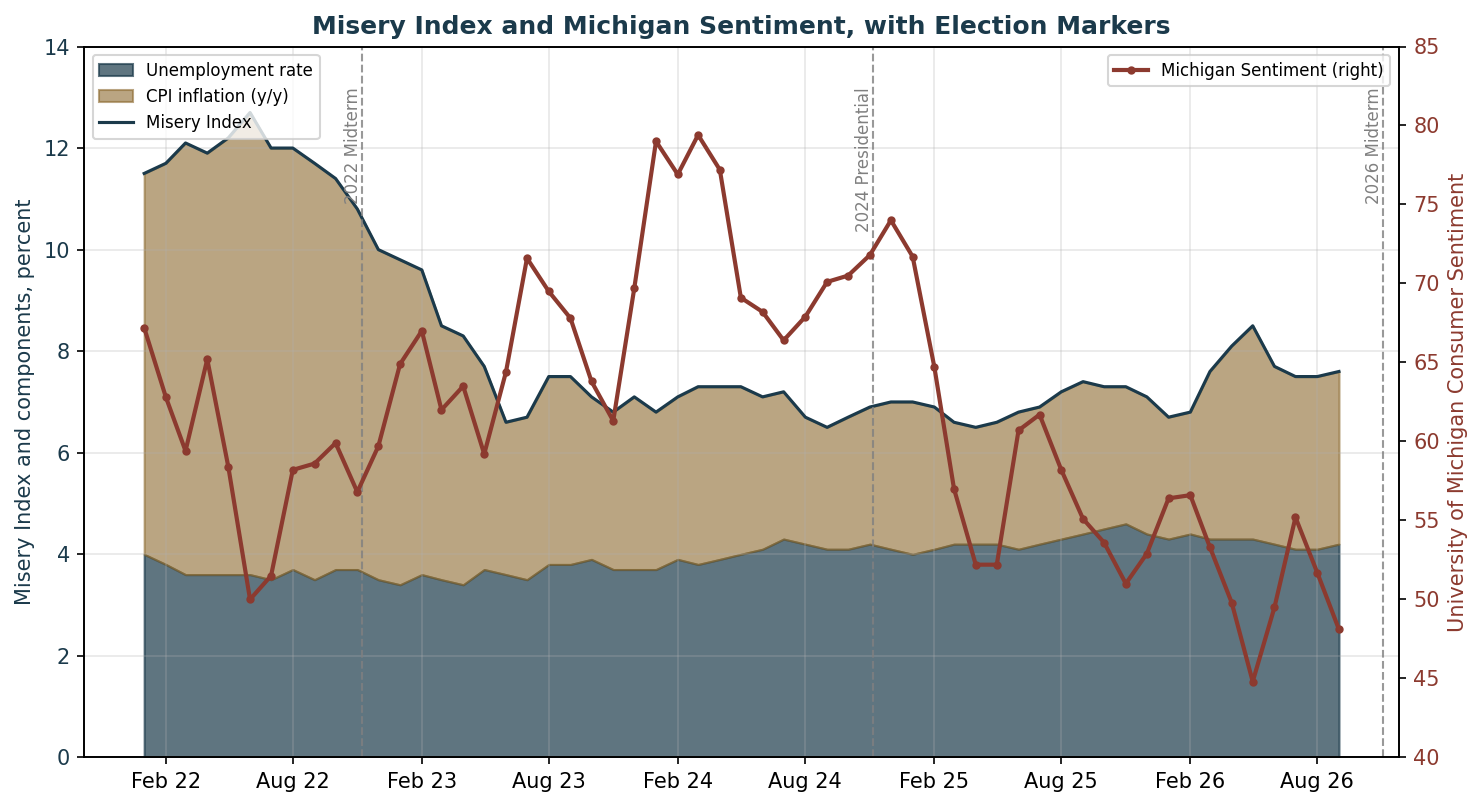
The Misery Index has moved into the mid-7s as inflation reaccelerated on the energy shock while unemployment has stayed near 4.2 percent. Michigan sentiment has moved the other way and sits near its May low. September 2026 inflation is held at the August rate pending the October 14 release.
BOTTOM LINE
The capital-heavy, employment-light expansion continues, and it is competing with record government borrowing for the same savings, which keeps long-term yields elevated across the developed world. The labor-force arithmetic is also tighter than the soft three-month payroll average suggests. Job growth is increasing and workers are returning, from manufacturing rehires in rural and smaller MSAs in the South and Midwest and from legal immigrants who had dropped out. That combination can keep the unemployment rate at 4.2 percent or less. Energy and diesel remain the principal outside risks. The week ahead tests the view: the bond market is closed Monday for Columbus Day, the big banks open earnings season Tuesday, and September CPI arrives Wednesday. We still look for a pause on October 27-28 and a quarter-point increase on December 9, with at least one further increase fairly early in 2027.
| Call | Made | Check date | Status |
|---|---|---|---|
| Pause Oct 27-28; 25 bp hike Dec 9; ≥1 more in 2027 | Sept 16 / Oct 10 | Dec 9 FOMC | On track; minutes: most see another hike by year end |
| Unemployment stays ≤4.2% as labor force reentry continues | Oct 10, 2026 | Next employment report | New; rests on rising hiring plus reentry absorption |
OUR FORECAST
We expect the Fed to pause on October 27-28, raise the funds rate a quarter point to 4.00 to 4.25 percent on December 9 and follow with at least one more increase fairly early in 2027. We expect the unemployment rate to hold at 4.2 percent or less as workers keep returning to the labor force, and real consumer spending to grow 2.3 percent in 2026. We carry forward our estimate of growth near 2.7 percent in the third quarter and near 2.5 percent into year-end, which the October 29 advance GDP report will test. Long-term yields should stay elevated while private capital spending and government borrowing compete for the same savings, and energy and diesel remain the largest outside risk to this path.
Risks to our view
A sustained drop in oil and diesel that pulls year-ahead inflation expectations under 4 percent. That would reduce the case for the December increase and the early-2027 follow-on.
A Conference Board labor-market differential that turns negative on October 27. That would challenge the view that the labor market is absorbing reentry without a rise in joblessness.
A wider shipping war or a formal halt to Hormuz traffic. Transits are a fraction of normal and the IRGC now says it will pursue ships it deems in violation anywhere in the region. A formal halt, or attacks that spread beyond the strait, would break the growth call, not just the rate call.
A sharper slowdown in AI-related capital spending. That would show up directly in the GDP accounts that were revised higher on its account on September 30.
A global term-premium shock. A weak auction or fiscal surprise in the United Kingdom, France or Japan, where yields are already at multi-decade highs, could push the 10-year Treasury well through 5.4 percent and tighten financial conditions faster than the Fed intends.
CFO AND TREASURERS CORNER
Term out ahead of a long end that remains elevated. The 10-year has spent the week above 5.2 percent and touched 5.36 percent on Wednesday, its highest since 2002. Waiting for a pullback that has not arrived is a bet, not a plan. Rates are being pulled higher by strong demand for capital and growing concern about fiscal deficits.
Assume capital is expensive abroad too. Sterling, euro and yen borrowers face the same pressure: 30-year gilts are near 6 percent and the 10-year JGB is above 3 percent.
Budget diesel separately from crude. Distillate stays tight on lost refining capacity and constrained Middle Eastern exports even on days crude eases. Retail diesel was $6.20 a gallon on October 5 and Hurricane Isaias put about 500,000 barrels a day of Gulf refining capacity in its path, so assume the tightness lasts longer than crude suggests. Food inflation is not expected to peak until the middle of 2027 on the diesel pass-through.
Watch labor-force reentry in the South and Midwest. Manufacturing rehires in rural areas and smaller MSAs are drawing people back into the workforce. That supports volume in those markets but limits wage pressure relative to a pure hiring shortage.
PIEDMONT PERSPECTIVE
The Piedmont Perspective: The Fed Should Explain More Than It Promises
Chairman Warsh wants investors to watch the economy rather than the Fed. We would keep the explanation and drop the promises.
Chairman Warsh wants monetary policy off the emergency footing it has held since 2008. He has said he wants investors to watch the economy rather than the Fed. After the September increase to 3.75 to 4.00 percent, market-implied odds of an October move climbed near 70 percent, then fell after Williams and Jefferson signaled no urgency. The episode shows the edge of the experiment.
Warsh’s objection is to commitment, not to explanation. At Jackson Hole he said forward guidance was essential during the crisis and has overstayed its welcome, and that in normal times its role should be limited and circumscribed. The pre-crisis Fed described leanings in plain language, a considerable period, patient, measured, without dates or thresholds. Calendar guidance and zero-rate promises came later. We prefer measured guidance, less of it but not none. The funds rate is back near 3.9 percent, so the tools built for the zero bound should recede.
Read our full Piedmont Perspective at: www.piedmontcrescentcapital.com/more-measured-guidance-not-no-guidance/
THE WEEK AHEAD
Monday: Columbus Day. The bond market is closed and equity markets are open, with no major U.S. data scheduled. Japan and Canada are also on holiday.
Tuesday: The big banks open third-quarter earnings season before the open, with JPMorgan, Goldman Sachs, Citigroup, Wells Fargo, UnitedHealth and Johnson & Johnson reporting. We will listen for commentary on loan demand, credit quality and capital markets activity tied to the buildout.
Wednesday: September CPI at 8:30 a.m. Consensus is near 3.6 percent for headline inflation and 2.5 percent for core, with monthly gains near 0.6 percent for headline and 0.2 percent for core. August was 3.4 percent headline and 2.4 percent core. Bank of America, Morgan Stanley and BlackRock also report.
Thursday and Friday: September producer prices, retail sales, jobless claims and the Philadelphia Fed index arrive Thursday at 8:30 a.m., with consensus near 0.5 percent for producer prices and 0.3 percent for retail sales after a 1.2 percent gain in August. The weekly EIA petroleum report, delayed this week, will show how Hurricane Isaias affected Gulf Coast refinery runs and distillate stocks. Chairman Warsh speaks late Thursday at the IMF meetings in Bangkok. Import and export prices come Friday.
What would move us: A core CPI gain of 0.4 percent or more would put an October rate increase back in play despite the soft payroll report. A reading near the 0.2 percent consensus keeps our call for a pause on October 27-28 and a quarter-point increase on December 9. We are also watching whether Iran sends a formal reply on Hormuz, whether the United States joins Saudi strikes on the Houthis, and how quickly Gulf of Mexico output and Gulf Coast refinery runs return.
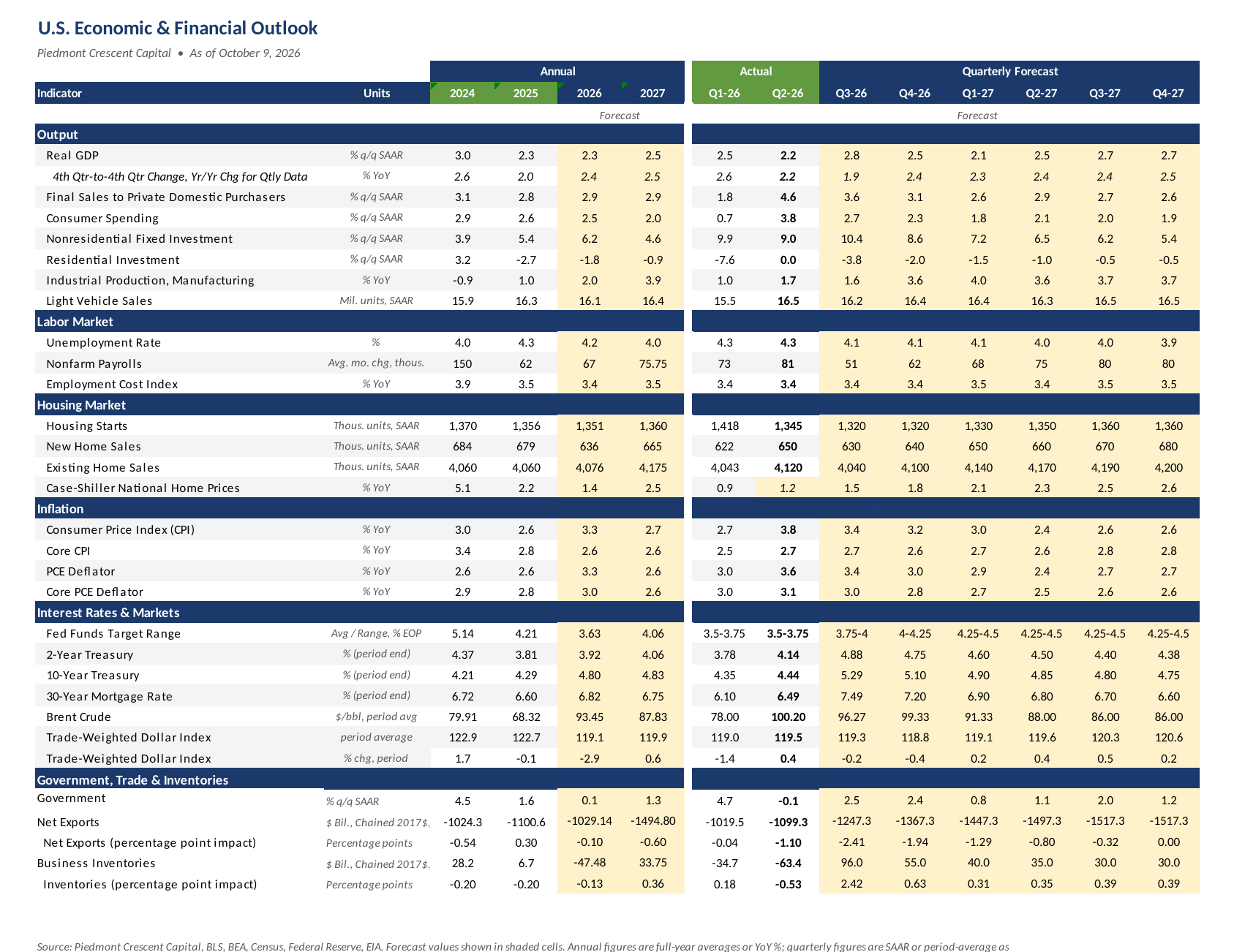
US ECONOMIC AND FINANCIAL OUTLOOK
Our full multi-year outlook, updated as of October 9, is below.
SOURCES AND NOTES
Sources. U.S. Bureau of Labor Statistics (Employment Situation, September 2026, released October 2); First Trust Portfolios (employment and ISM Services detail); Institute for Supply Management (Services PMI, September 2026); University of Michigan (Surveys of Consumers, preliminary October 2026); U.S. Bureau of Economic Analysis (personal income and outlays, August 2026; second-quarter GDP third estimate, September 30); Federal Reserve (minutes of the September 15-16 FOMC meeting, released October 7); Congressional Budget Office (letter on alternative scenarios for interest rates and the budget, September 24; Monthly Budget Review, September 2026, October 8; How Changes in Economic Conditions Might Affect the Federal Budget, April 21; The Budget and Economic Outlook: 2026 to 2036, February 11); Fitch Ratings (developed-market sovereign debt, July 23); Admiral Markets (September CPI preview).
Geopolitical and energy. Yahoo Finance and Reuters (Monday pre-open, October 12); FNArena (Friday close and overnight markets, October 12); HDFC Sky (Brent and WTI, October 12); Asia News Network and The Statesman (Riyadh airport attack, October 12); The National (Iran statement, October 11); Euronews (IRGC tanker strikes, October 9); UKMTO incident reports; U.S. Central Command statements; straits.live Hormuz brief based on IMF PortWatch data (October 8); Devdiscourse and Deccan Chronicle (U.S.-Iran statements and Iran’s seven-day plan); gCaptain, Insurance Business and FOX10 (Hurricane Isaias, Gulf shut-ins and impacts); Wolf Street (10-year Treasury auction, October 7); fxmacrodata.com (government bond yields by country, October 1-2); Yahoo Finance and TheStreet (U.S. market closes, October 9).
Monday pre-open futures and oil are as of about 4 a.m. ET on October 12. Market data as of Friday, October 9, 2026, unless noted: S&P 500, Dow, Nasdaq and Russell 2000 closes; WTI futures; gold futures. Brent is an approximate Friday settle. Treasury yields are approximate Friday levels, with the 10-year at 5.24 percent. Fitch deficit and debt figures are 2026 projections from its July report, and the U.S. and Japanese debt ratios are approximate. Hormuz transit counts differ across monitors and are indicative only.
Disclaimer: This report is provided for informational purposes only and does not constitute investment, legal, tax or accounting advice. Information is drawn from sources believed to be reliable, including the Bureau of Labor Statistics, the University of Michigan, the Institute for Supply Management and the Federal Reserve, but its accuracy and completeness are not guaranteed. Views are those of the author as of the date of publication.
© 2026 Piedmont Crescent Capital, LLC. All rights reserved.