Consumer Sentiment Report: Current Conditions Sour as Expectations Improve
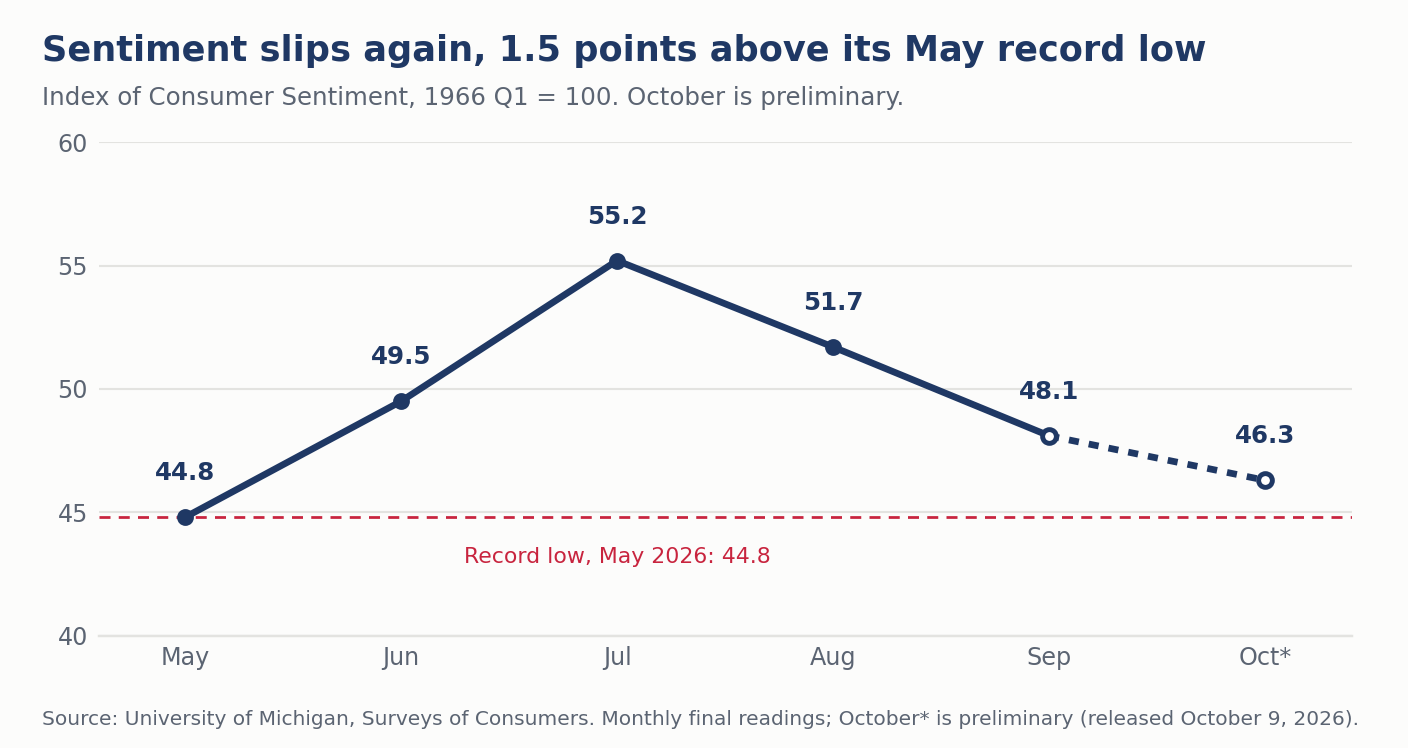
The University of Michigan index fell 1.8 points to 46.3 in October, 1.5 points above its May record low, as current conditions dropped 6.2 points and expectations rose 1.0 point.
Early Signal
- Sentiment fell 1.8 points to 46.3 in the preliminary October survey. The index was 48.1 in September and is 1.5 points above the record low of 44.8 set in May. Economists had expected a reading near 47.7.
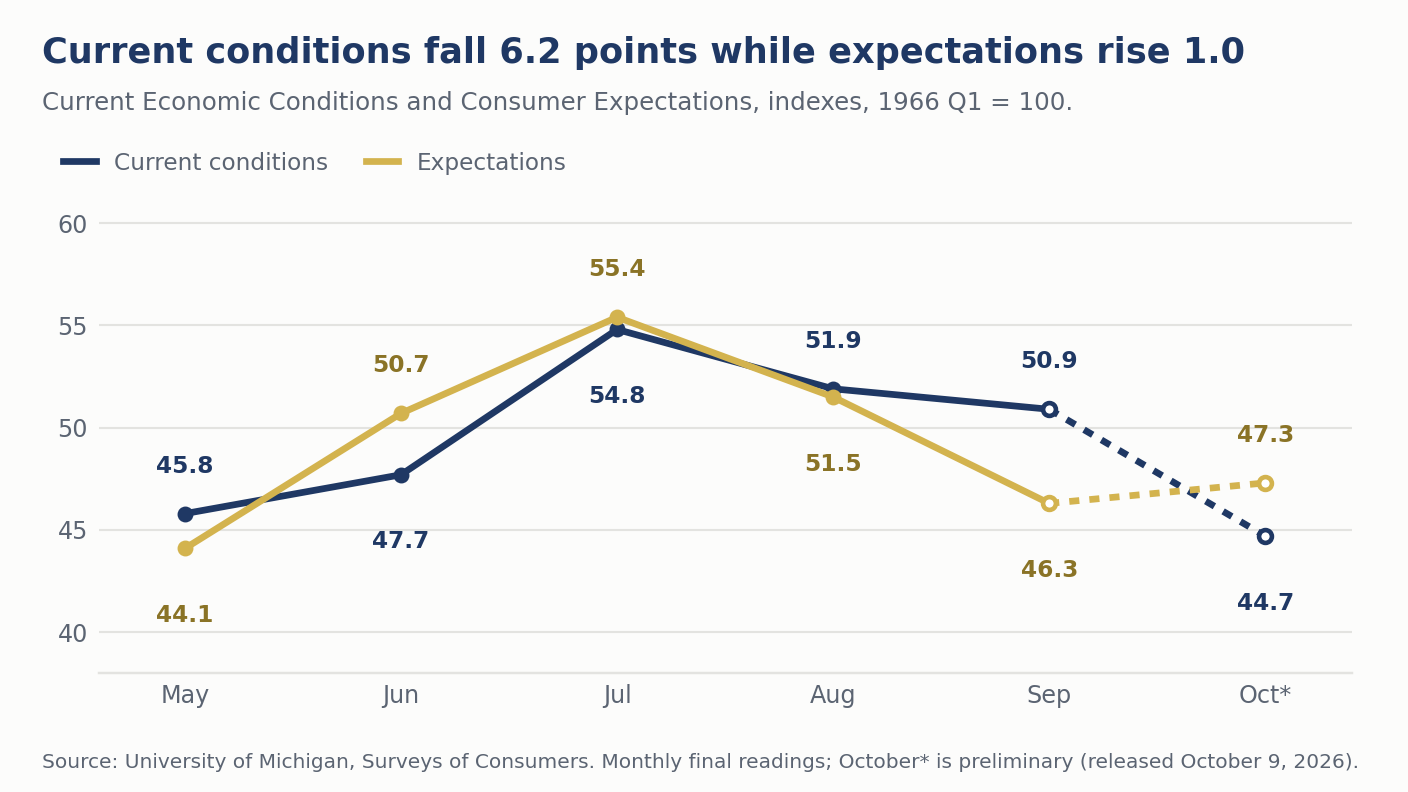
- Current conditions fell 6.2 points to 44.7. The index of current economic conditions was 50.9 in September, and forecasters had looked for a reading near 51.
- Expectations rose 1.0 point to 47.3. That is ahead of the 45.5 consensus and follows a 5.2-point decline in September.
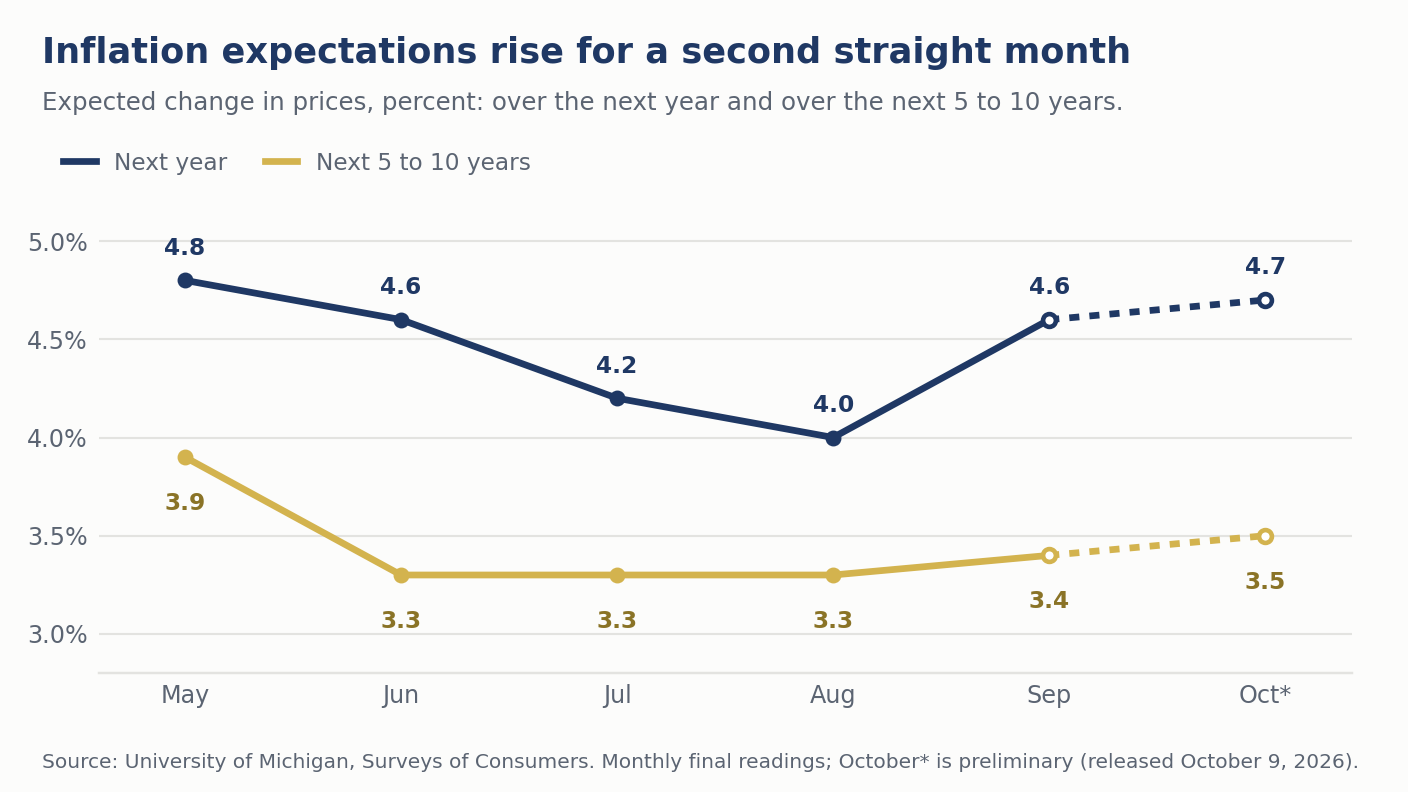
- Inflation expectations rose for a second straight month. The year-ahead expectation is 4.7%, up from 4.6%, and the long-run expectation is 3.5%, up from 3.4%. Both are the highest since May, and the long-run reading is above the 2.8% to 3.2% range of 2024.
- The hard data on household spending have not confirmed a pullback. The September flash composite PMI of 58.4 was the strongest since 2021, and we hold our forecast for real consumer spending growth of 2.3% in 2026. The split between lower- and upper-income households, however, is widening.
Overview
The University of Michigan's Index of Consumer Sentiment fell 1.8 points to 46.3 in the preliminary October survey, from 48.1 in September. That is below the consensus range of 47.6 to 47.8 and 1.5 points above the record low of 44.8 set in May. Current Economic Conditions dropped 6.2 points to 44.7 and the Index of Consumer Expectations rose 1.0 point to 47.3. The final October reading is due October 23.
A quick reminder about what these numbers measure. Each question behind the Michigan indexes is scored as the percent of households answering favorably less the percent answering unfavorably, plus 100, so the indexes report the breadth of sentiment and not its intensity. A household that moves from “good” to “bad” counts the same whether its view slipped a little or a lot. We try to use breadth language throughout our analysis and reserve words like growth and spending for the hard data.
September set the baseline. Sentiment fell 3.6 points to 48.1, the lowest reading in four months, and the damage was in expectations, which fell 5.2 points to 46.3 while current conditions eased 1.0 point to 50.9. The University of Michigan pointed to elevated fuel prices, high prices that keep climbing and renewed trade disputes. The decline was shared across political parties, with Republican sentiment 20% below January and Democratic sentiment 13% below.
What Changed In October
Current conditions took the hit. Buying conditions for durable goods deteriorated as high prices and borrowing costs discouraged purchases. Sentiment weakened the most among lower-income households and households with smaller stock portfolios, which have fewer resources to absorb higher prices. This is one of the primary transmission mechanisms of monetary policy and suggests the Fed will need to do less. Table 1 lists the five headline readings.
| Indicator | October (prelim.) | September | Change |
|---|---|---|---|
| Consumer sentiment | 46.3 | 48.1 | -1.8 |
| Current economic conditions | 44.7 | 50.9 | -6.2 |
| Consumer expectations | 47.3 | 46.3 | +1.0 |
| Year-ahead inflation expectation | 4.7% | 4.6% | +0.1 pt |
| Long-run inflation expectation | 3.5% | 3.4% | +0.1 pt |
Table 1. October's preliminary readings against September's final readings. Source: University of Michigan, Surveys of Consumers.
Expectations improved a little. Households are more dissatisfied with their present circumstances and somewhat less pessimistic about the coming year. That points to affordability pressures today as the source of the weakness. The expectations index beat the 45.5 consensus even as the current conditions index missed the 51.0 consensus by more than six points.
Inflation Expectations
Both inflation expectation measures rose for a second straight month. The year-ahead expectation rose to 4.7% from 4.6% and the long-run expectation rose to 3.5% from 3.4%, the highest readings for each since May. The long-run expectation stayed between 2.8% and 3.2% throughout 2024.
The long-run expectation is the number to watch. If households now treat higher inflation as a lasting feature of the economy, the long-run expectation is where it will show first. Energy prices and trade-related costs can lift expectations for a time without lifting underlying inflation. A persistent rise in the long-run measure would complicate monetary policy, with inflation still above the Fed's 2% objective.
Sentiment And Spending
Spending has not followed sentiment lower. Households are dissatisfied with the economy, yet many are still spending, supported by employment income and wealth. The Michigan survey measures perceptions, and those are shaped heavily by prices, politics and media coverage. Spending depends more directly on employment, income, wealth and access to credit.
The Conference Board survey carried the same message in September. Its index fell 6.7 points to 81.9, and fuel prices dominated what respondents wrote in. The September flash composite PMI of 58.4 was the strongest since 2021, and the labor market differential in the Conference Board survey stood at +1.7%, just above zero.
OUR CALL
The consumer sector is slowing without contracting. The sharp drop in buying conditions for durable goods is a downside risk to discretionary spending, particularly for households with limited financial buffers. Even so, sentiment has been an unreliable guide to spending for most of this expansion, and employment, real disposable income and household wealth are better guides to the near term. We hold our forecast for real consumer spending growth of 2.3% in 2026 and 2.0% in 2027 (September 23 vintage), and we leave the Fed call unchanged: a hold at the October 27-28 meeting, a second quarter-point increase on December 9 to 4.00%-4.25%, and at least one more in 2027.
The test is the Conference Board's October report, released October 27, the first day of the FOMC meeting. If the labor market differential turns negative, with more households calling jobs hard to get than plentiful, we will take our consumer spending forecast lower. If it holds above zero, we read the Michigan weakness as a response to prices and keep the forecast where it is.
Bottom Line
Households are less comfortable with the economy they have than with the one they expect, which is an uncomfortable combination but short of a recession signal. The Michigan index is built differently from the Conference Board's, and the 80 threshold in our midterm research does not carry over to it. The Conference Board's October report on October 27 is the last before the November 3 election, and it is the one we will use to test our spending forecast.
What We Are Watching
- Final October reading, October 23: the preliminary survey is subject to revision, and the split between current conditions and expectations is the part to check.
- Long-run inflation expectations: the 3.5% reading is above its 2024 range, and a third consecutive increase would add to the case that households see higher inflation as lasting.
- Durable goods buying conditions: the deterioration in October is the main downside risk to discretionary spending.
- Labor market differential, October 27: the Conference Board's +1.7% reading sits just above zero, and a move below zero would change our consumer spending forecast.
- The FOMC meeting, October 27-28: our call is a hold, and the inflation expectations in this survey are part of the case for patience.
Mark P. Vitner
Chief Economist, Piedmont Crescent Capital
mark.vitner@piedmontcrescentcapital.com | 704-458-4000
Sources: University of Michigan, Surveys of Consumers, preliminary October 2026 (released October 9) and final May through September 2026; investingLive, consensus forecasts; The Conference Board, Consumer Confidence Survey, September 2026; S&P Global, flash U.S. PMI, September 2026; Piedmont Crescent Capital, Consumer Confidence Report (September 29, 2026) and forecast vintage of September 23, 2026.
© 2026 Piedmont Crescent Capital, LLC. For informational purposes only. Not investment advice.