
The Umpire Defines His Strike Zone
The Piedmont Perspective
Chair Warsh told the market at Jackson Hole to play the ball and not the referee. Six days later Governor Waller answered that nobody can play the ball until they know the strike zone, and then he called his. The pitch that decides September arrives on the 11th, and the Committee’s real disagreement is over who is standing behind the plate.
The Argument in Brief
- Two speeches, opposite answers. Chair Warsh retired forward guidance at Jackson Hole and declined to describe a reaction function. Six days later Governor Waller agreed guidance belongs at the zero bound and nowhere else, then explained why a reaction function is a different thing and published his.
- The zone is narrow enough to be useful. If August inflation shows continued progress, Waller holds at 3.50% to 3.75% on September 16. If it comes in hot, he would consider a hike. His vote turns on the inflation data, not the jobs report.
- We share his reading of the July price data. Three-month annualized core PCE has fallen every month since February, from 4.76% to 3.05%, and is converging on the trimmed mean. Roughly half of July’s core increase came from prices that are imputed and never paid.
- Where we part company is on how much restraint is already in place. Waller sees policy as only slightly restrictive. We think the 2-year at a one-year high, mortgage rates back at 6.71% and single-family starts at their lowest since 2022 say the long end is already doing the Committee’s tightening.
- Twelve reaction functions are not a reaction function. Four voters called pitches in one week and September hike odds swung from 63% to 50% to 65% to 58%. Every reaction function is ceteris paribus, and the batter’s box moved between every pitch.
- The call, with dates. August core CPI at 0.2% or below on September 11 means a hold on the 16th. Core at 0.3% or above with core goods at 0.4% or more makes a September increase our base case that morning. Our house call is unchanged: hold in September, first increase December 9, one more in 2027 to a terminal 4.00% to 4.25%, and we own the tension between that date and Waller’s framework.
Two speeches six days apart asked the same question and gave opposite answers. The question is what a central bank owes the public about its own future behavior. Chair Warsh answered from Jackson Hole on August 28 that it owes a standard and nothing more. He retired forward guidance as a crisis legacy that “has overstayed its welcome,” declined to describe a reaction function, and closed with a line that has been quoted more than anything else he has said in office: “I stand here today committed to a discipline, not to a decision.” Governor Waller answered from a Reuters interview on September 3 that a standard is not enough. He agreed that forward guidance belongs at the zero bound and nowhere else, then spent the second half of his remarks explaining why a reaction function is a different thing, why he intends to keep publishing his, and what his looks like right now.
Waller’s framework separates three things that get lumped together as “guidance,” and the distinction is the most useful part of the speech. The first is explaining the vote just taken, which every policymaker does. The third is forward guidance in the strict sense, a path for the policy rate that is “essentially independent of incoming data,” and he confines it to the effective lower bound. He cites his own record: in September 2021 he supported guidance that signaled the end of asset purchases, and by March 2022 the 2-year Treasury yield had risen 200 basis points before the funds rate had moved at all. The second thing sits between them. A reaction function is a conditional statement, “IF the data comes in a particular way, THEN I will advocate for policy to be set a particular way,” and he was emphatic that “it is not a commitment to a policy action.” It is a description of how he will read the data he has not seen yet.
Then came the umpire. “The pitcher is trying to strike out the batter, and the batter is trying to hit the ball or walk to get on base. Both want to play the ball, but they cannot do that until they know the umpire’s strike zone.” The players do not need a perfect zone. They need “a rough idea of its parameters and some guarantee that it won’t change much on every pitch.” It is a direct reply to the Chairman, who has spent his first year telling market participants to stop watching the referee, and Waller drew the contrast himself when asked about it. A referee whose calls cannot be anticipated is not a discipline. He is noise.
So he called his zone, and it is narrow enough to be useful. If the August inflation data due over the next two weeks show “continued progress toward our 2 percent goal,” he will support holding the funds rate at 3.50% to 3.75% on September 16. If the data show the improvement “has been fleeting,” if inflation “comes in hot,” he “would consider a rate hike,” and he framed that as “a small adjustment in our stance.” He also told us how much weight each report gets. The employment data, he expects, “will not deviate much from what we have been seeing,” so his vote “will be heavily influenced by what we learn about August inflation.” In the interview he put it in a phrase that will outlast the speech: “To paraphrase John Lennon, I’m willing to give disinflation a chance.”
What sits inside his zone is a specific reading of the July price data, and it is a reading we share. Twelve-month PCE inflation is 3.7% and core is 3.3%, and he set both aside as “not the best guide for where inflation is today.” His number is the three-month annualized core rate, which has fallen every month since February, from 4.76% to 3.05% in July. Figure 1 plots it against the same three-month window on the Dallas Fed’s trimmed mean, which discards the extremes from the same basket and has run between 2.2% and 2.8% all year. The two lines are converging from above, and the direction is the argument. He then went further than any Committee member has in print this year. Roughly half of July’s core increase came from nonmarket services, prices that are imputed and never paid, and “ignoring this one factor, my take is that underlying inflation is doing better than the core numbers suggest.” He expects a pending Commerce Department change in how the fees paid to portfolio managers are estimated to take “a few tenths” off the twelve-month rate.
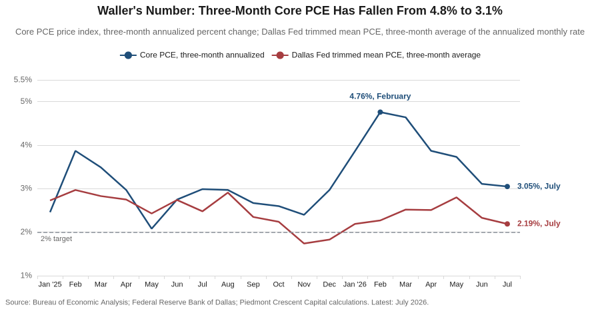
That is the same divergence we measured last week from a different direction. Core PCE is running more than a full point above its own trimmed mean, the widest gap since April 2022, and 0.87 points above core CPI, a relationship that has run the other way for most of the past sixty years. The categories carrying the gap are medical care, airfares and the asset-linked fees Waller named. A governor arriving at the same place from the headline series and a private economist arriving from the trimmed means is about as much corroboration as an inflation argument gets in real time. On the labor market, he and we also agree on the frame. Job growth of 60,000 a month through July, and roughly 80,000 with August and the revisions, is “close to and probably a bit above” what a labor force barely growing can absorb. Friday’s 162,000 does not disturb that. Two categories with distorted summer seasonals, restaurants and school districts, supplied 104,000 of it, and the three-month average of 71,000 is the number to carry.
Where we part company is on one clause, and it is the clause that decides how expensive a mistake would be. Waller judges that “policy is currently only slightly restricting aggregate demand, and it may not take much acceleration in inflation to nudge me into supporting tighter policy.” We think the restraint is larger than that, and we think it has been arriving without the Committee lifting a finger. The funds rate is 175 basis points below its August 2024 level. Over the same two years the 10-year Treasury has risen 81 basis points and the 30-year mortgage rate 17, on monthly averages, and this week the 2-year closed at 4.37%, its highest in a year, while Freddie Mac’s survey rate moved back up to 6.71%. Single-family starts fell to 808,000 units in July, the fewest since November 2022, and residential investment is subtracting from growth for the balance of the year. Core goods prices are up 0.8% over twelve months and new vehicle prices 0.5%. The maturities that price houses, plants and refinancings have tightened while the policy rate fell, which is restraint by any definition a borrower would recognize. The practical difference is this: if Waller is right about the cushion, the August CPI carries most of the decision; if we are right, a September increase would be adding restraint to channels that are already carrying the adjustment, and the cost of being wrong in that direction takes a year and a half to show up.
The pitch itself arrives Friday, and the strike zone tells us what to watch. The consensus for the August consumer price index is 0.4% on the headline and 0.2% on core. We published our own threshold on August 30 and it stands: a core reading at or above 0.3%, particularly with core goods above 0.4%, would mean the refining shock has reached the goods basket and would make a September increase the base case. Below that, Waller’s zone calls a ball, and so does ours. The evidence on pass-through this week leaned his way. The ISM prices indexes printed 71.1 in manufacturing and 72.6 in services, which say that seven in ten purchasing managers paid more in August, and the Beige Book said in nearly every District that firms are absorbing those costs, with Richmond reporting input price growth just above 7% against prices received “relatively unchanged.” That is a margin squeeze, and it is the mechanism behind Waller’s observation that his “earlier worry that higher energy prices would bleed into many goods and services prices hasn’t come to pass, at least so far.” The qualifier is doing real work. Margins are finite, and the place a hot number is more likely to show up first is Thursday’s producer price index, not Friday’s CPI.
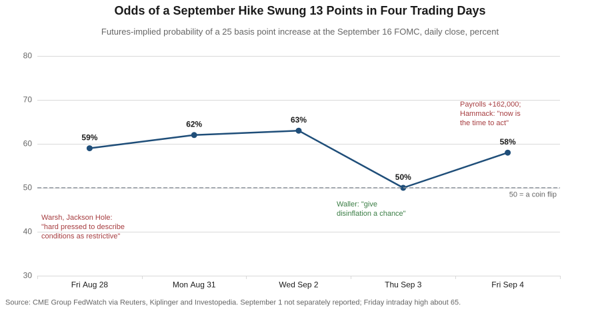
Now the cost of a strike zone, which the Chairman understands better than his critics allow. A committee has twelve umpires, and three of them called pitches in the same week. Governor Barr on Tuesday: act “decisively” if inflation is not moderating sufficiently, otherwise “take a bit more time.” President Williams on Wednesday: “no clear signs right now” whether the stance is sufficient. Waller on Thursday: give disinflation a chance. President Hammack on Friday, after the payroll report: “Now is the time to act. There’s no tension in the mandate. Policy isn’t restrictive.” The market repriced on every one of them. Futures-implied odds of a September increase went from 59% after Jackson Hole to 63% on Wednesday, to 50% after Waller, to roughly 65% in the minutes after Friday’s payroll print, and settled at 58% (Figure 2). The 2-year yield moved 4 to 6 basis points on each turn. Four conditional statements from four voters, each internally consistent, add up to a path by another name, and a noisier one than any dot plot. The reason is the clause every reaction function leaves unspoken: ceteris paribus. Each voter described what he or she would do if nothing else changed, and in the same five days Brent rose 9%, payrolls printed 162,000, Canada retaliated and two tankers were hit in the strait. A strike zone is stable only in a stationary batter’s box, and this one moved between every pitch. Warsh’s objection to reaction functions is not that they are wrong. It is that twelve of them are not a reaction function; they are a rumor.
The benefit is the other side of the same coin, and Waller’s own history lesson makes the case for him. His 2022 example was a market that tightened 200 basis points at the front end before the Committee moved, because the Committee had told it what was coming. Look at 2026. The Committee has told the market nothing about the path, and the 2-year has risen 90 basis points since January while the funds rate sat still and the 3-month bill moved 26. The front end has walked to the house call, a first increase after the midterms, without a word of guidance and without the Committee doing anything but describing its strike zone one voter at a time. That is the discipline Warsh asked for, delivered by the market, and it is a large part of why we think September can wait. The part of the curve no reaction function reaches is the long end, where the 30-year at 5.24% has priced a term premium for a fiscal deficit, an energy shock and a private credit boom, and that is doing the tightening the Committee would otherwise have to do itself.
The honest test of any strike zone is to apply it to your own forecast, and ours does not pass it cleanly. We carry core PCE inflation at 3.1% for 2026 and 2.7% for 2027, which is continued progress by Waller’s definition every quarter of the way. Applied to that path, his zone calls a ball in September and a ball again in December. Yet we expect the Committee to raise the funds rate on December 9, the first meeting after the midterms, and hold it at 3.75% to 4.00% before one more increase in 2027. The two views reconcile only if the December majority is judging by a different zone, and we think it is. Warsh’s standard is that underlying inflation must be moving to target “clearly and at sufficient speed,” which is a statement about speed as well as direction. The three July dissenters and Hammack are judging by the level: 64 months above target, averaging 4.0%. Our December call rests on the majority weighting level and speed over the trend, and on a Chairman who has said he cannot describe conditions as restrictive. If Waller’s zone is the Committee’s zone, our first hike is too early, and the argument for December becomes the argument for the spring. We would rather say that plainly than pretend the framework and the forecast agree.
So the falsifiable version, with dates. If August core CPI on September 11 prints 0.2% or below, the Committee holds on September 16 with no more than the three July dissents, and Waller votes with the majority. If core prints 0.3% or above with core goods at 0.4% or more, we move a September increase to our base case that morning, on the rule we published a week ago, and Waller’s zone gets its first real test of consistency: a hold vote after a hot print would mean the zone moved on the pitch, which is the one thing he promised it would not do. Either way the September meeting is the pitch, the umpire has shown where the zone is, and a batter who cannot hit a strike down the middle has no complaint about the umpire.
Our call is unchanged. We expect a hold on September 16 and we think the Committee should hold. We carry December 9 as the first increase, with one more in 2027 to a terminal 4.00% to 4.25%, and we own the tension between that date and the framework we have just praised. The condition that would move us on the whole path is the one we set in August and it has nothing to do with the strike zone: two or three more months of core services outside of shelter near 0.4% with shelter no longer decelerating. Until then, the disagreement inside the Committee is less about where the zone is than about who is umpiring, and on Friday the market decided that is a question worth 58 cents on the dollar.
Mark P. Vitner
President & Chief Economist, Piedmont Crescent Capital
mark.vitner@piedmontcrescentcapital.com · 704-458-4000
Sources: Christopher J. Waller, “The Economic Outlook and Some Comments on My Policy Communication,” Reuters NEXT Newsmaker Interview, Washington, September 3, 2026, and the interview with Howard Schneider that followed; Kevin Warsh, “In Our Time,” Jackson Hole, August 28, 2026; Michael Barr, remarks of September 1; John Williams, CNBC interview, September 2; Beth Hammack, statement of September 4; U.S. Bureau of Economic Analysis, Personal Income and Outlays, July 2026; Federal Reserve Bank of Dallas, Trimmed Mean PCE Inflation Rate; U.S. Bureau of Labor Statistics, Employment Situation, August 2026, and Consumer Price Index, July 2026; Institute for Supply Management, August 2026 manufacturing and services reports; Federal Reserve Board, Beige Book, September 2, 2026; U.S. Department of the Treasury, daily par yield curve; Freddie Mac, Primary Mortgage Market Survey; CME Group FedWatch as reported by Reuters, Kiplinger and Investopedia; Piedmont Crescent Capital, “A Wider Gap, a Narrower Problem,” September 2026. Three-month core PCE is the annualized change in the index over three months; the trimmed mean comparison is the three-month average of the Dallas Fed’s annualized monthly rate. This commentary is published by Piedmont Crescent Capital for informational purposes only and does not constitute investment, legal, or tax advice. Views expressed are those of the author as of the date of publication and are subject to change.