
The Wrong Number and the Right Worry
The Piedmont Perspective
The Argument in Brief
- The case for holding rates in September rests on the inflation rate we can measure today. The case for worrying about 2027 rests on the demand growth that will set the rate we measure then. Both are ours, and they do not conflict.
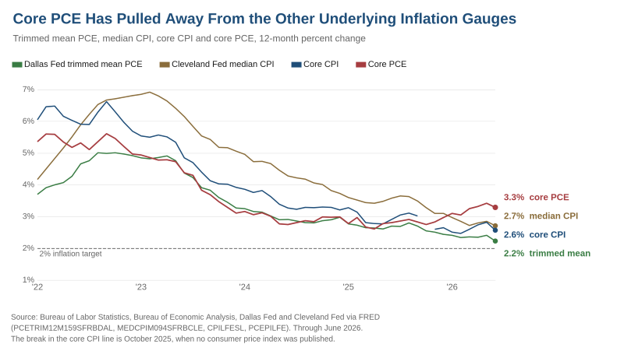
- On today’s number the case for tightening is weak. Trimmed mean PCE at 2.23%, median CPI at 2.7%, core CPI at 2.6%, wages decelerating to 3.1%, payrolls at 57,000 a month.
- Our trend estimates now run across three price indexes, and they have pulled apart. Core CPI 2.73%, core PCE 3.30%, producer prices 4.12%. The range across the three is the widest of the cycle.
- The worry is demand, not price. Private domestic demand grew 3.9% against a labor force that has shrunk by roughly a million people over the past year.
- The test prints Thursday. If second-quarter productivity is running 2.5% or better, the 2027 worry weakens materially, and we would say so.
We are inflation hawks and we have never minded the label. It is precisely because we hold that view that we do not think the Federal Reserve should raise rates in September, and it is precisely because we hold it that we are more worried about 2027 than most of the people currently arguing for a hike. Three officials dissented on July 29 in favor of a quarter point and the commentary since has been close to unanimous that the Committee is behind. We part company with it, and the reason is not that we have gone soft on inflation. It is that the number the hawks are pointing at and the number that should worry them are not the same number.
Everything below rests on one distinction: between the inflation rate you can measure today and the demand growth that determines the inflation rate you will measure in eighteen months. Monetary policy acts with a lag that every practitioner accepts in principle and almost nobody honors in practice. A committee that tightens because today's print is uncomfortable is treating a lagging indicator as a leading one. A committee that tightens because demand growth is inconsistent with its target is doing the job. On today's print the case for tightening is weak. On demand growth the case for being ready to tighten is strong. Holding both positions at once is what the lag structure requires.
Start with the measurable rate, because that is where the September argument lives and where it fails. The Dallas Fed's trimmed mean measure of personal consumption expenditures, which is not a fitted trend and does not get revised, fell in June to 2.23%, its lowest since July 2021. The Cleveland Fed's median consumer price index is up 2.7% over the past twelve months, down from 3.6% a year earlier. Core consumer prices are running at 2.6%. The employment cost index shows wages decelerating to 3.1% from 3.3%, and payroll growth has slowed to 57,000 a month. Michigan's inflation expectations eased. Producer prices are the honest counter-argument and we do not wave them off, with final demand up 5.5% and running between 5.5% and 6.0% since the spring, but a war-driven energy shock passing through a supply chain is the textbook relative price change and the textbook answer is to look through it unless it reaches wages or expectations. It has reached neither.
A second central bank facing a larger version of the same problem read it the same way last week. The Bank of England held Bank Rate at 3.75% on July 29 on a six to three vote and recorded in its minutes that there had been little evidence of material second-round effects so far, while noting that pass-through lags mean this cannot be taken as a strong signal about their future emergence. That is close to our own position, caveat included. Britain imports more of its energy than we do and its committee still concluded that an energy shock is not a wage-price spiral until it shows up in wages. We would not lean on an outside committee for our own view, but when two independent bodies looking at different economies reach the same reading of the same class of shock, that is worth a paragraph.
Our own estimate of underlying inflation is built to answer a question the published gauges cannot, and this month we widened it. We apply a one-sided Hodrick-Prescott filter to monthly annualized inflation, refit each month on the data available through that month, so the published estimate never revises. The point of it is that the Cleveland and Dallas measures work across the cross-section, discarding outlier categories in a single month, while a filter works across time, using the full run of data to separate a slow-moving trend from transitory noise. They are answering different questions and we would rather have both answers than argue about which one is better. Until now we ran it on the consumer price index alone. We have extended it to the personal consumption expenditures deflator and the producer price index for final demand, on the same sample and the same smoothing parameter, and the result is the most interesting thing in this note.
Run the same filter across all three price indexes and they have pulled apart, which has not happened since the war began. Our trend estimate for core consumer prices is 2.73%. For core personal consumption expenditures it is 3.30%. For producer prices it is 4.12%. The median of the three, which we would now treat as the house reading, is 3.30%. At the end of last year those three trends sat within 0.36 percentage points of one another. Today the range is 1.40 points, the widest of the cycle. A single index would not have told us that. Publishing off core consumer prices alone would have had us describing underlying inflation as being in the mid-twos and converging, when the fuller reading is low threes and diverging. We would rather be corrected by our own methodology than by a data release.
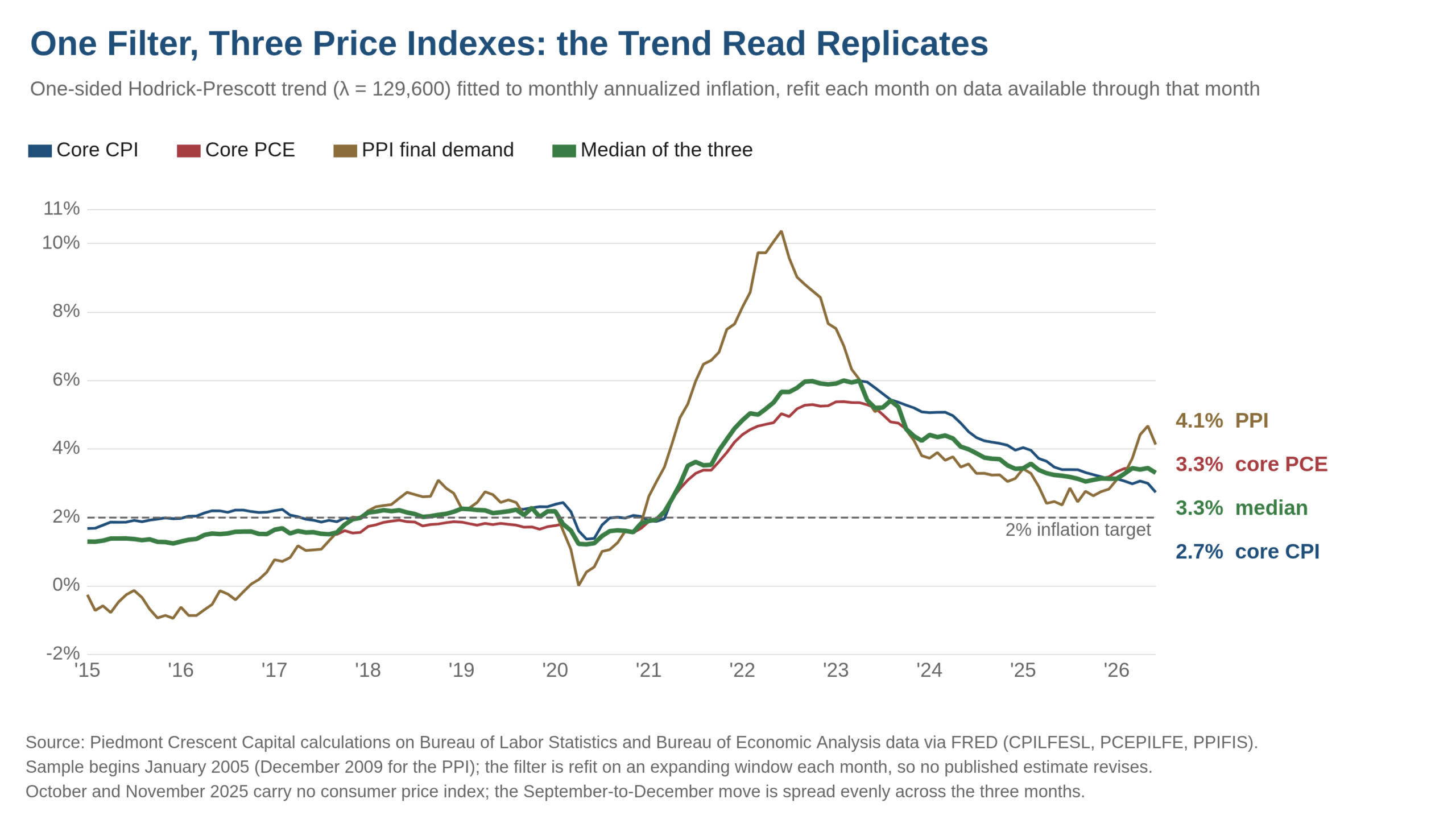
The producer index is the leading leg of that panel and it is moving first again. It rose fastest and furthest in 2021 and 2022, ahead of both consumer measures, and it has moved first again this year, up roughly 1.3 points since December while our core consumer trend fell 0.4. That is the pass-through channel showing up in a trend estimate rather than in a monthly print. It does not mean consumer inflation follows mechanically, and the pass-through from producer to consumer prices has been weaker and slower this cycle than the textbook would have it. It does mean that the reassurance people are taking from core consumer prices at 2.6% is resting on the one gauge of the three that is behaving best.
The gap between the two consumer measures is not a rounding difference and it is not monetary. Core personal consumption expenditures inflation is running 0.7 points above core consumer price inflation, which inverts the normal relationship. Part of that is shelter weights. A larger part is health care. The personal consumption index measures medical care by what providers are actually paid regardless of who pays it, and the producer price index for hospital services is up 3.6%. The consumer price index measures health insurance by a retained-earnings method currently printing minus 7.4%. The gauge the Federal Reserve targets is picking up the retiree services boom. The gauge the press quotes is not. On our reading that measurement gap, more than the shelter weights, accounts for most of the wedge, and its source is demographic.
Now the part that worries us, which has nothing to do with any of those numbers. Real final sales to private domestic purchasers grew 3.9% in the second quarter, up from 1.7% in the first and more than double that pace. The headline growth rate of 1.5% is a distraction; every part of the shortfall was inventories, imported capital goods, or a federal spending line depressed by petroleum reserve sales. Business fixed investment grew 8.4% on top of 10.6% in the first quarter, with equipment up 15.2%, which is a good deal broader than data centers. Set that against a labor force that has shrunk by roughly a million people over the past twelve months and it is not a sustainable configuration. Fed staff research puts trend labor force growth below 10,000 a month. We would not defend that estimate to the decimal, and an estimate several times larger would leave the same conclusion standing.
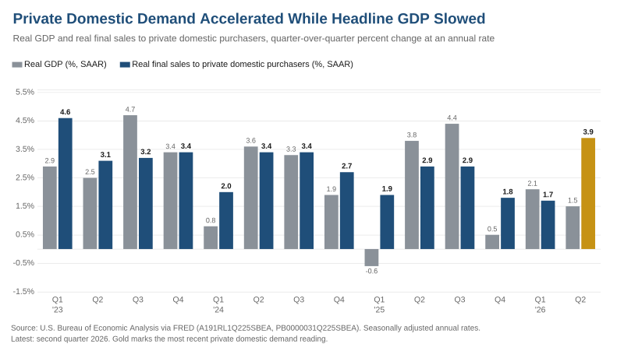
An economy cannot grow domestic demand at close to 4%, at full employment, with no growth at all in available workers, and expect inflation to settle at 2% for long. That is the whole of the worry, and it is arithmetic rather than forecasting. The question is not whether it is inflationary. The question is where and when.
The where is already visible and it is not diffuse. Five very large programs are running at once and each is pressing on a distinct physical constraint. The artificial-intelligence buildout, where conventional memory contract prices rose 93 to 98% in the first quarter and another 58 to 63% in the second, and where Governor Cook counts more than $1.5 trillion of announced data center projects with only a fraction realized. Electrification, where the PJM Interconnection's capacity auction has now cleared at its price cap three times running and still fell 6,831 megawatts short of its own reliability requirement, and where Lazard's nineteenth Levelized Cost of Energy study puts unsubsidized gas combined-cycle generation at $51 to $129 a megawatt-hour against a fifteen-year high for gas-fired power. Generator step-up transformer lead times run to four years with prices up about 80% over five years.
Two of the five have not moved a price index yet, and we regard that as the argument's strongest point rather than its weakest. Defense replenishment and pharmaceutical onshoring are still announcements to a greater extent than actual spending. The fiscal 2027 request for missiles and munitions is $70.5 billion against $24.4 billion enacted for 2026, an increase of 188%, with requested Tomahawk quantities rising from 55 to 785. Fourteen pharmaceutical manufacturers have pledged better than $480 billion of United States production across 22 sites. Meanwhile producer prices for ordnance are up 1.6% over the year, shipbuilding 0.7% and pharmaceutical preparations 1.1%, and construction spending on manufacturing structures is down 22% from a year ago, though the level is still more than twice the 2019 average. The money has been appropriated and pledged but not yet obligated, poured or paid. That pressure is ahead of us, not behind us.
The fifth program is not a capital program at all, and it behaves like the most durable one. Peak 65 runs from 2024 through 2027, with more than 11,200 Americans turning 65 every day, roughly 12% above the prior decade's pace, and Medicare enrollment now past 70 million. It converts a cohort's accumulated wealth into a permanent claim on services that cannot be imported and cannot be automated quickly: hospital services up 5.5% in the consumer price index, airline fares up 26.5%, lodging up 4.7%, food away from home up 3.4%. A data center can be cancelled. A turbine order can be deferred. A seventy-year-old's hip replacement is not rate-sensitive.
Underneath all five, the most cyclical part of the economy has started to turn up, and that is the mechanism that would make a narrow problem a general one. Chicago's purchasing managers index printed 57.6 against a 55.0 consensus. Philadelphia's general activity index jumped from 10.3 to 41.4 in a single month, with prices received up 7.1 points. Empire State shipments reached a four-year high. Industrial production ran at a 4.0% annual rate in the second quarter after 1.1% in the first. Core capital goods orders are up 12.5% from a year ago, orders excluding transportation have risen for fifteen consecutive months and unfilled orders for thirteen. Narrow bottlenecks in memory, turbines and transformers are containable on their own. They are not containable alongside a manufacturing sector competing for the same steel, copper, switchgear and electricians.
The long end of the Treasury curve appears to be pricing exactly this, and the Federal Reserve Chair came close to saying so without joining the dots. The 30-year closed July at 5.27%, a post-2007 high, the 2s-30s spread widened 22 basis points over the month, and the 30-year real yield reached about 2.9% in mid-July, its highest since inflation-protected securities of that maturity were reintroduced in 2010. That is a real-yield move rather than a breakeven move, which means investors are demanding more real return to fund a long-duration capital cycle rather than pricing more inflation. At his July 29 press conference Chair Warsh called the strong growth of business investment the most striking feature of the economy, observed that nominal and real yields are materially higher across the Treasury curve with the inter-meeting move among the largest in roughly two decades, and attributed that move to market participants reacting to real data rather than to anything the Committee said. He did not connect the two. We would.
Now the discipline, because an argument this tidy deserves to be tested rather than admired. The single most important number for whether we are right is one nobody is discussing, and it prints on Thursday. If second-quarter productivity is running at 2.5% or better, then 4% demand growth against a flat labor force is not an inflation problem at all, because output per worker is doing the work and unit labor costs stay contained. Our thesis requires productivity growth to remain near its recent trend rather than to accelerate. A strong productivity print would not damage the September call, which rests on the price and labor data, but it would materially weaken the 2027 worry, and we would say so.
There are three other ways we could be wrong, and they are worth naming precisely. The demand acceleration could prove to be one quarter rather than a trend, in which case the whole structure rests on a single observation that revises. The labor force could stop shrinking; participation among the over-55 cohort has surprised on the upside before and immigration policy could change. And the capital programs could be financed at the expense of other spending rather than on top of it, which is what happens if the long end keeps selling off, since a 30-year real yield near 3% eventually rations projects. That last one is the mechanism by which the market solves this without the Federal Reserve, and it is the reason we are short duration rather than calling for hikes.
The energy shock that dominated the spring is now moving against us, and we would rather point that out than let it pass. Over the weekend the President cancelled a planned strike campaign against Iran subject to a deal whose headline term is reopening the Strait of Hormuz, OPEC+ approved a 188,000 barrel-a-day September increase, and Brent fell to $83.57 with West Texas Intermediate at $79.57. Lower oil pulls headline inflation down through the fall and removes the last thing a September hike could claim to be responding to, which helps our policy call. It also weakens the framing we used through the spring, when the shock ran the other way. We would note that Iran publicly rejected the account on Sunday, that its foreign ministry said on Monday there are no talks with the American side at all, and that transits through the strait were last counted near a tenth of normal with war-risk cover at roughly eight times pre-crisis. Nothing physical has changed. But if the strait genuinely reopens, headline inflation falls faster than we have assumed and the hawks lose their last argument.
What would actually change our mind, in the order we would expect to see it. Private final domestic demand slowing back toward 2% would do it, and that is the cleanest single test. Productivity accelerating durably above 2.5% would do it. The median of our three trend estimates falling back below 2.5%, with the three re-converging rather than the producer leg simply rolling over on energy, would do it. On the other side, we would move toward the hawks if the employment cost index turns back up through 3.5%, if the Michigan five-to-ten-year expectation breaks above 3.5%, or if the producer trend keeps climbing while the consumer trends stop falling. None of those is happening now. All of them are checkable monthly, and we will publish the check.
So we hold the call, and we hold it for a reason that is not the usual one. No cut in 2026 and no hike required in September, because neither the price data nor the labor data supports one, and because housing, the one sector that responds cleanly to the funds rate, has already absorbed the full weight of it. A September increase would not touch a data center, a turbine order or a hospital bill. It would land on housing again, and housing is not where the demand growth is coming from. But we would want a Federal Reserve that arrives in 2027 with its credibility unspent, because the demand growth now in train is not consistent with 2% inflation, the constraints it is pressing on are physical rather than financial, and the cyclical sector that would broaden the problem has just started to turn. The mistake to avoid this fall is tightening on an energy move that is already reversing. If demand growth is still running near 4% next spring with the labor force flat, the Committee will need room to move, and it should not have spent it in September.
Mark P. Vitner
President & Chief Economist, Piedmont Crescent Capital
mark.vitner@piedmontcrescentcapital.com · 704-458-4000
Sources: U.S. Bureau of Labor Statistics; U.S. Bureau of Economic Analysis; Federal Reserve Board; Federal Reserve Banks of Dallas, Cleveland, Chicago, Philadelphia and New York; Bank of England; PJM Interconnection; Lazard; U.S. Department of Defense; U.S. Census Bureau; and Piedmont Crescent Capital calculations, all retrieved from primary releases or FRED. Trend estimates are one-sided Hodrick-Prescott filters (lambda = 129,600) fitted to monthly annualized inflation on an expanding window, sample from January 2005 for the consumer and personal consumption measures and December 2009 for producer prices. This commentary is published by Piedmont Crescent Capital for informational purposes only and does not constitute investment, legal, or tax advice. Views expressed are those of the author as of the date of publication and are subject to change.