
THE PIEDMONT PERSPECTIVE
A Wake-Up Call
A measured look at the revival of socialism, the real frustrations behind it, and the memory the moment is missing.
Download the full report (PDF)
“The country was emerging out of a tunnel.” — Mike Edwards of Jesus Jones, recalling the band’s tour of Romania weeks after the fall of Ceaușescu, 1990
Something has entered our politics that would have struck most of us as implausible a generation ago. The word socialism has been rehabilitated. A democratic socialist now runs the nation’s largest city, and his endorsed candidates swept their New York congressional primaries in late June, unseating a five-term incumbent in Upper Manhattan and claiming an open seat in Brooklyn and Queens. One week later the wave reached Denver, where a 29-year-old democratic socialist toppled a congresswoman who had held her seat since 1997. A year ago, the Democratic Socialists of America counted two members of Congress. They are now on track for at least five, with roughly three dozen primary victories this cycle and allied candidates winning or advancing in Washington, Los Angeles, and Seattle. This is no longer a New York story. It is a national one. The frustration underneath all of this is real, and we think it deserves to be taken seriously rather than waved away. That is where we want to begin, because the easy responses to this moment are mostly the wrong ones.
This essay covers more ground than most. We start with who actually backs the movement, a group narrower and more upscale than the primary headlines suggest. We then take its grievances seriously where they are real: a cooling labor market, the fading likelihood that children will out-earn their parents, and the handful of sectors where the cost of a stable life has genuinely outrun wages. From there we turn to why the diagnosis is largely right but the prescription largely wrong, and why the cure on offer risks shrinking the very prosperity that would make the grievances fixable. A memory from 1989 runs underneath the whole argument, and it is where we begin to explain why we are not persuaded that the remedy fits the complaint.
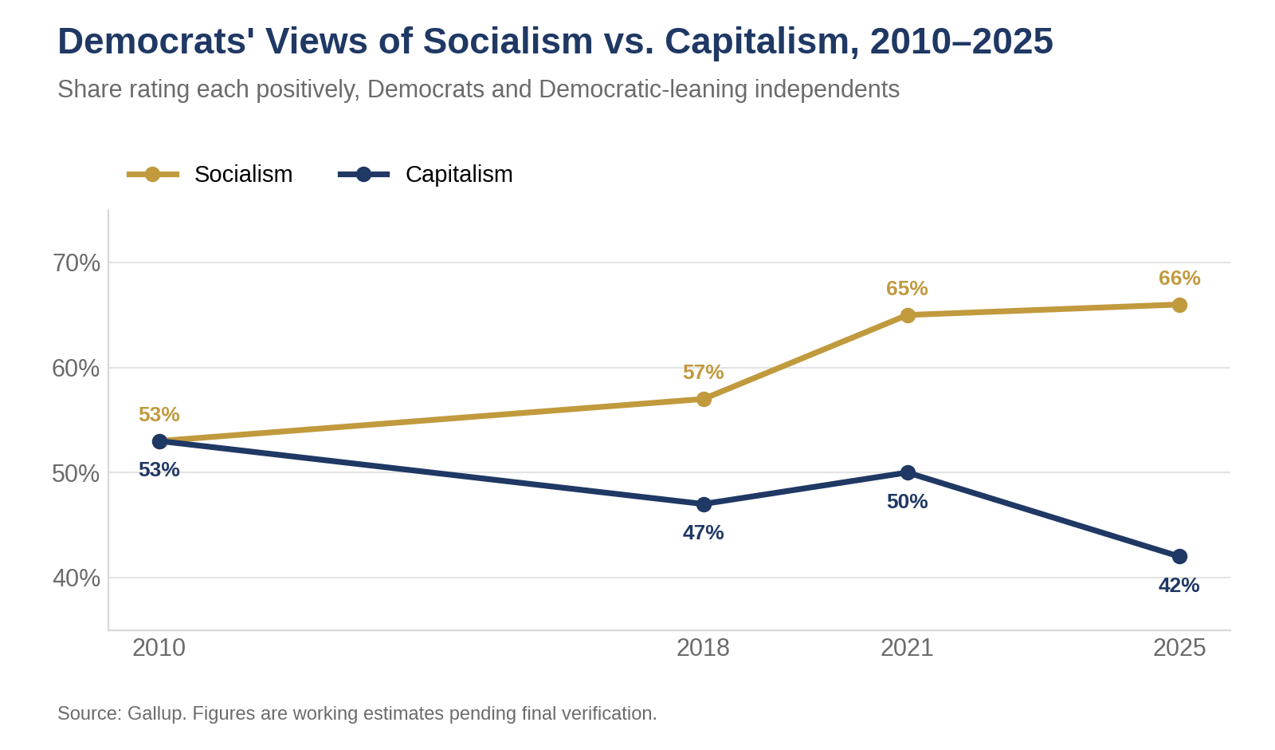
Step back from the primary returns, and the national picture is not a groundswell. It is ambivalence. A Pew Research Center survey taken in late January found that most Americans neither like nor dislike leaders who call themselves democratic socialists. Among the public, 43 percent land in that neutral middle, with 38 percent expressing dislike and only 17 percent affinity. The pattern holds inside the Democratic Party, where a 56 percent majority is neutral, 32 percent say they like such leaders, and 11 percent say they do not. For most voters, in other words, the label carries no strong day-to-day meaning at all. Warmth toward the word socialism, which Gallup finds rising among Democrats, is not the same thing as embracing a politician who runs under the banner, and the gap between the two is where the movement’s national ceiling shows.
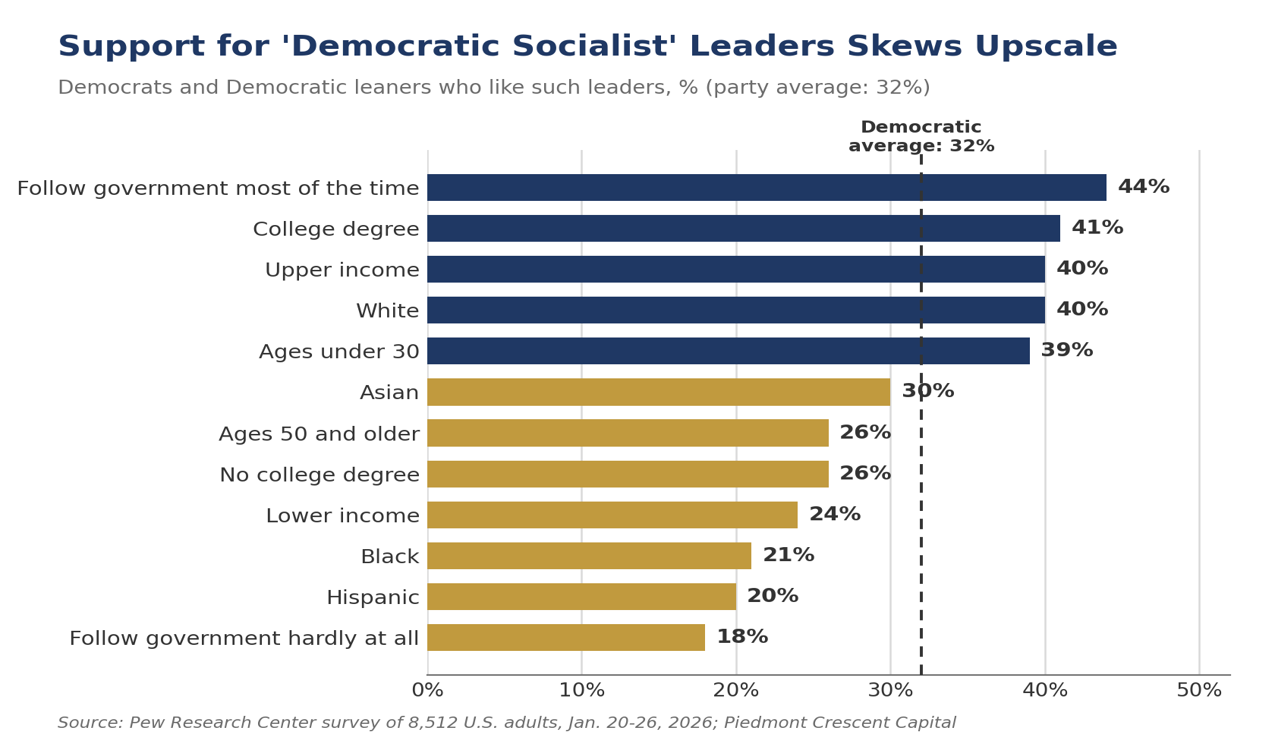
Look at who does like the label, and the movement turns out to stand on its head. Socialism has always claimed the working class as its natural constituency. The modern American affinity for the term runs the other way. In Pew’s data, the Democrats most drawn to democratic socialist leaders are the affluent, the credentialed, and the politically engaged: 41 percent of Democrats with a college degree versus 26 percent without one, 40 percent of upper-income Democrats versus 24 percent of lower-income ones, and 44 percent of those who follow government most of the time versus 18 percent of those who follow it hardly at all. It is also, uncomfortably for a movement built on solidarity, a racial inversion, with White Democrats (40 percent) and Asian Democrats (30 percent) far more receptive than Black (21 percent) or Hispanic (20 percent) Democrats. The enthusiasm is real, but it is concentrated in the party’s upscale, attentive wing rather than in the working-class base the ideology invokes.
Pew’s new political typology sharpens the same point into a fault line running through the Democratic coalition. The party’s ideological engine is two highly educated, heavily White, intensely engaged groups Pew labels Leftward Progressives and Loyal Liberals, together roughly 35 percent of Democrats. About two-thirds of Leftward Progressives (66 percent) like democratic socialist leaders, and roughly half of Loyal Liberals do. But the larger share of the coalition, about 42 percent, sits in the more diverse, more financially stressed, and more institutionally minded Left-Out Left and Order and Opportunity Left, where affinity falls to roughly a fifth (22 percent) and about one in ten. These are the Democrats most likely to feel politically ignored, and they are not asking for socialism. They are asking to be heard. A fair reading grants the caveats: Pew’s January survey predates the spring and summer primary wave, and liking or disliking a label is not the same as turning out to vote for a candidate who carries it, which is exactly why a brand this potent in a low-turnout urban primary can remain this niche in the country at large.
In 1991, a British band called Jesus Jones had an American hit about the strangest thing many of us had ever watched: a world rousing from history in real time. The song was “Right Here, Right Now,” and its writer had watched the Berlin Wall come down on television and tried to catch the shocking brevity of it before it passed. Those of us paying attention then remember it, as walls and regimes that had defined the entire postwar order gave way not over decades but over months, and the disbelief was part of the experience. We were, as the song had it, watching the world wake up from history.
To understand why that awakening felt close to miraculous, you have to remember the night that came before it. In the late 1970s and early 1980s, the tide appeared to run the other way. The Soviet Union marched into Afghanistan in 1979, and Soviet-aligned movements were advancing across Asia, Africa, and Latin America, from Angola and Ethiopia to Nicaragua. Those of us just starting out in the profession assumed the Eastern bloc was permanent, and perhaps still expanding.
The fashionable worry of the moment was not about them at all. It was about us. The much-discussed book of the day, talked about more often than it was actually read, was Paul Kennedy’s The Rise and Fall of the Great Powers, and the lesson the culture drew from it was American decline. Imperial overstretch, the argument ran, would do to Washington what it had done to every great power before, while a rising Japan prepared to inherit the century. The thesis found its readiest audience among those skeptical of Reagan, who saw in the defense buildup and the deficits a country spending its way toward the same fate. I remember discussing the book in graduate school and arguing that its logic made a far better case for the collapse of the Soviet Union than of the United States, a view that did not win me many points with my professors. Within a few years the power that actually buckled under the weight of its commitments was the other one. The smartest consensus of the age had the direction of history nearly backward, which bears remembering now, because every age is certain it can read the trend, and ours is no exception.
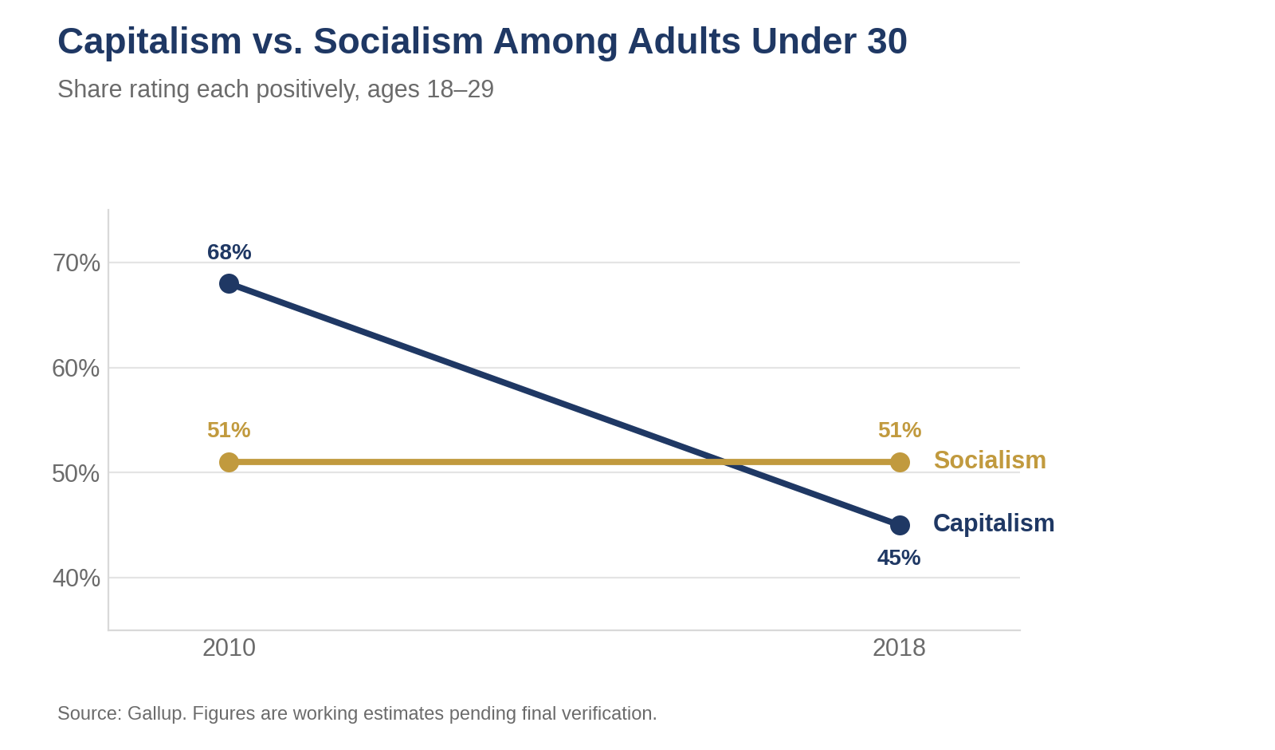
The youngest voters do not carry this memory. They did not live through the collapse, and they certainly did not live through the long stretch before it, when the other side looked like it was winning and confident experts kept calling the race wrong. What reaches them instead is a word, stripped of the experience that once gave it its infamy.
The same conviction is loose again today. On a recent trip to Europe, we kept meeting people certain that America had entered a serious and perhaps lasting decline, with its political turmoil offered as the proof. We did not argue the politics, although we suspect that is where much of the criticism was truly aimed. What stayed with us was how little the country they described, consumed and defined by its national politics, resembled the one most Americans actually live in.
The football fans who poured in for the World Cup this summer seem pleasantly surprised by what they have found. Across social media, visitors from dozens of countries have spent the tournament marveling at the everyday abundance of the place: the free refills and the ice water that arrives unbidden, the scale of the stores, the size of ordinary middle-class homes, the easy friendliness of strangers. Many had come expecting the angry and diminished country of the headlines and found something closer to its opposite. Critics are right that abundance can tip into excess, and how that abundance is distributed is a real question we will come to in a moment. But the aggregate is not seriously in doubt. The United States produces roughly a quarter of global output with about four percent of the world’s people, and even the economists who dispute how far American living standards have pulled ahead of Europe’s are arguing over how large and how durable that lead is, not whether it exists.
The abundance the visitors photographed is real, and so is the distribution problem underneath it. That is the resolution of the apparent paradox: seen from outside, the country is an obvious success; lived from inside, by a great many people, it can feel like a treadmill. We have written for some time about a K-shaped economy, two Americas living in the same country on different terms. For a large share of younger households, the price of the things that signal a stable adult life, a home, health care, a degree, a path upward, has outrun wages for the better part of two decades, while asset prices have rewarded those who already held the assets. When a generation concludes that the system was not built with them in mind, the conclusion is not irrational. It is a reasonable reading of their own balance sheets.
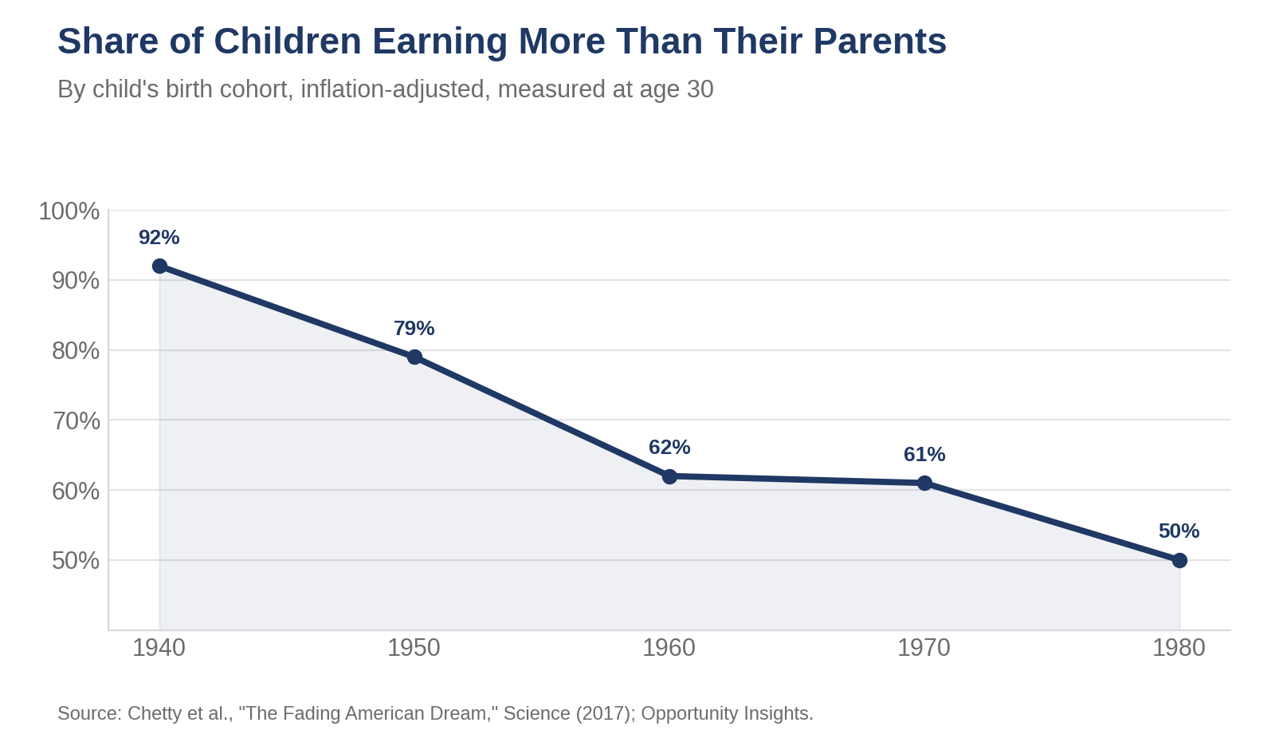
We see this in a variety of measures. One of the most telling, and one that gave the old order much of its legitimacy, is the expectation that children will out-earn their parents. That expectation has weakened persistently. For those born in 1940 it was nearly a certainty, on the order of 90 percent; for those born around 1980 it is closer to a coin flip. Part of that decline is mechanical, since each generation starts from a higher rung and the children of high earners have the most ground to defend. A physician’s children, for example, can prosper without ever matching a physician’s pay. The ladder itself has not seized up either, since the chances of climbing relative to one’s peers are about what they were in the 1970s. But for families nearer the middle the shortfall is not a measurement artifact, and that is the part worth worrying about. We can hold that thought and the next one at the same time, and we intend to.
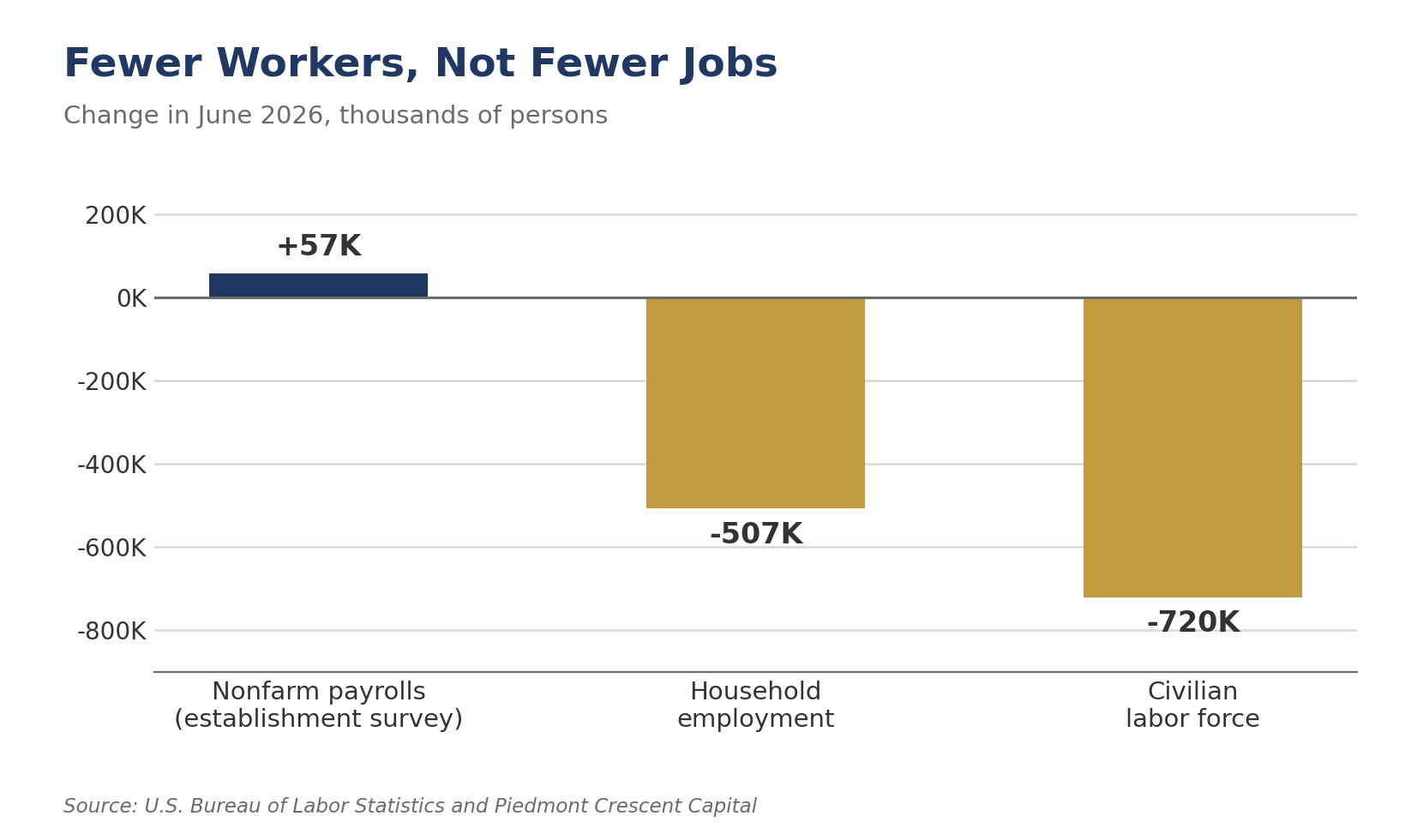
Our own research this week documents the soil in which this movement grows. The June employment report, which we covered under the title “Fewer Jobs, Fewer Workers,” showed payrolls rising just 57,000, with the labor force shrinking by 720,000 and participation falling to its lowest level since early 2021. The softness in employment was concentrated among workers aged 25 to 34, precisely the cohort now casting primary ballots for candidates who promise to rewrite the rules. Our companion report on the national capital cycle traced how a historic wave of private investment has carried this expansion through a hiring soft patch, and how narrowly that capital is concentrated, by industry and by geography alike. Growth is running on capital rather than labor, or, as we like to say, on protein rather than carbohydrates, and the difference is not an abstraction to a young worker watching data centers rise on the edge of town while entry-level hiring stalls.
For the people not yet at the table, the expansion can feel like a party happening in another room. The aggregate statistics are genuinely strong, and we have spent much of this year documenting their strength. But an economy that adds output faster than it adds workers, and adds both in a narrow set of industries and metros, will manufacture exactly the sentiment now showing up at the ballot box. The grievance is visible in the data and in lived experience. It does not need to be imagined, and pretending otherwise cedes the argument to the people offering the wrong cure.
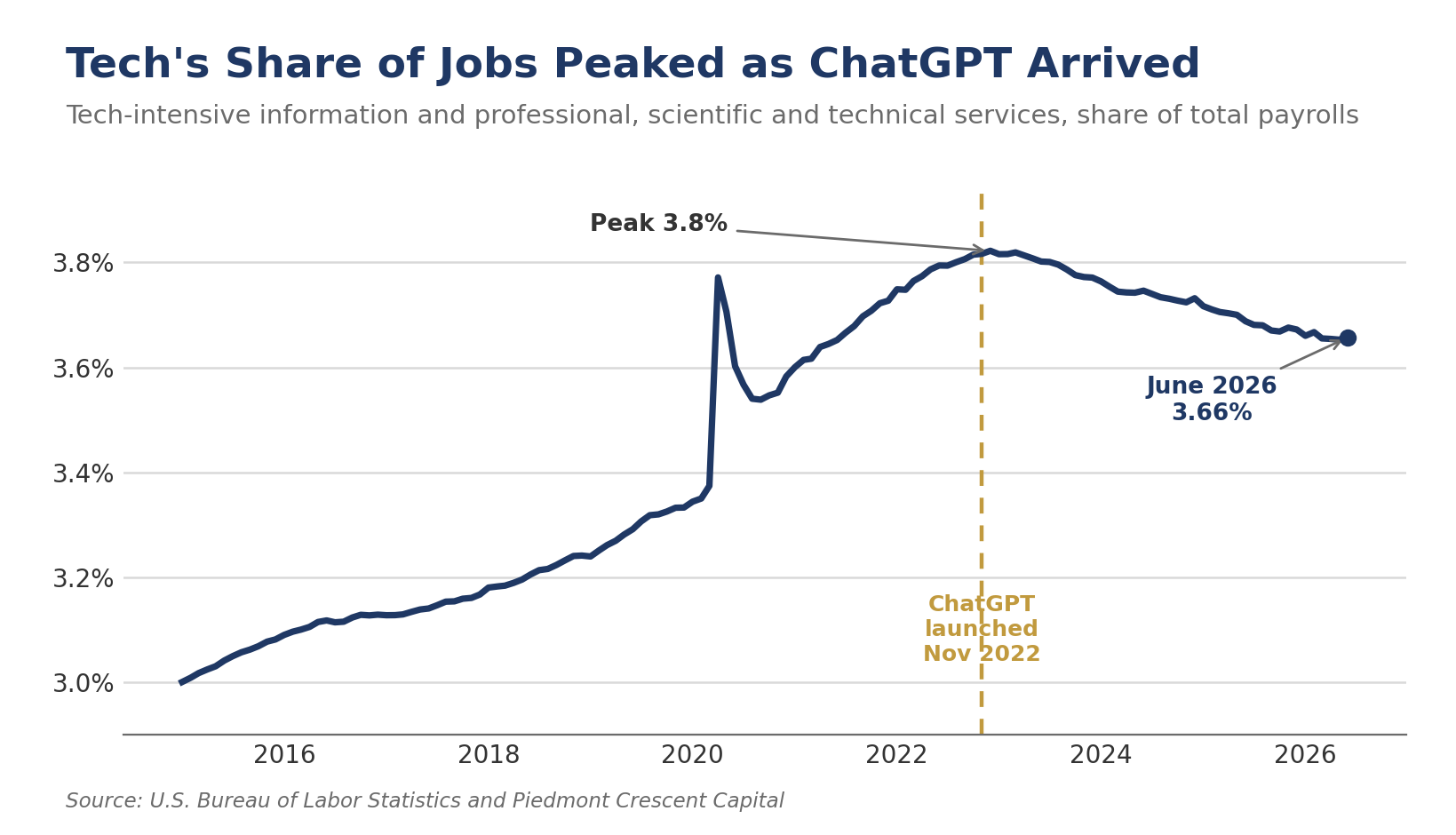
Part of the near-term softness is artificial intelligence itself. The tech-intensive slice of the labor market, the information and professional and technical services jobs that have long been the ladder into the knowledge economy, climbed as a share of total employment through the pandemic and peaked almost precisely as ChatGPT arrived in late 2022. The share has drifted lower ever since, as firms learn to produce more with the same headcount and slow their hiring of the very workers this generation expected to become. That is the mechanism behind a real and specific grievance. We read this as a near-term adjustment, however, not a verdict on the technology. The last comparable general-purpose technologies, electrification and the personal computer, each depressed measured employment in their early diffusion and then generated far more work than they displaced, in categories no one had yet identified. We expect the same arc here, with the broadening of hiring becoming more visible over the second half of 2026. The task is to carry this generation across the adjustment, not to conclude from the adjustment that the system has failed them.
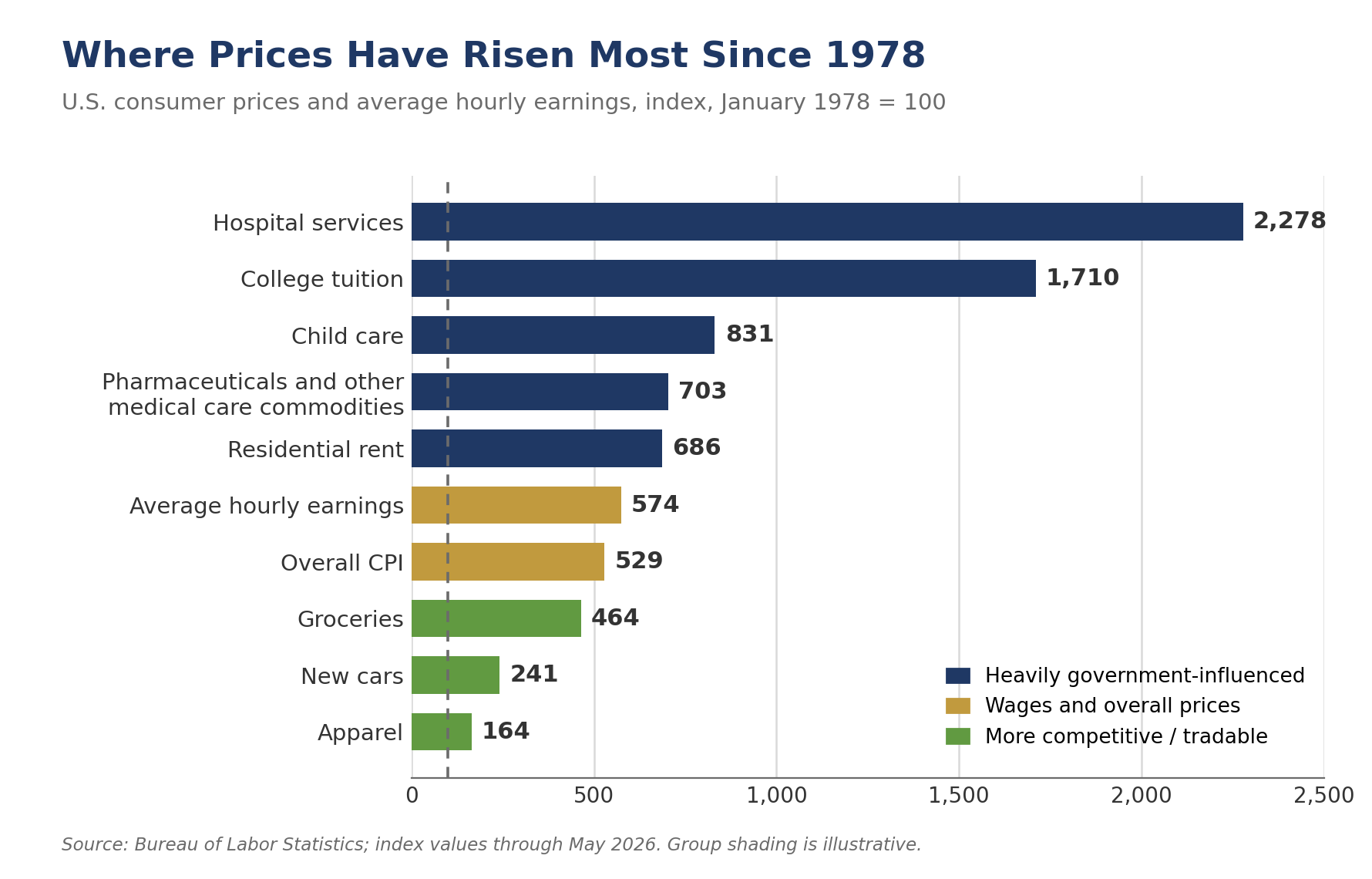
Affordability is another problem the democratic socialists are looking to solve. Look closely at where the squeeze actually falls, however, and a pattern emerges that should give the reformers pause. The costs that have outrun the family budget are concentrated in a few sectors, and they are not random ones. Hospital care, college tuition, child care, and the rent have all climbed many times faster than wages since the late 1970s, while the goods that come from genuinely competitive markets, clothing and automobiles and most of what crosses a border, have risen far less or in real terms grown cheaper. The common thread in the costly group is not greed, which is a constant, but design. Prices have risen the most in the sectors where government underwrites the demand and constrains the new supply at the same time, the textbook recipe for prices that outrun the paycheck. The affordability crisis now feeding the appetite for socialism is, to a considerable degree, a product of the government we already have rather than the market we are told to distrust. In these markets, we do not need more socialism. We need less of it.
The next thought is a distinction the branding tends to blur. Most of what polls well under the socialist banner is redistribution: tax-and-transfer policy, social democracy of the kind that is ordinary across much of the developed world and debatable on its own honest terms. That debate is a fair one. The genuinely socialist part, collective ownership of productive enterprise and the displacement of markets as the organizing mechanism, is the part with the long and grim record. The word now being rehabilitated does not point at the popular half. It points at the experiment whose results the world spent the twentieth century escaping, and the gap between the label and the ledger is where a careful reader should slow down.
The deeper error would be to treat the engine of American prosperity as the thing to dismantle. The abundance the World Cup visitors photographed did not arrive by decree. It is the product of a system that rewards invention and risk-taking, and that lets the people who build something keep enough of the gains to build again. The capital cycle we wrote about this week, the very force carrying the expansion, is that system at work. Dull those incentives in the name of fairness and the likeliest result is not a more even distribution of plenty but less plenty to distribute. Argentina spent the last century demonstrating the point, beginning among the richest nations on earth and legislating its way to chronic inflation and recurring default. A wealthy country can, in fact, vote itself poor. The grievances remain real; the danger is that the socialist cure would shrink the very pie everyone is fighting to divide.
There is an irony in reaching for Jesus Jones here, and it is worth sitting with rather than hiding. The man who wrote that 1991 anthem never intended it as an ideological statement and was uncomfortable when it was adopted as a triumphalist banner. Both Clintons campaigned to it; a conservative magazine later claimed it for its own list. So the point of invoking the song is not to conscript a champion who never enlisted. The point is quieter and, we think, more honest. The memory of what was at stake has faded so far that even the song’s own author would decline to wave the flag, and so the work of remembering falls to the rest of us who simply lived through it. That work is not to scold the longing but to supply the memory it lacks.
The song’s image was a world waking up from history. The revival of socialism, for all the legitimacy of the grievances beneath it, is the temptation to go back to sleep, to re-enter a dream the world already paid in full to leave. The measured response is neither to mock the frustration nor to indulge the remedy. It is to stay awake and fix what is truly broken, the affordability of ordinary American life, the cost of owning a home, seeing a doctor, and earning a degree, the narrowing of the path upward, and an economy that converts this remarkable capital cycle into broad-based hiring, without reaching again for the system the world rose from in 1989. We woke up once, and it was the work of a generation. We should be careful not to mistake exhaustion for a reason to lie back down.
Among the events of the long holiday weekend was a wedding at Madison Square Garden. We will borrow and rephrase a single line from the bride’s songbook: socialism is an alluring daydream on its surface but always ends as a nightmare, and this time, we would do well to stay awake. 1
Download the full report (PDF)
1 Note on the closing line: the daydream-and-nightmare image alludes to the theme of Taylor Swift’s song “Blank Space” but deliberately does not quote its lyric and does not attribute any statement about socialism to Swift. The line is the author’s own, framed as a borrowing and rephrasing, to avoid putting words in a real person’s mouth or reproducing copyrighted lyrics. ↩
Mark P. Vitner is President and Chief Economist of Piedmont Crescent Capital, a boutique investment bank in Charlotte, North Carolina.
mark.vitner@piedmontcrescentcapital.com | (704) 458-4000 | piedmontcrescentcapital.com