
The Center of Gravity is Shifting South
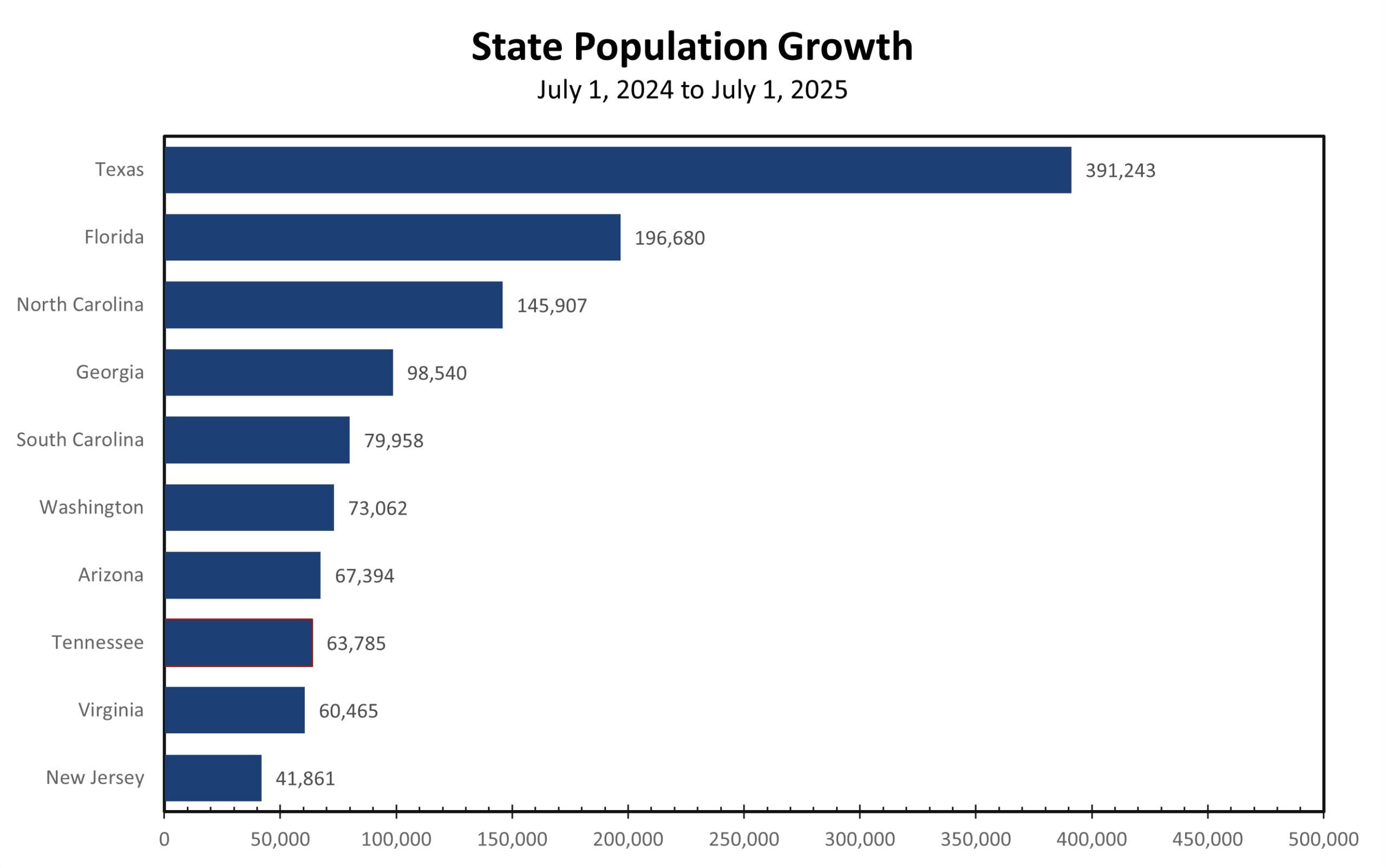
- U.S. population growth slowed to 0.5% (+1.8 million), the weakest pace since the early pandemic, driven by a sharp decline in net international migration.
- Domestic migration provides the clearest signal: Americans continue to vote with their feet, overwhelmingly favoring the South.
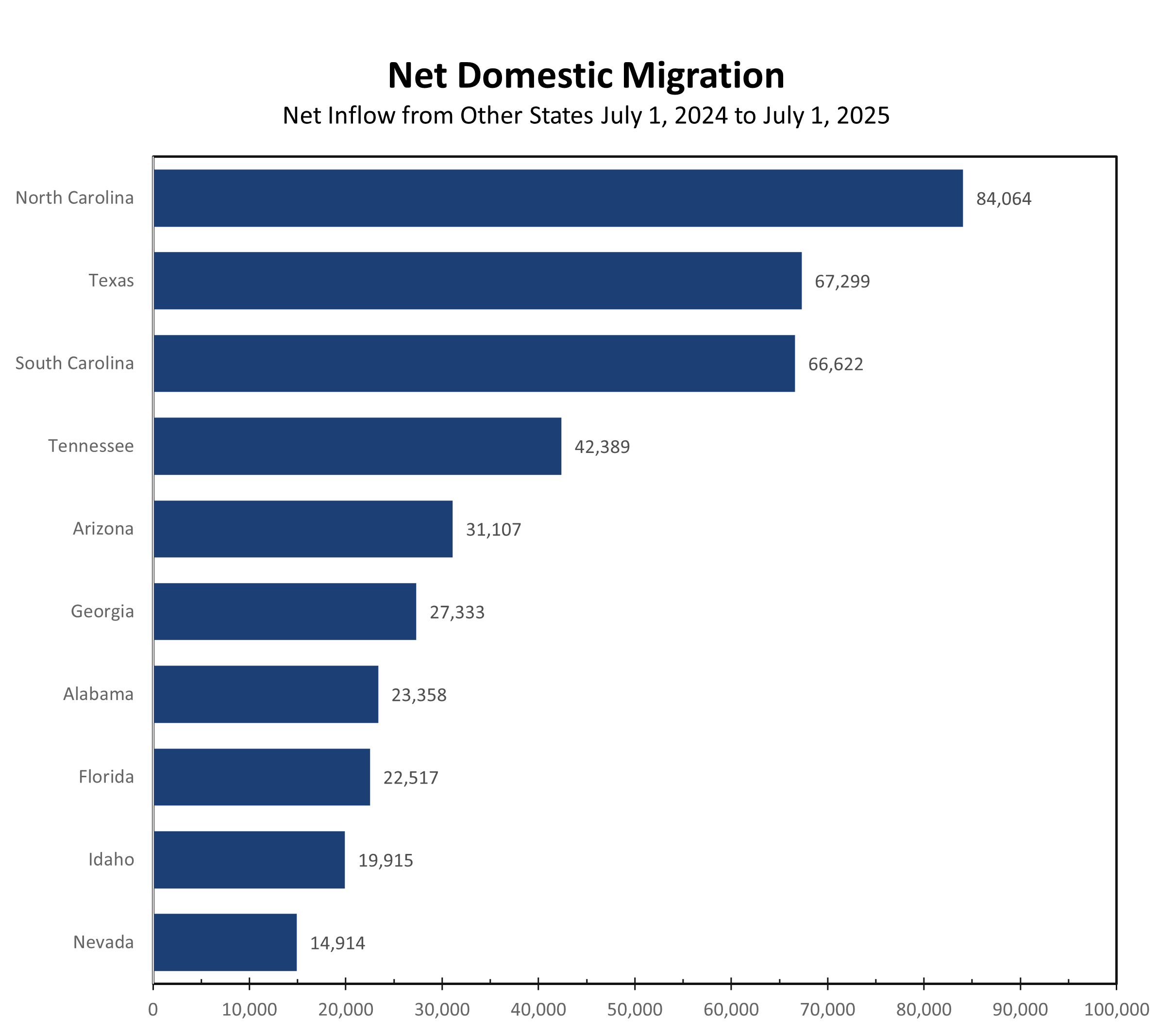
- North Carolina led the nation in net domestic migration, edging out Texas and surpassing long-time leader Florida.
- Florida and Georgia remain net domestic gainers, but inflows slowed sharply as affordability, insurance costs, and congestion concerns increased.
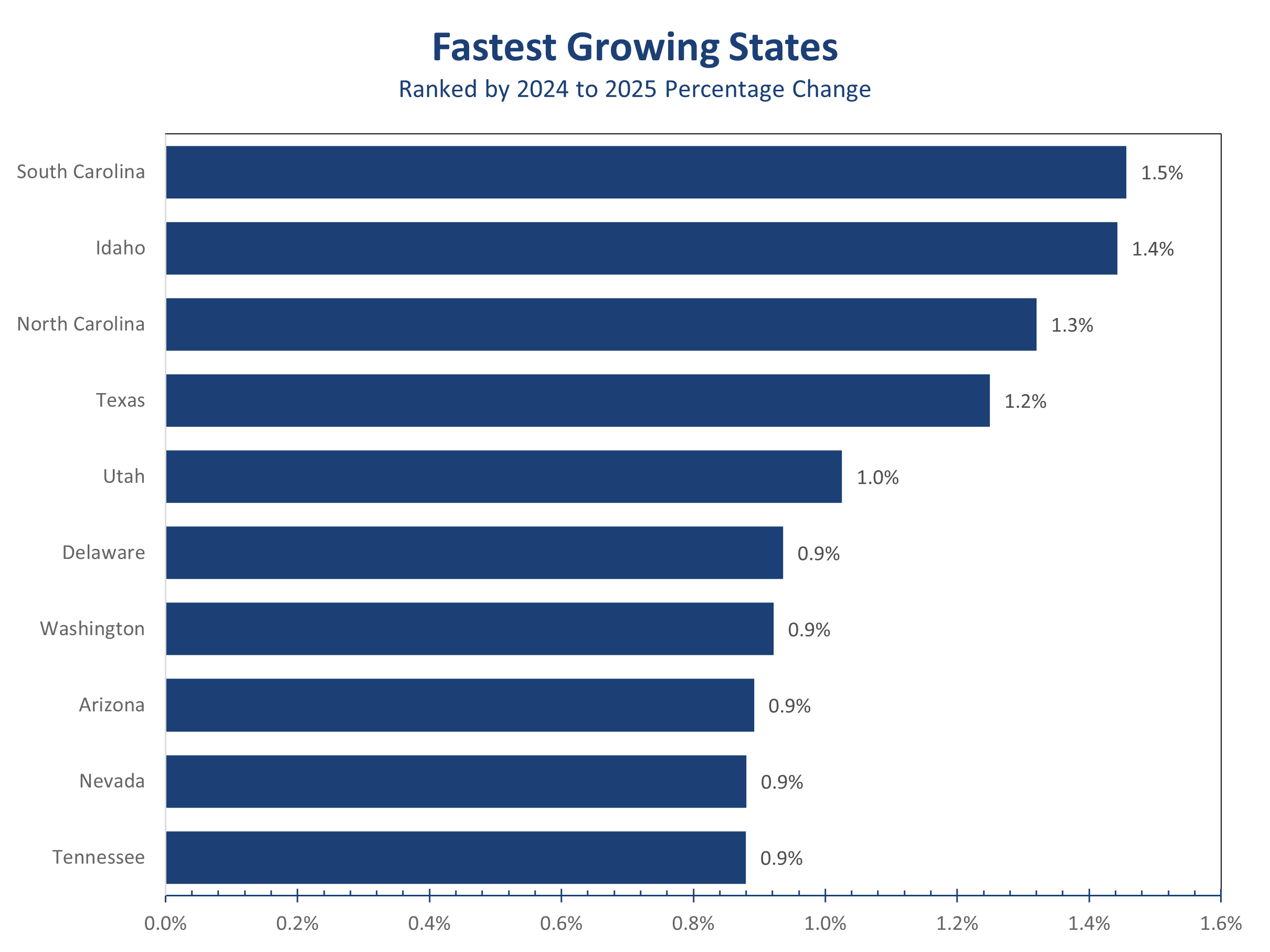
- South Carolina was the fastest-growing state in the nation and ranked third in net domestic migration, with broad-based gains across metros and regions.
- Tennessee and Alabama posted rising domestic inflows, signaling a widening second tier of Southern growth markets.
- The July 2024–July 2025 estimates already reflect slower immigration ahead of the election and in the early months of the Trump Administration; a more pronounced immigration slowdown is likely from mid-2025 to mid-2026, further elevating the importance of domestic migration.
Americans Continue to Vote with Their Feet
The Vintage 2025 Census population estimates mark a clear inflection point in the U.S. growth story. National population growth slowed to 1.8 million people, or 0.5%, between July 1, 2024 and July 1, 2025, down sharply from the 3.2-million-gain recorded the year before. The primary driver was not a collapse in births or a surge in deaths, but a historic decline in net international migration, which fell by more than half and coincides with tighter immigration enforcement.
That shift elevates the importance of domestic migration, the cleanest measure of revealed preference. Unlike immigration flows, which are heavily influenced by federal policy, domestic migration reflects millions of individual decisions about where households believe opportunity, affordability, and quality of life are best aligned.
Americans continue to relocate to the South in search of jobs, affordability, and quality of life.
Despite a year marked by slowing population growth nationally, domestic migration flows reinforced a familiar but increasingly consequential pattern. Households continued to gravitate toward Southern states where job creation has been stronger, housing costs remain comparatively more attainable, regulatory environments tend to be lighter, and climates are generally warmer.
The South Still Wins — but the Map Is Being Redrawn
The South remains the nation’s top destination for domestic movers, but the internal hierarchy is shifting.
North Carolina emerged as the leading state for net domestic migration, surpassing both Texas and long-time leader Florida. This strength is not concentrated in a single metro. Growth remains broad-based across Charlotte, the Research Triangle, the Triad, the Coast, Asheville, and the Mountain counties, reflecting an unusual combination of scale, economic diversity, and livability. Even a year disrupted by Hurricane Helene failed to materially slow in-migration.
Charlotte warrants special attention. As a metro straddling the North Carolina–South Carolina border, its growth increasingly spills across state lines. Fort Mill, Rock Hill, and Lancaster County rank among the fastest-growing communities in South Carolina, benefiting from proximity to Charlotte’s job base paired with lower taxes and more attainable housing.
The South Is still winning, just not in the same places that is used to.
South Carolina was the fastest-growing state in the nation and ranked third in net domestic migration. Beyond the Charlotte spillover, growth remains strong in Charleston, Greenville, and Myrtle Beach, each powered by distinct mixes of logistics, advanced manufacturing, tourism, retiree inflows, and defense-adjacent investment. The state’s performance reflects not a single boomtown, but a statewide alignment of cost structure, governance, and demographics.
Florida and Georgia: Still Growing, But Cooling
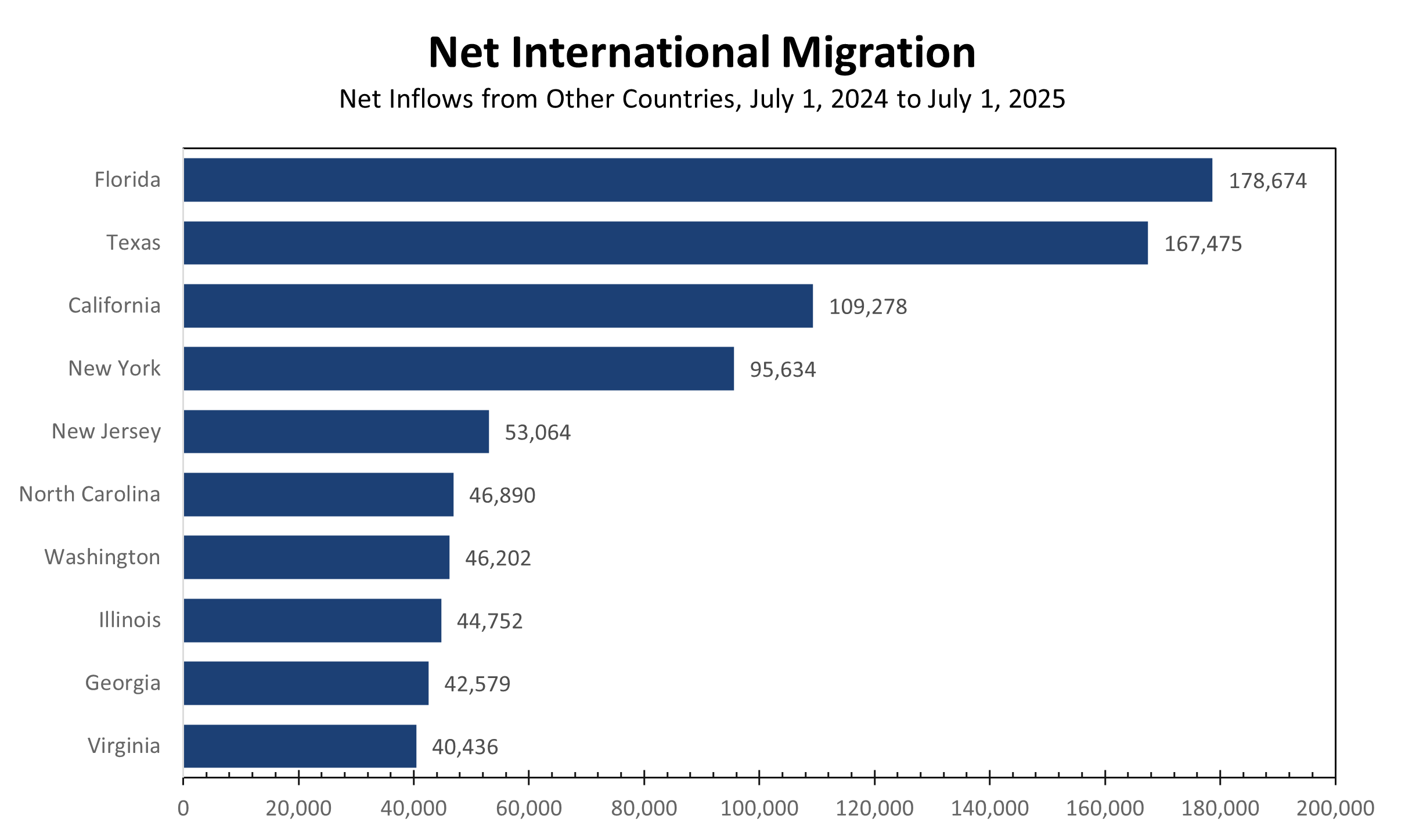
Florida remains a population growth heavyweight, but its domestic migration advantage has narrowed sharply. Net domestic inflows fell dramatically from the peaks of 2022 and 2023, pushing Florida out of the top tier of domestic migration rankings. Rising homeowners’ insurance costs, higher density, and eroding affordability are increasingly shaping household decisions. Florida continues to grow but is now doing so more through international migration than domestic inflows, a notable shift. One unique aspect of Florida’s international migration, however, is that movement between the Sunshine State and Puerto Rico is counted as internatiional migration, even though this is a U.S. territory.
Florida and Georgia remain key gateways, but domestic movers are increasingly looking for more affordable and less congested opportunities elsewhere.
Georgia followed a similar trajectory, though less pronounced. Net domestic migration remained positive but slowed meaningfully from prior highs. Atlanta’s economic fundamentals remain strong, but the state is no longer absorbing domestic movers at the pace seen earlier in the decade as competition from the Carolinas intensifies.
One important cautionary anecdote is that South Florida and Atlanta are both major gateways for immigration, which bolsters their international net migration numbers. After arriving and initially settling, many new arrivals eventually move to neighboring states, when they show up as domestic out-migrants, depressing net domestic migration for those states.
The Second Ring Is Expanding
Beyond the traditional Sun Belt leaders, Tennessee and Alabama recorded rising domestic migration, signaling a broadening of growth across the South as affordability-driven migration expands. These states are increasingly attractive to households priced out of higher-cost metros but still seeking warmer climates, lower taxes, lighter regulatory environments, and job markets anchored by manufacturing, logistics, and energy.
Tennessee’s advantage lies in its depth: growth across multiple metros, not reliance on one.
Tennessee illustrates this shift particularly well. Nashville remains the state’s primary growth engine, benefiting from its expanding healthcare, technology, and a bevy of corporate relocations. But growth is no longer confined to Middle Tennessee. Chattanooga, Knoxville, and much of Eastern Tennessee have been growing rapidly, supported by advanced manufacturing, logistics access, and quality-of-life appeal. Memphis, long a laggard in domestic migration, has gained momentum more recently, aided by logistics investment, manufacturing reshoring, and renewed interest tied to its cost structure and central location.
Within Alabama, two standouts underscore the same pattern. Gulf Shores has seen population surge as the area gains recognition as a lower-cost alternative to the Florida Panhandle. Huntsville, in northern Alabama, remains one of the fastest-growing metros in the country, benefiting from continued inflows tied to technology, advanced manufacturing, and aerospace. NASA’s Artemis “return to the Moon” program and the relocation of U.S. Space Command headquarters are likely to bring renewed attention and investment to the region. Birmingham, Mobile and Montgomery have all gained momentum this past year.
This widening footprint is also lifting Arkansas, supported by major investment in its steel industry, and Mississippi, which has quietly emerged as a force in aerospace, space systems, and shipbuilding. Growth across these markets reinforces a broader trend: the South’s advantage is no longer concentrated in a handful of headline metros.
This widening aperture matters. It suggests the South’s growth advantage is becoming more distributed and more resilient, reducing reliance on any single state or metro.
The Competitive Map Is Clearer Than Ever
Population growth has slowed, but the competitive map is clearer than ever. Americans continue to vote with their feet, and those votes still favor the South. Within that shift, North Carolina has emerged as the domestic migration leader, South Carolina is accelerating fastest, and Florida’s long-standing dominance has cooled. The coming year is likely to reinforce these patterns rather than reverse them, as immigration slows further and domestic migration becomes the decisive margin.
Disclaimer: This publication has been prepared for informational purposes only and is not intended as a recommendation offer or solicitation with respect to the purchase or sale of any security or other financial product nor does it constitute investment advice.
January 28, 2026
Mark Vitner, Chief Economist
(704) 458-4000