
Milei Puts the West on Notice
- Argentina’s President Javier Milei’s speech at the World Economic Forum staunchly defended free-market capitalism and warned against creeping socialism.
- Argentina has endured a long and arduous slide from one of the world’s wealthiest economies to one of its most troubled.
- Since winning the presidency, Javier Milei, a libertarian economist, has initiated significant reforms, including reducing government ministries, reshaping foreign policy, and issuing Decree 70/2023, which reduces energy and transportation subsidies and does away with rent control.
- The U.S. and the West can learn from Argentina’s economic challenges, especially regarding the impact from the persistence of large budget deficits, the pervasive growth of the administrative state, and ever-expanding entitlement commitments.
During this year’s World Economic Forum in Davos, Argentina’s President Javier Milei delivered a notable speech defending free-market capitalism and cautioning against the dangers of creeping socialism. Drawing from Argentina’s decades-long economic challenges, Milei emphasized the detrimental effects of extensive government intervention policies, including income redistribution, price controls, and burdensome regulations, which have led to increasing poverty. He stressed the effectiveness of free-market capitalism in reducing poverty throughout the world and cautioned against moving away from it, foreseeing disastrous consequences.
Researchers often refer to the rise and fall of Argentina as the “Argentine Paradox.” Once one of the wealthiest countries in the world, Argentina experienced a tenuous century of economic decline and political instability. The fall has served as a warning, mostly to Western governments that have run persistent fiscal deficits and have incessantly grown their administrative states. Argentina elected libertarian economist Javier Milei as president, who has vowed to reverse the decline by embracing free market economic principals.
The service sector is the largest in Argentina, contributing to over three-fifths of Argentina’s GDP while manufacturing comprises another fifth. Agriculture is a smaller portion of the Argentine economy, although Argentina is a leading exporter of wheat, soybeans, and beef.
Argentina’s abundance of natural resources sets it apart from much of South America, allowing for energy self-sufficiency. Deposits of minerals including uranium, zinc, copper, and silver are found throughout the country. Despite facing challenges, Argentina boasts a moderate quality of life, on an overall basis, ranking second in South America on the Human Development Index, and surpassed only by Chile. Moreover, it leads the region with the highest literacy rate.[1] Still, more than 40% of Argentines currently live in poverty and years of unfulfilled promises of reform have left the general populace disheartened.
A century ago, Argentina’s GDP per capita rivaled Belgium, France, and Germany, and easily surpassed its former colonizer, Spain.[2] The capital, Buenos Aires, was widely viewed as the Paris of the West. The population is generally composed of people of European heritage and Argentina is widely viewed as the most European-like nation in Latin America.
[1] Spruk, R. The rise and fall of Argentina. Lat Am Econ Rev 28, 16 (2019). https://doi.org/10.1186/s40503-019-0076-2
[2] https://www.economist.com/special-report/2004/06/05/becoming-a-serious-country
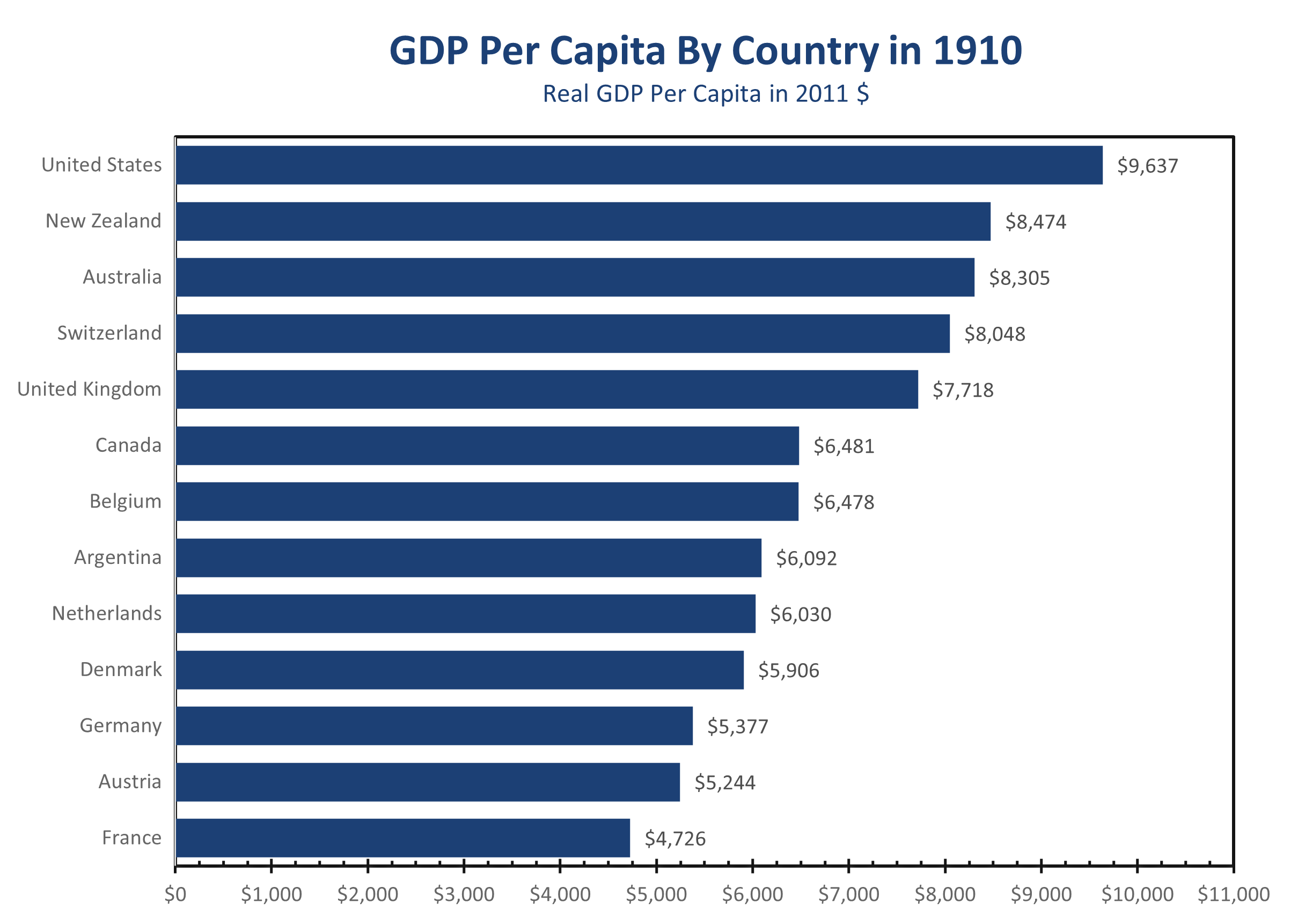
In the early 1900s, agriculture dominated Argentina’s economy, with the country excelling at exporting corn and beef to Europe while relying on imports of fuel and manufactured goods. World War I and its aftermath marked the start of Argentina’s decline, as rising protectionism in Europe and the United States led to a sharp drop in demand for Argentine goods. The isolationist trend intensified during the Great Depression, culminating in a severe economic downturn, a military coup, and the end of over sixty years of civilian government.
The military government of the 1930s introduced import substitution to protect Argentine industry and develop self-sufficiency. The practice continued into the 1940s when Juan Peron took power. Hailing support from the labor unions, Peron enacted many populist and left-wing reforms including wealth redistribution, nationalization of public services, and rent control. Although Peron was forced from office by the military in 1955, Peronist ideas became entrenched in Argentine politics, as once provided, benefits and social programs are extremely difficult to scale back or eliminate.
During the tumultuous 1960s and 70s, Argentina experienced a series of coups and intermittent shifts between military and civilian rule. Widespread terrorism plagued the country during this instability. In an attempt to attract investment, Argentine leaders devalued the peso, leading to rampant inflation. By 1976, inflation had surged to a staggering 600%. The unpopular civilian government was overthrown by the military that year.
Military rule marked the end of import substitution and the introduction of liberal free market reforms. Increased government spending and inefficient production by the junta sent inflation sent inflation soaring above 1000% in 1980. The military regime lasted until the end of the Falklands War in 1982, by which time the Argentine economy was in shambles.
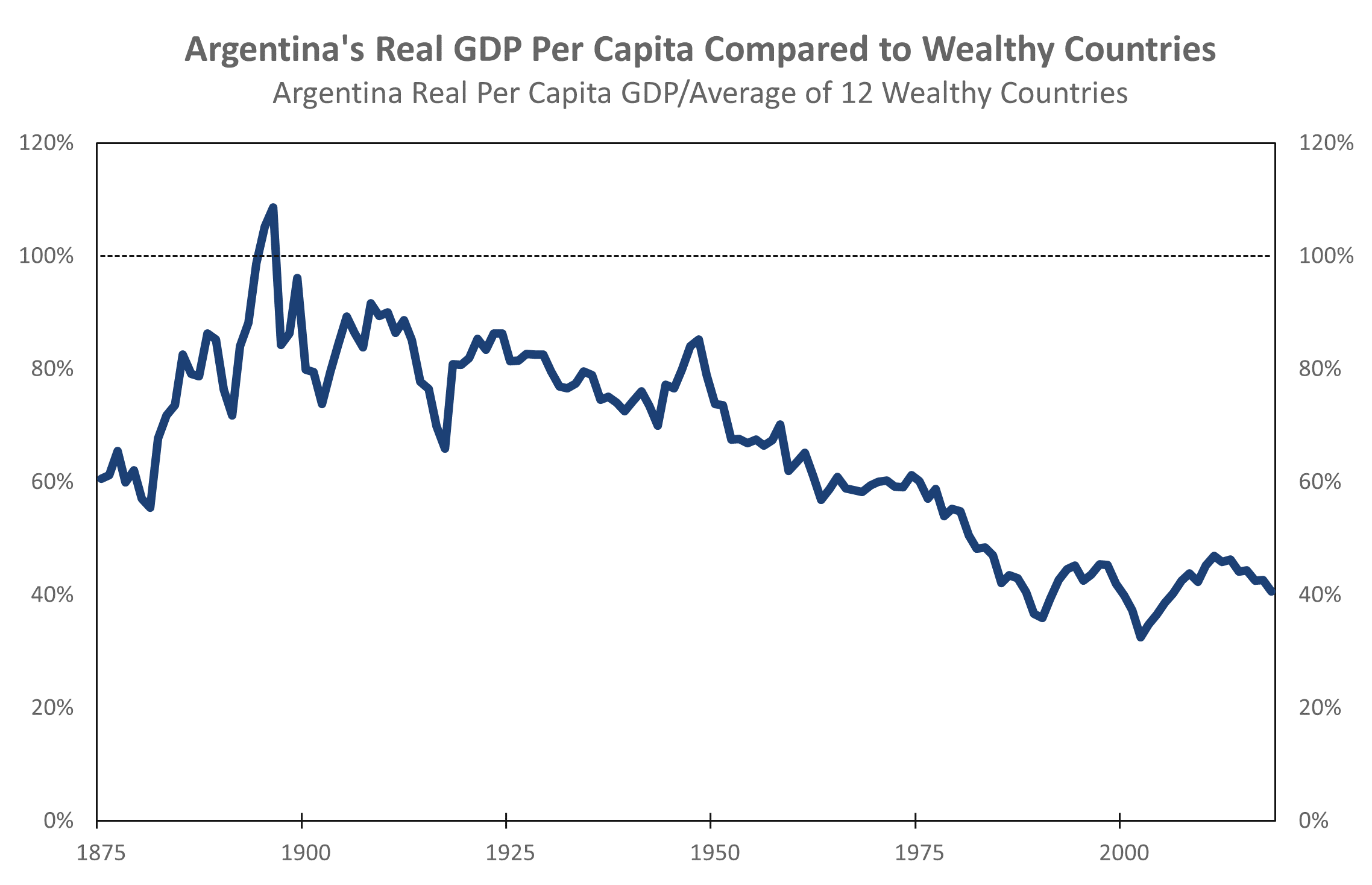
After its return to democracy, Argentina underwent austerity measures in the 1980s and 90s to bring down inflation. A new peso was established in 1992 and pegged to the US dollar. Many state industries were privatized. While inflation appeared under control in the early 90s, the Mexican peso crisis of 1994 and subsequent recession prompted further austerity measures.
Argentina defaulted on its foreign debt at the turn of the century amid a prolonged recession and mass protests throughout Buenos Aires. The peso was once again devalued, and inflation soared. The subsequent Kirchner administration saw success in restructuring Argentina’s debt. However, inflation rose once again at the end of his term.
Kirchner was succeeded by his wife, Cristina Fernandez de Kirchner in 2007. The economy seemingly rebounded going into the 2010s, although Argentina’s inflation rate was still among the highest in the western hemisphere. Argentina defaulted on its debt once again in 2014 when negotiations with US hedge funds collapsed.
Center-right Mauricio Macri won the presidency in 2015, breaking a decades-long Peronist grip over Argentina. Macri was initially unable to enact any sweeping economic reforms with his party in the minority in Congress. He removed certain taxes on exports, negotiated debt settlements, and raised interest rates to combat inflation. The latter triggered a recession in 2016, although Macri’s party made gains in the 2017 midterms and granted him more control over the economy. Despite this, Macri’s policies proved underwhelming. Inflation and poverty soared in 2018, and Macri lost reelection the following year to Peronist Alberto Fernandez.
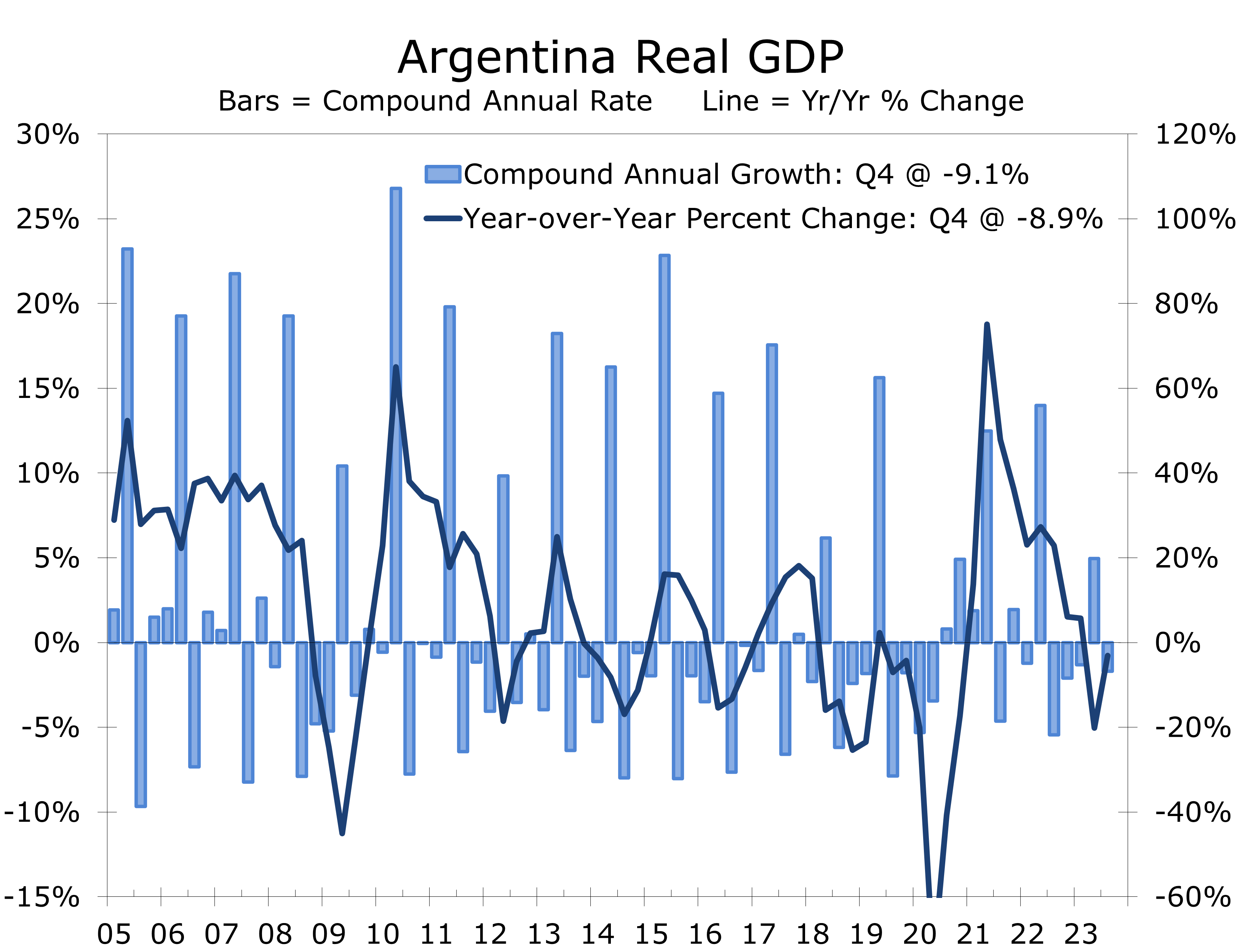
COVID-19 impacted Argentina particularly hard. Its GDP contracted by 10% at the pandemic’s onset. Inflation grew rapidly in 2021 and worsened the following years following the Russian invasion of Ukraine and a domestic drought.[1] Triple-digit inflation, not seen since the late 1980s, returned to Argentina. After decades of economic mismanagement from all factions of the Argentine political class, there was a hunger for drastic change going into the 2023 elections.
Argentina enters a new chapter of history with the election of Javier Milei to the presidency. A libertarian, Milei gained notoriety for his unconventional personal style and forthright opposition to socialism. Amid crippling hyperinflation, Milei champions libertarian proposals including the elimination of government ministries, the deregulation of the economy, and the privatization of state-owned industries. His most radical proposal is the dollarization of the Argentine economy, which entails shutting down the Argentine Central Bank and adopting the US dollar as the primary currency in Argentina.
To outside observers, Javier Milei seemingly came out of nowhere. His Libertarian Party was formed just five years prior to the 2023 elections, and it initially polled far behind the traditional center-right and Peronist parties. When Milei unexpectedly received the most votes during the August primary, he became the favorite to win the presidency virtually overnight.
Milei’s victory was far from guaranteed going into the fall elections. Sergio Massa, a Peronist and the sitting Minister of Economy, won the first round even as inflation neared 140%. Massa’s initial success was credited to waves of income tax cuts enacted in the weeks preceding the election.[2] Milei recovered the momentum after securing key endorsements from the center-right, and he won the November runoff by a convincing eleven-point margin.
[1] Spruk, R. The rise and fall of Argentina. Lat Am Econ Rev 28, 16 (2019). https://doi.org/10.1186/s40503-019-0076-2
[2] https://www.reuters.com/world/americas/how-argentinas-massa-pulled-off-election-upset-with-tax-cuts-bus-fares-2023-10-23/

When Milei took office in December, annual inflation was reported at 161% and four out of ten Argentinians were in poverty. Argentina was $45 billion in debt to the IMF and had a lopsided trade deficit of $43 billion. Milei’s inaugural address highlighted upcoming challenges, emphasizing the financial constraints by stating “there is no money.” He also conveyed that economic conditions would likely deteriorate further before showing signs of improvement.[1]
Milei’s party does not have a majority in the Chamber of Deputies or the Senate. His agenda is therefore limited to what center-right and independent parties within the legislature will support. Milei has already made some concessions by tapping members of President Macri’s Republican Proposal to head certain ministries. He notably selected Luis Caputo, a former president of the central bank and Macri’s Minister of Finance, to head the Ministry of Economy. The move was perceived as a pivot from his more extreme position of closing the central bank.
Despite some concessions to the center, Milei has followed through on key promises. He reduced the number of ministries from nineteen to nine. Several, including the Ministries of Education, Labor, and Culture, were merged into the newly created Ministry of Human Capital. Others like the Ministry of Women, Gender, and Diversity were eliminated entirely. Caputo stated that this move has cut 34% of public sector jobs.
Milei has also begun to reshape Argentine foreign policy. He declined Argentina’s invitation to BRICS, cut ties with Venezuela, Cuba, and Nicaragua, and developed closer relations with Israel. The realignment poses interesting questions for Argentina’s trade policy. Brazil and China are Argentina’s largest trading partners, and Milei harshly criticized the leadership of both countries during his campaign. Brazil’s Luiz Inacio Lula da Silva, or more commonly known as Lula, did not attend Milei’s inauguration.
The first major tests for the Milei administration will occur in the coming weeks. Milei issued Decree 70/2023 shortly after taking office, a sweeping act which overturned more than 300 regulations and removed various subsidies. The decree encompasses labor law liberalization, the repeal of real estate regulations and price controls,(including rent control and tenancy restrictions), and permits contracts in foreign currencies, including cryptocurrency.[2]
[1] https://www.pbs.org/newshour/world/argentinas-newly-sworn-in-president-milei-warns-of-shock-adjustment-to-economy
[2] https://www.cato.org/blog/argentina-one-most-regulated-countries-world?utm_campaign=Cato%20Today&utm_medium=email&_hsmi=287939859&utm_content=287939859&utm_source=hs_email
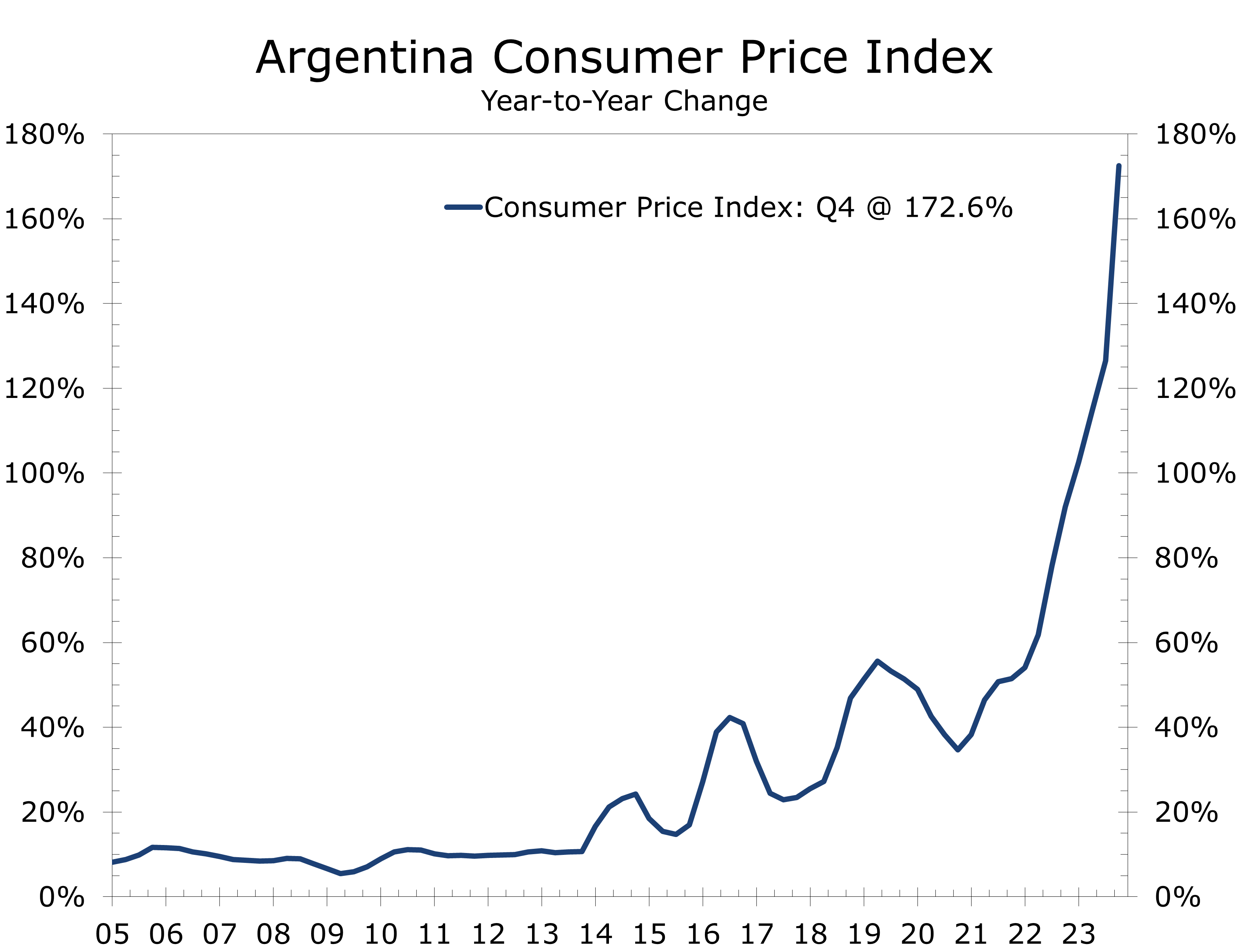
The immediate impact has been excruciating, particularly on Argentina’s middle class. Prices have spiked further, particularly for rents, fuel, and electricity. Though in effect, the decree could be nullified should both chambers of Congress vote to repeal it, there is at least some limited support for enduring the pain in hopes of shifting the economy back to a more sustainable and prosperous trajectory. Peronists have already voiced strong opposition to the decree and labor unions have threatened strikes.
If successful, Decree 70/2023 could pave the way for more ambitious reform, including dollarization, should it survive the scrutiny of Congress. Dollarization would be challenging but not wholly unfeasible. Roughly $200 billion in US dollars are already in circulation throughout Argentina, more than any other country in the world, aside from the U.S.[1] Argentinians have used dollars for significant payments, like real estate purchases, due to the lack of a strong peso. Other Latin American countries like Ecuador and El Salvador have already dollarized, although Argentina would easily be the largest country to do so.
In his inaugural address, Milei emphasized that the Argentine economy will face short-term challenges due to shock therapy. He devalued the peso by over 50% since taking office, pegging it to the dollar at 811:1, with a monthly 2% devaluation anticipated. To complement this, Milei implemented significant spending cuts, including substantial reductions in fuel and transport subsidies.
The IMF has expressed approval of Milei’s economic reforms thus far. Argentina is currently in negotiation with the IMF for a review of its $44 billion debt program, which under the Fernandez administration had neglected. IMF staff and Argentine authorities recently agreed on economic policies to restore stability and get the current program back on track. Pending ongoing policy implementation, the agreement will be presented for approval by the IMF Executive Board in the coming weeks. Upon completion, Argentina would be able to access approximately US$ 4.7 billion (or SDR 3.5 billion), aligning with some rephasing within the program’s scope, which would help cover some immediate funding needs.
[1] https://www.nytimes.com/2023/11/24/world/americas/argentina-economy-peso-dollar-javier-milei.html

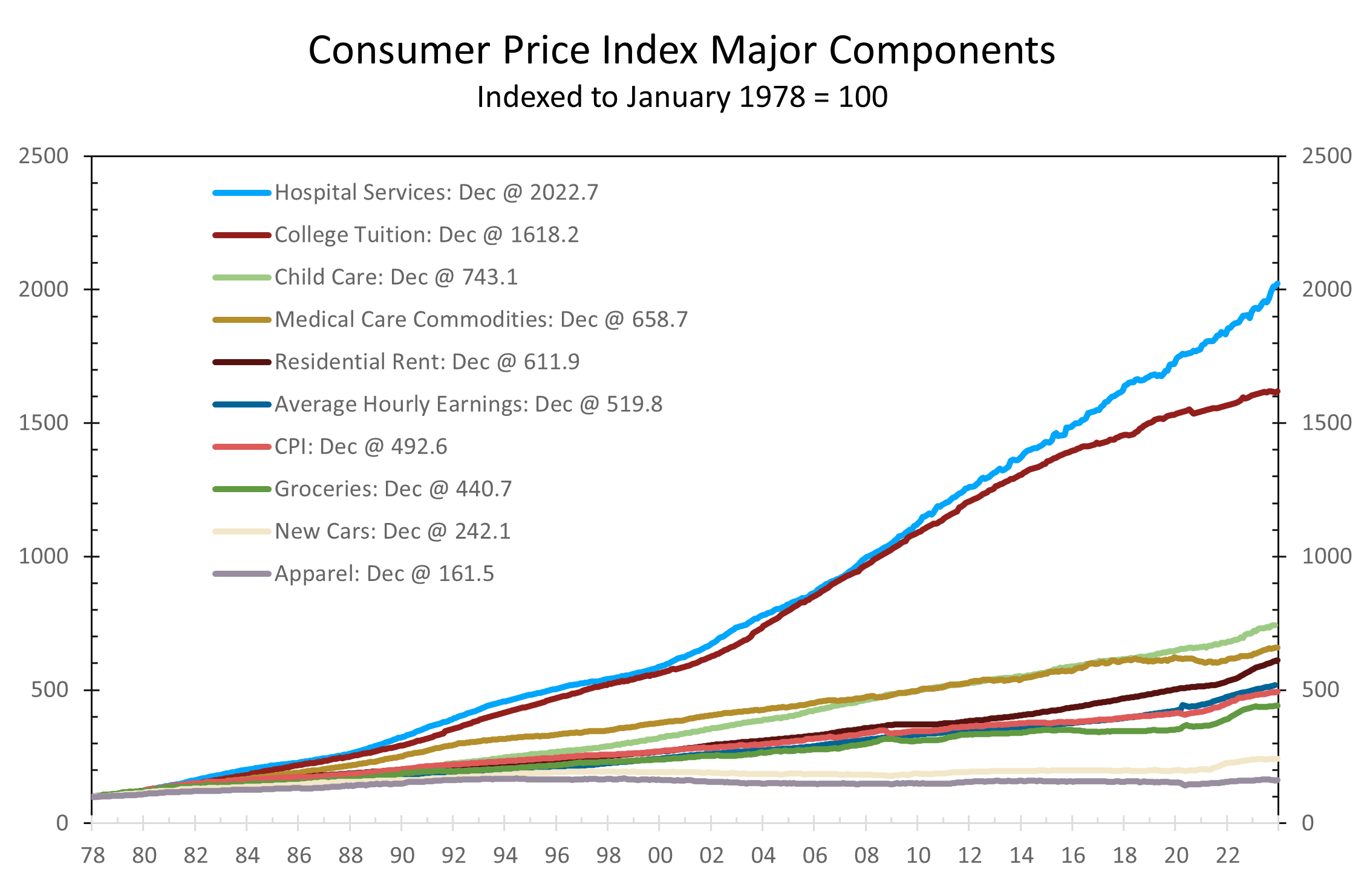
Argentina’s economic travails have often been cited as a cautionary tale for the U.S. The U.S. has experienced persistent budget deficits, coupled with significant growth in the administrative state and entitlement commitments in recent decades. The rapid increase in federal spending, supported by accommodative monetary policies, played a major role in the post-pandemic inflationary spike. Longer term, the expansion of social programs and the administrative state, primarily driven by increased regulations, has contributed to higher inflation. Notably, categories receiving the most government support and intervention have endured the largest price increases over time (health care, higher education, childcare and housing).
One easy way to think about this chart is that every $100 spent on college tuition in January 1978 would cost $1,618.20 today. The basket of goods and services, represented by the Consumer Price Index, rose from 100 in January 1978 to 492.6 currently, meaning that $100 basket of goods and services in 1978 would cost $492.60 today.
One crucial distinction between the U.S. and Argentina is U.S. debt and unfunded liabilities are backed by the full faith and credit of the U.S. Treasury. The dollar and value of U.S. debt are supported by an approximation of the present value of risk-adjusted cash flows from all sources (the theoretical tax base), within the world’s largest economy. Additionally, U.S. debt is denominated in dollars, the world’s reserve currency.

Argentina’s experience may be more instructive for California. The Golden State has lost its luster in recent years, as higher taxes and crushing regulations have sent businesses and residents scurrying to other states, most notably Arizona, Nevada, Texas, and Florida. The outflow is increasingly including many of the state’s wealthier residents, including leading figures from Silicon Valley and Hollywood.
The outflow appears to be taking a toll on the state’s economic performance, which has seen job growth slow and its unemployment rate increase. The outflow is also worsening the state’s fiscal position, as its revenue base narrows further and becomes even more dependent on the tech sector the state’s top earners. Spending has continued to increase, with the state’s generous social benefit programs continuing to expand. The combination has led to an abrupt swing in the Golden State’s fiscal position from a $100 billion surplus in 2022 to a projected $68 billion deficit in 2024.
Unlike Argentina, California must balance its budget and the state is unable to print currency to satisfy is obligations. Persistent budget challenges mean California will constantly be on the lookout for new revenue sources, which will encourage more middle and upper income residents to seek sanctuary in lower tax states.
Disclaimer: This publication has been prepared for informational purposes only and is not intended as a recommendation offer or solicitation with respect to the purchase or sale of any security or other financial product nor does it constitute investment advice.
January 24, 2024
mark.vitner@piedmontcrescentcapital.com
Chief Economist (704) 458-4000
saul.vitner@piedmontcrescentcapital.com
Policy Analyst (704) 458-8570