
Migration Trends Continue to Favor the South
- The US added 1.6 million people in 2023, with population growing by 0.5% to reach 334,914,895 residents.
- Population trends are still returning to their pre-pandemic norms, with fewer deaths and more typical migration patterns.
- Although births remain well below their pre-pandemic norms, a substantial increase in immigration resulted in the nation’s largest population gain since 2018.
- The South continues to attract new residents both from other states and other nations, accounting for 87% of the nation’s population growth in 2023.
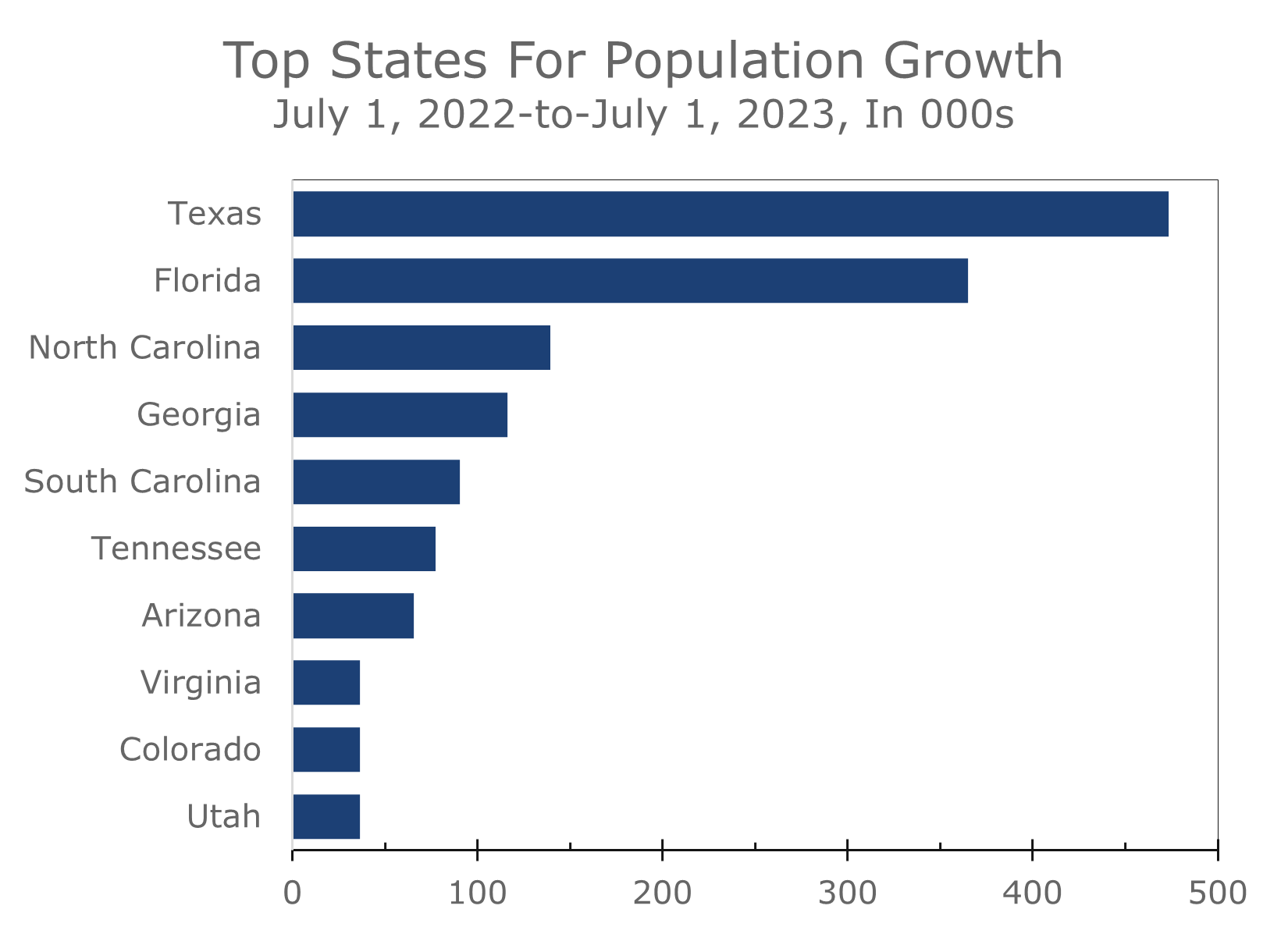
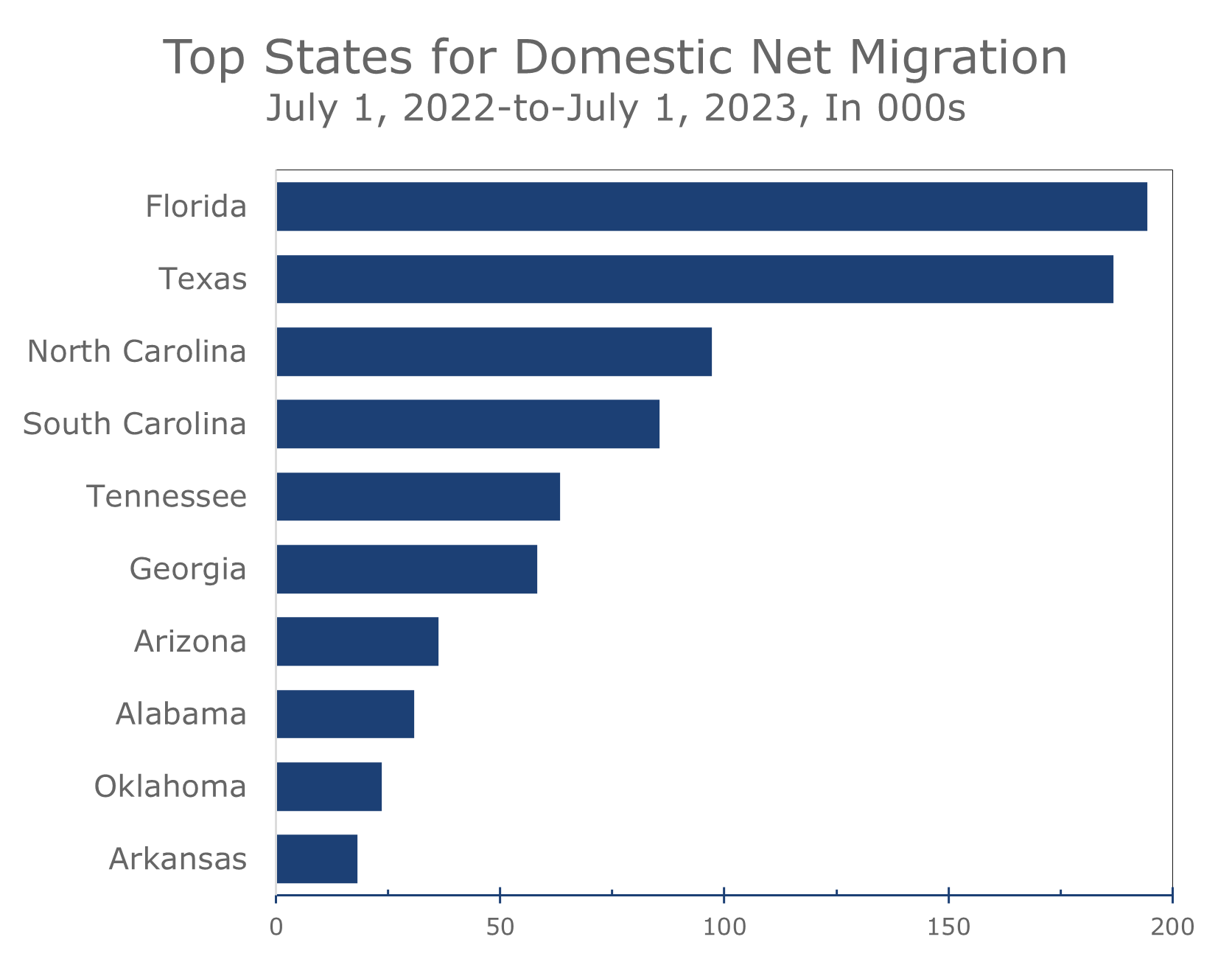
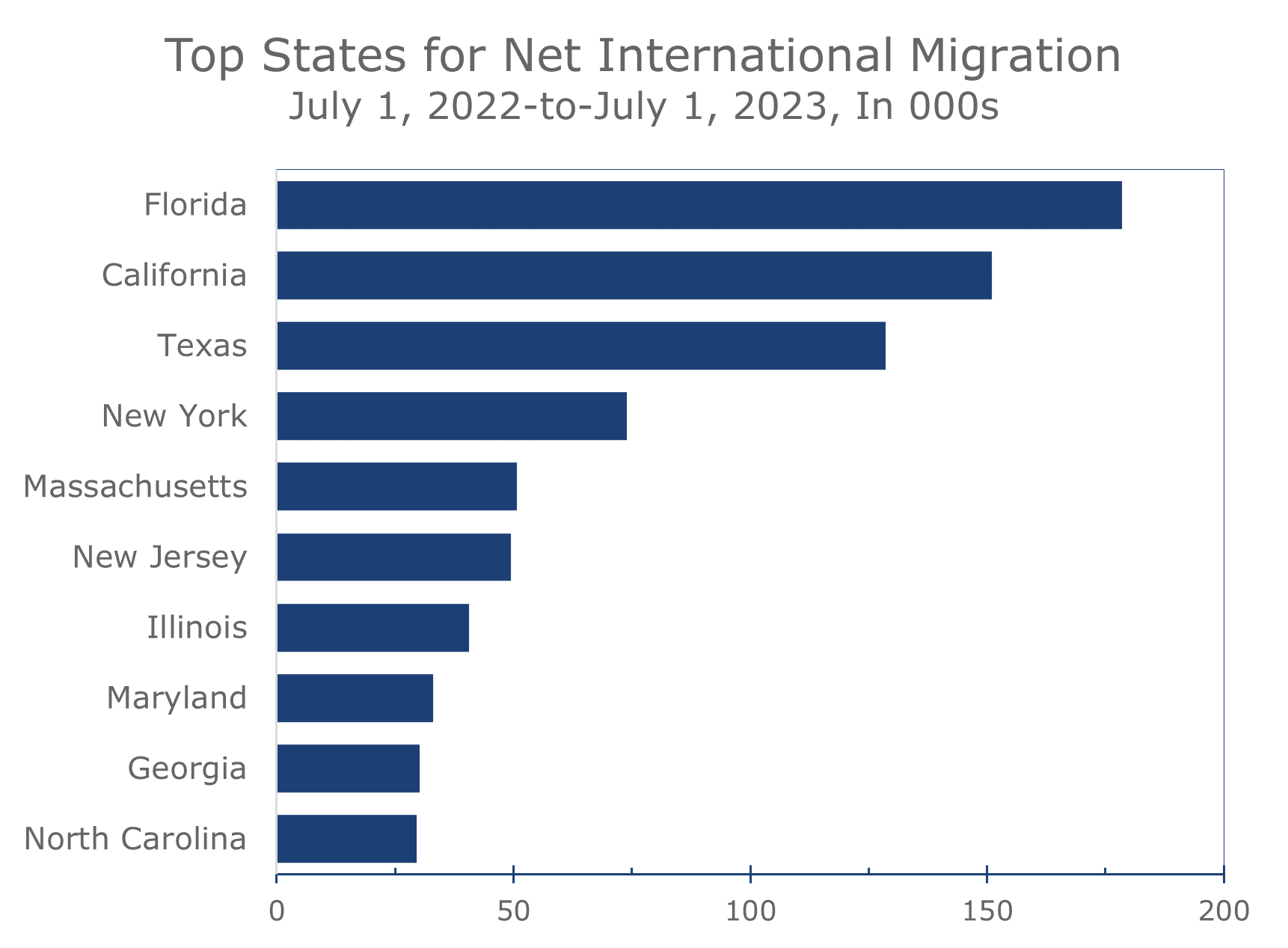
- Texas added the most new residents, while Florida led the nation in both domestic and international net migration.
- North Carolina added the third-largest influx of new residents, and South Carolina saw the fastest percentage increase.
- Immigration has re-emerged as the primary driver of US population growth. Internal migration is influenced by ongoing affordability concerns and a growing numbers of retiring baby boomers.
The latest Census population estimates show population growth continues to recover towards its pre-pandemic norms. The nation added 1.6 million new residents from July 1, 2022, to July 1, 2023. The 0.5% increase brought the US population up to 334,914,895. Immigration accounts for more than two-thirds of last year’s gain. Net natural increase added 504,495 residents, as deaths fell sharply.
Immigration is likely to remain the dominant source of growth, as births remain below their pre-pandemic pace. Deaths exceeded births in 19 states this past year, with Pennsylvania posting the largest ‘natural decrease’ with 11,079 more deaths than births. Pennsylvania also saw 24,825 more residents move away to other states than move in. That loss was offset by a net 25,766 increase in immigration from abroad.
Puerto Rico actually posted the largest net natural decrease in population, with 35,099 deaths far eclipsing 18,805 births. Immigration into Puerto Rico was only slightly positive, with a net 1,872 more residents moving into Puerto Rico than moving away, leaving the territory with a net loss of 14,422 residents.
Texas young and dynamic economy make it a top destination for businesses and residents.
Texas led the nation with the largest net natural increase, 158,253 more births than deaths, and ranked second in domestic migration and third in international immigration. Population growth once again led the nation, with Texas adding 473,453 residents. Most of that growth has been in the state’s largest metro areas.
Dallas attracts more companies relocating out of California than any other metro area, while Austin consistently ranks as one of the nation’s fastest growing metro areas and is one of the nation’s leading technology hubs. Growth is extending to outlying areas due to rising housing costs closer to Austin. Similarly, in historically affordable Houston, home prices have increased, pushing residents to more distant suburbs like Fulshear, Conroe and Pearland.
Rapid population growth is extending into distant suburbs and undiscovered areas.
Florida’s ongoing development is pushing affordability to historic lengths. The state continues to lead in net domestic migration, attracting a growing number of Baby Boomer retirees, particularly in Central and Southwest Florida. In 2022, Florida was home to seven of the nation’s ten fastest-growing metro areas, including Lakeland, Cape Coral-Fort Myers, North Port-Sarasota, and Punta Gorda. The Villages, situated approximately 55 miles north of Orlando, retained its status as the fastest-growing metro area in the country, boasting a population growth of 7.5%.
Jacksonville, in Northeast Florida, has experienced a significant increase in new residents since the pandemic. The metro area, with a younger demographic, reflects the dynamic economies of other rapidly growing Southeast metro areas. Jacksonville gained approximately 35,000 residents in 2022, with the fastest growth in St. Johns County to the South and Nassau County to the North.
Georgia ranked fourth in the nation for population growth, adding 116,077 residents. Fueled by robust net natural growth and gains in domestic and international migration, most newcomers favored the Atlanta metro area, especially in the northern fringes of the 29-county MSA. Georgia’s coastal areas are also experiencing rapid growth, led by the Port of Savannah and a continuous influx of new industry.
North Carolina gained the third-largest number of new residents (+133,088), and South Carolina added the fifth-largest number (+89,368). This influx includes prime-working age residents in larger metro areas, mainly along the Piedmont, and a significant number of retirees along the coast. Charlotte, Raleigh, Greenville, and Charleston consistently rank among the fastest-growing large metro areas, with Myrtle Beach is the nation’s second-fastest-growing MSA.
The affordability migration is fueling growth in the Carolinas and Eastern Tennessee.
South Carolina was the fastest-growing state in 2023 (+1.7%), driven primarily by retirees seeking more affordable alternatives to relocating to Florida. This trend is also benefiting Tennessee, especially Nashville, Knoxville, and eastern Tennessee.
Disclaimer: This publication has been prepared for informational purposes only and is not intended as a recommendation offer or solicitation with respect to the purchase or sale of any security or other financial product nor does it constitute investment advice.