
Two Teams to Watch Square Off in Charlotte
- College Football GameDay returns to Charlotte this Saturday for the Duke’s Mayo Classic, which will match the universities of North Carolina and South Carolina.
- This year marks the 60th meeting between the two schools, with UNC leading the series 35-20-4. South Carolina, however, has won 13 of the past 19 matchups.
- Both teams are widely considered to be on the cusp of contending for their respective conference championships.
- The teams feature two of this year’s top QBs: in UNC’s Drake Maye and South Carolina’s Spencer Rattler.
- The match is also likely to draw attention to the ever expanding ACC, which just voted to invite California, Stanford, and SMU into the league.
- Charlotte is an ideal backdrop for the game. Its booming skyline, dotted with a half dozen cranes, perfectly captures the Carolina rapid economic growth.
The North Carolina Tar Heels and South Carolina Gamecocks will face off this Saturday evening in the Duke’s Mayo Classic at Charlotte’s Bank of America Stadium. ESPN’s Gameday will be on hand to usher in the college football season, making its third trip to Charlotte’s Romare Bearden Park in the past three years. The park is just a couple of short blocks away from Bank of America Stadium.
Despite their proximity to one another, this year marks only the 60th meeting between the two schools. North Carolina leads the series 30-25-4 and won 29 of the first 40 meetings. South Carolina has dominated the series in recent years, winning 13 of the past 19 games played between the two.
The University of North Carolina began to play football regularly back in 1888 and South Carolina began play four years later in 1890. The two teams played for the first time in 1903, with North Carolina prevailing 17-0.
Both schools joined the Southern Conference in 1924 and were founding members of the Atlantic Coast Conference when it formed in 1953. The decision to form the ACC emanated from the Southern Conference’s decision to ban post-season play. South Carolina subsequently left the ACC in 1971 to become an Independent and later joined the Southeastern Conference in 1992.
Collectively over its previous 120 seasons, North Carolina boasts an overall record of 677-536-48. Over this time period, the Tar Heels have won 9 conference championships (4 Southern and 5 ACC) and competed in 37 bowl games, going 15-22. North Carolina has also won the ACC Coastal division twice since the division format was implemented in 2005, losing to Clemson both times.
North Carolina went 9-5 this past season but was on the cusp of doing much better. The Tar Heels were 10-1 going into their final two games, which they lost in very close and disappointing fashion, blowing a 17-point lead to lose to Georgia Tech 21-17 and losing in overtime to arch-rival NC State 30-27. The Heels then went on to lose to Clemson 39-10 in the ACC Championship and then a squeaker to Oregon 28-27 in the Holiday Bowl.
South Carolina began playing college football back in 1892 and has amassed an all-time record of 630 wins, 605 losses and 44 ties. They competed as a Major Independent, member of the Southern Conference, Atlantic Coast Conference (ACC) and Southeastern Conference (SEC). The Gamecocks have competed in 25 bowl games, going 10-15, and have one conference championship, the ACC Championship in 1969.
South Carolina went 8-5 this past season but finished the season strong with back-to-back victories over then fifth-ranked Tennessee 63-38 and seventh-ranked Clemson 31-30. Those victories earned the Gamecocks a birth in the Gator Bowl, where they narrowly lost to Notre Dame 45-38.
South Carolina’s strong finish has raised hopes for this season. Quarterback Spencer Rattler returns for his final year, but the Gamecocks lost 7 starters on both offense and defense from last year’s squad.
The Gamecocks great success came under Coach Steve Spurrier, who coached the Cocks from 2005 to 2015. Under Spurrier the Gamecocks went a collective 86-49, including three consecutive 11-win seasons, with the team finishing in the top 10 in all three seasons.
North Carolina’s greatest success came under Mack Brown in the mid-1990s, when the Heels had back-to-back 10-win seasons. The success helped bring football out of the shadow of UNC’s basketball program and prompted upgrades to Keenen Stadium. The program hit its pinnacle in a nationally televised showdown with Florida State. Both schools came into that late season game undefeated, with UNC ranked 5th and FSU ranked 3rd. Florida State prevailed that night and Coach Brown was soon lured away to coach the Texas Longhorns.
North Carolina and South Carolina have played just 59 times, which is surprising given the two were founding members of the ACC. The last time the two met was in the 2021 Duke’s Mayo Bowl. South Carolina won 38-21, marking a positive end to coach Shane Beamer’s inaugural season, finishing with a 7-6 record.
As far as rivalries go, this is not a heated one. South Carolina saves its greatest ire for in-state rival Clemson and Georgia. North Carolina’s fiercest rivals are Duke and NC State and Heels fans save their ire for basketball. One point of contention is the use of the Carolina moniker, with both schools laying claim to it.
There was only one Carolina colony from 1629 to 1712, with most of the development along the coast and eastern lowlands. The early history of the Carolinas was one of continual political conflicts and constant clashes with pirates and Native American tribes. In 1712, the colony was split into two, with South Carolina being the more dominant due to extensive development around Charleston, which was one of the largest and wealthiest towns in North America.
The origin of the Tar Heels dates back to colonial times. North Carolina’s economy was built around natural resources, one of which was abundant pine trees in the eastern half of the state. The Pine Trees were a source of turpentine and tar, which was used by the British Navy to coat the bottom of their ships. To produce tar, logs were covered in dirt and burned so the tar would ooze out into a channel. North Carolina was then one of the world’s leading producers of tar and its residents were then derisively referred to as ‘Tar Boilers’.
The impetus for the switch from shameful Tar Boilers to revered Tar Heels is somewhat in dispute. One theory is that when Lord Cornwallis’s troops forded the Tar River in May 1781 on their way to Yorktown, they emerged from the river with Tar on their feet that was dumped in the river to slow their crossing.
The most likely source of the Tar Heels moniker comes from the Civil War, when a regiment North Carolina stood firm in a battle in a fierce battle in Virginia, while a supporting Virginia regiment retreated. After the battle one of the Virginian’s asked derisively if there was any more tar left in the North State. The North Carolinians responded “No, old Jeff has bought it all up.” When the Virginian’s asked what Jeff was going to do with it, the North Carolinians responded that they were going to “put on the heels of Virginians so that they stick around and fight next time.”[1]
North Carolina was the last state in the South to commit to fight for the Confederacy. South Carolina was the first. The Gamecocks moniker, however, is firmly grounded in the Revolutionary War. The State newspaper in Columbia dubbed the team the Gamecocks because the way they played reminded them of the tactics employed by General Thomas Sumter in the Revolutionary War.
Sumter was an early pioneer of guerilla warfare and affectionately referred to as the Carolina Gamecock. His tactics prevented the British from attacking Georgia and pushed them out of the Carolinas entirely and into Virginia where they finally surrendered.
[1] https://alumni.unc.edu/whats-in-a-name-why-were-all-called-tar-heels/
While the Gamecocks name has a long history in South Carolina, what really made the name stick were the events following South Carolina’s 1930 12-6 upset victory over rival Clemson, which was coached by John Heisman. After the game some South Carolina fans paraded around a poster depicting a victorious rooster standing over a defeated Tiger. The sight provoked a fight that turned into a near riot the following day when South Carolina fans again displayed the poster in a parade that included cadets from both schools.
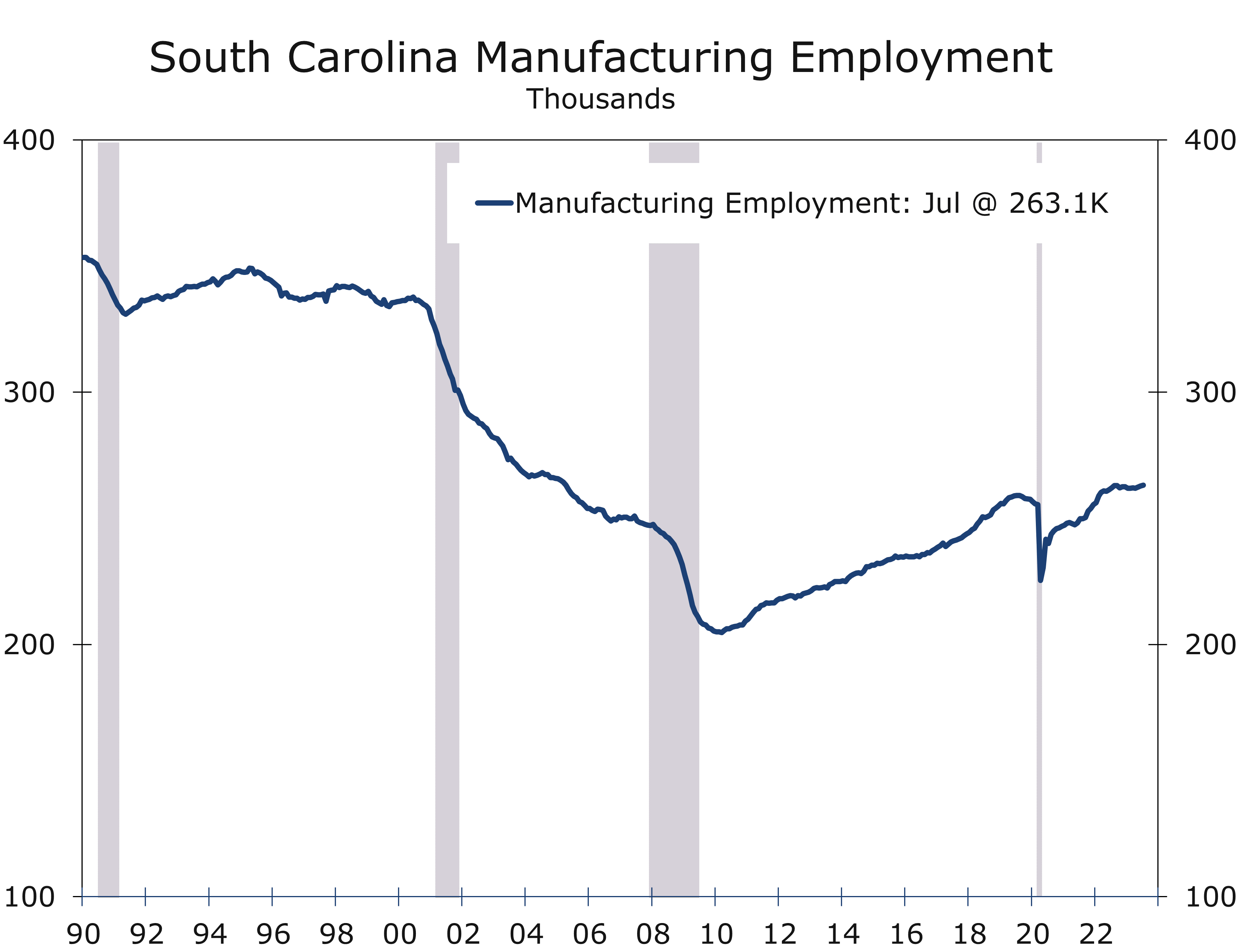
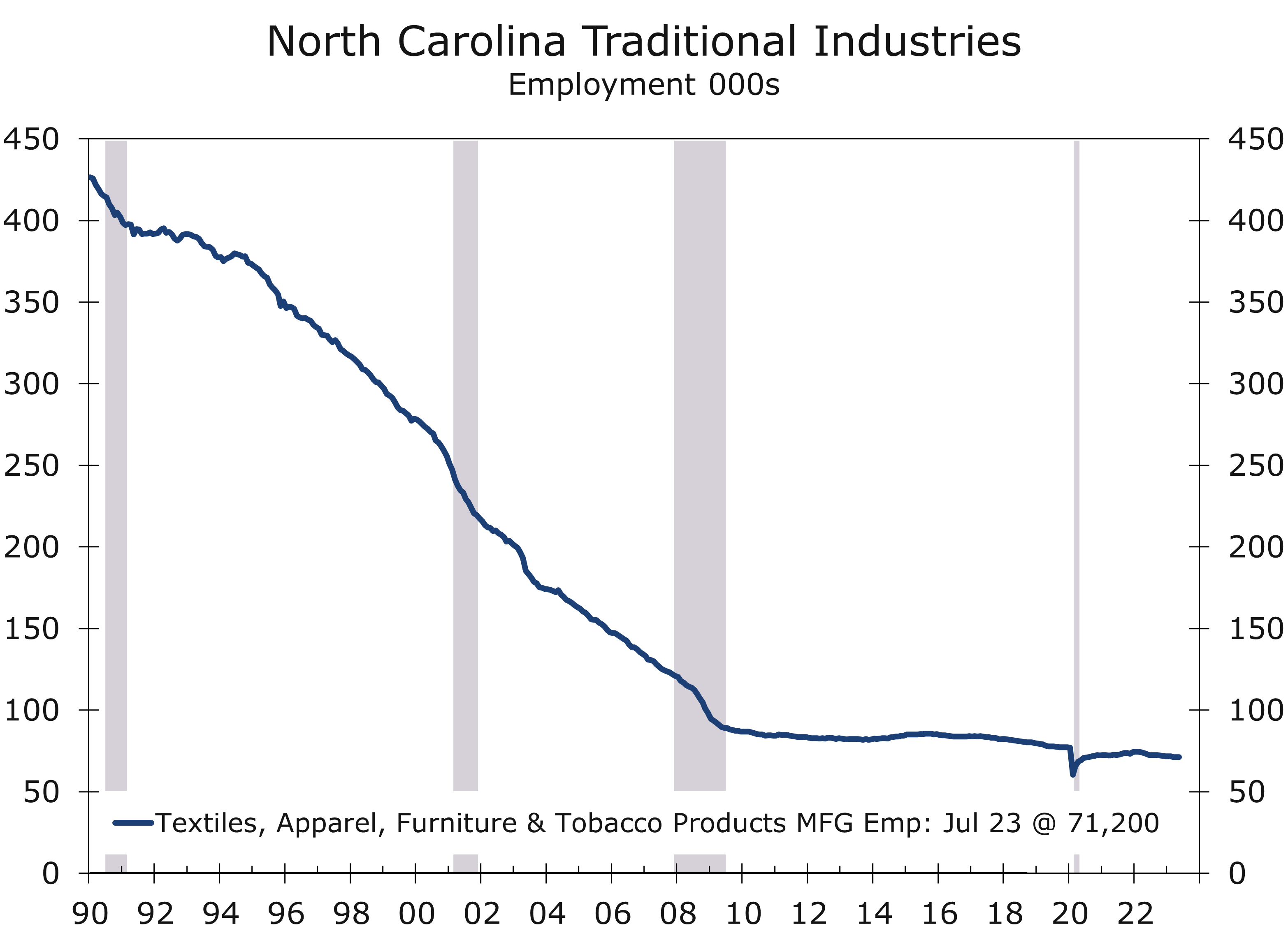
The Carolinas have changed quite a bit in the years since. The widespread adoption of air conditioning helped attract new residents to the region. Development pushed north to the Piedmont, where the fall line provided abundant waterpower and railroads provided connections to the Northeast, Midwest, and other parts of the South. Both states soon became leaders in textile and apparel production, and North Carolina also became the leading producer of furniture and tobacco products.
Along with agriculture and forestry, the dependence on these three resource-dependent industries would prove perilous, as attitudes toward smoking shifted and competition from emerging economies and China would dramatically shrink the footprint of the textiles, apparel, and furniture industries. The big three went from accounting for a third of North Carolina’s economy in the mid-1970s to less than 3% today.
Fortunately, leaders from business, government and academia had the foresight to plan for the evolution of the Carolinas economy. One of the key building blocks was the formation of Research Triangle Park, located between Raleigh, Durham, and Chapel Hill, which came together under Governor Luther Hodges. The park, which is one of the largest research parks in the nation, got a major boost in the mid-1960s, when IBM located a major research hub in the Research Triangle Park.
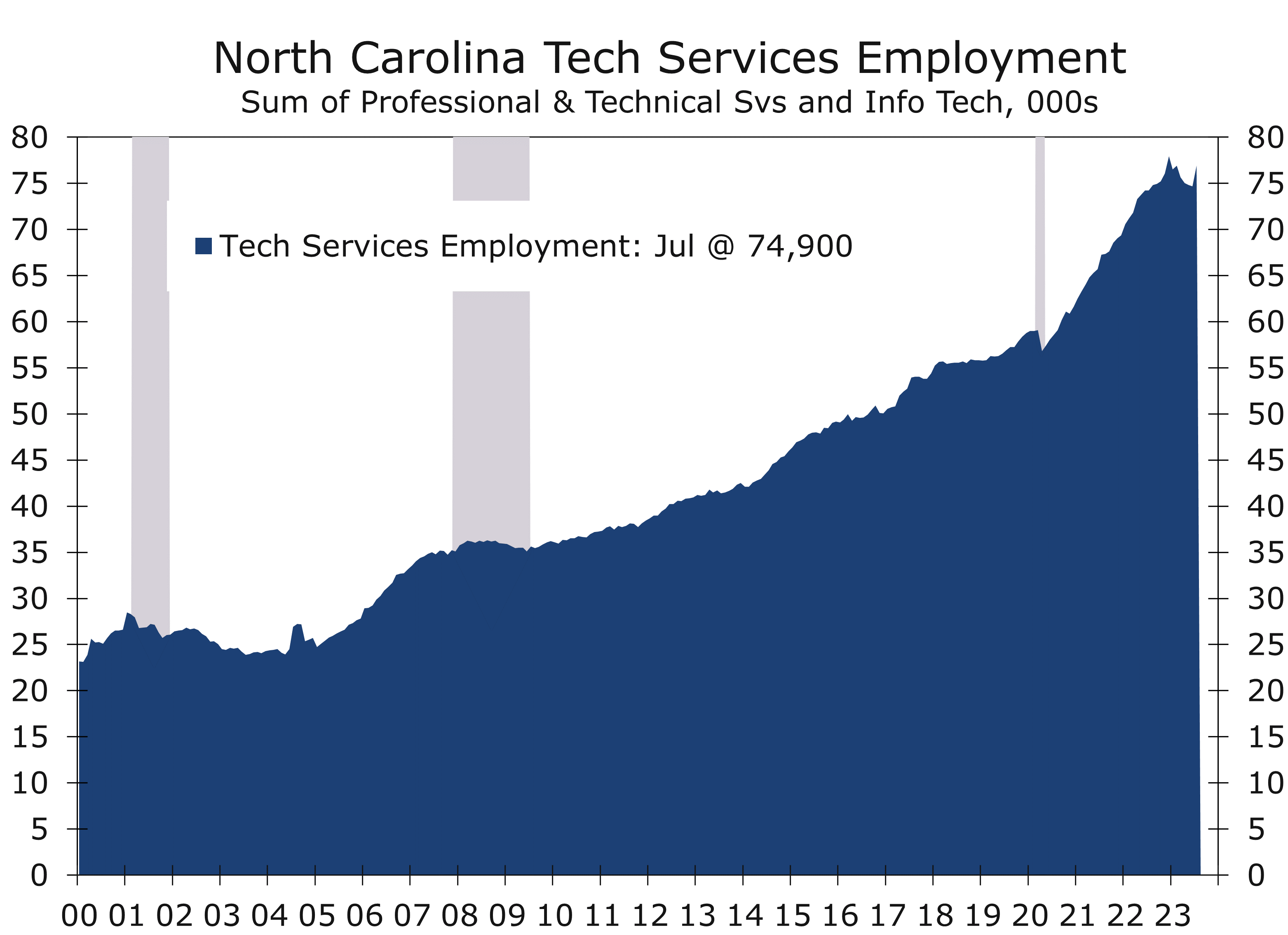
Today RTP is home to one of IBM’s largest employment bases and hosts more than 300 other enterprises, including Cisco, Fidelity, GlaxoSmithKline, Grifols and Biogen. And RTP is still growing rapidly, adding several major investments by leading life sciences companies as well as major campuses from Google, which added an engineering hub in Durham, and Apple, which is building its East Coast headquarters in the Wake County portion of Research Triangle Park.
North Carolina’s transformation was not limited to the Triangle region. As recently as the early 1990s, four of Charlotte’s ten largest employers were textile firms. Today the city is a major hub for financial services and is home to the headquarters of Bank of America, Truist Financial, and the largest employment center for Wells Fargo. Virtually every financial services firm has a presence in Charlotte, which boast a large base of skilled financial services workers and is seeing rapid growth in FinTech. The Charlotte area is also home to numerous corporate headquarters, including Fortune 500 firms such as Lowes, Nucor, and Honeywell, as well as rapidly growing firms such as LendingTree and Brightspeed.
One of the features that makes Charlotte such a good place for corporate headquarters is the proximity of the Charlotte-Douglas International Airport, which is located just 7 miles from Uptown Charlotte. Charlotte Douglas is the second largest hub for American Airlines and is the 10th busiest airport in the nation based on passenger traffic. CLT boast nonstop flights to 181 destinations throughout the U.S. and 26 countries. The airport is one of the fastest growing in the nation and is in the midst of a multi-billion dollar expansion that will upgrade the terminal, add more gates, and build a fourth parallel runway.
The Charlotte-Douglas International Airport is not only a powerful economic driver for Charlotte and the State of North Carolina but also provides a key competitive edge for South Carolina. The Charlotte and the South Carolina’s Upstate are home to the largest concentration of German-owned firms in the country. The ties to Germany data back to the textile industry but are now mostly due to the emergence of the automotive industry, as well as industrial machinery, robotics, and chemicals. The availability of nonstop flights to Frankfurt and Munich is essential to sustain this key source of growth.
The transformation of South Carolina’s economy is best exemplified by the growth of BMW located between the Greenville-Spartanburg International Airport and I-85. Since announcing its first North American assembly plant nearly thirty years, the BMW plant in Greer has been constantly expanding since it opened in 1994 and is BMW’s largest assembly plant in the world.
BMW exports the majority of its output via the Port of Charleston. The assembly plant employs more than 11,000 workers. BMW has also attracted scores of suppliers to the Upstate and other parts of South Carolina. BMW’s presence has also encouraged the state to pursue opportunities further up the value chain by establishing research centers at Clemson and UofSC focusing on advanced manufacturing, automotive safety, and material science.
The UofSC is a new moniker for the University of South Carolina. Most people still refer to South Carolina as USC, but a long running feud and trademark lawsuit with the University of Southern California (a private institution) resulted in a settlement where South Carolina would officially use the abbreviation UofSC instead of USC.
BMW’s role in South Carolina’s evolution to higher value added manufacturing cannot be overstated. The textile industry peaked in South Carolina during the early to mid-1970s, with textiles and apparel accounting for close to one-third of the Upstate’s 1973 private sector employment base. BMW was not the first step taken to dramatically diversify the state’s economic base. Michelin was recruited to the state nearly two decades earlier. The French-owned firm has its North American headquarters, research facilities and proving grounds in Greenville. The firm operates more than a dozen facilities across the state and employs over 9,000 workers.
The success of Michelin and BMW paved the way for other manufacturers to expand into the Palmetto State. These firms proved that you could build a world class product in South Carolina and also highlighted the state’s worker training initiative and its excellent community colleges and technical schools.
Volvo opened an assembly plant outside of Charleston in 2018 and Mercedes assembles Sprinter vans there as well. South Carolina has also attracted scores of other tire manufacturers in recent years, including large facilities for Bridgestone/Firestone, Continental, Trelleborg and Giti. More tires are produced in South Carolina than any other state, and South Carolina is also the nation’s leading tire exporter.
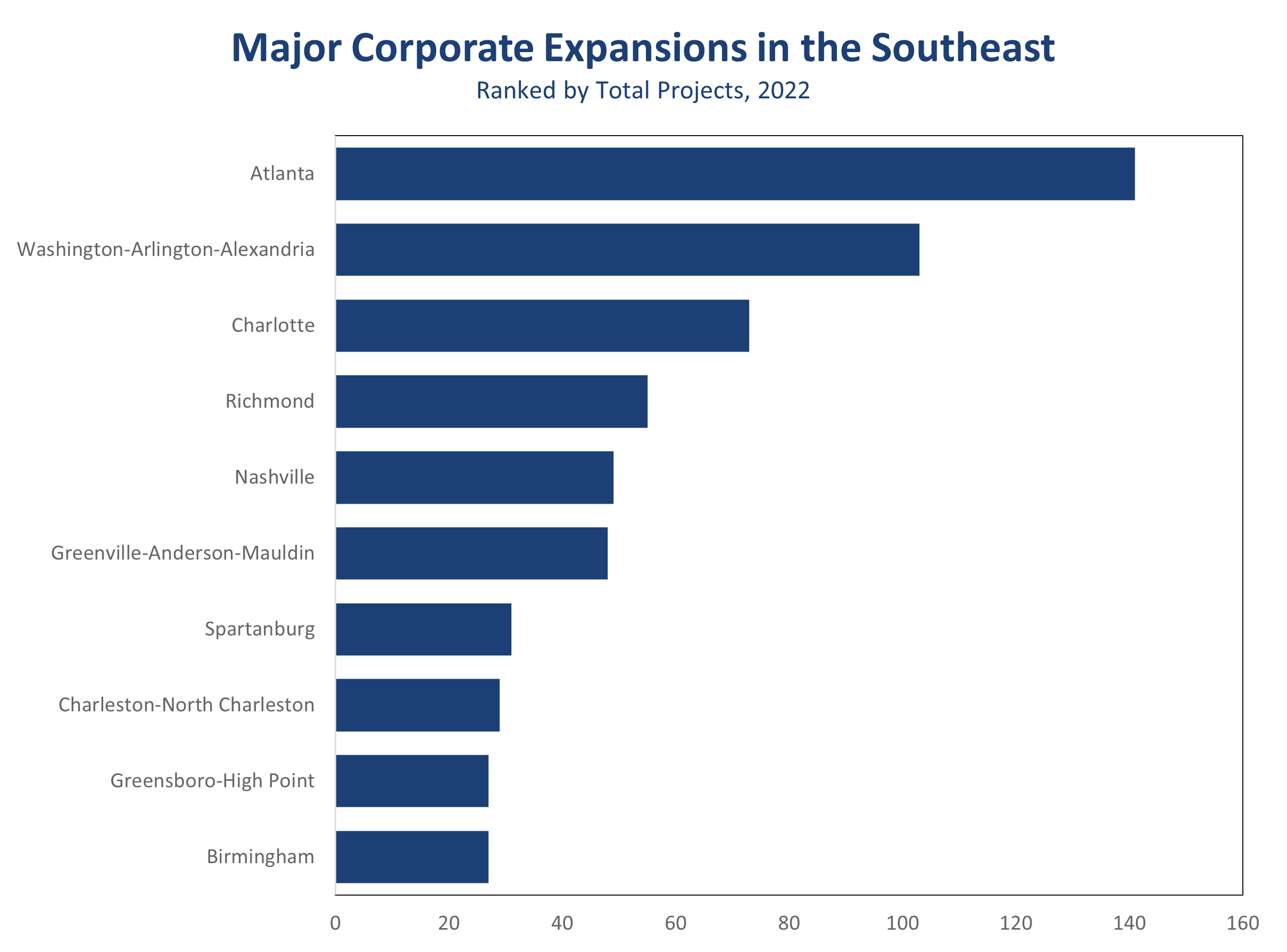
South Carolina’s manufacturing base took another huge step forward when Boeing announced it would acquire a key supplier and set up a major assembly operation to build its 787 Dreamliners in Charleston. Boeing employs around 7,000 workers in Charleston, where it operates several facilities in addition to its massive Dreamliner plant. The firm is currently adding a second production line.
Boeing is not the only firm producing airplanes in South Carolina. Lockheed began building F-16s in Greenville back in 2021 and has a large backlog of orders.
Just as with the automotive sector earlier, the growth of the aerospace industry is attracting numerous suppliers to South Carolina. The state is also investing in job training programs that will help ensure there is a steady stream of skilled workers.
More recently, South Carolina’s economy has gotten a huge boost from a flood of EV-related investments, including plants for AESC, which is investing $810 million to build a plant near Florence, which will produce batteries and components for a new line of BMW produced in Spartanburg. Redwood Materials is investing $3.5 billion in a massive EV battery plant outside Charleston and Scout Motors announced plans to build a $2 billion assembly plant just north of Columbia.
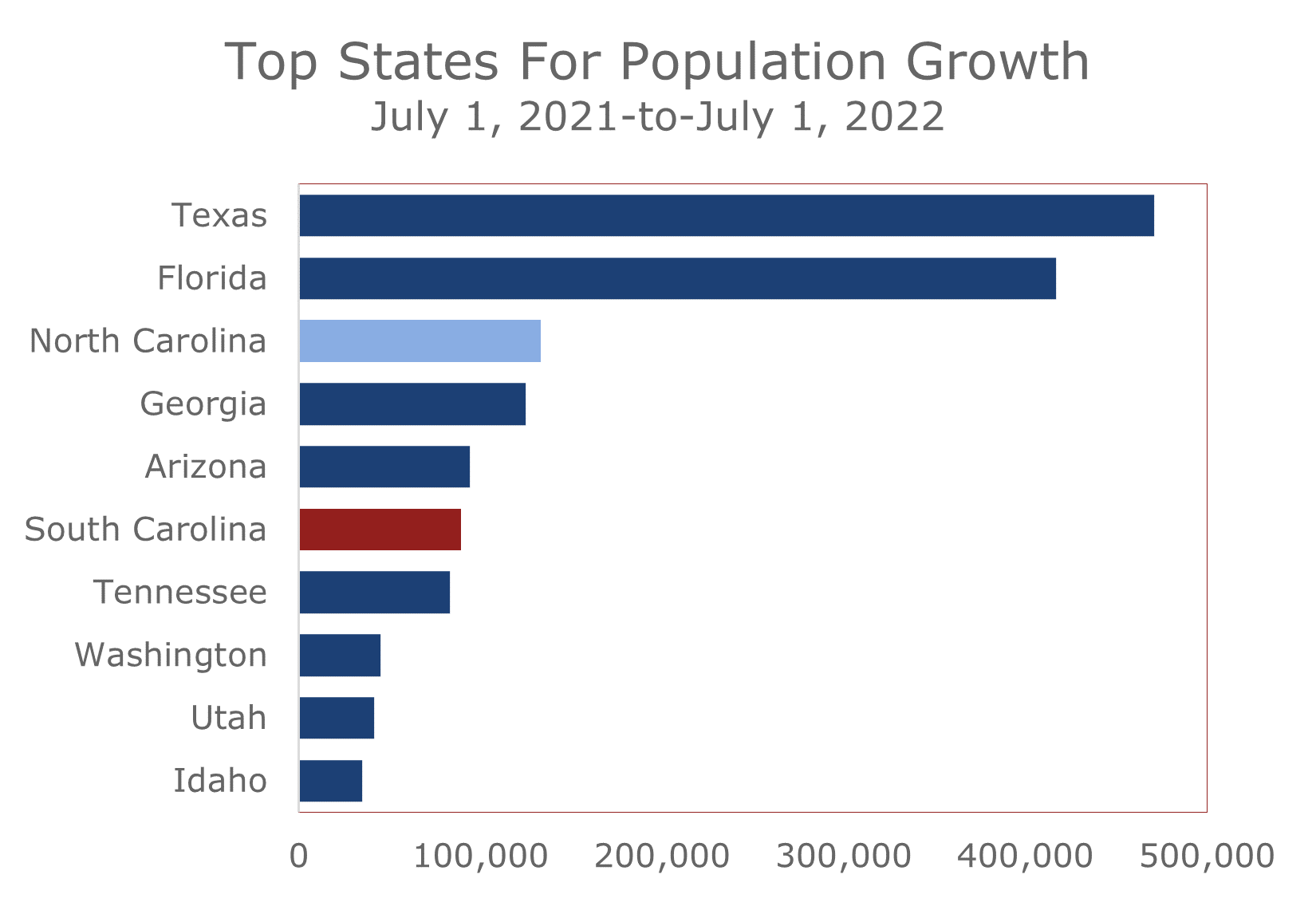
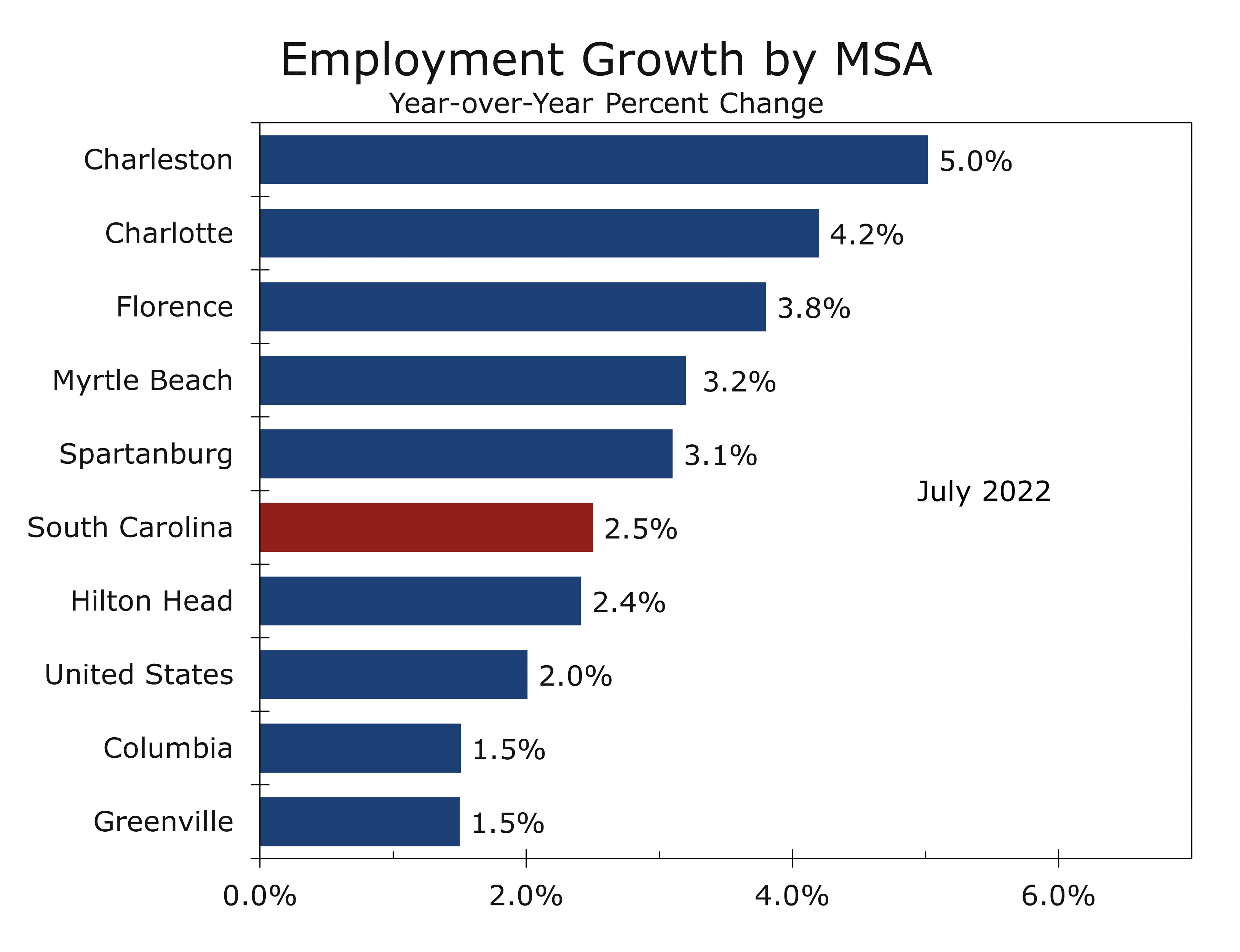
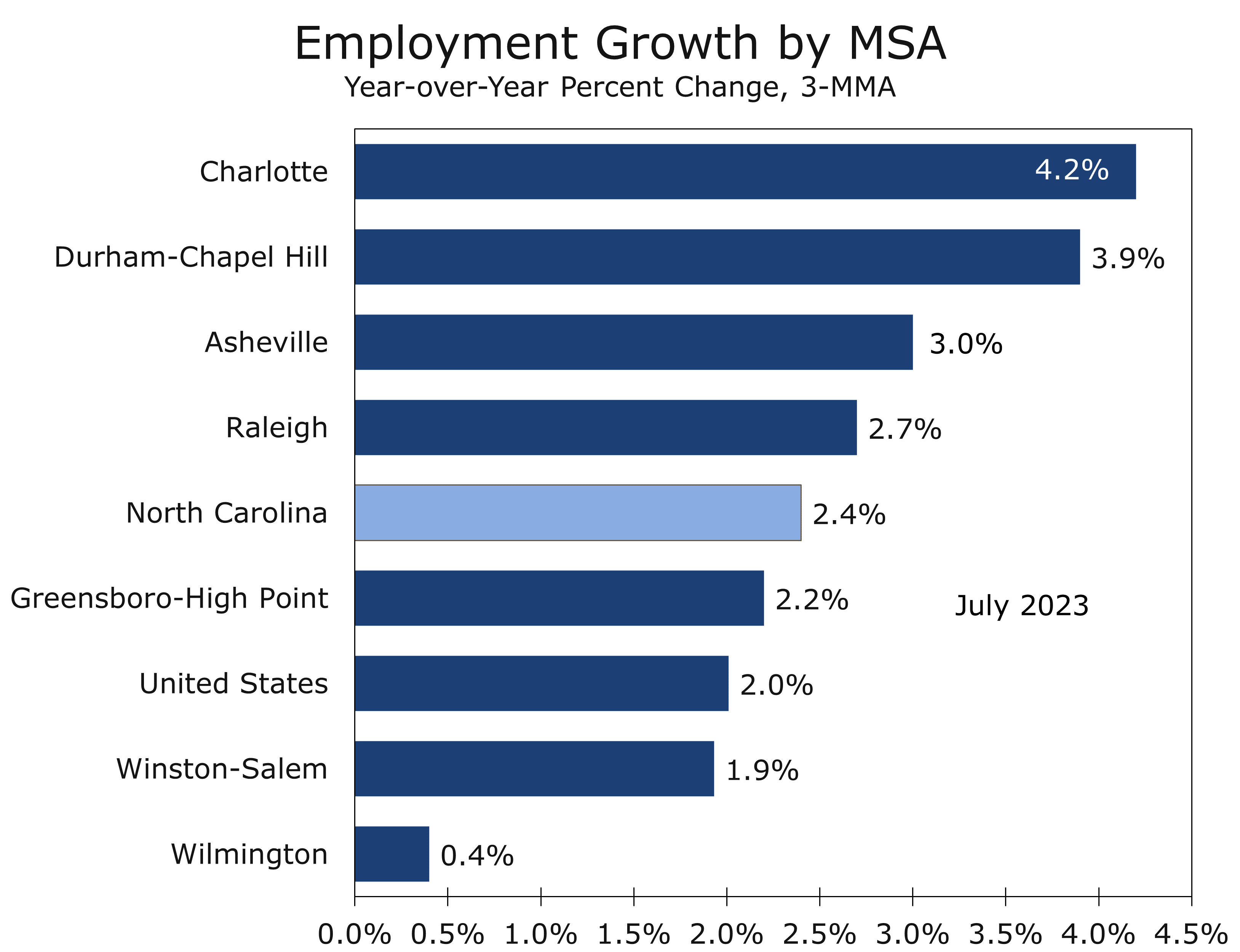
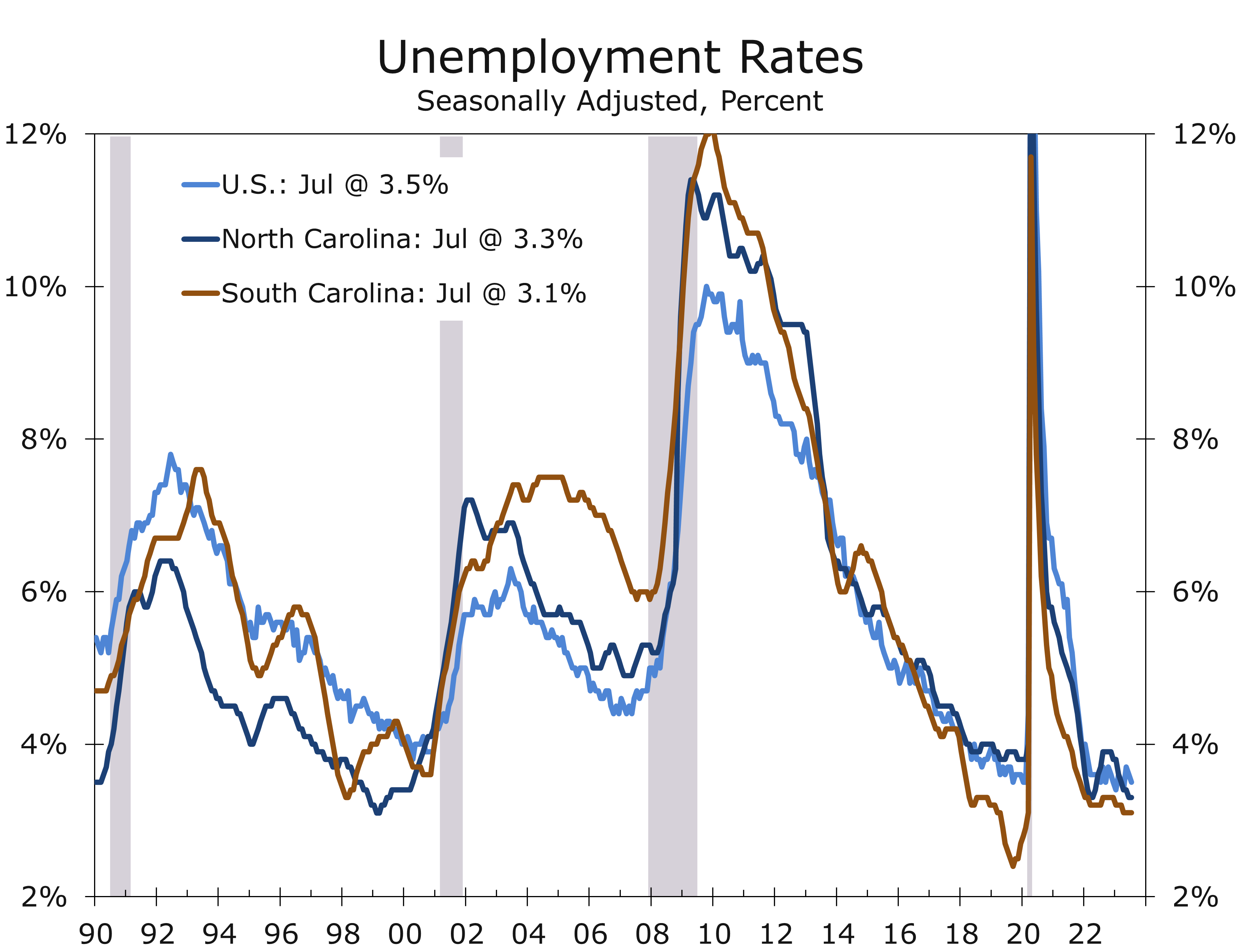
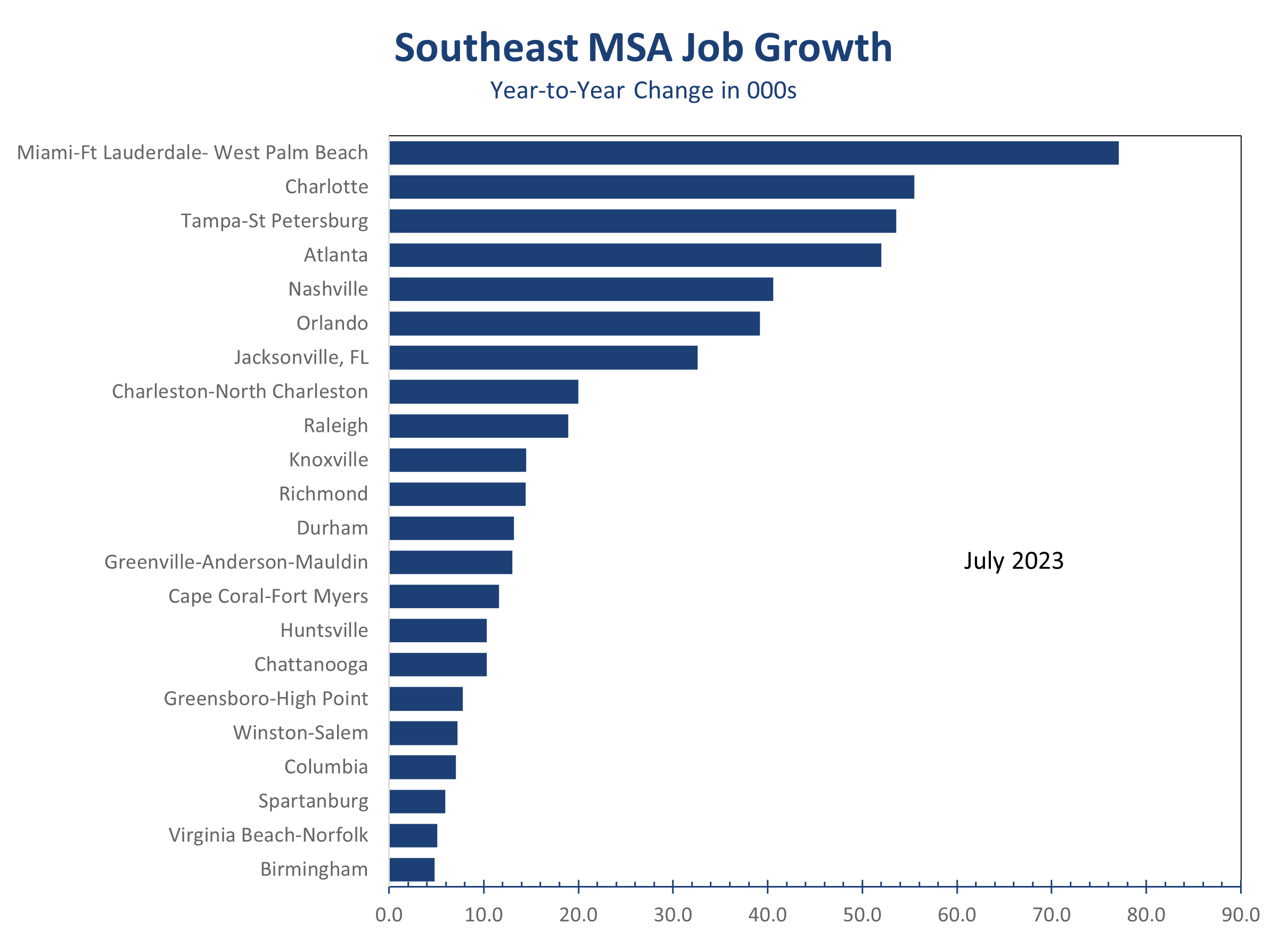
Charlotte is a fitting location for this weekend’s Battle of the Carolinas. The Queen City is located between the two schools, 92 miles north of the University of South Carolina and about 140 miles southwest of Chapel Hill. Charlotte also epitomizes the Carolina’s economic vibrancy. Bank America Stadium, surrounded by dozens of tower cranes building office buildings, apartments, and the new Atrium/Wake Forest School of Medicine, is the perfect venue to see evidence of the region’s growth.
The game itself should be a good one. North Carolina comes in as a two and half-point favorite. South Carolina has won 4 of the past 5 contests, however, and has high hopes going into the season following last year’s back-to-back wins over top 10 teams (Tennessee and Clemson). South Carolina lost 14 starters off last year’s squad, however, and North Carolina’s experience should give them a slight edge.
Disclaimer: This publication has been prepared for informational purposes only and is not intended as a recommendation offer or solicitation with respect to the purchase or sale of any security or other financial product nor does it constitute investment advice.