
Homes Sales Show Surprising Resiliency
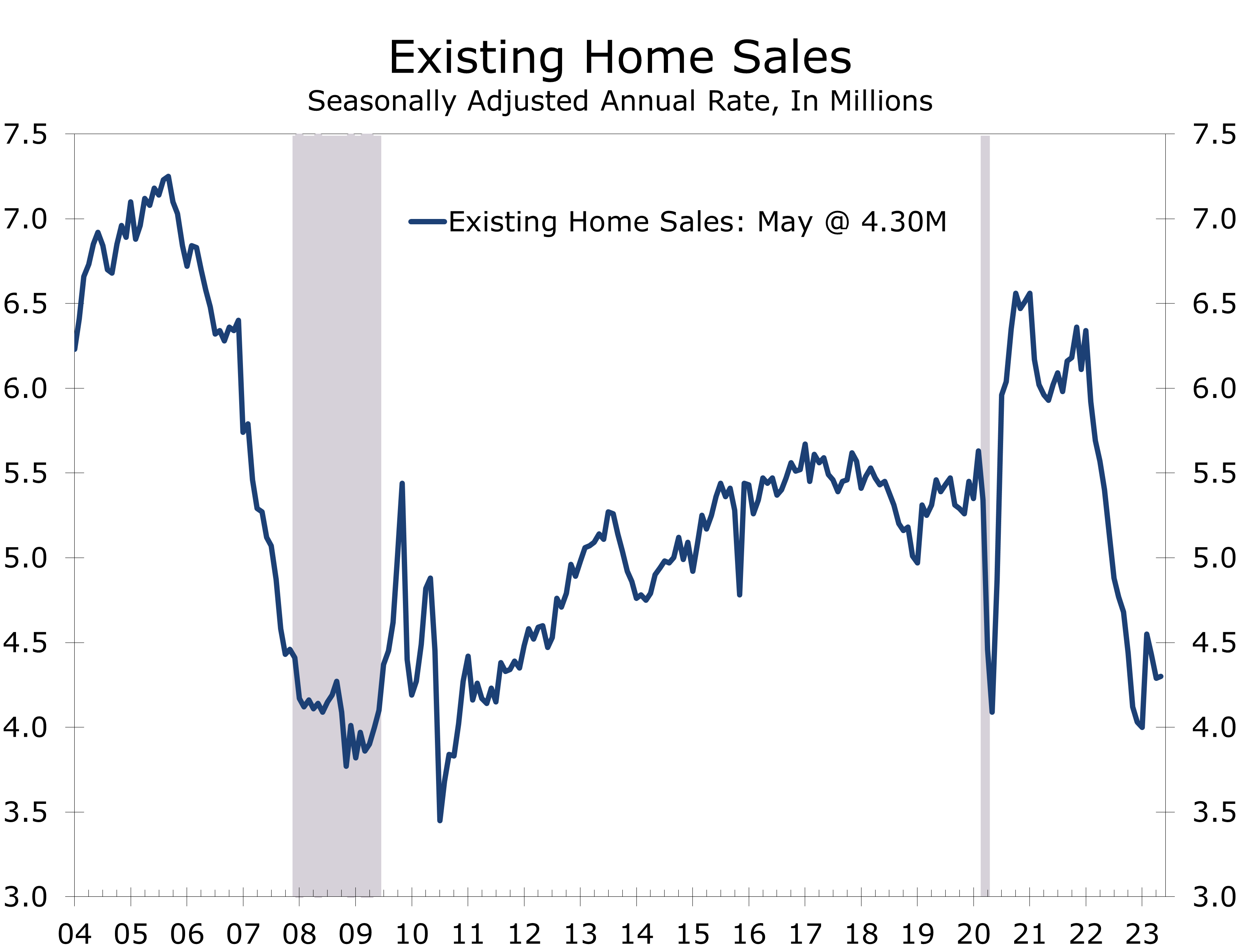
- Existing home sales rose 0.2% in May to a seasonally adjusted annual rate of 4.30 million units.
- Sales declined by 20.4% on a year-to-year basis and have now decline for 22 consecutive months.
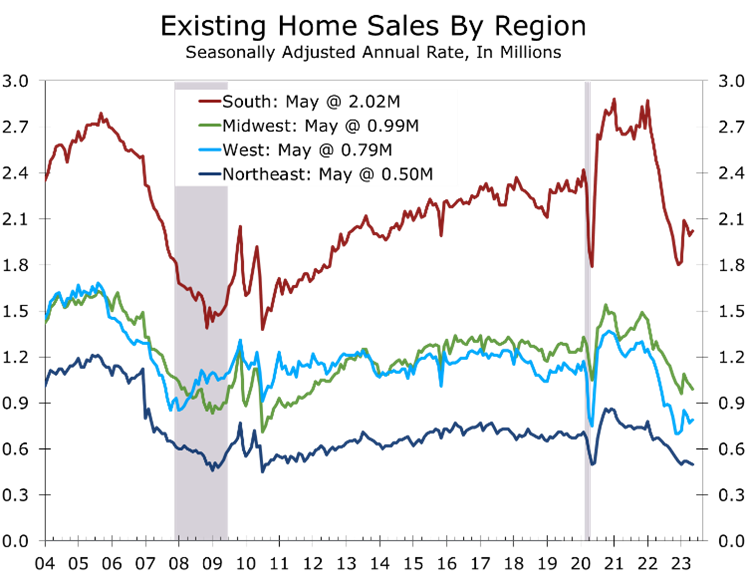
- Sales varied by region, with the South and West posting gains in May and showing signs of stabilizing, while sales continue to trend lower in the Northeast and Midwest.
- The inventory of homes available for sale rose 3.8% in May to a still tight 1.08 million homes.
- Sales of single-family homes fell 0.3% to a 3.85-million-unit pace, while sales of condos and co-ops rose 4.7% to a 450,000 unit pace.
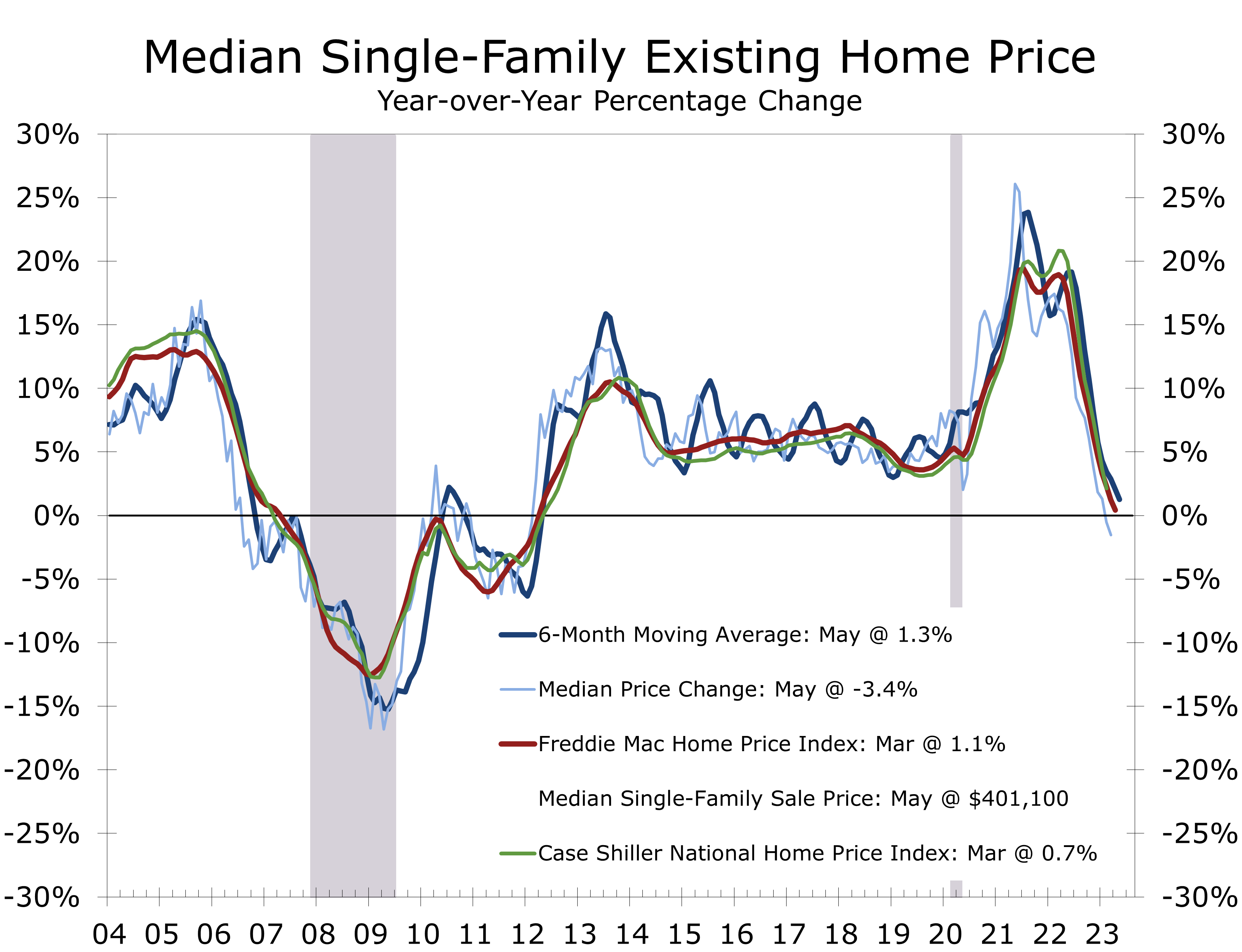
- Home prices rose 2.6% from April but remain down 3.1% from May of last year.
- Home sales continue to show a surprising degree of resilience. Demand continues to be driven by an affordability migration away from higher-priced markets to lower-priced markets in the South and parts of the West.
Existing home sales eked out a 0.2% gain in May against what is still a very challenging environment for home buyers. Affordability remains a formidable hurdle for many potential buyers and rising interest rates have raised that hurdle even higher. Buyers also have relatively few homes to choose from, as inventories of homes remain exceptionally low.
Inventories did edge higher in May, rising 3.8% to 1.08 million homes. That equates to a 3-month supply at May’s sales pace. Even with the increase, however, there are 6.1% fewer homes available for sale than there were a year ago. Homes are also selling quickly. Homes sold in May typically remained on the market for just 18 days, down from 22 days in April but up slightly from 16 days last May. Cash buyers accounted for 25% of closed transactions in May, down from 28% the prior month but even with the last May.
Higher mortgage rates are keeping many potential sellers on the sidelines.
Higher mortgage rates are keeping many potential sellers on the sidelines. As we noted in our housing chartbook, 80% of first-lien mortgages have rates below 5% and 60% have rates below 4%. With such low rates, fewer homeowners are looking to sell.
Sales of single-family homes fell 0.3% to a 3.85-million unit pace, while sales of condominiums and co-ops rose 4.7% to a 450,000 unit pace. All the increase in the latter was in the West and South, where sales rose 11.1% and 5%, respectively. Even with the increase, sales of condominiums and co-ops remain 23.7% below their year ago level, with sales off 27.3% year-to-year in the Northeast and 25% in the Midwest.
Overall demand continues to be driven by the affordability migration away from high-cost housing markets in the Northeast and along the West Coast. The South and more affordable parts of the Mountain West are benefiting the most from this shift.
Sales in the South rose 1.5% in May to a 2.03-million unit pace. Sales in the South have fallen 16.5% over the past year, which is the smallest year-to-year drop of any region. Sales rose 2.6% in the West to a 790,000-unit pace but are off 25.5% over the past year. Sales fell 2.9% in the Midwest to a 990,000-unit pace and are down 20.8% year-to-year. Sales in the Northeast fell 2.0% in May to a 500,000-unit pace, down 25.4% from a year ago.
At a 500,000-unit pace, sales in the Northeast are currently at the same pace they were at their lowest point of the COVID-19 lockdown. Sales in the Midwest are 5.7% below their lockdown low. By contrast, sales in the South are 12.8% above their lockdown pace and sales in the West are 5.3% above their lockdown low.
Home sales have held up better in the South and parts of the Mountain West because these regions continue to see strong in-migration from the Northeast and West Coast. The influx of buyers, flush with cash from the sale of their previous home, has bolstered sales at the higher end of the market. We are beginning to see signs this influx is beginning to slow, however.
Home prices rose 2.6% from April on a non-seasonally adjusted basis but remain down 3.1% from May of last year to $396,100. Prices for single-family homes are down 3.4% year-to-year to $401,100, while prices for condominiums and co-ops are essentially even with their year ago level at $353,000.
Home prices have fallen 5.8% in the West over the past year and are down 3% in the South. By contrast, prices are up 2.4% in the Northeast and 1% in the Midwest.
The drop in home prices in the South, where home sales are holding up better than in any other region, is somewhat surprising. While activity has cooled off in some formally red-hot markets, most notably Austin, sales remain strong across much of Florida, and rapidly growing metro areas in Georgia, Tennessee, and the Carolinas. The mix is changing. Demand for higher end homes has clearly cooled. A year ago, sales of homes priced between $500,000 and $1 million were up 40% from the prior year. Today such sales are down 17.5%. The bulk of sales are now among homes priced between $250,000 and $500,000, which accounted for 51.8% of sales in May.
Disclaimer: This publication has been prepared for informational purposes only and is not intended as a recommendation offer or solicitation with respect to the purchase or sale of any security or other financial product nor does it constitute investment advice.