Strong Job Growth Lessens Recession Risk
- Employers added 253,000 jobs in April, with gains evident across most major industries.
- The unemployment rate fell 0.1 point to 3.4%, as civilian employment rose modestly while the labor force declined slightly.
- Average hourly earnings rose 0.5% to $33.36 and are now up 4.4% year-to-year.
- April’s rise in nonfarm payrolls was almost perfectly in line with expectations, although job growth for the prior two months was revised down by 149,000 jobs.
- Job gains continue to be padded by a rebound in industries still recovering from the pandemic lockdown, namely health care, leisure and hospitality sector, and social assistance.
- Tech sector results were mixed. Information services added 1,000 jobs, with gains in cloud computing and web hosting offsetting loss at web search and social media.
- April’s stronger job gains should alleviate fears the U.S. economy is tipping into a recession, but also increase the odds the Fed raises rates once again in June.
Nonfarm employment rose by 253,000 jobs in April, close to our expectation. Revisions to the prior 2 months sliced 149,000 jobs off previous estimates. Employers have added an average of 222,000 jobs a month over the past three months, down from an average of 399,000 per month in 2022.
Job growth continues to be driven by industries hit hardest by the pandemic lockdowns. Health care added 39,600 jobs in April, with hiring up sharply at doctors’ and dentists’ offices, hospitals, and nursing homes. Health care providers have seen a resurgence in demand, as patients feel more comfortable with office visits and treatments. Demand for nursing homes and residential care facilities is also recovering.
Job growth continues to be driven by industries hit hardest by the pandemic lockdowns.
Leisure and hospitality added 31,000 jobs in April, with most of the gain coming at restaurants and bars. Hiring is also up solidly in arts, entertainment and recreation, a broad category capturing everything from theme parks and casinos to bowling alleys and arcades. Consumers are spending more on entertainment outside the home, driving strong demand across the sector. Leisure and hospitality employment remains 2.4%, or 402,000 jobs, below its pre-pandemic level.
Demand for childcare and family services also continues to drive rehiring. Social services providers added 24,600 jobs in April.

Construction firms added 15,000 jobs this past month. There was considerable variation among the major subcomponents, however, which provide some key insight into the state of residential and commercial construction. Employment declined in construction of residential and commercial buildings, with each losing 1,800 jobs during the month. Heavy construction and engineering construction firms also cut 8,100 jobs in April. Specialty trade contractors, however, added 26,700 jobs in April, with 16,000 jobs added in residential.
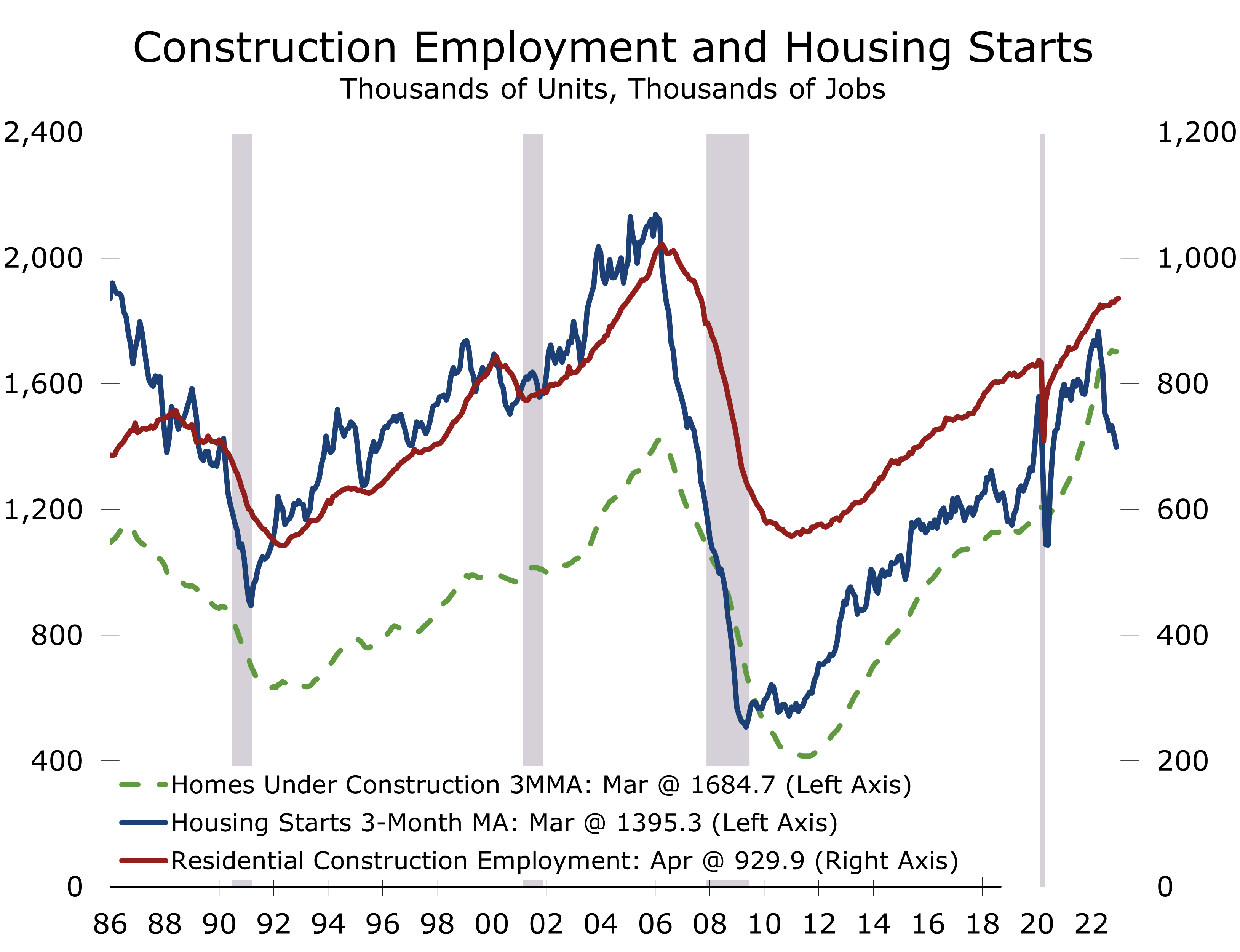
One of the more unusual aspects of the housing market is the exceptionally high level of homes currently under construction. Cycle times for apartments and single-family homes have lengthened considerably due to supply and labor shortages. The backlog of apartments currently under construction, much of which is in mid-rise and high-rise projects, is the largest since late 1973.
Single-family home builders are beginning to make headway at reducing their backlogs, with starts trailing completions for the past few months. Much of the work that is now needed to complete homes involves specialty contractors, such as plumbers and cabinet installers and floorers. The large backlog of homes under construction has created a break in the usually tight relationship between construction employment and housing starts.
Manufacturers added 11,000 jobs in April, more than reversing an 8,000-job drop in March. Fabricated metals and transportation equipment accounted for the bulk of April’s gain. Average weekly hours in manufacturing fell 0.1 to 40.2 hours. The goods sector has been under pressure the past few months as manufacturers and wholesalers strive to reduce inventories. Look for retailers to cut back stocks in coming months, which will likely weigh on transportation and warehousing jobs.
April’s stronger jobs data raise the probability the Fed will hike rates again when they meet in mid-June, a prospect we raised in our write-up following the Fed meeting. The unemployment rate is currently below the lower range of the Fed’s long-range target, while wages are rising at a pace that is consistent with a 3.5% inflation rate, which is well above the Fed’s target.
April’s strong jobs report raises the probability the Fed will hike rates when they meet in June.
The strength in hiring also reduces recession fears. Hours worked remain weak, however, rising at just a 1.2% pace over the past 3 months. That might be enough to keep GDP positive if productivity rebounds.

Disclaimer: This publication has been prepared for informational purposes only and is not intended as a recommendation offer or solicitation with respect to the purchase or sale of any security or other financial product nor does it constitute investment advice.