
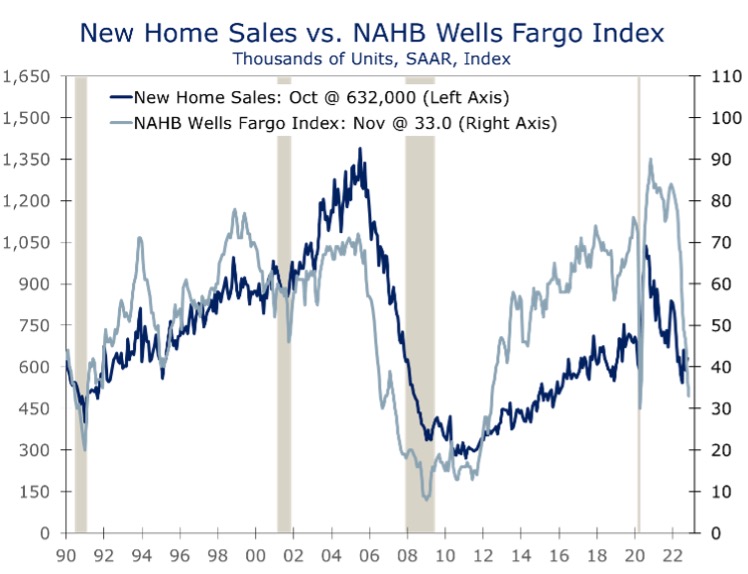
New home sales came in well above expectations in October, with sales climbing 7.5% to a 632,000-unit annual rate. The increase is at odds with what builders are saying. Most builders have reported a dearth of buyer traffic this fall and have been discounting prices to move inventory. Moreover, many builders have reported a spike in cancelations, which explains a large part of the sharp rise in inventories of completed homes over the past three months.
Notably Weaker Beyond the Headline
- New home sales rose 7.5% in October to a 632,000-unit pace.
- Sales for August and September were revised lower by a combined 31,000. On a year-to-date basis, new home sales are now running 14.2% below their year-ago pace.
- Even that decline understates the extent of the slowdown, however, as Census new home sales do not include cancelations, which have spiked the past few months.
- The South accounted for much of October’s gain, with sales rising 16%. Sales also rose in Northeast but fell in the Midwest and West.
- Sales of higher priced homes are holding up relatively well, which is a big reason why the median price rose 8.2% to $493,000.
- Home builders have grown increasingly cautious and are discounting more aggressively to work down inventories.
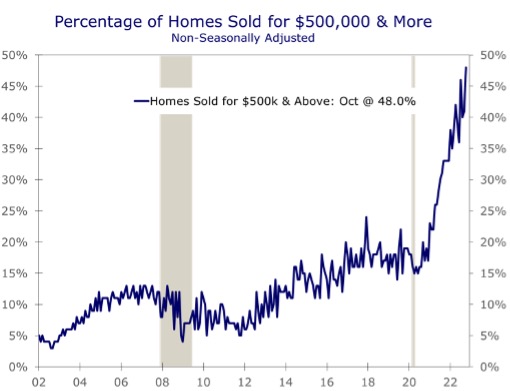
While October’s rise in new home sales overstates the strength in the housing market, the report still contains some valuable insights. For starters, discounts are bringing buyers back into the market, particularly at higher price points. Sales of homes priced above $500,000 rose 15% in October (NSA) and accounted for a record-high 48% of all new home sales. Buyers at these price points tend to be less adversely impacted by higher inflation. Many also sold homes in higher priced parts of the country and relocated to metro areas where homes are more modestly priced, particularly the South, which offsets some of the sting from higher mortgage rates.
Home builders also have considerably more room to discount prices at the upper end of the market and those discounts likely brought out more buyers in October. Profit margins had widened considerably during the boom that followed the lockdown at the start of the pandemic, as demand surged, and shortages of key building products and skilled workers restrained home construction. Supply constraints have eased considerably in recent months, and lumber prices and prices of other materials have fallen sharply.
One of the reasons those discounts have not shown up in a lower median or average price, is that sales have been much weaker at the lower end of the market. Sales of homes priced between $400,000 and $499,999 accounted for 21% of sales, which is down from the prior month but roughly equal with its average from the prior 6 months. By contrast, the share of homes sold for between $300,000 and $399,999 tumbled 9 percentage points in October to 18%, marking the smallest share for this price segment in more than 5 years.
The middle and lower end of the housing market are clearly more challenged today. Buyers for homes priced at or below the median price have been disproportionately impacted by soaring inflation and higher interest rates. Many would-be home buyers are having more difficulty qualifying for a mortgage and the higher monthly payments are harder to handle with costs of other essentials already taking a larger bite out of household budgets. Given these constraints, it is hardly as surprise that entry level buyers account for the bulk of contract cancelations.
The problems around the middle and lower end of the housing market are why home builder confidence has plummeted as much as it has. The NAHB/Wells Fargo Home Housing Market Index fell to 33 in November and is a whopping 51 points below where it began the year. Nearly two-thirds of that drop has occurred since May. Home builder confidence is now at its lowest level since June 2012. Builders are undoubtedly concerned about the recent surge in contract cancelations and protracted slowdown in buyer traffic.
Unfortunately, there is little builders can do in the short run to shore up traffic or curb cancelations. There is simply less room to discount homes at the middle of the market and at lower price points. The net result is inventories of unsold homes are rising.
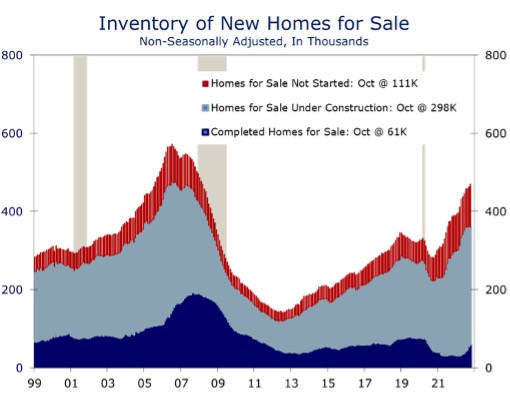
New home inventory is broken out into three categories: homes not started, under construction and completed. The latter was at record lows through most of 2021 but has nearly doubled since the start of this year. Inventories of homes under construction have fallen slightly but still account for an outsized 63% of new home inventories. Builders are holding off starting new homes until cancelations slow and homes under construction decline further.
Homebuilders are not nearly as optimistic about the housing market as October’s surprising rise in new home sales would suggest.
High inventories of homes under construction and the rising number of completed homes for sale has put builders on the defensive. Builders are holding off on starting new projects and trimming costs where possible, including reducing staff.
Disclaimer: This publication has been prepared for informational purposes only and is not intended as a recommendation offer or solicitation with respect to the purchase or sale of any security or other financial product nor does it constitute investment advice.