Small Businesses See Modest Improvement
- Small Business Confidence began the year on a slightly more optimistic note.
- The National Federation of Independent Business (NFIB) Small Business Optimism Survey rose 0.5 points to 90.3 in January.
- January’s rise primarily reflects a decline in pessimism rather than any sudden recognition of more positive trends.
- The share of business owners expecting the economy to improve rose 6 points to -45%.
- Many of the largest gains were tied to hiring and compensation, both of which remain strong and reflect the exceptionally tight labor market.
- The share of firms raising prices fell 1 point to 42% in January.
- The share of firms making capital expenditures over the past 6 months rose 4 points to 59%. Business owners, however, remain cautious about capital spending and inventories in the coming year.
January’s 0.5 percentage point rise in the NFIB Small Business Optimism Index primarily reflects a slight drop in pessimism among small business owners rather than rising optimism. The proportion of firms expecting the economy to improve in coming months rose 6 points but remains exceptionally low at -45%. Most of the other components posting large gains were tied to hiring and compensation, which is clearly a double-edged sword right now. Hiring plans rose 2 points to 19% but a whopping 45% of firms had job openings they have not been able to fill.
Less pessimism is still better than the alternative and there were some notable positives within the report. The share of firms reporting they made capital outlays during the past 6 months rose 4 points to 59%. Earnings trends also improved, rising 4 points to a less negative 26%. The net share of firms raising prices also fell 1 point to 42%.
The net share of firms raising prices over the past three months fell 1 point to 42%.
Price hikes were most prevalent in construction, retailing, wholesale trade and transportation. The share of firms hiking prices remains well above levels historically consistent with the Fed’s 2% inflation goal. Plans to raise prices rose 5 points in January to 29%.

Labor market conditions remain much closer to the peak levels than where they would be if the economy was truly on the precipice of recession. The NFIB noted that 57% of small business owners reported they were hiring or trying to hire in January, which was up 2 points from December. Of those businesses hiring or trying to hire, 97% reported they had few or no qualified applicants for their open positions.
Fifty-seven percent of small business owners were hiring or trying to hire in January.
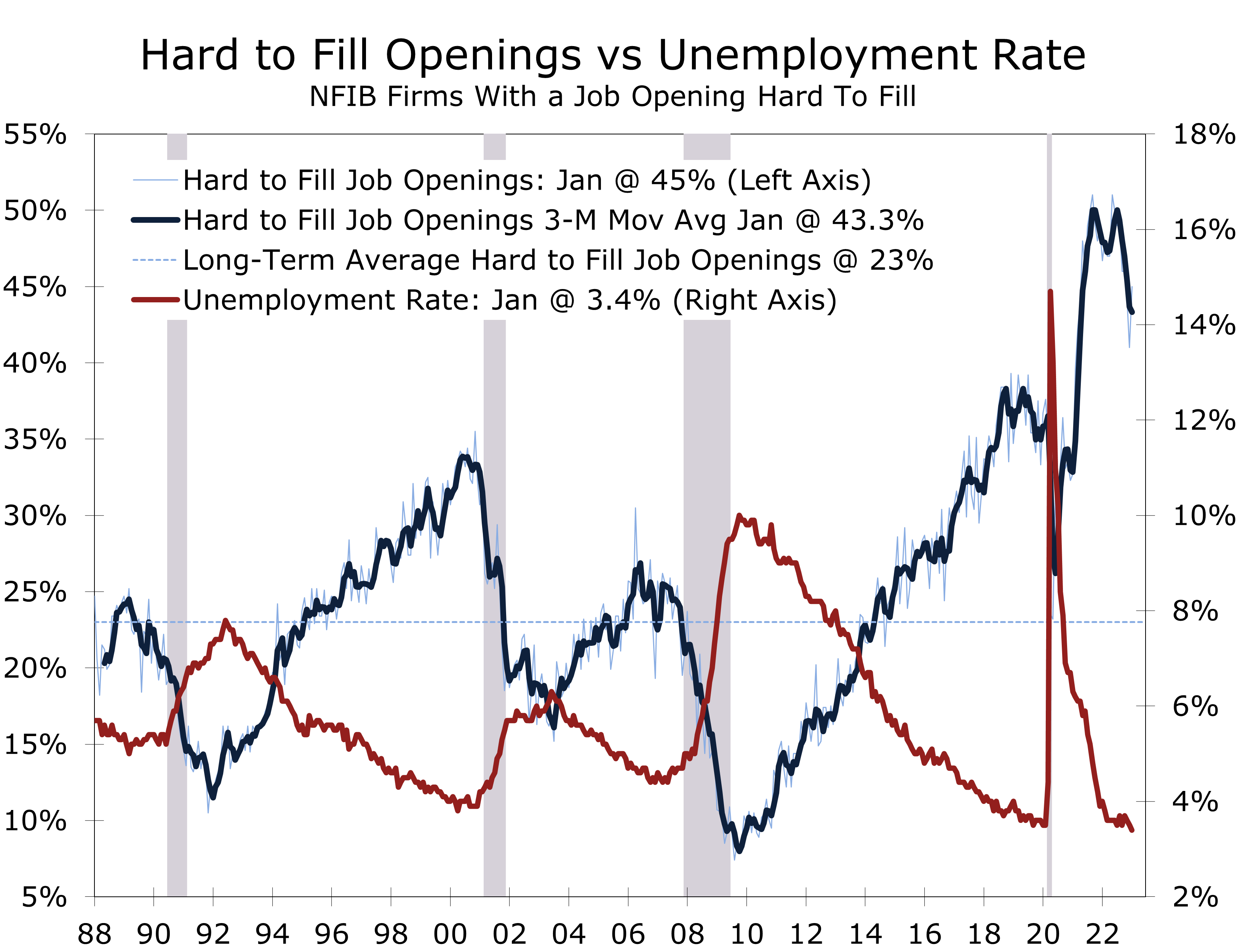
After showing some incipient signs of loosening, the labor market tightened further in January, a month that saw the unemployment rate fall to 3.4%. The NFIB noted that 45% of small business owners reported they had job openings they could not fill in January, which is up 4 points from December and just 6 points below its all-time peak of 51% hit in May 2022. The long-run average for job openings, dating back 49 years, is 23%, a level last seen in early 2014.
While lower unemployment rates are often celebrated as a sign of economic success, there appear to be structural impediments in the labor market today that make it tougher for businesses to hire even when the economy is growing only modestly. Ongoing shortages of workers are forcing business owners to boost compensation, hire less qualified workers, reduce operating hours, or offer fewer products and services.
Concerns about the quality of labor have risen to historic heights, with 24% of small business owners rating labor quality as their top concern. Another 10% of business owners rate labor costs as their top problem, which is up 2 points from December.
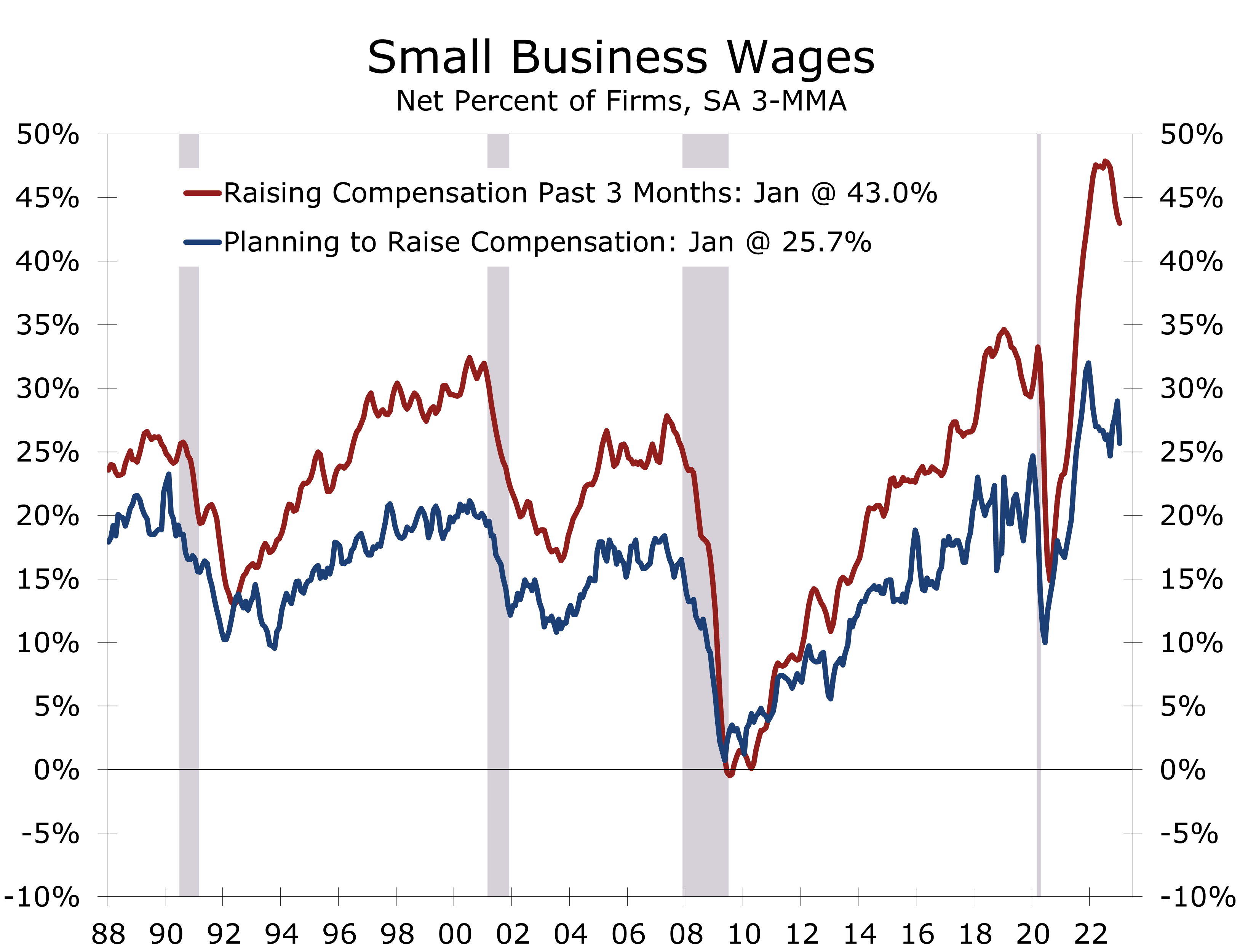
With labor markets so tight, businesses are having to pay more to attract and retain workers. A net 46% of business owners raised compensation during the past 3 months, which is up 2 points from the December and just 4 points below the record high hit in January of last year. The share of firms planning to raise compensation fell 5 points in January to 22%.
Significantly more businesses are boosting compensation than are planning to.
The share of businesses boosting compensation is more than twice the share planning to raise compensation. The gap is historically wide and provides insight into the persistence of stiff price hikes in labor-intensive parts of the economy as well as the ongoing pressure on operating margins.
Businesses are passing along their higher costs. Inflation in the most labor intensive parts of the economy rose 0.6% in January and is up 7.2% year-to-year. Today’s NFIB report shows the labor market remains too tight to support a sustained deceleration in wages and prices. The persistence of wage and price pressures raises the likelihood the Fed will raise rates a little higher this year and hold them there longer.
Disclaimer: This publication has been prepared for informational purposes only and is not intended as a recommendation offer or solicitation with respect to the purchase or sale of any security or other financial product nor does it constitute investment advice.