
Home Sales Continue to Decline
- Existing home sales fell for the 11th straight month, although the pace of the pullback appears to be moderating.
- Existing home sales fell 1.5% in December to a 4.02-million unit annual pace. Sales are down 34% year-to-year, which was close to the peak sales pace for the cycle.
- Sales of existing single-family homes fell 1.1% to a 3.64-million unit pace, while sales of condominiums and co-ops tumbled 4.5%.
- Homes are generally taking longer to sell, and prices are falling month-to-month.
- Sales fell 2.2% in the South, declined 1.9% in the Northeast, slid 1.0% in the Midwest and were unchanged in the West.
- First-time buyers were 31% of sales, up from 28% in November and 30% last December.
- The non-seasonally adjusted median price of an existing home fell for the 6th straight month and is now up just 2% year-to-year.
Sales of existing homes fell 1.5% in December, marking the 11th consecutive monthly drop. Sales fell in every region except the West, where they were unchanged. December’s drop was less than expected and sales may have been helped by the recent slide in mortgage rates. The 4.02 million-unit sales pace is the slowest since May 2020. Sales of single-family homes fell 1.1% to a 3.64-million unit pace, which is the lowest since the lockdown in spring 2020. Homes are taking longer to sell, and prices are falling month-to-month.
Sales of single-family homes fell 1.1% in December, with much of the pullback occurring at higher prices points. Sales of homes priced at $1 million or more are down 45.2% from one year ago and made up just 5.3% of sales. Sales of homes priced between a half a million dollars and a million dollars have also slowed. Sales of higher-priced homes are more sensitive to interest rates. Many prospective buyers of higher priced homes have also likely been stung by the stock market selloff.
Homes priced at $1 million or more remained on the market an average of 30 days in December, and homes prices between $500,000 and $1 million were on the market for 27 days. The overall average was 26 days.
A slowdown in the affordability migration away from higher-priced metro areas is also disproportionately weighing on higher priced home sales. Ironically, San Francisco and Seattle have seen a reverse of the population outflows, as fewer people are choosing to work remotely and many of those that had are having second thoughts now that so many tech companies are trimming staff. Data from LinkedIn show both Seattle and San Francisco returning to the top ten markets with net gains from members switching locations.

With the affordability migration slowing, fewer homes are coming on the market. The inventory of single-family homes available for sale fell 14% in December to just 860,000 homes, which equates to just a 2.9 month supply at December’s slower sales pace. The number of existing homes for sale is still 13.2% higher than it was last December, when just 760,000 homes were available. That equaled just a 1.7-month supply back then because existing single-family homes were selling at a much faster 5.41 million-unit pace.
Most of the rise inventory this past year has come from homes remaining on the market for a longer period of time. As noted earlier, homes that sold in December had remained on the market for an average for 26 days, which is up from 24 days in November and just 19 days in December 2021.
The number of new listings has also fallen this past year. A larger proportion of current homeowners with a mortgage have one at significantly lower rate that prevails today. When coupled with higher prices, a growing number of homeowners are choosing to remain in place, rather than downsize or trade up.
With homes remaining on the market, sellers are increasingly discounting prices. The median price of an existing single-family home fell 1.6% in December to $372,700. The median price has fallen 11.5% since June on a non-seasonally adjusted basis.

Home prices usually decline toward yearend, but this past year’s declines were greater than usual. The median single-family home price is now up just 2% year-to-year, down from a peak of 26.1% in May 2021.
Other home price measures have also declined this past year and the drop in the Realtors’ median price appears to be in line with those other price measures. We expect home prices to ultimately decline 15% from peak-to-trough, based on the widely followed S&P CoreLogic/Case-Shiller National Home Price Index.
We expect home prices to ultimately decline 15% from peak-to-trough.
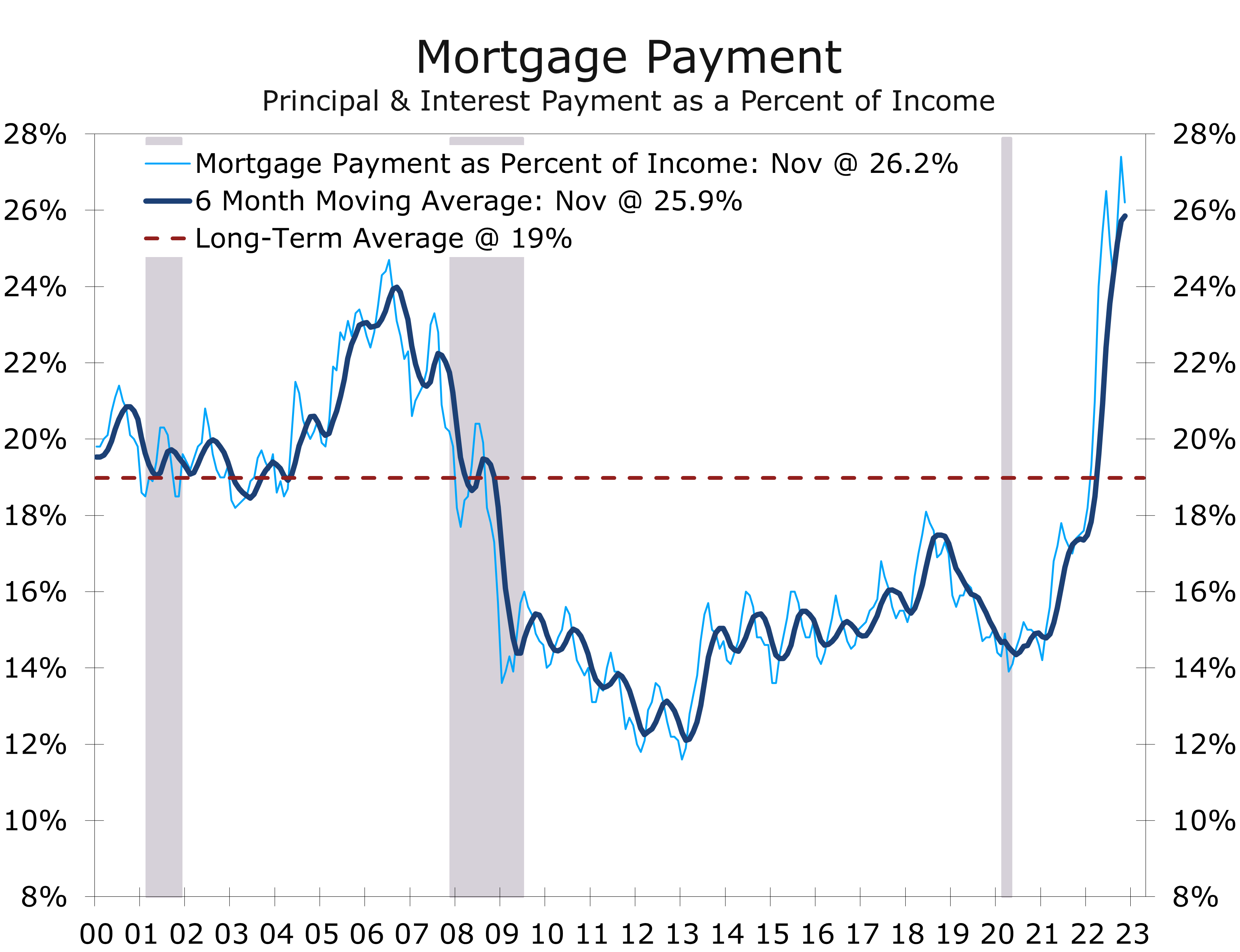
The post-pandemic housing surge differs from prior housing cycles in that the market never became over supplied. Affordability, or the lack thereof, is the critical issue today. The surge in home prices that accompanied the reopening of the economy coupled with sharply higher mortgage rates caused the share of income required to service principal and interest payments to spike to record heights. The housing market will not recover on a sustained basis until affordability falls back near its historic norm.
Disclaimer: This publication has been prepared for informational purposes only and is not intended as a recommendation offer or solicitation with respect to the purchase or sale of any security or other financial product nor does it constitute investment advice.