
Manufacturing Loses Momentum
- Industrial production tumbled 0.7% in December and November’s earlier reported 0.2% drop was revised to a 0.6% decline.
- The return of winter weather helped push utility output up 3.8% in December, following a 4.5% rise in November.
- Factory output slumped 1.3% and November now shows a 1.1% drop, nearly twice what was originally reported. The slide in manufacturing output is now significant and broad based.
- Output of business equipment fell 2%, following a 1.8% drop in November. The pullback reflects weaker exports and slower capex at small and mid-sized businesses.
- Output of consumer goods fell just 0.1% in December. Stronger energy output offset declines elsewhere. Output of consumer durables fell 1.4%, while output of nondurables excluding energy fell 0.6%.
Industrial production fell much more than expected in December, with overall output falling 0.7%. Data for the prior month were also revised lower. The headline number conceals much of the pain now reverberating throughout the factory sector. Overall output was bolstered by another spike in utility output, which rose 3.8% in December, following a 4.5% rise the prior month. Both gains reflect strong demand for electricity and natural gas in December when unseasonably cold temperatures impacted much of the country.
Output in the factory sector slumped by 1.3% in December. When coupled with the large downward revision to November’s data, output at the nation’s factories has fallen at a 2.6% annual rate over the past three months. The sharp pullback in manufacturing has brought the year-to-year change down to -0.4%, marking the first drop since February 2021.
Declines in manufacturing output were broad-based. Production of motor vehicles and parts fell 1% in December, following a 3.5% drop the prior month. While parts shortages hampered production earlier, the recent weakness appears to be driven by flagging demand. There had been some thought pent-up demand would keep sales rolling even if overall economic growth slowed. That now looks optimistic.
Excluding motor vehicles and parts, manufacturing output still fell 1.3%. Declines were evident across most industries but were particularly sharp for industries tied to housing and capital spending. Output of furniture and related products fell 1.4% in December, marking its third consecutive drop and fifth decline in the past six months. Output of machinery fell 3.4% in December, following a 1.7% drop in November.

The drop in factory output is concerning because manufacturing accounts for the bulk of the cyclical swing in the overall economy. The Federal Reserve’s industrial production report is one of the key pieces of information the National Bureau of Economic Research considers when determining whether a recession has begun. The most recent data are consistent with what has been seen at the onset of prior downturns. Declines would also need to be long-lived, however, and be matched by declines in other key indicators, most notably employment, income, and spending by households and businesses.
As if on cue, December retail sales also came in weaker than expected, with overall sales falling 1.1% in December and revised data showing sales falling 1.0% in November. While part of the drop reflects sharply lower gasoline prices, retail sales excluding gasoline states fell 0.9% in December, following an 0.8% drop the prior month.
Sales of motor vehicles and parts turned unexpectedly soft toward the end of last year, with sales falling 2.6% in November and a further 1.2% this past month. The drop likely reflects the strain on household budgets from higher inflation. Sales have not fallen to the point that dealers are discounting prices, but the premiums that new cars sold over sticker price following the pandemic finally appear to have given way.
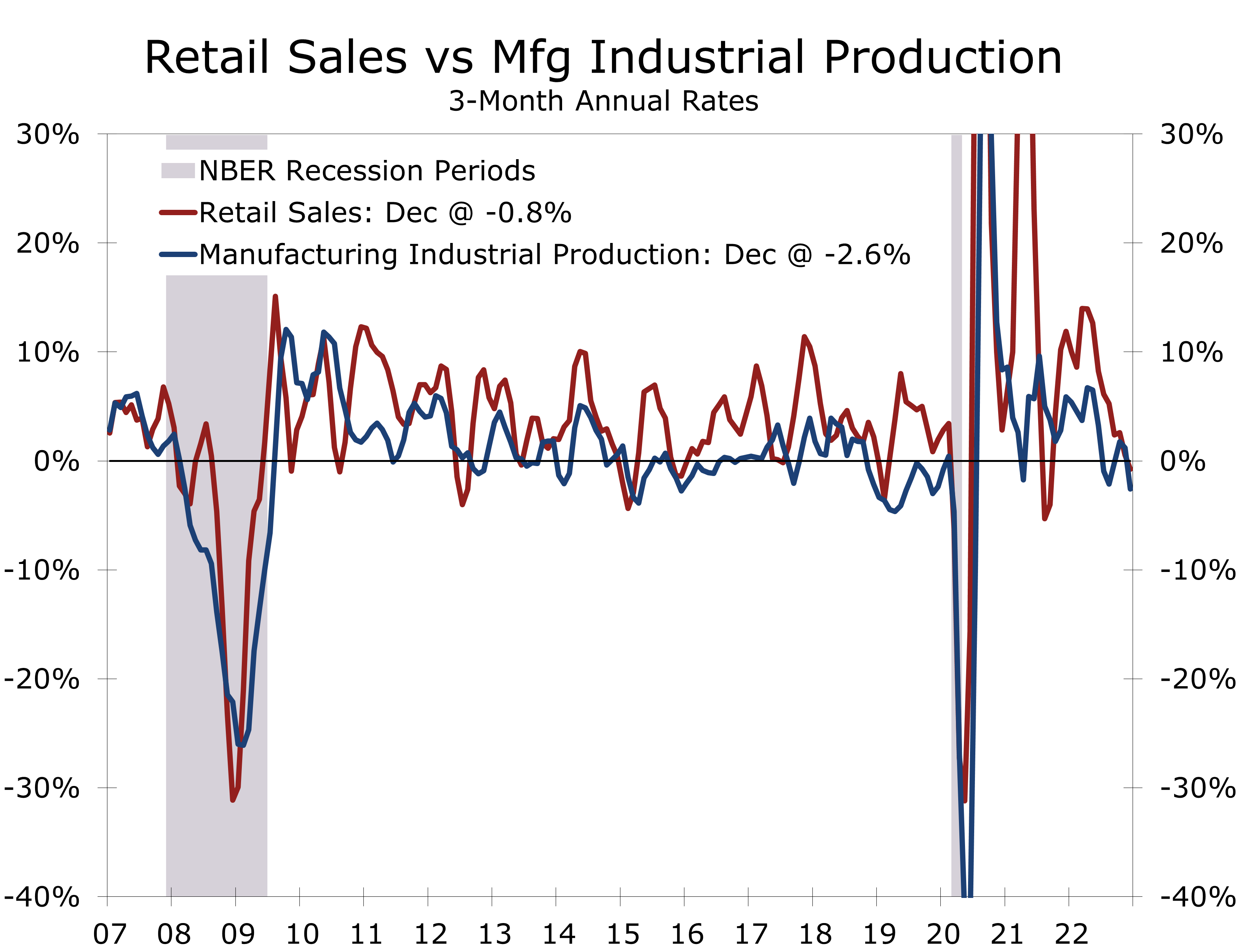
The slide in retail sales provides a sense of the challenge ahead for manufacturers. Inventories of consumer goods are building at warehouses, which will weigh on new orders and production. The pullback in home building and capital spending also likely has more room to run, which will restrain output of building products and industrial equipment.
The Federal Reserve Bank of New York’s Empire State Manufacturing Survey provides some indication as to how much further manufacturing output might fall. The general business conditions index tumbled 21.7 points in early January to -32.9, which is the lowest reading since May 2020 and marks the fifth weakest reading ever for this series. The decline was led by sharp declines in new orders and shipments. The employment index declined a lesser 11.2 points, but remained positive at 2.8, indicating more firms reported adding workers than reducing staff.
The Empire Survey measures manufacturing activity in New York State and is one of the more volatile regional manufacturing surveys. That said, the 3-month average of the Empire Survey, which is now -13.2, closely tracks overall manufacturing activity. One of the survey’s chief advantages is that it arrives early.

Disclaimer: This publication has been prepared for informational purposes only and is not intended as a recommendation offer or solicitation with respect to the purchase or sale of any security or other financial product nor does it constitute investment advice.