
More People Head to the Sun Belt
- U.S. population growth rebounded this past year as immigration and net natural increase both increased substantially as fears about the pandemic subsided.
- The U.S. resident population increased by 0.4%, or 1,256,003 residents from July 2021 to July 2022.
- Thirty-two states plus the District of Columbia added residents in 2022, while 18 states and Puerto Rico posted a net loss.
- Seven states (Texas, Florida, the Carolinas, Georgia, Arizona, and Tennessee) accounted for the bulk of the nation’s population gain.
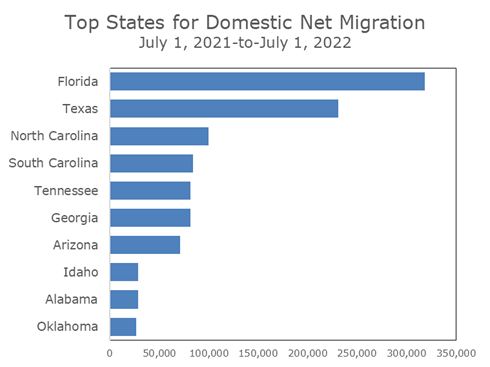
- Texas posted the largest absolute population gain (470,708), while Florida (416,754) posted the fastest percentage growth (1.9%) and largest net inflow of residents from other states and Puerto Rico.
- New York, California, and Illinois saw the largest population declines.
Population Growth Recovers from the Pandemic
U.S. population growth bounced back this past year. The Census Bureau’s latest national and state population estimates show the nation’s population grew 0.4% from July 2021 to July 2022, with the addition of 1,246,003 new residents. More than 80% of this past year’s gain came from immigration. Net natural increase, or births minus deaths, also increased, rising from 144,013 in 2021 to 245,080 in 2022. The number of babies born rose by more than any year since 2007. Net natural increase was held back, however, as deaths remained unusually high. Deaths outnumber births in 24 states and Puerto Rico in 2022, down from 26 states and Puerto Rico in 2021.
Immigration into the U.S. rose substantially, surging 168.8% to 1,010,923 net new arrivals in 2022, up from just 376,029 the prior year. The immigration figures also include the inflow of residents from Puerto Rico, nearly all of which are U.S. citizens. Many of those in-migrants have settled in Florida, New York, and Texas.

While population growth took a step forward, growth remains well below its pre-pandemic pace. Moreover, population gains are skewed toward only a handful of states. Texas added 470,708 residents this past year, while Florida added 416,745 residents. North Carolina (133,088), Georgia (124,847), and Arizona (94,320) round out the top five. South Carolina (89,368) and Tennessee (82,988) also posted notable gains.
Texas has become the nation’s primary growth engine over the past decade. The Lone Star State has attracted scores of corporate headquarters and expansions in recent years, with most setting up shop in Dallas-Fort Worth, Houston, Austin and San Antonio. All four metros consistently rank among the nation’s fastest growing metros and their suburbs often rank among the nation’s fastest growing municipalities.
With this past year’s gain, Texas’ population has now topped 30 million. Growth this past year was driven by a mixture of international immigration (118,614), domestic net migration (236,293) and net natural increase (118,159). The continued population influx is testament to the Lone Star State’s good economic policy, which features a lighter regulatory touch and low taxes. Companies tend to thrive in Texas, which now boast one of the nation’s most diverse economies, with technology, energy, and life sciences accounting for the bulk of the state’s growth.
The continued influx of new residents into Texas substantiates the State’s good economic policy.
Florida is another state where good economic policy is attracting waves of businesses and new residents. Florida was one of the first states to fully reopen its economy following the lockdowns at the start of the pandemic, which helped drive a strong economic recovery that has continued through today. Technology and financial services have seen tremendous growth since the onset of the pandemic.

Florida also attracts scores of retirees, and its older population makes it more dependent on migration for growth. Florida’s net natural increase is the lowest in the nation, with deaths outnumbering births by 40,216 in 2022. That marked a slight improvement from 2021, as births rose twice as fast as deaths this past year.
The Sunshine State led the nation in domestic migration in 2022, adding a net 318,855 residents from other states. While many of Florida’s new residents are retirees, the bulk are prime working-age adults drawn by Florida’s abundance of job opportunities. Florida is also seeing a rising number of new residents arrive from other countries, with this past year’s 125,629 net arrivals just barely trailing California.
North Carolina is another notable standout. The Tarheel State is the only state other than Texas and Florida that is home to more than one of the nation’s ten fastest growing major metropolitan areas this past decade (Charlotte and Raleigh) and that strength is evident in the most recent numbers. North Carolina added a nation’s third best 118,614 residents in 2022, the majority of which relocated from other states.
California, New York, and Illinois top the list of state’s losing population. California saw 343,230 more people leave for other states this past year than move in, while New York saw a net domestic out-migration of 299,577 residents and Illinois lost a net 141,656 residents. Many out-migrants from California and Illinois beat a path to Arizona and Texas, while out-migrants from New York primarily set their sights on Florida, Georgia, the Carolinas and Tennessee.
Disclaimer: This publication has been prepared for informational purposes only and is not intended as a recommendation offer or solicitation with respect to the purchase or sale of any security or other financial product nor does it constitute investment advice.